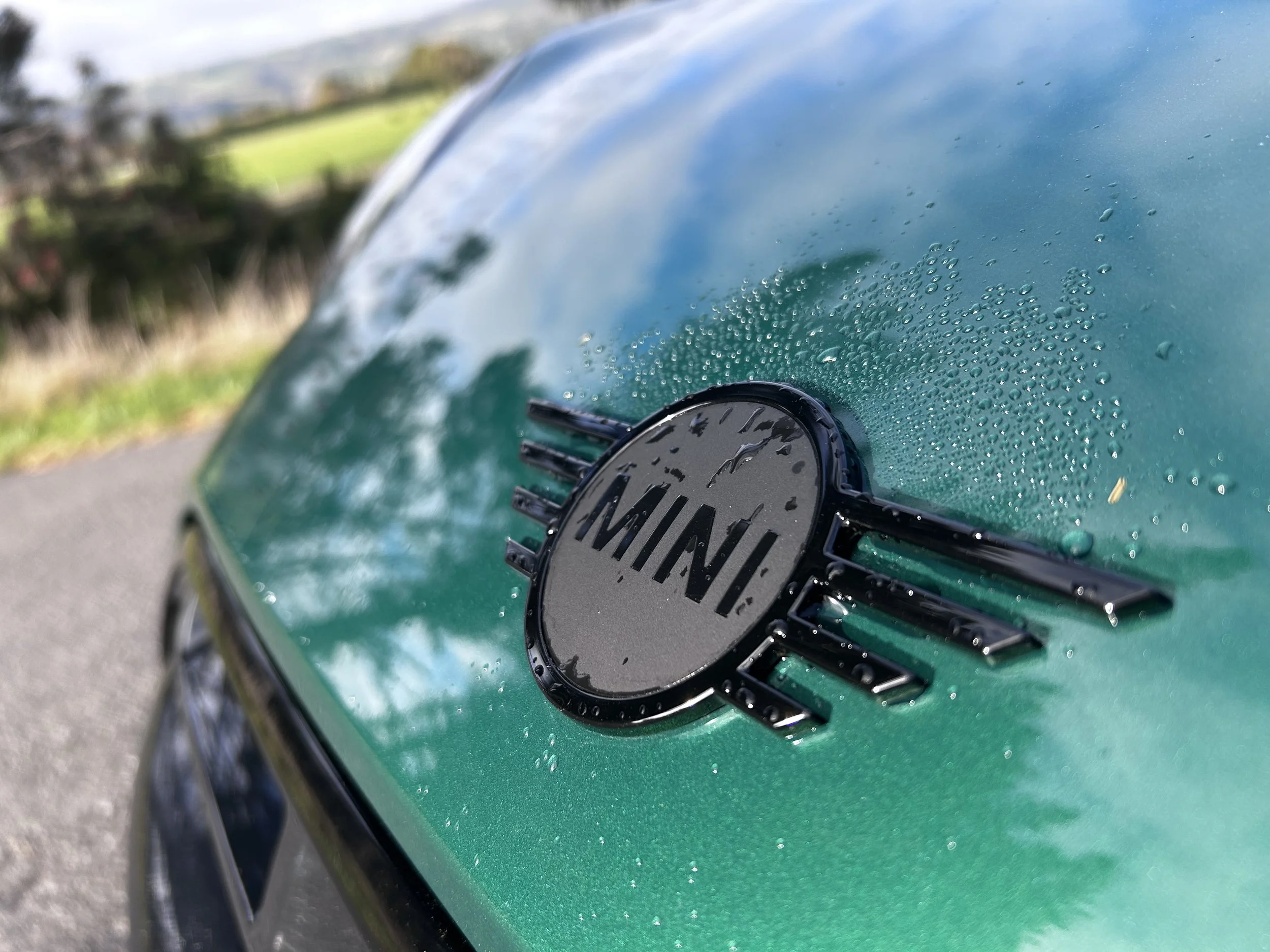
MINI Cooper JCW Convertible road test review: Zoom with a view
/Potential to deliver top-down giggles is this model’s greatest strength.
Price: $70,990.
Powertrain: 1998cc four cylinder turbo petrol making 150kW power and 300Nm torque, seven speed DCT automatic.
How big: 3839mm long, 1744mm wide, 1431mm high.
We like: Cheeky attitude; clever roof design; excellent heating.
Not so much: Poor stowage; not quite as feral as you’d expect for a JCW.
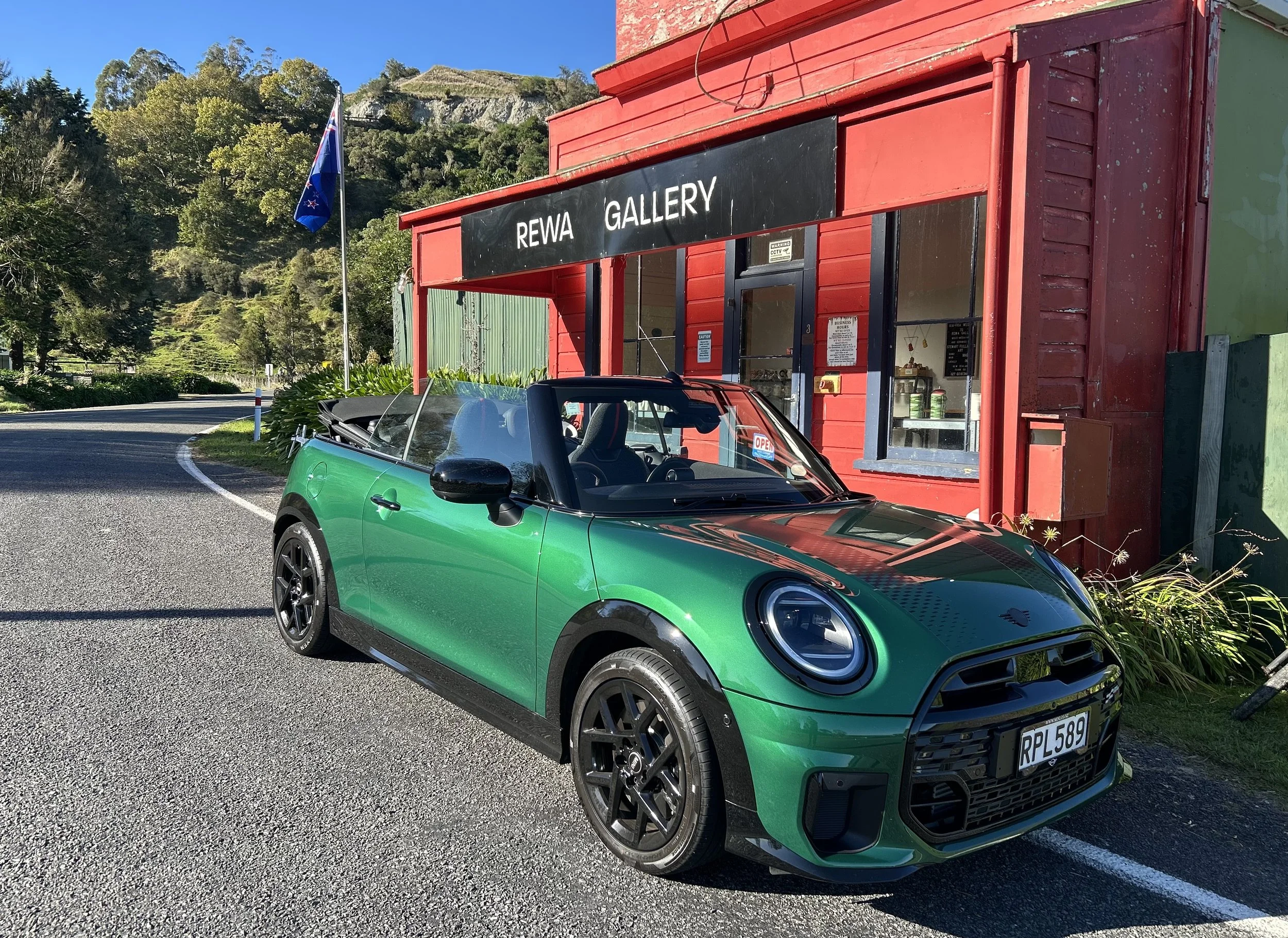
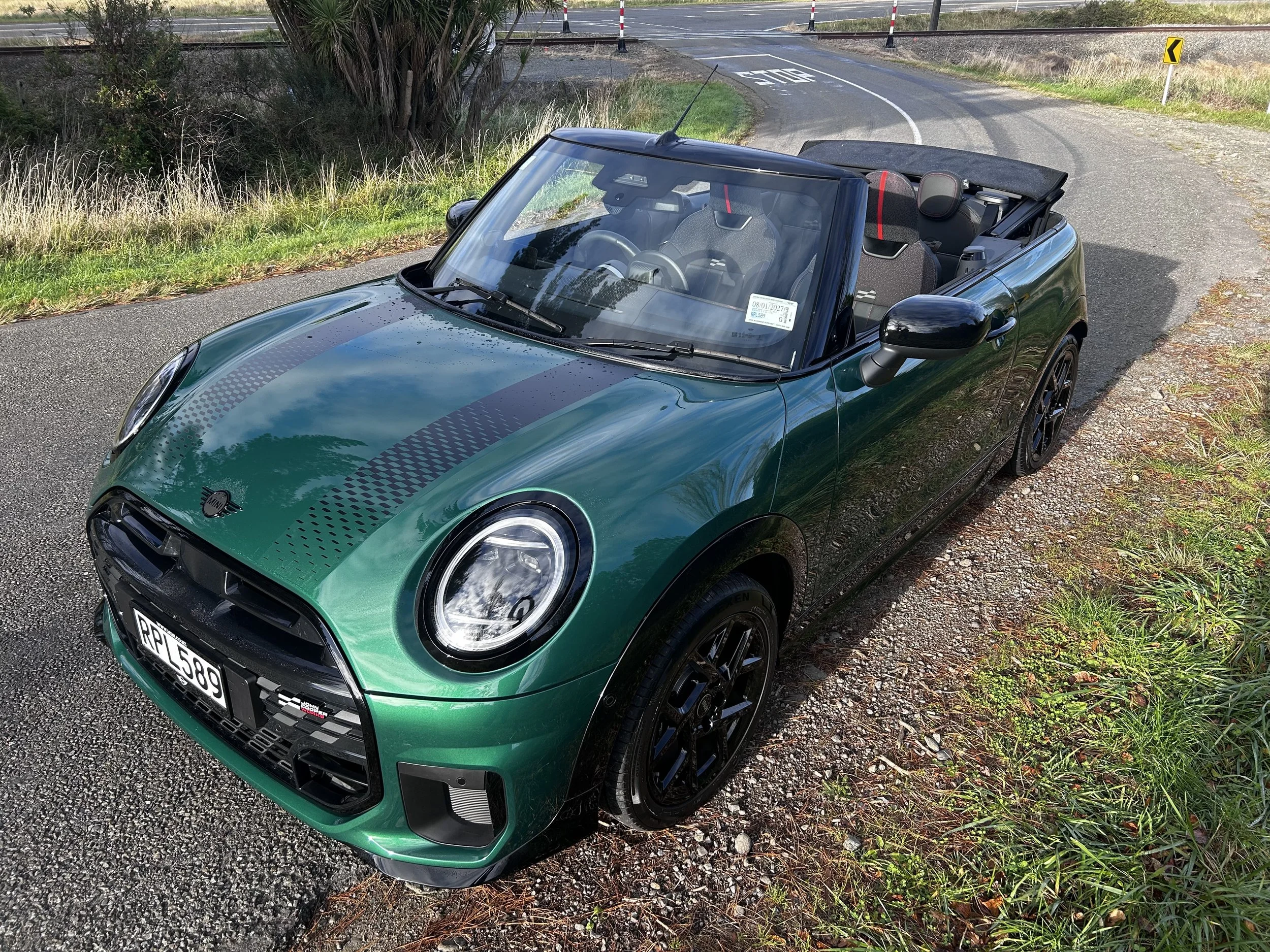
JUST when you’ve become resigned to all modern MINIs being much bigger than the originals, here’s one that almost cuts back down to yesteryear size.
Being the most ‘mini’ - or least maxi - of modern MINIs is one element that establishes the Convertible having some semblance of authenticity for anyone seeking a link between what this brand is now and what it once was.
There are others. The soft-top model is the make’s last new-generation petrol car and is also one of the few MINI models to claim true British birthright. Being built in Oxfordshire, England.
‘Best of British’ celebration is always laid on thick with MINI; it’s always optioned with a Union flag roof and all the latest sport taillights embossed with that emblem of old country allegiance.
All … but, ahem, this one. The latest Convertible has a new front fascia similar to other new-generation Mini models, as well as a redesigned cabin.
But it misses out on a key styling change seen on the latest hatchbacks, the triangular tail-lights (into which the emblem is embossed). That absence relates that even though it presents as a fourth-generation of this open-top genre, this variant is more accurately a ‘three-and-a-half’.
As much as this MINI stands no more chance as any other in being mistaken for anything else, the aesthetic here is more familiar than with other kinds.
We have, literally, seen it all before.The brand’s curvy, big-eyed lights are changed, and it now has what the brand calls an ‘octagonal’ grille, but around the back it retains the old model’s tailgate design and rounded-rectangular light shape.
The story goes that MINI was either unable to integrate the triangular tail-lights into the Convertible body shell, or was not willing to spend the money to do so.
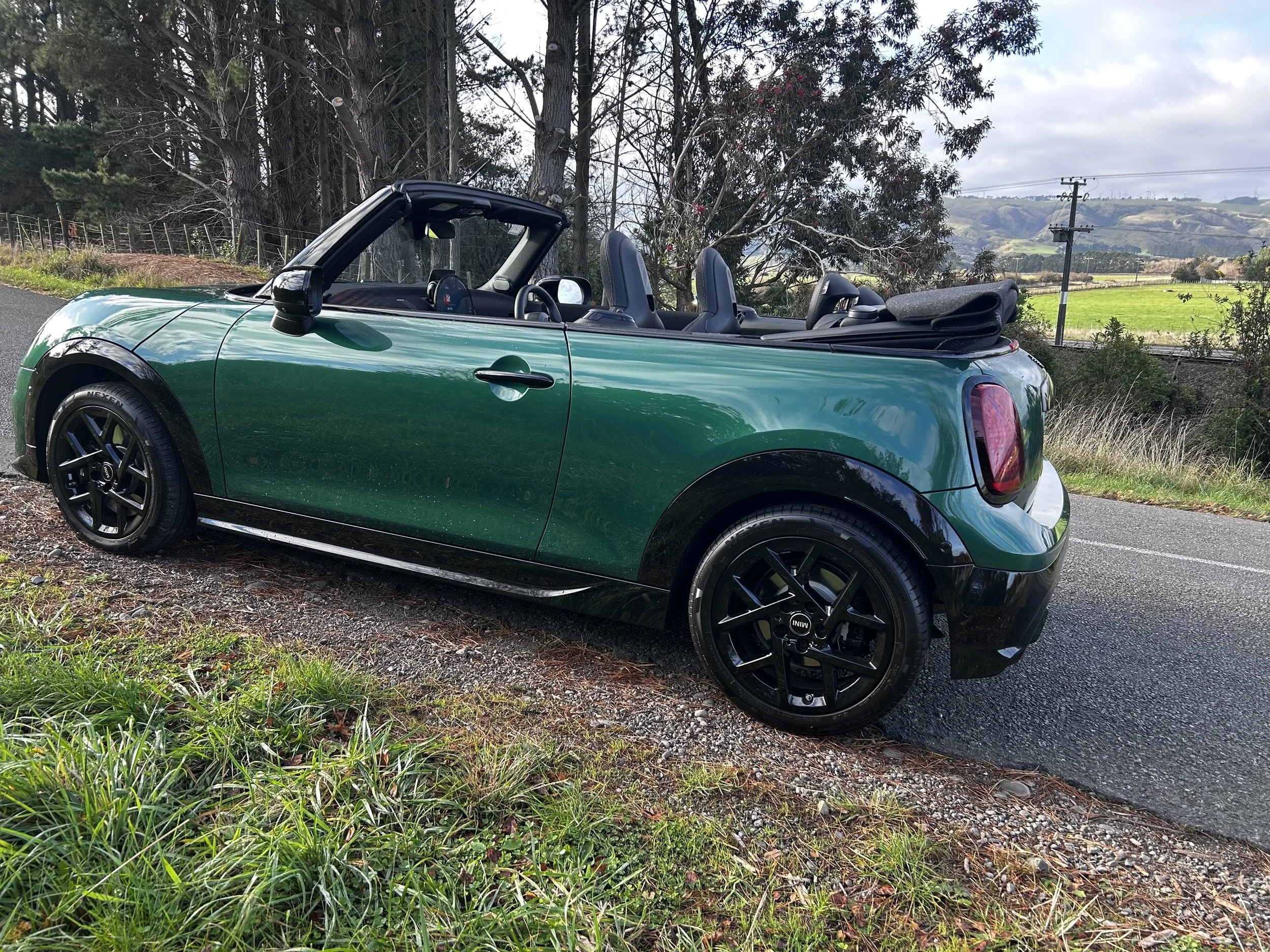
The latter could be the more plausible, as if a proposed product planning schedule shared some time ago is still accurate, the car as we now see it could be a relatively short stay model; perhaps set for retirement if and when a soft-top version of the MINI electric that comes from China is engineered.
Whatever the future holds for this genre, what we see now is definitely the last dance opportunity with petrol. In respect to that, those fans who believe in sashaying out of the spotlight in style might well prefer the John Cooper Works edition tested there over the alternate S.
Both are powered by a 2.0-litre turbo-petrol four-cylinder engine paired with a seven-speed dual-clutch automatic transmission that drives the front wheels, but whereas the S comes in 150kW/300Nm tune, the top-rung edition has an additional 20kW and 80Nm.
The fun-to-drive ethos of the MINI badge is best expressed at JCW level, and the tuning branch has never shied from delivering optimal outputs bordering on the outrageous.
Whether such chutzpah is absolutely needed in a car whose overall credibility is more about ‘look at me’ cruising is of course worth questioning.
On the one side of the coin, some will argue that when an open air MINI is clearly a bit of a daft choice to start with, so why not go whole hog with the one that’s most abjectly bonkers? And I get that.
But there’s a solid counter-logic too in that, of all the JCW products, this is clearly the one least likely to set about crushing circuit lap times, so how much use is that extra fizz anyway?
Given that the S is much the same in overall ethos, why not accept the saving it also offers and spend it instead on a fortnight’s holiday up in Raro?
Getting a handle on whether the strongest get-go is needed to flavour the open-top glamour was all part of this experience, and led to it being taken on an early morning drive on favourite driving roads that was fully brisk in more than one sense.
Years of MX-5 ownership have reinforced there’s no need to consider convertibles as solely summertime fun. Hitting the road in late autumn was not quite the same test of fortitude than driving fully bare into a fully mid-winter’s day, but as well as being a good way to clear the senses it also stood as a good evaluation of the car’s ability to deliver decent comfort.
A good heater up to pumping out Sahara-strength temps within minutes of being triggered, and heated seats and a heated steering wheel in support, meant it delivered trustworthy and welcome relief on an icy morning.
I wasn’t so imprudent as to not come prepared, all the same, by wrapping up warm. Even in summer, a decent jacket is always advisable and also, because I’m 1.8 metres’ tall, a beanie tends to be beneficial to avert forehead freeze.
The MINI is a cocoon of warmth from the driver and front seat passenger just with the side glass up, but another accessory that I only thought to fit halfway through my drive makes it substantially cosier still.
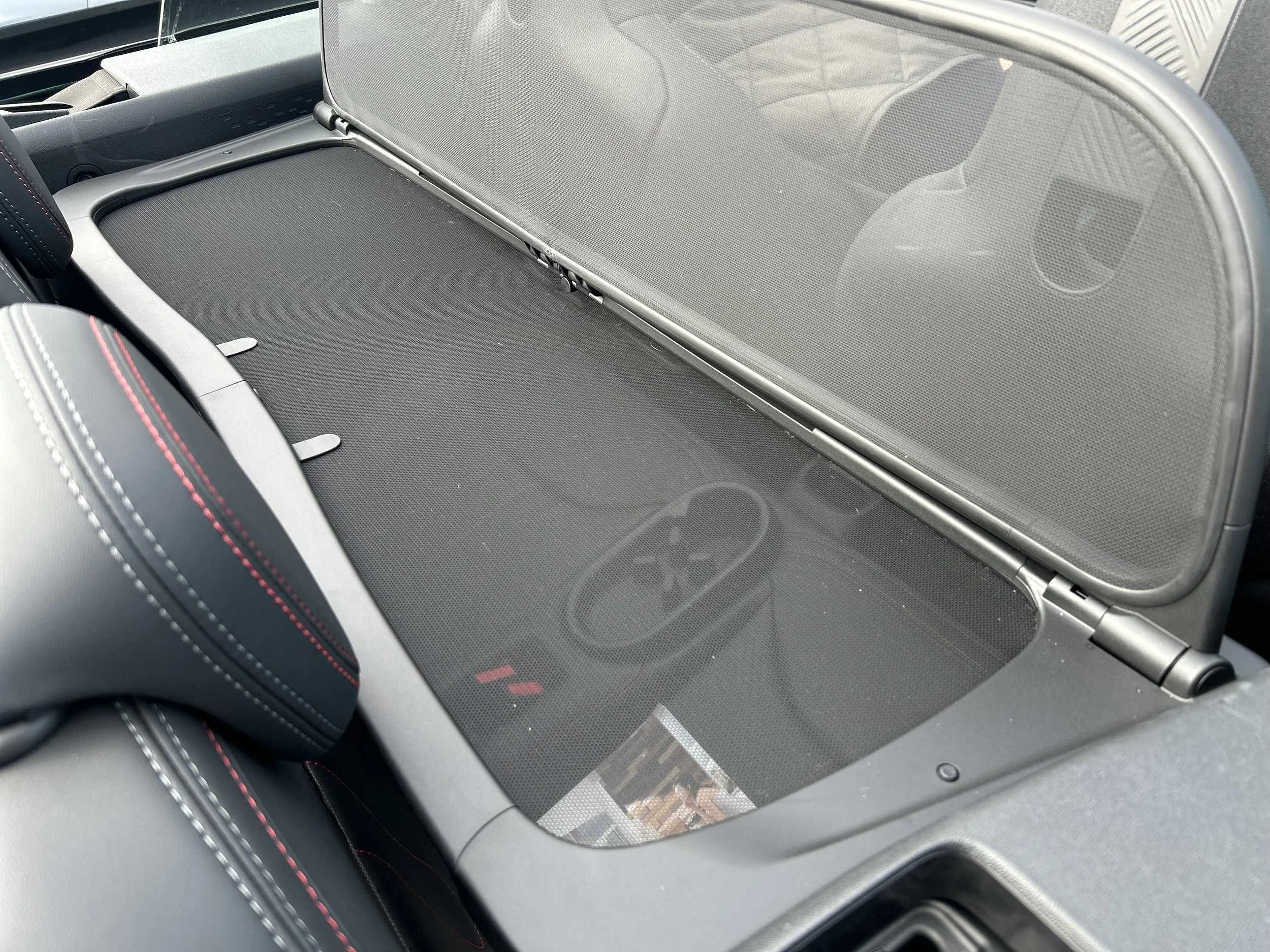
The factory wind blocker that resides in the boot is a foldout apparatus that is a bit awkward to fit, so keeping it in permanent situ is probably sensible as the rear seats are pretty much as useless as they’ve always been. To fit anyone with legs in there the front seats will need to be moved forward considerably, compromising their occupants’ comfort. Even if they could fit, anyone sitting in the back will find that, when the roof is down, the rear seats are blustery even at urban speeds.
The deflector not only fixes the wind swirl across the back of front seat occupants necks but also makes the cabin a bit quieter; though like so many open top cars once up to highway speed there’s enough wind and road noise to largely drown out the audio system or to hear phone conversations.
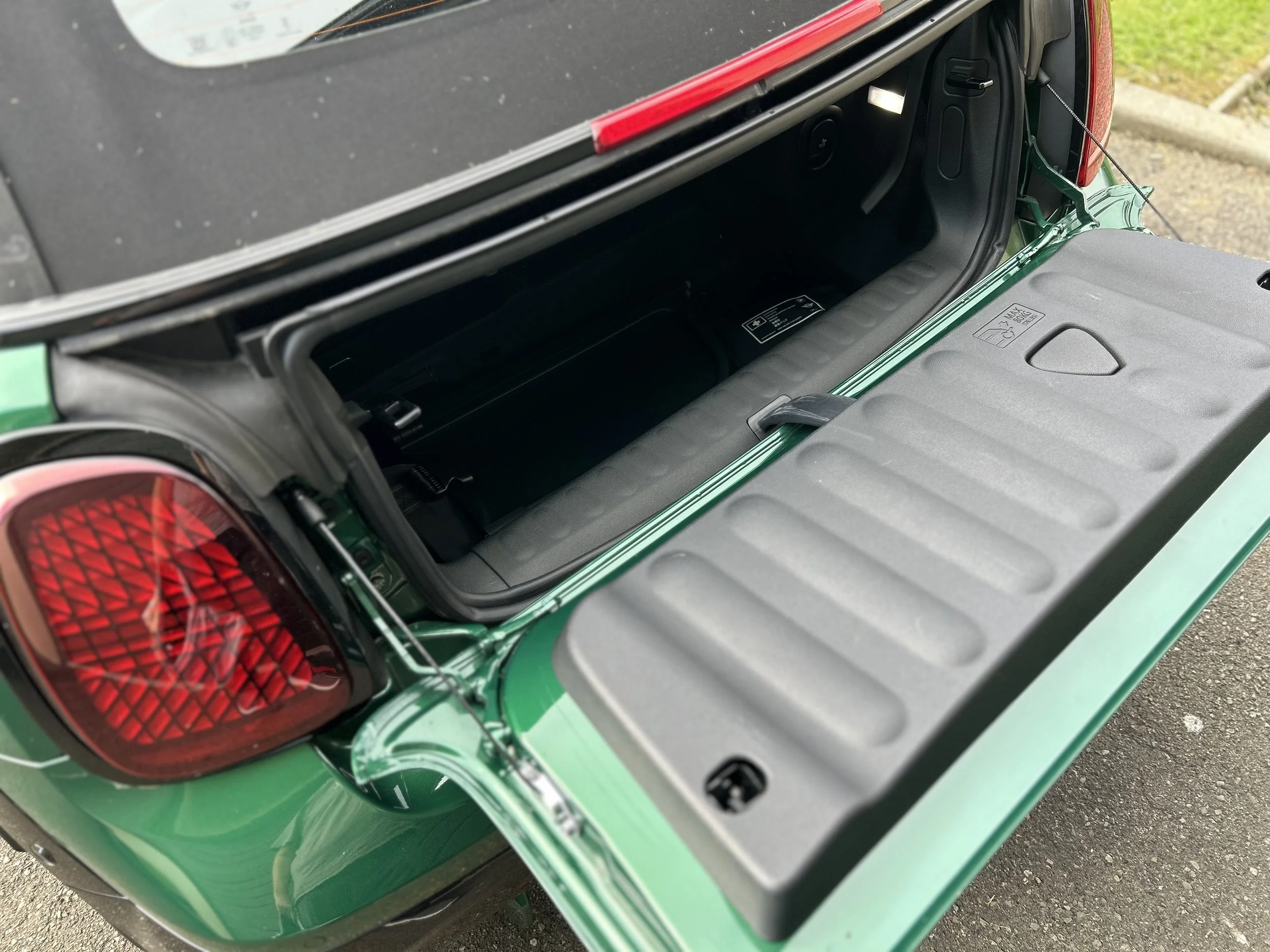
Anyway, best to treat those seats as useful extra luggage space, which is sorely needed as the boot itself is miniscule. It’s clever how the boot lid hinges from the bottom as those in the original Minis did, but inside there’s only 215 litres’ capacity. And that figure drops to an even more laughable 160 litres if the roof is stowed.
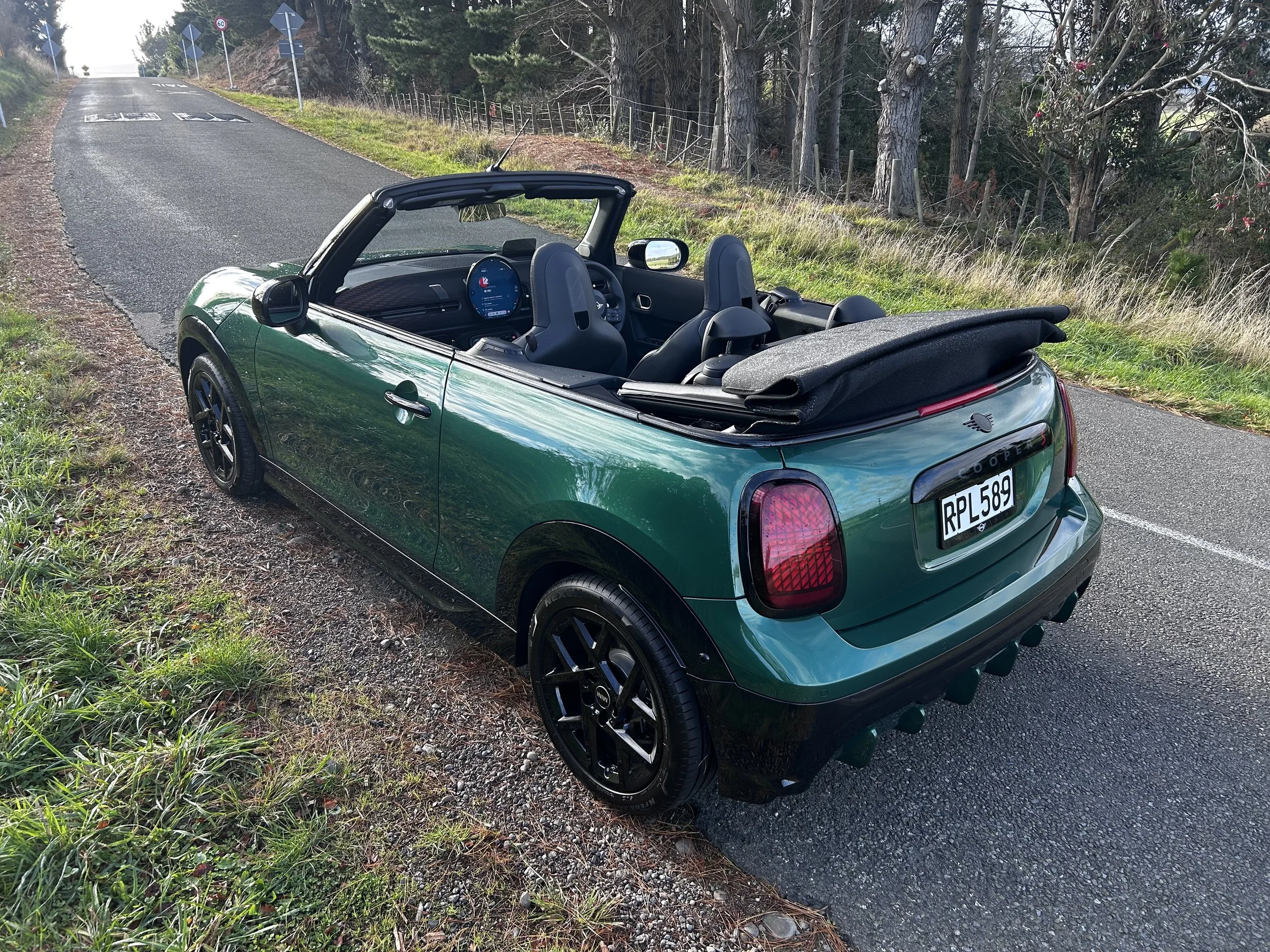
Speaking of that. You’re likely to hear plenty of jibes about the poor aesthetics of how the roof looks when fully retracted. You’ll stand risk of hearing jokes about how someone has left a deflated inflatable mattress draped across the car’s back end.
In countering that, you can rightly point out that it is a very clever piece of engineering. It’s entirely electronic, of course, is very slick in taking just 18 seconds to close or open and handily will operate at speeds up to 30kmh.
Operation can be done when you’re seated by pushing a button ahead of the rear vision mirror, but no need to wait until then. Before you even get in the car if you hold down the open button on the key fob, it can retract or reinstate.
Another slick integration is how the design also offers a sunroof function that allows all but a 40cm gap above the front occupants to be in its raised position. It’s remarkably effective at providing an approximation of the full open-air experience.
As per normal convention, the cabin is a bit of a cave with the roof up; forward and side visibility are decent, but the limited rearward view will leave you grateful for it having a suite of cameras and sensors.
Being such a compact car, with just 3.8 metres’ length, holds it in good stead for nipping around inner-city streets, but Cooper credibility must always be measured to a higher standard, not least when the famous tuner’s full name is employed.
It’s fair to say the convertible feels like a pukka MINI from the moment you get moving. But also reasonable to suggest that, should the local MX-5 club be encountered, best let them go.
As much as the steering is direct, the suspension allows you to feel everything happening at road level and there’s a sense of willingness to the whole car, with oodles of feedback, the MINI hasn’t the same level of driving thrills as Japan’s classic.
Argument about it being the best JCW car is highly tenuous.
Mixing in the performance division’s active ingredients of stiff springs, large wheels and low-profile tyres into this body shell is a give-and-take thing, simply because with no fixed roof the body has less torsional rigidity. As much as it also delivers a sense of being up to going around any corner at any speed, push it hard and you’ll achieve some scuttle shake and occasional squeaks and rattles.
It’s pleasantly fast when you need it to be, and there’s a touch of turbocharger whistle and whoosh on a twisty road as you come on and off the power.
Manual gearboxes are no longer available in any new MINI but the JCW at least has paddle-shifters for the automatic transmission. Most of the time, the seven-speed, dual-clutch gearbox does a perfectly decent job of choosing and changing gear, but on entertaining roads or even when accelerating to overtake slower traffic, you’ll want to override it.
Sharpest reactions are of course reserved for when the drive modes - sorry, ‘Mini Experience Modes’ - are in the sportiest setting, which is called 'Go-Kart' mode. Entry into this is an attention-grabber, as it this plays a loud 'WAHOO!' sound effect through the speakers, which further raises the cringe factor if you were to tap into it with the roof down in a busy area of town.
In ‘Go-Kart’ the infotainment graphics also change to a black and red colour scheme and the exhaust sounds a bit snarlier, though it’s pretty quiet all in all.
Without a dedicated instrument display, speed is shown on the circular OLED infotainment screen, as well as a flip-up head-up display ahead of the driver.
The seats being in a cloth rather than leather is a good idea, given how often they might be exposed to sunlight, and the equipment level is as fulsome as you’d expect.
The big screen is packed with functionality and physical switchgear under it comprises a take on the original Mini’s bank of toggle switches. The drive and Experience selectors are solid-feeling toggles, while there’s a built-in twist-switch to start and stop the engine. There you’ll also find shortcut buttons to the driving and camera settings, window demisting and a circular knob for the stereo volume.
In theory, you don’t need a head-up display to supplement the information on the touchscreen, but it’s highly useful nonetheless.
The steering wheel itself is a well-proportioned circle. MINI’s commitment to the environment as it focuses on sustainability and circularity in its cars explains why it’s not trimmed in leather. It’s also why the textured dashboard is covered in a newly developed knitted material made from recycled polyester. Don’t read that as meaning the cabin is in any way low-rent. It’s a very classy place, all in all, if of course rather tight.
Sensible and serious aren’t words in the MINI lexicon, gone are the days when these cars had to deliver as practical, cheap to buy and run cars for the masses. Today MINI is about fun and frivolity, and none express that more loudly than the Convertible.
Whether that makes it the best of the bunch is highly debatable; most will say it’s probably a bit too frivolous for its own good. That’s fine. As hard as it is to justify, it’s still one that’s good to see. And for extroverts to be seen in.