BMW i4 eDrive40 road test review: Last but not least
/Munich’s first all-electric compact executive model will next year bow out to the incoming i3. The final edition of the i4 is set to leave with head held high.
Price (as tested): $130,400
Powertrain: Single synchronous electric motor, rear wheel drive, 250kW/450Nm, range 479km WLTP, consumption 187Wh/km.
How big? Length, 4783mm; width, 1852mm; height, 1448mm.
We like: Well-suited to electric application; easy transition from ICE equivalent; brilliant long distance car.
Not so much: Four star ANCAP; no motor up front yet no frunk either.
BACK in the day this would have been the perfect trip for a diesel 3-Series; but now we’re in an electric age, there’s a BMW i4 Gran Coupe available … so why not?
Honestly, there wasn’t a moment I didn’t regret that decision.
Sure, had I started with a fully-topped diesel from times historic, the run to the Waikato from my Manawatu home - around 400 kilometres each way - might well have been undertaken without need to put any additional fuel into its tank. Those cars had famously long legs.
BMW’s electrics don’t quite match that yet, but soon will. As in next year ‘soon’.
Amazing to think that the brand new i3 sedan, the one on the 800 volt Neue Klasse platform, has high potential to conceivably match the old oiler in achieving there-and-back on this very journey without stopping for extra energy.
Even more astounding to think, too, that the new i3 of 2027 will come to New Zealand just 12 years after BMW launched its first electric here.
The original i3 was very much smaller and though quite good at open road pace, really proposed itself as being primarily for inner city driving, rather running between them.
It’s a good illustration of how far EV tech has come in a period when all internal combustion cars haven’t fundamentally change at all.
But this is why electric is so exciting, right? The i4 Gran Coupe tested today has about four times the achievable real world range as that first i3.
Yet it will probably only be slightly better than half as decent as the next one. In EV world, the pace of progress is very often … well, electric.
When the i3 lands, the the i4, despite having just been lightly refreshed, will likely be retired.
You don’t need two cars very similar in style. Not least when one, on a new 800 volt architecture, is so much more advanced in tech and likely even more enjoyable to live with and be seen in.
And, of course, even you won’t need to be stopping as often to replenish the battery. Maybe once, if you’re careless about driving efficiently. Certainly not - ahem - five times. Which was my tally.
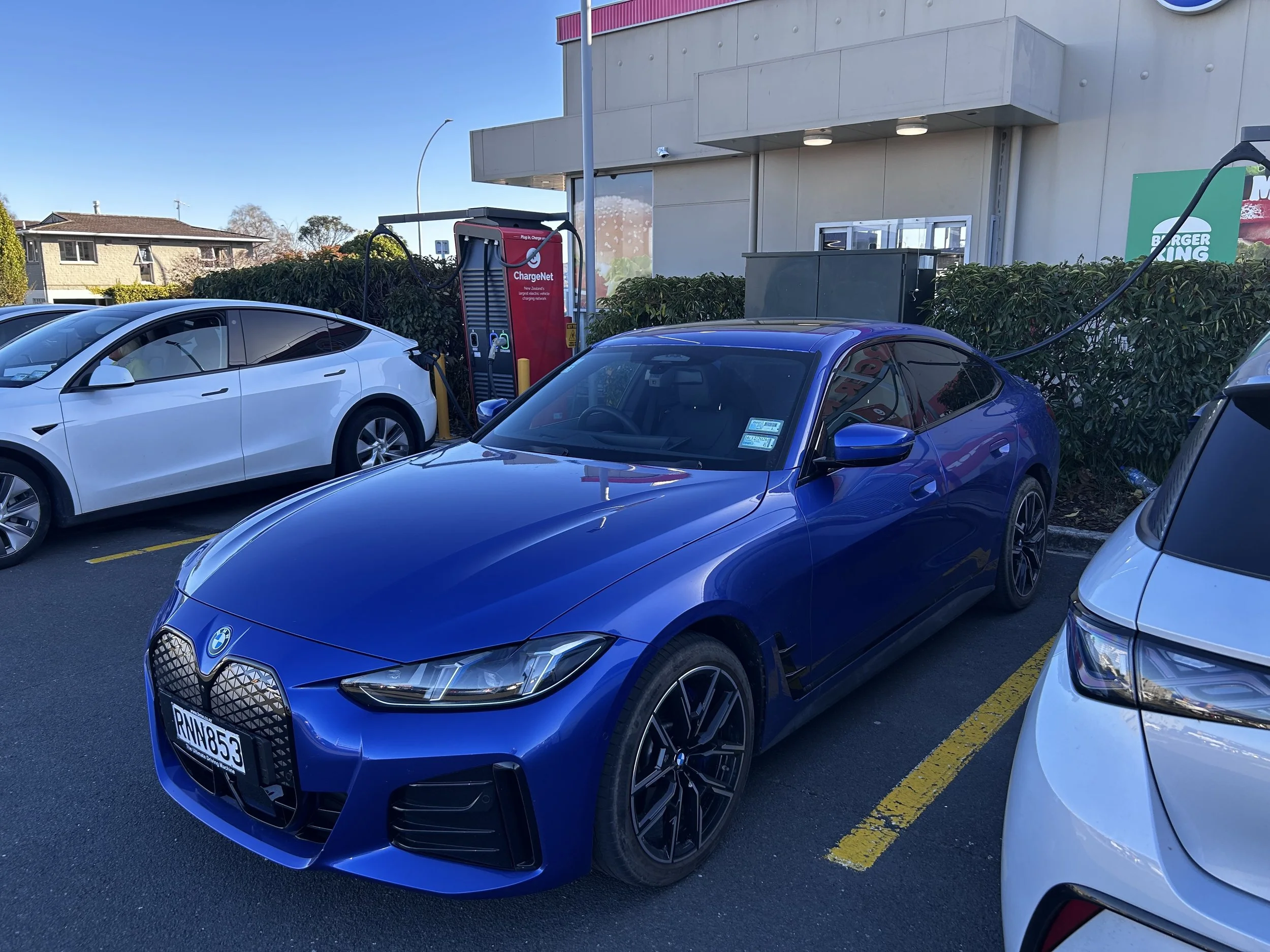
To be clear, just two - one on the way up, again on the way back - both at the halfway point (more or less) of each leg were absolutely necessary.
Halting at Taupo also made sense because it has a hypercharger, a famously good public loo and lots of places to find a late-ish lunch.
I also plugged the car in on night of arrival in Cambridge out of prudence. The trip computer assured there was probably enough juice in the tank to get back to Taupo next day. But I knew I had a few side trips, so perhaps not. Hence a quick half hour on a 50kW charger.
The other two? Just dabbles. One of those to prove a point (it didn’t, and I’ll explain why) and the other because there just happened to be a trickle charger right where I parked so I figured I should make use of it. Which was wasted effort. because only on returning to the car did I notice the charger had a start button, which I’d neglected to activate.
Anyway, the way this trip should have gone, the more charging the better. You might recall BMW having recently advised
of it having enacted a simplified process to amplify user-friendliness of EV replenishment.
In a nub, drivers of most new models can simply plug into a ChargeNet public outlet without any additional involvements. They begin charging automatically, eliminating the need for any onsite authentication steps. So no fob-tap, QR-scan or phone-app required.
A bespoke involvement with the provider’s own Autocharge system that went live in March, this is the kind of tech owners are surely going to love, as it asks for nothing more than them having to spend five minutes setting up an account.
I could honestly see it being a crucial selling point to those keen to go electric but having concern about the intricacies of how to recharge when away from their home base.
ChargeNet is the largest national provider of EV fast-charge stations and this new AutoCharge works at most of its DC sites, currently around 520 charge points from Cape Reinga to Bluff.
Sure, it’s compatible purely with vehicles that use the CCS (combined charging system) connector, but nowadays all NZ-new electric cars are in that state, right?
Having been a long-term ChargeNet customer who very much enjoys their service, I needed no persuasion to give it a go. Especially so since this trip was perfect to hook into their premium hyperchargers. BMW had a car all set up, was keen to see a story about how well the new regime worked … so it was all systems go.
Before getting into how all that worked out, a word about the i4 Grand Coupe.
In its fourth year of sale, here’s a product that has aged well; it’s a classic BMW design, picking up all the best bits of the ICE age 3-Series it so obviously emulates in general look, plus in driving feel.
Actually, the second is the best bit. This car is sublime in dynamic aptitude. I might as well state right now this stands as one of the best electric cars to drive. It might weigh considerably more than the petrol-powered 4 Series, but BMW has worked its engineering magic so it feels just as fluent from behind the wheel. The steering, braking and turn-in are just sporty enough but it’s also very refined with excellent body control and a lovely loping aptitude that bodes will for distance running.
This was my third stunt in the model line. The first was in early 2023, with the dual motor M50 that then topped the choice list; 400kW and 795Nm feeding from an 84kWh battery for $137,900.
In August 2024 there was time with the eDrive 35 that ran single motor rear drive; 210kW/400Nm and a 67kWh battery meant a more subdued performance, but still a beautiful car from behind the wheel and the $98,900 tag put it in a good spot/ Remembering it then cost just $8k more than the iX1eDrive20, this lift backed sedan just seemed so much better value. NZ Police found it so interesting they accepted several for highway patrol duty. BTW the one in my area is still prowling.
I thought they were a good fit, but sales count for everything snd so too the climate for buy-in. The periods of past test were tough times to sell any kind of EV. A bit tragic none of the variants originally offered did enough to earn their keep, but that’s obviously why the family of three is now just down to one.
As it transpires, the i4 eDrive40 that was the mid-pack choice previously was also the sole one left unsampled so that, plus knowing the calibre of the car, it was hard to say yes.
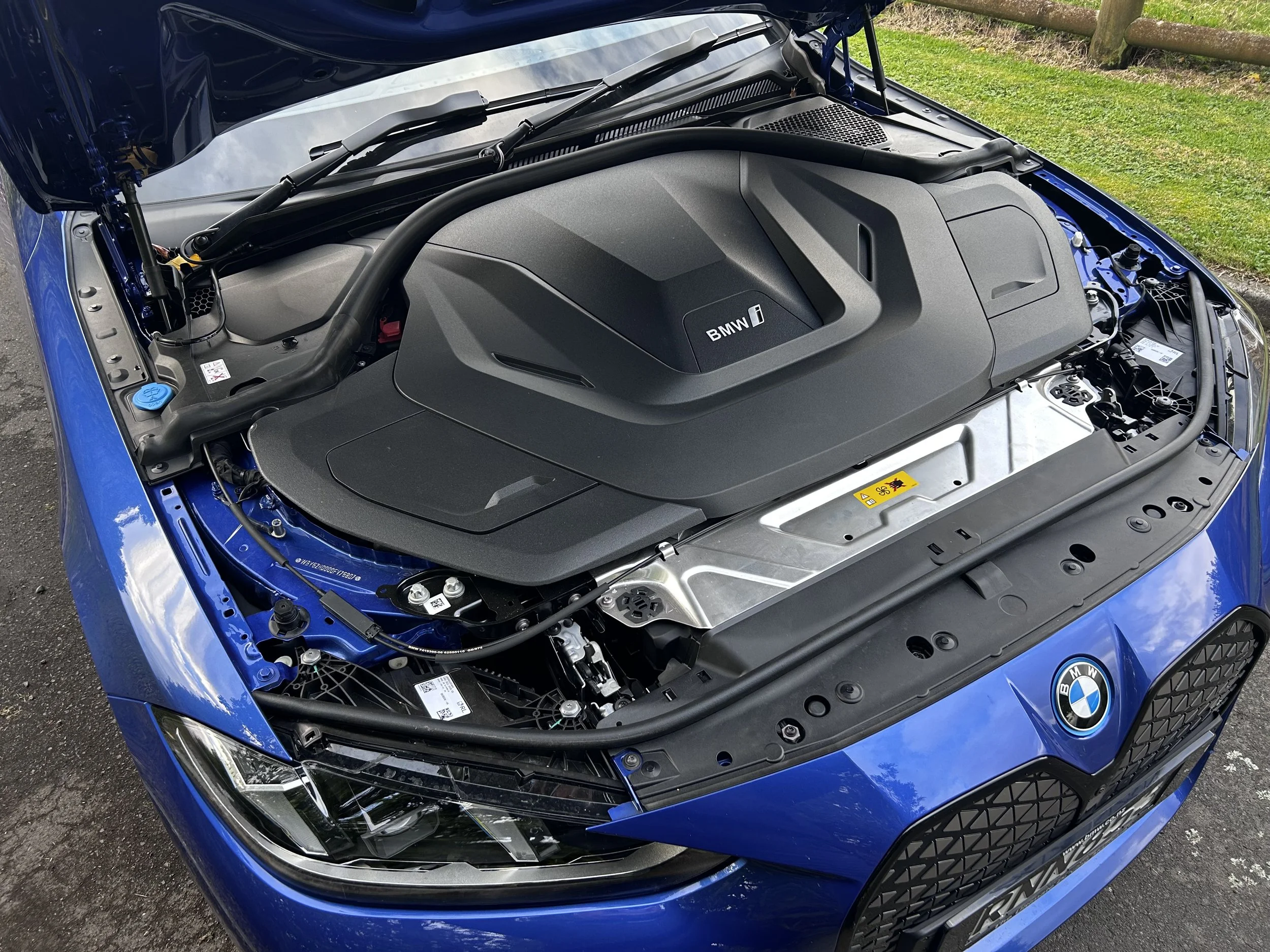
What we see now continues with the same single motor in rear-drive format making 250kW and 430Nm, still feeding from an 80.5kWh (net) battery. However technical revisions allow range to enhance to 540 kilometres when measured to WLTP standard, a 20km improvement.
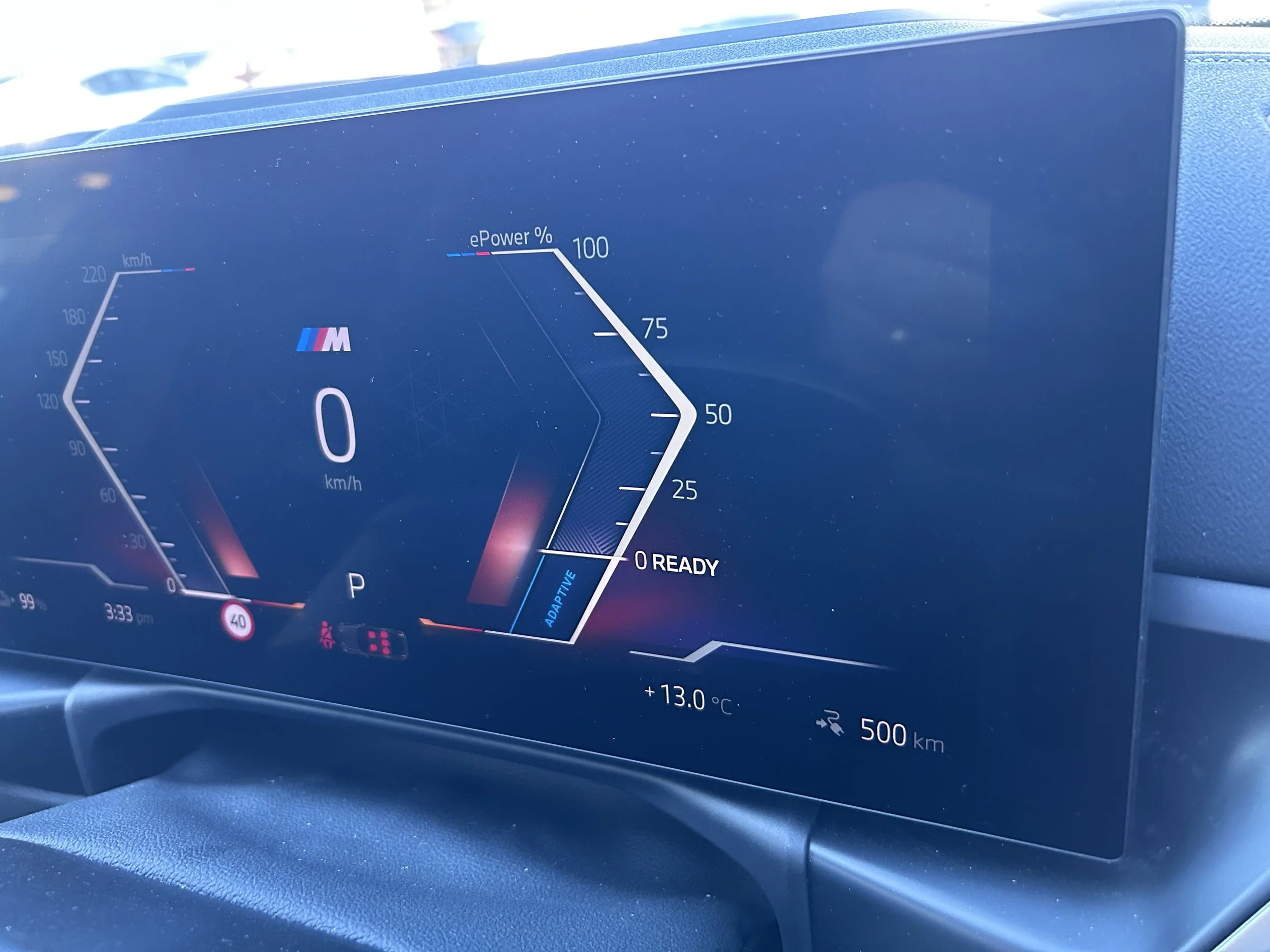
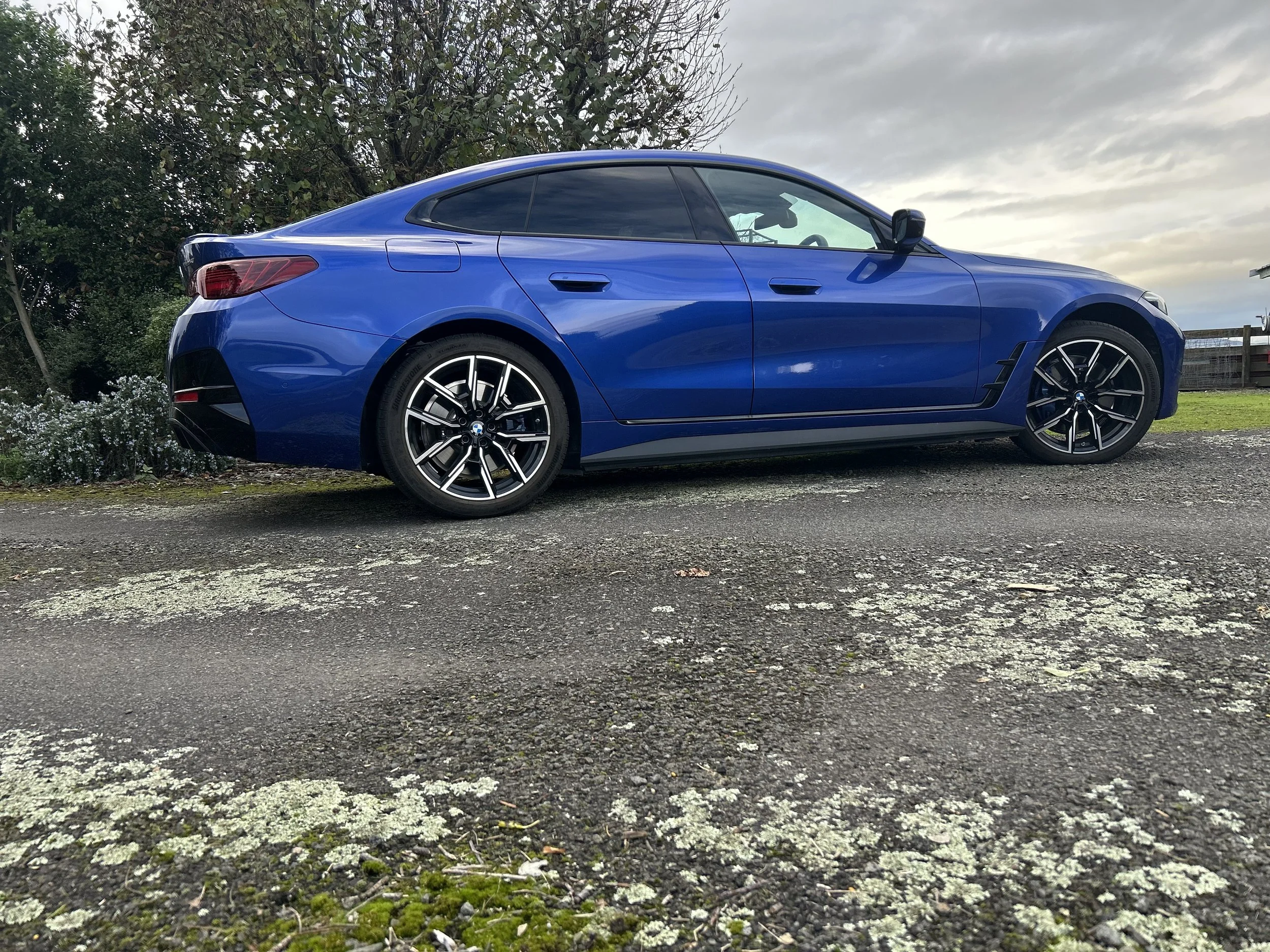
Having once represented at $115k, the model now sites at $124,900, before options are considered. This example took the $5500 ‘Enhancement Pack’ that delivers trim embellishments and a Harmon Kardon stereo upgrade. Further step ups are a $2000 M Sport Pro accessory fit out that includes M Sport brakes, with red callipers. The standard rim here is a 19 inch type, but 20s are optional for $2500. Also costing extra are some metallic paints, from $4000 Dravit Grey to $10,200 Frozen hues, in Pure Grey and the example’s Portimao Blue.
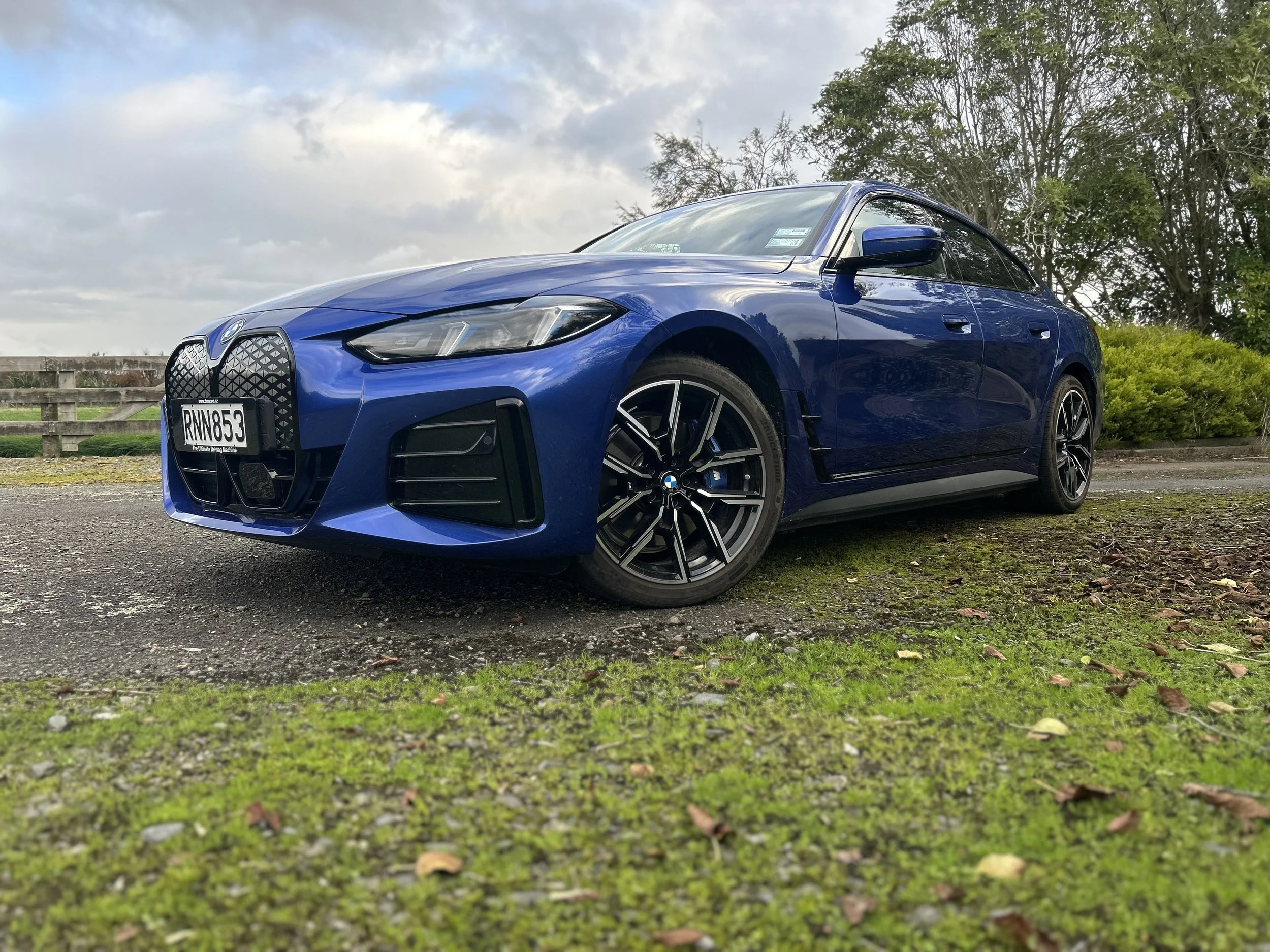
If handover of duty to i3 next year plays out, styling revisions delivered here should do the job of keeping it fresh in the interim. The alterations start with a new BMW kidney grille with a diamond textured surface and new headlights with vertical structures for the daytime running lights and turn signal indicator functions.
Adaptive LED headlights with blue elements come with the Enhancement Package, which also integrates laser tech into the tail lights.
The interior changes run to a flat-bottomed M leather steering wheel with a 12 o’clock marker, seat heating for driver and front passenger and lumbar support. An electric glass sunroof is now also included as standard specification and the climate control function is redesigned. It’s probably the last blast in BMW’s electric portfolio for the iDrive infotainment set-up; just when you’ve felt wholly confident with it, the whole shebang has been ousted from the Neue Klasse cars.
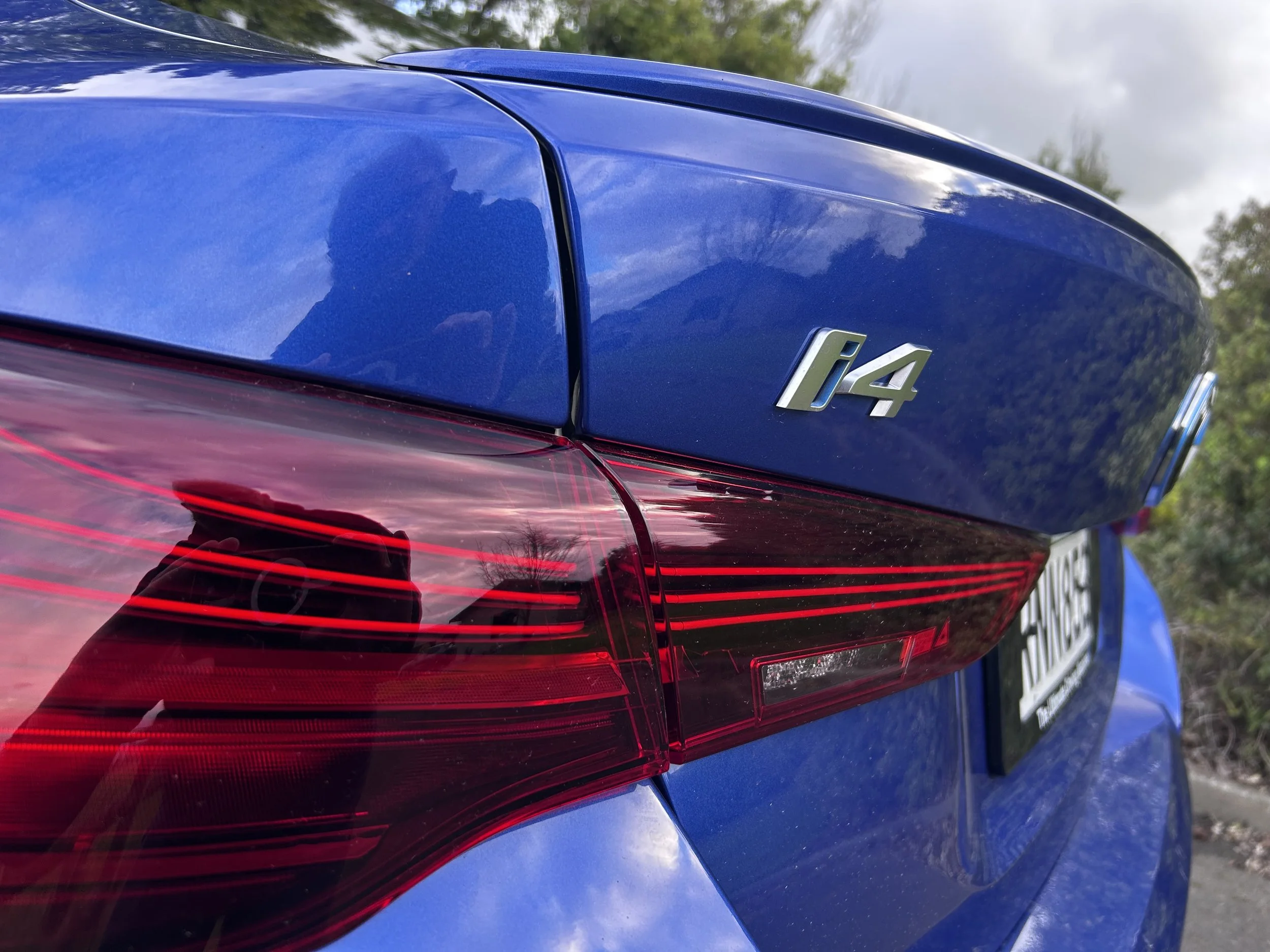
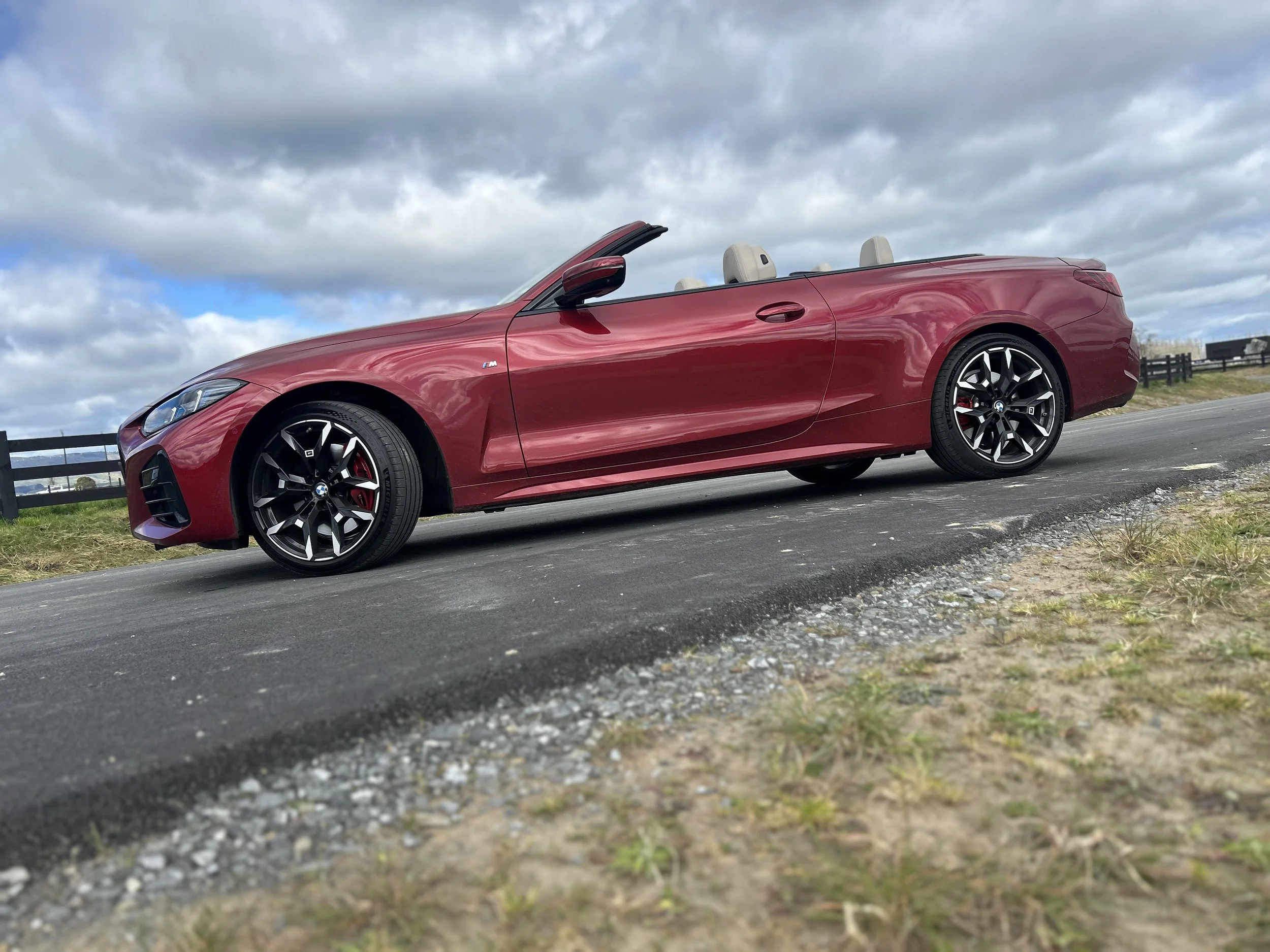
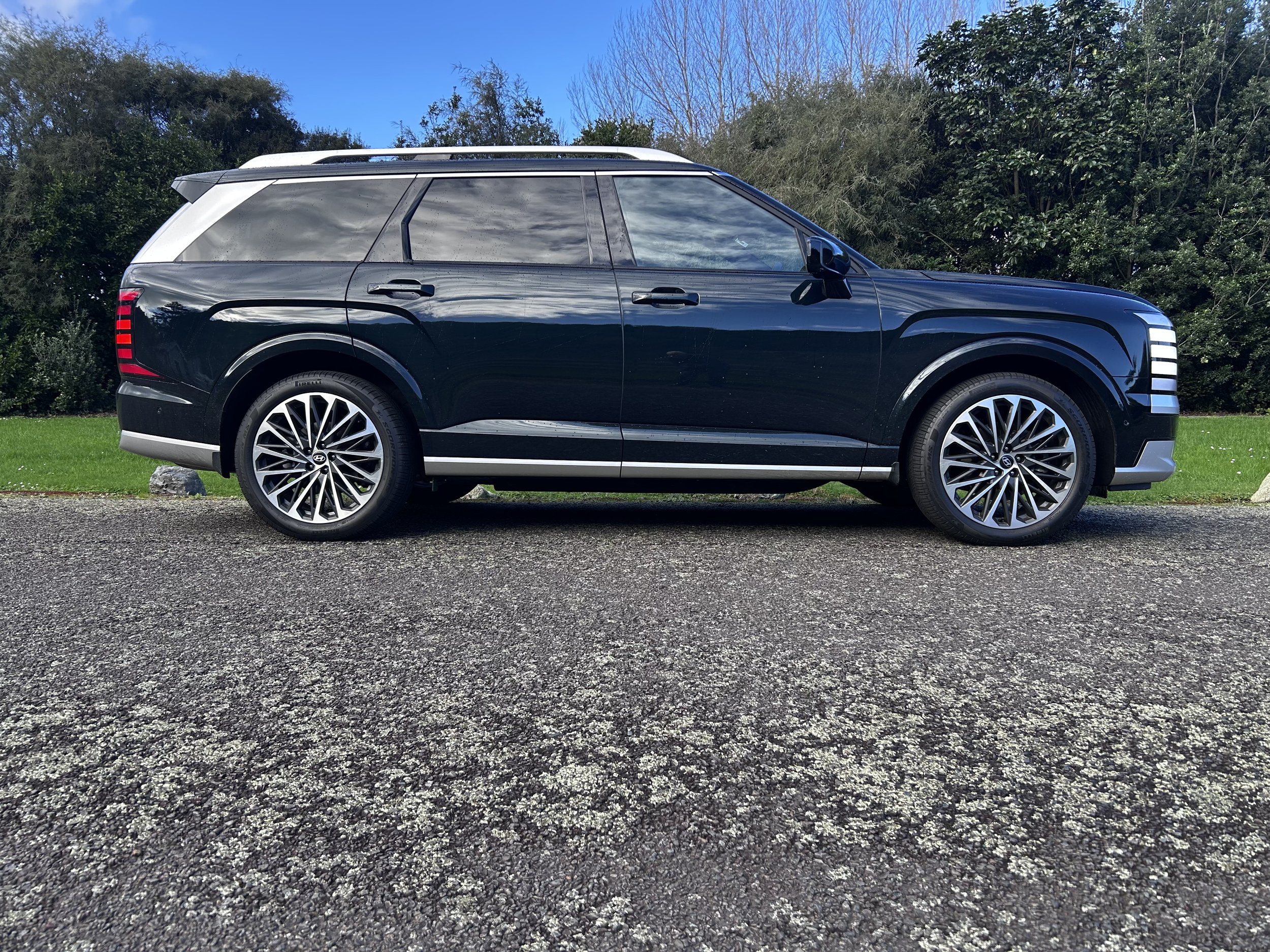
One plus of the look is that there’s no much to give away that this isn’t a regular 4-Series Gran Coupe. There’s not much to give away that it’s an electric version aside from the blanked-off grille, BMW roundels encircled in blue, eDrive badging on the tailgate and a rear bumper diffuser in place of tailpipes.
It’s the same sense of ‘all but the same’ when slipping into the cabin. Settling into the driver’s seat is a good start because, even though the battery is located under the floor, BMW has managed to keep the driving position low to the ground, so totally in keeping with the brand’s sporty character.
The driver’s seat is very welcoming for big driving stints; they styling is sporty, but in addition to being supportive of thigh and shoulders they remain comfortable. There’s plenty of adjustment, so drivers finding a comfy driving position wasn’t tough.
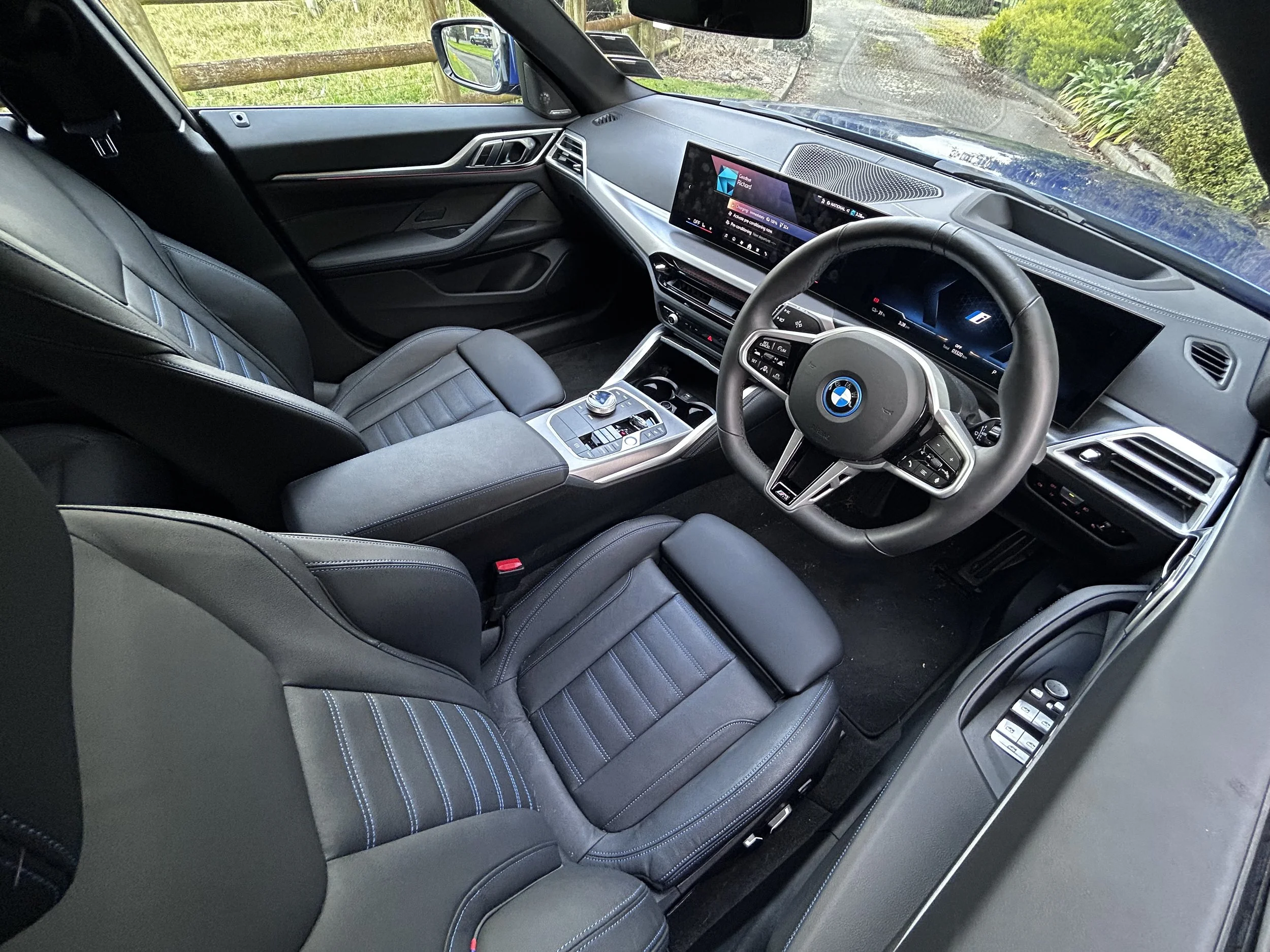
The cabin has the same excellent build quality, with brushed metal finishes and leather, and common infotainment setup as the 3 and 4 Series, which features a 12.3-inch instrument display and 14.9-inch media screen in a single curved panel, floating above the dash.
The uptake brings the screens up to the latest iDrive 8.5 software, with tech including 5G connectivity, augmented reality sat-nav and an Intelligent Personal Assistant. The display itself offers sharp graphics and rich colours but, during test, the mapping actually improved, due to the uploading of a software upgrade. More about that soon.
One thing to look forward to with i3 is a big step up in processing power, but as is the system here is pretty nifty. The one challenge when driving is working through the array of sub-menus; these can be tricky to navigate. A similar thing can be said for the climate controls, which occupy the bottom of the screen, rather than being operated via physical dials.
Still, that rotary controller makes navigating the somewhat cluttered menus a bit easier while on the move; something to keep in mind when comparing against touchscreen-only interfaces.
Size and dimension-wise, the cabin is on the cosy side. As my driving was for the most part a solo thing, that didn’t really matter. But if you had a Gran Coupe for family use, expect to adjust the front chairs to compromise for rear seat occupancy and also be prepared to put anyone tall up front, as the headroom in the back is a touch tight.
The actual driving side of this excursion passed pleasingly. The i4 can cope quickly and neatly through corners, despite hauling two tonnes-plus, the weight distribution is 50:50 and the battery has given it a very low centre of gravity. The axles have been widened; all up it feels lighter than anticipated, well-balanced with minimal body lean.
As is so common in BMWs, the steering is not just precise but generally natural in feel; sometimes it’s hard to judge exactly how much grip the front tyres have but overall it’s a car you learn to drive with confidence.
It’s the refinement that impresses as well. Near-silent electric motors and an impressive lack of wind and tyre noise make it a relaxing car. While this version hasn’t the tarmac-tearing oomph of the M50, it still has plenty and the throttle response is great. plus, while stacked with driver assists, none are in your face. Or ears. No bing-bongs here.
It’s a car in which you feel you can drive all day, and still want more. Doing just that isn’t quite within remit of the car, but beyond that the test idea was to stop to check out the new recharging opportunity.
And about that? No sugar-coating this, it was a fail. I’ve no doubt the system does work. What unfortunately became apparent, when the first stint at charging went rather awry, was that the car wasn’t playing its part. It was only days later, when the test was over, that the reason why was made clear.
While BMW here had been confident the car had been configured for auto-charging … turns out it wasn’t. Which didn’t mean calamity. I have a ChargeNet account. On stopping, I just used the old way of plugging in, activating off my phone app and paying as I went. Total cost $123.95 FYI; a bit of a hit abut still a lot cheaper than a tank of petrol or diesel during time of test.
You can see why Plug and Charge will be useful. As is, the i4 is pretty handy for those who don’t like to dwell too long on public chargers. Searching out anything with more than 50kW is worthwhile, because the battery can be replenished from 10-80 percent in around half an hour. For point of reference, while a home charging cable is included, empty to 100 percent replenishment requires up to 13 hours.
Beyond having been assured it was configured for plug and play, what caught me out initially about the car being good for that was that the screen menu includes a ‘plug and charge’ prompt. I’m not sure if it is actually required if the car was sorted, as the way I read it when the car is hooked up, it simply begins a secure digital connection between the vehicle, the allocated ChargeNet account and the charging station, using a unique identifier linked to the vehicle.
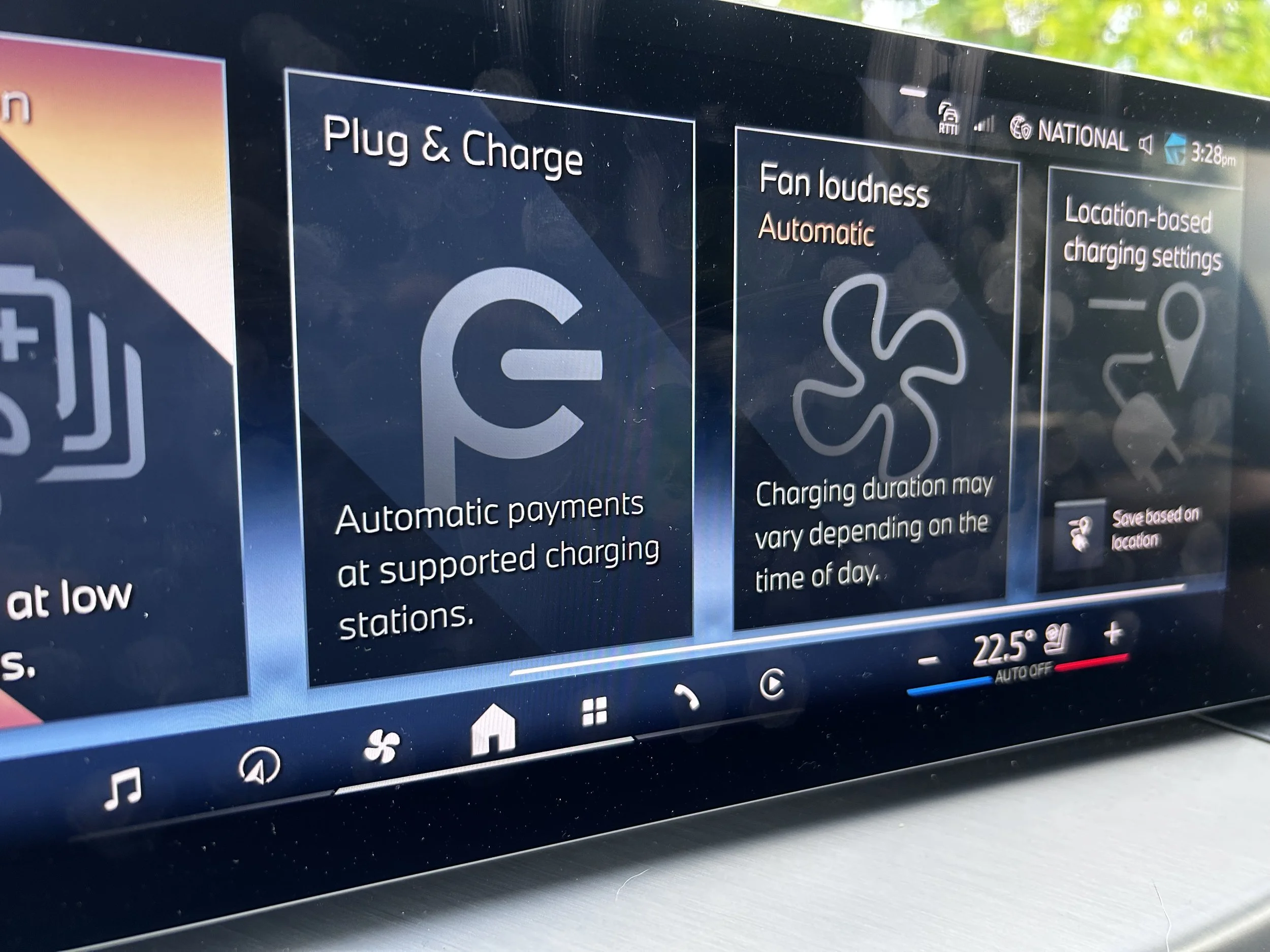
Anyway, having hooked up the i4 to the Bulls’ 300kWh charger and finding it dormant, I’d touched that screen control to fizz things up.
Which it did, but in the wrong way. The car and charger packed a (thankfully only momentary) sulk. Screens went haywire, the charger went into a limp mode. Fortunately, the automotive equivalent of ‘alt control delete’ - unplugging them restarting the whole charging cycle - remedied all.
One other little lesson about the car’s electronics came during another charging session. With the car identifying that it’s software update was due, and that this would require 20 minutes, seemed portentous, as that was also the amount of charging time to run.
So I started the upgrade …. another bad idea.
The car completely shut down, all screens going blank, but not before flashing up a message that said it simply could not be driven until reprogramming was complete.
At same time, it close downed the recharge. So I was stuck in a car that was dead, fervently hoping no-one would turn up seeking use of the charger I was now hogging. Fortunately, they didn’t. But I was mighty relieved when the car regained full systems in the exact time it said it would.
Neither experiences took the shine off the drive. The i4 will have its place in BMW history as the first all-electric model intended to win over buyers of the 3- and 4-Series internal combustion models.
It has paved the way for the incoming i3, which in turn represents as a far more advanced car for the compact executive electric car class.
Even when you know what’s next is all the better, that doesn’t keep what we have now from feeling really quite good.