
Nissan amps up electric push
/
By the end of this decade Nissan’s electric car park will be full to bursting.
Read MoreBy the end of this decade Nissan’s electric car park will be full to bursting.
Read MoreNissan’s boss in Europe says a small crossover will replace the eponymous electric hatch.
Read MoreNissan's critical new small SUV will arrive in New Zealand early next year.
Read MoreNissan finally reveals the latest evolution of its eponymous sports coupe.
Read MoreArguably Nissan Leaf owners rival the Teslarati as the biggest noise makers about the benefits of driving electric. Now, it seems, their pride is sounding out more stridently as well.
Read MoreIf the standard Navara Pro-4X isn’t tough enough … there’s now a ‘Pro-4X Warrior by Premcar’
Read MoreMIGHT admission from Nissan in Australia that it’s not set to take the brand’s next generation electric car due to the lack of incentives be bad news for Kiwis awaiting that vehicle?
In relating to our neighbour’s national media at the weekend that Australia is "missing out" on newer, cheaper electric vehicles, Nissan offered as a specific example the new Ariya crossover – and it’s bad news.
Read MoreTHOUGHT an innovative electric powertrain will prioritise in the next Nissan X-Trail seems to have been cemented with the car’s full reveal.
Nissan chose the Shanghai motor show that opened this week as the venue to fully display the car and also confirm that it will option in seven seat form and also deliver with the new ePower powertrain technology.
Read MoreCONFIRMATION that a potent hybrid powertrain will feature in the next-generation of Nissan’s Qashqai crossover has come with the brand now fully revealing the car.
Nissan New Zealand has still not offered any comment about the new model, which once again is being produced in the United Kingdom.
Whether this market will be in line for the new hybrids – psrticularly the top version of which combines a 1.5-litre petrol engine with an electric motor - remains unknown, though given the national climate for such powertrains is warming, the tech would seem to have a good chance.
As previously reported, also offering is a 1.3-litre turbocharged petrol related to that of the current car, but with its own internal improvements to reduce fuel consumption. This unit is now mated to an uprated 12-volt electrical system, known as Advanced Lithium-ion battery System.
With Nissan’s hybrid the 115kW petrol engine doesn’t ever drive the wheels directly - instead it sends all of its exertions to a power generator, inverter and 140kW (electric motor that's similar to the one found in the likes of the Nissan Leaf fully electric.
It drives through the Xtronic CVT automatic and also comes with the option of four-wheel drive, with five driving modes - Standard, Eco, Sport, Snow and Off-Road.
The e-Pedal system that features on the Leaf also enacts on the five-door crossover, meaning drivers can make use of one pedal driving. Stepping off the throttle can provide up to 0.2G of regenerative deceleration without any need to touch the brake.
The revised 1.3 turbo comes in two states of tune, 102kW and 116kW. The more powerful avails with a CVT automatic gearbox and four-wheel drive; the other with a manual six-speed.
The styling is familiar, but the shape is more smoothed-off and more creased in places; it also has the same family face premiered by the smaller Juke. There's also, for the first time, the choice of having 20-inch alloy wheels.
Inside, visibility is said to be improved and there's more room for passengers in the rear - with the back doors opening by up to 80 degrees to make ingress and egress as simple as possible - and the boot space has gone up by 50 litres compared to the old model, too. This is accessed by a powered tailgate as standard.
Up front, there's an updated and significantly sharper infotainment system plus heavily digital interface. Besides the nine-inch touchscreen, which contains the navigation, onboard entertainment and more, there's a 12.3-inch TFT instrument cluster, while a 10.8-inch head-up display is the biggest in this segment.
New tech and fresh styling, plus a return to an automatic transmission, with current underpinning and engine retained.
NISSAN has revealed the next generation of its Pathfinder sports utility, but has yet to make clear if it will be available in New Zealand.
Designed and built in its primary market, North America, the new model presents a new styling on top of a current platform that has been extensively re-engineered.
The sole engine being discussed for now is a 3.5-litre petrol V6 that’s been a Nissan stalwart though it has slightly more power and torque, with an uplift to 212kW and 351Nm, but a hybrid featuring a 2.0-litre four-cylinder petrol is said to be in the wings.
Plus, the transmission is new, Nissan having divorced the current model’s constantly variable unit for a nine-speed orthodox automatic. The model avails in front as well as four-wheel-drive.
Other news is that it seats eight, over three rows, and loads up on latest Nissan technology, including a swish infotainment suite.
Much of the old car remains under the new model's skin, with the new SUV sharing the previous model's 2900mm wheelbase. Overall length has shrunk by 38mm to 5003mm, while the car's width and height have grown by around 19mm and 12mm to 1979mm and 1778mm respectively.
The body styling rework delivers the company's new design language, expressed particularly strongly up front with C-shaped LED headlights and signature daytime-running lights, plus Nissan's 'V-motion' grille.
The eight-seat layout is standard, but a seven-seat configuration is an option, the latter taking individual chairs in the second row separated by a removable centre console.
Comfort levels step up. The driver and front passenger enjoy climate-controlled seats and even the third row seats can be heated. The interior is dressed in semi-aniline leather.
The new infotainment provisions with a 9.0-inch touchscreen running a 'NissanConnect' system, including wireless Apple CarPlay and wired Android Auto capability and a Wi-Fi hotspot.
The driver gets a 12.3-inch digital instrument panel with a 10.8-inch head-up display, while other interior featured include wireless smartphone charging, satellite navigation, a 360-degree camera, and a Bose premium audio system with 13 speakers.
Nissan's release today speaks of an onboard 'ProPilot Assist' system with adaptive cruise control and lane-keep assist, to offer semi-autonomous speed control on highways. The brand's 'Safety Shield 360' safety suite offers front and rear autonomous emergency braking with pedestrian detection, blind-spot monitoring, rear cross-traffic alert, lane-departure warning and high-beam assist.
ENHANCING the safety spec, improving refinement, delivering a restyling and introducing of a new flagship model have hardly impacted on Nissan Navara pricing.
In advance of delivering the facelifted model line, Nissan New Zealand has sent out RRPs to its dealers and it appears to be a good news story.
The biggest increase seems to be a $1300 hit, for the ST doublecab automatic four-wheel-drive.
Many other derivatives go up by much less – in one case by a mere $300 – and in two instances, the stickers have reduced.
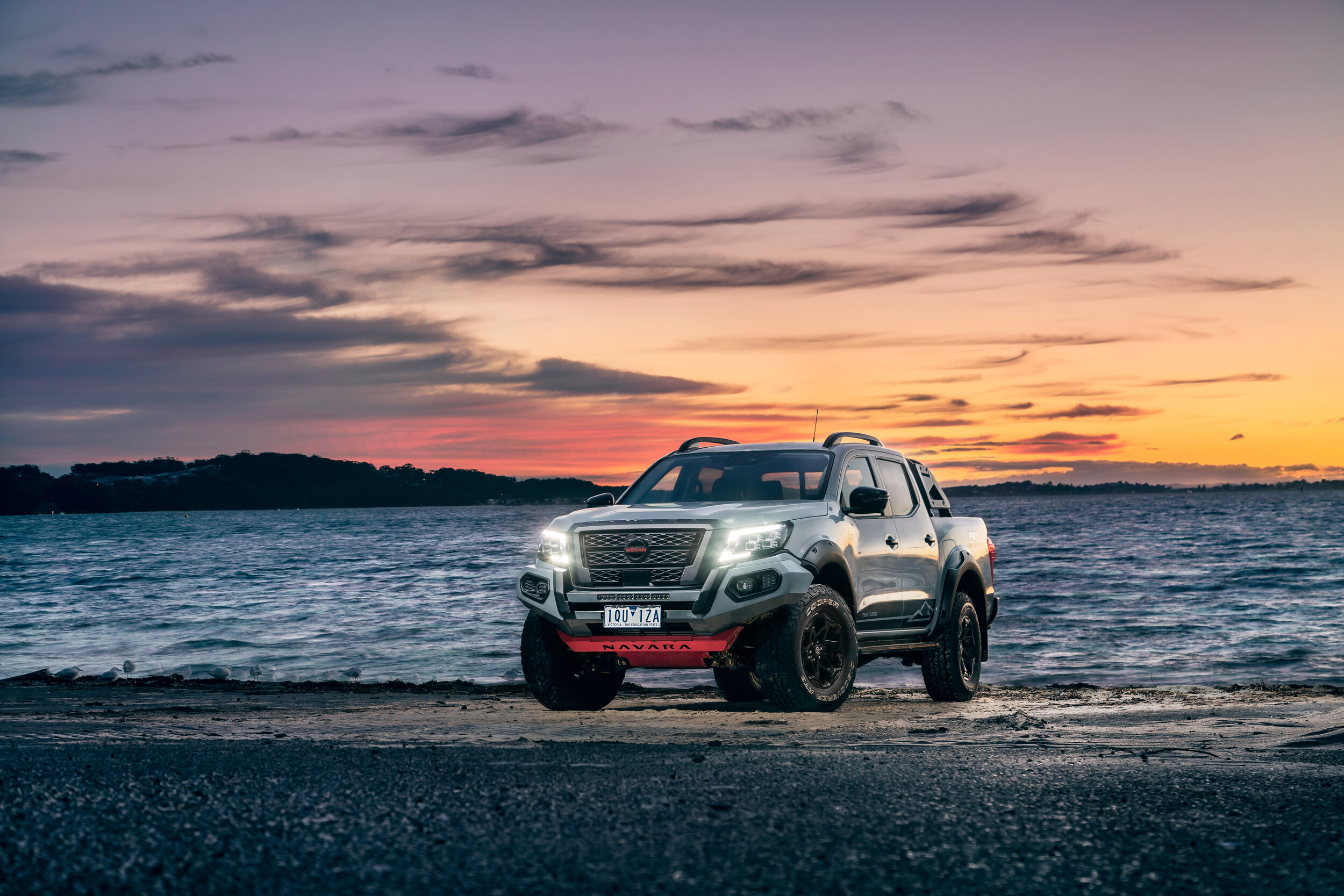
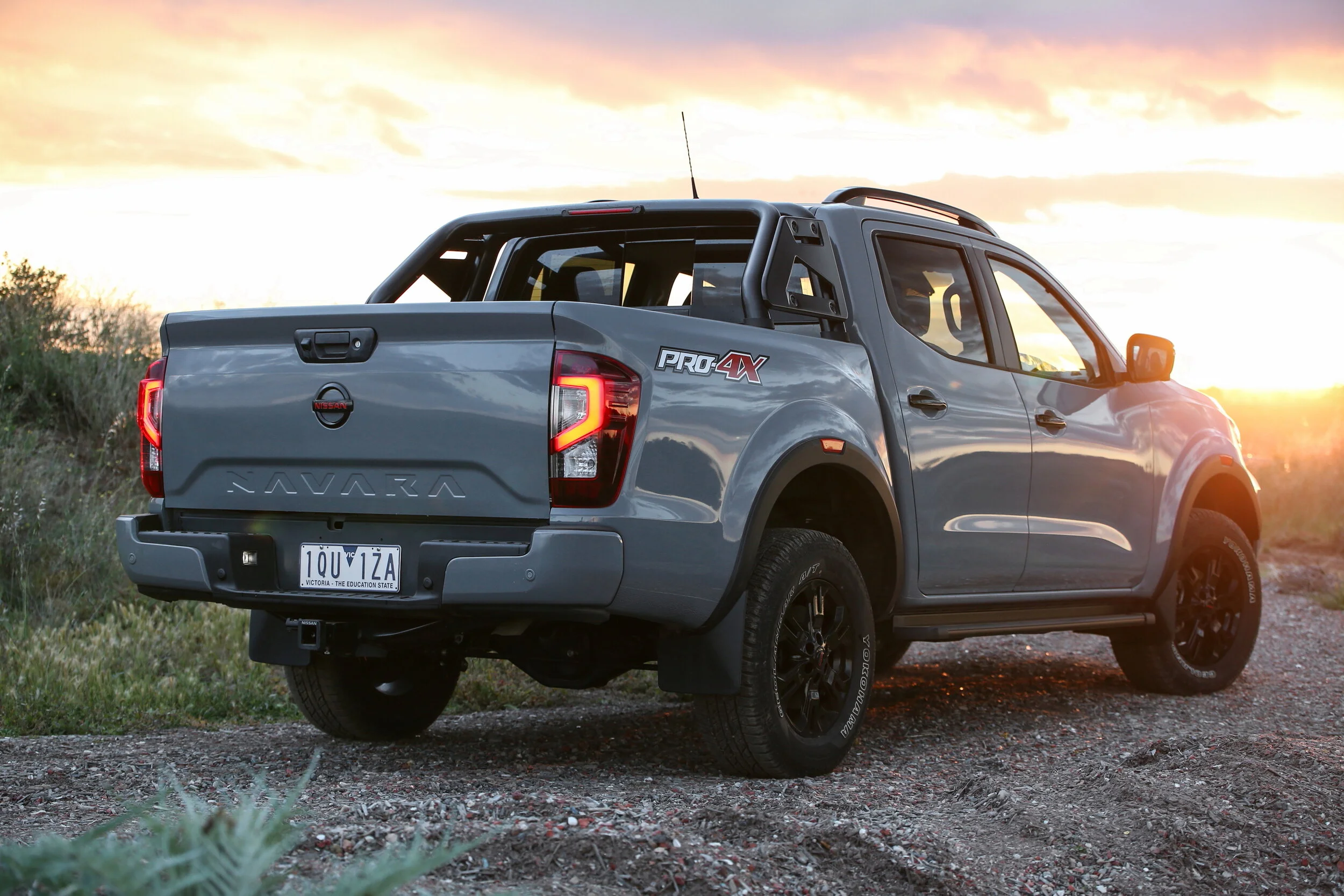
The ST four-wheel-drive auto doublecab is down $1100 and the range’s new flagship, the Pro-4X (pictured), at $70,400 in automatic form is $6200 cheaper than the top dog of the outgoing range, the N-Trek.
Whether the Pro-4X replaces the latter is still a matter for conjecture; it’s a factory flagship that might yet become a base for a new N-Trek (a package created in Australia for Nissan by a third party developer).
The updated line comprises five rear-drive models and 11 editions with on-demand four-wheel-drive, all with a 2.3-litre four-cylinder twin turbo diesel engine.
The 2021 lineup presents the first big facelift for the ute and introduces five years into its life cycle.
Not everything changes. The engine continues to make 140kW and 450Nm and remains wed to the existing seven-speed auto. Suspension tune is not touched. Towing capacity remains capped at 3500kg but Nissan has indicated improved payload, with up to 1.1-tonnes of carrying capacity in the Pro-4X and up to 1.2 tonnes on workhorse models.
However, it’s not challenging to pick the new from the old.
The biggest obvious visual revision is to the front. The fresh face is a shared identity – the next-size-up Nissan Titan in North America has much the same look. Aside from the XL-sized grille, Navara takes bi-LED headlights with C-shaped daylight running lights.
All this means it adopts new sheetmetal forward of the windscreen, bonnet included. The rear outer skins, tailgate, wheel arch flares and tail-lights are come in for re-sculpting.
The sides of the ute tub are 20mm higher, though this is more for styling than to create extra usable space and the tailgate hinge is spring-loaded.
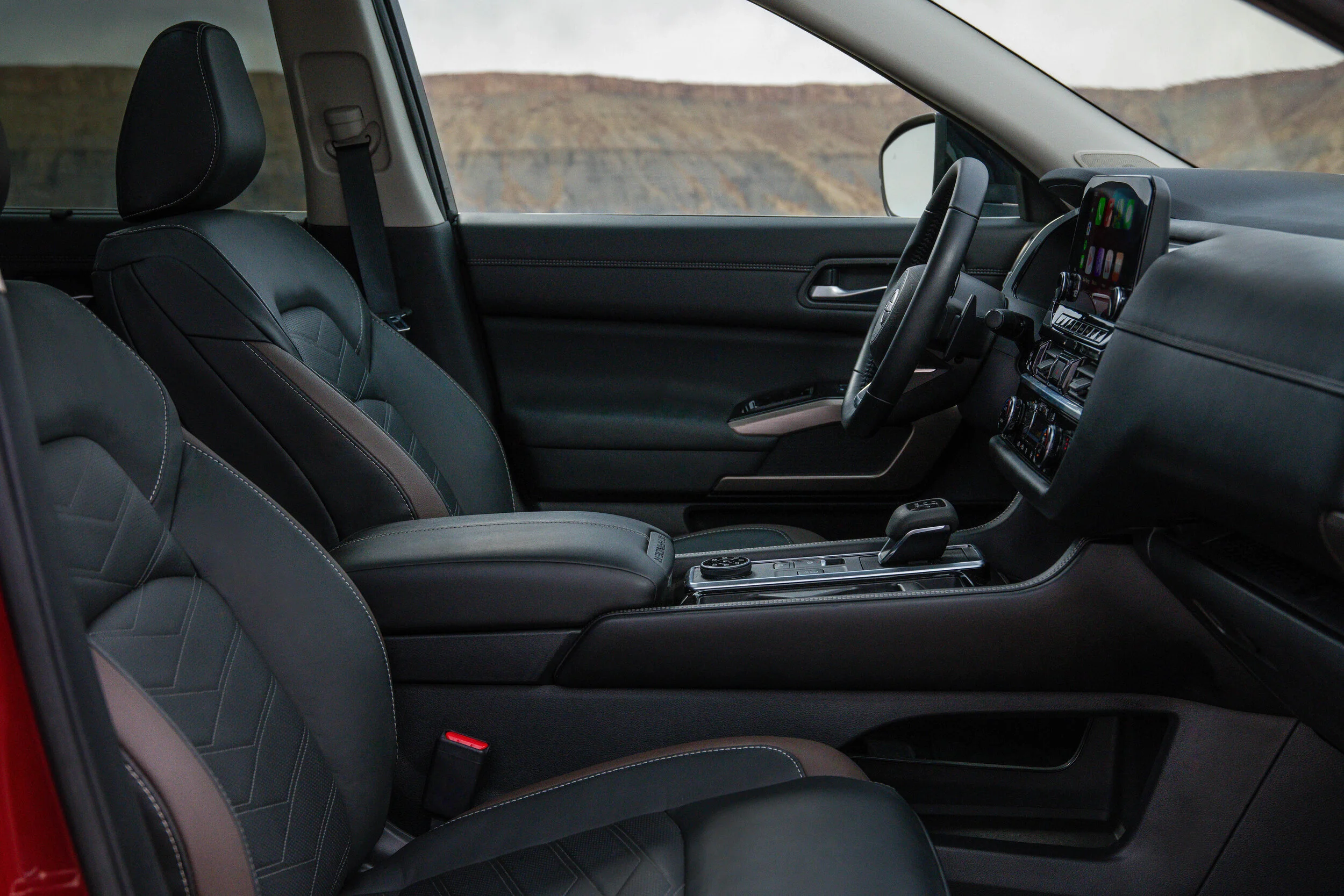
The interior gets a minor makeover and a more compact steering wheel, with extra buttons which work in conjunction with a larger digital display between analogue dials in the instrument cluster. The steering wheel still only has tilt adjustment rather than height and reach adjustment. A new laminated windscreen, thicker side glass, and extra sound-deadening behind the dash promise a quieter driving experience.
The Navara moves to autonomous emergency braking, forward crash alert, lane departure warning, rear cross-traffic alert, and blind zone warning for the first time. So, a step up … but still a step behind the likes of the Toyota Hilux, Ford Ranger, Isuzu D-Max and Mazda BT-50.
Nissan is yet to outline if this advanced safety tech will be on all variants.
As before, top-end Navara models come with push button start, dual zone air-conditioning, rear air vents, heated front seats, power folding sides mirrors, Apple CarPlay, Android Auto and embedded navigation. The infotainment is the same system that came with an update 18 months ago.
HYBRID powertrains will feature in the next-generation of Nissan’s Qashqai crossover.
Even though the car’s official release is still a year away, Nissan has decided now is the right time to share information about the new option, the most advanced version of which is intended to be offered under the e-Power branding.
Nissan New Zealand has not offered any insight as to whether this market will be in line for the new units, the top version of which combines a 1.5-litre petrol engine with an electric motor to drive the front wheels.
Also offering is a 1.3-litre turbocharged petrol related to that of the current car, but with its own internal improvements to reduce fuel consumption. This unit is now mated to an uprated 12-volt electrical system, known as Advanced Lithium-ion battery System.
Hybrid drive appears to be set to be the sole choice for the car in Europe, however that does not discount that other engines could be provisioned elsewhere.
The 1.5-litre set-up differs from many other hybrids in that the 115kW petrol engine doesn’t ever drive the wheels directly - instead it charges the battery which supplies an electric motor producing 140kW and 330Nm of torque.
The advantages? There are several, the brand claims. Primarily, though, with the electric motor driving the wheels alone, the Qashqai will benefit from the driving characteristics of an EV, not least more instantaneous throttle response.
The car will not only accelerate quicker than its hybrid rivals but does so with a lower engine rpm, which should mean that it doesn’t suffer from the much-criticized rubber-band effect under acceleration of other parallel hybrids with CVT transmissions, the maker suggests.
Lower CO2 emissions also result and the arrangement also means that Nissan has been able to tune the 1.5 petrol unit to operate at its most efficient when topping up the battery, meaning that it has the potential to deliver strong fuel economy.
The e-Pedal system that features on the Leaf also enacts on the five-door crossover, meaning drivers can make use of one pedal driving. Stepping off the throttle can provide up to 0.2G of regenerative deceleration without any need to touch the brake.
Recuperated energy is deployed in the form of a modest 6Nm torque boost under acceleration for up to 20 seconds at a time. Combined with a stop/start system that cuts the engine from 17kmh when coasting to a halt.
The revised 1.3 turbo comes in two states of tune, 102kW and 116kW. The more powerful avails with a CVT automatic gearbox and four-wheel drive; the other with a manual six-speed.
As Nissan has previously confirmed, diesel will no longer feature in the Qashqai’s engine family.
Surprisingly, a plug-in hybrid won’t be coming, either, with Nissan instead prioritising e-Power tech and all-electric vehicles such as the new Ariya, the Qashqai’s slightly larger electric sibling.
The car has yet to be fully unveiled – that happens soon – but some carefully-considered images of some interior highlights have been issued. Also, the car’s general dimensions has been revealed. It is known that the new car is 35mm longer and 30mm wider than its predecessor. The interior gains 22mm extra knee room for rear seat passengers and 28mm more shoulder room for those up front. Front and rear headroom has also improved by around 15mm, thanks to the redesign.
COULD it legitimately be called a jack-up?
A recall action for the latest Nissan Juke, that seems not to have impact on examples shipped to New Zealand, is certainly something out of the ordinary.
It seems the car has become subject to a precautionary check-over action across the Tasman because the jack that comes with the car does not comply with Australian safety standards.
The problem isn’t with the device itself – it’s in perfect condition to undertake the job of lifting the vehicle off the ground to change tyres.
It’s all down to it not having a label that passes muster with the Australian Competition and Consumer Commission (ACCC).
It says the jacks do not comply with Australian safety standards due to the omission of a correct instruction label. Not having this could potentially cause an accident if a vehicle is not jacked correctly by the operator.
Affected vehicles were sold between 20 May 2020 and 2 September 2020. Nissan Australia is contacting owners to organise inspection and repair of the defect.
As for New Zealand? Well, we take the same stock as Australia, but there has been no word from Nissan New Zealand – whose new boss in still stuck in Australia, due to coronavirus travel restrictions – and, from a quick check with a local dealer, the consternation raised across the Tasman has not been felt here. ‘All news to me’ was the local comment, with thought no action is required here.
ADDITIONAL safety tech – but still not as much as others in the category - the promise of improved refinement, a restyling and the introduction of a new flagship model.
These are among highlights of a facelift for the Nissan Navara, introduced five years into the model’s life cycle and set to hit New Zealand early next year.
What doesn’t change? The engine’s outputs, the towing capacity and the suspension tune.
The biggest obvious visual evision is to the front. The fresh face is a shared identity – the next-size-up Nissan Titan in North America has much the same look. Aside from the XL-sized grille, Navara takes bi-LED headlights with C-shaped daylight running lights.
All this means it adopts new sheetmetal forward of the windscreen, bonnet included. The rear outer skins, tailgate, wheel arch flares and tail-lights are come in for re-sculpting.
The images Nissan has provided are of the new flagship, called Pro-4X. This is a new global name for the top dog model; it’s assumed it will bump the Navara N-Trek, yet there’s also though the N-Trek fitout – mainly developed in Australia – can carry into the new line, so expect it to re-emerge as a localised special edition, some time after the factory models have settled in. Navara Pro-4X Warrior is being bandied already.
There is no extra power or torque from the twin turbo 2.3-litre four-cylinder diesel. Is 140kW and 450Nm enough? The familiar engine remains wed to a familiar transmission, a seven-speed auto.
Towing capacity remains capped at 3500kg but Nissan has indicated improved payload, with up to 1.1-tonnes of carrying capacity in the Pro-4X and up to 1.2 tonnes on workhorse models.
The sides of the ute tub are 20mm higher, though this is more for styling than to create extra usable space and the tailgate hinge is spring-loaded.
The suspension has not been updated because Nissan is happy with the third iteration of the suspension tune, according to overseas reports.
The interior gets a minor makeover and a more compact steering wheel, with extra buttons which work in conjunction with a larger digital display between analogue dials in the instrument cluster. The steering wheel still only has tilt adjustment rather than height and reach adjustment. A new laminated windscreen, thicker side glass, and extra sound-deadening behind the dash promise a quieter driving experience.
Safety systems? It moves to autonomous emergency braking, forward crash alert, lane departure warning, rear cross-traffic alert, and blind zone warning for the first time. So, a step up … but still a step behind the likes of the Toyota Hilux, Ford Ranger, Isuzu D-Max and Mazda BT-50. Nissan is yet to outline if this advanced safety tech will be on all variants.
As before, top-end Navara models come with push button start, dual zone air-conditioning, rear air vents, heated front seats, power folding sides mirrors, Apple CarPlay, Android Auto and embedded navigation. The infotainment is the same system that came with an update 18 months ago.
Local details, including prices, are expected to be released closer to launch.
SO how many can you see?
References to past Z-cars, that is.
Let’s just agree there are plenty. Which is the irony in Nissan’s claim for the Z-Proto.
This concept pointing to “a new generation of the legendary Z car” seems unable to break away from the type’s past. Which probably pleases the fanbase greatly yet might also disappoint those expecting something a little more creative.
As much as this is a design study – sorry, a "development study vehicle" in Nissan-speak - and despite its maker being reluctant to share very many technical details, Nissan has identified what we see here is a "near-production protoype," and confirmed it will outfit with a twin-turbo V6 engine – the first since the 300ZX - and manual transmission.
As is patently obviously, the styling is clearly reminiscent of many old Zs.
Basically, every old Z. And that’s a few, given the sporting sub-brand has a 50-year history.
The front-end with teardrop headlights and long bowed bonnet is from the 240 and 260 Z era.
The side profile? Just like that of the original. Look at the rear end and tell me you don’t see the 300ZX? The bootlid appears to feature a Fairlady Z badge – a name used for the original in Japan and the US, but often seen here as well, thanks to the used import trade. The pod gauges on top of the dashboard (one for turbo boost pressure) and door handles? Clear links to the 370Z.
Easy peasy so far. But perhaps the reason why it has teardrop-shaped LED headlights will sort the regular fan types from the hardcore. Answer? They reference a particular rarity, the Japan-only 240ZG of the 1970s.
The yellow paint used is also an ode to popular paint choice colours for both the original S30 and subsequent Z32 generations, according to Nissan.
It’s not all backward-looking. The rectangular front grille, 19in alloy wheels and carbonfibre side skirts aim to modernise the look, the brand expressed during today’s international, on line reveal.
Nonetheless, the make’s head of design, Alfonso Albaisa, has conceded that the process to determine this design very much involved “making countless studies and sketches as we researched each generation and what made them a success.”
“Ultimately, we decided the Z Proto should travel between the decades, including the future.”
The cabin is finished in black Alcantara-like material, yellow stitching highlights and has a fully digital 12.3-inch display dash for the driver.
There’s still a vintage aesthetic in that, as with every Z car, the design is centred around the driver with dials and gauges facing from the centre towards the most important seating position in the car.
The car measure 4382mm long, 1850mm wide and 1310mm high, and rides on 19-inch black alloys wrapped in special 255/40 front and 285/35 rear rubber.
The engine seems likely to be the unit found in the Infiniti Q50 Red Sport, where it creates 300kW of power and 475Nm of torque. Enough to give rivals like the Toyota Supra a real run, right? Particularly since the sports car should be significantly lighter than Infiniti.
When is it coming to our market? No date has been provided for the launch of the production car, though chances of it achieving showroom status within a year would seem as safe a bet as the proposal it’ll be called ‘400Z’.
Nissan New Zealand has yet to offer any comment.
ENTERING production next year, with no word yet on where New Zealand sits in distribution planning – that’s Japan’s first mass produced fully-electric sports utility, the Nissan Ariya, unveiled online in its production format today.
Retaining the bold Blade Runner-esque styling of the concept unveiled at the 2019 Tokyo Motor Show and the first product to sit atop the Renault-Nissan-Mitsubishi Alliance’s CMF-EV electric architecture that will be used by all partner brands, the Ariya also showcases a new brand identity for Nissan.
However, for electric vehicle buffs, there are more important factors to consider for a vehicle set to sit above the LEAF, which has become a firm New Zealand favourite – this country’s highest volume EV, albeit on the strength of its popularity as a Japanese used import.
Ariya’s also heading for the big time; crossovers are hot and Nissan plans their car to provision in five variants, topped by a performance model.
The lesser models arrive with single motor rear-wheel-drive and the others delivering twin motor four-wheel-drive powertrains, the latter swapping the entry 63kWh lithium ion battery for a 87kWh unit.
The 63kWh single motor model will offer 160kW/300Nm and a range of around 450 kilometres in its most modest format.
The 87kWh edition is enabled for 178kW/300Nm, a range of at least 500kms and – if in rear-drive - 610kms, 0-100kmh in 7.5 seconds and a top speed of 160kmh as standard.
There’s also an e-4orce flagship that packs more punch – 389kW and 600Nm – and extra pep: Zero to 100kmh in 5.1 s and top speed of 200kmh. Range for that one drops to 400kms. All those estimates are from Nissan. The WLTP figures have yet to be provisioned.
All models have an on-board 130W fast-charging inverter that can top up 375km (80 percent of the smallest battery’s lowest range) in 30 minutes.
Ariya adopts standard, sport and eco modes, with e-Force models adding a snow function. It also uses the Leaf’s e-Pedal regeneration set-up, allowing one pedal driving. And some variants will take Nissan’s Pro Pilot 2.0, which allows for hands-free driving in some circumstances. It relies on more than 20 sensors such as cameras, radar and ultrasonic components.
At 4595mm long, 1850mm wide and 1655mm tall, the Ariya is relatively compact, but it has a 2775mm wheelbase and the absence of a transmission tunnel plus some clever stowage ideas will enhance interior space. The entry rear-drive car’s boot offers 466-litres’ capacity; editions with the 87kWh battery have 58 litres’ less space. Still, what helps is that the battery is a flat pack, which allows the vehicle to have a completely flat floor.
The interior features a high-tech interior, with almost no buttons or knobs, and aims to deliver a premium feel. Many touch controls are neatly integrated into the timber fascia that runs across the dash and are handled through "capacitive haptic touch-sensitive icons that light up on the dashboard.
Nissan has also freed up space by removing the air conditioning equipment from the cabin. It’s located under the bonnet instead because … well, no engine, right?
Nissan claims Ariya is expected to represent a new electrified brand identity – “blazing a path to an era of advanced electrification, interior layout, and seamless vehicle intelligence.”
Led by Senior Vice President of Global Design Alfonso Albaisa, Executive Design Director Satoru Tai and Senior Design Director Giovanny Arroba, Nissan’s designers worked from the beginning to lend a Japanese identity.
“We wanted to ensure that the soul of the vehicle reflect our distinctive Japanese DNA, conveyed in a simple, yet powerfully modern manner,” Albaisa said. “We dubbed this ‘Timeless Japanese Futurism’ and tapped into key Japanese words to inspire our global design team to produce the Ariya’s ultra-sleek, seamless, sharp and powerful form.”
Example? The grille has a large sunken area with a subtle pattern that's supposed to resemble a traditional Japanese kumiko design.
EXTRAORDINARY times require unprecedented measures.
Covid-19 has thrown the world into economic turmoil affecting just about every sector you could think of - the automotive industry included.
The downturn in new vehicle sales here and abroad has seen a tightening of the purse strings disrupting many new vehicle programmes, from delays to the complete axing of planned vehicle redesigns.
In Nissan’s case, the Corona curse appears to have poured more salt onto a pre-existing wound. The Japanese carmaker was struggling before the pandemic, and further rationing of their product portfolio was announced on May 4.
The Nissan-Renault-Mitsubishi ambition now is to leverage each member's strength (for instance, Nissan will take the lead in autonomous driving, while Renault will do so for connected-car technologies).
Also, each alliance member will be the reference for particular regions where it has particular status. So, Nissan will lead the China, North America and Japan regions. Renault will be the reference for Europe, Russia, South America and North Africa. Mitsubishi, meantime, will be the reference for the Asean and Oceania regions.
So, there’s that. Then there’s the bit that we’re a little nervous about. Cost-cutting is coming. Big cost-cutting. To achieve new targets, the companies say close to 50 percent of their models will be developed and produced under a so-called leader-follower arrangement by 2025.
The implication for the one-tonne ute sector could be massive. It seems to means the upcoming Navara replacement could well be based off Mitsubishi’s next Triton, to the point of becoming an exercise in badge-engineering.
That is, a common vehicle with lightly-altered front and rear ends. Everything else will mostly be the same as its Mitsubishi donor vehicle …even the often criticised Nissan-based Mercedes-Benz X-Class programme had more creative freedom.
However, what if Nissan had the complete free rein over the design and development - what could the Navara look like, and what else could we expect?
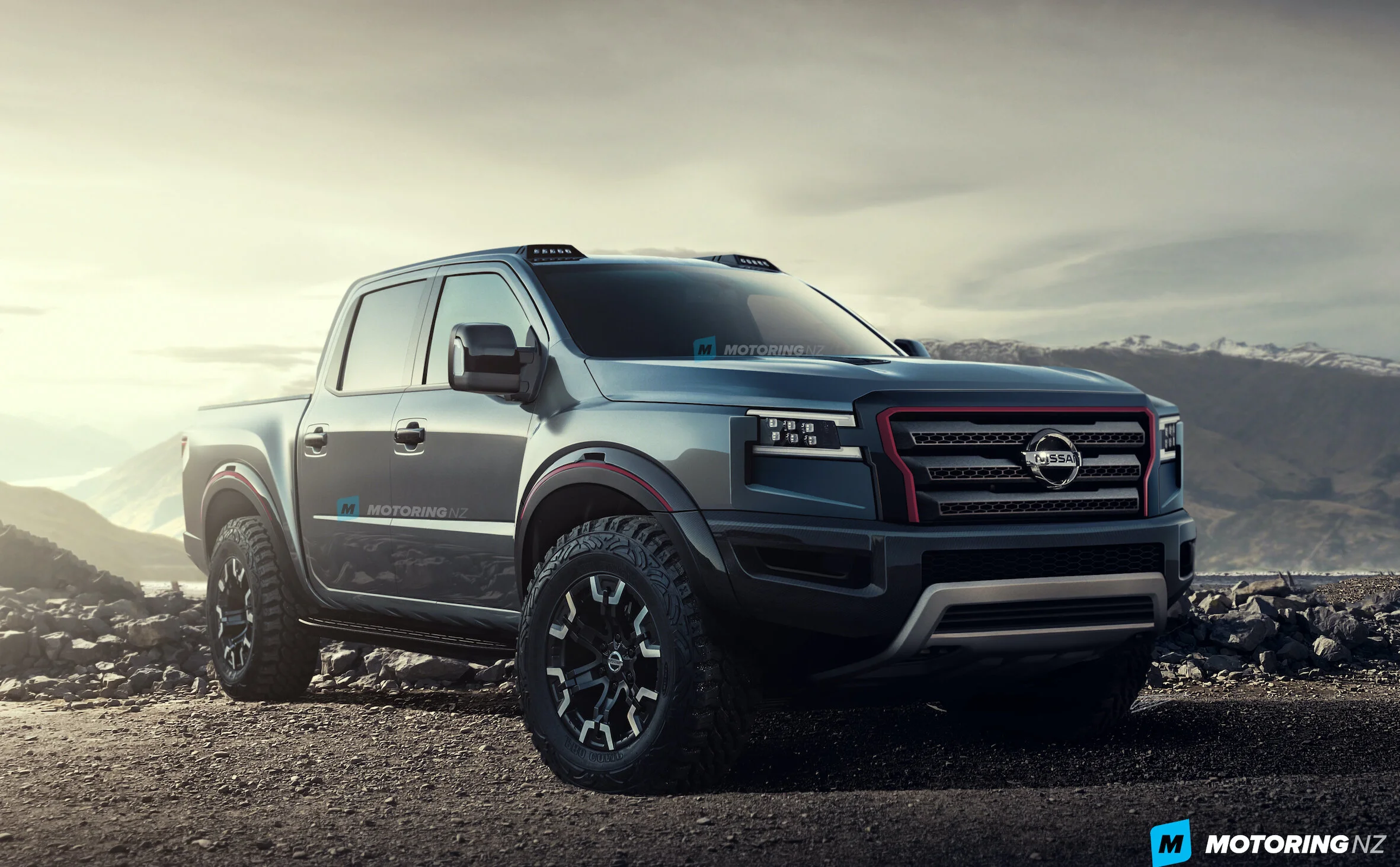
Our in-house illustrated study envisions the next Navara in Ranger Raptor-fighting ‘Nismo’ specification. So, cue all the necessary off-road bits; raised ground clearance? Check. Pumped wheel arch flares? That too. Giant wheels, likewise. And to top it all off …an in-your-face front-end that wouldn’t look out of place amongst a fleet of military vehicles.
Unlike Nissan’s recently-added Navara N-Trek Warrior variant, upgrades would go beyond just simple suspension tuning and visual add-ons. Here the frame would be strengthened, aided by off-road shock absorbers helping it to endure any punishment thrown its way.
While its Ranger Raptor rival is a tad underdone in the engine compartment; this study ditches diesel and puts aside any powertrain mediocrity by utilising a plug-in hybrid (PHEV) shared with Mitsubishi’s next-generation Outlander SUV.
This setup employs a new 2.4-litre four-cylinder engine with 94 kW coupled to dual electric motors (one on each axle) producing 69 kW. In this application, the improved range comes from a larger 13.8-kilowatt-hour battery pack. In the Navara, this would be ideal for low-speed off-roading with prodigious amounts of low-down torque.
Diesel power will still feature for core volume-selling models and a myriad of variants in single, king and dual cab configurations will be available in both rear-drive and four-wheel-drive formats.
A full redesign of Nissan New Zealand’s most popular model is tipped to land sometime within the next 24 months as an MY2022 model.
Will it look anything like this rendering?
here’s one they do now … the Navara N-trek
Navara’s ambitions are presently headed by the just-released N-Trek.
COMING in the wake of Nissan identifying readiness for a new product onslaught that could include a new-generation ‘Z’ sports car is determination to slim down spending, in part by closing a plant that has supplied New Zealand.
A factory in Barcelona, Spain, that has been a supply point for the Navara utility appears to be the biggest victim of the maker’s determination to cut global production by 20 percent.
Nissan’s overnight signal that it intends to close the factory by December has triggered worker protests and a response from Spain’s government, which is asking for a reconsideration on grounds that it will cause considerable unemployment and hit the national economy hard. In addition to the 3000 factory positions, 20,000 more jobs in the brand’s supply chain in Spain are also at risk.
The full extent of impact on our market remains unclear. Current Navara also sources out of Thailand, is nearing production life and odds of it being developed off the next-generation Mitsubishi Triton seem to have strengthened with another announcement this week confirming that platform-sharing between the Japanese firms and their other partner, Renault, will intensify.
This to the point, some onlookers say, that an effort to slash model investment costs by up to 40 percent will inevitably mean some crucial forthcoming models such as next-generation utes and SUVs will become badge engineering exercises.
The three makers have acknowledged implications of their “leader-follower” vehicle strategy discussed this week will be significant.
A core ideal of a new co-operation business model is that it green lights the current “standardisation strategy” evolving from the platform sharing that occurs now to common adoption of upper bodies: So, effectively, no more styling divergence to create individual identities but instead lookalikes differentiated at best by modest design revisions and, at worst, by badges alone.
The potential for this seems high given the alliance has also said that, going forward, responsibility for product development and regional priorities will go to a single brand.
Mitsubishi has been saying for some years that it has been in the box seat for being the home base for a future ute, as current Triton presents as a far more cost-effective vehicle to build and sell than the Navara.
Any cloning is unlikely to stop with the ute. It’s highly certain the next-generation Mitsubishi Outlander, Nissan X-Trail and Renault Koleos mid-size SUVs will come off a new Nissan-developed platform. Mitsubishi already has a rebadged version of the Renault Trafic van.
Closing the plant in Spain (and another in Indonesia) is in response to Nissan sinking into the red for the first time in 11 years as the coronavirus pandemic squashed global demand and disrupted production.
In announcing the closures, the maker has also reiterated that its biggest plant, the Sunderland facility in the United Kingdom that supplies the new Juke that releases here soon, is not going to be touched. In fact, Sunderland’s status will be elevated as the centre of all future production for Europe.
Nonetheless, with global vehicle production having dropped 62 percent in April from a year earlier to 150,388 vehicles and global vehicle sales slipping nearly 42 percent last month, Nissan is having to move fast and decisively.
It also determined today to reduce the number of its models and focusing on certain geographic areas, such as Japan, China and the United States, to enhance its efficiency and profitability, rather than chasing sales size.
Nissan has spent much of the past year seeking to recover from the November 2018 arrest of its former chairman, Carlos Ghosn, over financial misconduct allegations, including under-reporting future compensation and misusing Nissan money.
The company’s management appeared to be in disarray after the sudden departure of Ghosn, who was sent by Renault to help Nissan recover from near-bankruptcy in 1999.
Ghosn’s successor, Hiroto Saikawa, also ended up resigning amid allegations about dubious income.
Amidst all this, Nissan this week also released the future model teaser video (above) that suggests it has a replacement for the 370Z sports car.
What media have immediately tagged the ‘400Z’ is expected to be remodelled on the same platform as the 370Z and the video suggests it follows the same styling path as its predecessors. The especially eagle-eyed have identified that the headlights appear to be circular – a nod to the original 240Z, it’s conjected.
The engine will be a 3.0-litre twin-turbo V6, producing 298kW (400hp, hence the 400Z name), and 475Nm through an automatic transmission to the rear wheels.
Other new additions include refitting of the original ‘Z’ badge to the rear quarter panel like the old models have and, in its home market, the Fairlady nameplate is to continue.
manley took over when the nz vehicle assembly industry was in a state of flux. closing the line at wiri was an early job.
HE’S the world’s longest-serving Nissan managing director and wants to retire – but the Covid-19 pandemic is preventing it.
John Manley runs Nissan New Zealand. He was supposed to retire at the end of April after 39 years working for the Japanese brand – 20 of them in his present position.
The plan was for his role to be taken over by Ben Hamilton, on transfer to New Zealand from Nissan Australia. But then the pandemic hit, and both New Zealand and Australia went into lockdown – which meant the Australian couldn’t get across the ditch to take up his new job.
Not that it mattered – because Manley couldn’t do what he planned to do anyway.
“We were supposed to head off on a trip to Canada,” he explains.
“But then in what seemed the blink of an eye I was unable to retire, my wife Helen was made redundant as a flight attendant, our daughter was also made redundant, and we ended up stuck at home.
“It’s amazing how quickly things changed. Everything looked tickedy-boo – and then the whole world closed down.”
john manley - world’s longest-seving Nissan ceo
The plan now is for Manley to continue with Nissan New Zealand until his replacement can get across the ditch to his new job.
“It’s not a hassle at all,” says Manley. “All our plans went pear-shaped anyway, so I’m more than happy to help out.”
When John Manley does retire, he will finish as New Zealand’s longest-serving motor industry executive. He’s also considered to be the world’s longest-serving Nissan managing director.
His motor industry career began 39 years ago when he started work as a new vehicle salesperson at Newmarket Nissan in Auckland. Prior to that he was a bricklayer.
“I was sitting on a job one day, it was absolutely pissing down with rain and I thought ‘there’s gotta be more to life than this’.
“I flicked through a newspaper and saw this job advertised by the local dealer offering a car and the promise of pretty good money so I thought ‘that’s me.’ And that’s how it started.”
At that time the dealership was a factory shop, Nissan NZ’s head office was in Lovegrove Crescent in Otara, and the brand’s assembly plant and national parts warehouse was at Wiri.
He progressed up the corporate ladder, becoming sales manager and fleet sales manager before being appointed dealer principal at Takapuna Nissan. Then in 1997 he moved to Nissan NZ as national sales manager, and was promoted to managing director three years later.
Manley took over the big job at a time when New Zealand’s motor vehicle assembly was in a state of flux.
The Government’s plan had been to gradually decrease import duty on vehicles over a period of years to allow the importation of fully-built up product. But in the 1998 Budget it instead made the sudden announcement to drop all import duties several years ahead of schedule.
This had an immediate effect of making motor vehicle assembly un-viable in New Zealand, and Manley – like the heads of every other brand involved in CKD assembly in the country – had to begin the process of shutting down assembly operations.
At that stage Nissan NZ had about 400 employees building 40 vehicles a day at Wiri. But thanks to their high levels of training, the vast majority were able to be re-employed in other industries by the time the plant closed down a few months after the Budget announcement.
“It created some immediate difficulties, but it was the correct decision and a better option than a slow wind-down,” Manley recalls.
“And from that point on we at Nissan NZ had access to a wider range of Japanese domestic product that had a greater specification level.”
From a business perspective the halt of CKD assembly, and move to a fully CBU regime, represented dramatic change. In one fell swoop Nissan NZ went from manufacturing to becoming an operation focussed more on sales and marketing.
overseeing the release of the latest juke should be manley’s last big gig.
Adding to complications at that time was the fact that Nissan Motor Company had entered into a strategic partnership with French manufacturer Renault to form what was known as the Nissan Alliance. Manley says this in itself caused a quantum shift in focus and priorities – all of which had a major impact on operations. But the impact was positive, he adds.
One such impact has been the ability to source product from all over the world. For example, today New Zealand sources a selection of vehicles from Japan, Thailand, USA, and United Kingdom that best suit the Kiwi motoring environment.
And the benefits of that wide international choice are best illustrated by what vehicles John Manley will take with him when he is finally able to retire. He’s going to have a Thailand-sourced Navara ute, while his wife Helen will have a United States-built Pathfinder SUV.
“That will cover every eventuality,” he quips.
And what does John Manley see of the future of the motor industry in New Zealand?
“I see the industry constantly evolving to meet the requirements of consumers,” he says.
“The current pandemic will provide further opportunity for revision, but basically we are a people industry – an industry building vehicles that fulfil consumer needs and aspirations. The personal interaction with the customer is the highlight,” he says.
And insofar as his career goes? Lots of memories, no regrets, plenty of quiet pride.
“Not a bad effort for a brickie, I’d say.”
MotoringNZ reviews new cars and keeps readers up-to-date with the latest developments on the auto industry. All the major brands are represented. The site is owned and edited by New Zealand motoring journalist Richard Bosselman.
NEWS | FIRST DRIVE | TESTED | VIDEO | CONTACT | THE CREW | TERMS + CONDITIONS