MG QS road test review: High end, low spend
/It’d be a shame if the kids trashed it, but at least you can take solace in not having had to break the bank to buy in.
Price: $55,990
Engine: 2.0-litre four cylinder turbo petrol 153kW/360Nm, all wheel drive.
How big? 4983mm long, 1967mm wide, 1770mm tall.
We like: Price; it’s a genuine seven seater, not a five plus two; overall competence.
Not so much: Usual ADAS annoyances; needs a hybrid option; might ride better on taller tyres and smaller rims.
IF in the market for a wholesome seven-seat large SUV, ask yourself this very simple question: How much will I stand it being systematically destruction-tested by the priority passengers?
Kids. Gotta love ’em, I suppose. But is there any tougher test for a car’s interior than from those in the toddler to pre-teen phase?
I’m not a parent, but know plenty of car detailers. Their shared experiences from tidying up, as best they can, for ongoing resale readiness cars that have come in from the kindy, child care and school run front lines can be harrowing.
Common feedback is this. Modern interiors are resilient and hard-wearing, but only to a point. Rough play can be rough indeed. Rule of thumb is that when kids are in the picture, your pristine ride becomes a mobile playroom, vulnerable to messes you didn't even know were possible.
Ingrained residue from food and dirt, scratches and scuffs from shoes and tears from sharp objects, sticky buttons from spilled sugary drinks. Melted chocolate creates greasy and stubborn stains. Should the little fiends get handy on cloth or leather with marker pens? Nightmare. It often bleeds deep.
Car seat bases can leave permanent indentations. When those grabby little hands conduct ‘innocent' exploration? Mayhem. You risk more than just broken audio controls. This same curiosity can jam seatbelt buckles and seat sliders.
You think pet hair is a challenge? I’ve heard how the sparkly aftermath of a single craft project can haunt a vehicle forever after. Just wait and see how well glitter embeds itself.
And as for those malodorous nasties under those seats or squished into crevices and the carpet? Sometimes you REALLY don’t want to find out what they are. Or were.
Into this world of horror arrives the MG QS. A family wagon through and through, lots of room for bodies big and small, buggies, trikes and small bikes. Is it is any better placed to withstand brat attack than anything else on the market?
Likely not. There are no materials here that shout out as being up to resisting the worst little terrors can inflict. If they decide to punish it, then you’ll see the bruises.
But there is damage limitation, in sense that when the kids do their worst, you can at least take solace in knowing that the financial loses are far more contained than is often the case.
Cars like this generally aren’t cheap. The types this one logically competes with certainly aren’t. Out of the Toyota Highlander, Hyundai Santa Fe, Kia Sorento and Carnival, and Mazda CX-80 and CX-90, just the Kias cost less than $70k.
Even that’s way more than MG requires for the QS. The flagship Essence on test is $10 short of $56k.
That specification brings a lot of the luxury fittings you achieve with those products from Japan and South Korea. Because of that, exposure to child care would realistically become too tearful a dereliction of duty.
A better bet is conceivably the entry edition, with the same seat count and configuration. It leaves $10 change from $50,000. Which is what you might generally expect to spend on a medium, five seater SUV.
In respect to its kerbside persona and it’s kit level, I cannot quite reconcile how the QS in either format positions where it does.
Sure, it must benefit from the incontrovertible truth that it is cheaper to make cars in China than anywhere else, for all sorts of reasons. MG parent Shanghai Automotive has definitely benefited from huge support - from big cash handouts to tax breaks - from national and provincial government. I daresay its suppliers have, as well. Industry wages are good by domestic standard, low by any other.
There’s also potential that saving has been made because the QS, in design terms, is not quite the latest. China Inc has been releasing a slew of new cars of late, but this isn’t the freshest serving.
While the car as it introduces to NZ arrives with the benefit of a recent facelift, the base design dates back to 2022. That makes it old by Chinese standards, because their industry is zeroing in on complete model cycles being done and dusted after five years, which is roughly half the lifespan makers elsewhere tend to consider prudent.
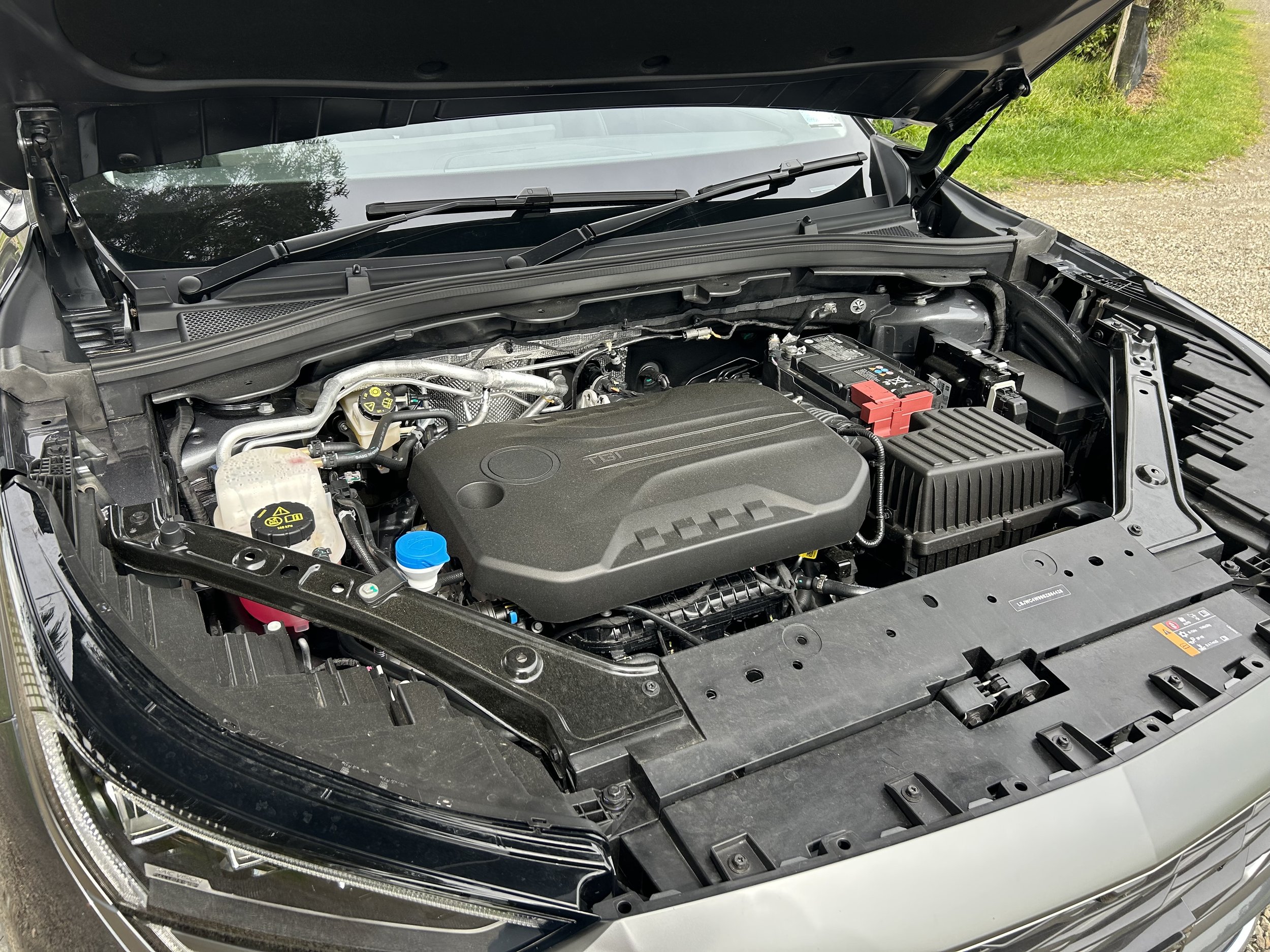
Also, it doesn’t dollop the latest in drivetrain tech. As much as a nine speed dual clutch transmission is decent, MG is a brand that has embraced electrification pretty much across its entire family here. The QS stands out as being the biggest car that doesn’t have any of that. Motivation arrives from purely petrol powered turbocharged 2.0-litre four-cylinder.
This furnishes via all-wheel-drive in the Essence, front-drive in the entry Excite, and in either you get decent but not dramatic impetus. Such is the way, of course, with most modern MGs; this is a brand that has some sporty cars, but in the most seeks to sell to an audience that wants value more than verve.
The QS is an exemplar of that ethos. Everything in this instance in spect to the driving demeanour is a touch measured.
The engine is in this format hauling 1994kg even before the seats are filled; you get decent but not outstanding acceleration and it’s not a car to chuck into a passing lane without careful consideration for the circumstances.
All the same, if you’re one to keep an eye on the fuel gauge, rest assured the engine even when it feels taxed doesn’t seem to be a huge drinker, something of a relief given it prefers a minimum of 95 octane in its 65 litre tank.
The driving feel in general is also in tune with the kind of duty it is most likely to perform. You find it’s an easy car to park, given its size, but that there’s not much in the way of feedback from behind the wheel.
One of the tangible dynamic benefits of stepping up to the Essence are the adaptive dampers, packaged as Electronically Controlled Adjustable Suspension. Tuning is tied to the driving modes of Normal, Sport, ECO and Custom.
Naturally, Normal offers the most compliance but even Sport isn’t too uncomfortable; you notice a touch more road noise, though. That mode shouldn’t be misconstrued as an invitation to go bonkers.
The limitations of the tuning and of the car’s sheer size and substance are pretty clear when you reach more serious imperfections in the road. Try to trigger that old MG spirit at your peril. Corner it with enthusiasm and, if passengers are aboard, assuredly they will let you know, hopefully from urgent yelling rather than yodelling. Because upchucks are the worst of the worst to clean up, right?
MG also hints at this model having some degree of off-road talent, but if you took it there it’s be on understanding the tyres aren't right, that ground clearance is semi-generous at best and that even the specific modes for off-seal AWD are probably pretty limited. Everything suggests a big day out could end badly.
Drive it with consideration to what it is and, chances are, it’ll seem like a pretty satisfactory choice. Restricting to that might be hard because of the way it dresses, specifically in respect to tyre and rim size.
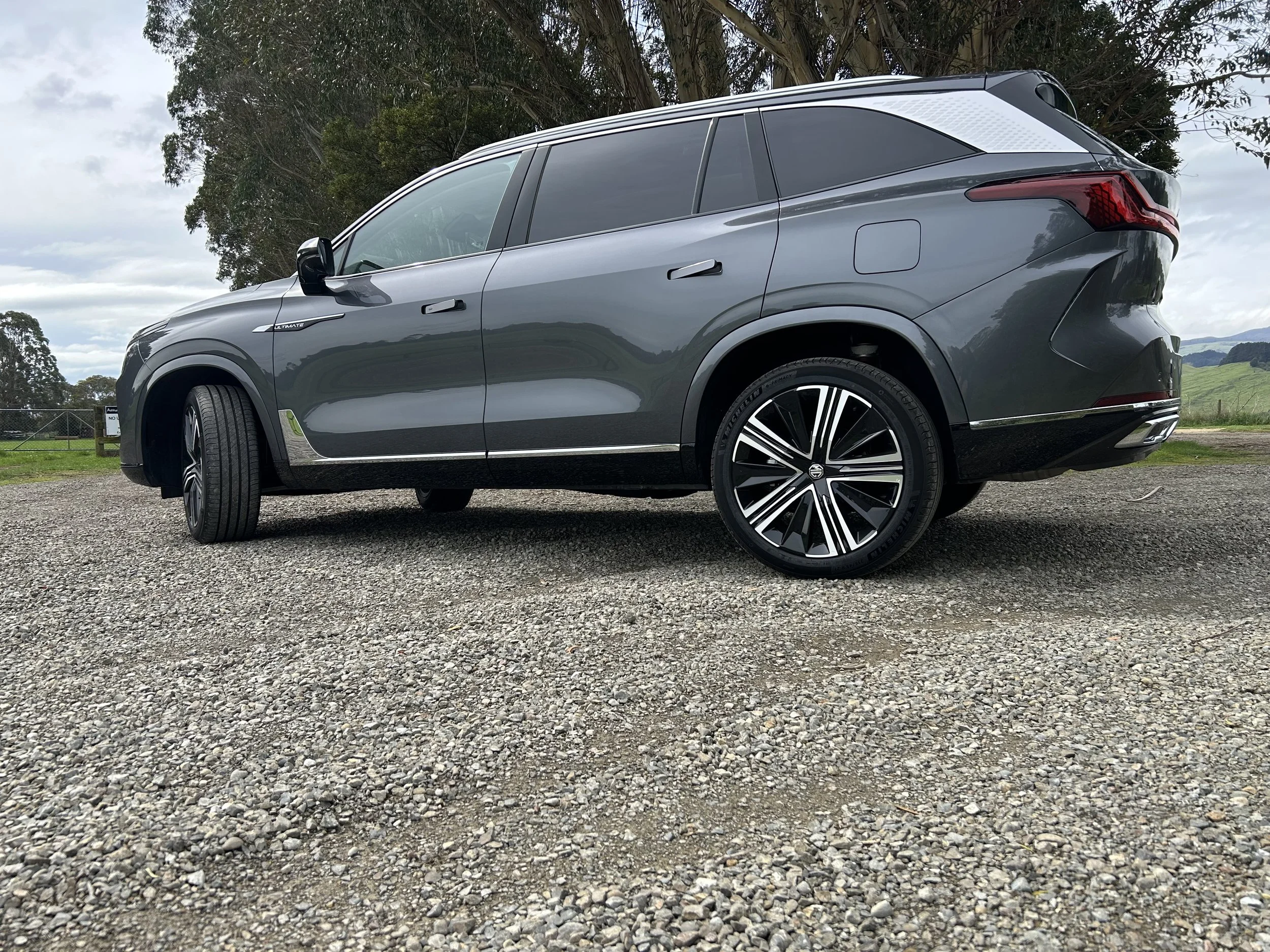
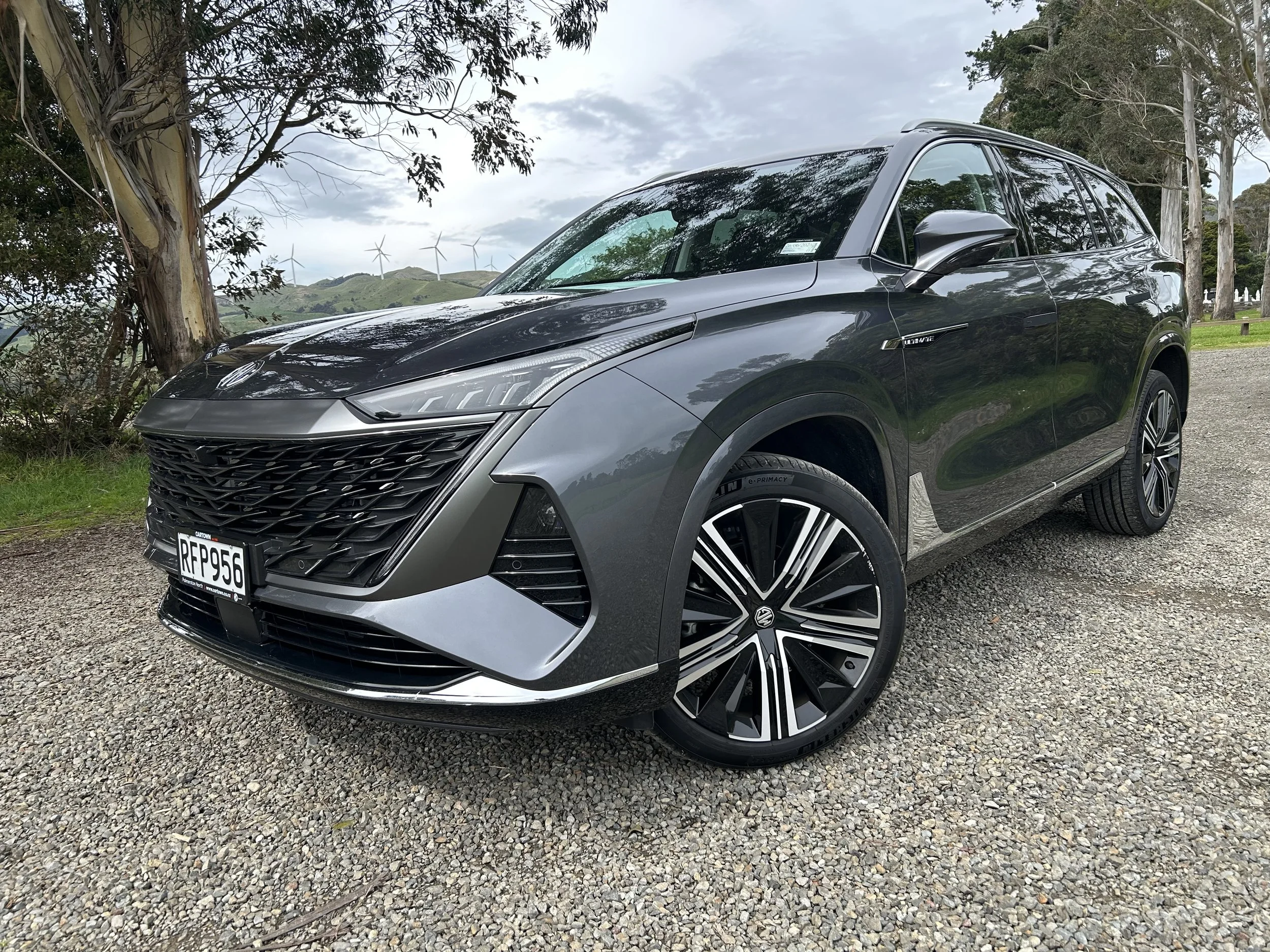
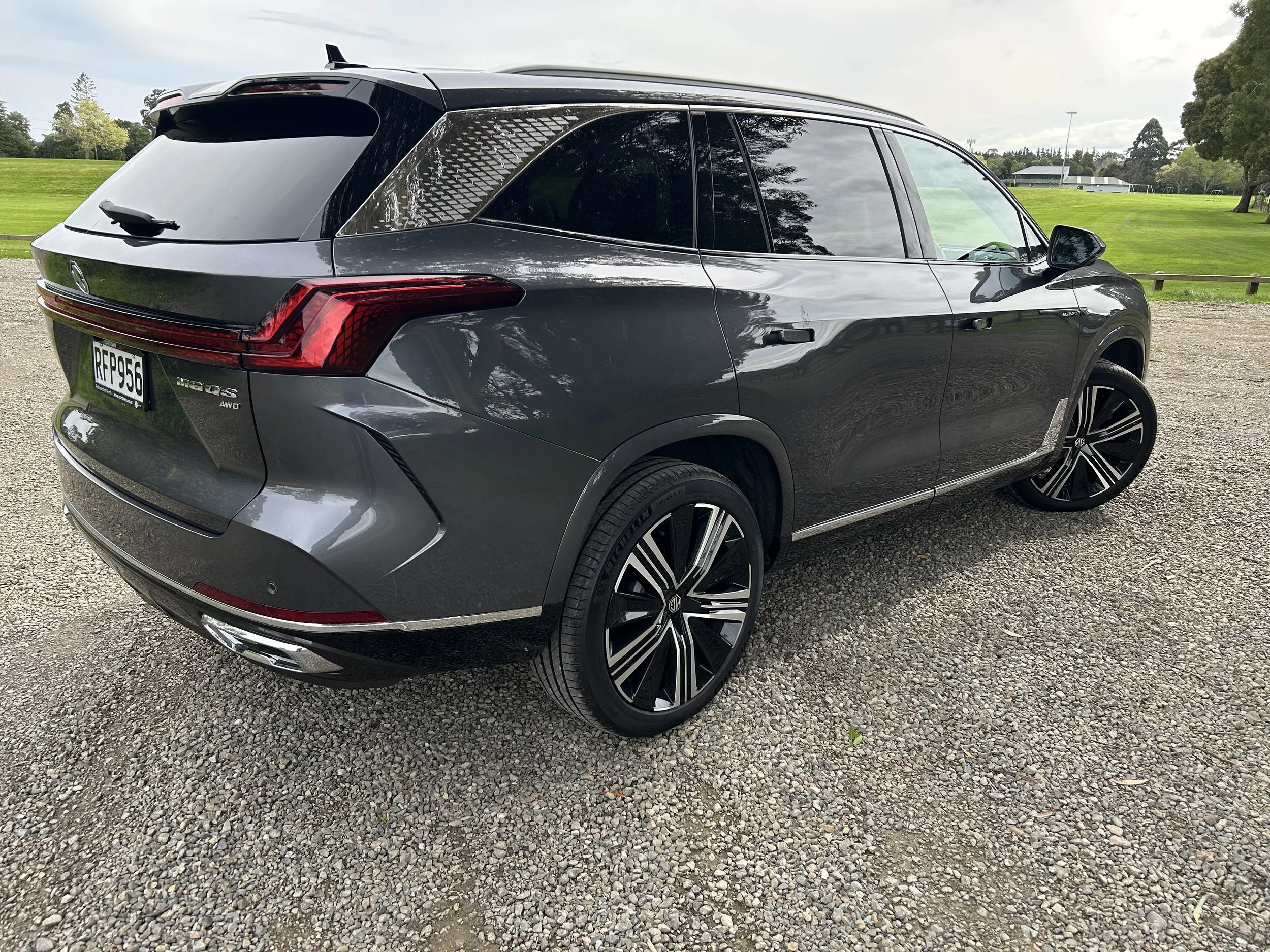
A car of this ilk being on 21-inch alloys isn’t unusual, but generally it only occurs at the expensive end of the spectrum. But MG not only treats it to a good-looking style but shoes it with high-quality Michelin rubber.
Again, how they do this for the price, I do not know. But it’s a generosity that ties well with the chrome accents, LED headlights and taillights as well as the integrated rear spoiler. If you’re a fan of fake exhaust outlets and pop-out door handles? It has those, as well.
The car’s driving characteristic reminds it’s a big rig; not only longer and wider than the Highlander, Sorento and Santa Fe, but delivering a larger wheelbase as well, but the benefit of all this shows when you open it up.
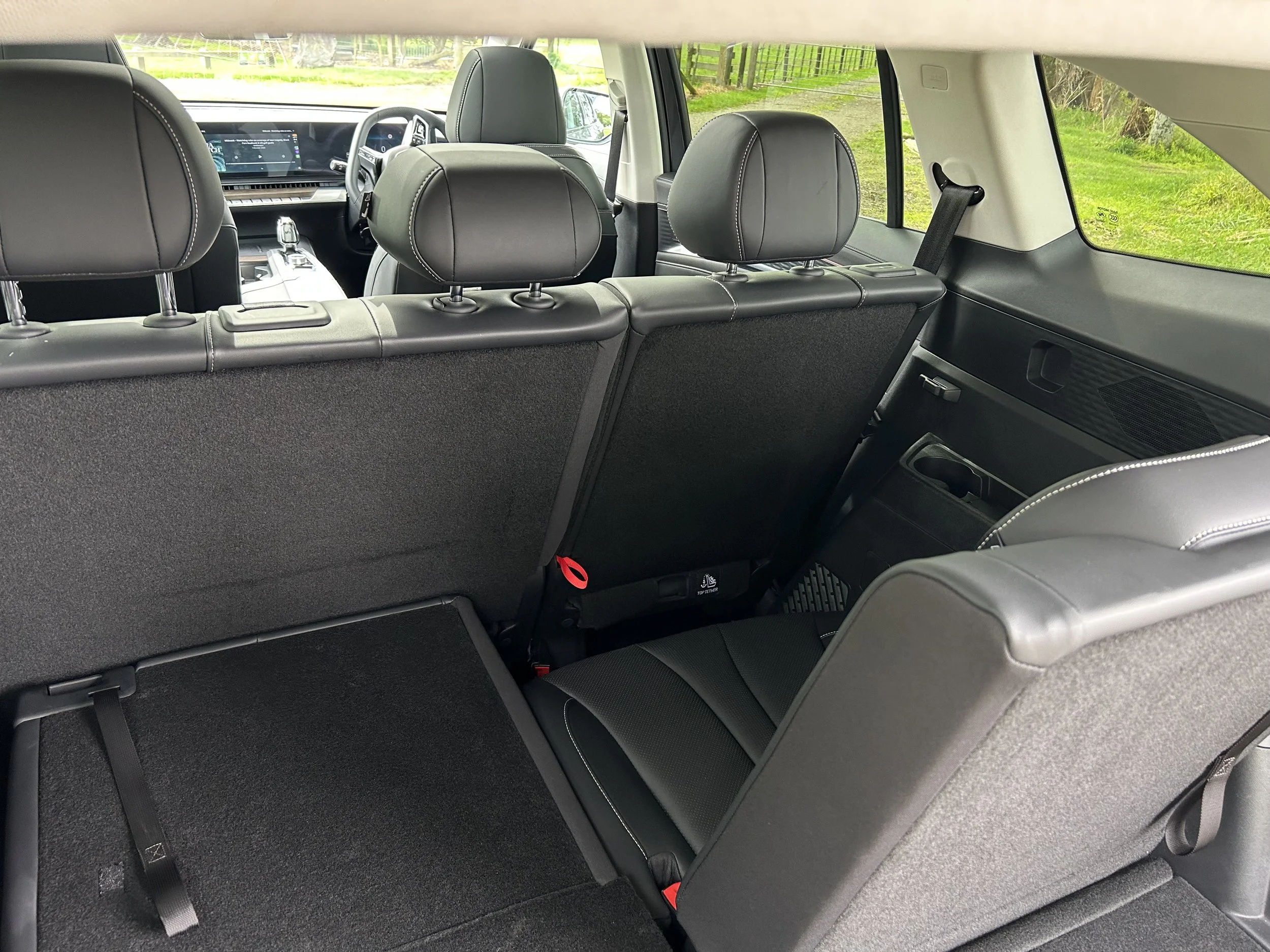
The room in the second row is impressive, but what it also delivers well is a considerate third row; it seems genuinely able to accommodate adults – both in terms of head and legroom.
The middle and front rows are, of course, better still. The mid bench can slide forward or aft, as well as recline, and offers very good head and legroom. One glitch from it having started out as a China (so left hand drive) market car is that access to the third-row seating is easier to the road than the kerbside.
A panoramic sunroof, with a shade for those hot days, is part of the kit and helps with the cabin’s airy ambience.
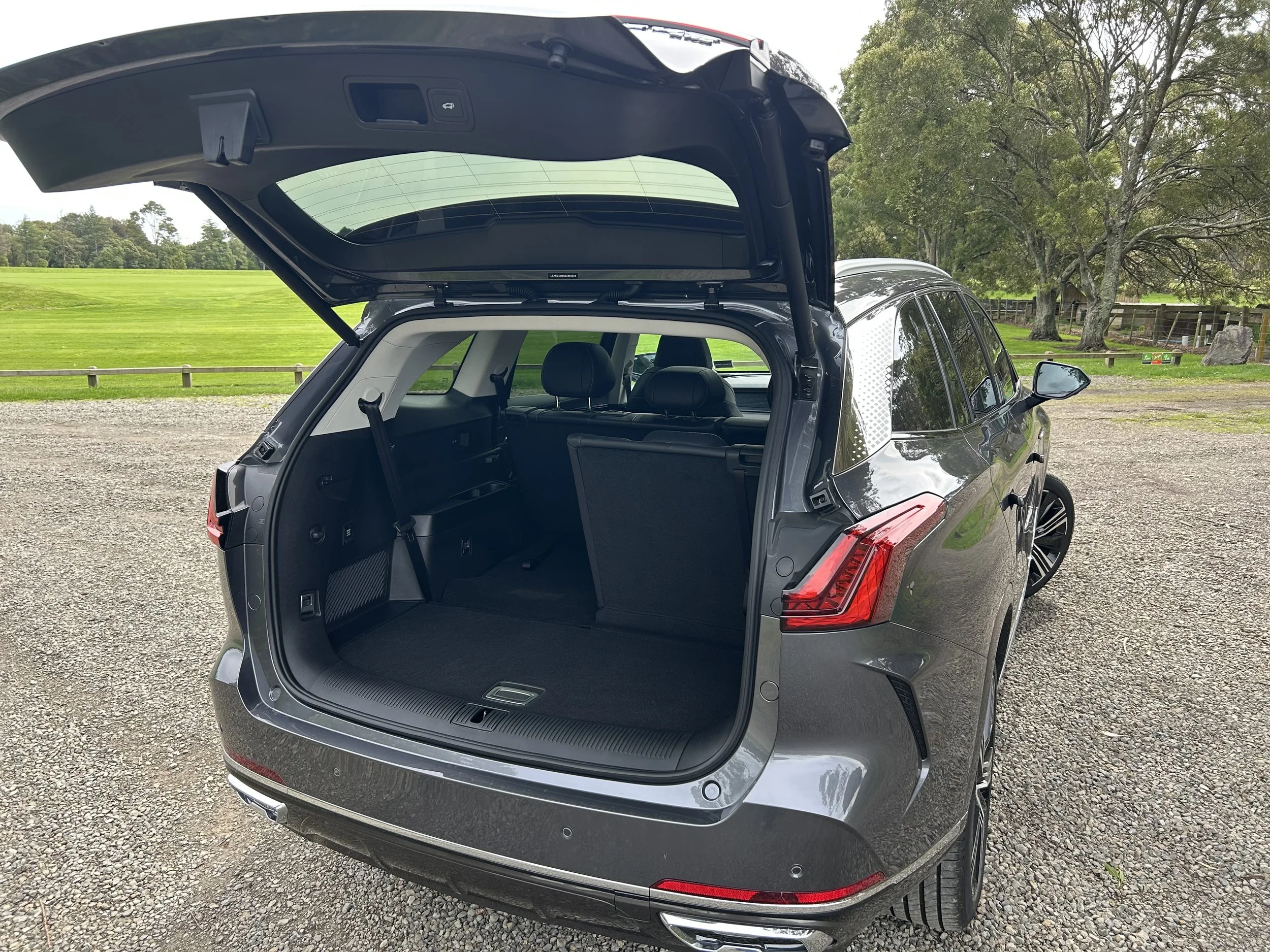
Cargo capacity with all pews occupied falls back to 203 litres, but just stowing the third row expands that to a highly convenient 517L; in that configuration it’s a good size - and nice and square and practical. Go all out at a maximum of 1052L is available. When everything but fort front chairs are stowed, you have a carpeted van in which there’s a dedicated place for the cargo blind as well as clips to keep seatbelts in place.
A plethora of general storage ideas raise its family function status. The cubbies will ll need checking to ensure they’ve not become stowage spots for discarded sandwiches etc. There are lots of cup holders set to filled with who knows what.
A colleague along for the ride pointed out the release for the centre console bin is located right where the driver’s elbow can rest, raising risk of the lid popping open when you hadn’t intended it to. Maybe that wouldn’t be an issue for left hand drive. In respect to that side of its development path, the indicators remain are on the left and the USB ports up front are to access from the ‘other’ side of the cabin.
The space and convenience aspects of this cabin will make it great for school bus duty but, as suggested, would you really like to see it despoiled by little Tyson and Tiffany?
At this spend, you’d anticipate buying synthetic leather so to find that the major surfaces achieve genuine cowhide is a surprise. MG did constrain itself in that the ‘woodgrain’ patently isn’t.
But it’s a nicely trimmed interior and stacked with good features. Those seated aft of the front chairs achieve ceiling-mounted air vents and their own climate-control zone, plus there’s great LED lighting, coat hooks, map pockets, central arm rest, USB ports and myriad cup/bottle holders.
As an older MG, it retains more physical controls for things like fan speed and demister, which is a good thing, though it’s not so old as to miss out on a big curved display sitting proudly within the dash and another for the infotainment. Being 12.3-inch screens, they’re both on the large side.
The QS hasn’t been tested by our independent safety auditor ANCAP, but is well equipped. There are seven airbags as well as ISOFIX and top-tether anchorages for the middle row and active safety elements span autonomous emergency braking (AEB), active cruise control, lane departure warning with lane keeping assist, blind spot monitoring, driver attention monitoring, road sign recognition, rear cross traffic alert, parking sensors and 360-degree cameras with a 3D view.
It’s rare to test a China brand car and not be disappointed by the tuning of the driver alerts and assists. The QS continues to hair-pulling theme.
One quirk here that really annoyed was that the camera whose job is to read, and alert to, speed signs is confused by suggested corner speed limits as well; so if you come across one advising it’s best to take a bend at 75kmh, and are driving at 100kmh, it gets rather excited.
If you attempt to disable or at least quieten down the audible warnings, you raise the ire of the attention monitoring which is even more strident. The active lane keeping angel is also demonic in this respect. The ‘intelligent speed limit assist’ combines speed limit recognition with a “you are going over the speed limit” verbal warning. Just want you don’t need to hear when your mission is to get a load of screaming young ones to play centre ASAP.
If driving alone, you’ll want to take time to scroll through the menus and deactivate as much as possible; a laborious task because there prompts are slow and also some alerts are confusingly labelled and appear to require several steps to get them fully and properly off.
At least until the engine is turned off. Whereupon all the electronics revert back to bleeping, bonging and Brit-accented speed warning def-con madness.
But small potatoes, overall. The QS makes positive impression for plainly being a pretty good deal for a very decent price.
Though it doesn’t deliver the latest MG tech under the bonnet - which might well change, with talk it’s due to be hybridised - and regardless it really doesn’t better any of those other cited competitors in any way - if anything, on performance it falls behind - overall this family bus still stands out because really doesn’t cut many basic corners.
You can imagine how it might suffer from the mischief of evil little fiends. If that’s the cost, at least you’ve come off cheap.