Chevrolet Corvette E-Ray roadtest review: Wired for speed
/Going mid-engine was a big thing for America’s most muscled sports car. Engaging electric with a side of all-wheel-drive? Just as momentous.
How much: $285,000.
Powertrain: 6.2-litre petrol V8 with 119kW/169Nm electric motor fed by a 1.9kWh lithium ion battery, 488kW/806Nm combined, eight-speed automatic transmission, all-wheel-drive.
Dimensions: Length, 4688mm; width, 2025mm; height, 1234mm.
We like: Massive thrust; all-wheel-drive a positive; clever engineering.
Not so much: Electric motor tone too obvious at times; challenging ergonomics; poor rearward visibility.
SEVEN generations of Corvette were old school - it took the C8 to bring this American legend into today’s world.
Now the car that came of this age simply from going mid-engined, and thus becoming the least ‘Corvette-like’ Corvette since the car’s inception, is looking to the future.
If you think that abdication from the front-engined, rear-wheel-drive formula that served all seven preceding generations, back to 1953, was no small thing, consider the ruction the E-Ray is likely causing.
You’d think credential as the most powerful version ever to come out of the factory for road use would put this version on a pedestal.
But there’s just one catch. If not two. As well as throwing in electric, this model also introduces another all-new to the buyer: It’s also all-wheel-drive.
This wasn’t a full road test. There was no chance of securing the car for even one night, let alone the usual period of seven days. All I had was a couple of hours.
But even that was insightful. A couple of years ago I drove the C8 in its initial fully fossil-fuelled V8 Stingray. Thought then was that the utter revision in design and engineering emphatically made for a decent car.
Now the E-Ray. It’s another level again.
The name is a giveaway to what’s going on. As said, base Corvettes are Stingrays.
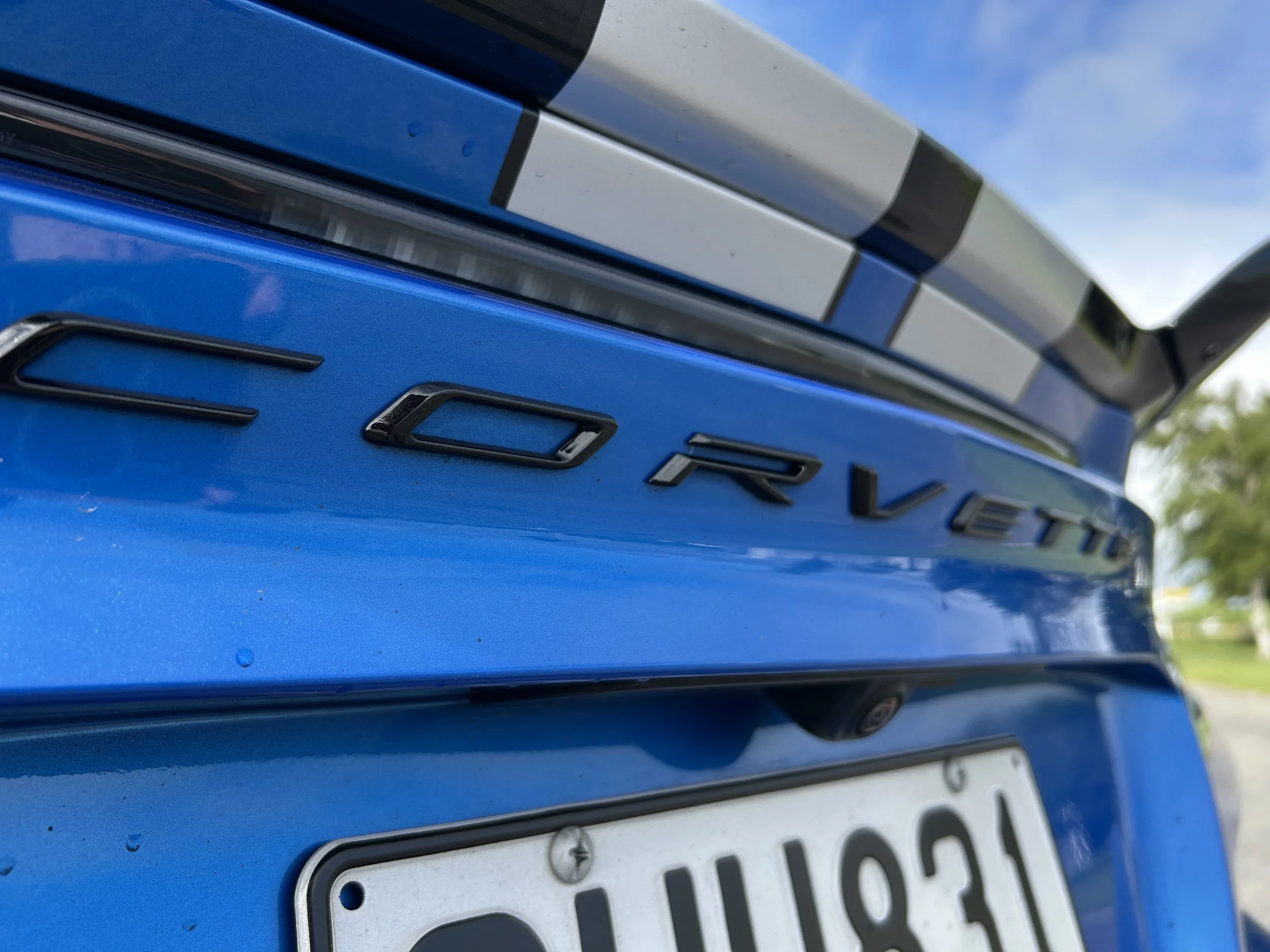
E-Ray is an actual sea creature – hence why the car has a ray-shaped badge on the boot lid – but it’s also a play on convention.
You’d think GM would have saved the e-name for the full electric (still in the future, but coming) rather than the one that adds self-replenishing (as opposed to plug-involved) electrification to the 6.2-litre V8 that sites in its fully pure form in entry 2LT and 3LT derivatives that have been here for several years already. But they haven’t.
As is, the car here is a bit of a parts bin creation. The genetic makeup draws both from the base Stingray and the ZO6. The Stingray donates its pushrod V8, performance exhaust and eight-speed auto. The ZO6 lends its wider body, wheels and tyres and carbon-ceramic brakes.
And then they added the electric bits. What kind of machine results?
Experiencing the performance and the driving feel is quite a thing. Time flew, yet almost every minute was special.
First, the grunt. Officially zero to 100 kilometres per hour is in 2.9 seconds.
On paper, that puts it at second pegging to ZO6, which is either way the fastest pure petrol out of the Bowling Green, Kentucky, plant. A 3.0 seconds time is credited to that monster. Independent checkers have been dubious. But in a good way. They say it is actually good for 2.9s. So, lineball with the official figure for E-Ray.
But … the Z06 is lighter than the E-Ray. On the other hand, with 475kW/595Nm its 5.5-litre V8 outputs 13kW and 211Nm less.
Again, plenty of independent testers have proven the hybrid is reliably faster than its maker says. They say it is a 2.5s car.
The touch paper moments will also be different. E-Ray just loads up, hunkers down, then blasts off. A touch of tyre squeak, but no wheelspin.
All being given to impetus makes it incredibly brutal. For first taste, I simply ran the car off the line in its everyday settings, then repeated in the bespoke max attack mode. Run one was thought-provoking. Run two left me winded.
The cleanness of its action also shows in the driving. I’ve driven a 3LT previously; it’s an incisive car through bends, but you need to contain the power feed else the tail will kick out.
The E-Ray is wholly different. The push from the V8 behind the seats pushing is matched by a lot of electric pull from up front, so there’s heaps more traction. It’s not quite like a high performance Audi quattro, but in the short period I had the car, it straight away felt less intimidating; smoother, too, in its power delivery.
Excellence of engineering effort shows in the steering being untarnished; it’s not as light as in the rear-drive cars, but is nonetheless well weighted and communicative. Clipping apexes is easy.
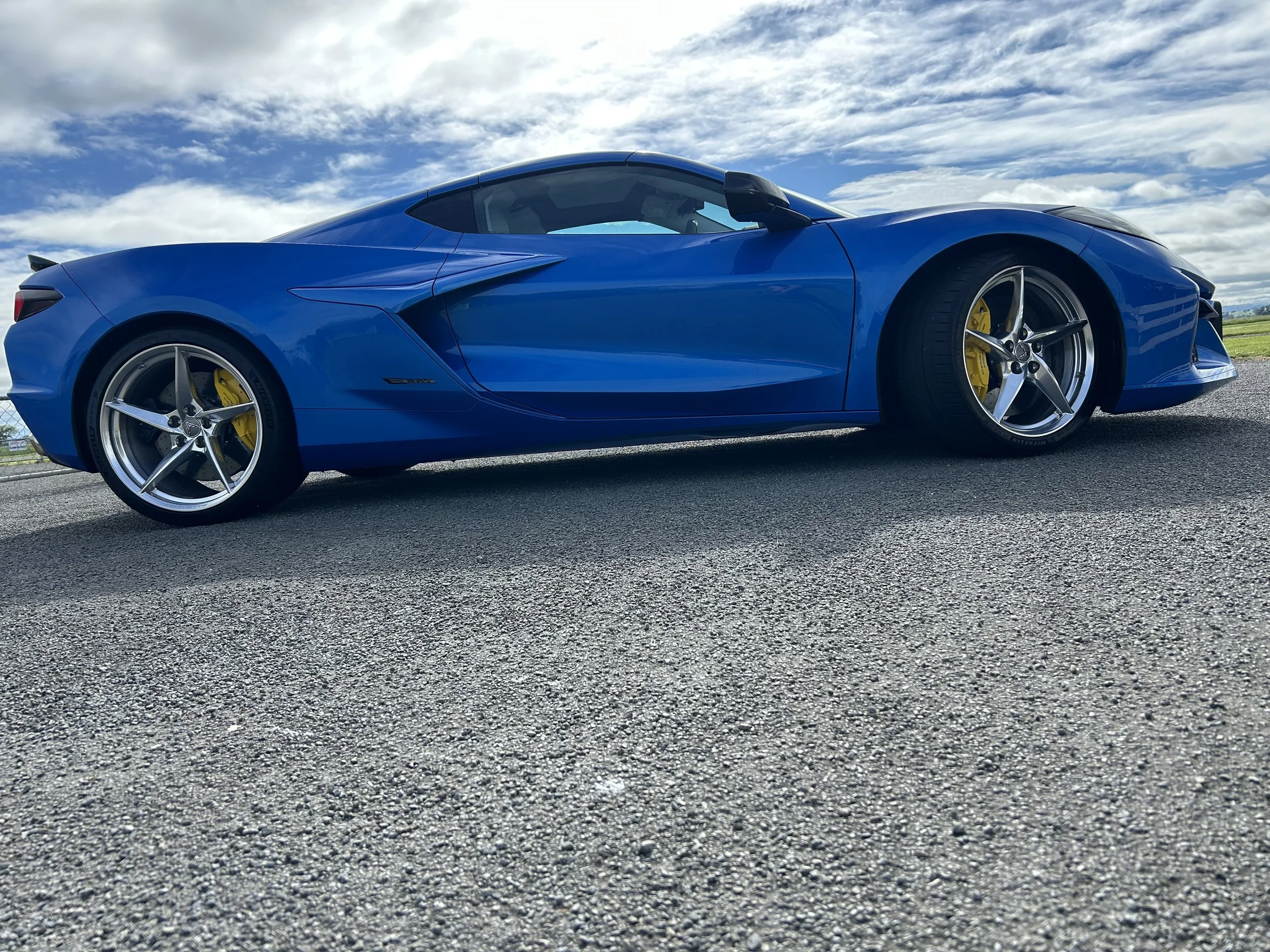
No mystery why the amount of grip seems phenomenal. It runs a set of staggered 20- and 21-inch wheels and prefers Michelin Pilot Sport or Pilot Sport 4S tyres, in 275/30 ZR20 front and a truly colossal 345/25ZR21 rear.
Packaging the drivetrain wasn’t too much of a headache as the current generation car was engineered from the outset with hybrid in mind.
Due to the battery and motor hardware, the 1712kg dry weight exceeds the standard car’s figure by 110kg.
To compensate, Chevrolet’s engineers have fitted carbon ceramic brakes and the firm’s Magnetic Ride Control 4.0 suspension as standard, the latter of which is likely to adopt a bespoke tune.
GM product planners and engineers have indicated the kilo count was a reason why the car isn’t a plug-in hybrid. Adding a charging port and additional cables and electronics to the car would have also added even more weight.
The car’s soundtrack is interesting; the V8 still lends the most strident note, but the electric side also includes noticeable shrillness on occasion; it’s a bit weird. More persistently intrusive on this particular car was some tappet noise.
The battery can only be recharged using the engine, or energy captured under braking, yet going electric allows the make to claim some environmental cred, though it cannot crow too loudly. Optimal fuel burn is 2 litres per 100km better than can be eked from a Stingray.
Even from my limited exposure, there seems high potential that it won’t take any effort at all to ruin that.
Still, there’s enough coming from the 1.9kWh lithium-ion battery, mounted in a tunnel that runs between the two seats, to let it travel up to 6km on electric-only power, in Stealth mode. Unless you turn the air con on. That’s enough to disengage electro drive and to bring that burly, barking V8 to life. There is also Shuttle mode that allows engine off movement, but Chevy claims it’s not for public roads.
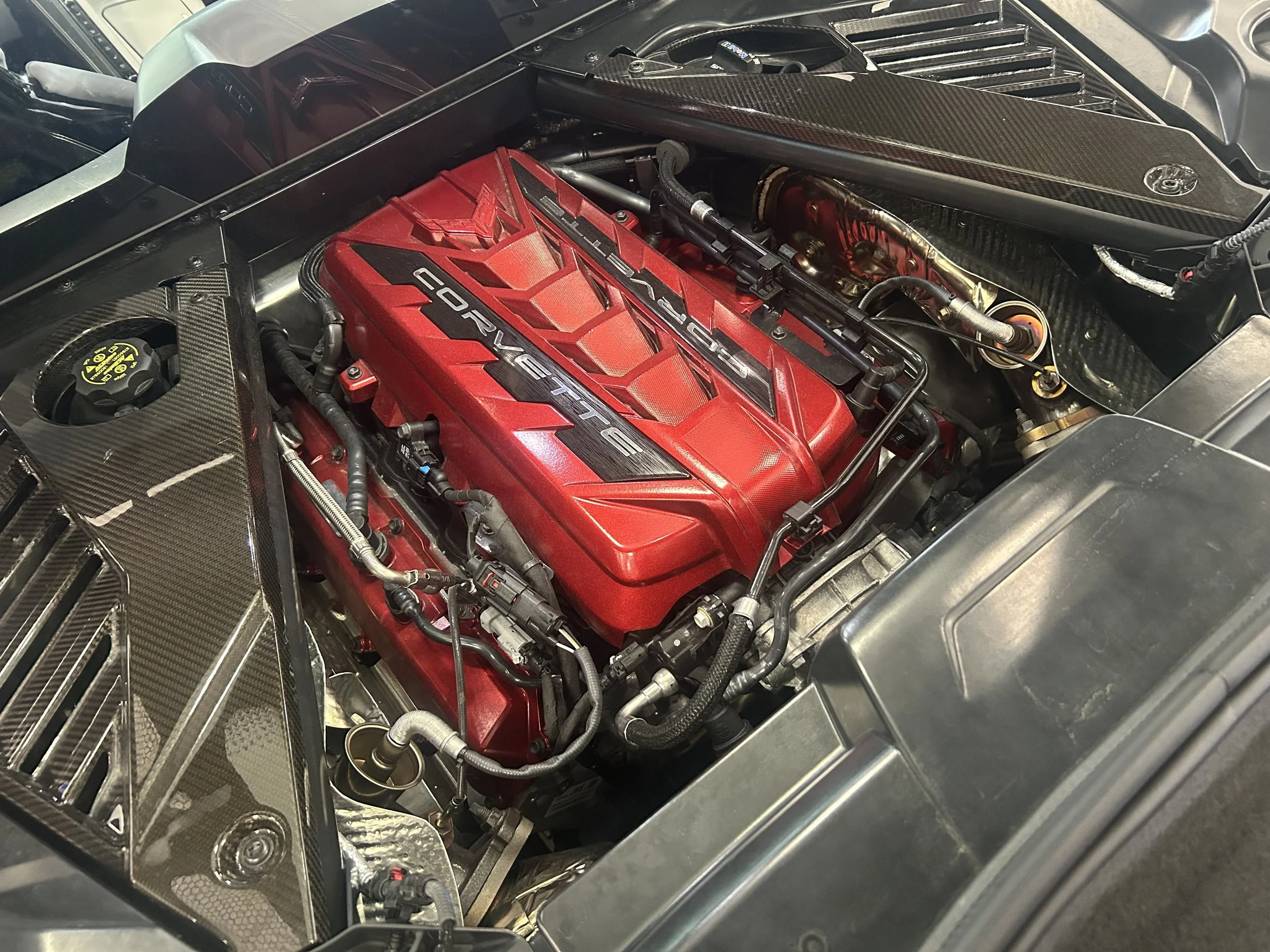
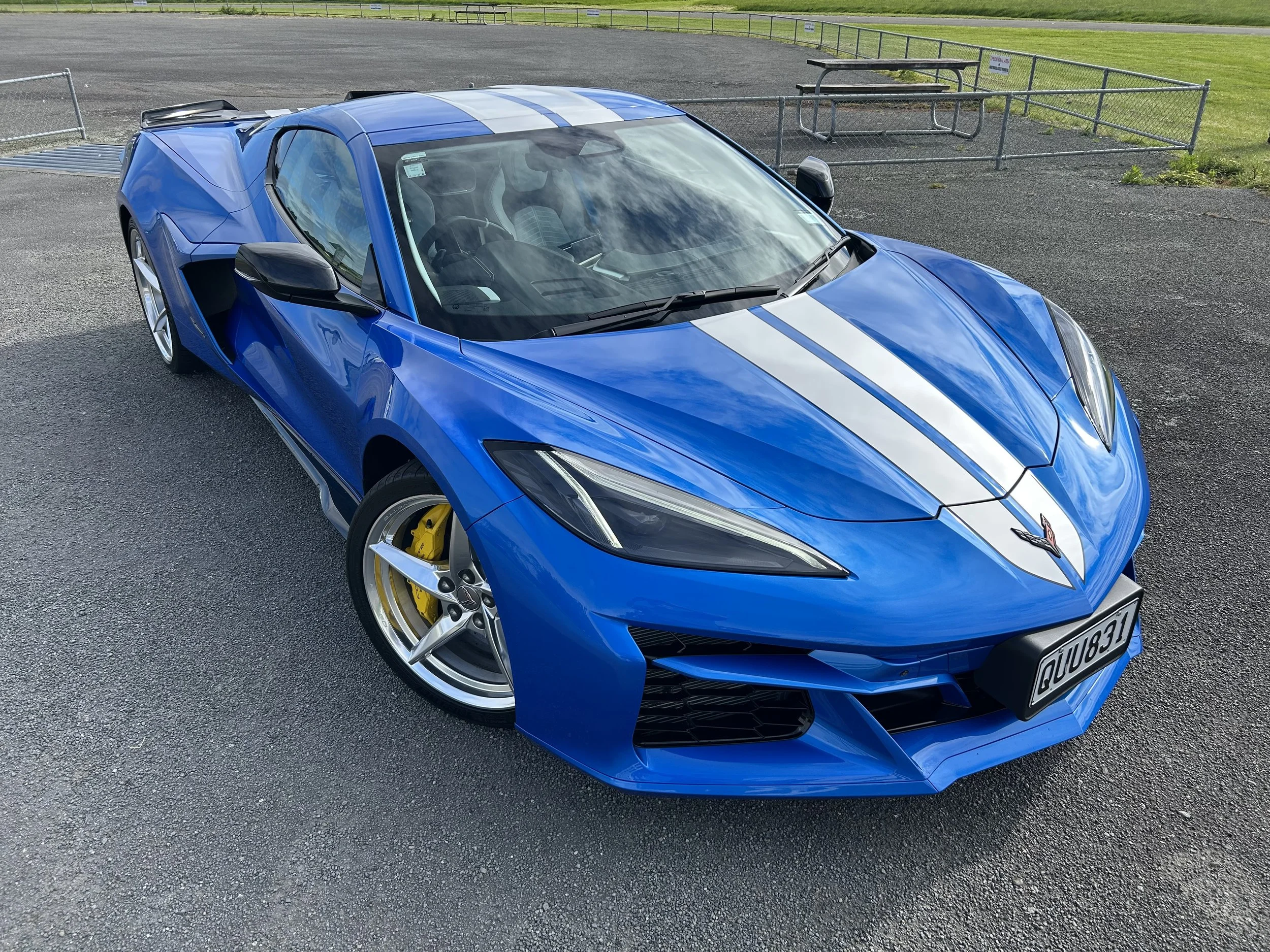
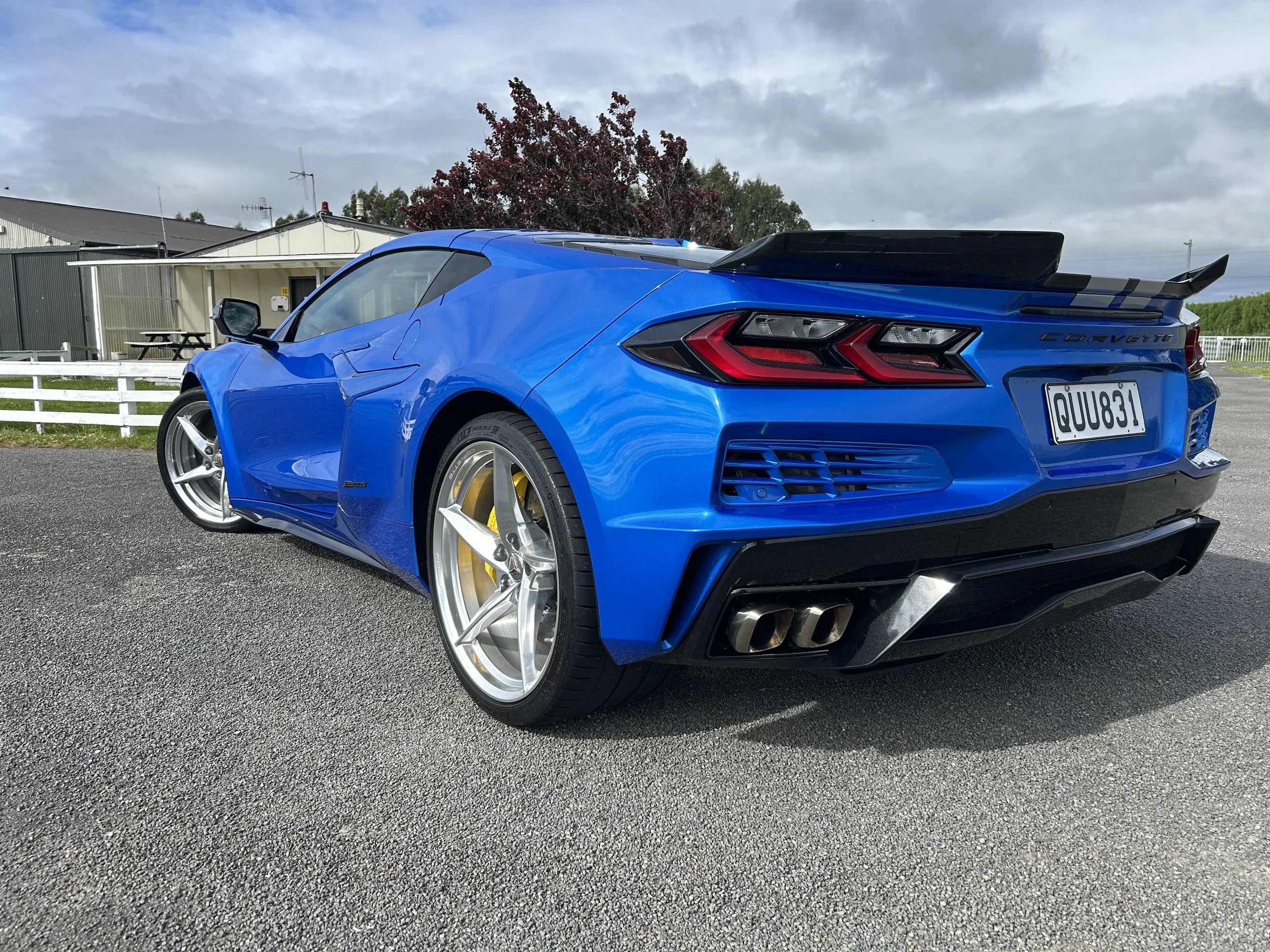
The E-Ray has a sportier body kit, body-coloured accents, and a unique rear spoiler. It gets eight-way powered leather-covered driver and passenger seats, both seats with heating and cooling functions. Carbon fibre and suede microfibre pervade the interior.
I drove GMSV’s demonstrator, a 2025 car so with the original look cockpit. The 2026 product shifts to a new layout that looks to be better. The one here has too many buttons laid out vertically on a single strip that borders the driver control space.
Chevrolet doesn’t see the E-Ray as a track car - that’s more what the Z06 is for - but nonetheless lends it a dedicated circuit driving setting, in which the hybrid system can be set for maximum short-term performance, allowing the lithium battery to use up most of its charge in a lap or two, or for more conservative, lap-after-lap use.
The car will maintain a certain minimal state of charge in case it needs to use the electric motor to help pull out of a skid, for instance. You can monitor the relationship between engine and motor with the Performance App, which delivers key driving data and telematics.
Any Corvette is not the easiest choice as a daily driver. Too low, too wide. Too enclosed. This edition being wider than a Stingray - by over 9cm - is immediately obvious For any view other that forward or out either side window, you don’t see a lot of the outside world from the regular car. You see even less out of the E-Ray. Look in the wing mirrors and all you see are crazy angled panels and big intakes.
There’s also the price. The Stingrays, in coupe and convertible, start at $192,000 2LT hard-top and top at $224,500 3LT in open air enabled form. The E-Ray is only here as a Coupe, for $60,500 than the latter choice. Of course, a Z06 is now $346k; meaning old school is even more expensive than the new way.
Those who have sampled both extremes say the ZO6 is a much more raw, borderline track-focused beast by comparison. But they also admire what Chevrolet has done.
In respect to that? Donald Trump might have it that electrification is not necessary, and that there’s nothing wrong with an oil-first and last future. But the adults in the room know that is just so much tosh from the tangerine twerp.
Tony Roma, the Corvette’s chief engineer, said his team could see the writing on the wall regarding electrification when developing this generation, knowing it would become part of the powertrain mix.
“Looking back almost 10 years ago, we knew electrification would become a bigger thing, as has become for other cars around us in the Supercar Paddock.”
The E-Ray is controversial; it’s not the full game; but it’s a logical pathway. Corvette as a pure V8 is a heck of a thing, but it’s audience prefers to dreaming about the past than look to the unavoidable future.
But, to paraphrase Charles Darwin, evolve or die. That imperative applies to cars as well as animals and plants. And especially to cars that run highest risk of being perceived as dinosaurs.