Tesla Model Y Performance road test review: Letter perfect
/The fastest version of Elon’s sales staple is genuinely grin-tastic.
How much: $100,900.
Powertrain: Dual motor, 343kW/741Nm, 82kWh battery, single speed, 580km range (WLTP).
How big: 4796mm long, 2129mm wide, 1624mm tall.
We like: Chassis tuning; carefully tempered styling enhancements; genuinely enthusiast-oriented; undercuts more expensive alternates, more fun than cheaper choices.
Not so much: No head up display; FSD-Supervised demands close attention to avoid curve ball quirks.
EVERYONE has said it, myself included.
Tesla cars deserve credit for being great technology advancements, but they do relate rather dispassionately. As exemplars of clever computing and smart engineering? Home run hitters. For having ability to stir the soul? More often, they tend to miss.
So now to with the most driver-focused version of the updated Model Y.
The Performance has more power, a significantly revised chassis, bespoke aerodynamics, a Track Mode and a few unique bits and pieces inside. Unsurprisingly, it lays down a stupendous 0-100kmh time. Which is great.
But when almost all EVs now feel spirited off the line, even a sub-four second sprint-ability surely doesn’t seem such a big deal any more. How many videos of Teslas humbling European exotica do you need to see?
In truth, there’s very good reason straight line impetus has stopped been enough to satisfy true driving enthusiasts. It means nothing.
How they stop, how they steer, how they scythe through corners … how they ‘connect’ at emotional level. That’s the key.
In that respect, the Model Y Performance presents as a big serving of humble pie to cynics such as myself. It emphatically has that ‘x’ factor I didn’t imagine was possible to implement. Don’t ask me how they’ve done it, but celebrate that it has occurred. This car absolutely and utterly registers a high score on the fun scale.
Will that make a difference? Well, let’s not forget that being a touch bland hasn’t kept the Model Y from being the best-selling electric car ever made. By huge margin.
On the other hand, there’s the whole head versus heart thing. EVs make sense, but how many hit a sentimental chord? My personal carpark of keepers is pretty small. If I could, I’d love to have a VW ID.Buzz, Audi’s Q6, the Hyundai Ioniq 5 N and the original BMW i3. Would there be room for this Tesla? Yes, I think there might.
The Performance side resonates, of course. But on that measure, it’s not as visceral as that Hyundai; laugh all you like about the concept of synthesised shifts and sounds, but when you try the Korean product tell it me it doesn’t get under your skin?
But while the Y doesn’t have that element of involvement, there’s really something about it that made it the Tesla I’ve so far enjoyed most and determined to be the one that was hardest to say good bye to.
The basic bones are good. A comprehensive overhaul for the Y just over a year ago has been hugely beneficial. The exterior update that radically altered the front and rear of this design did much more than enhance the aerodynamics. It also made the whole look far more palatable.
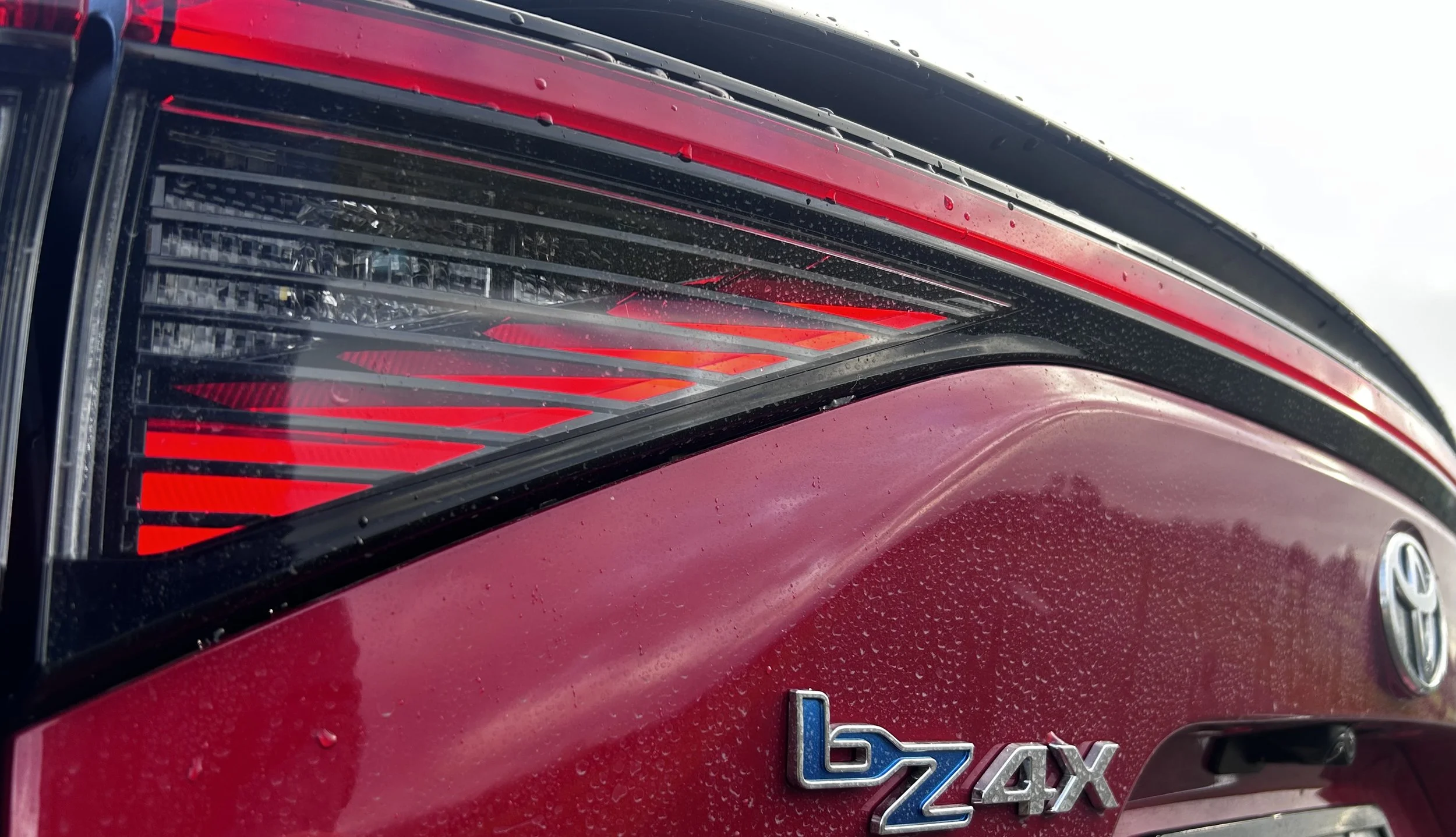
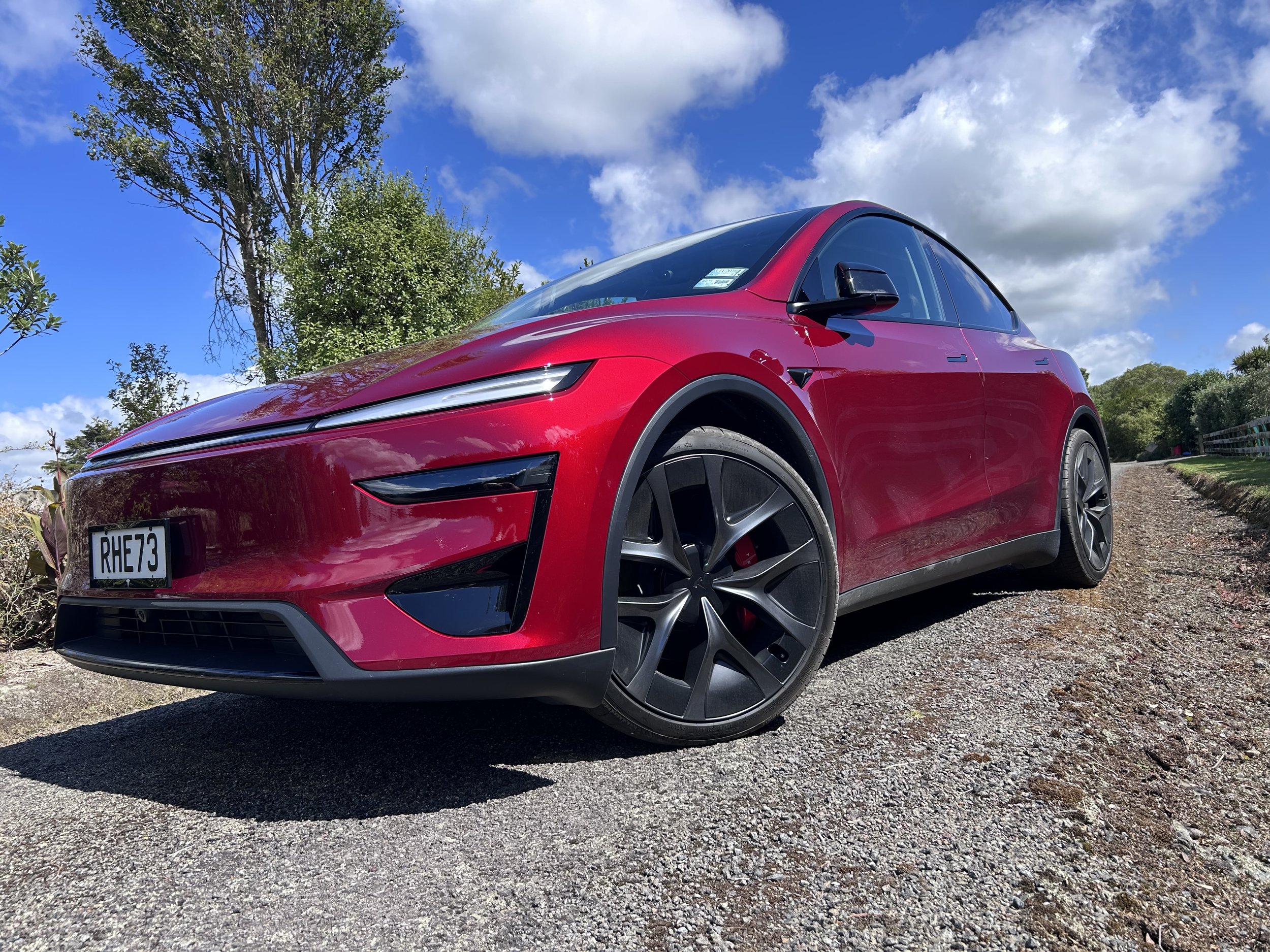
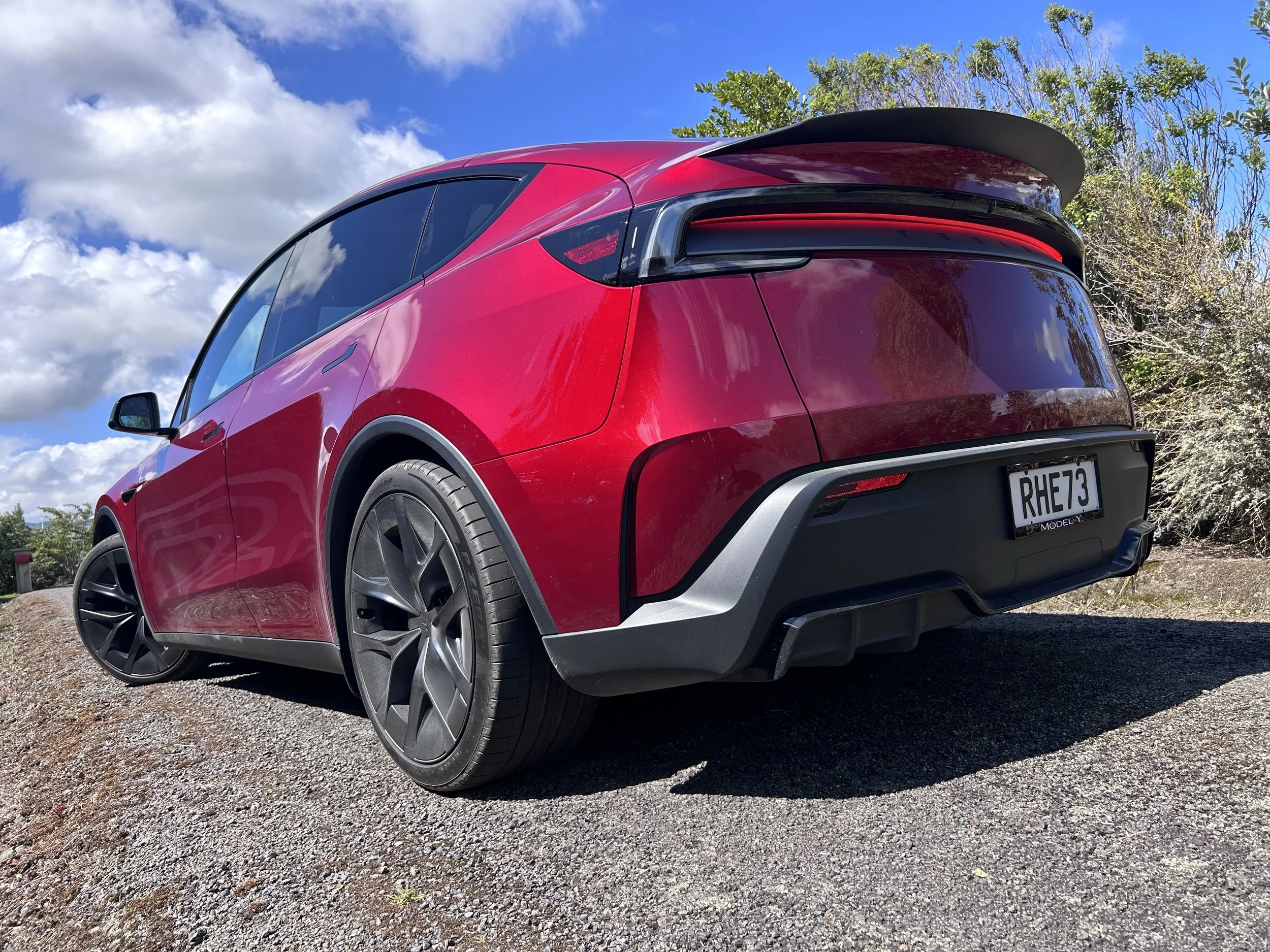
It’s unmistakably a Model Y, still with frameless windows and those infuriating flush door handles of the original, to maintain the clean, minimalist aesthetic. But the new nose and reshaped rear are much more pleasing to the eye. Modern LED lighting front and rear also sets the newer car apart, the indirect red glow at the back is a small but highly appreciated update.
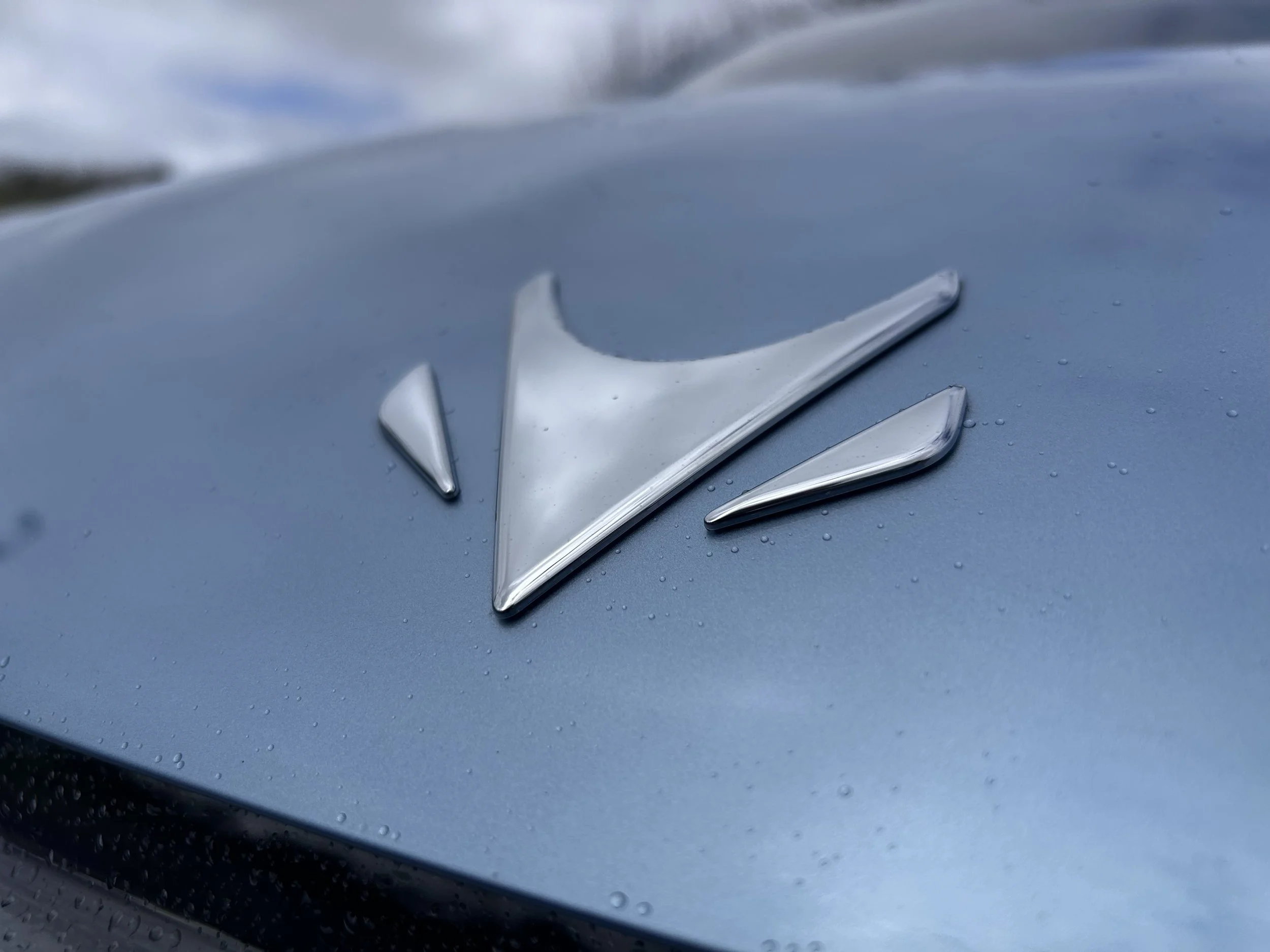
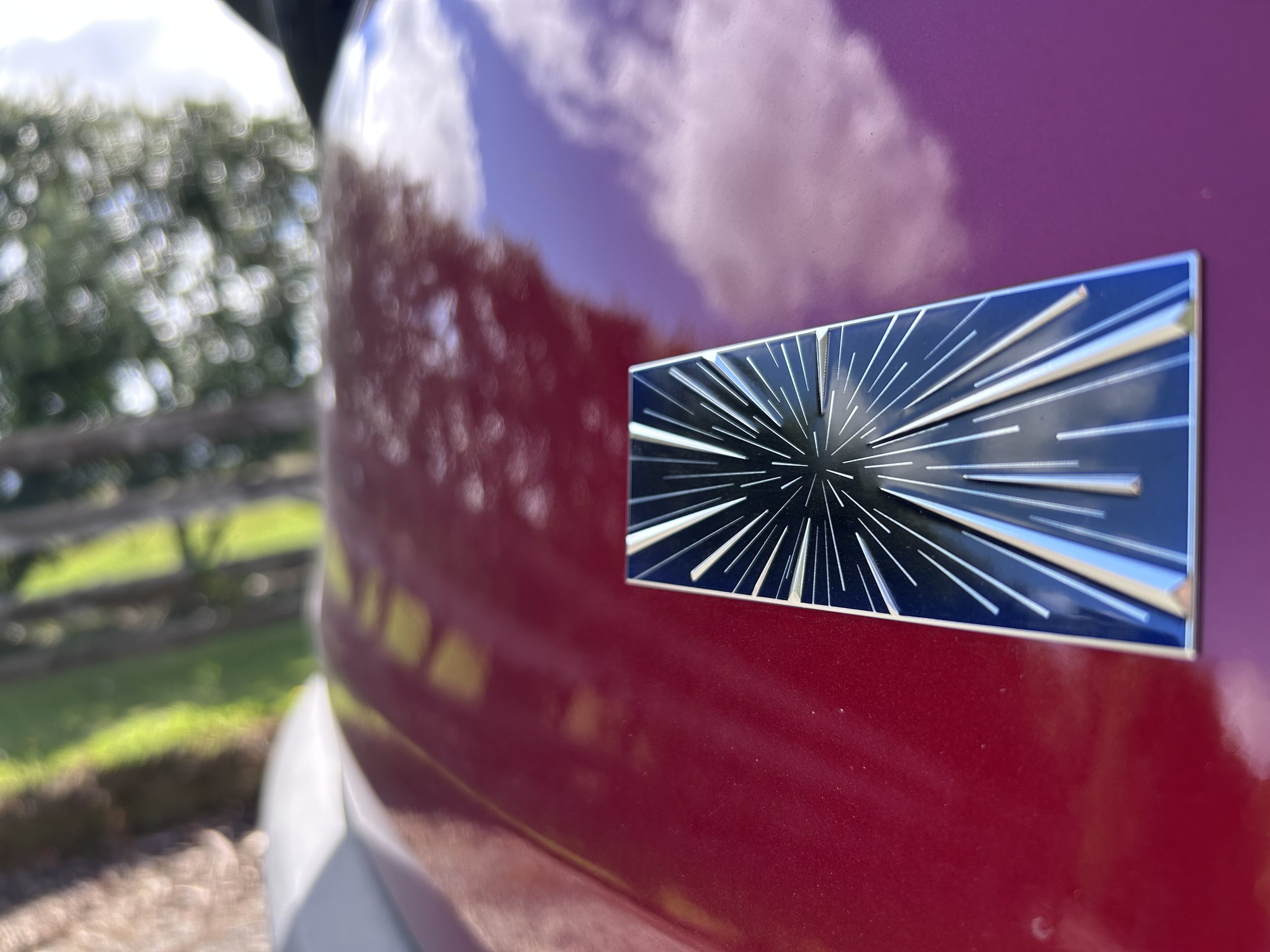
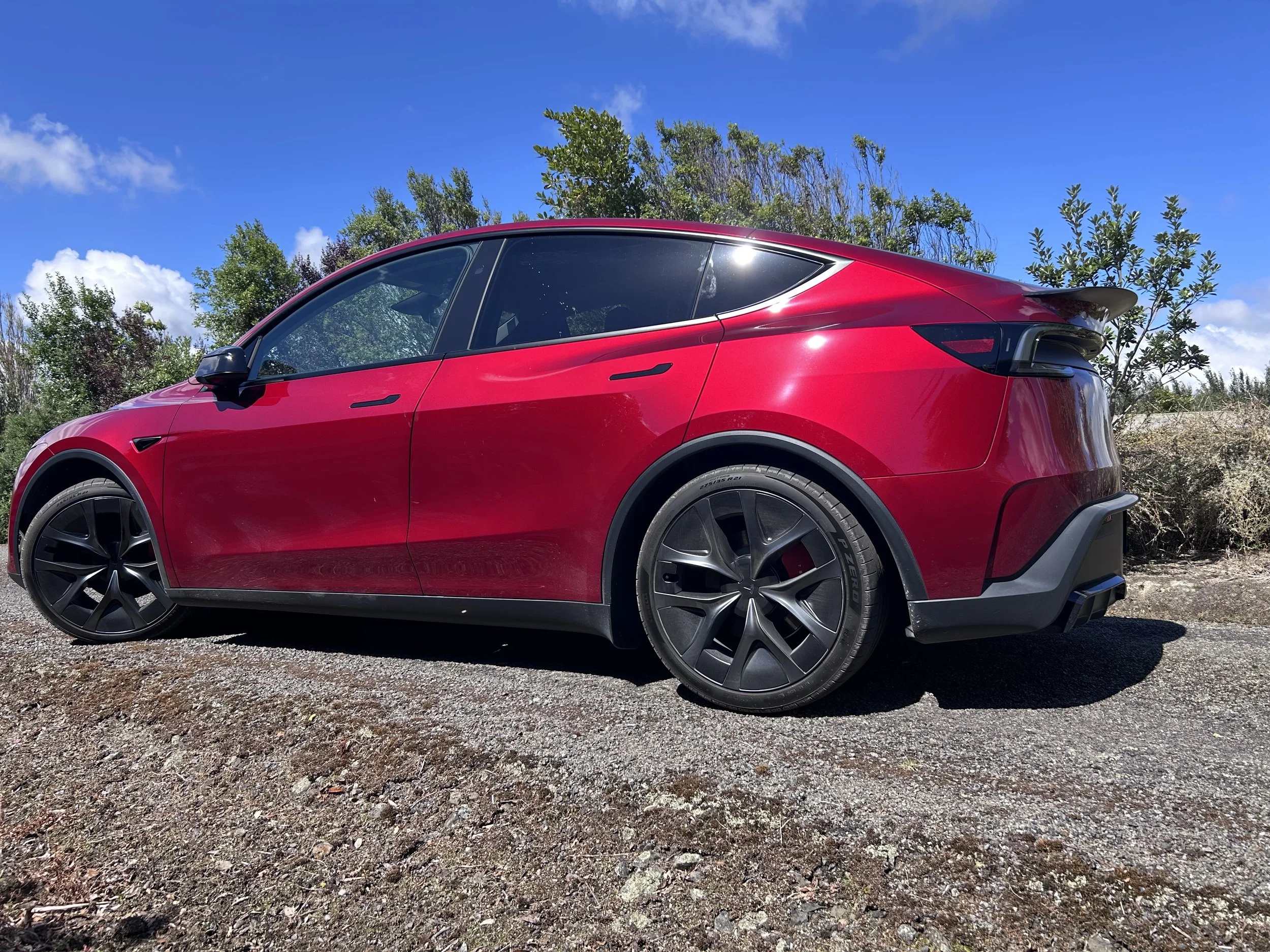
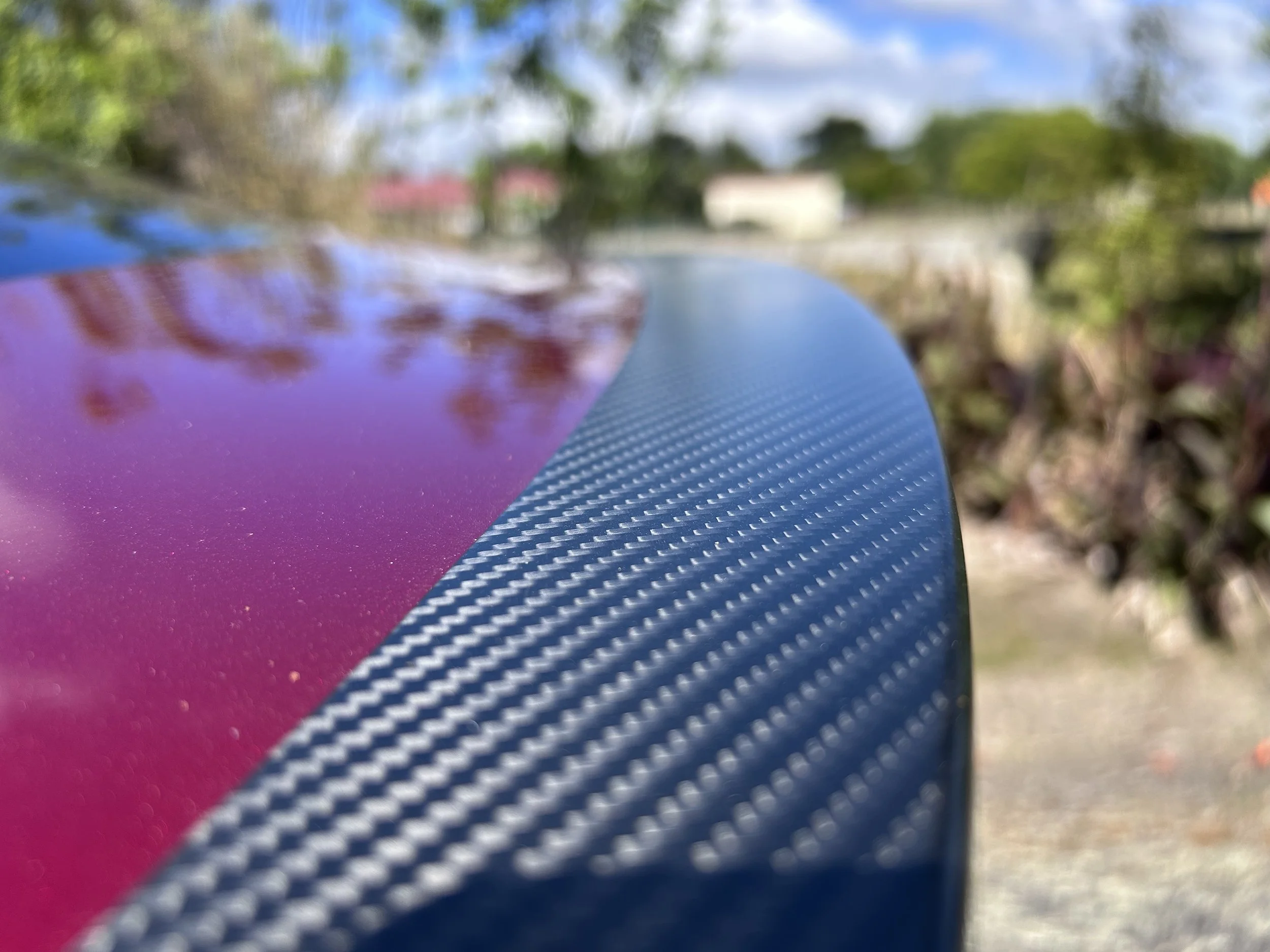
The Performance is clearly sportier in look than that standard car. The 21-inch forged ‘arachnid’ alloy wheels shod with serious 255/35 front and 275/35 rear Pirelli P Zero tyres are exclusive to the variant, work with the lower ride height for a notably more muscular stance. But the overall effect is subtle, to extent you have to look a bit closely to see there’s a small boot spoiler, surprisingly wrought from real carbon fibre. The type also takes a more pronounced rear diffuser, a new front bumper as well and the slightly weird Performance badge that seems to represent an exploding star or a hyperspace moment. It’s a bit too Star Warsy for me.
There isn’t a lot inside the Performance model to set it apart from others in the lineup. Carbon fibre also intrudes, but as a sliver across the dash, and it also achieves some nifty ambient lighting effects lighting not meted in the mainstream models.
The Performance uses a slightly larger touchscreen than lesser Y/3s and even though it uses the same software as those others, the presentation seems just that little bit smarter and easier to navigate than some.
As per this brand’s promise, it is stacked with more features than the usual trove - Tesla includes apps like Spotify and Netflix – perhaps in hope you won’t notice it lacks Apple CarPlay and Android Auto because …. well, it’s a Musk thing.
An ‘Elon element’ that annoys even more than not being able to use my favourite phone app as I want to is the lack of a speedometer or a head-up display in front of the driver. Instead, the speedo is located on the driver’s side of the screen, but you have to look downwards off the road to see it.
I’ve driven enough Teslas now to have become used to this, but it doesn’t mean I like it. Likewise, I’m uneasy with how Teslas are just a little too dependent on their touchscreens. It’s a trend that has taught a lot of Chinese makes too many bad habints. Yes, there is voice control, but none of that makes up for the lack of physical switchgear.
The front seats are ventilated and in a sports style that will be welcomed by those keen to take its stomp through the bends; with beefier side cushioning and a extension allowance for the cushion, you don’t slide around as much as with the standard chairs.
Rear seat occupants seem to achieve the same bench seat of the cheeper editions; it’s quite sculpted - to the benefit of those sitting in the outer two positions - but whoever draws the centre seat will find a narrow, raised and not very comfortable perch. Occupants get a 8.0-inch rear touchscreen that controls the rear temperature and also features apps.
Just as noticeable are all the revisions made with the mid-cycle Juniper revision. So, softer plastics, more suede, sharper the seat controls.
The Performance has the same enormous - 938 litre seats up, 2022 folded - boot capacity as a regular Y; Juniper has brought ability to raise and lower the seat backs electrically. The front boot adds another 117 litres of space, and it now features drainage.
All these elements remind why the Y not comfortably outsells the Model 3; simply the sedan it bases off is there less practical car. All the same, at Performance level, there potential for debate about whether the sedan is better, simply because it is basically as fast yet costs a lot less.
It’s hard to argue against that logic. The ultimate Y is pretty decent in nailing 0-100kmh in 3.5 seconds (so, 1.3 seconds faster that a standard dual motor) and drawing 580 kilometres’ range from the 83kWh battery, yet Tesla data suggests the sedan is 0.4s faster to 100kmh and has a slightly higher top speed - 262kmh versus 250kmh. Where it lapses is for range. Despite being more aerodynamically efficient, the sedan delivers a max 528km under the WLTP cycle.
There’s some question about the motor outputs. On paper, they should be the same: 343kW/741Nm. In feel, there are plenty who believe independent view that the Y unofficially has quite a lot more; up to 461kW. I haven’t driven a Model Performance. But the Y Performance definitely lives up to its name.
How urgent you’d like response to your accelerator inputs can be altered from Chill to Standard to Insane. Yet even though the car is more pleasant to drive in the former two settings, it feels incredibly quick at all times. But ’insane’ mode is seriously thumping, to point of being sick-inducing.
Still, the sedan starts at $84,900, which is a $16k saving over the SUV version. Simply because it’s the SUV version? That does come into it. But it’s worth noting in fairness that the Model Y Performance takes as standard Full Self Drive Supervised which in isolation is a nearly $12k package.
As dor the driving side? Juniper brought a big lift in the ride and handling delivered by the regular cars, and that’s to be celebrated. But product honed to deliver much sharper dynamics are arguably more challenging to get right.
So here’s the verdict: In its own right, the Y Performance is genuinely impressive; the dexterity delivers huge fun but also is rewarding in a low-risk way. When a car has a lot of sizzle, it’s all the better for to to also feel safe and secure. The Performance achieves that, with ease.
The chassis has been substantially altered from that in the other versions, including beefier brakes and firmer anti-roll bars, but the biggest news is the addition of two-level adjustable damping, plus a lower ride height to lower the centre of gravity.
Straight up; it’s a car capable of scary speeds through the twisties with far more confidence than I’d expected. That’s where it really showed up the MG IM6 Performance tested last week.
Impressively, too, this is a Tesla that truly rides quite well, even when you’ve selected the Sport setting for the damping. It’s firm, sure, but not bone-jarring; that’s said to be a big step up over the original, which many apparently considered too unremitting. Now there’s a suppleness, at least in the settings most likely to be chosen for road driving, that has positive benefits on how it behaves.
It’s not at the level where it threatens to rattle cages, and within the remit of electric performance fare is less driver-focused than a Hyundai Ioniq 5 N or a BMW i4.
But it is nonetheless sharp and can be so confidently placed through bends, no matter how tight, to not just raise a smile but also to leave very firm impression Tesla used the kind of talent some might have imagined it didn’t feel need to have. Namely, engineers who happen to also be bone fide car nuts.
Chassis charisma is abetted by steering that is pleasantly direct and brakes you can rely upon; the stoppers are reportedly no larger than a standard Model Y, but still perform well and pedal feel is good.
Next step would be one it’s hard to imagine Tesla ticking off; taking the concept even further, as Hyundai has done with the Ioniq 5 N, in adding genuinely soul-stirring noise and gearshift feel.
In its current format, the Korean model and this Tesla are likely quite evenly-matched for their alacrity. The Model Y feels to have more front bias to its urge, which affects the balance. In extremis, the Hyundai would be more willingly tail-happy. All the same, the Model Y Performance is genuinely a car in which you will want to seek out driving roads.
One of the major advantages of any Tesla is of course access to the company’s excellent Supercharger network of fast charging stations. The Performance model can recharge at up to 250kW on DC power, so you’re not going to hooked up for too long. Tesla quotes 16.7kWh/100km for the Performance model, which means you won’t have to visit on a daily basis.
Driving this car gave opportunity to try out FSD Supervised on home turf. As thing transpired, it wasn’t really too much of a deeper dive than was achieved it my only previous try, the regional launch in Brisbane last year. That’s because the functionality of Tesla’s press cars is re-set after each week-long stint. It takes about that long for the car to truly ‘learn’ its environment, so really it was on the back foot with me.
Still, I have a friend of a friend who has bought, but is still awaiting, FSD in his own Model 3, because that car is old enough to have to previous camera set that demands a bespoke activation setting he believes will land around July.
He rode shotgun with me for a town and country run, during which the car displayed all the pluses but also some quirks.
For instance, I tended to set destinations by sat nav; it was flawless in running through controlled - whether they used lights or signage - intersections, roundabouts and nimble at lane changing and so on. But it did once perform a surprise lane change when halfway through an interaction, by abdicating the left turn it had gone into in preference for going straight ahead.
That happened too quickly for me to correct; even more surprised (perhaps) was the cop behind. How I wasn’t pulled over for a chat remains a mystery. Also, when directed to my home by sat nav, it always identified, but failed to take, a 90 left into my sub-division. But it would always take the same turn when approached from the opposite direction. Odd.
Wayne witnessed all this and wasn’t perturbed. His view: The overall pluses of a feature he has deeply desired since purchasing his on Model 3 in 2021 outweighed a few occasional negatives. An acolytes? Well, it he seemed resistant to persuasion that, as good as it is, FSD-S is a long way short of the complete autonomy he really craves.
Which raises another question: Is the Performance as good as the Model Y will ever get? The whole ‘what happens next’ thing is a relevant discussion point in respect to Tesla. As competitive as it still is, in design terms the Model Y isn’t exactly fresh any more. The Model 3 likewise, and it’s a car that has very much become a minor performer. The Model X and Model S being consigned to history was not a huge surprise - they are so much older still - but it leaves Tesla with just two cars relevant to our part of the world.
And with Musk having decided the Model S/X line will in future build robots, it seems to fair to wonder if he has cooled off on car-making altogether.
Which would be a shame, given how good this one is.