Mercedes-Benz GLC 350e road test review: Power surge
/Plug-in hybrid choice has finally delivered to this well-received SUV. Still interested?

How much: $115,900
Powertrain: 2.0-litre turbopetrol four-cylinder with electric motor, 25.4kWh battery; 230kW/550Nm combined.
How big: 4723mm long, 2075mm wide, 1647mm high.
We like: Beautifully integrated drivetrain; maintains fundamental GLC attractions.
Not so much: Styling starting to date; extra cost elements; as good as it is, will struggle to alter PHEV preconceptions.
CONSUMER confidence in positives from taking a halfway stop on the journey to full electric isn’t what it used to be.
Lack of clarity about how much saving really comes out of settling into a plug-in hybrid and how easy it really is to live with its requirements are impediments.
Cessation of regulatory support certainly hasn’t helped either. Not every PHEV achieved a rebate, but the withdrawal of that support has not been helpful. That electrified cars are hurt by Road User Charge ditto. Paying tax to drive when you’re reliant on an already taxed fuel is a distasteful double-whammy only PHEVs cop.
Maybe the cost-saving numbers still add up, maybe they don’t. But the big downturn in PHEV buy-in since early 2024 suggests many who might have been tempted previously now are asking why they should bother any longer? Sentiment that the potential of a ‘best of both worlds’ ideal leaving you at risk of coming up halfway short is all too often heard.
But still they come. Out of China, in particular, because right at the moment, PHEV and full electric are the forefront technologies from the big makes there seeking to win export success.
The world’s largest car producer by volume just doesn’t do many fully fossil fuelled cars, for simply reason their Government doesn’t want them do. Electric is China’s future; electric with ICE-involved is part of that picture.
Europe also has plenty of PHEVs to share and, when the current generation of the GLC came out, it seemed weird that the plug-in hybrid that was at the forefront of sales effort in Germany wasn’t recruited for inclusion here when the latest generation arrived in mid-2023.
At that time our environment was certainly more welcoming;. Back then anything with a battery included seemed a good thing to have beyond the simple dint that those costing less than $80,000 (not a Mercedes, obviously) got a nice little rebate cheque.

But reason for having PHEV into this part of the planet wasn’t all that clear-cut, because it had to be a regional decision, not just a New Zealand-specific one. Then as now, ‘what’s good for us’ is dictated by what’s good for the neighbour. And, at that point, PHEV just wasn’t as tasty in Australia.
Times have changed. But it’s a matter of a reversal of fortune. Aussies have woken up to electrification and, moreover, their legislators have as well, so the logic of a plug-included car in the lineup across the Tasman i solid. Moreso than here, but we’re along for the ride nonetheless.
On strength of how it acquits, you won’t be disappointed. It is really quite good. The GLC in itself is an easy sell as it’s absolutely established as one the most highly-regarded products in the Mercedes-Benz range. Accordingly, it should be no surprise that the one with a plug portal is also a very pleasant variant to drive.
Whether it makes make more sense than, say, the GLC 200 donor with a straight out four-cylinder petrol (or the diesel that featured back in the day, but no longer?) is not easily tackled.
Let’s just agree the case for having it would be so much more clearcut if we weren’t in the situation of having to pay tax on the fuel it consumers as well those road user fees, whose requirement I have no issue with.
But on technical level, the car delivers one of the better plug-in set-ups I’ve encountered. The electric-only driving range is impressive and makes a lot of sense if you do a lot of urban driving, the low fuel consumption claim is quite easily proven.
The benefit of having the petrol engine there for when you do need to go further afield is further enhanced by it being one of a relative few PHEVs in which you can completely sideline the electric involvement, if you so desire. That facet is a reminder of how seriously Mercedes takes the whole ‘excellence in engineering’ ideal.
Performance isn’t startling; the claimed 0–100kmh sprint time of 6.7 seconds would require quick wits. It’s happier at higher speeds.
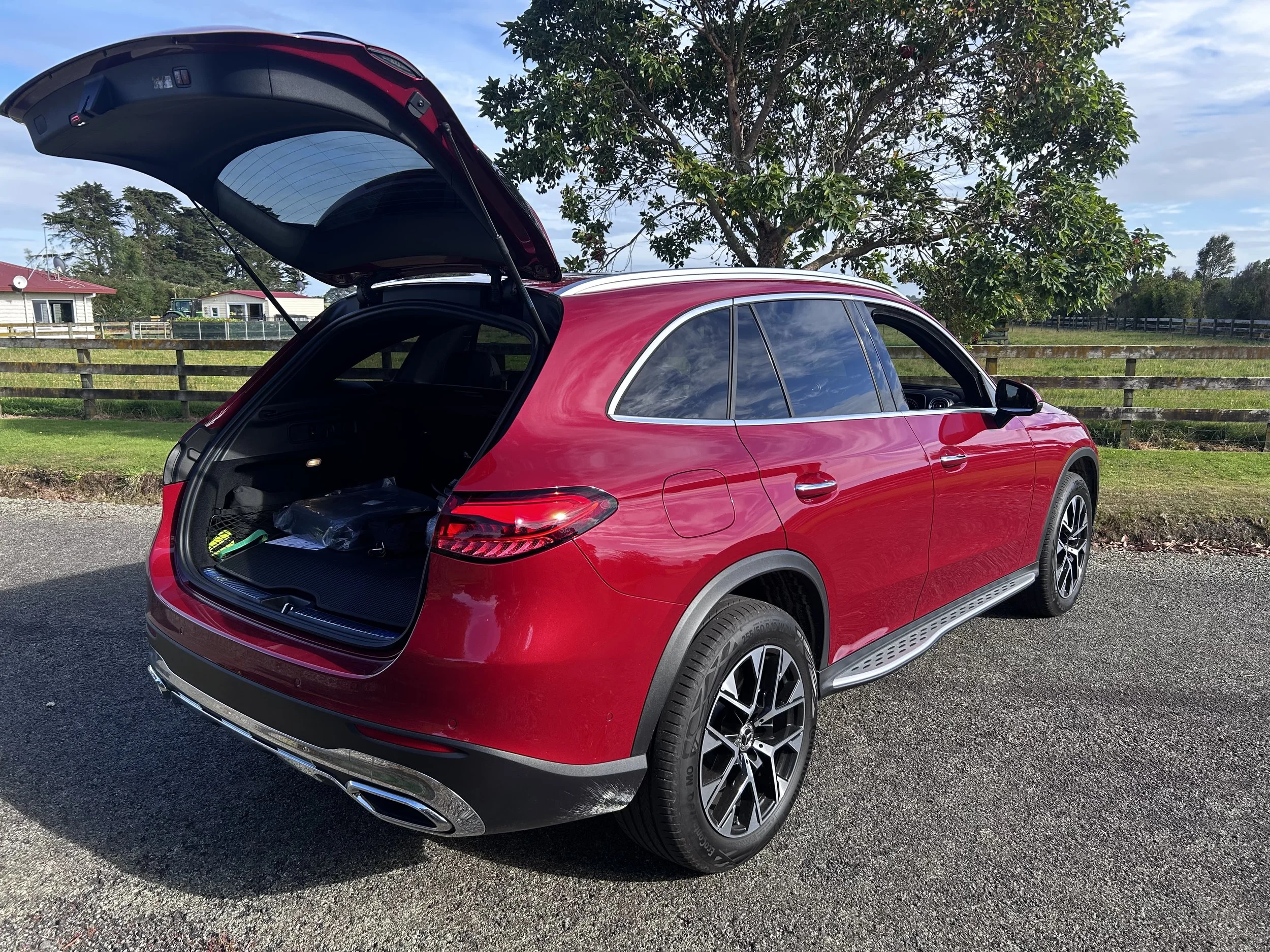
The high levels of refinement and comfort have made it popular as a family luxury SUV aren’t affected with the addition of the plug-in hybrid.
It is a quiet, highly refined car; in performance and dynamic aptitude, it sits flat though cornering is when you start to sense it is being asked to haul another 400kg more than the regular GLC.
A more tangible reminder of the hybrid side of things comes when you open the boot. The size of the drive battery on board means some compromises have had to be made.
It has less boot space to accommodate the hybrid battery, offering 470 litres’ capacity compared to the petrol car’s 620L, but a a high floor that’s not quite flat is the first thing to contend with when the powered tailgate is opened. It’s still a relatively sizeable area, provided you make a decision about whether to leave one or both of the two sizeable charger cable kits at home. Mercedes includes two as standard, one for a wallbox or public chargers, and a three-pin trickle charger, both with their own bag.
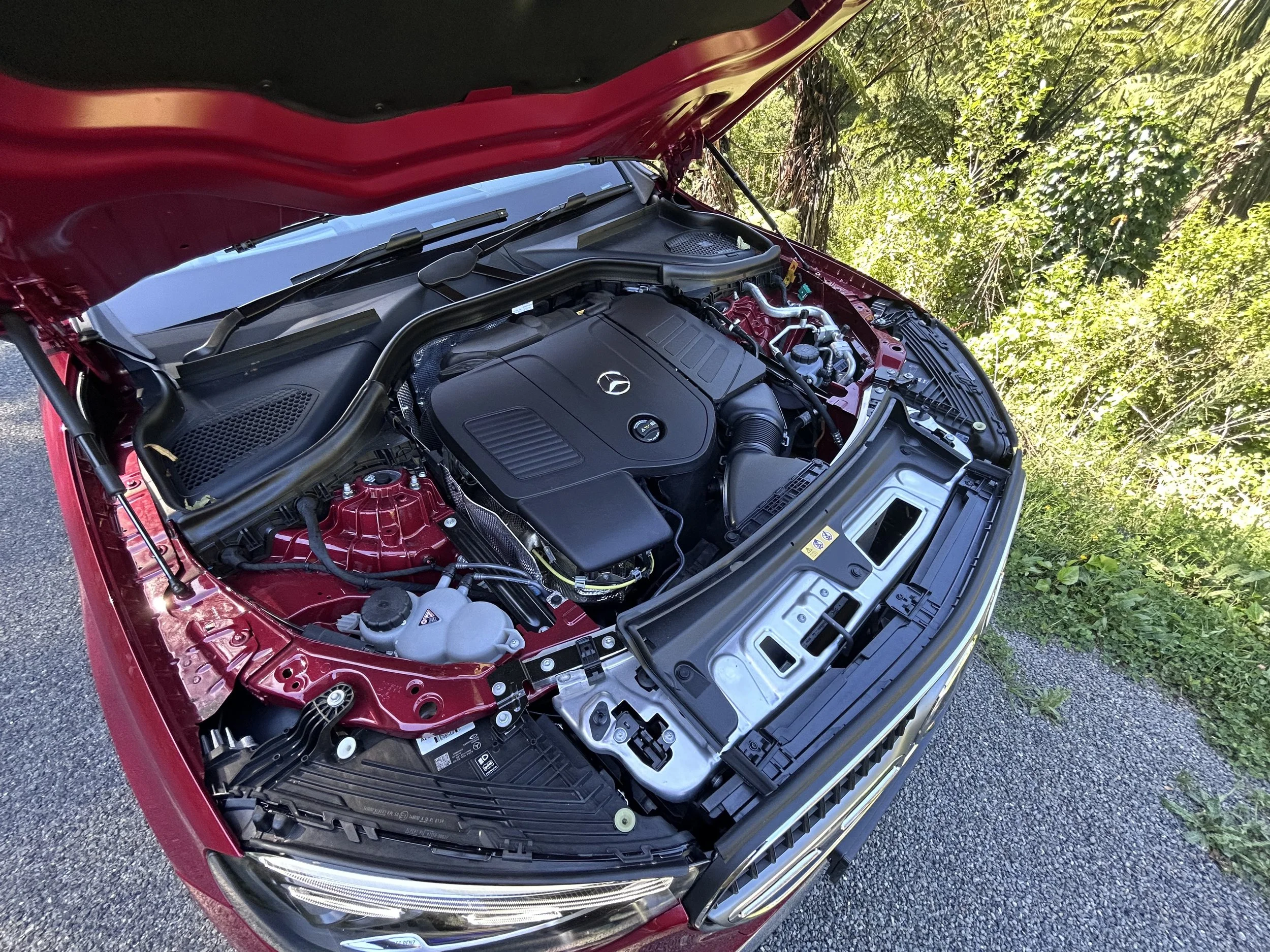
Lift the bonnet and the packaging is not too divorced from what you see in the GLC200; the same 2.0-litre four-cylinder turbocharged petrol engine takes up the space.
Of course, it’s a far more complex drivetrain, with that 25.28kWh battery feeding two electric motors, which produce a joint output of 230kW/550Nm, but all that is hidden elsewhere.
This generation of electrified GLC is far more meaningful than the last in respect to the non-ICE involvement. The electric-only driving range of Benz’s early plug-in hybrids came to around 30-40km. The 132km claimed for this test model is according to testing to NEDC, a schedule not highly regarded here. The NZ-trusted WLTP figure of 112km seems more realistic.
Everything comes down to your driving style - smooth and measured inputs reaps benefits - but from my experience it definitely has more than enough for your average commute.
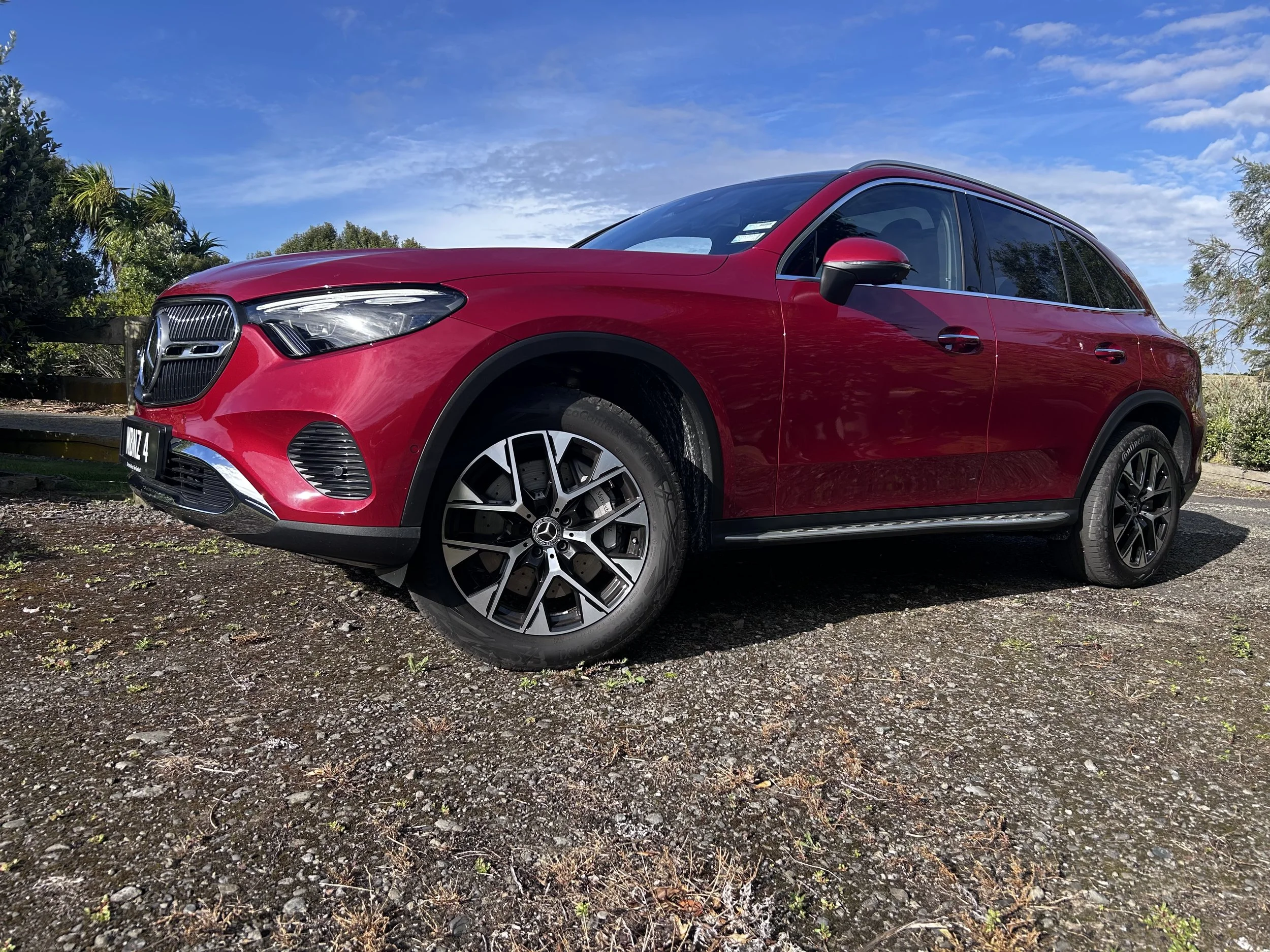
Topping up the hybrid battery is key for efficiency in any PHEV and it’s well known that this simple act is just too much for some to contemplate. I cannot see why in this case, as Benz could not have made it any more straightforward. Simply open the hatch on the left side flank (which looks just like the one directly opposite for the fuel filler) - and use the supplied cable. Couldn’t be easier, really.
What’s a faff about recharging at home with a battery this size is pretty obvious. It’s going to take a long time if you are reliant on a household plug.
You can understand why Benz talks up using an an 11kW AC charger - that aftermarket accessory will get the job done in around two hours.
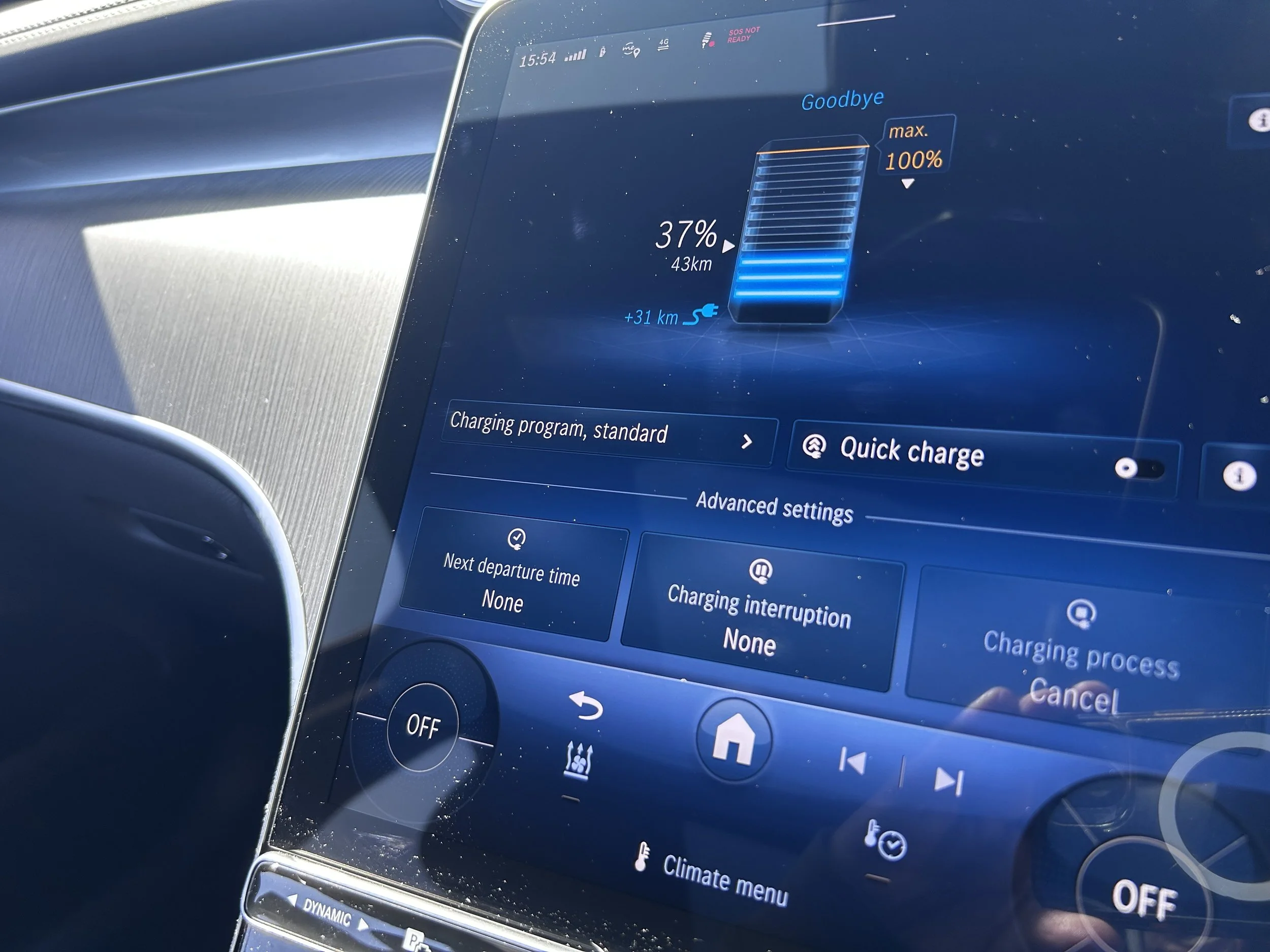
Of course, it’s even faster if you visit a public charger. Benz cites 55kW DC fast charging from 0–80 percent is around 20 minutes. But to gain advantage of this you need the DC fast charging package, which this car had … but is optional.
Using the three-pin cable asks for much, much longer downtime. After five hours from late afternoon to turn-in time, I’d only got the depleted battery back to 30 percent and according to the car would have needed to keep it hooked up until lunchtime next day to achieve 100 percent. It didn’t happen.
There are five driving modes: Electric, Hybrid, Sport, Off-road, and Battery Hold. In Electric mode, the GLC can travel at speeds of up to 140kmh, though with hunger for electrons noticeably increasing above 80kmh, it is patently far more effective at low speeds around town.
Facility to preserve the electric-only driving range isn’t always delivered on PHEVs and while the Battery Hold didn’t seem to prevent some leakage on a long drive, it’s a genuinely beneficial feature.
Urban tootling on electric alone, you’d not think the GLC any different from a car fully committed to petrol. Ultimately, a more convenient sweet spot if you need to be zipping about for a while is Hybrid, which at sub-100kmh pace strives to maintain an electric edge.
When the engine does have to cut in, the transition is not particularly invasive. The engine is quite smooth and not very loud. That makes for a car that is not only quiet around town but also maintains terrific refinement when cruising at the speed limit.
To go into ICE advantage, you need switch into Sport mode. This appears to actively charge the battery to ensure there is power on tap whenever needed. All the same, the GLC feels its most responsive and enjoyable in this setting, almost frisky. That’s impressive when you consider the weight that the powertrain has to cope with; all up it’s close to 2.4 tonnes.
As said, you can get to a point where you begin to feel the car's weight in corners, but it still handles well, with decent steering and a brake pedal that feels pretty good most of the time.
Regenerative braking is via paddles on the back of the steering wheel, with ‘D’ settings to choose from; four are manual and the most involved mirrors what you’d get from a full electric at max; potentially it’s a bit much for many situations.There’s also a D Auto that strives to adapt the braking to suit the conditions, such as traffic or navigation.
Fuel burn is always the crux. The average for the entire 614 kilometres clocked on test came to 6.2 litres per 100km. The wrapped up with an open road run of two hours, mainly in Sport; on this specifically, the rate rose to 7.4L/100m.
On urban-centric days, the consumption was at times very low, occasionally down to 2.9L; and that without any particular diligence, so who’s to say the Benz cited optimal of 1.2L couldn’t be struck, albeit perhaps with a degree of additional dedication?
Certainly, it also lends reasonable potential of realising the PHEV ideal, at least for anyone rigorous in duty to always keeping the battery in high state of charge, of being able to undertake short, low-speed trips without ever troubling the petrol engine for weeks.
As much as the 350e format is new to the GLC, the car itself has been around for a little while now. That, and the maker seeing fit to give this one an evolutionary design, means it is a handsome looking car, but not the most modern-looking of the current Mercedes choices. It is the one that stands most chance of being picked as older than it really is.
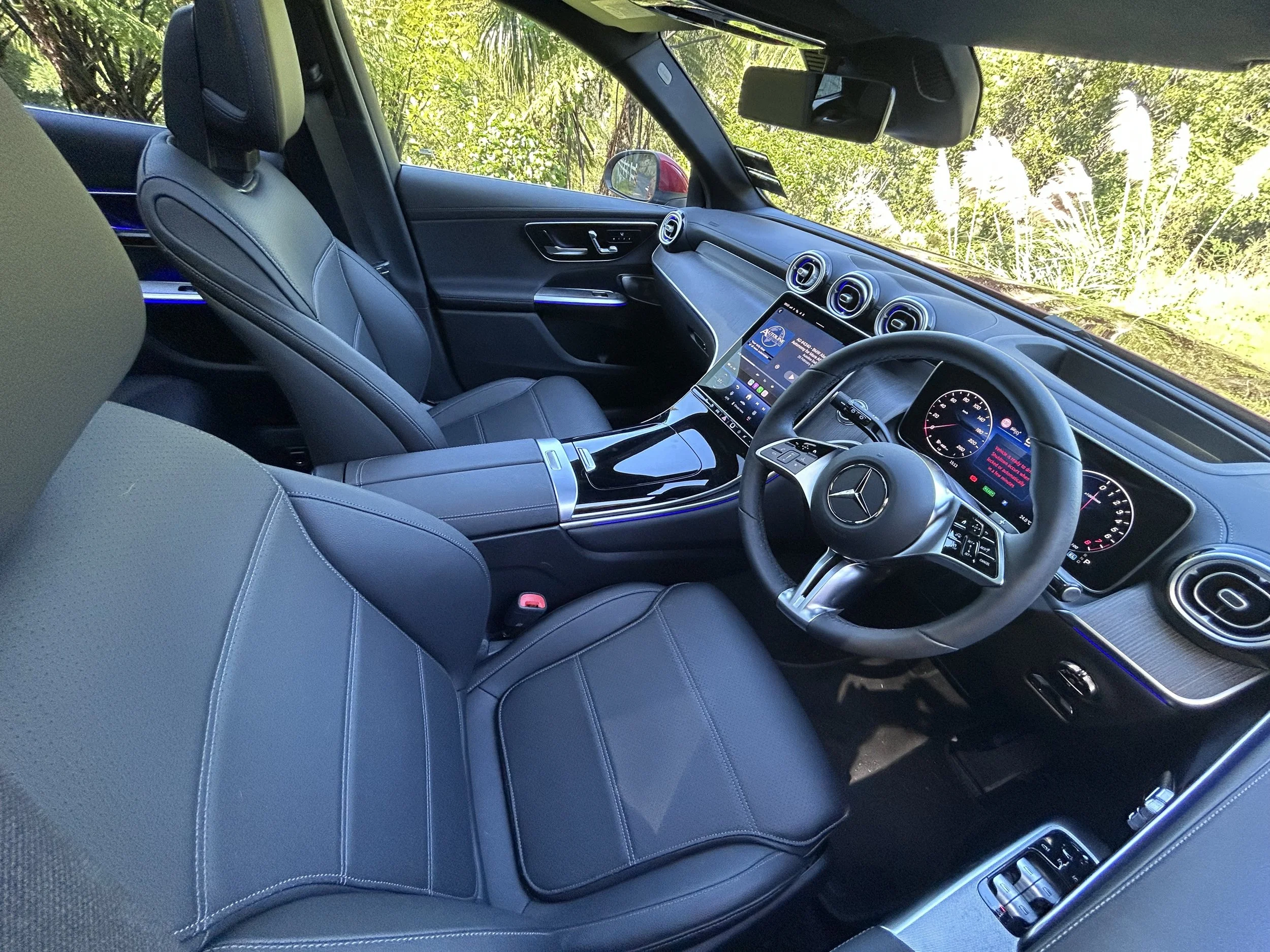
Still, when you come on board the cabin is sure to win approval. A dashboard shared with the C-Class is beautifully crafted; the slanted touchscreen looks great and works pretty well, too.
There's a 12.3-inch screen ahead of the driver for the instruments, while the 11.9 inch central touchscreen comes with Mercedes's latest MBUX multimedia system. The picture quality is crisp, it responds quickly to input and everything makes sense. Although the heating and ventilation are not controlled via physical buttons, they are permanently displayed at the bottom of the screen, making them easily accessible. Take note, China Inc.
The electrically-adjusted, heated and memory front seats are superb for long distance driving and it’s a roomy cabin, with a good amount of space in the front and in the second row.
As standard, the GLC350e comes with a nine-speaker audio system, wireless Apple CarPlay and Android Auto, a wireless phone charger, a head-up display, ambient lighting, dual-zone climate control, privacy glass on the rear windows, a panoramic sunroof with a blind, and a powered tailgate.
This had the optional Sport Package, which includes an AMG Line exterior look and interior details such as sport seats, a sports steering wheel in nappa leather, 20-inch wheels, larger brake discs, and body-coloured wheel arches and the Plus Package, which is technology-focused.
It adds the Driving Assistance Plus Package, which brings additional safety features, a Burmester 3D surround-sound system, Mercedes’s Digital Light intelligent headlight system, Guard 360 enhanced security protection, heat- and noise-insulating acoustic glass, and augmented reality navigation.
When it comes to safety, the PHEV is ancillary to the regular GLC. The latter has a five-star ANCAP rating, which awarded in 2022; however, this rating doesn’t apply to the PHEV variant, as it was not available at the time.
As standard, it comes with 10 airbags, road sign recognition, blind-spot monitoring, a 360-degree camera, forward collision warning, and adaptive cruise control. Also included are driver attention detection, lane-departure warning, lane-keep assist, parking assist, a driver fatigue warning, rear cross-traffic alert, and a rear seat occupant reminder, among others.
PHEV acceptability is going through a real rough patch, but if you like the concept, it’s hard to think of a more polished example of this tech than is found here. Mercedes engineering integrity is certainly exemplified.
But … well, there is one. GLC is moving on. The next generation car is fully electric, it’s been revealed and it’s coming. A bigger leap, yes, but that GLC 400 with EQ Technology is the obvious end game.