Continental: Engine maker to the US vehicle industry

Recalling the history of the enterprise that would power a diverse count of car and light trucks.
large.jpg

IF asked to compose a list of the 10 figures most responsible for the development of the American automobile industry, would your list include A.W. Tobin and Ross Judson?

Those men today may be less than an obscure footnote to automotive history. Yet the business they created was the very cornerstone for a staggering number of famous and forgotten manufacturers. It was also a foundational element in the development of the fledgling American aeronautical industry.

The story begins in 1901 when Judson, a gifted engineering student, had an opportunity to dismantle and examine a Mercedes L-head four-cylinder engine and noticed numerous flaws. The mechanical odyssey filled him with unshakeable conviction that he could resolve these issues and vastly improve that engine.

In 1902, almost immediately after graduation from the Armour Institute of Technology, Judson drafted a sales pitch that he presented to Tobin, his brother-in-law, an up-and-coming financier. His enthusiasm was infectious, and Judson soon had a partner in Tobin, a $US2000 investment of capital from this partner, a rented hayloft converted to a machine shop in Chicago, and a company incorporated as Autocar.

Judson’s first engine showcased by an eye-catching display debuted at the1903 Chicago Automobile Show. Judson and Tobin were possessed of unbridled confidence and had high expectations from this endeavor, but the inundation of orders must have left them stunned.


To fill these initial orders, the company hired 25 men and launched full-scale production along with expansion of the facilities. By 1904, Judson and Tobin found themselves in the enviable position of needing to find a location suitable for dramatic and immediate expansion.

Incentives provided by the city of Muskegon, Michigan, resulted in the relocation of Autocar operations and the construction of a state-of-the-art, 16,000-square-foot factory in 1905.

The following year, the company experienced equally dramatic changes and was already planning expansion as a result. As an example, Studebaker, just one of several customers, increased its order from 100 engines to 1000 in just six months. Production of stationary engines commenced and the number of employees increased from 25 to almost 600.

Then the fledgling company hit a major obstacle in the form of a lawsuit. Autocar, a manufacturer in Ardmore, Pennsylvania, had used the name since 1899 and was threatening to sue if the name of the Muskegon based company was not dropped. As a result, Tobin and Judson reorganised their company under the Continental name.

As an example of the men’s willingness to adapt to changing markets, in 1908 the company developed an aircraft engine production-and-development division. This would become a subsidiary, Continental Aircraft Engine, in 1929, with the 170hp A-70 radial engine as the foundation.

From its inception the company had turned a profit and expanded production each year. Then in 1910, with receipt of an order for 10,000 engines by a new manufacturing concern, Hudson, Continental launched an ambitious expansion programme that included addition to the Muskegon facility and construction of a second factory in Detroit. Two years later, Walter Frederick, a former engineer for the truck manufacturing concern Autocar, assumed Judson’s position as chief engineer.

Under his supervision, the company dramatically expanded the engineering department and launched the development of a line of engines specifically for catalog sales to automobile manufacturers, companies in need of stationary industrial engines, aircraft firms, and tractor manufacturers. And if a client requested engine specifications not listed in the catalog, staff engineers modified existing models accordingly.

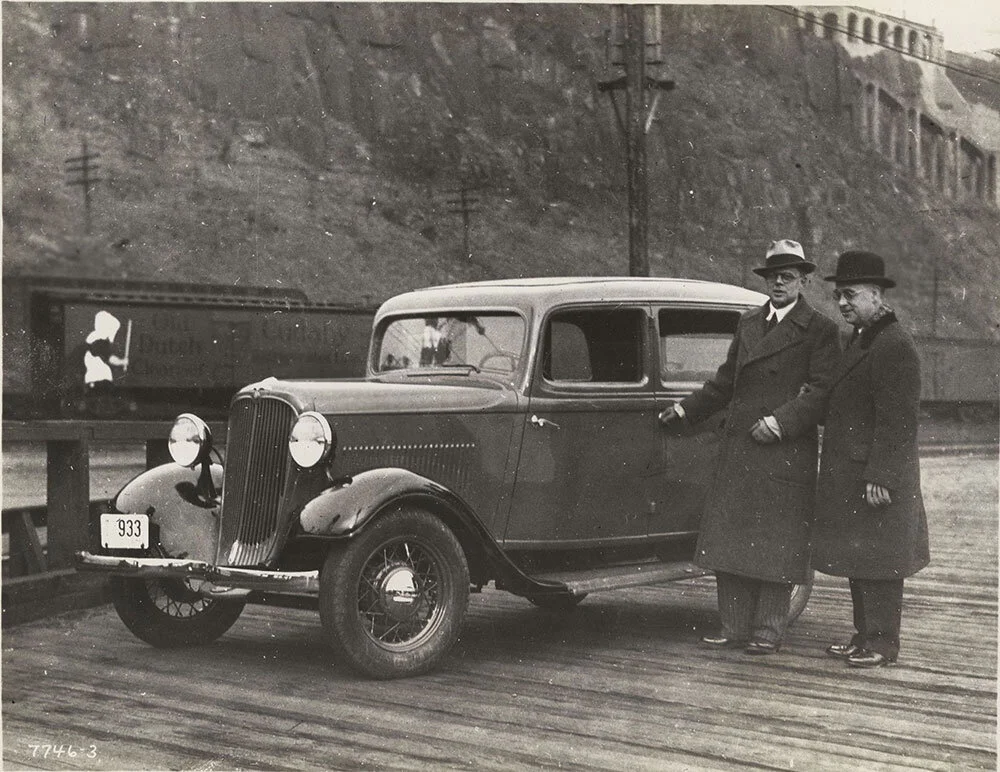
The next 20 years were golden for Continental. Automobiles manufactured by Apperson and Case, Crawford and Jordan, Ace and Vellie, Durant and Erskine, and more than two dozen other companies ran on Continental engines. Companies that manufactured trucks exclusively including Corbitt, Federal, Schacht, Selden, Sterling, and Reo used gasoline and diesel engines designed by Continental for industrial applications.

Wolk_Continental(111).jpg

The 1920s was another pivotal period for the company. W.R. Angell, a member of the company’s board of directors, finalized an agreement with William Durant, the founder of General Motors and Chevrolet, to supply engines for his new lines of automobiles – Durant, Star, Flint and Ruby trucks for export.

The success of the company led to numerous purchase inquiries, and merger overtures. The most promising and thought-provoking merger negotiation was between Continental and three automobile manufacturers that utilized that company’s products – Peerless, Moon, and Jordan. In the midst of discussion Jordan was placed in receivership, Moon sales plummeted and Peerless suffered a series of dramatic setbacks. As a result, any plans for merger were abandoned.

The new decade and the dawning of the Great Depression began at Continental with Judson’s retirement and the rise of Angell to the presidency of the company. His expansion of the diesel truck, aircraft, stationary, and agricultural engine divisions of the company kept it afloat and even relatively profitable during the early days of the economic calamity.

However, his decision to initiate the launch of a Continental-manufactured automobile and the acquisition of a truck manufacturer nearly sank the company. The short-lived Continental Beacon, Flyer, and Ace were little more than new emblems placed on the equally unsuccessful De Vaux. The acquisition of Divco, a manufacturer of delivery and step vans, in 1932 proved another unwise, costly venture.

Norman De Vaux, a close friend of William Durant, had had several successes in the auto industry. He was instrumental in establishment of the California dealership network for Chevrolet and had worked with Colonel Elbert J. Hall in the establishment of Hall Scott Motor Company to produce aircraft, tractor, and bus engines. The De Vaux automobile endeavor was their second partnership.   

Resultant of the worsening economic climate, poor sales, quality control issues and other problems, the De Vaux introduced in early 1931 was on the cusp of receivership by midsummer. To further complicate issues the company had an arrangement with Hayes Body Corporation to produce De Vaux bodies. And so, when the company was acquired by Continental, it was deeply in debt. Divco was not in much better shape. And so Continental was pushed to the brink of insolvency resultant of the acquisition. But the company survived.

The richly diverse legacy of independent thinking Ross Judson did not end with the Great Depression or the heady days of the post-war era. Continental engines powered the grandfather of the Jeep, the Bantam Reconnaissance and Command Car prototype, as well as the iconic Checker taxi through early 1964. Nor did it end with the cessation of engine manufacturing as Continental lived on into the late 20th century as Ryan Aeronautical and Teledyne Continental Motors.

Written by Jim Hinckley of jimhinckleysamerica.com

Remembering the Ruxton

The story of America’s first front-wheel-drive car is a turbulent tale.

1929Ruxton-front.jpg

THE Ruxton could have changed the direction of America’s automobile industry. It could have been the saving grace for Moon. It might have transformed the Hupp Motor Car Corporation and enabled the company to survive the Great Depression. It had the potential to give Kissel a marketing boost.

But there were two major obstacles that proved insurmountable. One was the dramatic economic downturn that kicked off with the stock market crash in October of 1929. The second was Archie Andrews, a swashbuckling financier and promotor not constrained by ethics.

The Ruxton story starts with William Muller who was working as an experimental engineer at the Edward G. Budd Manufacturing Company in the mid-1920s. The company was a major producer of auto bodies for numerous manufacturers that was looking for opportunities to diversify operations.

This worked well for Muller who had an idea for a revolutionary front wheel drive vehicle. After presenting his ideas to the board of directors, he was given the green light to develop a prototype. Upon completion, plans for the car that had been dubbed Ruxton by Andrews, with Budd body, would be sold to an established manufacturer under limited license for production and distribution.   

Archie Andrews was a member of the board of directors for several companies including Budd and Hupp Motor Car Corporation. The Ruxton project piqued his interest. So, he deftly used his position on the boards in the hope of having Hupp manufacture the car. When that initiative failed, he established New Era Motors in April 1929 with plans to produce the car himself.  

But Andrews was unscrupulous. Indicative of this was use of the Ruxton name. When Andrews had first gained control of the project at Budd, he had been involved in back door negotiations with William Ruxton, a financier that was a member of the New York Stock Exchange. Ruxton chose not to invest in New Era Motors, but the Ruxton name on the car enabled Andrews to attract investors. It took William Ruxton several years of legal wrangling and lawsuits against Andrews to prove that he was not involved with the company and had not given permission for use of his name. By then the Ruxton was an historic footnote.

New Era Motors had a prestigious address in New York City. It had eager investors and it had excited stockholders. It had a colorful prospectus. It had a stylish front wheel drive prototype with Budd body. It had exclusive production rights secured from Budd. But it was all a façade, an automobile manufacturing company without a factory, engineers, a dealer network, or plans for distribution.   

With the colorful low-slung front wheel drive car powered by a 100-horsepower eight-cylinder engine produced by Continental as his business card Andrews aggressively sought partnership with a company to produce the Ruxton. Negotiations with Peerless, Gardner and Marmon were fruitless. Next, he prepared a sales pitch for St. Louis based Moon, a company that had been established in 1905 and that was on the cusp of receivership resultant of declining sales, quality control issues, and a growing reputation for unreliability.    

In November 1929, a press release announcing that Moon would be producing the exciting new Ruxton was published in trade journals as well as St. Louis newspapers. The board of directors at Moon staked it all on the project that had two components. The Ruxton and production of the Moon bodies by Budd as a cost saving measure, an arrangement negotiated by Andrews. What they had not counted on was Andrews ruthless back room deals.

As part of the arrangement, Andrews would provide designs and limited patent rights for the Ruxton in exchange for a sizable, preferred stock interest in Moon. Unknown to the directors he had also acquired blocks of stock through purchase by a proxy before closing the deal. These were sold at a profit with announcement that Moon would be manufacturing the new car. Then came his boldest move which was an attempt to remove the board of directors with plans to assume complete control of the company. His plans also called for restructuring the company and using it as collateral to fund acquisition of several small independent automobile manufacturers that were on the cusp of bankruptcy.  

C.W. Burst and the Moon board of directors filed for an injunction hoping to stave off Andrews company take over. When the stay was overturned, they filed an appeal and literally barricaded themselves in the boardroom while awaiting a decision. Andrews and Muller that had been lured from Budd with the promise that he would be appointed president at Moon, and several hired thugs broke down the door and served court papers giving him control of the company.

As suits and countersuits circulated in the courts, and precious cash reserves were expended on legal fees, the Ruxton and the Windsor, a rebadged Moon, entered production in June 1930. The Ruxton was also being produced in the Hartford, Wisconsin factories of Kissel, a company that Andrews had manipulated into producing the car as well as transmissions and final drive assemblies.

When Andrews attempted a take over of Kissel in a manner like that used to gain control of Moon, the Kissel brothers shuttered their company and filed for bankruptcy. As Moon’s cash reserves had been depleted, parts suppliers were demanding payment, and the Ruxton project was brought to a standstill without the Kissel produced components, Andrews was forced to suspend all production on November 10, 1930. A filing for receivership was submitted on the 15th.

Kissel, a company that had began operations in 1907 as Kissel Kar, reorganized as Kissel Industries and manufactured automotive components into the 1940s. Andrews had so financially entangled Moon with other companies, resolution of the bankruptcy, and subsequent claims and lawsuits were not completed until 1965!

Incredibly this was not the end of Andrews automotive endeavors. He maneuvered his position on the board of directors at Hupp and was elected chairman. Angry Hupp stockholders that had lost money on Moon and New Era Motors filed a string of lawsuits when Andrews attempted to gain full control of the company and use assets to take over Gardner, Stutz and Peerless.

Andrews was forced from Hupp, and private assets were seized. For the next few years Andrews was engaged in constant legal battles. They only ended in 1938 because Andrews died of heart failure at age 59.

Only about 500 Ruxton automobiles were manufactured but some were not sold until 1932. Of these about twenty-five had been produced at the Kissel factory. This included two custom phaetons produced for the Kissel brothers. Four other special bodied show cars were produced in the Moon factory. The production models were roadsters and sedans.

For all his shortcomings, Andrews was a promoter and showman extraordinaire. Ruxton automobiles were finished in outlandish tricolor or two tone finishes with color combinations such as lavender, black, and grey. They sat ten inches lower than most production cars manufactured at the time, and there were no running boards. The narrow Woodlite headlights gave the car a distinct appearance. The Ruxton would not be mistaken for anything else on the road.

Surprisingly, the cars were well engineered. Owners expressed overall satisfaction with the Ruxton. And unlike the first generation of the contemporary front wheel drive Cord, the Ruxton did not have shifting or transmission issues. And those that have survived into the modern era are treasured by collectors.  

Written by Jim Hinckley of jimhinckleysamerica.com

Spark of genius

Albert Champion did not invent the spark plug, but his name lives on today with this vital component.

albert-champion-2-2jpg-8430ffed840daf59.jpg

EARLIEST references to sparking plugs date to 1839 and newspaper articles about Edmond Berger who had created and was experimenting with such a device.

What it was to be used for and how it was powered are a mystery.

Another reference was made in 1859. Jean Joseph Etienne Lenoir, a Belgian-born French inventor built a single cylinder engine that used an electric spark to fire a mixture of kerosene and air. Detailed information about the endeavour is lacking.

Sir Oliver Lodge, a British scientist, developed an electric sparking plug in the mid-1880s and had the first financial success with the technology. A decade later his sons established the Lodge Sparking Plug Company. And in about 1900 the eccentric inventor Nikola Tesla developed an electric igniter for use in petrol engines.

But it was Albert Champion who is best known for perfecting the device, and in the process played a pivotal role in the development of the auto industry.

 Born in 1878 in Paris, France, Champion’s first employment was as a courier for a bicycle manufacturing facility. Seeing a promotional opportunity in his speed, the factory sponsored his entry in several competitions. Champion became a champion and soon, an award-winning competitive cyclist he came to the United States.

The bicycle craze of the 1890s overlapped with the development of a practical horseless carriage, and many a bicyclist, including Champion, Barney Oldfield, and Louis Chevrolet were enamored with the new transportation option and the quest for speed. And so Champion added auto racing to his resume but in 1903 he was seriously injured in the crash of the Packard Grey Wolf during an event at the track in Brighton Beach in Brooklyn, New York. He sustained a compound fracture that left one of his legs two inches shorter than the other and ended his career as a bicycle racer.

635502756441750108--At-age-18-in-1896.jpg

Champion made the best of the incident and while recovering in France initiated the study of mechanics and automotive engineering. As his studies progressed, he sharpened his focus and was soon working exclusively with electrical components including magnetos and seeking ways to improve them.

In 1905 he secured financing from investors, returned to the United States, and opened a small factory in Boston, Massachusetts, to manufacture a spark plug of his design and distribute imported magnetos. What made his spark plugs unique was the use of insulators made from a special clay imported from France and kiln firing. His protection of the center electrode from grounding, from engine heat, and from moisture with ceramics was an industry first.

The spark plugs soon became a favorite of auto owners and sales soared. To meet the exponentially growing demand, he established a second Champion Ignition Company factory in Toledo, Ohio.

Champion’s success was meteoritic. Shortly after establishment of General Motors in 1908, that company’s founder, William C. Durant, met with Champion and negotiated an agreement that led to Champion Ignition Company relocating to Flint, Michigan. With Durant as an investor, the company was reorganized as AC Spark Plug. As part of the arrangement, Champion was contracted as the sole provider of spark plugs and ignition components for Buick. The following year the contract was rewritten to have Champion supply these items for the entire GM line.

In late 1909, Durant initiated an ambitious plan to acquire all parts suppliers and fold them into the General Motors conglomerate. This included AC Spark Plug. Then in 1916 when Alfred P. Sloan launched an ambitious restructuring of the company, AC Spark Plugs was again reorganized as the AC Division, an independent division of GM just as was Chevrolet, Buick, Oakland, and Oldsmobile.

Sloan also expanded the scope of manufacturing at the AC Division. In addition to spark plugs and ignition components, the company began producing speedometers, ignition coils, magnetos, and automotive light bulbs.

Through all these iterations, Albert Champion had deftly ensured he was retained as the president. From that position Champion negotiated acquisition of Sphinx Sparking Plug Company, the largest spark plug manufacturer in England and the British Empire, and Oleo Company, another spark plug manufacturer in France. He also positioned the company to supply ignition components to leading aircraft manufacturers. When Charles A. Lindbergh used AC spark plugs during his historic solo flight across the Atlantic in May 1927, and as per arrangement, praised their reliability in company promotion, sales soared.

Five months later, Champion and his wife sailed to Europe on their annual vacation. It was to be a business and pleasure trip as Champion was to inspect the new AC factory opened by General Motors in Paris, France. However, the day after his arrival, during dinner with his wife, friends, and business associates at a Paris hotel, Champion collapsed and died almost instantly. An autopsy revealed the cause of death as a pulmonary embolism.

635502756416400108-Portrait-of-The-Chief-.jpg

The Champion story didn’t end with his death. In 1916, Remy Electric was merged with Dayton Engineering Laboratories Company of Dayton, Ohio, to form Delco-Remy Corporation, another division of General Motors. Manufacturing at AC Division was later expanded to include Rochester carburetors. In 1971, Delco-Remy was reorganized as the United Delco Division.

Three years later GM streamlined the manufacture and distribution of parts operations and the two divisions were merged into ACDelco. Then in 1986, GM established Service Parts Operations as the umbrella for several divisions including ACDelco. Champion itself became a division of Federal-Mogul Corporation.

Champion never acquired the dubious immortality that is having a name transformed into a brand. Still, his work is at the foundation of empires that were built by Dodge, Ford, Chrysler, and Chevrolet.

Written by Jim Hinckley of jimhinckleysamerica.com

Charles Kettering - an extraordinary American inventor

This engineer, businessman, and the holder of 186 patents was the electric starter, fast-drying car paint, the world’s first cruise missile and an engine that became known as the copper-cooled calamity … plus so much more.

MPYAPXDDE57KRG6U2EJHDLI7LM.jpg

HIS contributions to the development of automotive technology, to education and even to medicine transformed the world.

He eliminated the need for a hand crank to start a car. He almost sank Chevrolet. He was a commonsense philosopher that espoused the benefits and value of failure - “99 percent of success is built on failure.” His was a life well lived.

Charles Franklin Kettering was born on August 29, 1876, in Loudonville, Ohio. Plagued with poor eyesight, he was a voracious reader even though this often led to blinding headaches.  

Surprisingly, even though he was well read he was only a mediocre student. Still, after graduation he accepted a teaching position at Bunker Hill School. He challenged and engaged students, encouraged them to evening scientific lectures on electricity, heat, magnetism, and gravity, and was immensely popular.

His quest for learning led him to resign from teaching and register for classes at the College of Wooster, and then Ohio State University. Resultant of his eye problems that led to almost crippling migraine headaches, he abandoned higher learning and took a job as foreman of a telephone line crew. He was a quick learner and enjoyed experimenting on his own time.

Fascinated by electricity, he again registered for classes at Ohio State University after an optometrist was able to rectify some of his vision problems. He graduated in 1904 with an electrical engineering degree and was hired directly out of school to head the research laboratory at National Cash Register.

In this position he developed a revolutionary credit approval system that would later be adapted by Diners Club, one of the first credit card companies, in 1950. In 1906 he developed a small electric motor and created the first electric cash register. During his five years of employment at NCR, from 1904 to 1909, he secured 23 patents for the company.  He attributed his success to a good amount of luck but often quipped, “I notice that the harder I work, the luckier I get.”

In 1907, his NCR colleague Edward A. Deeds, Kettering, and other NCR engineers, including Harold E. Talbott, established the “Barn Gang.” Together they would work nights and weekends in Deeds's barn to develop products or ideas to enhance everyday products. In 1909, Charles F. Kettering and Edward Deeds left NCR and established a company of their own, the Dayton Engineering Laboratories Company, known today as Delco, in Dayton, Ohio. Despite developing an array of products and acquiring patents, the company was only moderately successful. It was a tragic accident that propelled Kettering and Delco to success.

KetteringAerialTorpedo.jpg

Many injuries and even deaths had occurred resultant of the hand crank used to start automobiles. Byron Carter, a prolific inventor from Jackson, Michigan that had developed bicycles and various automotive technologies, as well as the friction drive Cartercar, stopped to assist a motorist on Belle Isle near Detroit. While cranking the vehicle he was severely injured and died several days later. Henry M. Leland, an automotive engineer that had been involved with Cadillac from its inception, a friend of Carter’s, became determined to develop an electric self-starting device for automobiles. When he and his team of engineers failed, they turned to Kettering and Delco. An operational model was delivered to Leland in February 1911.

It exceeded all expectations. In addition to the electric starter the system included key operated ignition spark and as a source of current for the lighting. Leland ordered 12,000 units and the 1912 Cadillac became the first production vehicle with a modern starting and electrical system.

In 1914, Kettering became a founding partner in a company that manufactured motorcycle sidecars. The same year he launched a company to mass produce generating systems for rural farm lighting applications. This included experimentation with the use of solar power as a source of electrical generation. He also was a founding partner in the Dayton-Wright Airplane Company.

The following year he accepted a contract from the United States Army to design an unmanned "flying bomb" which could hit a target at a range 64 kilometres.  Formally called the Kettering Aerial Torpedo it was jokingly called the Kettering Bug. It was built by the Dayton-Wright Airplane Company with Orville Wright acting as an aeronautical consultant and Elmer Ambrose Sperry as assistant engineer for the design of the control and guidance system.

The innovate aircraft was powered by a two-stroke V4 40-horsepower DePalma engine mass-produced by the Ford Motor Company at a cost of $40 each. The fuselage was constructed of wood laminates and papier-mâché, and the wings were made of cardboard. The cost per unit was $400.

It was launched using a dolly-and-track system like the method used by the Wright Brothers when they made their first powered flights in 1903. It could fly at a speed of 80kmh. A small onboard gyroscope was used to guide the aircraft to its destination. The control system also used a pneumatic/vacuum system, an electric system, and an aneroid barometer/altimeter. An intricate mechanical system was devised that would track the aircraft's distance flown. Before takeoff, technicians determined the distance to be traveled relative to the air, considering wind speed and direction along the flight path, and then calculated the total number of engine revolutions needed for the Bug to reach its destination. When a total revolution counter reached this value, a cam dropped down which shut off the engine and retracted the bolts attaching the wings, which fell off. This began the ballistic trajectory into the target which ended with an impact detonation of the 82 kg payload.

In 1916 Kettering negotiated the sale of Delco to United Motors Corporation, an automotive parts and accessories company that was acquired by General Motors in 1918. Then in 1919 he accepted a position as head of the new General Motors Research Corporation in Dayton, Ohio. He would continue working for this GM division for 27 years during which he acquired 186 patents.

Kettering was also the man behind Duco, the paint that revolutionised automobile painting. Prior to Duco many automobile manufacturers hand painted cars. Still regardless of system used the drying process required days. Duco developed with Du Pont cut that time to hours.

1923-Chevrolet-Series-C-02.jpg

Not all his projects were successful. “It doesn’t matter if you try and try and try again and fail. It does matter if you try and fail and fail to try again.”

In 1919 his first assignment for General Motors was to develop two air cooled engines: a four cylinder for Chevrolet and a six cylinder for Oakland that could also be used in Oldsmobile. The Oakland/Oldsmobile project was shelved, but the Chevy air cooled engine made it into production. It was an abject failure as the car tended to overheat when operating in conditions of high heat and humidity. It burned valves and bearings, and lost compression when hot.

Only 759 of these cars were built. Except for two cars, all were recalled from dealers or bought back from buyers. It was the first automotive recall in history, and it almost caused the demise of the Chevy division. 

Chevy sales had been strong since 1916 but there was no growth. An attempt to introduce a V8 engine as a Model D in 1917 proved a costly failure. During the post WWI economic recession, the Chevy division hemorrhaged cash. The air-cooled engine project exacerbated a critical situation. Only the last-minute intervention of Alfred P. Sloan prevented the Chevrolet division from being culled.

As an interesting side note, trying to resolve the problematic detonation issue of the air-cooled engine led Kettering to begin experiments with fuel. In 1921, working with General Motors engineer Thomas Midgley Jr., Kettering created a new additive which worked to reduce the “knocking” in car engines. That additive was tetraethyl lead. And that resulted in the development of leaded gasoline.

Another dubious invention that at the time was heralded as a world changing discovery was Freon gas for use as a refrigerant. Kettering also played a key role in the development of automotive safety glass, a lightweight diesel engine for application in trucks, an electric auto theft prevention system, and diesel-electrical dynamo engines for locomotives. But Kettering’s interests were not limited to cars, trucks, airplanes, and trains.

His launched research into magnetism and its use in medical imaging devices and designed an incubator for premature infants that he patented. He created a formula for synthetic aviation fuel and pioneered the mechanism for retractable aircraft landing gear. He perfected the spark plug and devised a process for extraction of bromine from sea water. He is credited with the creation of the first practical two-filament headlamp. And he established the Charles F. Kettering Foundation for medical research, partnered with Alfred Sloan to establish the Sloan-Kettering Institute for Cancer Research, and funded establishment of the Charles F. Kettering Memorial Hospital, as well as Kettering University.

Charles Kettering is an example of a life well lived. He is an inspiration. And in the modern era, he is largely a forgotten pioneer.

Written by Jim Hinckley of jimhinckleysamerica.com

Roland Conklin’s amazing land yacht


When one of the wealthiest men in America decided to take his family on a road trip he did so in grand style – with a cook, maid, driver and mechanic.

MphsuBx.jpg

FROM the perspective of transportation, World War One was an odd blending of the past and the future.

Armies used horse cavalry as well as tanks and airplanes. Draft horses pulled artillery pieces; four-wheel-drive trucks hauled supplies.  Motorised ambulances shard the roads with pack trains of mules.

With the cessation of hostilities, recognising the need to modernise, the United States Army launched a series of initiatives with the extensive use of motorcycles, trucks, and staff cars.

One manifestation of this was a coast-to-coast convoy in the summer of 1919, testing the military’s mobility in wartime conditions. The United States’ army’s expedition consisted of 81 motorised vehicles and 302 men. They went from Washington, DC to San Francisco, a venture covering 3251 miles (5231km). One of the participants of that 62 day venture was a young Lieutenant Colonel named Dwight D. Eisenhower; a future president of the United States and the man credited with launching the interstate highway system.

The venture highlighted the poor and even antiquated condition of America’s rural roads even though there had been tremendous expenditure to modernise them. Wooden bridges had to be reinforced to support the heavy trucks. Covered bridges had the tops removed to accommodate the loaded trucks. There was deep sand, muddy quagmires. Soldiers collapsed from exhaustion after driving and pushing their vehicles for 20 miles. Tires were shredded and radiators punctured. It was a grueling endeavour.

Four years prior, before the roads had been improved, Roland R. Conklin of the Chicago Motor Bus Company, Roland Gas-Electric Vehicle Corporation, New York Motor Bus Company and Hexter Truck commissioned the construction of a luxurious land yacht that he dubbed the Gypsy Van. Then he set out on a transcontinental family outing with a cook, maid, chauffer, and mechanic.

As Conklin was one of the wealthiest men in America, the venture was newsworthy. But it was the Gypsy Van, a summer cottage on wheels of epic proportions that was the showstopper. It and the arduous journey over poor roads was described in detail in newspapers, trade journals and publications that targeted the automobilist.  

From the New York Times, August 21, 1915: “The first impressive thing about the vehicle, which Mr. Conklin calls his ‘land yacht,’ is its size. Overall, it is twenty-five feet in length, six inches longer than the Fifth Avenue buses.

Yrtb5JE.jpg

“It is seven and a half feet wide and thirteen feet high. It weights between seven and eight tons without gear, filled water or fuel tanks, passengers and supplies. The size of the great automobile ceases to dominate one’s thoughts when one investigates the comprehensiveness of its equipment. It is really a house on wheels, though it runs smoothly at moderate speed.”

“As speed was not a special object, a comparatively small motor of 60 horsepower could be used, especially geared for power grades. Canvas strips for sandy sections, a knockdown, portable bridge to ford streams, and a winch operated by the motor, strong enough to pull the car out of a mudhole or ditch are special items of equipment. No such vehicle has ever been attempted before on this scale, but his experience in designing large vehicles for traffic, as the President of the New York Motor Bus Company, convinced Mr. Conklin that his idea for a double deck bus with roof top garden was practical, so he went ahead.”

 “The transmission is of the selective sliding dog type, with gears always in mesh. It is really a double-gear box, as it gives nine speeds forward and three in reverse. This unusual transmission was necessary because of the special requirements of this vehicle. It must be able to travel faster on good roads than the ordinary motor truck of similar weight and must also be able to negotiate far steeper grades and deep sand. The gear ratio on the lowest forward speed is 86 2/3 to 1, as compared with 26 to 1 on a Fifth avenue motor bus. The gear ratio of the highest speed is 8 2/3 to 1. Final drive is through worm gears. Solid tires 5x36 inches, dual on the rear, are fitted to steel wheels.”

It had a generator with electric lights and a vacuum cleaner, and storage for the motorcycle to be used in the case the chauffer had to go for assistance. There were freshwater tanks and a shower bath, folding bunks, a hideaway card table, a kitchen with electric cooking range, and bookcases, built in lockers for food, clothes, guns, fishing gear, and tools. There was even an ice box that hold 100 pounds of ice, and a fold out canvas awing.   

“As you approach the car from the back you see a wooden door, but no steps, unless you happen to recognize the folding steps of a pattern similar to that used on some of the New York surface cars. When you turn the doorknob and open the door these steps unfold easily. When you have mounted and opened the screen door you find yourself in the rear compartment, which probably combines more different functions with less waste of space than any yacht or launch cabin in existence.”

“In one side of this a folding metal wash bowl not unlike those in the washroom of a railroad parlor car. A little pull brings this basin down into its position for use. It is fed from the large water tanks on the roof. Above this basin is a water filter for drinking water, one coil of which passes through the icebox, so that chilled water of filtered quality is constantly on tap. Next to the icebox toward the front of the car is a neat porcelain kitchen sink, and near it is an electric range with several burners and a large oven. A miniature dresser with spices, sugar, flour, and the like are on the wall, and other cunningly contrived cupboards and racks hold pots and pans and a plentiful supply of cutlery.”

As luxurious and well prepared for rugged uses as the Gypsy Van was, the road conditions ensured that the odyssey was fraught with challenges. 

“Mr. Conklin and his party will take the Post Road to Albany. The route will then be through Buffalo, Chicago, Denver, Yellowstone Park, Glacier National Park, San Francisco, San Diego, and Los Angeles. The party will return to New York by steamer through the Panama Canal, leaving the van to be shipped East.”

New York Times, August 23, 1915:“The land-going yacht in which R.R. Conklin, of the Motorbus Company of New York, and a party of twelve are going from Rosemary Farm, near Huntington, L.I., to the Panama-Pacific Exposition, came near foundering on her second day out, and was obliged yesterday to send a save-our-yacht call at 4:32 P.M. to the nearest port, Briar Cliff.

“The automobile, with its kitchen, hot and cold water, beds, tables, and even a roof garden, was stuck fast in the slippery mud which lined its channel, the State road just north of Briar Cliff. Puffing contentedly, the big double-decked cross between a Fifth Avenue bus and a prairie schooner left Long Island on Saturday and proceeded on the first leg of its 5000-mile transcontinental voyage. At the last moment, a change was made in the plans, and the automobile ship steered through Briar Cliff instead of going through White Plains, as was first intended. A bridge only ten feet wide was the cause, the yacht needing but twelve as a minimum.”

Two months and more than 5000 miles later the trip was completed. A journal from the trip notes an endless array of issues and problems that resulted from road conditions; bridges unable to support the weight, mud, deep sands, washed out roads, steep grades, and fording streams. But it also details an exciting pioneering odyssey.

News stories about the trip and the amazing Gypsy Van inspired the wealthy and the innovative to create their own motorised home on wheels. The Conklin’s adventure and the military convoy, as well as Emily Post’s bestselling book, By Motor to The Golden Gate about her cross-country odyssey also inspired road trips and galvanized the Good Roads associations to action as they worked to craft a national network of modern highways.  

Written by Jim Hinckley of jimhinckleysamerica.com

‘Cannon Ball’ Baker – a true high-powered hero

He started racing bicycles … and then went into record-setting with motorbikes and cars. Ultimately, his name is remembered through an unofficial, unsanctioned car race that rebels against authority.

Cannonball-Baker.jpg


MANY big name start-ups in the automotive industry began with bicycles: So it went with Erwin Baker, a man who became known internationally as ‘Cannon Ball Baker.’  

Born March 12, 1882, in a tumbledown log cabin near Lawrenceburg, Indiana, Baker was a sickly youth and an indifferent student. His parents worried over his future and wondered if he might even survive into adulthood. No one could have possibly guessed that Baker would become an internationally-acclaimed celebrity who inspired countless imitators.

His family moved to Indianapolis shortly after Baker turned 12. To supplement his father’s meagre income, before he’d turned 15 birthday Baker went to work toiling in 10 hour shifts at the Indianapolis Drop Forge Company. The hard work transformed the scrawny boy into a sturdy man who craved a hearty lifestyle. In 1905 Baker joined a traveling acrobatic vaudeville act. He entertained audiences by beat punching bags with his feet while standing on his head and using his head as a battering ram to shatter various items.

To earn extra income, and to fuel his passion for the thrill, he began bicycle racing. In 1906 he purchased an Indian motorcycle and begin racing on the board track circuit. The long string of record setting finishes, and his natural talent as a showman, earned notice from Indian and in 1909, Baker was offered a position with the factory Indian motorcycle racing team. His first race as a company representative was at the inaugural event at the Indianapolis Motor Speedway on Aug. 14, 1909.

Conditions at the new Speedway were less than ideal. The surface of the track was crushed limestone with a thin coating of oil. It was deemed treacherous by automobile drivers. For motorcyclists accustomed to racing on surfaces of hardpacked beach sands or board tracks it had the potential to be deadly at high speeds. As an added hazard there were sharp rocks bound to destroy tires. Thirty riders entered, four finished. Baker claimed first prize. G.H. Westing Company, the sole distributor of Indian motorcycles in central Indiana, was quick to capitalise on the success with an array of advertisements.

the-story-of-cannonball-baker-badass-riding-legend.jpg

While the rest of the factory team was board track and beach racing to promote the company, Baker was given a free hand to develop publicity events. Resultant stunts included racing passenger trains between towns. Bear in mind, these were days when roads were little more than frontier era trails pocked with mud holes and rocks.

George Hendee, co-founder, and president of Indian, was ecstatic about the publicity. In 1912, Baker was tasked with staging a promotional tour of South America. As export sales of Indian soared, the tour was deemed a success.

For Baker it was a heady adventure, a 14,000-mile cross country tour of South and Central America as well as Jamaica and Cuba. Never one to rest on his laurels, a few months after returning to the United States he became the first man to cross the United States on a motorcycle. Then he set a record for miles covered per day on a motorcycle on a ride from Vancouver, British Columbia, Canada, to Tijuana, Mexico.

These events sold Indian motorcycles and transformed Baker into a celebrity. In May of 1915 he moved from motorcycles to automobiles when commissioned by Harry C. Stutz, founder of the Indianapolis-based Stutz Motor Company, to drive coast to coast as a promotional stunt for the new Bearcat model.  

Stutz received a tremendous return on investment as Baker arrived in New York City after 11 days, seven hours and 15 minutes, a new record for a solo driver. Newspapers in the city proclaimed him ‘Cannonball’, a reference to a record-setting train. Baker ever the showman quickly recognized the value of the name and copyrighted it as ‘Cannon Ball.’ The following year he bested this record by four days, this time in a Cadillac.

Building on his successes, He began offering his services to other automobile manufacturers with a “no record, no money” guarantee. Nash, Lexington, Willys St. Claire, Franklin, and Graham-Paige were counted among the companies that hired Baker to boost sales through the setting of records and the subsequent garnering of headlines internationally.  

Promoters in Australia chose two cities and challenged Baker to ride between them on an Indian motorcycle. He accepted the challenges and, in each instance, set new records. For Oldsmobile, he drove a sedan coast to coast in America in high gear. In 1924, to promote Gardner automobiles, he made a North American transcontinental run in the dead of winter. To promote Rickenbacker, he started in Vancouver, British Columbia, and ended in Tijuana, Mexico. In 1928 on a run from New York to Chicago, he bested the 20th Century Limited locomotive that was promoted as the “pride of the railroad.” For Buick, he drove a two-ton truck loaded with Atlantic Ocean water to San Francisco in just under six days. Then in 1933 he established a record that stood for 40 years, a 53-hour solo drive across the United States from coast to coast.

When he was not setting records, Baker was racing. At the behest of Henry Ford, a pioneer automobile racer himself, Baker drove a Frontenac at the Indianapolis Motor Speedway in 1922. Despite an array of mechanical and tire issues that resulted in numerous pit stops, Baker finished the 200 laps in 11th place. Not surprising, in 1948 when NASCAR was established, Baker accepted a position as commissioner.

Though his record setting days were behind him, Baker continued to race and test new cars all through the 1950s’. Then, on May 19, 1960, he collapsed from a heart attack and died at Community Hospital in Indianapolis, Indiana. The monument at Crown Hill Cemetery in Indianapolis that towers over his grave notes that here lays Cannon Ball Baker. In 2017, an Indiana state historical marker commemorating "Cannon Ball" Baker was installed by the Indiana Historical Bureau in front of Baker's home at 902 East Garfield Drive in Indianapolis.

The most enduring homage paid to the legendary record setter was one many have heard about; the Cannonball Run. The initial Cannonball Run (named in a nod to the exploits of Cannon Ball Baker) in 1971 was more a protest of the newly implemented 55 mile per hour national highway speed limit than a race.

Organised by automotive journalist Brock Yates, at the end of the event he thought it might be a good idea to do it again and compete with other drivers, and The Cannonball Run was officially established. The full name of the race was the "Cannonball Baker Sea-to-Shining Sea Memorial Trophy Dash." Many people referred to it as the "Cannonball Dash," and it has since become most familiar as "The Cannonball Run" due to the movie series about the race.

Written by Jim Hinckley of jimhinckleysamerica.com

The Duesenberg era was short, but made powerful impact

The rich and famous, including many of Hollywood’s most glamorous, bought the cars in all manner of body styles, ranging from brash two-place roadsters to long, elegant limousines.

IMG_0903.JPG


 THIS company had burst on the scene, streaked toward the heavens, and was nearing a crash all in less than a decade.

One division produced vehicles that had become synonymous with speed, style, and performance. It had even become a part of the American lexicon and a comparative as the word ‘doozy’ was derived from Duesy, the nickname given the mighty Duesenberg.

Born in Lippe, Germany, the Duesenberg brothers Frederick, and August came to America as children in the 1880s. The immigrant family settled in Rockford, Iowa, the heart of farm country, fortuitous for the inquisitive brothers. Fred lacked formal training and was largely self-taught yet by age 17 he was making sizable contributions to the family’s income by repairing farm machinery and building windmills. Soon Augie was lending his skills to the endeavor and learning from his older brother.

When bicycle mania began sweeping the country in the 1890s, the brothers established a repair shop. Then they began customising and racing bicycles, and then they launched the manufacture of a bicycle that they had designed.

As with the automobiles that they would later build, the bicycles creation was rooted in experience gained through racing. By 1900 they were adding gasoline engines and transforming the bicycle into a motorcycle. Financial success from the endeavor proved elusive and in 1903 the Duesenberg brothers bicycle business ended with bankruptcy.

But the brothers landed on their feet. In 1902, Fred relocated to Kenosha, Wisconsin, and went to work as a mechanic for Rambler. Then before the ink was dry on the bankruptcy, they had opened a garage and were specialising in the transformation of cars into performance machines. This brought them to the attention of a wealthy Iowa attorney, Edward Mason, who was obsessed with automobile racing.

PIC_0293.JPG

It was a questionable and shaky partnership but the blending of Mason’s money, and that of some of his friends, and the Duesenberg’s mechanical prowess resulted in the launching of the Mason Automobile Company in 1906.

It was advertised as "The Fastest and Strongest Two-Cylinder Car in America," a claim built on a series of successful entries in hill-climbing events and races. The zenith for the Mason company came in 1912 when the Duesenberg’s took their first shot at the Indianapolis 500, nearly qualifying a highly modified four-cylinder model.

The following year the brothers left the company, relocated to Minnesota, and established the Duesenberg Motor Company to produce high performance four-cylinder engines like that used in the Indianapolis 500 Mason. Fred’s reputation as a gifted mechanical engineer soared. Augie had proven himself to be a craftsman. And so, their company prospered with the manufacture and sale of their engines for automobiles and boats, all of which the brothers promoted through racing.

With the advent of WWI, they turned their attention to the development of aircraft engines and relocated their company to Elizabeth, New Jersey. One of their projects included a collaboration with Bugatti on the development of a straight-eight engine. And at the end of the war that engine design would serve as the cornerstone for the brothers building a revolutionary straight eight powered car.  

In 1920, the brothers debuted that vehicle with an overhead valve straight-eight engine and the first four-wheel hydraulic brakes on an American car. The body styling was worthy the advanced mechanics of the car but the timing for the launch of a new car company could not have been worse; the post war economic recession was gaining strength.

Magnifying the company’s problems was Fred's obsessive perfectionism that led him to redesign the engine as an overhead cam unit just as advance orders were being taken. As a result production was postponed until 1922. In turn this precipitated a battle with investors in the Duesenberg Automobile and Motors Corporation.

Only 600 Model A Duesenbergs were produced in the next five years. They were expensive, stylish, and race proven. The crowning achievement was a race tuned prototype driven to a first-place finish at the French Grand Prix. The brothers approached business as they did with racing - unbridled optimism, outside of the box creativity, boundless energy, and overextension of resources. It was not uncommon for Fred and Augie to lead a team on a 72-hour working spree to transform an idea into a reality.

20191015_172240493_iOS.jpg

Obviously, this was not a formula for a company to financially succeed. Enter E.L. Cord, the young whiz kid that transformed Moon, and then resurrected Auburn from a moribund company to major automobile manufacture. Cord acquired controlling interest in the Duesenberg company and merged it into an Auburn combine. Then in 1929 he added the revolutionary front-wheel drive Cord to the stable. With Cord at the helm Duesenberg was transformed into the ultimate luxury performance brand.

Cord tasked the Duesenberg brothers with but one task, build the fastest and most luxurious car in the world. And so, as money was no object, Fred and Augie applied all of their skill and talents, and harnessed Fred’s perfectionism. The now legendary Model J debuted on December 1, 1928 at the New York Automobile Salon.

The Model J was mechanical perfection personified. With exception of the limited production SJ and SSJ models, and modified racers it would continue in limited production until the collapse of E.L. Cord’s automotive empire in 1937.

Every aspect from styling to mechanics were stunning. Under the hood was a massive 420-c.i.d. (7-litre) straight-eight, twin-cam overhead valve engine. It was a glorious piece of mechanical sculpture. The immense block was painted in the trademark Duesenberg green and adorned with flawlessly machined aluminum camshaft towers, intake manifolds, and external pump housings.

It was outfitted with an array of revolutionary gadgets such as an automatic chassis-lubricating system. Unlike the stately, almost dowdy Model A, the new car was an artistic masterpiece with sensuous lines that accentuated the nearly 20 foot-long car. The prow was a bold, upright radiator. The sales price was as astounding as the car; $US8500. As a comparison a new Ford roadster could be bought for $US385.

They were beautiful automobiles with bodies designed by Gordon Buehrig, or by a factory approved list of custom coachbuilders including Le Baron, Derham, Murphy, Brunn, and J. Gurney Nutting. But it was the Duesenberg’s speed and power that captured the imagination of the world. The company claimed 265 horsepower, enough to propel the four-thousand pound plus beast to speeds of more than 110 miles per hour. In head to head competition it outperformed every luxury automobile built anywhere in the world.

“He drives a Duesenberg” became the simplistic advertising slogan for the Model J, which was openly claimed to be “the world’s finest motor car.” The rich and famous, including many of Hollywood’s most glamorous, bought the cars in all manner of body styles, ranging from brash two-place roadsters to long, elegant limousines. In May 1932 Fred improved on perfection and introduced the Model SJ, a centrifugal supercharged version of the J that was rated at 320 horsepower in production form. It could be ordered in a special 400 horsepower competition version.

Stock sedan bodied models were tested to 104 miles per hour in second gear and almost 140 miles per hour in high gear. Lighter bodied roadsters were clocked with 0-100 miles per hour times of seventeen seconds. In 1935, Ab Jenkins, a famous endurance driver, took an SJ with a lightweight body to the Bonneville Salt Flats and averaged 135.47 miles per hour for twenty-four consecutive hours. During a one-hour sprint he sped across the salt at 152.1 miles per hour, and he was clocked at over 160 miles per hour during a short burst. The Duesenberg SJ reigned supreme as the fastest production car then in existence.

IMG_0896.JPG

Tragically Fred Duesenberg never lived to see these accolades for his masterpiece. Three months after the SJ was introduced, he crashed one of the cars while descending Ligonier Mountain near Johnstown, Pennsylvania on the Lincoln Highway. He died weeks later of complications from injuries suffered in the wreck. Augie would live until 1955 and would continue working to develop performance automobiles.  

There is one more chapter in the Duesenberg story. It was written in 1935. Gary Cooper, one of Hollywood’s top stars, entered the Duesenberg showroom in Los Angeles and examined a short, 125-inch bare chassis SJ that had been built for display purposes.

Cooper purchased the display and paid to have it shipped back to LaGrande in Indiana, where a lightweight roadster body would be installed. This was the SSJ (for “Short Supercharged J”). A second car was ordered by Clark Gable, also a loyal Duesenberg customer. These were the only SSJs that would ever be fabricated, and they remain perhaps the most glamorous and valuable of the Duesies built.

In desperation to save his company, and to maintain the prestige of the Duesenberg brand, Cord assigned Buehrig to create a “Baby Duesenberg” which could be sold at a price more competitive with the top of the line Packard, Pierce Arrow and Stutz. The car came to market in 1936 as the Cord 810/812, the now classic front wheel drive “coffin-nosed” sedans and roadsters with hidden headlights.

Neither speed, luxury, nor Cord’s business acumen could save Duesenberg or the company. By mid-1937 the Auburn-Cord-Duesenberg empire was placed in court ordered receivership. Aside from the treasured cars that grace automotive collections what remains is a simple phrase, “It’s a doozy” as testimony to the ultimate automobile.

Written by Jim Hinckley of jimhinckleysamerica.com

The glory and tragedy of the Dodge brothers' story

The death of the Dodge brothers marked the end of an era and sent shock waves through the American auto industry.

view (2).jpg

THE implications of the Spanish Flu pandemic that began its relentless march around the world in 1918, much like COVID 19 today, were far reaching.

While at the National Automobile Show in New York City in January 1920, both John and Horace Dodge became sick. There is still some debate over their illness but at the time the consensus was that they had been infected with the last wave of the devastating Spanish flu pandemic that killed more than 50 million worldwide.

As with many victims of COVID 19, on January 14, mere days after becoming ill, John was afflicted with pneumonia and died in his hotel room at the age of 55. Even though he suffered from cirrhosis of the liver, the official cause of death, Horace recovered from influenza and pneumonia but was nearly bedridden for most of a year in Florida before dying on December 10 at the age of 52.

The death of the Dodge brothers marked the end of an era and sent shock waves through the American auto industry. It also brought an end to plans to revolutionize the industry from manufacturing to sales and marketing.

The brothers epitomized the American dream of rising from humble beginnings to vast wealth. They were rough and tumble, hard drinking blue-collar men from Niles, Michigan.

John Francis was born in 1864, Horace Elgin in 1868. Their grandfathers, father and uncles were machinists. Both were mechanically inclined. John was somewhat reserved; Horace developed a reputation for a hair trigger temper.  Together the redheaded Dodge boys were an inseparable team.

The brothers never were able to move beyond their brusque blue-collar ways even with the acquisition of tremendous wealth. In 1910, the Detroit Times enhanced their reputation as brawlers with an article that detailed a wild bar room fight. John Dodge responded by first publicly apologizing to the bar owner and then paid for damages. He then threatened to kill the paper’s owner. Horace once beat a man unconscious in the street after he made fun of him for being unable to crank his Ford. The brothers were known throughout the Detroit area, as well as in Chicago and New York City, for hard drinking exploits while wearing identically tailored suits and speedboat racing.

view (4).jpg

Even though they were counted among the wealthiest men in America, they were excluded from Detroit high society. So, when the Grosse Pointe Country Club wouldn’t admit him, Horace built an enormous mansion on the adjacent property, with a 12-car garage and testing facility that faced the country club. They also funded the Detroit Symphony and led the effort to build their Symphony Hall.

The brothers began making their mark in Detroit almost as soon as John moved to the city in 1886. The following spring Horace joined him. The brothers were bright, ambitious, and hardworking, and soon John was earning $16.50 a week as a foreman and Horace $13.50 as a machinist in a boiler manufacturing company.

In 1892 they began working for an equipment manufacturer in Windsor on the Canadian side of the Detroit River. They also developed a ball bearing bicycle, the Evans and Dodge Bicycle, in the hope of profitably tapping into the tsunami of interest in the two wheeled transportation phenomena. In 1900 they established their own machine shop in Detroit. They placed an advertisement in the city directory that mirrored their confidence and ambition, “we are prepared to do any class of work that can be done in a first-class modern shop."

They soon established a reputation for quality work and within one year had secured a contract from Ransom E. Olds to supply engines for his fledgling Olds Motor Works. The brothers began supplying transmissions for the company six months later. In February 1903, the second major contract was secured. This time the customer was Henry Ford who retained their services to manufacture the running gear for his forthcoming Model A.

As this was Ford’s third attempt to launch an automotive company, and as he had a reputation of being pursued by creditors, the Dodge brothers entered the agreement with concerns that were made manifest a few months later. In June 1903, with Ford owing the brothers more than $7,000, they negotiated an arrangement that would change their lives and the course of the auto industry. They agreed to write off overdue payments and extend Ford an additional $3,000 in credit, due in six months, in exchange for ten percent of Ford Motor Company stock.

For a decade, the Dodge Brothers worked almost exclusively for Ford, and John Dodge accepted a position as vice president of the company. By 1910 their production facilities had become a bottleneck and so they opened a massive, state of the art factory complex in Hamtramck, an enclave surrounded by Detroit.

By 1913, the Dodge brothers had 2,500 full time employees and were the largest supplier of automotive parts and components in the United States. It had been a meteoric rise and the brothers were wealthier than could have been imagined when they moved to Detroit. But as John Dodge once quipped, “I'm tired of being carried around in Henry Ford's vest pocket.”

And so, the brothers initiated an ambitious 18 month plan that included suspension of their agreement with Ford, additional factory expansion, designing an automobile, and purchasing the machine tools needed for manufacture. Dodge Brothers Motor Car Company, one of one hundred and twenty automobile manufacturers launched that year, was established on July 1, 1914. The initial announcement was made in the Saturday Evening Post in August. This was followed by simple advertising and promotion designed to pique interest. "Dodge Brothers."

Then, “Dodge Brothers, Reliable, Dependable, Sound." were added. There were no illustrations or details. This was followed by carefully selected interviews and press release distribution. "The Dodge Brothers are the two-best mechanics in Michigan … When the Dodge Brothers car comes out, there is no question that it will be the best thing on the market for the money," wrote the Michigan Manufacturer and Financial Record in August.

view (3).jpg

In November, the first Dodge dealership opened in Detroit, and at the debut display of the new Dodge more than 6000 people came to see it in just one day. The five-passenger open touring car was an instant success. It had a 35-horsepower four-cylinder engine with a sales price of $785. A new Ford Model T sold for just $490 but it was rated at only 20 horsepower. And unlike the Ford, the Dodge had as standard equipment an electric starter and lights, a 12-volt electrical system, and a speedometer. The cars were also the first to use an all-steel body. Dodge Brothers manufactured everything for their new cars but the bodies, tires, glass, lights, and batteries.

The Dodge brothers had entered an extremely competitive market. An industry study determined that cars selling for $676-875 accounted for 15.5 percent of the market in 1915 and 19.8 percent in 1916.

There were 15 manufacturers competing in that narrow price range. The Dodge brothers were undaunted. They exported to nearly 50 countries and targeted a multifaceted commercial market that included aircraft companies, communication companies, ship lines, and taxi franchises.

The company was launched with 5000 employees but grew to more than 7000 within a few months. By mid-1919 there were 17,000 men and women working for Dodge Brothers in Hamtramck. Besides Ford they were also the only manufacture to hire African American workers. Other innovations included the first dedicated test track built on the factory grounds.

Like Ford, Dodge Brothers did not make annual model updates. Instead the focus was on mechanical improvements. They also added a wider range of models and commercial vehicles. It proved a recipe for success. Sales soared from just over $US11 million for the year ending June 30, 1915 to $US161 million for 1920. In that same time production had gone from 370 vehicles in 1914 to more than 145,000 in 1920.

In less than 20 years, John and Horace Dodge had built an empire. Then in 1919 their fortunes were magnified exponentially when Henry Ford bought their Ford Motor Company shares for $25 million in cash. This and the dividends cashed over the years gave the brothers a mind-boggling $32 million return on their initial investment of $10,000 in 1903. 

One can’t help but wonder what might have been. With the death of John and Horace Dodge, their widows inherited the company. But management foundered without the brothers and in 1925 financial advisors recommended that the Dodge Brothers’ widows sell their interests in the company. Three years later, Walter P. Chrysler purchased Dodge for $170 million in cash and stock options.

Written by Jim Hinckley of jimhinckleysamerica

From bicycles to automotive marvels

Alexander Winton successfully convinced the American public that automobiles were more than a passing fad.

Winton.jpg

BORN in 1860 in Grangemouth, Scotland, Alexander Winton immigrated to New York City at the age of 19.

He worked as an engineer apprentice on an ocean steamship for several years before accepting a position as superintendent at an iron factory in Cleveland, Ohio; a city was at the heart of what would soon become a tsunami of national interest in bicycles.

To capitalise on the rapidly expanding market he founded the Winton Bicycle Company in 1891 with his brother-in-law as a partner.

As bicycles became a national mania, and Winton and his partner had a head for business, the company profited almost as soon as the doors were opened. But as with many successful businessmen of the era, Winton found himself increasingly drawn to self-propelled vehicles. Winton filled every available minute with study and the reading of everything he could find on the subject and began developing his own engine designs.  Soon his company was producing bicycles as well as motorised bicycles.

Then in 1896, Winton unveiled his first “motor wagon” to the press. The following year he incorporated the Winton Motor Carriage Company. He introduced the cars with great fanfare and a drive through town to the Glenville Track where he was clocked at a then astounding 33 miles per hour. By 1898 he was selling cars and perfecting as well as promoting them through racing.

As a bit of historic trivia, one of Winton’s most notable racing losses came against Henry Ford. Ford’s success put him in the automotive spotlight and eased his ability to find needed investors for the establishment of the Henry Ford Motor Company.

There is another Henry Ford connection: Leo Melanowski, Winton’s trusted chief engineer, had proposed hiring Ford as a mechanic. Winton, however, felt that Ford lacked the temperament needed to take orders or focus on bringing a project to completion.

In 1902, Winton built the first of three custom race cars, all named the Bullet.

Bullet No.1 was the first car to win a sanctioned race at Daytona Beach, Florida. Bullet No.2 was built for the Gordon Bennett Cup in Ireland in 1903 and was one of the first eight-cylinder automobiles built.

Alexander_Winton.png

As a result of mechanical issues, this car did not complete the race. However, after being brought back to the United States and repaired, Barney Oldfield drove it to a near-record of 80mph at Daytona. Before retiring from racing Winton retired built a Bullet No.3. Oldfield toured the country with that car and launched an award-winning racing career that would span decades.  

Aside from racing, Winton used practical application as a promotional platform. In 1897, Winton and William Hatcher, shop superintendent, drove from Cleveland to New York City with tremendous media attention. In 1899 he made a second trip with Charles Shanks, a Cleveland Plain Dealer reporter as a passenger and sales soared with 100 vehicles finding buyers by the end of the year.

Not all the customers were satisfied. James Ward Packard purchased a vehicle in 1898 and broke down several times on the way home. In a heated argument with Winton, Packard was told that if he thought he could build a better automobile he should do so. The challenge was accepted and the Packard Automobile Company was born.

In 1901, Winton set his sights on an unprecedented adventure that would also ensure international media focus on his automobiles. With Charles Shanks on board to cover the odyssey, Winton proposed a coast-to-coast drive of the United States, the first by automobile.

The ill-fated venture left San Francisco with great promise but ended abruptly on the east side of the Sierra Nevada mountains.

Shanks wrote: “That the expedition failed is no fault of the machine Mr. Winton used, nor was it due to absence of grit or determination on the part of the operator. Neither was the failure due to roads. The utter absence of roads was the direct and only cause.”

Dr. H Nelson Jackson triumphed where Winton had failed and became the first to cover the distance, in 1903. As Jackson was driving a Winton, the company benefitted mightily from the endeavor. Sales soared to 850 cars in 1903, and 1100 by 1907.

Winton quickly developed a reputation for inventiveness and generosity. Over the course of his career he would develop, and patent more than one hundred items related to automobiles, engines, and bicycles. Indicative of his character, he offered his safety related patents for free to interested manufacturers.

Winton continued building cars through 1924 with innovations like a steering wheel in 1901, shaft drive, external and internal brakes on the same brake drum, and the first American diesel engine in 1913. The post WWI economic recession struck the auto industry hard and even pioneering companies such as Winton were not spared. Sales plummeted and in 1922, Winton issued a statement that the company was “financially embarrassed.” In 1923 there was a stillborn initiative to merge Winton with Haynes and Dorris. On February 11, 1924, Winton closed the automobile company and initiated liquidation.

However, he continued operation of a subsidiary company, the Winton Gas Engine and Manufacturing Company, that manufactured marine and diesel engines. The company prospered into the early years of the Great Depression before being sold to General Motors.

In the pantheon of automotive pioneers Winton is in good company, as he is but one of many that has been relegated to obscurity. Still, one can’t help but ponder what the world would be like today if Winton hadn’t added a motor to a bicycle, selected a steering wheel rather than the traditional tiller or perfected the diesel engine.

Written by Jim Hinckley of jimhinckleysamerica.com

Style leader from small beginnings

 Auburn made numerous pioneering contributions and was known for innovation, style and performance.

PIC_0121.JPG

 IN 1900, Frank and Morris Eckhart saw merit in making automobiles. With funding from their father, Charles, they established the Auburn Automobile Company that year.

The initial product was an assembled car built with parts sourced from an array of companies. The assembly process took place in a corner of the carriage company factory, whose craftsman built the wood framing for the bodies.

Nothing much came from their enterprise until the brothers displayed a car at the 1903 Chicago Auto Show. That put them into the spotlight.

By 1909 the brothers were successful enough to absorb two local automobile manufacturers and relocate production to a larger facility in 1909. The company enjoyed moderate and steady sales growth until the First World War, a shortage of materials dramatically curtailed manufacturing.

For investors and in media interviews the brothers painted a rosy picture, but the truth is that the company was in serious financial trouble. In 1919, on the cusp of bankruptcy, the company was sold to a group of Chicago investors that included William Wrigley Jr., the chewing gum mogul. Still, the company languished result of the economic recession, dated styling and a limited dealer network.

By 1924 only six cars a day were rolling from the factory and yet there was a surplus of unsold cars that was growing. Then to salvage something from their investment, the board of directors turned to E.L. Cord, the Chicago whiz kid that had transformed the St. Louis-based Moon from a moribund automobile manufacturing company to solvency.

After evaluating the operation Cord accepted the position of general manager at Auburn in exchange for a modest salary, stock options, and the option of buying controlling interest in the company.

His first step? Add nickel trim and repaint unsold stock. Then he cut the wholesale price but added an options list and hosted an auto show for area dealers on the town square.

He offered the dealers huge discounts and, within a few months, had sold off his overstock. As the log jam of unsold inventory began to move, in 1925 he contracted with Lycoming for eight-cylinder engines that were then installed in the formerly six-cylinder Auburns. This as well as a slight tweak to the bodies to present a more streamlined appearance and two-tone paint options led to a dramatic increase in sales.

PIC_0054.JPG

Incredibly by 1926, Auburn was not only a profitable company, it was also counted among the top 20 manufacturers in the United States; no mean feat as there were dozens of automobile companies in operation at the time.

Rather than rest on his laurels, Cord hired Alen Leamy and Gordon Buehrig, cutting edge young automotive designers, and entered a limited partnership with the Duesenberg Company that had limited production of high-performance automobiles. He also established an extensive nationwide dealer network with a focus on select cities.

Cord used the Duesenberg association as the cornerstone for building a diverse industrial empire that included a new line of performance-oriented luxury cars. He incorporated some of these features into the L-29 Cord, the American automobile industry’s first successful front wheel drive car. Then with acquisition of controlling interest in Duesenberg, he shifted into high gear even though the economy was beginning to falter.

In 1928, the Auburn 8-115 was introduced with hydraulic rather than mechanical brakes. These cars were used to establish Auburn’s reputation for speed, performance, and luxury at the price of a Buick. At Daytona that year the Auburn 8-115 was driven to a speed record of 108.46 miles per hour.

The resultant media attention and a brilliant marketing strategy resulted in 1929 being the best year yet for the Auburn Automobile Company. Dealers clambered for cars and production was unable to meet demand even though manufacturing facilities were expanded.

Using the profitable company as leverage, Cord began acquiring companies to streamline operations, diversify income streams, and lessen the company’s dependence on other manufacturers. He purchased or acquired controlling interest in Stinson Aircraft, Anstead Engine Company, Lycoming, Limousine Auto Body, Duesenberg Motors, and Columbia Axle Company. He also expanded into the commercial market by introducing the Auburn Saf-T-Cab, a car purpose built as a taxi. This led to a limited partnership with Checker Cab Manufacturing Company.

  Even thought the economic situation had deteriorated dramatically, and automobile sales had plummeted, in 1932 two new Auburns were introduced, the eight cylinder Model 8-100 and the astounding Model 12 series with V-12 engines at an incredible price of just $975 for the coupe. And as an option, a Columbia dual ratio rear axle was available. For promotion, a fully loaded Auburn Twelve Speedster set several speed records at Muroc Dry Lake, many of which stood until the late 1940s.

PIC_0165.JPG

Even though sales and profits were plummeting precipitously at the end of 1932 the Auburn 851, a boat tail speedster designed by Gorden Beurig, with a Lycoming straight eight engine and a Schwitzer-Cummins supercharger was introduced. The car was sold with a written guarantee of 100 miles per hour and a plaque on the dash stating that the car had been tested to that speed by Indianapolis 500 driver Abe Jenkins. About 500 of these stunning Auburns were built and sold for $2,245. Still, the company lost money on each car sold as it had been conceived to get buyers into the showroom with the hope of selling them one of the cheaper Auburns. Initially the scheme was a success as sales of Auburn increased by 20 percent, but overall sales had declined by nearly 60 percent since 1929.

To stave off impending collapse, a six-cylinder model was introduced in 1935, initial development of a proposed diesel-powered limousine for 1936 was launched and production of the V-12 and the straight eight were cut. Then precious resources were diverted to the now legendary 810 and 810 Cords. As a result, the last Auburns rolled from the factory in 1936 with little fanfare.

Under investigation from the Securities and Exchange Commission, largely resultant of a questionable partnership with Checker Cab Manufacturing, and the Internal Revenue Service resultant of accounting practices, Cord sold his interest in Auburn-Cord-Duesenberg. On August 7, 1937, the Auburn Automobile Company went out of business and assets were liquidated. In the grand scheme of things, it was a small loss for Cord as at this time he was one of the richest men in the world. He owed airlines, aircraft companies, communication companies, ship lines, and other businesses including taxi franchises.

The Auburns that have survived into the modern era are treasured and revered. When equipped with the Columbia two speed axle, they blend modern road manners with classic car styling and luxury making them an ideal touring car for the modern enthusiast.

Written by Jim Hinckley

Film star, inventor – automotive pioneer


She proposed the turning indicator, electric windscreen wiper and stopping alert on a car and never made a cent from these breakthroughs.

WHS-71623.jpg

FLORENCE Lawrence was a very unusual woman, to say the very least.

One of the first superstars of the silver screen she also became a passionate automobilist as well as an accomplished mechanic.

And if that wasn’t enough to ensure that she was a media sensation in an era when women in America were not allowed to vote and the Jaxon was promoted as ‘a car so easy to drive, a child or woman could operate it’, she also became an inventor who contributed to the early evolution of the automobile.  

The swirling mists of time have obscured much of her early history. Lawrence was born in Ontario, Canada sometime between 1886 and 1890. Her father, George Bridgwood, worked as a carriage builder and her mother, Charlotte, was a vaudeville and stage performer that used the professional name Lotta Lawrence. So, it was only natural that Florence would join her mother on stage and become an important part of the Lawrence Dramatic Company.

With the advent of the motion picture, Florence Lawrence transitioned from the stage and made her film debut in 1906. Early studios often refused to put actors’ names in the credits, especially women. Nonetheless she quickly became a familiar face to a legion of fans and soon the media had dubbed her the “The Biograph Girl” as she was working for Biograph Studios. Her career spanned decades and the film credits included more than 300 motion pictures.

As her fame soared so did her income and soon, she was earning an astounding $500 per week. Now she was wealthy enough to afford an automobile, something she had become enamored with after a friend provided her with an exhilarating ride through the countryside. She often noted that driving provided her with an unbridled sense of excitement and of freedom. After ownership of a succession of ever more powerful automobiles, in 1912 she purchased a Lozier.

florencelawrence-2.jpg

Since 1907 this company had been establishing a reputation for speed and endurance. Over the course of a four-year period cars built by Lozier had been driven in every major race in the United States and several in Europe. No other car of the era broke as many records for speed, for 24-hour endurance runs or for long distance touring without mechanical failure.

All of this came with a price. As an example, Lawrence’s six-cylinder Knickerbocker Berlin model carried a factory list price of $US6500. As the beautiful starlet performed much of her maintenance and repairs, and often took long drives unaccompanied by mechanic or driver, she was a popular focus of interviews and news stories.

After a friend was severely injured in an accident, Lawrence began giving thought to ways for improving automotive safety. In 1914 she devised an innovative mechanism that signaled turns to trailing drivers. With the simple push of a button, a flag was raised and lowered on the rear bumper of the automobile to inform other drivers what direction the car was turning. Next, she developed an ingenious device to alert drivers of a pending stop. When she depressed the brake, a small sign reading “stop” would pop up at the rear of the car.

Unfortunately, she failed to patent any these developments. Likewise, with another that she developed in 1916, the first electric windshield wiper. Even without the patent she prospered from the invention by establishing the Bridgwood Manufacturing Company for the manufacture and distribution of the wiper motors as well as other aftermarket items. As other companies began producing the wiper motor, Lawrence’s mother would try to remedy the patent oversight, but it was too late.

In the late 1920s her movie career was, for the most part, over. After suffering severe burns while attempting to save an actor in a studio fire, and extensive surgeries, she found herself more and more relegated to working as an extra or making step on appearances.

Still, Lawrence maintained an active interest in automobiles and automotive development and invested heavily in various companies including the manufacturers of automobiles as well as parts. And she continued developing aftermarket components such as a radio antenna that could be installed under the running board for Bridgwood Manufacturing Company and established a makeup company. With the crash of the stock market in 1929, and the onslaught of the Great Depression, her companies were forced into bankruptcy and Lawrence was financially devastated. Tragically on December 28, 1938, Lawrence committed suicide.

busv2.jpg

Lawrence was not the only woman to contribute to the embryonic auto industry. In 1902, Mary Anderson was visiting New York City and became increasingly frustrated as the trolley driver was continuously stopping to clear snow from the front windows. Shortly after returning home to Alabama she designed and patented a hand operated blade that would clear the window without leaving the trolley. Soon numerous automobile manufacturers began offering a “windshield wiper” as an option or as standard equipment.

In 1924, Marie Luhring made history by becoming the first female truck designer when she was hired by Mack Trucks. She also became one of the first woman to join the Society of Automotive Engineers.

Raymond Loewy was an automotive designer of renown. He was also a progressive visionary as evidenced by his hiring of Helen Dryden and Audrey Moore Hodges for the design studio at Studebaker. Nash was another progressive company. They hired Helen Rother Ackerkncoht at assist with development of streamlined bodies. The functional artistry of the 1941 Hudson instrument panel was the creation of Betty Thatcher.

Today Lawrence and her many accomplishments, as well as those of Helen Rother, Marie Luhring and Mary Anderson are less than historic footnotes. But they are only a few of the woman who contributed to the evolution of the automobile, and yet today are largely forgotten.

Written by Jim Hinckley of jimhinckleysamerica.com

The age of the cyclecar


The purpose was to fill a gap in the market between the motorcycle and the car; placing the engine of the first into a construct used by the second. It was a budget experience that bloomed … for a while.

Without a doubt the most intriguing manifestations of the cyclecar in the United States manifested from the fertile imagination of James Scripps-Booth.

Without a doubt the most intriguing manifestations of the cyclecar in the United States manifested from the fertile imagination of James Scripps-Booth.

IT was an interesting concept, a vehicle that bridged the gap between the automobile and the motorcycle.

 For a time during the early to mid-teens, it was an international fad that launched hundreds of manufacturing endeavours.

 And then in an instant the entire movement became less than an historical footnote. Yet in a way it was a glimpse of the future, the post WWII years when microcars would enjoy popularity, especially in Europe.

As understood at the time, the term cyclecar was in reference to a vehicle with a single cylinder or V-twin engine. They were often air cooled, carried one or two people, had open air light weight bodies, and had two or three wheels. They were born of taxation, especially in Europe, that provided a sizable discount for registration and license of cars with engines under a certain displacement.

 The first cycle cars appeared in 1910. By 1912 they were popular enough to justify Temple Press’s investment in a new magazine, The Cyclecar, on the 27th of November. Also, in that year the Cyclecar Club, forerunner of the British Automobile Racing Club was established.

 But truly indicative of the diminutive car’s popularity are the explosion in manufacturers. As an example, in 1911 the number of cyclecar manufacturers was less than a dozen in Britain and in France. By 1914, there were over 100 manufacturers in each country, as well as others in Germany, Austria, and other European countries, and in the United States.

 Even though the cyclecar was a niche market of the burgeoning automobile industry, especially in the United States where the consumer was already beginning to show affection for larger vehicles, more than one automotive pioneer invested in the idea.

20191014_153250808_iOS.jpg

 Benjamin Briscoe had been involved with the auto industry almost from the beginning. As a Detroit sheet metal manufacturer, he had supplied materials for body construction to Ransom Olds, Henry Ford and a multitude of automotive pioneers. He was the initial money man behind David Buick and had partnered with Jonathan Maxwell to create Maxwell-Briscoe. After an ill-planned venture to create a General Motors styled company that led to the collapse of Maxwell-Briscoe, he turned his attentions to European automobile companies. This led to Briscoe’s role in the cyclecar fad.

On his return to the United States, Briscoe purchased the manufacturing facilities of the defunct Standard Electric Car Company in Jackson, Michigan. After acquiring investors, he launched the Argo Motor Company in early 1914 to manufacture an American version of the Ajax, a car Briscoe and his brother had produced in France. Even in 1914, the customer could not expect much of a car for a mere $295, but the Argo was a surprise.  

Essentially this was a luxury version of the diminutive cyclecar. It was a 12-horsepower two-passenger roadster with a four-cylinder water cooled engine, shaft drive, sliding gear transmission that had 44-inch tread and weighed a mere 750-pounds.

For, Briscoe it proved to be a short-lived endeavour. In 1916 he radically transformed the Argo into a more traditional car, and then sold the company to Mansell Hackett. Hackett had built a profitable business buying and liquidating bankrupt automobile manufacturing companies. He continued producing the Argo for two more years alongside the Hackett, a car built from a hodgepodge of parts.

Without a doubt the most intriguing manifestations of the cyclecar in the United States manifested from the fertile imagination of James Scripps-Booth. His first vehicle debuted in 1912. A feature article about the car appeared in The Automobile under a headline that read, “Detroit Man Designs Strange Vehicle.”

IMG_0869.JPG

The headline was an understatement as the BiAutogo was unlike any vehicle built before or since. It was a two-wheeled, two passenger vehicle with two stabilizing wheels like a bicycles training wheels that could be raised or lowered with a lever in the drivers cockpit.

It was powered by a 45-horsepower V8 engine, the first to be manufactured in Detroit. It had a compressed air starter and four speed transmission. The chain drive enclosure was incorporated into the body. But what people found most striking was the bright red paint and a cooling system that consisted of 450-feet of copper tubing that flowed from the hood and along both sides. Scripps-Booth spent $25,000 building the prototype, and then decided not to manufacture the oddity.

This was not the case with the Rocket, a tandem seat cyclecar. Power was produced through an air cooled Spacke manufactured vee-twin. The car had a wheelbase of 100 inches, and tread 36 inches. It was belt driven with a two-speed transmission and sold for $395. Four hundred cars were produced before the fad began to pass on the US side of the Atlantic. And so, Scripps-Booth turned his attention to the manufacture of a more conventional automobile, at least in appearance.

By 1920 the cyclecar craze was on the fast track to becoming an historic footnote. Today it is a nearly forgotten chapter. And the Argo and the Rocket, the National and Nebraska, Daisy and Fifty-Fifty cyclecars that have survived into the 21st century are revered and treasured. They are tangible links to a brief time in automobile manufacturing history when smaller was better.

Written by Jim Hinckley of jimhinckleysamerica.com
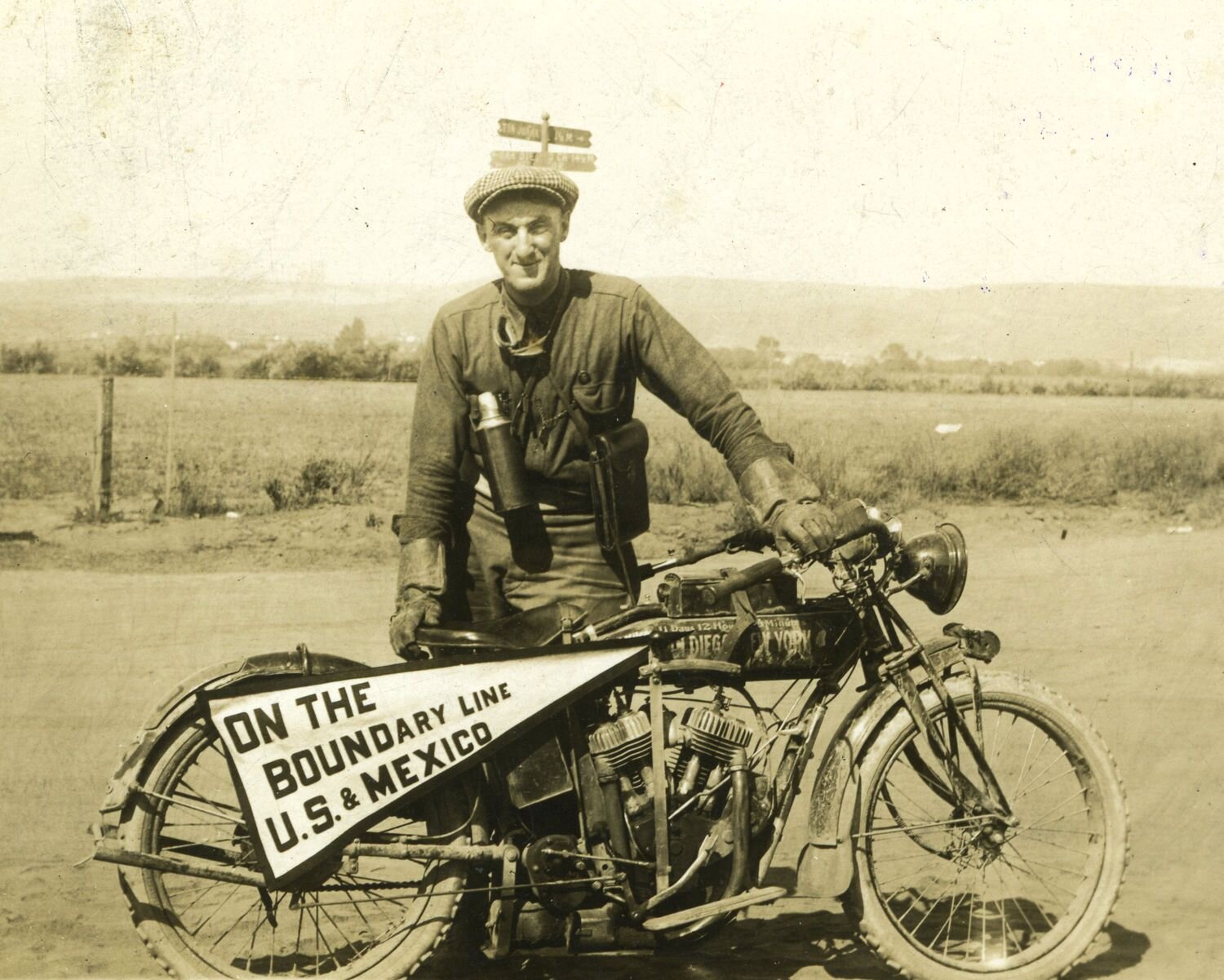
PIC_0086.JPG

Remembering C Harold Wills

He was known for an infectious and boundless energy, a sharp mind and a profound ability to transform ideas into reality.

A Wills Saint Clair 1921 Roadster

A Wills Saint Clair 1921 Roadster


THE pantheon of men and women who played a role in putting the word on wheels at the dawning of the 20th century is lengthy.

A select few such as Henry Ford, John and Horace Dodge, Louis Chevrolet and Charles Nash were awarded a dubious form of immortality as brand names. Others have faded into obscurity with the passing of time. Counted among the latter is C. Harold Wills.

Wills was known for infectious and boundless energy, a sharp mind, and a profound ability to transform ideas into reality. His mother was an avid fan of the writings of Lord Byron, specifically Childe Harold's Pilgrimage.

Childe Harold Wills despised his name and insisted that instead people use his first initial. His father was well known in Fort Wayne, Indiana as a railroad master mechanic, and began teaching his son the use of tools almost as soon as he could walk, according to stories told by Wills. At age 17 his four-year apprenticeship with the Detroit Lubricator Company commenced. In the evenings he took night courses and studied metallurgy, mechanical engineering, and chemistry. With completion of his studies he accepted a position with the Burroughs Adding Machine Company and by age 23 was employed as the company’s chief engineer.

Fortuitously in 1902 he was introduced to Henry Ford. Intrigued by Ford’s work with the building of a performance cars, Wills began assisting at nights with two legendary race cars, the 999 and the Arrow. This relationship would last seventeen years before ending in a heated argument.

As Ford’s principal shop assistant Wills’ first major contribution drew upon his metallurgical training as he worked on a means to produce lightweight, strong, nickel-chrome vanadium steel in volume. A relentless search to find a mill that would work with him led to a small company in Canton, Ohio. The new lightweight but strong steel was used in production of the 1907 Model N. He was also a major contributor to development of the Model T as it was Wills that conceived and developed its planetary transmission. As a curious historic note, he was an amateur calligrapher and designed the now legendary Ford script.

By WWI Wills and Ford's relationship was strained. Time and again Ford had claimed credit for his work and Charles E. Sorensen was hired as Ford’s right hand man. In 1919, to strengthen his hold on the company Ford began buying out shareholders. This included the Dodge brothers (John Dodge had served as the vice president of Ford). Rather than meekly submitting to Ford’s power grab Wills threatened legal action if a full accounting of the accrued profit-sharing income owed was not completed. With more than $5 million in his pocket Wills parted ways with Ford. He also had nearly $4 million from investment in steel companies that he had persuaded to produce vanadium steel.

HG1_219_e6250103-0394-4848-97b6-941667319016_2048x2048.jpg

Wills had long toyed with the idea of manufacturing an automobile of his own design. But he was a dreamer, a visionary and launching an automobile company was but one component in a much larger plan for the future. In 1920, he initiated plans to build an automobile manufacturing factory that was to be the anchor in an industrial park as well as a planned housing community for employees that included a park, schools and a complete business district with theater.

The car was named Wills Sainte Claire, after the St. Clair River that separated Marysville, Michigan from Ontario, Canada. The fatal flaw in Wills planned automotive empire was an absolute obsession to create a mechanically perfect automobile. Resultant of that attention to detail, the Wills Sainte Claire introduced in 1921 stunned the automotive community. The car was powered by the industry’s first overhead-cam V-8 designed for automotive use. It had a displacement of 265.4 cubic inches and that was rated at 67-horsepower. That engine was a refined version of an overhead valve V-8 engine Wills had designed for aeronautical application during WWI. The engine made extensive use of molybdenum steel, had crossflow induction and exhaust routing, and the block and cylinder heads were cast as a single unit.

The car was doomed from its inception. It debuted with a $3,000 price tag in the midst of a post war reception that had decimated automobile sales. As a comparison, a comparable Cadillac could be purchased for $2,800. Mechanical complexity equaled a high cost of repairs. Still, Wills had realistic expectation and set his breakeven point as 1,500 cars annually. The first year’s production was a mere 900 cars. Anemic sales, and Wills near constant improvements to the manufacturing facility and the cars fueled mounting losses. Even eye-catching plaid paint jobs were not enough to keep the company solvent and in 1927 production ceased. Only 12,000 cars were manufactured under the Wills Sainte Claire name.

Wills was out but not finished. He signed on with Ruxton to assist with development of a transmission for the front wheel drive automobile. He then went to work at Chrysler as a metallurgist. Unfortunately, his attempts to sell or collect royalties under a limited license arrangement for a patented process for production of all steel body shells were unsuccessful. Both Ford and General Motors deemed the process cost prohibitive and continued using wood framing for their vehicles. The smaller independent companies such as Hudson, Packard, Studebaker and Nash could ill afford the investment either, especially amidst the economic troubles of the Great Depression.

Interestingly enough, Wills patents expired in 1937, the year that Ford and GM introduced their first all steel bodied automobiles. It was the final chapter in an amazing automotive career. In the closing days of 1940, Wills suffered a major stroke and was rushed to the Henry Ford Hospital in Detroit. He died there before the dawn of the new year.

C. Harold Wills, a forgotten automotive pioneer.

Written by Jim Hinckley of jimhinckleysamerica.com
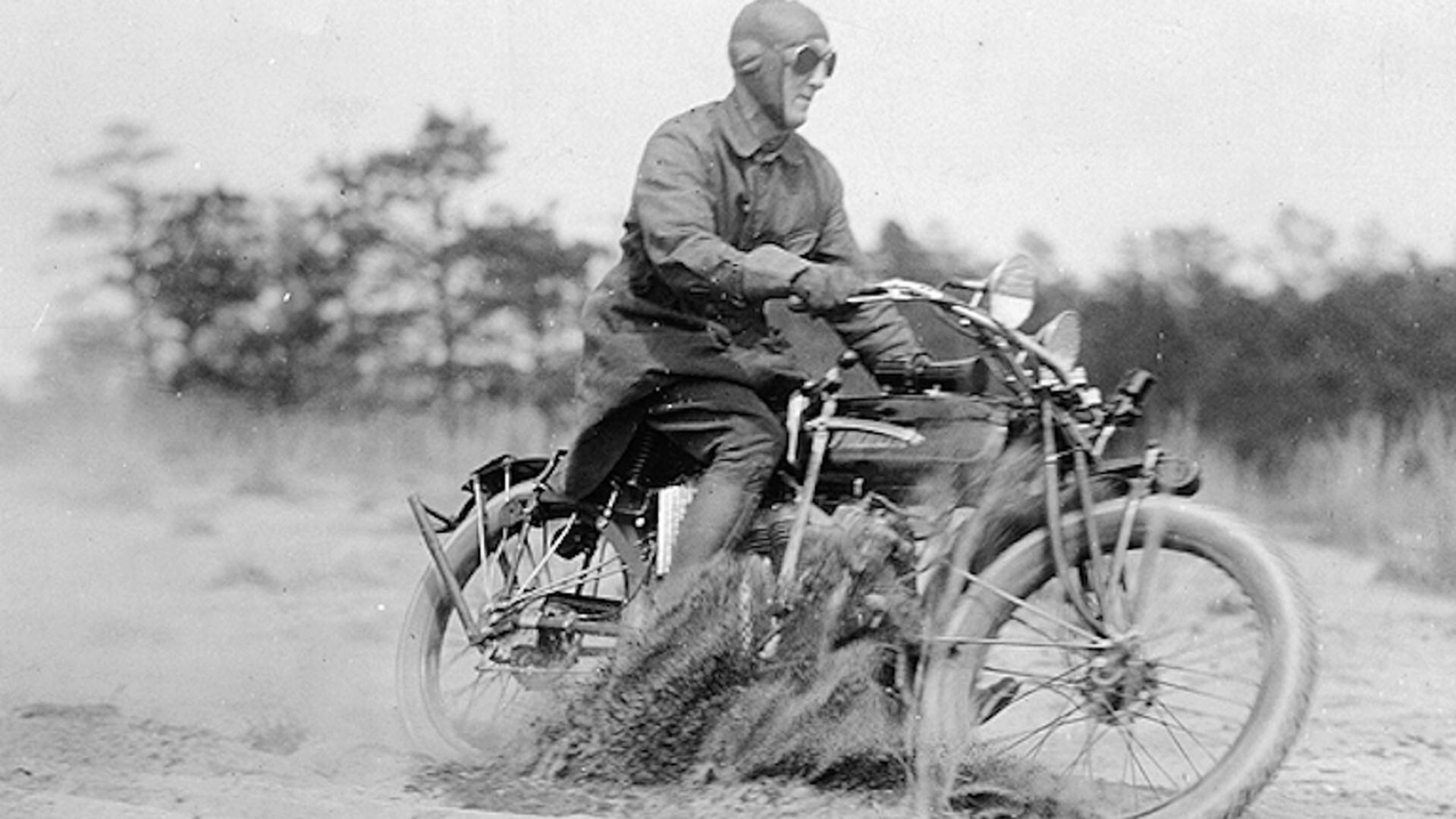
Henry Leland: The genius of precision

He came into the automotive industry late in his lifetime, but in that short span of years founded two of America’s most storied automotive brands.

A 1922 Lincoln … the brand was renowned as a producer of well-crafted luxury product.

A 1922 Lincoln … the brand was renowned as a producer of well-crafted luxury product.

“THERE is a right way and a wrong way to do something. Hunt for the right way and then go ahead.”

That was a favourite saying of Henry Leland, a truly gifted machinist, a mechanical engineer with vision and an obsessive perfectionist. It was a winning combination during the dawning of the American auto industry.

Born in 1843, Leland earned engineering degrees from the Universities of Michigan and Vermont and studied precision machining in the Brown and Sharpe plant at Providence, Rhode Island and Colt, the firearm manufacturer.

During the American Civil War, he worked as a toolmaker in the United States Arsenal. His first forays as an inventor, first with electric barber clippers and then with a unique toy train, the Leland-Detroit Monorail proved financially lucrative.

In 1890 Leland moved to Detroit and established Leland and Faulconer Manufacturing Company to build marine and stationary engines. The company soon established a reputation for quality, innovation, and precision engineering, and by the turn of the century, was also making engines for automotive application. Counted among the company’s ardent supporters was Ransom E. Olds, who had hired the company to design an engine for the Olds in 1902.

613276-970x1250.jpg

By the dawning of the new century Leland found himself embarking on a new business endeavor as financiers and bankers retained his services to appraise the assets of moribund companies that manufactured automobiles and automotive components. In 1902, he was hired to appraise the assets of the Henry Ford Company and to create a plan for making the company viable. The company namesake, Henry Ford, was incensed and left the business taking several partners with him. Leland seized the opportunity.

A devastating fire at Olds Motor Works had led to termination of his arrangement with that company. It also left him with a single cylinder engine designed for automotive application.

After appraising the company’s assets, he suggested that the investors should reorganize, use the chassis designed by Henry Ford and the engine Leland had designed for Oldsmobile. Hoping to cut their losses, and perhaps even turn a profit, the investors agreed. The new company was named for Cadillac, the French explorer that had established Fort Detroit.

Leland established unprecedented manufacturing principles that soon became industry standards. He and Ransom Olds had used interchangeable components on several vehicles but on the 1907 models of Cadillac, Leland took the concept of uniform parts to an entirely new level. The idea had originated with firearms manufacturing. Eli Whitney had displayed the advantages of interchangeable musket parts at an exhibition before the president of the United States in 1801.

On Saturday, February 29, 1908, three Model Ks were randomly selected from the stock of the Anglo-American Motor-car Company, the British agent for Cadillac automobiles. The three cars were driven 25 miles to the Brooklands racetrack and then completed 10 laps of the track, approximately 30 miles. Under strict supervision the cars were locked away until Monday, March 2, 1908. Then before an audience of reporters, mechanics, engineers, automotive enthusiasts and automobile agents, the cars were displayed and fully disassembled. Each car was reduced to a pile of 721 component parts that were scrambled into one heap. Next Cadillac mechanic E. O. Young began reassembling the cars with the help of his assistant, M. M. Gardner. By Thursday morning, March 12, the third car was completed. The following day they were all driven 500 miles.

On completion of this test, one of the cars was locked away until the start of the 2000-miles reliability trials in June, 1908. That car finished in first place and was awarded the R.A.C. Trophy for its class. Cadillac was deemed the Standard of the World.

Lincoln.jpg

In 1910, Leland began working with Charles Kettering to develop an improved electrical system. Two years later Cadillac became the first company to offer an electric starter and lights as standard equipment. But the company had been acquired by William Durant in 1909, and folded into the General Motors combine, and that proved to be a turning point for Leland’s association with Cadillac.

Durant had an abrasive and overbearing personality that had become his trademark. In late 1916, after a heated discussion about Durant’s refusal to accept a government contract for the manufacture of aircraft engines, Leland left the company. In the years that followed, Charles Nash, Walter Chrysler and others would also leave General Motors after disagreements with Durant.

And so, Leland and his son Wilfred formed a company for the manufacture of Liberty Aircraft engines in 1917. It was named for the first president Leland had cast a vote for in 1864, Abraham Lincoln. As testimony to Leland’s reputation he received the government contract to produce 6000 engines without review. But before full production could commence, the Armistice was declared, and the contract voided. This left the Leland’s deeply in debt and with a huge factory as well as a workforce of nearly 6000 men.

And so, the decision was made to shift to automobile manufacturing. Again, Leland’s reputation proved to be a valuable commodity as the initial $6.5 million capital stock offering for Lincoln Motor Company sold in less than three hours. Without a single car being produced, trade journals and automotive journals praised the Lincoln based solely on Leland’s plans for the vehicle.

Leland’s obsession with detail and extensive testing resulted in a near continuous string of delays. As a result, the new Lincoln debuted in September 1920 amid a severe economic recession and nine months after the cars planned release. Mechanically it was a technological masterpiece, powered by a 60 degree V8 engine. Seventy mile per hour speeds were guaranteed. Innovations included circuit breaker electrical system, full pressure lubrication, thermostatically controlled radiator shutters, and a sealed cooling system with condenser tank.  Prices ranged from $4500 for the Town Car to $6000 for the roadster.

The cars mechanical prowess was proven almost immediately. In April 1921, a Lincoln was driven to a first-place finish in race from Los Angeles to Phoenix. The second-place finisher arrived almost an hour later. But technological advancement, performance, and ecstatic press was not enough to overcome the delayed debut and the resultant company debt, the economic recession, the high sales price and dated styling. A mere 674 cars were sold in 1920, and 2800 in 1921.

In November 1921, the company was forced into receivership. As a touch of dark irony, the company was acquired for $8 million dollars by Henry Ford. The Leland’s were retained as consultants, and Edsel Ford was installed as president. It proved to be a short association as the company’s founders left within four months and initiated litigation to force Ford to reimburse original creditors and stockholders.

Leland’s last act was pure class. In 1931, as the ongoing legal battle with Ford continued, he wrote letters to the former stockholders, parts suppliers, and investors, and personally apologized for the fact that Ford had not compensated them as promised. He died in March of 1932.

It was truly the end of an era. Leland’s career had spanned the period between the beginnings of the industrial age to the mass production of automobiles. He had made contributions to manufacturing, to the automobile industry, to barbershops, to children’s toys and to business management. He had launched an automotive empire that would come to symbolize prestige and luxury. Leland’s contributions transformed our world. 

  To read more by Jim Hinckley go to jimhinckleysamerica.com


Edel’s grand adventure was no smooth run

It was the ultimate roadie … at a time when there were not always roads.

The adventurers took a a variety of vehicles but, of course, for Edsel there could be but one choice: the Model T

The adventurers took a a variety of vehicles but, of course, for Edsel there could be but one choice: the Model T

EDSEL Ford’s odyssey in the summer of 1915 might seem as epic as the voyages of Captain James Cook.

What the son of the great Henry Ford and his college buddies H. V. Book, Thomas Whitehead, William Russel, J. H. Caulkins Jr. and Robert Gray Jr. embarked on was a great road trip, right across the heartland of America, from Michigan to California.

This was no easy drive. After all, the first transcontinental trip by automobile had occurred a mere 12 years prior. Many companies, including Studebaker, were still manufacturing horse-drawn vehicles. In Arizona, a state that was only three years old in 1915, stagecoaches were still in use in rural areas. It would be 1936 before there was a single highway that was paved across the entire United States.   

Technically it was a business trip. The Shell Oil Company of California was a partial sponsor and in exchange they were given a promotional boost, especially with limited publication of Souvenir Transcontinental Tour: Detroit to San Francisco June 17, 1915 to July 25, 1915 after the trip. For Ford Motor Company it was also a promotional opportunity. Additionally, Edsel was unofficially tasked with the chore of evaluating Ford agencies along the way.

Cross country trips by automobile were still somewhat of a novelty. Still, Edsel and his buddies were not alone on their trip to the Panama Pacific Exposition in California. Event organisers noted that in 1915 tens of thousands of people arrived from outside the state, some by train but many came by automobile. Even though the exposition was held in San Francisco, many travelers chose to follow a southern route along the National Old Trails Road. Then as now, and in the era of Route 66, this course was the portal to the very best of the great southwest, Grand Canyon, Painted Desert, Oak Creek Canyon, Petrified Forest to name but a few attractions.

Edsel and Henry Ford with a V8 in 1934.

Edsel and Henry Ford with a V8 in 1934.

As the sons of very wealthy families Edsel Ford and his friends did not lack for funds as evidenced by their vehicles. Edsel had a new Ford outfitted with wire wheels instead of the standard wooden spoke wheels. Book and Gray started the trip in a new eight-cylinder Cadillac. Russel had a new Stutz. They had new camping gear, tools and even traveled with a portable phonograph.

The travel journal entry for Thursday, June 17, 1915, provides a glimpse of travel by automobile in 1915, and the troubles faced by Edsel and his friends. “Encountered some mud in vicinity of Saline. Ford had puncture and blow out on both rear wheels. Roads good but dusty.” The following days troubles included the Stutz running out of gas, and a couple of flat tires on the Ford. The latter led to Edsel’s purchase of hand tire pump, and a pocket lamp that ran off the magneto for night work.

On the 19th, the group managed to travel a mere 85 miles. The Stutz required roadside repair after dirt clogged the vacuum pump. The Ford became mired in the mud just 18 miles after departure, and when it would not budge with use of the block and tackle, a farmer with team was hired. Then the Ford skidded on wet pavement and broke spokes in a rear wheel.   

Even though the entries are concise, Edsel’s travel journal provides fascinating insight into the times; real world reports on the durability of certain automobile brands, on travel, on people adapting to changing times, and on a world in a rapid state of transition. “Wigwam Ranch, Colorado, Thursday July 1 – Took one hour to go four miles up long steep hill. Had to remove all superfluous weight from car such as cushions, tent, baggage, and tools. Had to carry items up by hand.”

“Williams, Arizona, Thursday July 15 – All got supplies at garage. Talked to Ford agent. Bought some gas and oranges at Seligman. Stutz broke another spring about 15 miles out and returned to Seligman. Very rough and dusty roads. Wired Los Angeles for axle parts. Day’s run 146 miles.”

“Needles, California, Saturday July 17 – Started west at 6:15 P.M. in procession of eight cars – a Jeffrey, two Fords, two Chalmers, two Stutz and a Cadillac. Thirty miles out Chalmers broke a spring. Roads in desert were fair. Stopped for midnight lunch. Played phonograph, fixed a tire. Stopped at Ludlow for gas.”

Judging by Edsel’s trip the Ford was far better suited for the grueling road conditions than the Stutz, but not as well as the Cadillac. The Stutz was plagued with a litany of problems large and small. There is no mention of issues with the Cadillac aside from tires. The Ford suffered a series of mechanical failures, not surprisingly. Some were serious but the ease of repair hints at the reasons for the popularity of the legendary Model T.   

“Dodge City, Kansas, Saturday June 26 – Had excellent lunch in Syracuse. Afterwards went to examine peculiar noise in transmission; found universal joint housing broken. Bought new one at Ford agent and installed it at the café.” “Camp near St. John, Arizona, Friday July 9 – Took car to garage in Holbrook. Had rods tightened and rear axle examined. Found chewed up ring gear and pinion. Back on the road by 1:00 P.M.” “Flagstaff, Arizona, Saturday July 10 – Found friends with Stutz at hotel. Had left them in Albuquerque as Stutz had to be shipped by rail.” 

Edsel and his friends had a grand adventure. I am confident that they talked of it often in the years that followed. Surely the trip also provided Edsel with valuable insight into the shortcomings of the Ford, and how it could be improved. Unfortunately, it didn’t provide him with the ability to buck his famous father, and so cars such as the six cylinder Ford designed by Edsel in the late teens was stillborn.

Automotive travel journals and guidebooks, as well as newspaper and magazine features written in the first decades of the 20th century are more than mere time capsules. They are fascinating windows into a world in a dramatic state of transition and a glimpse at how our now revered vintage cars were driven when still new. If you have interest in these wonderful stories, I have two great books to recommend.

VT 15.JPG

The first is Motoring West: Automobile Pioneers 1900 – 1909. This book is a compilation of articles, travel journals and factory sponsored features that together present a multifaceted picture of automobile travel in the American west in an era when roads were little more than trails.

The second book was a best seller when first published in 1916. Now being reprinted, By Motor To The Golden Gate by Emily Post is an illustrated chronicle of the odyssey that she made by automobile from coast to coast.

 To read more by Jim Hinckley go to jimhinckleysamerica.com


Going with … and against … the flow

Carl Breer and fellow Chrysler engineers initiated a series of wind tunnel tests, in cooperation with Orville Wright – yes, THE Orville Wright one - to study efficient shapes for automotive bodies.

file2.jpeg

TESLA’S Cybertruck is the latest manifestation of Elon Musk’s eccentric genius and  sense of vision.

There is, however, a question. Is a vehicle described by one leading magazine as looking as if were “dropped off by an alien race” a glimpse of the future or was it just a manifestation of eccentricity that with the passing of time will be relegated to historical curiosity?

In 1934, during the depths of the Great Depression, a vehicle that was just as futuristic made its debut and the reviews were even less favorable. And it was also a manifestation of the future as seen through the eyes of a visionary, Walter P. Chrysler.

Carl Breer, along with fellow Chrysler engineers Fred Zeder and Owen Skelton, initiated a series of wind tunnel tests, in cooperation with Orville Wright, to study efficient shapes for automotive bodies. Chrysler had built the wind tunnel at the Highland Park site, an industry first, and tested at least 50 scale models by April 1930. Engineers were not surprised to learn that the industry standard two-box design was aerodynamically inefficient. In fact, they learned that most automobiles were more efficient when turned around backwards.

The engineers also studied numerous models produced by other companies and learned that in most of these vehicles 65 percent of the weight was over the rear wheels. When loaded with passengers, the weight distribution tended to become further imbalanced, rising to 75 percent or more over the rear wheels, resulting in unsafe handling characteristics on slippery roads. 

file1.jpeg

To compensate and create a smoother ride, spring rates were higher in the rear. However, this had a mixed outcome; the weight distribution and seat position subjected rear passengers to a harsher ride on anything but glass smooth highways, a rarity at the time.

Innovative weight distribution on the new Chrysler Airflow provided the car with superior handling dynamics. The engine was moved forward over the front wheels, another innovation, and the rear passenger seating was moved so they were seated in front of instead of over the rear axle. As a result, the weight distribution had approximately 54 percent of the weight over the front wheels, which evened to near 50–50 with front and rear passengers. 

As with the Edsel introduced in late 1957, Chrysler launched an extensive promotional and marketing campaign before the public was even given a glimpse of the Airflow. Since this was the first new model of a production car that was designed with engineering focused on aerodynamics, the company launched a publicity stunt in which they reversed the axles and steering gear of a conventional 1933 model.

This allowed the car to be driven “backwards” throughout Detroit. The stunt captured the public’s attention. Related advertising campaigns including print, automotive feature articles and even short films to be shown in theatres called attention to the fact that most cars were more streamlined in the rear than the front. Promotion also hinted that soon Chrysler would introduce the car of the future, a vehicle that would transform the driving experience.

20191125_203033642_iOS.jpg

Styling for the Chrysler and DeSoto Airflow was heavily influenced by the then popular streamlining and Art Deco movements that was influencing everything from hotel construction to home radio design, logos, and kitchen appliances.

Apart from costly custom models and special orders from companies such as Duesenberg, Hudson and Packard, and the Czechoslovakian Tatra, there wasn’t a car on the road that compared with the Airflow. 

It was sleek and low, the grille presented a smooth, rounded waterfall look, and headlights were built into the fenders rather than in the conventional design of pods on stanchions or on a bar that crossed in front of the radiator. In the rear, Airflow models encased the rear wheels using fender skirts adorned with sedate but noticeable chrome accents.

Instead of the industry standard of a flat panel of glass windshield, on the Airflow two sheets of glass were used in a deeply racked “vee.”  All windows used the recently introduced laminated multilayer safety glass. And as with the Cybertruck, in a vehicle debut a professional baseball player pitched a ball into a side glass with dramatic results. While most companies were still using a metal attached to wood framing construction method, the Airflow was built entirely of steel which provided superb structural integrity. Except for the Essex Terraplane, the Airflow also possessed a better power to weight ratio almost every car in production. 

20191125_204221927_iOS.jpg

Again, just as with the Edsel, the initial models introduced in January, 1934, were plagued with an array of problems, many were resultant of the rush to production and others came about because of the significant manufacturing challenges required to mass produce such a futuristic car. The first Airflows to leave the factory had major defects such as engines that broke loose from their mounts at 80 mph. These problems as well as the resultant bad press, and the unconventional styling kept customers away in droves. Only 6212 units had been produced by May of 1934.

Publicity stunts, including rolling a car off a high embankment and driving the car away when it hit bottom, and having Pawnee Bill shoot out a tire at high speed, expensive marketing campaigns, refinements, and positive reviews were of little avail. The Airflow sold poorly, and in 1937 the company discontinued the model. As an interesting historic footnote many attributes of the Airflow would be incorporated in other models and influence automotive design and engineering for decades to come.

Today the Airflow provides a glimpse of the future as seen from 1934. And for the savvy collector that wants a vintage car that can be driven as a modern car, the Airflow is the best of both worlds.

 To read more by Jim Hinckley go to jimhinckleysamerica.com

Remembering the pioneers


Some found fame, many did not – but all left an imprint

PIC_0038.JPG

THERE were motorised bicycles and vehicles with four, six and even eight wheels. They were powered by steam, gasoline, kerosene, electricity … even oversized clock springs and compressed air.

They began as a manifestation of eccentricity and scientific curiosity but soon morphed into side show curiosity and promotional gimmick.

Then, in the blink of an eye, the automobile was a multimillion-dollar industry.

Names became brands. Streetscapes were transformed with gas stations, garages, electric vehicle charging stations, billboards, and dealerships. Society was transformed. The world of transportation was transformed. Our lexicon was transformed with the addition of words like motel. Generational businesses were decimated. Time honored careers were transformed into historic footnotes.

In 1872 Studebaker based in South Bend, Indiana was billed as the largest manufacturer of wheeled vehicles in the world; wheelbarrows, freight wagons, prams, carriages, surreys, ambulances, buckboards. In 1897 the company built the first of several prototype horseless carriages, and in 1902 their first production models, an electric designed by Thomas Edison, rolled from the factory. The company continued producing horse drawn vehicles until 1920 albeit in ever smaller numbers as the company evolved into one of the largest automobile manufacturing companies in the United States.

In 1889, Elmer Apperson and his brother Edgar opened the Riverside Machine Works on Main Street in Kokomo, Indiana. As the brothers were talented machinists and blacksmiths, they prospered and development a reputation for quality workmanship. This was the reason that an eccentric Kokomo businessman named Elwood Haynes retained their services to install a Stintz marine gasoline engine in a carriage. That horseless carriage took to the street on the Fourth of July 1894. From these humble beginnings the Apperson Brothers Automobile Company was launched. Even though it is largely unknown today, the company continued producing automobiles until 1926, and pioneered an array of developments.

PIC_0146.JPG

Clinton Woods lacked the business savvy needed to attract investors or successfully form a corporation. But he was a visionary obsessed with a simple idea; the horseless carriage was the future and the future of horseless carriages was electric vehicles. In 1899 financier Samuel Insull and several board members of Standard Oil purchased Woods designs and patents, and with an astounding $10 million in capital stock launched the Woods Motor Vehicle Company.

The company immediately began producing an electric Hansom Cab that sold well in New York and other cities. In 1900 they began producing a Victoria that was displayed at Chicago’s first auto show. It was here that the manager of the Honolulu Iron Works saw a Woods, placed an order, and imported the first automobile into Hawaii.  

The company enjoyed moderate success even though the electric vehicle was being quickly eclipsed by gasoline powered vehicles. But the companies crowning achievement was the Woods Dual Power introduced in the summer of 1916. The car used a Woods designed four-cylinder engine as an auxiliary to the electric motor. At speeds under 15 miles per hour, the gasoline engine idled and the car was driven by the electric motor. Faster speeds were obtained by using the gasoline engine with the electric motor as an auxiliary. The Woods Dual Power was a hybrid!  

Alexander Winton established the Winton Bicycle Company in 1891, and five years later took his first experimental horseless carriage for a spin. On March 1, 1897, he organized he Winton Motor Carriage Company, and to promote his new vehicle, proceeded to drive from Cleveland, Ohio to New York City. By 1899, with the production of 100 vehicles, he became the largest manufacturer of horseless carriages in America. That was also the year he turned away a young mechanic as he was turned off by his ego and launched a rivalry that would last for years. That mechanic was Henry Ford.

Winton played a pivotal role in the launching of one of America’s most famous automobile manufacturers. In 1898 car number twelve was sold to James Ward Packard who proved to be a very dissatisfied customer. During the drive from Cleveland to his home in Warren, Ohio, his new machine broke down numerous times and was eventually towed by a team of horses. Packard confronted Winton and made several suggestions for improvements. Winton was heard to say, “Mr. Packard, if you are so smart, why don’t you make a car yourself.” And so, Mr. Packard launched the Packard Automobile Company in 1899.

The establishment of automobile companies in the first years of the 20th century was a tsunami. But the market was very finite. This and a major economic recession in 1907 decimated the industry. An increased demand for vehicles, advancements in production and a growing middle class fueled another gold rush in the industry before WWII.

The post war recession and the growing dominance of major manufacturers including General Motors, Ford, Hudson, Nash, Studebaker, and Packard forced many companies to close or merge. And then came the Great Depression, and the industry that was birthed with such promise for the independent thinker was forever transformed.

Before the launching of Tesla by Elon Musk, only one man was able to successfully launch an American automobile manufacturing company after 1925 – Walter Chrysler.

  To read more by Jim Hinckley go to jimhinckleysamerica.com


Essex – all about affordability

Originally for budget-minded buyers, designed to compete with Ford and Chevrolet, Essex found great success. This story continues from last week’s ‘Roscoe Jackson – consumed by ambition.’

9640323352_1ec121f8b0_b.jpg

THE introduction of Essex in 1919 as a separate company that was in essence a lower priced companion model to Hudson left American Motors sited.

Primarily, it was in excellent position to garner a larger share of the market as the economy recovered from the post war slump.

Though priced $US900 more than a Ford, the Essex sold briskly. Further fueling sales was the introduction of a closed sedan with a price of just $US1495. No other manufacturer was offering a closed car at this price.

Essex dealers were encouraged by Hudson to capitalize on the growing reputation for speed and endurance, the unique F head engine, and the familial association with Hudson.

Some ambitious dealers were so inspired by this message they staged speed and endurance tests in demonstrator models with customers on board!

For the abbreviated model year 21,879 cars were sold in 1919. With minor changes to styling, and slight improvements mechanically the Essex remained relatively unchanged until 1924 when the then legendary F-head four-cylinder engine was replaced with an all new L-head six-cylinder.

Essex_Coach.jpg

The Hudson built engine offered features unheard of in a mid-price automobile. Deeper oil trough to improve lubrication for the rear main bearing on steep grades. A fully balanced three bearing crankshaft. Aluminum pistons. Roller valve lifters. Automatic spark advance. A cast enbloc intake manifold. The styling was also all new.

It proved to be a winning combination as 74,523 vehicles were shipped to dealers in 1924. Meanwhile, the parent company, Hudson, was positioning itself for a mid-decade surge with all new models and the introduction of technologically advanced features.

In mid-June 1923, for the 1924 model year. Hudson a fully restyled car with an array of mechanical improvements from engine to suspension. More than 59,000 models sold. The stage was set for Hudson to become a dominant manufacturer.

For calendar year 1925, 269,474 Hudson and Essex automobiles rolled from the factory. This placed Hudson Motor Company in a solid third place position behind Chevrolet and Ford. But this was only the beginning.

With profits exceeding $14.5 million the company initiated aggressive expansion. An all new $3 million body plant was built. An additional $7 million was spent to modernize and expand production, improve the engine casting facility, and develop a training program for dealers and their mechanics. The line between Hudson and Essex was blurred in 1927, but the Essex continued to outsell its parent.

9060800345_4476b36c93_b.jpg

The year 1929 was pivotal for the company and for the world. The boom times of the 1920s were largely fueled by expansive corporate loans and the introduction of consumer financing programs such GMAC.

Still, in rural areas, the post war collapse in agricultural prices had devastated local economies and for most of the decade small town banks failures were a common event. The decline in agricultural prices also resulted in a marked decline in exports to countries such as Australia where wool prices had plummeted.

Through the closing years of the 1920s, Hudson continued to dominate motorsports. And this translated to sales. For 1929 the company set a new sales record with more than 300,00 Essex and Hudson units produced. This as also the year the company dropped the time honored Super Six and began promoting new models as the Greater Hudson.

Marketing touted 64 improvements as well as a long list of new standard options including electric gas and oil gauge, windshield wiper, electrolock anti-theft device.

Essex mirrored Hudson for 1929. Distributors were encouraged to stage well publicised demonstrations that highlighted braking and acceleration. With an improved engine, lower rear axle ratios and all new carburetion, the Essex was also promoted its fuel economy, 20.35 miles per US gallon. All of this marketing was enhanced with the setting of records and entry into racing as well as hill climbing events.

The stock market crash in October of 1929 heralded the dawn of a deteriorating economic climate. It would be two years before the full impact of the decline was made manifest.

8388054016_68fb56dfb8_b.jpg

In the meantime, Hudson introduced an all new line of vehicles for 1930 that had been on the drawing board since 1927, this included the stunning Model T and Model U powered by an all new in-line eight-cylinder engine. Even though Essex was not given such dramatic improvements, there were enough changes to the body as well as mechanics to warrant promotion of an all new model.

But the economic downturn, magnified by the growing environmental catastrophe that was a significant drought leading to the Dust Bowl and massive displacement of people in central farming states, was decimating sales throughout the industry.

For calendar year 1931, only 40,338 Essex automobiles rolled from the factory. Hudson fared even worse with only 17487 vehicles shipped to dealers.

But as bad it was for this company; Hudson was in a better position than many manufacturers. Studebaker, production, of all lines, was a mere 44,218 models. Ford, in 1929, produced 1,507,132 passenger cars. In 1931 production plummeted to 541,615 vehicles.

Unlike a number of manufacturers Hudson would survive the ravages of the Great Depression. They would continue to be an industry leader with innovation, and they would continue setting records for speed. They would even enjoy a short post WWII renaissance. But the company would never eclipse the sales successes of 1929.

 To read more by Jim Hinckley go to jimhinckleysamerica.com


Roscoe Jackson – consumed by ambition

The story of American Motors, the last independent manufacturer to challenge the big three.

Hudson knew how to impress the customer when it came to displaying their cars.

Hudson knew how to impress the customer when it came to displaying their cars.

AS with so many tales told of the origins of the American auto industry, this story begins with one man.

By all account, Roscoe Jackson was a gifted young mechanical engineer. He joined the Olds Motor Works in 1902 as part of a team of youthful visionaries that included Roy D. Chapin, Howard E. Coffin, James J. Brady and Frederick O. Bezner. Together they would transform the automotive industry.

But Jackson was also a man consumed with ambition. His career at Olds was meteoritic and within five years he had risen through the ranks to the position of manager at the main assembly plant. Meanwhile, spurred on by Jackson, Chapin, Coffin and Brady began laying plans to launch a company of their own. In 1908, shortly after marrying the niece of Detroit retail magnate Joseph L. Hudson, they brought Bezner who had left Olds for a position at Chalmers-Detroit into their planning session.

With his father in law as a major investor Jackson and his cohorts took the plunge. An article dated June 19, 1909 in the Saturday Evening Post noted the formation of a new automotive manufacturing company in Detroit – Hudson. Initially Jackson served as the company’s general manager and treasurer. The partnership was short lived. Within two years Coffin and Bezner cashed out and left the company. Chapin assumed control of Hudson product management. Jackson assumed control of most other aspects of the company from engineering to production.

From the date that the first car rolled from the factory on July 8, 1909, the company reputation for speed and durability began to grow exponentially. Before WWI, Hudson consistently ranked in the top ten American automobile manufacturers, an amazing feat considering the fact that there were literally dozens of companies producing automobiles.

 In 1916 shortly after introducing the now legendary Super Six, Chapin and Jackson rebuffed a proposal to merge Hudson with Willys-Overland and Chalmers. Instead they initiated a series of meetings with plans to merge Hudson with Dodge and Continental as well as Timken, the leading manufacturer of automotive bearings. The mergers were stillborn and so Hudson was reorganized with a new stock issuance that made Hudson's surviving founders fabulously rich men. In 1923 Chapin resigned but assumed a position as chairman of the board. Jackson assumed Chapin’s former role as president.  

In March 1929, Jackson died suddenly of influenza while on a trip to Europe. But Hudson was only one facet of his legacy. In the early 1920s, Jackson and several wealthy Detroit tycoons including Edsel Ford began vacationing along the coast of Maine near Bar Harbor and todays Acadia National Park. One year while on vacation they came to know the former president of the University of Maine, a Harvard-trained biologist and medical researcher named Clarence C. Little.

Little was a pioneer in the development of cancer research and at the time of the first meeting with Jackson and Ford, was in the planning stage of establishing a research laboratory on the Maine coast. This was to be an expansion of the cancer research facility he had established at the University of Michigan. Impressed with his work, Jackson, his brother-in-law, president of the expansive Hudson retail businesses, Richard Webber, and Ford become benefactors to Little's University of Michigan of facility. In 1929, shortly before his death, Jackson agreed to underwrite establishment of the Maine facility in Bar Harbor. Stunned at the abrupt loss of their key supporter, Little and the board unanimously agreed to rename the research unit the Roscoe B. Jackson Memorial Laboratory.

Jackson died four months before the 20th anniversary of Hudson. It was a tumultuous time for the company. Chapin had accepted appointment as Herbert Hoover's commerce secretary, a position fraught with scandal after he organized a “to big to fail” campaign to bail out key Detroit banks, many of which were affiliated with the Guardian Group, an organization that was chaired by Chapin. With the election of Franklin D. Roosevelt, Chapin returned to a position of management at Hudson.  

Hudson was greatly diminished by the time this 1937 model arrived.

Hudson was greatly diminished by the time this 1937 model arrived.

The leadership void created by Chapin’s departure and Jackson’s death, coupled with the deteriorating economic climate had left Hudson in a precarious financial position. The strain of restoring the company to solvency was credited as a contributing factor in Chapin’s death at age fifty-six in 1936.

Hudson would survive the Great Depression. But as with Studebaker, Nash and Packard, the company was greatly diminished. In the post war years there would be numerous successes such as the introduction of the legendary Hudson Hornet. Still, by 1950 it had become increasingly apparent that the company could not successfully compete against the big three auto manufacturers. Survival required hard decisions and the board of directors turned toward the idea of merger for the first time since 1916.

President George Mason of Nash initially planned a merger with Packard in 1948. He and the President of Packard James Nance had created a proposal but neither man was able to finalize the plan with their respective board of directors. In 1954, Mason’s second attempt was more successful when he facilitated the merger of Nash-Kelvinator Corporation and Hudson Motor Car Company to create American Motors. Mason envisioned this as the first step in the building of a powerful automobile manufacturing combine that would also include Packard and Studebaker.

The brilliant strategy came up short when Packard merged with Studebaker two months after the formation of American Motors. The plan to merge the four companies died with Mason on October 8, 1954. When George Romney, former vice president, assumed the leadership position he terminated discussions to merge with Packard-Studebaker, and began focusing on making American Motors a contender.

First, he phased out the Nash and Hudson names in late 1957. Next, he focused all resources on the development of the Rambler. The success of the small car that was in stark contrast to the large chrome bedecked and finned cars that were rolling from the factories of Ford, Chrysler and General Motors was aided in part to a major economic recession. In 1959 a Rambler won the 1959 Mobil Economy Run as well as accolades from numerous automotive publications. Incredibly by 1960, Rambler by American Motors was the third most popular brand of automobile in the United States, behind Ford and Chevrolet. Chrysler was a distant fourth.

To compete Chevrolet unveiled the Corvair and then Chevy II. Ford unveiled the Falcon, and Chrysler the Valiant and Dart. These cars were the ghost of Christmas future when a decade later an energy crisis would leave manufacturers scrambling to recreate what AMC had done in 1958.

And it all began with one man, one visionary that inspired others to transform a dream into a reality. Roscoe Jackson, the forgotten pioneer with a legacy that bridged the modern era with the origins of the American auto industry.

 To read more by Jim Hinckley go to jimhinckleysamerica.com


A hallmark for low price, good quality

The Hudson Motor Car Company was the brainchild of four talented young engineers.

IMG_3394.JPG

THEY stopped making cars in 1957, yet the make remains a legend, with a significant enduring fanbase.

For decades, their cars set speed records, featured advanced engineering, and provided customers with stylish durable transportation.

The brand enjoyed an enviable brand loyalty that proved crucial for survival during the Great Depression.

And for a new generation, this marque has been forever linked to Route 66 as result of achieving a starring roll the animated Cars movies.

It is, of course, Hudson.

Fortuitously the company was named for the primary investor, Joseph L. Hudson, owner of the largest department store in Detroit.

The Hudson Motor Car Company was the brainchild of Roscoe Jackson, Roy Chapin, Howard Coffin and George Dunham, talented young engineers that had launched their automotive careers at Olds. Dunham and Coffin further perfected their skills at companies such as Thomas-Detroit and Chalmers Detroit. Their goal was an ambitious one, build a durable and stylish automobile that could be sold for under $US1000.

Launched in 1909 against an ever-rising tide of automobile manufacturers, including Ford Motor Company that had recently introduced the Model T, Hudson Motor Car Company stunned the industry with its immediate success.

745px-Hudson_Super_Six_car_in_front_of_State,_War_and_Navy_building,_Washington,_D.C._LCCN2016824660.jpg

The Model Twenty was an instant hit with the consumer. Available only as a roadster the 20-hp, four-cylinder cars were marketed with a 50mph guarantee and a $900 price tag. The price included headlamps, dual side lamps, generator, three speed transmission, tool set and horn. They were available in but one-color scheme, dark maroon with black striping, black fenders, and the interior was dark blue leather. The options list included Bosch magneto, windshield, rumble seat and twenty-five-gallon fuel tank.

In 1910 4508 vehicles were produced. This was a new first year record for an automobile manufacturer. Production in 1911 increased to 6486 vehicles, and Hudson found itself in an enviable position, they had outgrown their production facilities within two years.

A new facility was built on a 22-acre parcel at Jefferson Avenue and Conner Avenue in Detroit diagonally across from the Chalmers Automobile Company factory and sales continued to climb.

Management was not content to rest on its laurels and in 1911 the Howard Coffin designed Model 33 was introduced. Buda was replaced by Continental who manufactured the revolutionary engine with balanced crankshaft to Hudson specifications.

The signature clutch with cork face in an oil filled unit that would be a Hudson standard for decades was introduced in the Model 33. The following year the company continued offering this model with limited mechanical changes, but the big news was that it was now available in seven body styles including the Mile A Minute Roadster.

The company had moved far beyond its original plan of offering cars for a $1000 price. For 1912 the most reasonable model was the three door Torpedo with a list price of $1600.

WarrenBrothers_LincolnME_1949.jpg

Then, in 1913, with introduction of the four-cylinder Model 37 and six-cylinder Model 54, the company was able to expand the list of available body types and offer a vehicle in the mid-price range or the luxury market. The base Model 37 coupe had a factory list price of $1400. At the opposite end of the spectrum was the Model 54 seven passenger limousine priced at $3750.

For 1914 the company began promoting themselves as the largest manufacturer of six-cylinder automobiles in the world, and discontinued production of four-cylinder models.

But the big news came in 1916 with the introduction of the astounding Series H Super Six with the first Hudson built engine, a car that would transform the company and the automobile industry. Even though it continued to be refined and improved, the Super Six would remain the company’s foundation into the early 1950s.

After a series of impressive wins on various tracks, the eagerly anticipated car drew immediate attention for its styling as well as mechanical prowess when it was officially introduced in January 1916 at the New York Auto Show. For the remainder of the year the company fueled media attention with an array a record setting races, and endurance runs.

One of the most astounding was a transcontinental drive from New York to San Francisco in five days, three hours and 31 minutes. Then (after an eight-hour break) the team returned to New York in just over six days. Incredibly, aside from issues with tires, both trips were completed without mechanical failure.

IMG_3386.JPG

Before the end of the year drivers behind the wheel of a Hudson Super Six had shattered numerous records including the Pikes Peak Hill Climb and the stock chassis 24-hour record with an average speed of 74.9mph. This record stood until 1931 when it was eclipsed by a V16 powered Marmon.

Record setting wins translated into sales and fierce brand loyalty. Sales remained steady through the WWI years, and only dipped slightly during the post war recession. Exemplifying the durability and racing prowess of the Hudson was the 1919 Indianapolis 500. Ira Vail rolled across the line in eighth place with an average speed of 94.1mph. Denny Hickey finished with an average speed of 80.22mph. Ora Haibe started in 26th place and finished in 14th but the most astounding fact was that each of these contenders was driving a used Hudson. The newest one was a 1917 model.

As the price for a Hudson had continued to climb the company introduced the Essex as a lower priced companion car in 1919. The Essex had a sales price $700 less than the base model Hudson. Even though it was a bare bones vehicle that lacked some of the amenities Hudson owners had come to expect the car was a proven performer.

IMG_3385.JPG

Under strict AAA supervision a stock 55-horsepower, four-cylinder Essex was tested at the Cincinnati Speedway in December 1919. In 50 hours, the car was driven 3037.4 miles for an average speed of 60.75mph.

In 1920 a brilliant promotional initiative was launched. The drivers and relief drivers of four Essex cars were sworn in as US post Office letter carriers. Then a bag of mail was loaded in each car, two on the west coast and two on the east coast. The average time for completion of the coast to coast run was an astonishing four days, twenty-one hours, and thirty-two minutes. Not surprising is the fact that by the beginning of 1921 the Essex was outselling its parent.  

But this was just the beginning.

Part two next week.

 To read more by Jim Hinckley go to jimhinckleysamerica.com