Gymkhana star car also a sneak peek?

US media wonder if the wildest WRX ever built is a test bed for the next STI’s engine.

Screen Shot 2020-12-09 at 10.20.28 PM.png

MORE than just a great video – perhaps also an ultimate pre-release test for the engine set for the next Subaru WRX STi.

So goes speculation in respect to the powerplant in the STI Travis Pastrana’s drives to the limit – and occasionally almost beyond – in the latest of the wild Hoonigan videos, Gymkhana 2020, released today.

Concurrent with the film’s release, Subaru of America has released information about the American driving talent’s brand-provisioned car and the engine under the bonnet – an all-new 2.3-litre boxer four-cylinder making 642kW, the work of Subaru Motorsports USA and technical partner Vermont SportsCar.

As astounding as the output is – and no WRX has had more - it’s the engine’s capacity that has raised even more interest. 

 Subaru does not have a 2.3-litre turbocharged boxer engine in any of its cars; however it’s speculated that the next-gen STI, due out in 2022, will have a version of the new 2.4-litre that runs in the US market Ascent SUV and will debut here next year in the new Outback.

US website TorqueNews says reports “from many sources” say the next-generation Subaru STI will be powered by an Ascent-sourced engine, but with plenty of Subaru Tecnica International upgraded internals to produce close to 390kW.

It speculates “Subaru would use the 2.4-litre turbocharged engine in the 2022 WRX and possibly the all-new 2.3-litre … in the STI. This new engine would give separation to the two performance models, like the current generation.” 

Adds the website: “The Gymkhana STI is the perfect car to test the new powerplant’s reliability and performance capabilities. It gives Subaru plenty of time to tweak the engine before the launch of the next-generation model.”

As you can see from the film, Pastrana gives his new ride a total workout in stunt sequences with planes, boats, action sports athletes, and significant landmarks in the driver’s home town of Annapolis, the historic capital of the US state of Maryland. 

The high-flying gap jump over a racing speedboat that kicks the action off is over Annapolis’ famous Ego Alley waterway.

Subaru says they started with a production Subaru WRX STI shell. The car was fully caged and lightened to just 113kg. That’s around 360kg lighter than a standard STI as sold in the US.

Screen Shot 2020-12-09 at 10.15.54 PM.png


Bentley’s assault with battery outlined

It all starts with a slightly lofty, swoopy sedan with leading edge tech smarts.

EXP100GTPartners(6).jpg

IMAGINE the EXP 100 GT concept as a four-door sedan with a crossover stance and, according to an overseas report, that’s a fairly accurate representation of the direction being taken by Bentley’s first full electric car.

The pioneering model will be the first of a number of battery-reliant products the Volkswagen Group-owned high-brow Brit brand will deliver into showrooms from 2025, according to latest information rolling out. 

This builds on the November 5 announcement that Bentley will drop all combustion engines in the next decade, will produce plug-in hybrid and all-electric cars starting in 2026 and aim to be all-electric from 2030. 

A new report by the website for top British motoring weekly Autocar suggests Bentley’s first EV will be in the same vein as a Jaguar I-Pace; standing slightly taller to accommodate the underfloor batteries. However, it won’t push up to the extent of a traditional SUV.  

It will also be an electric with a smart edge, being one of the first cars to use a new Audi-developed luxury car platform. 

The architecture is from Project Artemis, an Audi-led initiative aimed at developing new technologies for electric, highly automated cars. 

Artemis cars – the Bentley, an Audi and probably a Porsche at this point - all base off a single reference, which VW Group has recently identified as Landjet, that is less an underpinning in an engineering sense and more a technology set.

BentleyEXP100GT(5).jpg

Landjet will enable 5G connectivity functions, including extensive use of ‘car-to-X’ features, over-the-air upgrades, and augmented reality, as well as top-of-the-line battery cell, electric drivetrain, and autonomous driving technology.  

Bentley’s specific model plan, Beyond 100, is already under way with two plug-in hybrid models coming out next year, but the bigger step is that breakthrough electric vehicle, coming to market in 2025.

It will have more generous ground clearance than the EXP 100 GT, a highly-acclaimed styling study Bentley revealed last year, but will draw design cues from that car (seen here) and might also have some links with an Audi concept of 2018, called Aicon.

Bentley bosses are not expecting a major leap in battery technology any time soon so the firm’s first electric models will be designed to match the range and weight limitations of current systems with Bentley’s luxury positioning, the report says. The result will be models that differ significantly from Bentley’s current line-up.

Bentley chairman Adrian Hallmark has told Autocar his company hasn’t decided whether future electric models will take on the nameplate and lineage of existing combustion-engined cars.

“Our position is to look at customers and segments. As well as moving to electric, we’re going to adapt our product range because the world is changing.

 “We want to appeal to more women and be more relevant in future urban environments which are very much different to today, and we want to appeal to modern luxury values which are different to ones from 20 years ago.”

Bentley’s ambition synchs into Volkswagen Group’s broader strategy to become a leading producer and seller of electric, connected cars. The Group has set a target to sell about one million electric cars per year by 2025.

GQawardsHERO.jpg


Wham bam grand slam ‘super’ Ram for right-hand drive


Australian website says the 523kW TRX monster model is among variants of the new-gen Ram 1500 that’ll be on sale next year.

RM021_565FNhdqi156ekf7t11fvbm0fn373ma.jpg

 RAM-BUNCTIOUS stomp is part of the scenario when New Zealand switches across to the latest generation of Fiat Chrysler’s giant pick-up truck – with confirmation that the TRX supercharged flagship is in the mix. 

The monster truck rival to the Ford F150 Raptor is powered by a supercharged 6.2-litre Hemi V8 – shared with the Dodge Challenger Hellcat and Jeep Grand Cherokee Trackhawk – with an astonishing output of 523kW and 881Nm.

 Even though the TRX is bluff, massive and weighs 2.7 tonnes, Ram claims it’ll still hammer out the 0-100kmh dash in 4.5 seconds and the quarter mile (400m) run in 12.9 seconds at 174kmh. Top speed is rated at 189kmh. That makes it one of the world’s fastest production pick-ups.

Talk of the TRX being in the mix comes as production transition from the Ram 1500 offered brand-new to Kiwis now – the old DS generation model that still circulates Stateside, but as a ‘classic’ variant – to the latest ‘DT series’ RAM 1500 that introduced to America over a year ago is all but complete.  

The Melbourne facility where factory-fresh product is converted into right-hand-drive format for New Zealand and Australia is deep into re-jigging for the new model, which is far more advanced than the one Kiwis are enjoying – and still can. DS availability will continue, in a lower price slot than DT, which can be expected to deliver with a bigger sticker than the current range carries, a reflection of it being vastly more modern. Regardless, with DT comes a new opportunity that’s sure to create extra excitement.

RM021_560FN9sr9l6v3tovghtr7uqed2bnvta.jpg

According to Australia’s CarAdvice website, the TRX has been signed off for right-hook reconfiguration, initially as a limited production run from next year. Two are arriving within weeks for early tooling and engineering work.

The website says Ram Trucks Australia has advised its dealers to initially expect a limited run of 200 to 250 vehicles priced between $NZ189,000 and $NZ210,000 – making it the priciest Ram ever offered here, assuming it will be.

 New Zealand’s Ram distributor, Ateco, has yet to speak about the programme and whether it is involved. Given the interest in Ram here, however, it’s difficult to imagine why they wouldn’t want to be.

RM021_576FNd7b9mrkc4frsnki1fg400o1o7o.jpg


Pluses, no penalties, with driver monitoring app

Insurer-promoted tech will only reward.

Less proficient drivers who do not score well with the app won’t be penalised, Tower assures.

Less proficient drivers who do not score well with the app won’t be penalised, Tower assures.

A LEADING car insurance provider proposing customers adopt phone app that judges their driving style and rewards good habits with a discount on car insurance has assured those who don’t make the cut won’t be censured.

The possibility of drivers being hit with elevated excesses on strength of how they are scored by such technology has become an experience for motorists in the United States.

The GoCarma app advocated by Tower Insurance here appears to be among those available to America’s motoring public, and Tower has confirmed it can access and assess the driving habit data accrued about individual users.

But it has no intention of penalising those who are shown up for doing poorly. 

“If poor driving behaviours are detected it won’t impact the premium that you pay,” a spokesperson said today. 

 “You will earn a lower score on the app but this won’t impact any currently agreed premium. Your score will not affect the premiums you pay or any other conditions of your policy cover.”

 The potential of that was raised in a recent assessment by a top US publication, Forbes magazine, which reminded its readers that data from phone-tracked metrics are commonly shared with the app provider and can work both ways in the US.

It concurs with the proposal that a system that rewards with lower premiums for better driving can be a smart way for good drivers to take advantage of their daily safe driving skills and highlights that, in the US, such apps stand as a useful tool for parents to track new drivers’ behaviour, particularly teenagers. 

However, in the US, there is a catch: Some insurance companies will increase premiums if a driver on the policy scores poorly, Forbes says. 

Its advice: “If you are interested in usage-based insurance, check with your insurer to determine if bad scores will result in higher rates.” 

Tower is thought to be the first insurance provider to tout this technology to Kiwi motorists.

Questions about the potential of penalties, and also much data accrued by individual motorists is used by insurers and how often it is collated, were put to Tower via Auckland public relations firm, We Are Pead, which sent out a release on the insurer’s behalf yesterday. 

It assured there will be no brickbats – just bouquets.

GoCarma works on Android and IOS (so Apple) systems and is operates via Bluetooth. It monitors driving habits in areas like acceleration, braking, cornering and driver distraction (including phone use). 

The PR material says every time users make a trip the app, which is available to people who aren’t customers of the company as well as those who are, scores their driving out of 100 and provides them with personalised feedback on their habits and where they can improve.

Tower specifically says that for its customers, the app can help reduce their insurance excess based on how safely they drive as certain scores will earn them discounts. Scores of 70 plus, 80 plus and 90 plus would earn $100, $200 and $300 off the excess respectively.

Tower acknowledged it has access to the GoCarma data.

“The users’ data is security managed with Tower's app partner. Tower use the driving info to improve the scoring, product development and offer targeting.  

“The data is collected and collated in real time so customers can see their score in the app shortly after they finish their drive.” 

It suggests its concern is that, as much as most Kiwis think they are great drivers, the country’s road toll suggests many over-estimate their abilities.

It says its own research shows nine out of 10 people believe they drive better than the average New Zealander and that just one percent are willing to admit their driving is below average. Almost all – 96 percent - reckon other people need to sharpen up.

Tower does not say how expansive its research programme was but suggests the results show men to be more likely to rate their driving as above average (92 percent) than women (86 percent), and that Kiwis aged 21-30 and 61-70 rated their driving skills highly with 92 percent in each group rating themselves above average.

Tower managing director Michelle James acknowledges in the release that tracking and assessing driving skills has become normalised in insurance in the United States and England. 

She expressed confidence 82 percent of drivers will possibly or absolutely use an app to track their driving, while 85 percent have indicated they’ll give it a go if it leads to better premiums and rewards.


Aston builds a booze bus

DBX by Bowmore is fuelled by the maker’s association with the well-known maker of single malt whiskey.

QbyAstonMartinDBXBowmoreEdition_1.jpg

DRINK drive sensitives are potentially never higher than at this time of the year, so perhaps announcement of an Aston Martin that earns ‘limited edition’ status through a tie-up with a high-end whiskey is bound to raise … well, eyebrows as much as any cheer. 

Aston has explained the impetus for the Bowmore Edition of its DBX sports utility all about capturing the essence of two luxury British brands. 

Bowmore is a known single malt whiskey distillery, sited in Islay, Scotland.

This version of the $330,000 DBX, Aston’s first SUV and considered vital to its maker, was created by the in-house bespoke service, Q by Aston Martin, and only 18 will be made. 

Although Bowmore Edition models are globally available, part of the buy-in is that an owner achieves delivery during a private lifestyle experience at the distillery.

“Aston Martin DBX has provided the perfect canvas for the highest level of Q by Aston Martin customisation,” Aston Martin boss Marek Reichman is quoted in an overnight release.

QbyAstonMartinDBXBowmoreEdition_5.jpg

“The Aston Martin and Bowmore brands share the same vision of creating timeless beauty and a lasting legacy, loyal to their heritage but also embracing new methods and this is reflected in the DBX Bowmore edition.”

A car fuelled by whiskey isn’t to be taken literally – the DBX’s V8 drop of choice is s high octane petrol – but there are plenty of cues.

For instance, Bowmore-branded strips from the copper whiskey stills are inlayed into the side strakes and Bowmore Tweed accents the interior.

Inside, there are polished copper cup holders, while the sill plaques are made from recycled copper from the Bowmore still.

There’s also hand-laid copper foil detailing on the gloss black centre console trim inlay, and each car features a selection of specially designed Q by Aston Martin accessories such as the Bowmore tweed picnic blanket and leather holdall.

One of the bespoke paint colours is called Bowmore Blue, while the other is Xenon Grey.

“We cannot wait to welcome each of the owners of this beautiful car to our distillery on Islay and show them all that Bowmore and our island home have to offer,” says Francois Bazini, global managing director of Scotch at Beam Suntory, owners of Bowmore.

“Although we make entirely different products, our shared values and passion are very much aligned so you can expect more exciting announcements in the future.”

Customer deliveries are planned to take place in the final quarter of next year.

QbyAstonMartinDBXBowmoreEdition_2.jpg


Electric Toyota, Lexus just a year away?

A line drawing and a shadowy image are the latest elements of an information rollout about the new platform-sharing products.

The Toyota BZ series (above) and the as yet unnamed Lexus base off a common platform.

The Toyota BZ series (above) and the as yet unnamed Lexus base off a common platform.

Lexus hint.png

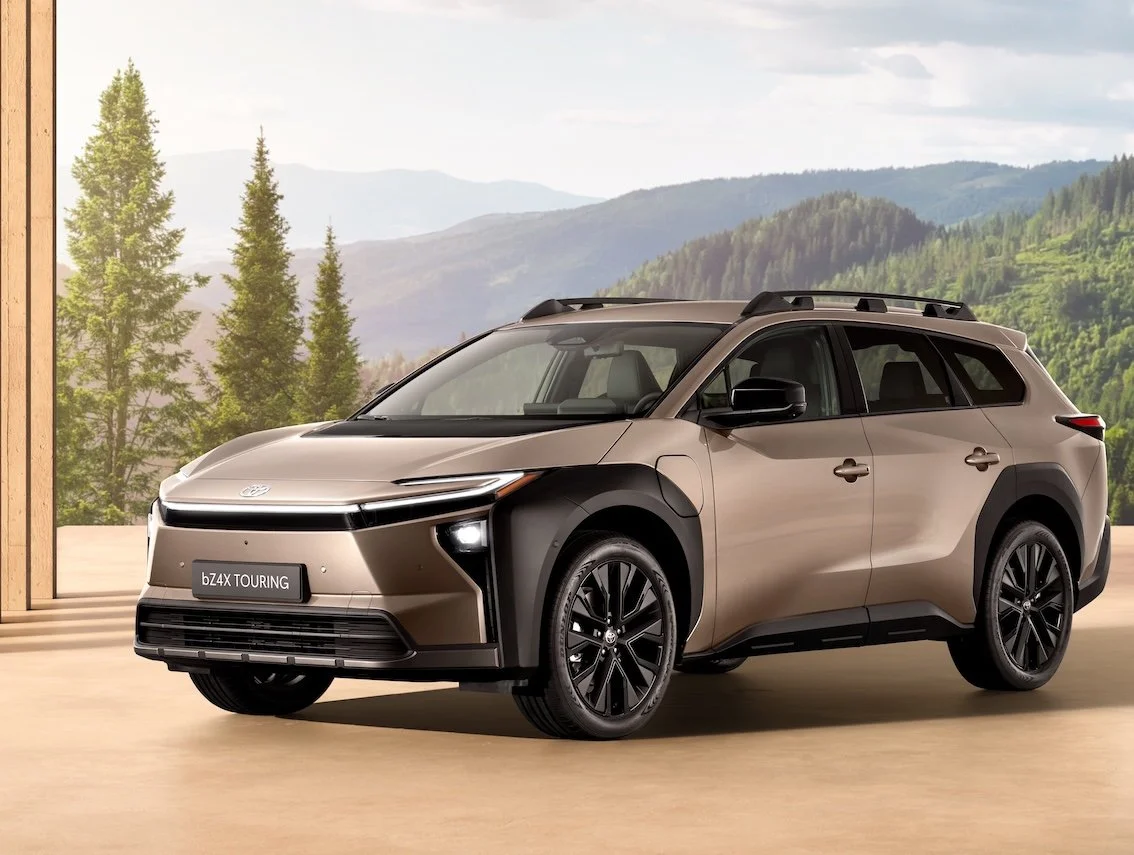
TOYOTA and upmarket spin-off, Lexus, have released additional clues about their first bespoke electric cars, developed off a common platform for potential release next year. 

The brands have each released shadowy images giving a hint of how the Toyota BZ - for ‘beyond zero’ – series and the as-yet-unnamed Lexus will look on release, with industry experts immediately seeing some styling connection between the latter and the LF-30, a concept Lexus displayed at the 2019 Tokyo motor show.

Toyota’s been slow to join the electric car field and for a long time was historically disparaging of the technology, saying it was an unnecessary stop on the journey between the mild-hybrid (so, non-mains replenishable) tech that kicked off with the first Pruis and now proliferates its family and is Kiwi-favoured, to the ultimate future of hydrogen fuel cell motivation.

However, that sentiment ceased when new boss Akio Toyoda took the reins; these brands now have more plug-in hybrid cars – which do rate as EVs – and also have developed the NX300e, a fully battery-reliant version of the smallest Lexus crossover, coming on sale in New Zealand next year. 

The latest announcement from Toyota overnight represents further confirmation of a bigger investment into battery driving.

 Even though the platform they build upon appears related to the new TNGA underpinning now used by many popular Toyotas, these are not conversions of existing products but new cars designed from the get-go to only be compelled by batteries. In short, they’re bespoke. 

Overseas’ reports suggest the BZ series and Lexus are timed to make their public emergences at a common time, but no-one yet quite knows when that will be.

However, 2021 is looking good. Toyota says that it will announce final details on the BZ “in the coming months” and that the model “has already been developed and is being readied for production”. 

Toyota New Zealand’s boss Neeraj Lala, in an interview in June on his first day as chief executive, promised “we’ll have an EV here within the next 18 to 24 months. Just in time for demand.”  

He would not be drawn into saying which badge that tech would sit behind. In hindsight, it’d surely have to be both. 

the LF-30 concept was revealed last year.

the LF-30 concept was revealed last year.

A strong styling feature of the Lexus concept is an aggressive bonnet lip over what seems to be a typically complex ‘spindle’ front grille. 

The BZ, meantime, is are expected to roughly the same size as the RAV4 SUV - although the wheelbase is almost certainly likely to be longer than that of the conventionally-powered vehicle, and the front and rear overhangs should be shorter. 

There’s another string to the BZ bow in that it is likely to also be the basis for an electric Subaru; the brands are, of course, partners already with the current and new 86/BRZ – only the latter coming to NZ, next year, as the GR86 (because it’ll be part of the Gazoo Racing tribe).

Onlookers say panel creases highlighted in the BZ sketch make it clear that it and Subaru’s effort, which has been spoken of in the past, are going to share more than their underpinnings.

Says Britain’s AutoExpress: “The lines should translate into a distinctive-looking model with an image unlike anything else in the Toyota range - much as the Prius hybrids have their own identity.”

Toyota calls its new EV platform e-TNGA, and says it is designed to support a wide range of vehicles, since only a few areas of the architecture - notably the space between the front axle and the base of the windscreen - are fixed.

Toyota claims this allows difference widths, lengths, wheelbases and heights - and also says e-TNGA can be fitted with front-, rear- or four-wheel drive, and a range of battery and electric motor capacities. Some of the trademarks registered by Toyota - including BZ4X and BZ5X - would sit easily on a four-wheel-drive vehicle.

Lexus is reportedly hoping that its defined styling and a sophisticated new four-wheel drive system, called DIRECT4, will lend enough distinction between its model and the Toyotas.

The new Lexus set-up uses a motor on each axle and features sophisticated computer hardware and software that can split power and torque depending on the dynamic experience required.

As all this unfolds, Toyota has also stated intention to build another conventional – so petrol and petrol hybrid – SUV to slot between the C-HR and the RAV4.

toyota has displayed various electric car design studies over recent years, including this one from 2018.

toyota has displayed various electric car design studies over recent years, including this one from 2018.

M enthusiasts, this is for you

A quick trip to BMW’s fantasy burb where everyone drives … well, need it be spelled out?

Screen Shot 2020-12-07 at 5.50.39 PM.png

HERE’S the latest ‘M Town’ commercial, that features some of the company’s finest performance vehicles ever.

BMW says M Town is the most successful digital campaign it has run for the M division and in this film, dubbed ‘The Drop’, the protagonist drives a red E30 M3 from the BMW M Heritage Fleet.

In total, 18 M models are featured in the video, including the likes of the M2 CS, M4 GTS, M3 GTS, M5, and an E46 M3. The film also provides us with a quick glimpse of the upcoming M3 Touring in the clip, with BMW M chiuef executive Markus Flasch leaning the rear. Plus check out the bloke hefting an electric charger wearing the most powerful letter in the world. A hint an electric M car is coming to those who didn’t already know (spoiler alert: It’s based on the i4 sedan) .

 “M Town is the most successful digital campaign from the BMW M GmbH, particularly as the entire BMW M Community throughout the world actively participates and shapes it,” director of global sales and marketing at BMW M Lothar Schupet.

“This enthusiasm and this identification create that very special something that makes BMW M so unique. Therefore, we are happy to continue this success story with the next film whilst also giving a small glimpse into the future.”

Modest revisions with XV’s mid-life update

Apart from the opportunity to order it with a LOUD colour, implementation of an SI drive and a restyling to bring it in line with the XV Hybrid that landed earlier this year are the biggest changes.

Subaru XV 2021 Press Imagery_Plasma Yellow Pearl.jpg

THREE years on from original launch, the second-generation Subaru XV has received a freshen, the biggest single change being to implement the make’s Subaru Intelligent Drive.

SI Drive in Subaru speak is a drive-mode system, already seen in other models, that alters engine mapping to influence torque characteristics and throttle efficiencies. In Premium models SI Drive will include X-Mode — a calibration designed for snow and mud.

The 2021 car can be picked out from achieving a new front bumper, fog lights, grille and an altered side-cladding. Most of the changes are designed to mirror those found on the XV e-Boxer Hybrid, launched locally earlier this year.

A new style of alloy wheel (17-inchers on most models, and 18s on the Premium model), and there’s a vibrant new colour — Plasma Yellow Pearl.

Auto door locks become standard across the range and the Premium achieves front and side-view cameras, and an auto-dipping wing mirror on the passenger side.

Subaru defines the XV as its ‘small SUV’ within a family that also includes

Subaru XV 2021 Press Imagery_driving.jpg

Devil of a time with this famous Lamborghini

On release, it imprinted as the world’s fastest production car.

IMG_3137.jpeg

BEST get used to a heavy, truck-like gear shift and best not look underneath: The basic frame construction is … well … particularly artisan enough to suggest the ‘devil’ is not in the detail.

So says John Bellamore, vehicle collections manager for the country’s top car museum, Southward’s on Wellington’s Kapiti Coast, when discussing a rare gem among the hundreds of cars on display. 

“I drove it down here from Auckland and it was … (expletive deleted). It was probably brilliantly in 1997.” But a reality check by today’s standards. “Ah …. yeah.”

Still, despite all its foibles and shortcomings, he loves the Lamborghini Diablo as being an exemplar of where exotic Italian sports car design stood in the 1990s, a time when it imprinted for a period as the world’s fastest production car.

Today the two-seaters greater strength is an eye-catching attraction. It stands few peers in a collection far from short of marvels of automobilia – the dramatic, impossibly low wedge shape almost as wide as it is long, those trademark scissor doors… and, of course, that absolute beast of an engine, a 5.7-litre V12.

On top of that, the Southward collection’s car is an ultra rare open top version, called the Spyder, thought be one of just two of two produced by the factory in the year of its manufacture, 1997.

IMG_2089.JPG

Why talk about Diablo today? Because Lamborghini has taken time out to recall this being the week when, 30 years ago, this car went into production.

The car’s story, however, began five years before with the Project 132. Styled by Marcello Gandini, it was then revised by Chrysler’s Design Centre, as the American car maker became the majority shareholder in the Italian company in the meantime.

It was tuned with input from famous rally champion Sandro Munari and officially stood as the fastest production car in the world at the time of its launch, capable of a top speed of 325 km/h. 

The first iteration was a handful: No power steering and electronic driving aids, yet it did feature leather upholstery, electric windows, electrically adjustable seats and air conditioning.

Four-wheel drive was introduced in 1993 in the Diablo VT,  also featured other mechanical and visual improvements.  

The SE30 boasted 390kW, a considerable step up from the original’s 361kW and 580Nm of torque, though the 6.0-litre unit in the special series models and racers was even gruntier.

IMG_3138.jpeg

Two years later, the saga continued with the Diablo that was unveiled at the Geneva Motor Show and had rear-wheel drive, 380kW and an adjustable rear wing.  

The open-top variant was launched in December of 1995 as the brand’s first 12-cylinder, mass-produced convertible, with four-wheel drive and revised styling. 

With Audi purchasing Lamborghini in 1999, the Diablo was upgraded once more.

Top designer Luc Donckerwolke left his signature on the supercar, which was joined by the VT and VT Roadster.

All three were updated inside and out, and the engine developed 369kW and 605Nm of torque. Moreover, for the first time, the Diablo came with ABS and variable valve lift system.

However, all through its life the Diablo maintained a chassis and construction that was, well, “interesting”, Bellamore says.

“If you ever look underneath one … well, the tube in the chassis is basically all inch box section. It’s just not what you’d expect with a lumping V12 sitting in the back there.”

He is upfront that the Diablo was a second choice car when they got it; the aim was to secure the car it replaced, the Countach, but one could not be bought for love nor money.

In hindsight, though, the Diablo has proven to be worthy of selection, because it’s just a magnet for attention.

The doors were the famous touch and the design was a credit to them, he says.

With 2903 units built, the Diablo was eventually retired in 2001 and was replaced by the Murcielago, which was then replaced by the Aventador in 2011.

1996LamborghiniDiabloSE30.jpg


Buddy's winning heaps of mates

Start with a Toyota RAV4, render in classic Chevrolet sports utility cues … and, it’s the start of a special friendship.

Buddy 2.png

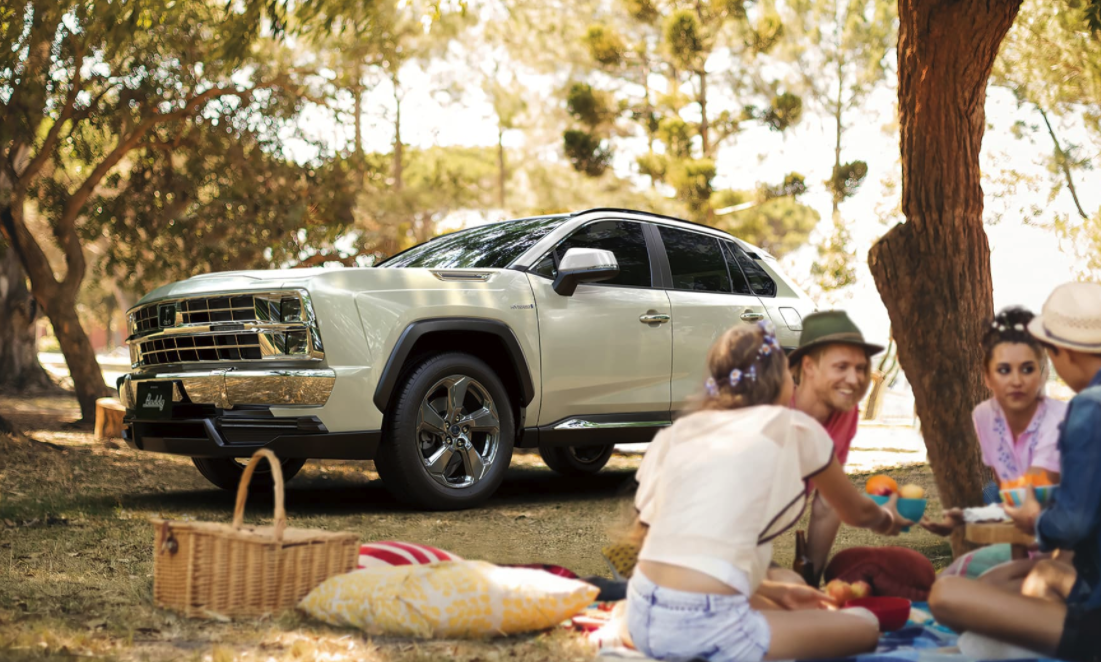
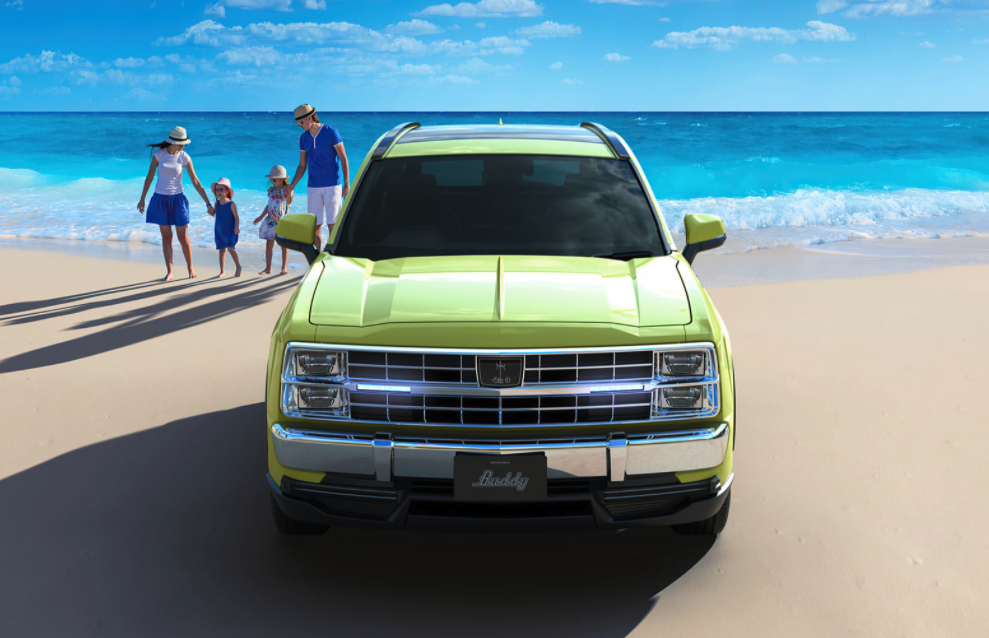
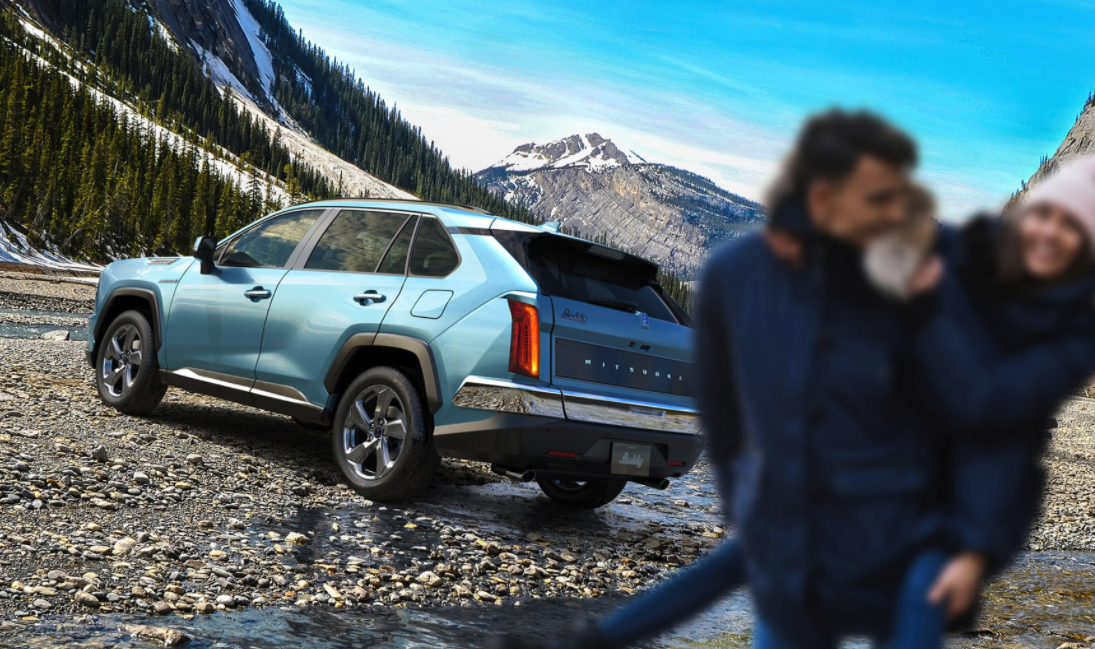
SEEMS everyone wants to meet the Buddy, a Toyota RAV4 alchemised into something like an American Chevrolet sports utility from the 1980s.

It’s the latest work from Japan’s 10th largest passenger vehicle producer, a brand you can only name check from used import rosters, and since being revealed in Japan last month has attracted so much attention the entire production for the next two years is accounted for.

Mitsuoka Motors doesn’t export, yet even so it has developed something of a worldwide reputation for its speciality  - putting a retro spin on popular modern models.  

It’s been busy in recent years with the Himiko, a rebody of the previous generation of the world’s best selling sports car, the Mazda MX-5, so that it looks a bit like a 1980s’ Morgan, and the Viewt, a half-scale homage to the legendary Jaguar Mk II of the 1960s. Based off the Nissan March, which was sold new here as the Micra until five years ago, that one stayed in production for 25 years and achieved sales exceeding 12,000 units. A small number has found their way to NZ.

Those cars are now yesterday’s news. Consumers are now hankering for sports utilities – and so the Buddy was born to meet that demand.

Buddy 1.png

The design influence comes from the Chevrolet Blazer pick up truck-based wagons produced for North America in the early 1980s.

The shiny grille and the two-piece rectangular headlights and the rear-end reshape are particularly reminiscent.

Even though the donor model has a relatively squared silhouette, the Buddy is much boxier still, so quite a few exterior panels have been replaced or at least altered.

The wheels as well. Buyers can order the Buddy with ‘dog dish’ hubcaps and vintage-looking wheels.  

Once again, the reproduction is a physically smaller vehicle than those that it draws inspiration from.

Don't expect to find a 454-cubic-inch V8 in the engine bay or a period-correct column shift  transmission; Mitsuoka has kept the original Toyota drivetrain in place.  

In this respect, though, the Buddy is at the leading edge of technology, in that the top version is provisioned with the electric-assisted 2.5-litre petrol hybrid setup that has become the most popular choice for Kiwi RAV4 buyers. 

AS said, if you’d like an example of this artisan car, be prepared to join a long queue. Mitsuoka doesn’t work in high volumes. They reckon on knocking out 50 next years and 150 in 2022 - and every build slot for the next two years is spoken for.

 Pricing for the Buddy starts at the equivalent of $64,000 for the non-electrified model and rises to just under $84k for the hybrid.

Buddy 4.png


Audi’s baby Q joins plug-in hybrid gang

No word yet about NZ introduction timing.

AudiUK00029278AudiQ3lookstothefuture_.jpg

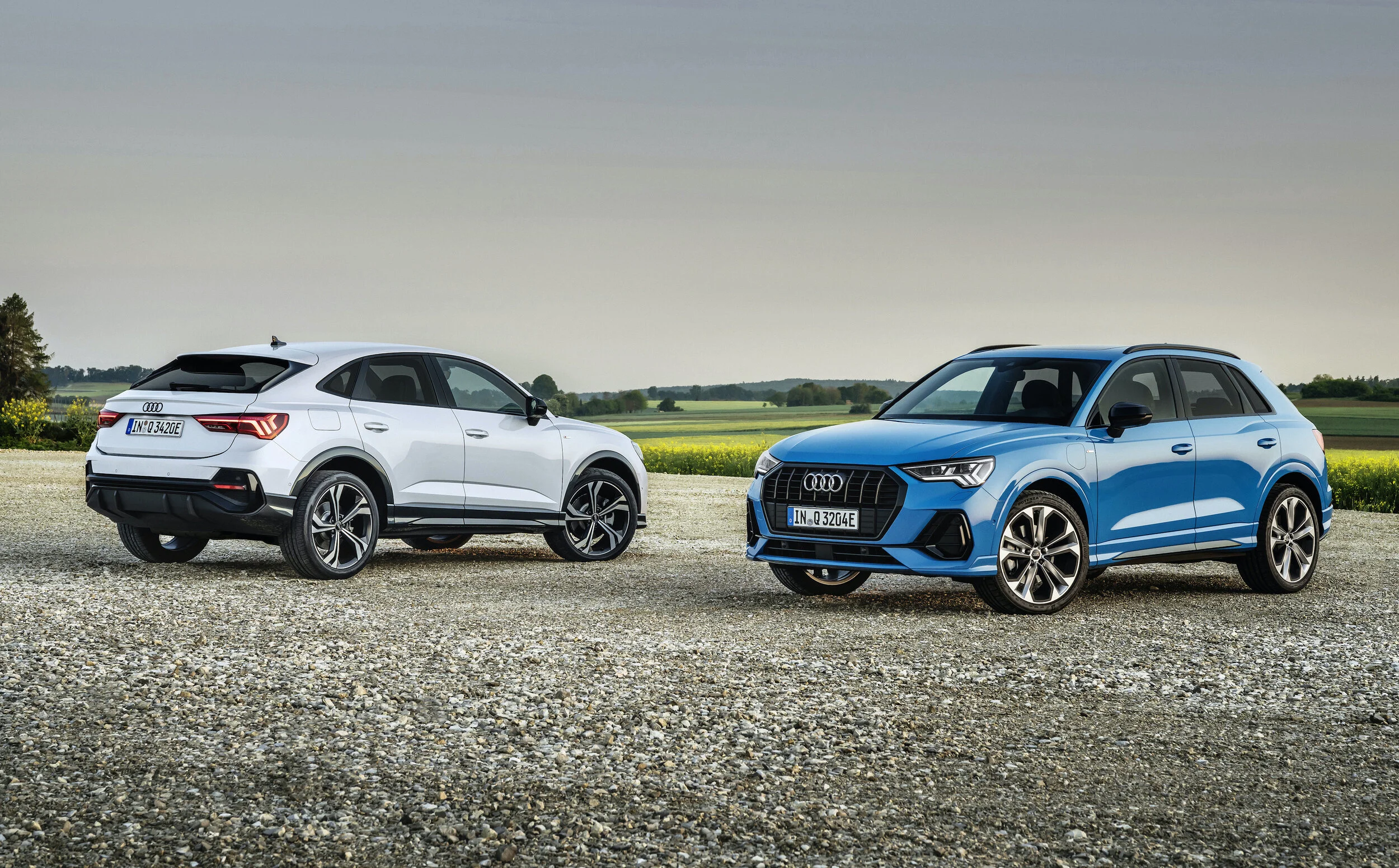
THE SMALLEST offer in Audi’s sports utility portfolio has joined the plug-in hybrid club.

There’s no word from Audi New Zealand about when the Q3 TFSIe will become available here, but it goes on sale in Europe in March. 

The new edition uses a 1.4 TSI turbo petrol engine aided by an 85kW electric motor.

Power for the electric half of the drivetrain comes from a 13kWh battery, which when fully-charged gives the Q3 TFSIe an electric-only range of 51km on the WLTP cycle. Combined power is 182kW, with 400Nm of torque, and Audi claims a 0-100km/h time of 7.3 seconds.

The plug-in hybrid tech is available in both the standard Q3 and in the Q3 Sportback and is badged as a '45 TFSIe' in current Audi badging-speak.

Audi claims both return figures of 32 to 39g/km of CO2 and fuel economy of 1.4 litres per 100km.

The Q3 plug-in’s commitment to eco-minded motoring is quite pronounced. It will always start-up in electric mode unless it's in very cold conditions and, when running in 'Auto Hybrid' mode, an engine-off coasting feature will often enact, which helps to save a little extra fuel. The computers that decide how best to juggle electric and petrol power can also take info from the sat-nav to predict how best to deploy that power. 

There is, of course, the option to charge the battery while driving, and there's an S setting for the gearbox which allows brief bursts of maximum torque, gauged to be 330Nm, released from the electric motor for hard acceleration.

Audi suggests the brake energy recuperation system can recover 40kW of power during braking. Charging from a home socket with 3.6kW output, the Q3's battery can be recharged in just under four hours, and you can use the MyAudi smartphone app to monitor and schedule that charging.

The battery pack does impact on boot space – Audi cites it at 380 litres – but the cabin and exterior styling are essentially unchanged, aside from the addition of an extra cover for the charging point.

AudiUK00029280AudiQ3lookstothefuture_.jpg


Toyota NZ urges Government to rev up climate stance

Country’s top car seller says a feebate a must to get wheels moving

Neeraj Lala.

Neeraj Lala.

NEW Zealand risks becoming the “Cuba of the South Pacific”, a dumping ground of Europe’s dirty diesels and high carbon-emitting petrol-fuelled cars.

That’s the view of Toyota New Zealand’s chief executive officer, Neeraj Lal, reacting to recent occurrences of political shift toward encouraging a shift from fossil fuels and toward more environmental motoring solutions, including battery-motivated products.

His comments come in the wake of two big headline actions: The move by the United Kingdom to ban sale of new fossil-fuelled cars after 2030 and our own Government’s determination this week to formally joined 32 other countries around the world in declaring a state of climate emergency for New Zealand. 

The NZ initiative brings with it a revitalised focus on electrifying its public service vehicle fleet, thorough prioritising fully electric and hybrid cars, and plans to become carbon neutral by 2025. 

That’s conceivably a switch Toyota NZ cannot leverage to advantage as much as some other brands as even though Toyota hybrid cars are highly favoured by private and fleet buyers, they are not considered electric models, because they lack facility to recharge off the mains.

The Government’s climate response decision has been welcomed by not-for-profit pressure group Drive Electric, though this organisation - which involves 17 new car brands, including TNZ - says the move still doesn’t go far enough.


Mr Lala says the UK’s move is both an encouragement to New Zealand policy-makers and a danger sign that this country could be flooded with used internal combustion engine (ICE) vehicles at the end of this decade.
 
New Zealand needs to work urgently on the right policy settings that encourage much higher take up of electrified vehicles through meaningful financial incentives, he said today. 

“We also need to make sure that we do not end up importing vast numbers of ICE passenger vehicles. Otherwise there is no hope of meeting the Paris Agreement’s 2050 net-zero carbon target.”

A push by new vehicle distributors, via their representative body, the Motor Industry Association, to introduce the ‘feebate’ that incentivises purchase of low and no-emissions cars has TNZ’s support. Mr Lala said the scheme, proposed in the last Parliamentary term by kyboshed by the Government’s then-partner, NZ First, has much merit.

The core element of the scheme is that it incentivises private and fleet buyers of low-emitting vehicles by adding a levy to high-emitting vehicles and using that revenue to reduce the price of low-emitting vehicles costing less than $80,000.

Mr Lala also reminds that the era of Covid-19 has affected car makers ability to produce and ship vehicles.

“As the worldwide supply of hybrid and battery electric vehicles becomes stretched due to global demand, New Zealand will find it harder and harder to access stock without a financial incentive.

“Essentially, we need to get our hybrid and EV numbers up to get higher stock allocations.  

“The feebate scheme should be back on the table, urgently. Toyota New Zealand has opened a dialogue with the Minister of Transport, Michael Wood, and will continue to advocate for financial incentives for electrified vehicles.”

TNZ is easily the biggest seller of mild hybrid vehicles in this country – and is now seeing hybrid editions of popular models outselling their fully fossil-fuelled equivalents. However none will conceivably be considered when Government weans off fossil-fuelled cars in public service use and into electric models, as proposed.

the rav4 hybrid has become massively popular and outsells the fully fossil-fuel alternates.

the rav4 hybrid has become massively popular and outsells the fully fossil-fuel alternates.

The market leader has just one plug-in hybrid car, a version of the Prius, but will add another, in the form of a PHEV edition of its most model of the moment, the RAV4. It has plans to deliver an electric car in 2021.


Mr Lala has applauded Government for confronting environmental issues, but says it needs to put financial resources behind its policy.

“Companies such as Toyota (NZ) would be willing to supply the public sector with low-emitting vehicles, but not at cost – it needs to be a win-win for both parties.
 
“With transport emissions accounting for nearly 20 percent of all carbon output, we have a large influence on how New Zealand will progress to a zero-carbon economy. The transition to a low emissions transport market comes with a price tag, but the cost of not enabling a greater uptake of low emissions vehicle could cost Aotearoa/New Zealand and the planet a lot more.”


Government’s EV push a sweet synch with Hyundai announcement

The drive has begun to stock the Government fleet with electrics by 2025 – sweet timing, perhaps, for an already favoured brand.

The new e-gmp platform is a breakthrough for Hyundai that will underpin 23 new Hyundai, Genesis and Kisa vehicles between 2021 and 2025.

The new e-gmp platform is a breakthrough for Hyundai that will underpin 23 new Hyundai, Genesis and Kisa vehicles between 2021 and 2025.

ARRIVAL timing of a swathe of battery-compelled Hyundai and Kia products atop a new dedicated electric architecture announced by their parent overnight could time sweetly with Government impetus to shift its fleet into that technology. 

The Government has formally joined 32 other countries around the world in declaring a state of climate emergency for New Zealand, bringing with it a revitalised focus on electrifying its vehicle fleet, thorough prioritising fully electric and hybrid cars, and plans to become carbon neutral by 2025. 

The decision has been welcomed by not-for-profit pressure group Drive Electric, though this organisation - which involves 17 new car - says the move still doesn’t go far enough.

It could be sweet news for Hyundai New Zealand, a Drive Electric member which is already established as the leading provider of electric cars – defined as passenger vehicles that can plug into mains replenishment (which excludes hybrid cars) - for public service usage, with its Ioniq and Kona, though in the overall scheme of things that involvement is token.

Of the 15,000 vehicles that could be defined as Government vehicles, just over 100 vehicles are electric.

A case of Ioniq irony? The current Ioniq is different to the Ioniq 5, so far only seen in concept form (below) that will be the first car on the E-GMP platform.

A case of Ioniq irony? The current Ioniq is different to the Ioniq 5, so far only seen in concept form (below) that will be the first car on the E-GMP platform.

IONIQ5(45EVConcept)01.jpg

Even so, Government has now pledged all of its cars will have some degree of electrification by 2025 and determined to trade in internal combustion vehicles for either fully electric replacements or hybrids if EVs aren’t deemed fit for purpose.

 Quite coincidentally, the announcement timing synched with one overnight from Hyundai, this about a brand-new electric skateboard architecture that will underpin of the electric future for Hyundai and Kia cars and SUVs, as the basis for 23 products coming out between next year and 2025.

 E-GMP (for Electric Global Modular Platform) is a flexible architecture and an undertaking that lifts Hyundai’s electric car development to a much higher level, in that with exception of the batteries, it’s an entirely in-house achievement, requiring no reliance of components sourced from outside suppliers, as has been necessary with the current Hyundai-Kia electrics: Ioniq hatch and the Kona and Kia Niro SUVs.

With E-GMP every aspect, even motor design, is brought in-house: The same process Telsa undertakes.

 Hyundai’s underpinning is a rear-drive set-up that can also format, with addition of a second motor, to all-wheel-drive. It enables a range of up to 500km, develop as much as 447kW and take just 18 minutes to reach 80 percent battery capacity when using a high-speed charger.

The first vehicle on this new platform is the Ioniq 5, which has so far only been seen in concept form (where it was called the 45). Ioniq 5, should not be confused (but probably will be) with the current Ioniq, which presents in mild hybrid, plug-in hybrid and fully electric form.

Hyundai announced earlier this year it intends to start a whole new EV sub-brand, akin to Volkswagen’s ID line, called … Ioniq. The Ioniq 5 is the first of the new family’s products. It’s a medium crossover, larger than the Ioniq hatch.

But that’s just a pathfinder. E-GMP is intended for 23 new Hyundai, Genesis and Kia vehicles in car and SUV formats over the next four years, including a high-performance model that will be shown off next year.

That car will be capable of 0-100kmh in less than 3.5 seconds and have a top speed of 260km/h, with rear- and all-wheel-drive versions available. To save energy, the front motor on the latter will decouple from the wheels when it's not needed.

 Hyundai has not shared details on battery pack size, but said that it's targeting 500 kilometres of range – a sizeable leap on the abilities from its current electric products.

By bundling the components, Hyundai said, it raised the maximum speed of the motor by up to 70 percent compared to existing motors, despite its small size.  

EVs based on the new platform will be capable of charging to 80 percent in 18 minutes, thanks to an 800-volt architecture that supports charging speeds up to 350kW. A five-minute charge can add about 100km.

The E-GMP also supports bidirectional charging; meaning that it can – in markets that allow this - can be configured to discharge its energy from its battery back to the grid or to a house. The vehicle-to-load (V2L) function supplies 3.5 kW of power which, according to Hyundai, can operate a mid-size air conditioner and a 55-inch TV for 24 hours. Alternately, it can be used to charge another EV.

The national distributor for Kia says it has no comment to make about E-GMP. Hyundai NZ has yet to respond to an invitation to provide its thoughts.


NZ-bound MX-30 sees stars in crash test

Euro NCAP analysis generally praised, but pointed out a perceived shortcoming.

MazdaMX-30_Exterior(6).jpg

THE next Mazda set for New Zealand introduction, also the marque’s first fully electric car, has just undergone an important validation – securing a respectable crash test score.

The MX-30’s performance in tests run by Euro NCAP, the sister organisation to the Australiasian New Car Assessment Programme part-funded by NZ tax payers, was good enough to secure a maximum five-star rating, with praise for its impressive front-end safety structure and far-side restraints.

Those systems helped it achieve a 91 percent score for adult occupant protection and 87 percent for child occupant protection.

It also achieved 68 and 73 percent for the Pedestrian and Safety Assist respectively.

However, the car’s collision avoidance capabilities didn’t impress as much.

The EV scored 73 percent for its safety assistance systems and 68 percent for vulnerable road users collision avoidance capabilities.

Euro NCAP described the latter score as a “mediocre test performance”, noting the car lacks “more advanced functionalities, such as turn-across-path intervention.”

What also requires consideration, though, is that the test ramped up this year to become tougher than ever.

Michael van Ratingen, the secretary general of Euro NCAP, said the latest five-star ratings demonstrate that the 2020 protocols are “having a tangible impact on the safety equipment and crash performance of car models in Europe, including the latest electrified vehicles.”

MazdaMX-30_Exterior(4).jpg


Feebate 'best' route to lower exhaust emissions

Forget about banning gas guzzlers – convince motorists to buy low-emission vehicles, says the new car industry’s voice.

The lower a passenger vehicle’s emissions, the bigger the incentive, the MIA believes.

The lower a passenger vehicle’s emissions, the bigger the incentive, the MIA believes.

NEW vehicle importers have begun urging the Government to introduce a feebate scheme to accelerate the uptake of low-emission vehicles.

In a move obviously designed to see off any chance of an outright ban on importing vehicles fuelled by petrol or diesel, as has just been suggested by the Green Party, the Motor Industry Association, which presents new vehicle distributors, is pushing for new policies aimed at incentivising motorists to buy passenger models with the cleanest exhaust emissions – or none at all.

Chief executive David Crawford says members are strong supporters of having effective policies to encourage the reduction of carbon emissions from transport.

The way to do that is not to introduce policies aimed singularly at limiting vehicle supply. This would happen if the Government adopted the United Kingdom’s decision to ban pure petrol and diesel vehicles from as early as 2030. More preferable is to have policies that influence demand by incentivising the adoption of low technology technologies, Crawford says.

Such policies would be effective tools so long as they were implemented in a way that addressed the price premiums the low-emission vehicles have, he adds.

And the best way to achieve that is to introduce a feebate scheme that encourages car buyers to choose vehicles that are more efficient and less polluting, through rewarding those who do by giving them a rebate on the purchase price, funded by fees added to the price of less efficient vehicles.

“Because the distribution of new vehicles in New Zealand is a derived demand model, a well-designed feebate scheme incentivises change as it influences the purchase decision,” he says.

“This in turn alters the mix of models supplied by distributors which is more influenced by what is bought, and therefore restocked, rather than policies aimed singularly at limiting supply.

“Low emission technology is expensive, so policies that address low emission vehicle affordability are likely to be the most effective tools available to the Government.”

The previous Government proposed a ‘clean car initiative’, a ‘clean car standard’ (which would be a vehicle fuel-efficiency standard) and a ‘clean car discount’ (which would apply a rebate or penalty depending on exhaust emissions).

At the time, the MIA said it welcomed sensible discussions on ways to make vehicles cleaner and greener, and it promised the new car sector would work constructively with Government to help  create the best mix of policies to achieve that outcome.

The organisation didn’t like the ‘clean car standard’, because it implied that distributors had a significant influence on what vehicles Kiwi motorists chose to buy. It claimed that policies aimed at controlling supply into our market, imposed artificial controls that could distort the market.

But the MIA was particularly keen on the proposed ‘clean car discount’, as it would send a very clear signal to consumers and would over time increase demand for lower emitting vehicles. The MIA said that in its view it would be the most powerful policy available to the Government to influence car purchase decisions.

However, later in the year the whole ‘clean car initiative’ came to a screeching halt when the kybosh was put on the proposal by New Zealand First, a partner in the then coalition Government.

The MIA is asking for the ‘clean car discount’ to get picked up again by the new Labour Government, and as originally suggested it should apply to all light vehicles of less than 3500 kilograms gross vehicle mass.

Under the MIA’s proposed feebate scheme, vehicles with CO2 outputs of 230 grams per kilometre and above would pay a penalty, those with emissions of between 100-230 g/km would be in a “neutral” zone, those with emissions of between 50 and 100 g/km – which would be some hybrids and most PHEVs - would attract a low rebate, and those with CO2 outputs below 50 g/km would attract the highest level of rebate.

“If the Government were prepared to put say $10 million a year for several years into the feebate scheme, then the level of rebate for low emissions vehicles could be higher thereby significantly increasing the rate of uptake of low emission vehicles,” says Crawford.

He adds that the level at which a fee or rebate (and the size of the neutral zone) would need to be lowered with each successive year, so that over time these would become more challenging. If the Government agreed to contribute to the rebate fund this would also reduce over time.


Here and gone – Endura’s short NZ residency

A big Canada-sourced five-seater SUV that only got here in mid-2018 is leaving Ford’s local line.

The endura as it released in May of 2018. By the end of that year it had a new look, new drivetrain, new tech.

The endura as it released in May of 2018. By the end of that year it had a new look, new drivetrain, new tech.

TAKING a name suggestive of longevity wasn’t any help to the Ford Endura – two years on from its local launch, the big Canadian-made five seater sports utility has been dropped from New Zealand sale.

The Auckland-domiciled brand’s confirmation of the model’s demise was not unexpected; earlier this week the car’s only other right-hand-drive customer, Ford Australia, also pulled the plug. 

Ford NZ declined to comment on speculation that the car was doomed without our neighbour’s support, spokesman Tom Clancy suggesting that the car had been “reasonably successful” in our market.

He also cited that the model is set for complete withdrawal from production, as it does not synch with Ford’s move toward an electric vehicle future that demands specific platforms. The Endura’s underpinning is not suited to that purpose, he said.

He voiced same optimism expressed in Australia about Ford still having decent SUV strength without Endura; citing – as Melbourne’s PR team has –the recent expansion of that family to include the new Puma and Escape. In addition, Ford has a Everest off-roader.

Ford NZ says it never saw Endura coming in to reprise the opportunity left by the Falcon-derived Territory, a much-loved car in New Zealand that ended production on 2016.  

Because? Mainly on grounds the new model was a five-seater whereas Territory had room for seven. As does the Everest – though Ford also made clear that Ranger-based vehicle wasn’t a Territory equivalent, either. 

However, families looking for a large Ford might have viewed Endura (which would have been called Edge here, had not Toyota New Zealand claimed dibs to that name) differently. Despite offering fewer chairs it was similar sized and had similar performance traits to the big Aussie, including capability for some limited off-road operation.

 The car’s entry into the market in May, 2018, was interesting; the initial model offered was a short-term proposition, as it arrived in a $73,990 ST Line all-wheel-drive biturbo diesel format whose design dated back to 2014. It already been superseded in North America (where it represents as the Edge) and the United Kingdom.  

Ford NZ had 300 of the pre-facelift cars to sell then subsequently moved in December of 2018 into the refreshed product which offered specification and technical improvements, notably a drivetrain change.

The initial car’s 154kW/450Nm 2.7-litre V6 turbodiesel and six-speed direct shift gearbox was usurped by an eight-speed auto biturbo 2.0-litre diesel with 140kW and 400Nm, and one variant became three: Trend, ST-Line and Titanium, spanning from $53,490 to $69,990.

Ford NZ says it has a handful of cars left in stock.


Skoda on patrol

Winning the contract to provision Police with their next frontline patrol car seems set to significantly improve Skoda’s market share here.

IMG_5449.jpeg

COPPING the contract to replace the police’s Holden Commodore patrol cars with its Superb station wagon will likely at least double Skoda’s market share, the make has acknowledged.

 Neither Police nor Skoda NZ will say how cars are involved, but in a statement about the deal the Police identified that the NZ force presently has more than 2000 front-line cars nationally. 

Skoda New Zealand boss Rodney Gillard says this is by far his operation’s biggest fleet opportunity, much larger than a bulk deal to provision cars to Corporate Cabs, which started four years ago, is ongoing and has so far provisioned several hundred cars. 

Last year Skoda sold around 1500 cars in New Zealand, for a 1.6 percent passenger market share, and is looking at a 1200 unit tally this year, mainly to Covid-19’s impact on buying trends and product availability. He suggested this arrangement will put Skoda in front of a much bigger audience than it has at present and did not discount suggestion that the count might be high enough to double the annual registrations volume.

Police say the Superb wagon has been accepted in two 2.0-litre petrol versions, a 162kW front-drive and 206kW four-wheel-drive. The supply kicks in from April, 2021.

The cars are essentially standard production models, which will be converted into patrol guise on arrival in New Zealand, but equivalents that represent in the showroom are presently in slightly different tune; 140kW and 200kW.

The engines offered to Police have been in models presented here previously, and Skoda NZ has suggested they might yet return in other showroom-bound versions of the Superb. The closest equivalents on public sale at present appear to be the front-drive Super Style, which has the 140kW engine and costs $65,000, and the Superb Sportline 4x4, with the 200kW engine. It’s a $71,990 car. 

The fleet changeover was forced by General Motors determining in February that Holden, which held the contract for almost 20 years with the Commodore, would cease making cars and retire as a brand.

That took the NZ Police by surprise. The hunt for a new preferred vehicle supplier was fast-tracked; they went to the new car industry with a request for proposals in July and the tender closed on August 21. Seven brands presented 27 vehicles for consideration; of these 12 were short-listed for the job, including at least one hybrid and several electrics.

IMG_3383.jpeg

While police have declined to cite the brands, other than the contract winner, the testing process at Taupo racing circuit last month allowed for easy identification of the battery-compelled Hyundai Kona and the Tesla Model 3 (above) plus the Toyota Camry hybrid. None passed muster.

Though important for selection, track and on-road testing was not the only qualifier for passing muster. Police say the cars with electric drive technologies were not only thwarted by power efficiency limitations but also when considered on grounds of total cost of ownership.

However, that experience was been positive, they say. In their statement, Police says they have gained valuable real experience with electric and hybrid vehicles and been provided with practical learnings for their future implementation. “While the technology does not currently align with Police’s core business requirements, EVs and hybrids will continue to be tested as the technology improves in terms of vehicle performance and range.” 

 Even after the Superbs start coming into the front line, some of the force’s VF and ZB Commodores will still serve, as police cars are considered for replacement at an average age of six to seven years or once the clock up 120,000km, whichever comes first. 

Police said the Superbs stood out as the “ideal primary response vehicles” throughout the process; frontline staff said they handled well, and they felt confident and safe driving the vehicle.

The spaciousness of the rear passenger area also came in for praise; a reminder of how rear-seat capacity has been a sore point in respect to the ZB Commodore liftback. It was withdrawn from frontline duties in 2019 due to health and safety issues caused by a lack of headroom in the back. Those cars were replaced with ZB station wagons.

There had been speculation German manufacturer BMW would be a strong contender for the contract given it manufactures a range of purpose-built vehicles for law enforcement and are used by police in Australia. However, no BMWs were seen at the Taupo circuit test days.


BT-50 a passenger car with a tray

Mazda NZ has explained background to how it set pricing for its new one-tonne ute. They’ve made it part of their passenger car family.

David Hodge.JPG

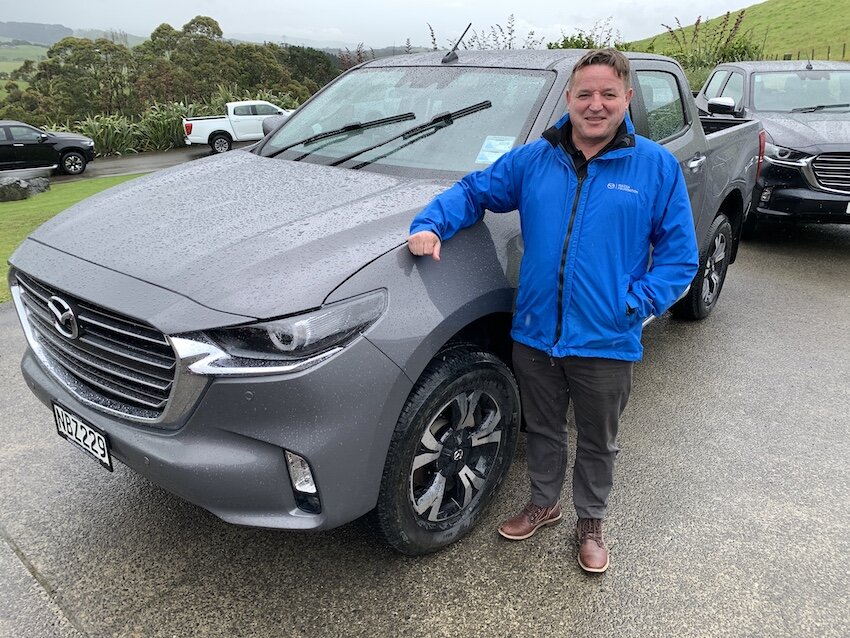
DETERMINATION to align the BT-50 more naturally with its passenger models was a reason Mazda NZ gave when successfully winning head office approval to site the one-tonner into a price zone that has proven significantly different to that occupied by its Isuzu doppelganger.

That impetus also explains why the Auckland-centre distributor has bypassed worksite-biased variants in the D-Max family and focused purely on double cab automatics wellsides, in three rear-drives and three four-wheel-drives, formatting in GSX, GTX and Limited. 

The BT-50 rear-drives placing respectively at $47,490 GSX, $51,490 and $53,990, with the four-wheel-drive versions adding an additional $7000, leaves them undercutting their Isuzu equivalents, most obviously at flagship level, where the Limited 4x4 sites $14,500 below the top D-Max X-Terrain. The latter has additional body styling enhancements that, when added to the BT-50, do not reduce the gap significantly.

 Isuzu Utes New Zealand, which released its range a month before the BT-50 launch yesterday, has been asked to share its thoughts about Mazda NZ’s strategy, but has not responded.

While BT-50’s pricing also leaves it looking good against the category-dominating Ford Ranger and Toyota Hilux, it’s the situation that exists between it and the D-Max that is most likely to create chat as the models are essentially one and the same under different skins.

Identical chassis, drivetrain, closely linked for bulk interior architecture and built in the same factory in Thailand, on a common line. Mazda was able to implement its own exterior styling, so few panels are shared, and had responsibility for the cabin’s look, but the ute is primarily enough of an Isuzu project for Mazda NZ to refer to their brand as being a customer.

David Hodge (pictured), Mazda NZ managing director, said he could not speak to how Isuzu chose to market the D-Max, but confirmed that BT-50 negotiations were conducted solely with Mazda HQ in Hiroshima, took more than a year and were based on persuading that aligning the BT-50 as not only a workhorse but also a lifestyle alternate to the CX-designated sports utilities would bring growth.

The caveat from persuading Japan to give the green light is that the big factor that has driven the ute market, willingness to discount, will be absent from the sales process for this one.

Mazda BT-50 012.JPG

“Traditionally the (ute) segment has been about a high recommended retail and a high discount, and it’s been that way for a very long time,” Hodge says. 

“I think most retail buyers have not had to pay the full RRP for a long time and, if they were, they were probably paying too much.

“With passenger cars, certainly Mazda passenger cars, we’ve tried to make our pricing more transparent, and having our retail price close to what the transaction price is. We’ve now followed that example with the BT-50. 

“We don’t expect there will be discounts, but we think … we will have no problem selling it to buyers wanting to pay the price we ask. We think it is a fair price and still offers bloody good value for money.”

They’re not outright selling the BT-50 as a car, or even a straight out car alternate, but the intent is to sell it in the same way they would a passenger vehicle.

Says Hodge about the type: “It was once pretty much solely the vehicle for farmers, tradies and those in the construction industry.

“While they are still a very important buying segment … we wanted to create a truck that was equally capable of being a tough workhorse and also doing the business of transporting the family in comfort to outdoor leisure activities.

“A design that shines equally in all situations, all the way from rough off-road settings to passenger car-like comfort for active weekend life-stylers and families.”

Mazda NZ is confident a fresh step of now including the BT-50 in the Mazda Car programme that has previously been for passenger models, will pay dividend. The old model was subject to a less generous process than now. Buyers of the new benefit from the same cover that has been provisioned the make’s cars: So five years, 150,000km factory warranty and a fixed priced servicing programme, also over five years, in which any scheduled workshop time will never cost more than $250.

Mazda BT-50 325.JPG

That servicing cost cap is a big driver for building trust, Hodge says. “Some of these services can be really, really expensive. If a customer feels they are being looked after by a dealership then they are more likely to want to stay with a brand.”

There’s a third identified strength with the latest model: It’s improved safety. Hodge says it is “as safe, if not safer, than any other new car on sale today.”

As much as Mazda NZ anticipates growth, and has established sales targets, it has no intent of making these public. The outgoing BT-50 was generally languishing at fifth on the annual ute sales roster, but with the new model offering so much more, and with the Holden Colorado – which usually held at third place behind Hiliux and Ranger even after its maker announced in February it was departing from the market – now out of the picture, it’s clear every lower-placed performer will see opportunity to move up.

Hodge doesn’t disagree, but he and product and sales planning manasger Tim Nalden say BT-50’s success will not be measured by chasing share; it’s more about customer satisfaction. 

“We’ll just accept where the market puts us,” says Hodge. “WE have a really successful passenger range, so we’re not heavily reliant on the BT-50. It sits alongside our passenger range as an extra vehicle, so we have a complete range. It’s not our do-or-die model.

“We’re pretty confident we are going to do alright with our truck, but the volume is what the volume will be. We will have limited amounts that we can get from the factory. It’s not a tap we can turn on quickly. We can increase volume, but it will take a while.”

In respect to this, Mazda NZ has still not had clarity from Japan about the plant’s operational status, which has been in question since Isuzu announced that production has curtailed, and might not restart until February, due to a Germany-based supplier of a vital part having been closed by Covid-19. Isuzu has intimated the vehicle cannot be built without a component only that supplier can provide. So it has closed the factory.

Well, apparently. Hodge says as far as Mazda NZ is concerned, the BT-50 is still in production until it is emphatically advised otherwise.

 “I cannot talk for Isuzu but everything we have been told is that our December production is firm. We have not heard anything about our January production but we will assume, until we hear otherwise, that this is also unaffected.”

Mazda BT-50 055.JPG


Mazda drops BT-50 pricing bombshell


The Mazda BT-50 is out in fighting form, with a flagship whose position allows almost a small car-sized saving over its Isuzu equivalent.

BT-50-05.JPG

 TWINS under the skin – but the Mazda BT-50 and Isuzu D-Max have proven somewhat less closely related when it comes to price, particularly at sales hot zone flagship level, where a $14,500 difference exists.

Focused purely on double cab automatics wellsides, Mazda’s mix comprises three rear-drives and three four-wheel-drives, formatting in GSX, GTX and Limited, the rear-drives respectively at $47,490 GSX, $51,490 and $53,990 and the four-wheel-drive versions adding an additional $7000.

So, three trim levels versus Isuzu’s four, no single or space cabs as in the partner’s mix and, so, fewer choices.

The line isn’t adverse to work, yet aims at a lifestyle-valuing customer chasing a reasonable passenger experience. It’s all about lifestyle balance, suggests product spokesman Tim Nalden.

“It’s rugged, it gets the job done … but it also offers new versatility outside of nine to five.”

On current trend, pure toilers aren’t requisite for volume expansion. Diesel utes achieve one in four new vehicle sales nationally, double cabs snare 94 percent of that volume and, within that, automatic uptake is high (86 percent). Three in every five utes sold in NZ are diesel, double cab and four-wheel-drive. So, what Mazda has now tailors very well to consumer taste.

And that’s where it gets interesting. Like its sister ship, BT-50 installs a remarkably high tech loading, particularly in respect to safety and driver assist. Like Isuzu, Mazda has felt need to raise its prices to account for this, yet at showroom level, the outcomes are quite different.

All weighing in Mazda’s favour? In scenarios of best specification equivalency with Isuzu’s models, the Mazdas seem to have price advantage.

That is most apparent when flagships are compared. Whereas Isuzu asks $75,490 for the high-tech and glam D-Max X-Terrain, Mazda NZ’s equivalent, the Limited, is a $60,990 vehicle.

The top choice models’ specifications are not identical; X-Terrain standardises with roof rails, fender flares, a rollout tonneau cover, rub liner and aero sports bar Mazda buyers will have to pluck from the accessories catalogue. Even after doing so, the BT-50 buyer is likely spending comfortably less.

The BT-50 enjoys keyless entry and start, a feature only on X-Terrain, in mid as well as high-grade trim; both flagships have part-leather seats but Mazda adds seat heating; the BT-50 is sold with a spare alloy wheel, where the D-Max ships with a steel spare and Mazda is confident it has an appealing warranty and servicing package, both five years and up to 150,000km (any service capped at $250), and five years roadside assist.

On top of that, both stand equally tall due to their maker (Isuzu) having gone to town on active and passive safety equipment in an attempt to establish technology and safety benchmarks.

Buy into either range and regardless of the variant you get eight airbags (including a segment-first “far side” restraint to separate driver and front passenger in a side collision), autonomous emergency braking, stop/go adaptive cruise, blind spot detection, lane departure warning/assist, forward collision avoidance, drive attention warning, automatic high-beam lights, rain-sensing wipers and a reversing camera.

The D-Max and BT-50 are the only two utes tested under the very latest ANCAP protocols; both achieved the maximum five score and, though other rivals have this too, their returns were achieved when the test was less stringent. The Isuzu just beat the Mazda on the Vulnerable Road User score (69 per cent versus 67), so it’s officially the safest one-tonne ute on the market right now.

Mazda’s pricing strategy is also bullish when compared for those for the Toyota Hilux and Ford Ranger, which are the dominant two choices with ute buyers, again resonating in the same formats Mazda brings, as well as the Mitsubishi Triton.

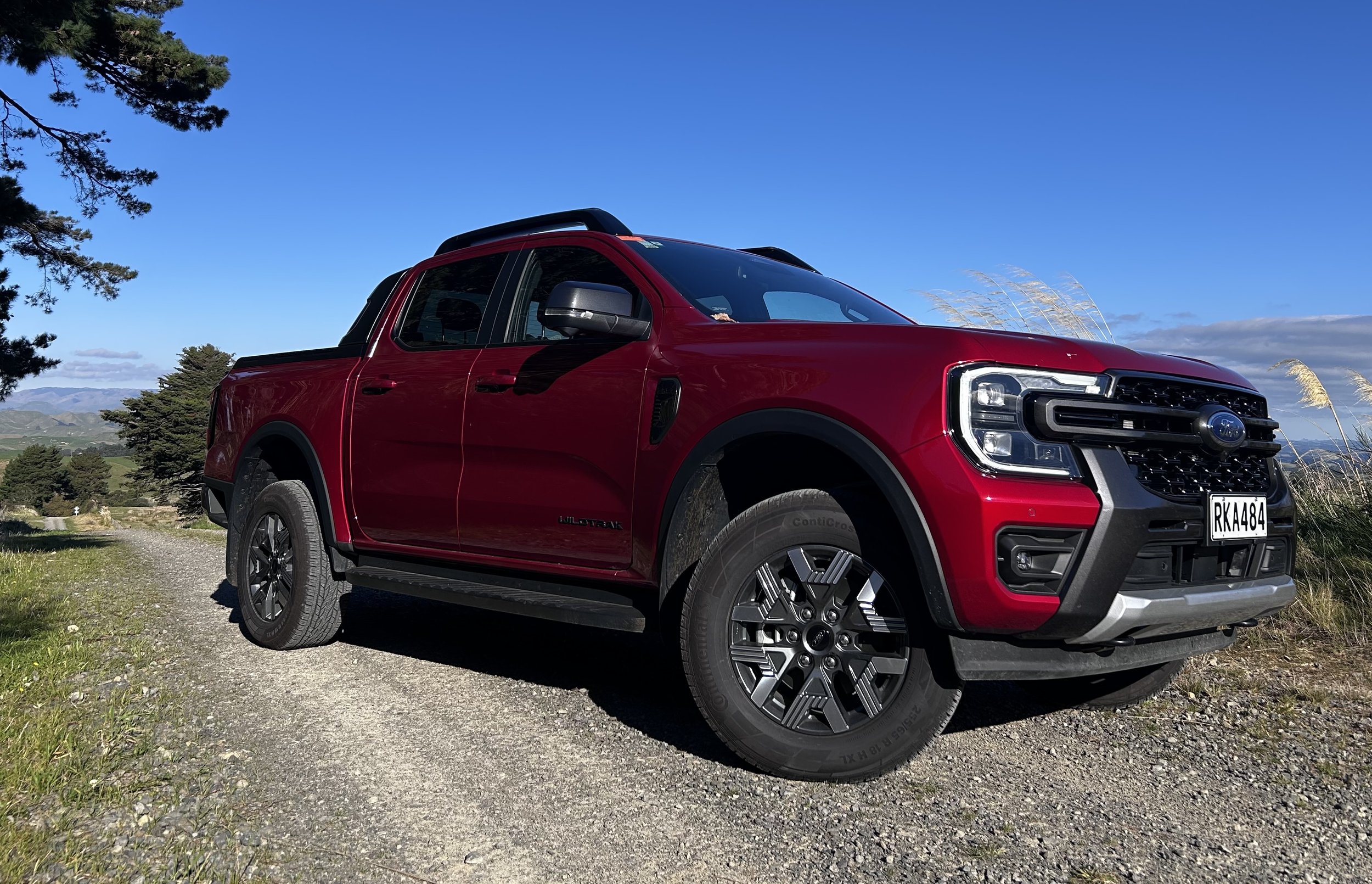
When comparison restricts to the top spec offers, the Limited undercuts the Ranger Wildtrak – and incoming $69,990 FX4 - but places $2000 above Hilux SR5 Cruiser, though Mazda’s spec is stronger, closer overall to Ford’s highest trim provisions and, in some instances, exceeding them.

However, the situation that exists with the BT-50 and D-Max is arguably most interesting, given that they are essentially one and the same under different skins. Identical chassis, drivetrain, closely linked for bulk interior architecture and are built in the same factory line, on a common line (which has closed until February due to Covid concerns).

It is not clear if suspension tuning is different between brands, but both offer same base level of performance of 140kW/450Nm from the 3.0-litre turbo-diesel four-cylinder engine. Quoted fuel consumption is the same for both, with an 8.0L/100km combined claim for the shared auto transmissions; so, around 20 percent more efficient than the preceding BT-50’s five-cylinder. 

Both utes have a maximum braked towing capacity of 3500kg – pretty standard for a 4x4 double-cab ute – and both have payloads of 1050 to 1080kg. 

Off-road wise, they share approach, departure and ramp-over angles of 30.5, 24.2 and 23.8 degrees, respectively and each is able to wade in depths up to 800mm.

Look inside either and the cabins are very well equipped. Each receives a 9.0-inch infotainment screen which runs wireless Apple CarPlay and Android Auto on top-spec models. A smaller digital read-out within the instrument cluster to provide key vehicle information. Entry-level variants in each range equip a 7.0-inch infotainment screen.

Dual-zone climate control, rear air vents, leather-appointed seats and keyless entry are other hallmarks in the higher-end models. 

 Fair to summarise that both new models are far advanced than their predecessors; all those extras unavoidably have to add to the bottom line. The old D-Max at full retail was positioned between $39,890 and $61,990, but an aggressive clearance over the last few months has delivered those editions for substantially reduced stickers. The previous BT-50, which will continue in some forms for months yet, was generally around $8000 less now.

The utes share few exterior panels because Mazda’s styling team has again worked to engender a tie to its car line; much more successfully than with the previous generation, which suffered from over-ambitious creativity and poor timing.

 Within 18 months of the last ute coming out, Mazda adopted a new styling ethos called Kodo which it still adheres to 10 years on. The old ute was right out of step; the new one not at all.



MIA: Feebates to encourage efficient cars better than outright ban

We’re not well-placed to even consider following the UK’s ban on selling fossil-fuelled new cars from 2030, the new vehicle industry contends.

David Crawford.jpg

CONTENTION New Zealand should follow Britain’s lead and pursue a ban of sale of fossil-fuelled cars and vans from 2030 has alarmed new vehicle importers, whose representative body says that deadline is way too close.

David Crawford, chief of the Motor Industry Association, which represents factory-appointed distributors, says his organisation does not dispute that a ban on pure petrol and diesel vehicles might become necessary at some future point.

However, thought proposed by Greens co-leader and Climate Change Minister James Shaw that NZ needs adopt the same policy announced in the UK this week, and introduce a ban on the sale of new petrol and diesel cars in 10 years, has alarmed and, the MIA contends, is based on poor information.

“2035 is too soon let alone 2030. Readily available and affordable alternatives are not yet apparent with the priority given to the development of left-hand drive markets. 

“I believe that some of the premises underlying James Shaw’s comments about doing the same in NZ are ill-informed.”

Mr Crawford explains that the new vehicle market operates off a derived demand model, not a supply model.

“Change what customers buy and we will change over time what is supplied. Supplying items that sell is where companies aim to operate.”

The MIA remains a supporter of the feebate Clean Car Policy thwarted under the previous Labour government by its then coalition partner, NZ First.

The proposal to encourage car buyers to choose vehicles that are more efficient and less polluting, through rewarding those who choose more efficient models by giving them a rebate on the purchase price – this funded by fees added to the price of less efficient vehicles – remains unreconciled. 

Had it got through, from next year, the most efficient vehicles up to three years old would have conceivably cost up to $8000 less, while the least efficient would cost up to $3000 more. Older used imports (sold in New Zealand for the first time) were to attract a maximum rebate of $2600 or a $1500 fee. 

Mr Crawford offers that a feebate would be much more effective than a ban.

“Bans will create a lot of issues, resentment and perverse behaviour. People will hold onto their old vehicles for much longer.”  

The main issue facing the NZ market is affordability and access to a suitable range of makes and models that fit customer needs, he adds. 

Having crunched the numbers, the MIA was certain the rise in transport emissions was not coming from new vehicles. He said Mr Shaw’s reference to diesel utes, which are popular are do produce relatively high emissions,  with comment about NZ’s love affair with Ford Ranger – usually the country’s best-selling one-tonner and occasionally its best selling vehicle on monthly count – was “shallow.”

“The sales-weighted average emissions for the new vehicle fleet is reducing year on year … not fast enough but it is reducing.

“The rise in transport emissions in NZ has more to do with the increase in the rate of vehicle ownership.

“Over the last decade it has gone from being well less than 700 vehicles per every 1000 people to well over 800.”

This, he contended, is mostly due to “the flood of cheap old, used imported vehicles.  

“Address the rate of vehicle ownership and we begin to address overall transport emissions.”

In direct respect to the UK’s ban, he said there were risks for that country, particularly in its standing as primary market. There are few right-hand drive markets; Britain is presently well-considered by car makers but there was potential its importance could diminish with this.

General Motors’ pulling out of right-hand drive market for sedans and SUVs around the world this year was effectively the death of Holden, a popular brand here.

“The point in favour for the UK, versus Australasia, is their market size. Their market might be big enough for manufacturers to prioritise development for their market. It’s a big question mark, though. 

He believes manufacturers will struggle “big time” to meet the UK’s timeline.

However, one positive for NZ is if makers do put more effort into meeting that timeline, “then it might mean we get a wider range of right-hand models developed sooner than what would normally be the case.”

If that were to unfold, NZ would be better to adopt policies to “make us a fast follower. Feebates to address affordability is the best approach in our view.”