Kia Seltos, Hyundai Venue: Don’t sweat the differences

The Kia Seltos has stormed into the compact sports utility sector, but let’s not forget Hyundai has a contender in that arena as well.

Venue and Seltos front.jpeg

HYUNDAI VENUE ELITE
Base price: $33,990 full RRP ($31,990 on test)
Powertrain: 1.6-litre petrol four, 90kW/ 151Nm, six-speed automatic, FWD, fuel economy 7.2 litres per 100km, CO2 160g/km CO2.
Vital statistics: 4040mm long, 1565mm high, 2520mm wheelbase, 17-inch alloy wheels.
We like: Strong spec, versatile cabin.
We don't like: Harsh and underwhelming drivetrain, challenging price position.

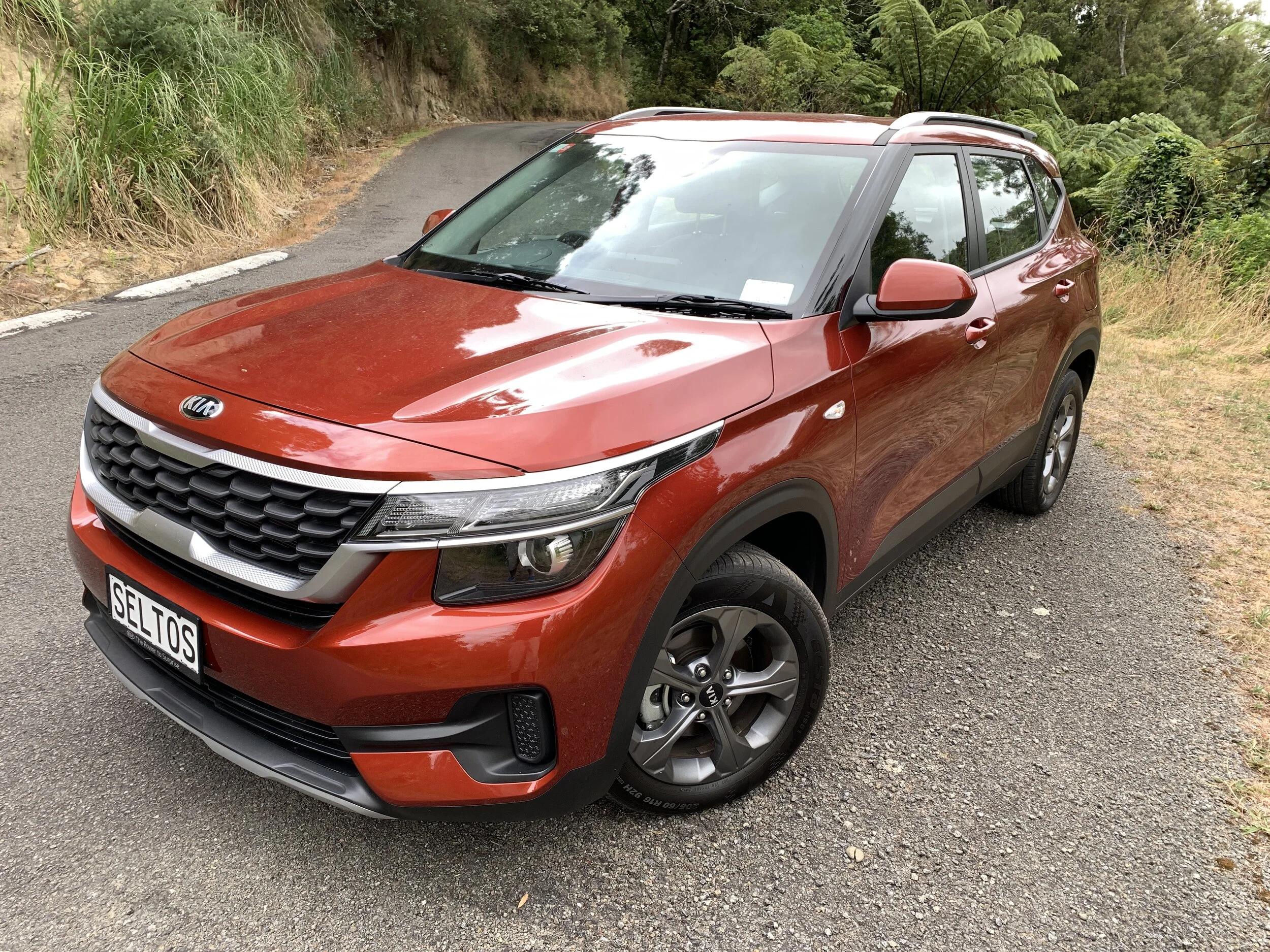
 KIA SELTOS LX
Base price: $30,990 full RRP ($26,990 on test).
Powertrain: 2.0-litre petrol, 110kW/ 180Nm, eight-step constantly variable, FWD, fuel economy 6.8 litres per 100km, CO2 157g/km.
Vital statistics: 4370mm long, 1615mm high, 2630mm wheelbase, 16-inch alloy wheels.
We like: Strong value, roomy cabin, perky performance.
We don't like: Secondary ride needs sorting, poor front seats.

WHENEVER Kia and Hyundai contest a common segment with a common kind of car you’d be brave to bet against their respective products not being related. 

Brand-specific styling inside and out surrounding core common parts (the chassis, engines, transmissions and other gear) … that’s been the recipe for years. 

Yet anyone considering the Kia Seltos and the Hyundai Venue and expecting more of the same will be in for a surprise.

Even though these cars draw from other, already-established family members, what they lack is a direct relationship. 

Here’s how it goes. Venue bases on Europe’s i20 hatch, plucking the floorpan and 1.6-litre six-speed auto transmission. Seltos? It actually has a lot more in common with the 2.0-litre Hyundai Kona than you’d ever possibly imagine.
Seltos 2.jpeg
Venue 5.jpeg

Yet insofar as finding any direct chromosonal link? Some say you’d have better luck looking for the lost city of Atlantis. They’re not only disparate in DNA, but Hyundai asserts – quite strongly – that the Venue is not a Seltos competitor.

Who’d bet on car buyers either (A) thinking as Hyundai does or (B) giving a jot regardless? Not I.

For all the technical disassociation and regardless that there’s also a degree of price disparity – less noticeable during now discontinued launch price promotions that were shaving $2000 from Venue’s recommended retail and up to $5000 from that entry Seltos LX) – they’re still two city slick front drive petrol crossovers of similar size chasing much the same crowd. So I’d suggest cross-shopping is going to be something of a certainty.

Straight out, both brands can take a bow for delivering a pair of interesting natural urban adventuring fits. On top of this, Kia can take extra kudos for its especially aggressive pricing strategy. It is possible to consider the base Seltos not only against the most expensive Venue but even the cheapest Kona.

For sure, Venue’s Elite designation means it packs more comfort and safety features. On the active and passive safety side, Venue stands well-sorted with a SmartSense package that includes Forward Collision Avoidance, Lane Keep Assist, Driver Attention Warning, Hill Start Assist, and automatic high beams is. Seltos is also looking strong, though be aware that automated emergency braking at this level is tailored for vehicle-versus-vehicle scenarios and so lacks the pedestrian-sensing ability provisioned further up in the Seltos family and standard to the Venue.

Enough blanked switch locations to be impossible to ignore, a less creative interior, manual air con and old-school ‘key in the lock’ ignition also signal why the spending gap between a Seltos LX and next-up LX Plus is so wide. Stick at LX also asks for you to control any envy felt about the more expensive Seltos derivatives having a better, touch-activated media screen  But, hey, as much as keyless start would be nice – given its so commonplace nowadays - that’s not to say that it outright shouts out for more technology.

In fact, when you come to box-ticking what might be regarded as ‘essentials’, it really isn’t shown up to be way miserly. The most pressing imperative would be to negotiate putting in onto the dearer versions’ factory 17 inch rims. The 16-imchers the LX arrives with are fine for ride and fair for dynamics, but they just look too small for the body.

If the LX has any particular weak point, it is being cursed by pretty mediocre front seats. Anyone who appreciates the merits of good lower back support won’t be at all satisfied by the driver’s chair; it’s too soft and shapeless and not a patch on the one that goes into the other variants. In this test, too, if you had to pick which had the better driving position, Venue wins out. Hyundai just delivers a better span of  seat and steering wheel adjustment, accommodating all shapes and sizes.

Even so, Seltos through simply being a slightly larger car – appreciably so for wheelbase and overall length, a little less evidently for width and height – makes a more convincing choice if you’re carting stuff, including other people.

Seltos 3.jpeg
Venue 2.jpeg

The cabin is simply roomier and the extra few millimetres it provisions in key areas, like rear seat lower legroom, is going help sell it. The Venue was also capable of carrying four adults in comfort, proved incredibly adept at swallowing some large, awkward objects and earned points for good storage space for bottles and paraphernalia in the centre console and doors. However,while lower leg and headroom is good, it hasn’t the same shoulder room and that might be telling with all-adult ensemble.

While the Seltos shape has a slightly more modern, appealing sharp-lined air, I really warmed to the Venue’s chiselled, upright body and stance and excellent visibility. Both cars are enhanced by a range of colour options; the two-tone, grey with green highlights and contrasting roof scheme applied to the Venue I drove also provisions with the Kia and lends a pleasing look to both. 

Out on the road, they’re similar in driving feel yet as far apart for performance as you’d imagine. Neither is what you’d call muscled, yet there’s simply no dispute about which has more zest.

It’s not that the Hyundai unit is utterly puny, yet the 20kW power and 29Nm torque that Kia’s bigger engine delivers is telling at kick-off and … erm, everywhere else. Really, though, what irks most about the Venue unit isn’t so much its more limited reactivity as its lack of refinement; it’s much more vocal and raw-edged and seems in constant dispute with the transmission. The Seltos would be better with paddle shifters to better engage with its eight-speeder, but it just operates more effectively and enthusiastically.

The dynamics are interesting. If you want something approaching youthful and sports-tinged, go straight to Seltos; it’s no outright GT, but drives with a level certainty not usual for this grade . For a more grown-up and measured feel, Venue is the place to be. It’s not vague or unduly remote, but there’s far more of an air of laidback amiability. 

Dimensional pertness and tight turning circles ensure they both work well around town and neither feels at all overawed by open road running, either, though it’s in the latter environment where the Seltos’ secondary ride seems a touch busy. It’s nothing a slight suspension retune couldn’t remedy.

Would you off-road? Venue’s provision of Sand, Snow, and Mud traction modes activated by a dial controller suggests it’s up for something, though we’d say keep it ‘lite’. Seltos has a control just like it, but turning it simply puts the transmission into a sports mode. So, yeah. There’s your answer from Kia.

Crystal ball gazing these cars’ futures is easy; consumer swing to crossovers and SUVs ensures each will find a ready audience. Venue does a reasonable job, but it lacks the Kia’s character and Kia’s value edge is much sharper. If you’re seeking to chase an ascending star, Seltos is definitely the one.

Seltos 1.jpeg
Venue 1.jpeg


Final farewell to an old friend

Hope to bid a quiet and easy-going goodbye to Holden that with a run along memory road turned into a rush trip thanks to coronavirus.

At Holden NZ headquarters in Mangere East, Auckland.

At Holden NZ headquarters in Mangere East, Auckland.

START where it finished, end where it all began.

Signing off Holden’s time here with a roadie in its last press vehicle from brand headquarters to the birthplace of General Motors New Zealand, calling by places of relevance, seemed right.

That the ‘car’ is a one-tonner ute is no insult to a certain other: Commodore. A desultory ZB performance hasn’t kept Holden’s most famous car from being ensured perpetual place as the brand’s biggest breadwinner in this country. There’s just no argument, Commodore was, is and always will be remembered as Holden’s finest, most successful and, perhaps, most missed.

At same token, let’s not underestimate or devalue Colorado’s impact. It certainly also deserves dues for having been top dog in recent years, riding high on the crest of the ute sale wave. Not quite as high as the Ford Ranger and Toyota Hilux, agreed, but certainly doing well enough to bury the Mazda BT-50 and Nissan Navara and generally keep Mitsubishi’s Triton out of third spot on the sales sheets.

The last ride is being taken in the family-topped Z71 that has certainly benefitted these last few years from the massive Kiwi affection for well-detailed, high-end automatic turbodiesel double cabs.

The drive gives plenty of opportunity to reflect on why this particular variant is so deserving on a place at the pointy end of one of NZ’s most competitive segments. MFW45 enforces why the talent definitely reaches well beyond its initial attraction of a well-proportioned and tough-looking styling that has proven especially enduring – a saving grace given that ute lifespans are much older than for cars and, until the bombshell of Holden’s demise, this one looked set to stick around for at least two more years.

Would it have lasted the distance? I’m confident it would have. It especially benefitted from that MY17 mid-life facelift that, in hindsight, could be considered a life-altering moment for this line. 

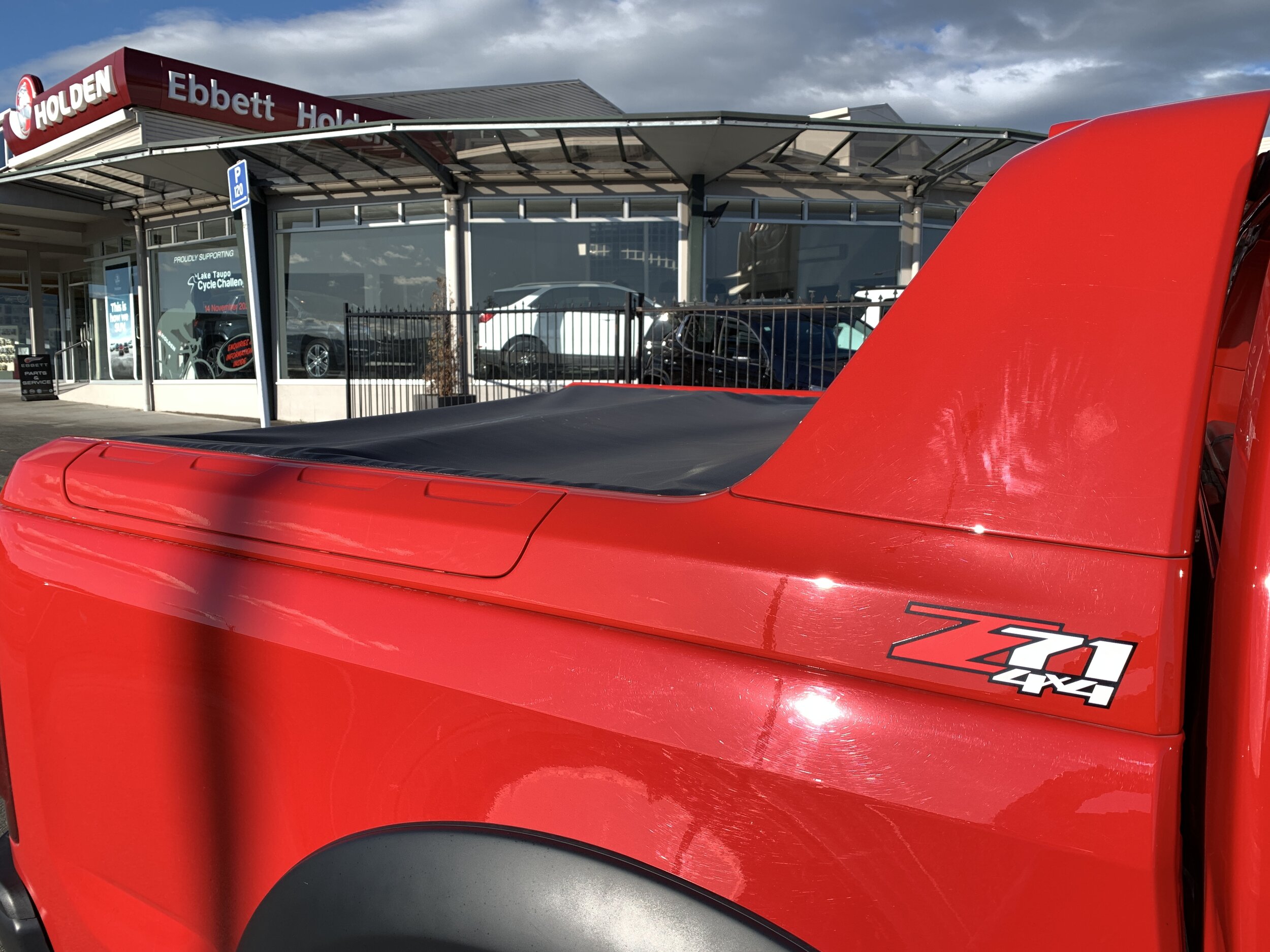
At Ebbett Holden, Taupo.

At Ebbett Holden, Taupo.

Continuing revisions that, for MY20, brought in leather-accented upholstery with heated front seats, a front bash plate, four black fender flares and a ‘soft-drop’ tailgate with gas struts have kept the pot on the boil. Nd though it will leave the scene with the suite of driver-assist systems still failing to tick off the increasingly important involvements of autonomous emergency braking, lane-keep assist, blind-spot monitoring or adaptive cruise control, it will still surely be remembered as Holden’s best work through this final chapter of the brand’s life story.

The high points, certainly, include the Holden-specific drivetrain. That 2.8-litre Duramax turbo-diesel four-cylinder unit producing 147kW of power at 3600rpm and 500Nm of torque at 2000rpm remains a tough act to follow. It’s not only been a relatively punchy unit, with a thick wad of torque coming on strong and early – so making it perfect for towing – but also a more refined engine than most of its key rivals. The six-speed torque-converter automatic is one of the best you can find in a ute, too; gear changes are smooth if not quick, while the calibration is receptive to spontaneous throttle inputs, with downshifts occurring promptly.

Holden’s involvement in tailoring Colorado’s ride and handling also deserves credit. The best evaluation of the magic performed is to hit a rugged road. Corrugations are a killer for so many utes – the manner in which they recklessly bounce over bumps when unladen can become, quite literally, a pain in the butt. The way Colorado maintains its composure, providing relatively superb ride comfort, in that environment is entirely due to tuning wrought over the Tasman, mainly at the Lang Lang testing ground near Melbourne.

In short then, the Colorado is a worthy candidate for this last chance to reflect on Holden and what it has meant to our country.

Retrieving the Z71 from Holden NZ’s digs, deep in the heart of an East Mangere industrial area, is how I wanted it, but accompanying corporate affairs manager Ed Finn upstairs for the keys feels awkwardly intrusive. A Covid-19 work from home option explains the empty desks now in this ground zero for February 17’s bombshell, Ed assures, yet knowing redundancy is now just weeks away for almost all the 40 staff, my mate included, is sobering. A team that has always batted above their average deserved better.

GM also deserves gratitude. It’s imprint into our national story is greater than many today probably know. GM was the first car brand with a proper car assembly plant here. It banged out 600,000 vehicles over six decades and employed thousands. When World War II broke out, it stood particularly tall, repurposing swiftly to build military equipment vital to our armed forces. Another major achievement: The Frigidaire division was responsible for introducing an everyday appliance into many homes, the fridge. For a while, Frigidaires were built alongside cars 

Typical of best-laid plans, my honour run derails when I plot a course. Additional to this mission, I’m fulfilling a promise to help a pal in the Waikato who’s selling a model racing car collection to another friend, in my home district, the Manawatu, who is buying. In my mind’s eye, this won’t impinge on a primary mission ticking off dealer locales where the Lion has roared loud and long.

Even by choosing to skip Pukekohe, where the hugely entrepreneurial outlet here from 1921 to 1994 sold not only cars but, as the local funeral director, also caskets, I figure can surely at least hit Hamilton, home to Ebbett Group (founded in 1928 by Alf Ebbett and today Holden’s single-largest representative dealer body) then Te Awamutu’s Rosetown Holden, which opened one month before the 1987 stock market crash?

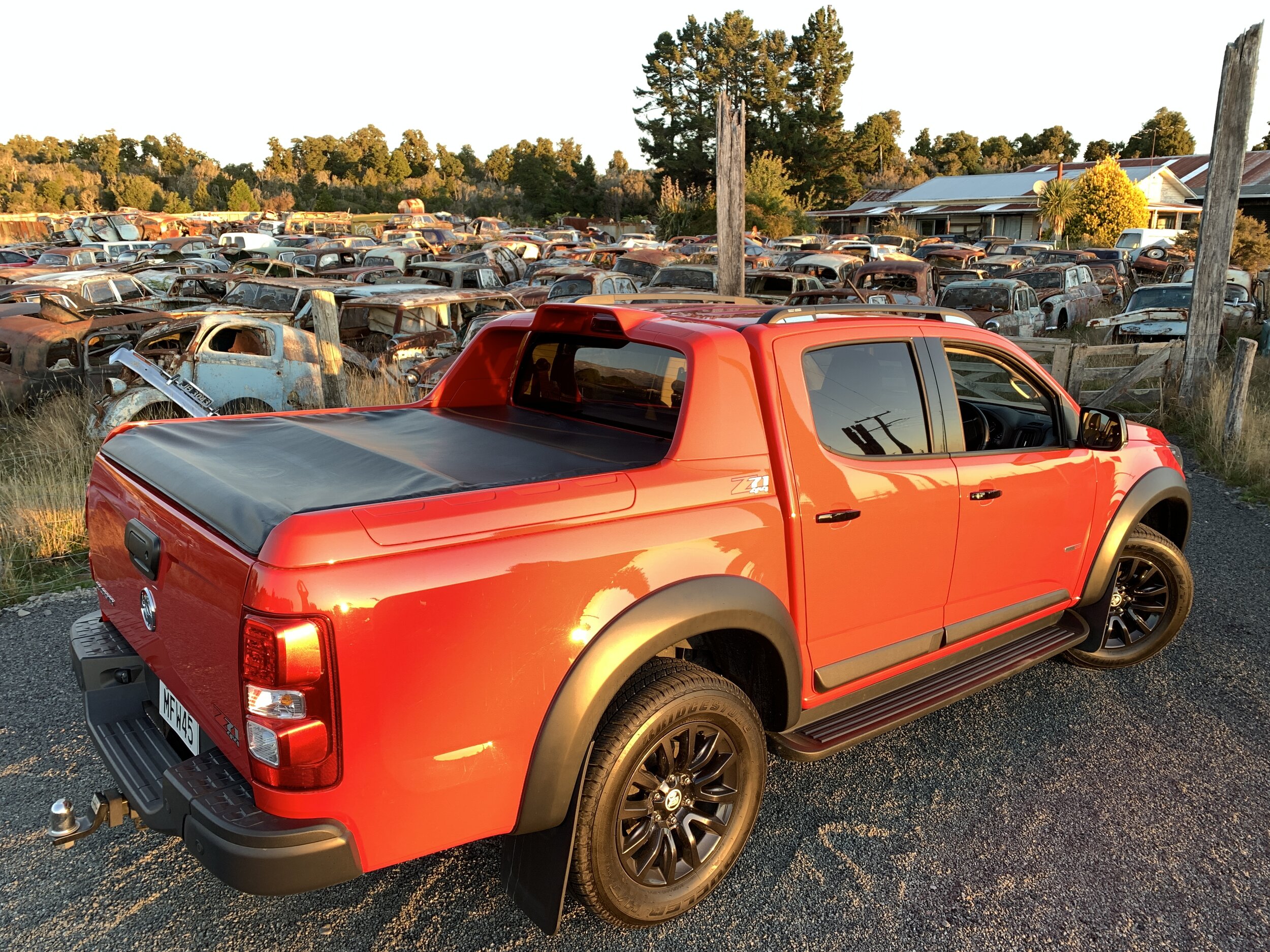
Smash Palace, Horopito.

Smash Palace, Horopito.

Inputting the collection owner’s address changes everything. Sat nav shows his “near Hamilton” is nowhere close to that city nor my targets. If I’m to get home in reasonable time, the just-opened Huntly bypass section of the Waikato Expressway is my only choice.

The Ebbett connection is at least made in Taupo, where Holden didn’t represent until 1998, but it’s gone closing time, so after a quick snap for posterity, I’m off again, straight down the line.

Or not. The Desert Rd is closed. It’s way too warm for snow, so maybe something to do with talk about Ruapehu’s crater lake warming? I still don’t know. 

Nothing for it but for me, Jim Clark, Jackie Stewart and Emmerson Fittipaldi to go the long way around, past the turn-off to Chateau Tongariro, then turning left onto State Highway 4 at National Park.

It adds an hour to the run, but at least allows the bucket list tick of Australasia’s largest vintage vehicle dismantler, Horopito Motors and Museum, aka ‘Smash Palace’. Stopping off on the sideroad that cuts through these hectares of rusting relics bathing in a sunset glow is a reflective moment. Even though I fail to spot any classic Holdens, assuredly this place holds a fair share. Even in the early evening, the place is a hive of activity. With wrecks being shuffled here and there by a JCB. Seeing two flattened early Falcons being moved is a satisfying ‘take that Ford’ moment.

Next few days are restricted to my home turf, but there’s more visiting to be done. Trucking to Manfeild Circuit Chris Amon recognises this being where our greatest Holden hero of motorsport, Greg Murphy, got his motorsport break, that big brand fans the NZ Police have conducted driver training here – predominantly in Holdens - since the ‘70s and that, in 1982, the GMNZ-made SS V8s that were then the world’s fastest and most powerful production examples also made their racing debut here. 

To Whanganui, where when I grew up, Ian Wilks Motors was a big kahuna. The Holden franchise has long switched, but the original dealership building where I recall visiting as a kid to stare in wonderment at the Gemini capsule – and, later, as a teenager, the first concept car I’d ever seen (Giugiaro’s Ace of Clubs, which spawned the Isuzu Piazza) is still standing. The first Holden press car I ever drove, a Starfire VK, came through here.

Next day, I’m down at Palmertston North’s Robertson Holden. Reminiscence about the massive history of the Palmerston North-centred Robertson Group empire and how it started with lion-taming, 30 years ago, is not the sole reason for a visit. During the day I’ve discovered why the ute’s deck cover hasn’t been sitting quite properly. One of the latches is broken. Can my mates resolve this? A jury-rigged fix satisfies me, it’s not good enough for these pros. A replacement part is ordered under warranty.

Robertson Holden in palmerston north was swift to sort a small issue

Robertson Holden in palmerston north was swift to sort a small issue

By the weekend, coronavirus is the big and only news. Travel restrictions are impending. I resolve on waking that Sunday morning that, if I’m going to complete my mission as planned, today is the day. So, by 7.30am I’m off, heading across the Pahiatua Track to Masterton so as to clock Wagg Motors (NZ’s oldest dealership, Holden since 1972) then battling Rimutaka crosswinds to at last tread historic turf.

GM manufacturing based in the Hutt Valley, with 47 hectares of property, in two key zones, the first now requiring imagination.

There’s no trace of the Bouverie St factory whose production stream started with a four-cylinder Chevrolet car in 1926 and curtailed with a Bedford van in 1984. I imagine, but cannot be sure, it was probably located where the Mitre 10 Mega now stands.

Bouverie wasn't the first place where cars were assembled in New Zealand. Distributors had been bolting knocked-down kits together for years prior. Yet it stands as our first proper car plant – or as close as we ever came to having one (vehicles always came in CKD - for ‘completely knocked down’ - format to be locally assembled and painted, though local production did encompass making tyres, glass, wheels, seats and wiring looms) establishing 10 years before Ford set up shop, and also the first GM owned full-blown assembly line not on American soil that GM owned rather than leased. 

Completed within eight months and rolling out the first vehicles even before an access road was completed, it initially assembled American GM vehicles - Chevrolet, Pontiac, Buick, and Oldsmobile - followed by British Vauxhalls, starting with the VX, five years later. It also produced those chunky Frigidaire refrigerators, this brand being owned by GM from 1919 to 1979.  

By 1939 the factory was expanded for a total floor space under one roof of 2.4 hectares, nearly double the original space, fortuitously as it turned out as almost immediately after completion World War II began. The place very soon turned over to the war effort, producing Bren gun carriers, mortar bombs, metal radio cases and battery boxes. More than 900 US Army trucks from the South Pacific combat zone were also reconditioned there.

a quick stop at waggs in masterton is due, this being nz’s oldest holden dealership.

a quick stop at waggs in masterton is due, this being nz’s oldest holden dealership.

Following World War II, Vauxhalls continued to keep the plant running together with limited numbers (restricted by currency shortages) of Chevrolets and Pontiacs. Buick and Oldsmobile were dropped. 

The site was cleared in 2004. It needs a plaque, if only to commemorate a famous employee, Jack the cat.

Twenty minutes later, I’m at the General’s second fortress, outwardly looking no different to as it appeared on the day it closed, save that now there’s a big mesh fence around the whole place.

Holdens hit NZ in 1954 and, indeed, we stand as Holden’s first (and most faithful) export market. Though just 321 FJs were shipped in by the end the first year of sale, 1954, some resourceful Kiwis had also by then also managed to secure a handful of the landmark 48-215 models as private imports. Interest in the brand grew quickly and GMNZ was in confident mood when, in 1957, the FE became the first of many Holden models to be assembled on NZ turf, at Bouverie. But demand then was always greater than the assembly line could meet.

Ultimately, GM took a deep breath and determined to create a much larger, utterly modern facility. So we got Trentham. Adjacent to the NZ Army’s camp and opened by Sir Keith Holyoake in 1967, this was a plant protecting market share equal to that enjoyed by today’s kingpin, Toyota NZ. With a total area of 41542 metres, Bouverie continued to impress as a large undertaking for the Petone area. But Trentham was so much bigger and grander. And could do so much more.

In its heyday Trentham was one of the country’s largest car plants and in the 1960s’ and 70s’, the Wellington area, with Todd Motors in Porirua and Ford (also in Petone), was in effect our ‘Motown’.

It made GM even more of the regional kingpin, with 47 hectares of property and around 930,000 square metres’ floor space, situated on three (Petone and Trentham: assembly/manufacturing plant, parts, and later, assembly, warehouse and office facilities) properties in the Hutt Valley. 

Even when the Oil Shocks of the 1970s’ hit sales of large six- and eight-cylinder sedans (and influenced Holden to consider a smaller alternate to its HQ), and some Japanese brands – Mitsubishi, Datsun, Honda and Toyota – were starting to raise their profiles, Holden remained a hugely influential player.

GM was huge in the hutt valley and the trentham plant was its crowning glory

GM was huge in the hutt valley and the trentham plant was its crowning glory

Commodore arrived in August of 1979 and triggered a sweet gold rush. From then until 2005, this Aussified Opel design consistently placed as a top three best-selling car in every year save for two. In that period, Holden NZ sold more than 100,000 Commodores. A four-cylinder SLX sedan built in May of 1982 was GMNZ’s 500,000th vehicle.

So what ended the dream? Government axing of import duty was a killer to all local assembly. On November 21, 1990, a V6 VN, the 593,945th GM product built here, marked the end of the line. GMNZ changed its name to Holden New Zealand and left the Hutt for good in 1999. 

Commodore continued to do its maker proud, though. It held as one of the country’s top three sellers even when Holden was down to being the sixth most popular brand.

Perhaps you’re wondering how a Isuzu co-designed ute from Thailand fits this history? Well, GMNZ represented Isuzu; we took its cars and Colorado’s forebear, the Rodeo. They weren’t assembled at Trentham per se, but were certainly prepped there. Indeed, light trucks kept rolling down the line for seven years after it stopped assembling cars.

So the Colorado has every right to be here. And on this trip, it’s done the brand proud as total trouper.

Utes are built for toil, yet Z71 comforts have made it a good tripper for this exercise. For a model nearing the end of its build cycle regardless of what was going to happen to Holden, you wouldn’t say that age really has unduly wearied it.

I’d call it a keeper. A shame that events won’t allow it to be.

William Durant Drive, Trentham. Durant was a founder and first president of General Motors.

William Durant Drive, Trentham. Durant was a founder and first president of General Motors.


Skoda Superb Scout: Natural troop leader

Skoda took its sweet time to give its biggest wagon the one last lift it needed. A Scout edition elevates the Superb’s solid status all the more.

IMG_5428.jpeg

SKODA SUPERB SCOUT
Base price: $64,990
Powertrain and economy: 2.0-litre four-cylinder turbo-petrol, 200kW/350Nm, 7-speed automatic, AWD, combined economy 8.1L/100km (WLTP), CO2 180g/km.
Vital statistics: 4862mm long, 1477mm high, 2841mm wheelbase, luggage capacity 660/1950 litres, 18-inch alloy wheels.
We like: Improved ride and styling, comfortable, hugely roomy and practical.
We don't like: Goes a touch light on off-seal assists so less rugged than a Subaru Outback, shame it loses the TwinDoor boot.

THE latest addition to the Superb family was always odds-on to be appreciated – what I hadn’t expected was to feel such a strong twinge of second thought syndrome.

Journalistic integrity - yes, a seemingly outdated concept in this game, yet important to me - demands a straight-up disclosure. We already have a Skoda allegiance, our personal garage space taken by a Karoq. So you’ll fully expect to hear what I don’t mind saying; it’s a great little car.

All the same, going this way asked for a change of thinking, really a reshaping of thoughts. Ticking the box for a model that Mrs B enjoys on strength of its compactness, comfort and fitout and I see as being perfect for our rural and my race car trailer-towing requirement through being diesel and four-wheel-drive came with awareness we were forging a fresh path across familiar terrain.

Like the vehicle it replaced, the Karoq is pretty much a car; except not so much in look. Accepting that required a broadening of my outlook. Call me outdated, but as dominated as the Kiwi "wagon" (to use that term in its broadest possible sense) market has become dominated by SUVs made to look as blocky as possible to (you’d have to think) enforce a sense of enhanced toughness, I remain fond of those that don’t.

Conceivably, then, I should have gone from one kind of jacked-up, plastic-clad crossover editions of a station wagon – a Subaru Outback – to its Skoda equivalent, the Octavia Scout.

That I didn’t was down to timing. Karoq was fresh whereas the Octavia Scout available then was, well, pretty dated; the last car on a discontinued platform, lacking the best tech and, I was sure, on the verge of entering run-out. So, anyway, the Karoq it was, with no regrets. 

IMG_5432.jpeg

And yet, from driving the Superb Scout, there’s an emergent twinge. How might things have gone had I remained wagon-true? Even though it would have been too much in size and price, this car nonetheless muddied the waters through enforcing its brilliance.

Given it’s taken until a mid-life facelift of the third generation Superb to finally spur Skoda to bring its largest model into the Scouting movement, the obvious question is: Why so long?

Certainly, there’s also a strong sense that in finally giving it a high-riding dirt-attuned aspect, Skoda has completed the jigsaw, in that every other relevant component was already in place. It’s been four-wheel-drive for a while now and, of course, has long traded on a principal strength of offering exceptional roominess, very good packaging and basically Audi-esque quality and tech at a sub Volkswagen price.

The only potential off-putting elements until now have been the slightly awkward styling and the Skoda badge; though the first is well rectified by this facelift and anyone who still sees the second as a problem is simply so stuck in the last century they need to be pitied.

So, anyway, if a synopsis in a sentence is sought, well rest assured the Scout format simply improves the Superb and adds extra evidence, if any more were needed, that station wagons with a little bit of off-road attitude remain a decent alternate to a full-on SUV.

Comparison to the Outback works in respect to size and specification, but less so on positioning and price, with Superb sitting $5000 above the priciest Outback, the Premium R (which runs a 3.6-litre six-cylinder petrol engine against Skoda’s 2.0-litre four).

Also flavouring any contest is abiding sense of the European offer being tailored to meet a different mission statement. Regardless that it adds extra cladding and elevation, plus some additional underbody protection, the Superb is more subtle in its outdoors-readiness, a point that hammers home when you see an ‘exclusive’ off-road drive mode only adds hill start assist and hill descent control. Not quite X-mode, right?

IMG_5437.jpeg

Whether that becomes relevant depends, of course, on what you intend to do with the car. In that regard, Skoda is probably on reasonably safe ground, as anecdotal evidence suggests likelihood of going to extreme is rare with these kinds of cars. I have to admit that, despite every best intention to the contrary, I rarely exploited the Subaru’s sludge-side skillset. 

That’s not to say the Superb Scout is so ‘lite’ to be considered a mall-wheel-drive. It certainly had no issues being driven across a paddock and also felt as much nicely at home running on gravel (also an Outback forte); you’d potentially just have to be a bit wary in slush and, perhaps, snow.

Insofar as overall driving appeal goes, it’s very much a matter of relaxing and enjoying a quality of ride that strikes as being more compliant than the settings used by the standard wagon. The bump-soak is definitely welcome on the patchy and lumpy surfaces so prevalent on our secondary, country roads and while there’s some body roll, the suspension is well-judged, focusing, as it should, on passenger comfort.

For sure, it doesn’t take long to be reminded this is quite substantial car in respect to its size and, because of the all-paw drivetrain, its weight. Yet, if handling never approaches athleticism, it’s not so lacking in talent to allow the big body to flop around through a sequence of interesting corners. Overall, there’s a confident ambience as it never falters to the point of feeling as if it is distancing itself from the road.

The choice of engine here reflects the comfort consideration. This turbo four-cylinder is not without fire, but overall it’s the torque that overshadows the power side of things and driving it with that in mind also delivers

best chance to access some pretty decent economy. The ability to deliver decent thrift, plus a sense of emergent anti-diesel sentiment, has doubtless triggered the decision to ditch the diesel from this car. I can understand the logics, but still feel it a pity the oiler has been shelved, as the last (also a 2.0-litre) was a refined unit with another 50Nm.

IMG_5451.jpeg

Compensation for going back to diesel is a change of direct shift transmission; from a six-speed to a seven. It’s a better unit, less prone to hesitancy, and more immediately reactive than a regular automatic or a constantly variable transmission. The facility to more easily drop back to the appropriate gear at the right moment for engine braking into a bend, and therefore be ready to engage positive pull out the other side, is also pleasing. You don’t find yourself having much need to chase ratios on regular basis in this car, so broad is the torque spread. The lack of paddle shifters reminds that it’s not about scintillating performance.

Most of the restyling occurs at the front end and is good news for those who found the old look a bit too confrontational. Viewing the car in profile nonetheless continues to offer best enjoyment. It’s here where you see proportional perfection. The gently sloping roof line and steeply raked rear wind screen are both beautifully designed and help to hide its significant length well. 

The obvious Volkswagen corporate look to the cabin and, in particular, the infotainment screen and switchgear is no detraction. The parent brand’s interior design elements are really solid, now, and there’s nothing about them that suggests a less than modern presentation.  If anything, Skoda’s opportunity for enhancement, through less stylisation and better fonts and LED colours, makes a good thing even better. There’s more warmth to their displays.

What’s also attracts is enough of a genuine luxury feel to undermine the view that premium brands further up the chain are all the better for comfort. That might be true, yet if Skoda is the start point, you’re hardly in cheap seats. The quality of the seat coverings and the abundance of other soft materials, all in dark tones, give real opportunity for owners to play guess-the-price games with those unfamiliar with this car. Fit and finish as good as you’ll find anywhere else in the VW family. 

It takes the usual wealth of fixtures including virtual cockpit, automatic tailgate, heated electric Alcantara and leather seats with memory function, Climatronic triple-zone air conditioning, reversing camera, adaptive cruise control, wireless charging and stainless steel pedal set.

IMG_5459.jpeg

Safety is also up to usual Superb standards with nine airbags fitted as standard as well as Emergency Assist, Passenger Protection Assist, tyre pressure monitoring, Front Assist with City Emergency Brake and Predictive Pedestrian Protection. 

Other features include automatic park assist with manoeuvre assist, Side Assist, Lane Assist and Traffic Jam Assist. 

All this might seem icing on the cake, because the primary reason for looking at a Superb wagon, surely, will be more to do with its genuine capaciousness. It’s hard to reconcile that this model rates as medium wagon because, really, it’s so much larger inside than anything else in that category. It’s as though they’ve taken the blueprint for a VW Passat and upscaled by 10 percent.

Rear legroom is extremely good the rear bench is wide parents that need to get three seats across there may be in luck depending on the sizes of their child seats. It also wins a ‘best in show’ for boot capacity, which has to be a huge win for any family on the move. A pity the old TwinDoor boot door design has gone; yes, it must be complex to engineer, but what a cleverness.

Not that it lacks originality. You can’t discuss Skoda without giving a nod to it dedication to delivering strongly on neat little features: the brolly and ice scraper/magnifying glass, of course, but also a 12-Volt auxiliary power outlet, locating hooks for shopping bags, a first aid kit and brackets that can be positioned anywhere in the boot to keep luggage from sliding around. Having the latest in VW Group driver-assistance equipment shouldn’t be undervalued, either.

So, really, there are no major surprises. The off-road enhancement is mild, yet is enough to add polish to a competent and simply huge family car.

IMG_5443.jpeg


Ford Fiesta ST – celebrate the madness

Ford’s smallest hot hatch hasn’t cooled its heels in the time taken to get here.

IMG_5273.jpeg

Base price: $35,490.
Powertrain and performance: 1.5-litre turbo-petrol three-cylinder, 147kW/290Nm, 6-speed manual, FWD, fuel economy 7.0 litres per 100km (source: WLTP), 0-100kmh 6.5 seconds.
Vital statistics: 4068mm long, 1469mm high, 2493mm wheelbase, luggage capacity 311 litres, 18-inch alloy wheels with 205/40 tyres.
We like: Characterful engine and chassis, so much fun.
We don't like: Recaro seats better for short distances than long, chintzy interior.

 WHO wants a sensible, straight-laced small car?

Yeah, not many hands are being raised these days. Understandable. For better or worse, the models that used to be pick of the litter are now struggling to be noticed.

So, it’s really not that surprising that the latest Ford Fiesta won’t be emigrating. If too few bought the old one, why bother bringing in the new, right 

Except that’s not quite how it goes. Ford NZ hasn’t left the party entirely. For fans of the hotshot ST, it’s still very much Fiesta time. In fact, from now on playlist entirely fixates on the performance model.

Which is … well, a ‘fascinating’ strategy. No dissing the ST, it’s a great car. A really great car. But if this is a pitch to pep up the model’s sales pace …. well, history suggests it’s not going to work.

Hot hatches are select choices. Hot hatches with manual gearboxes all the more so. Ford learned as much with the previous ST. Though the best of the bunch, it also pulled in the fewest registrations of all the variants.

So, clearly, Ford here has been affected by some sort of madness. And, personally, I hope they never find a cure. If they’re happy to sell simply it on the strength of vivacious verve and not give a thought to actual volume, then assuredly their risk is your gain.

As oxymoronic as it might seem, the ST is all the better for being tailored to the tastes of a maniac few than to the mainstream many.  In saying that, this car is so tailored to the push-on enthusiast you wonder how on Earth its development team got away with achieving sign off. Quite potentially, they might never get to do so again.

All power to those motorsport genes, right? Erm, actually … no.  One of the ST’s naughty secrets is that the marketing pitch lending impression of firm association between this hot hatch and the machines that fly the Blue Oval flag in rallying is not quite true. In fact, it’s barely credible.

IMG_5284.jpeg

This ST wasn’t in circulation when the full-out WRC and R5 Fiesta cars that gravel smash for Blue Oval glory were developed. Malcolm Wilson’s M-Sport crowd, which isn’t so much a works outfit as a works-supported one, developed its wee titans off the Fiesta ST-Line. Basically a standard car in sports shoes. 

Not that it matters one way or the other because, on technical grounds, the race and road products clearly rally to different causes. Good luck trying to buy from a dealer a Fiesta with a tricky sequential gearbox and four-wheel-drive, let alone enough horsepower to frighten Ferraris. You can’t. Indeed, if any production Ford comes even remotely close to that formula, it’s the Focus RS. Which has just been axed.

No matter. It’s not as if the ST has been neglected under the bonnet. True, the 1.5-litre three-cylinder is the smallest engine ever committed to duty behind the ST badge, but it’s no shirker.

If anything, actually, this is exactly the right ingredient for these times. If you want a fast, agile, eager powerplant that hits the target for requisite social responsibilities in regard to economy and emissions, yet still manages to feel properly old-school raw edged and loud at all the right times, then this engine is it.

The outputs are a very senior and serious 147kW and 290Nm of torque, which is 15kW and 50Nm more than the predecessor’s 1.6-litre created, most of which is thanks to a new, bigger, turbo and some fuel injection and exhaust manifold trickery.  Power peaking at 6000rpm suggests you’ve got to work it, yet that’s not quite case – yes, it loves a good rev, but with torque laying out from 1600-4000rpm, it also delivers very broad pull.

And though thrift is potentially going to take a back seat to its thrust, it is quite clever in hitting good economy thanks to a clever fuel-saving cylinder shut-down system, which can reduce this to a two-cylinder car. That trick occurs only under light throttle loads so, you know, will probably be something many owners only get to read about rather than actually experience, yet it’s a tweak that keeps it on the right side of Green worriers. 

IMG_5277.jpeg

But, anyway, it’s a real tribute to the three-cylinder programme that all began with a 1.0-litre that also debuted in Fiesta and was also a fantastic thing. Like that one, the 1.5 only occasionally betrays its odd-numbered cylinder count with a curious thrum. Generally, though, you'd otherwise never guess it's been down-sized. There's minimal turbo lag, it pulls strongly right throughout the rev range and also snarls and gurgles and gets a bit deep-throated.

Could it do with a direct shift gearbox with paddle shifts? Assuredly that kind of tech would straight away broaden the car’s appeal and undoubtedly a good one would elevate its attractiveness for push-on driving. And, yet, the ST is also all the more of an experience from having a hand-shifted snappy, slightly meaty, six-speed in marriage with this gem of an engine. Manuals demand dexterity, but if you’ve got the talent, this one just really ‘engages’ with the experience.

And wow, what an experience. Drive hard and the ST becomes, as a colleague put it during a pre-coronavirus lockdown run, “effing quick, with a capital eff.” All the more so when slotting into the Sport or ultimate Race mode – which, you can use quite easily on a decent road despite being warned it’s really just for tracks (mainly that’s Ford covering its butt because the traction control is disabled). In either mode it really rockets. So much so that the time of 6.5 seconds to 100kmh almost seems understated. It certainly feels faster through the gears. For all that, I dunno if it really needs the Launch Control. Yes, it contains the wheel-spinning hooliganism on hard-out releases, but also seems to somehow sanitise the take-off experience.

Read up on this car and you’ll find different opinions about the steering. It has become lighter and has a slightly artificial feel now. Is this Ford trying to broaden the car’s appeal to a wider audience? You’d have to think so. You’d think that’s also why the the ride, while still very firm, is definitely softer and, for all its  the ST is, overall, more refined.

IMG_5306.jpeg

Yet only within the parameters of what it is. Outside of those, it remains a very feral and involving car, requiring more dedication to driving duty than your average Fiesta. Which, as I say, is what makes it great – and yet, of course, is what will make it too much for many. 

Anyway, the steering gains real feel and feedback when you’re hoofing and, in fact, the car’s whole attitude changes. For one, it has decently good balance. That's helped by the Quaife differential, which can help you tuck the nose into a tight corner. And it also has suitably decent tyres, with 18-inch 205/40 Michelin Pilot Sports, though those on the test car – an Ireland market model they nabbed to raise interest ahead of release of actual NZ-market models – were pretty close to being shagged. And, yes, the four-disc brakes are excellent, too.

I suppose you can argue that this car sells on its family-minded practicality, and sure enough the cabin is roomy for the class and the boot is big enough to make it practical. Yet the provision of Recaro front seats is a pretty telling indicator in its own right about this being the most driver-centric Fiesta by far.

As much as all the spending on performance bits likely makes this model a bottom line burden for Ford, it is hardly matched by attention to broader design detail. I’m not saying the car feels cheap but, on the other hand, it’s apparent Ford has a different approach to ambience and detailing than VW does with the Polo. There’s no sense of ‘premium budget’ here. Too many cheap plastic parts inside for that.

Might that pin it back? Only if you take the wrong attitude and try to measure it against others in the category that are similar sized and specced, but haven’t the same shove. Against them, the Fiesta will seem something of an extravagance. Yet if you can view it for ewhat it actually is – a performance model foremost – then it surely positions in a pretty sweet spot, given everything else that ticks the ‘fun’, ‘agile’ and ‘truly fiesty’ boxes all cost more.

IMG_5281.jpeg

There’s just one annoyance about this car and it’s this: The time it’s taken to get here. Basically, we’re being introduced only now to a variant that has been cutting up UK and European roads since 2018.

Fair dues, it’s not Ford NZ’s fault. The delays in getting the car here are all down to Ford Australia. As is so often the case, Ford head office considers our two countries as one yet, when it comes to determining spec, it’s the larger of the two that has all the say.

In this instance, the whole delivery process has been grievously held up by specification quibbles. The Aussies wanted as standard an active safety kit that’s optional overseas. This all meant a first quarter 2019 launch became a Q4 2019 launch, which in turn became a Q1 .. sorry, make that Q2 … 2020 launch.

Okay, it’s a good news story in the end, because it means the car is loaded. In Europe, Fiesta STs are available in ST-1, ST-2 or ST-3 guise, with an optional Performance Pack on top of that, but our cars get the lot.

So, keyless entry and start, an 8.0-inch infotainment touchscreen with smartphone mirroring and SYNC3 connectivity, a 10-speaker Bang & Olufsen stereo, heated leather steering wheel, heated Recaro front seats, auto headlights, auto emergency braking, blind-spot monitoring, forward-collision warning, lane-keep assist and more. Plus the big wheels, the diff, launch control and shift lights, all of which constitutes the Performance Pack that’s an option overseas. 

So it’s all worked out well in the end. But what a palaver! Now all Ford NZ has to do is buy it. Were the allegiance so far sworn by every motoring writer who has so far sampled the test example to turn into actual sales – and it won’t, because I’m in the minority within that group as being an actual new car owner – then the ST would have its best year here yet. Something to think about.

IMG_5286.jpeg


Ford Focus ST-Line: No sweat going to sports-lite version

The new generation car has plenty of appeal, but this version is a low-temp warm-up to the ST.

IMG_1579.jpeg

Base price: $36,990.
Powertrain and performance: 1497cc three-cylinder turbo petrol, 134kW/240Nm, 8-speed automatic, FWD, Combined economy 5.3 litres per 100km.
Vital statistics: 4398mm long, 1454mm high, mm wheelbase, luggage capacity 375 litres, -inch alloys.
We like: The drivetrain, strong spec, appealing to drive. We don't like: Too-dull interior ambience, fiddly gear selector.

REMEMBER when a Ford car was a New Zealand best seller?

Bad call, all who answered ‘just last year’. Family use favouritism regardless, utilities are defined as commercial vehicles. So, exclude Ranger from this exercise.

In respect to a pure Ford passenger car? It’s been a while. Best evidence – because this precedes current industry record-keeping process - suggests the year was 1982 and the titleholder the Mark V Cortina, a rare sight now. There’s a cracker on display at Southward Museum.

 Anyway, market realities will assuredly keep the Focus from making history. So what that Ranger cruised to the top. With cars it’s harder. Fleet penetration is key. Ford had it 40 years ago. Toyota does now and so completely nothing else achieves a decent look-in.

So everything comes down to private buyer interest and Focus has been tailored accordingly. It’s also made tastier by being more ideologically European in dynamic attitude and driver engagement than its predecessor.

IMG_1584.jpeg

An arresting styling, an intriguing and very forward-thinking drivetrain technology and a talented chassis that gives a big thumbs up to a fresh and more rigid platform are also core to achieving appeal.

That new C2 platform delivers a larger, more practical basis. The increase in cabin space is particularly noticeable in the back, the changes are less obvious in headroom (well, the silhouette demands compromise) but certainly delivers in legroom and the wide cabin means there’s decent shoulder room. Three people across the rear bench? It’s possible.


The boot is a decent 375 litres, and the load lip to lug heavy items over is modest. The rear seats drop to extend capacity to 1354 litres, with an almost-flat load floor.

The Focus has been awarded a five-star crash test rating by Euro NCAP. You can see why, too, with automatic emergency braking, electronic stability control, hill start assist and a system that locks the brakes on after an accident to help prevent any further impacts. 

Updating to a head-up display (HUD) is timely and lane departure warning, lane keep assist and a parking aid (smart enough, now, to do gear selects and braking) are also the norm. Evasive steering assist helping drivers steer around stopped or slower vehicles, night-time pedestrian and cyclist detection, a rear wide-view camera, an adaptive front lighting system with its predictive camera-based tech that pre-adjusts headlamp patterns for improved visibility by monitoring bends in the road and road signs are premium features nice to find here.

IMG_1588.jpeg

With dual-zone climate control, keyless entry and start, and wireless smartphone charging as standard, it really is smartly-specced.

A shame, then, that Ford’s struggle to match best rivals for interior quality continues. The materials should prove fairly hard-wearing, but most of the surfaces don’t have the tactility, texture or colour tone to cut it with the best. In this case, the Mazda3.


The dashboard has a fairly sensible layout and though the touch-screen infotainment system demands some playing about, it’s worth persevering, as the technology is impressive. Sync3 infotainment system, satellite navigation with live traffic, Apple CarPlay and Android Auto support, Bluetooth connectivity, voice control and Wi-Fi hotspot …. again, that’s pretty much at the leading edge.

Ability to deliver a solid, comfy driving position is a cinch as there’s lots of adjustment and visibility is pretty clear in every direction, with no major blind spots. Controls locate sensibly though there are operational niggles. One is with the weight of the switchgear: it’s so light as to make it very easy to overshoot the intended selection. Another is the rotary dial to operate the eight-speed automatic. Ford’s following Jaguar down this route but nowhere as pleasingly, with piddly, loose-feel controller. 

IMG_1581.jpeg

For all that, the gearbox itself works well and the engine works even better – it’s the best element.

Three-cylinder engines are not new, but turbocharging and precisions unachievable 10 years ago having done the trick for refinement and flair and Ford is a proven leader with its EcoBoost mills. The one-litre in the previous Fiesta was a breakthrough but the 1.5 in this Focus is better still; very responsive to throttle inputs and providing good acceleration, yet also going easy on the juice. It also engages really positively with this transmission and, on top of all that, there’s a lovely exhaust note.

Such a willing, energetic and characterful engine surely deserves a chassis of equal quality.

On that note, the Focus now isn’t the car it used to be, having traded off some nimbleness for a more grown up attitude, not least in respect to the ride, which is compliant, comfortable and well-controlled. Another example of its improved sophistication comes with the reduction in mechanical and exterior noises. They’re not wholly eradicated, but are better isolated.

The attitude change isn’t wholly total, though. While more grown up in how it deals with poor surfaces and fiendish bumps, it’s still a fun car if you want to let the reins loose. 

Trademark Focus impishness reveals especially well on secondary routes. It flows really nicely through bend to bend, with lot of grip, impressive agility and steering that could be a little quicker yet is lovely for feel. It’s not so sporty as to leave thinking something spicier is unnecessary yet is nonetheless so well tied-down in its body movements to raise a smile and leave impression that, by any normal hatchback measure, it is well-sorted, not least for damping and control.

In summary, it has winning qualities in good looks, a roomier interior, tons of useful tech and lots of on-road character. All factors that should keep it sweet with anyone seeking a nice niche mainstream five-door.

IMG_1609.jpeg


Holden Acadia LTZ-V: High-stakes Holden

General Motors’ Australian outpost looks to America for salvation.

Holdenacadia171018-009.JPG

Base price: $71,990.
Powertrain and performance: 3.6-litre petrol V6, 231kW/367Nm, nine-speed automatic, AWD, Combined economy 9.3 litres per 100km, 0-100kmh N/A.
Vital statistics: 4979mm long, 1762mm high, 2857mm wheelbase, luggage capacity 292-2102 litres, 20-inch alloy wheels.
We like: Ride and handling, comfort, high level of safety aides, infotainment. We don't like: Second-row split on traffic side, blind spots, no diesel or petrol-electric option.


AROUND 92,000 first year registrations would seem a dream run for Holden’s latest big hope, right?

It’s happened. The 2018 North American sales count for the Acadia large sports utility suggests this model has potential. 

GM’s Aussie outpost is keen to see its first American-made product gain acceptance. Holden needs a break. Logic suggests SUVs can pull it out of the mire.

A seven-chair wagon designed primarily to deliver a swish sealed road experience, Acadia is a $100 million gamble. The cost of rejigging a US domestic GMC into a right-hooker is 60 percent higher than it might have been had Holden involved from the start, instead of two years in.

Acadia comes in three trims, all in two and four-wheel-drive, all running a Commodore-shared 3.6-litre V6 and nine-speed-auto, and aims at everything from Hyundai’s Santa Fe and Mazda’s CX-9 to the Ford Everest and Toyota Prado. 

Holdenacadia171018-013.JPG

Impression from testing the LTZ-V flagship suggests near on 100,000 North Americans aren’t wrong. Sure, some aspects require getting used to, yet it feels born to run comfortably here.

Will the square-jawed and hunky styling demand time to settle? The shape’s not divisive but expect discussion. The front-end is Holden-ised to the point where a GMC grille won’t fit, but all else is as North America knows it. The rhomboid wheel surrounds divide opinion, why the rear glass lacks the chrome edging meted the side windows piques curiosity and those thick A-pillars and large side mirrors create blind spots.

Despite sharing basic ergonomic ideals with Commodore, from comparing interiors for look and layout, fit and finish would you ever pick the SUV as the more modern? It’s plush and practical and right on point for tech, yet more polish and pizzazz wouldn’t hurt.

Right-way-around indicator and wiper stalk placements are achieved yet left-hand-drive-centricities remain. The convex outer section of the driver’s door mirror suggests it was meant for the kerb side. The mode switch is awkward to reach, being on the left rear of the centre console. Families with scampering young ‘uns might be alarmed the second-row seat split fold accessing the rear seat is engineered for the traffic side.

Holdenacadia171018-011.JPG

Trim rattles undermine GM’s quality boast but the spec’s rich. Leather, wireless phone charging, keyless entry/start, sat-nav, triple-zone air conditioning, power tailgate and automated parking are popular convenience and comfort features and LTZ-V adds memory for the driver's chair (which, like the passenger pew, is heated, cool-air ventilated and power adjustable), dual-panel sunroof, gas-discharge headlights, adaptive cruise control, 360-degree camera and Bose audio which, with a radio that abdicates stations as quickly as Trump drops staff, pleasingly lends Apple CarPlay podcast provision as a fallback. A Bluetooth system that accepts two devices simultaneously and five USB ports spread across the three rows, including 2.1-amp outlets for charging iPads, highlights expectation every occupant will have an electronic device. 

There's huge comfort and heaps of head and shoulder room for the front and middle-row seats and though the back row will only provide a knees-up seating position for big adults, it’s big for kids.

Luggage space is tight in three-row mode, generous otherwise, but hope you won’t get a flattie, with the space saver spare buried so deeply it’s a mission to access, let alone remove. The tailgate thoughtfully has a setting for 75 percent opening height and will open/close off the keyfob. The boot floor has sturdy tie-downs.

Holden’s touch is felt foremost with suspension retuning. I’ve not experienced a GMC Acadia but Holden’s claim it has firmed the spring rates seems reasonable. It’s still soft and loping but stable enough not to wobble over ruts or bumps.

Holdenacadia171018-015.JPG

Holden intent to make the LTZ-V feel like the VF Holden Caprice luxury sedan used to was evidenced during an almost six-hour solid open road run, where it came across as being capable and composed, if not a car that asked to be chucked about. The AWD dismisses in normal driving, so it’s not always quattro when pushing into a bend.

It might odd to propose the Acadia shines brightest in relaxed operation when it has a relatively rorty big six. Particularly when this mill marries to a transmission that, in addition to the usual sport mode (which sharpens shifts and seeks to self-downshift at slowdown), has an 'L' setting that provides a full manual mode. You won’t bother as this facilitates by toggling a ridiculous plus/minus switch atop the gear lever.

Though this engine hauls the heft well, offers a nice rumbling sound and is seamless in acceleration to the 6700rpm redline, you get the sense it’s probably just as well the Acadia wasn’t bigger or heavier than its 2032kg mass. The modest 2000kg braked towing capacity suggests it hasn’t too much left, so it’s a shame there’s no torque-rich diesel as an option. Economy depends on the roads you regularly drive. Relaxed running, with just 1400rpm at 100kmh in ninth gear, delivers parsimony that’s easily undone by ascents, winding stretches or push-on play.

Going by how it looks, you might have trouble convincing Acadia is Holden’s most advanced vehicle yet. Autonomous Emergency Braking (AEB) with pedestrian and cyclist recognition is a fantastic provision and even though it annoys by flashing incessantly once you go 5kmh above any posted limit, Traffic Sign Recognition is also highly useful – it’ll even read temporary roadworks signs. Acadia also has Equinox’s initially weird, ultimately worthy haptic seat alerts, plus blind spot and rear cross traffic alert, lane keep assist and lateral impact avoidance.

Holdenacadia171018-067.JPG

At a time when some argue about the Holden nameplate’s ongoing currency, let’s hope a model name recalling a moment of history that didn’t go well (Acadia being France’s New World foothold subsumed, under protest, into America in the early 18th century) isn’t a portent. I’d hate to see Holden relegated to the past.


MX-5 RF: Brilliant, but original recipe still works best

Doing the same thing better each time might seem a lazy approach to car design, yet it’s clearly an ace idea for the world’s most-loved small sports car.

IMG_1156.jpeg

Base price: $53,745.
Powertrain and performance: 2.0-litre petrol four, 135kW/205Nm, 6-speed manual, RWD, Combined economy 7.2 litres per 100km.
Vital statistics: 3915mm long, 1235mm high, 2310mm wheelbase, luggage capacity 127 litres, 17-inch alloys.
We like: Engine has a touch more character, chassis charisma, steering column adjust. We don't like: Ummmm … okay, the MZT infotainment’s a bit rubbish, it could do with a digital speedo readout, I prefer a full convertible.

INCREDIBLE to think that it was way back in 1989 when Mazda gave us a brilliant two-seater roadster.

The MX-5 has been charming drivers around the world ever since – holding station as an unbeatable budget benchmark.

That good? Okay, my view is coloured. Cards on the table: We own two 1990 examples for Sunday drives – one for fun roads, the other for circuit racing.

Those NA cars are a world apart from the current ND is respect to safety and comfort features. No AEB, pedestrian detection, driver attention alert and traffic sign recognition then. No ABS or airbags, either. 

Driving-wise, though, there’s still a high degree of commonality. They say the trouble with coming up for a brilliant idea for a car is that, once you’ve achieved it, you’ve got to keep doing it. Slip from an NA to the ND - via the NB and NC if you prefer the full route – and there’s a sense of satisfying sameness.

IMG_1163.jpeg

In saying that, there’s so much about the current car that has gone back to original form. It’s light – down to meeting the 1000kg weight target set for the first model (and slightly ignored by the next two) – not too complicated, nimble and incisive. 

The only decision with this latest edition is whether to stick with the original format roadster or spend a bit extra for the RF retractable hardtop. 

The latter is the cleverest of things. At the touch of a button it’s a coupe one moment, a roadster the next.

There’s one caveat. You’ve got to be the right size. Which isn’t me. I’m a touch too talk and, well, perhaps a bit too bulky as well. Even so, slipping from an original to the update suggested the cabin’s become a bit more conveniently-shaped for my kind. The seat design has slimmed but is also better shaped for larger bods, the chair slips back perhaps a couple more millimetres on the rail. And maybe something’s gone on with pedal placement, because I’m sure the footwell is more accepting of my size 12s, too.

So it’s better. Yet I’m still niggled by what the RF does to the car’s lines. As much as the roof is an exquisite example of the quality of design and engineering excellence that has become a type hallmark, and although it adds but 50kg to the scales, the visual ‘weight’ is too much of a load to my eyes. 

IMG_1178.jpeg

I’d just add, though, this is more an observation than a criticism because I reckon weighing up MX-5 pros and cons needs to be a measurement of degrees of excellence. One-eyed? Utterly. Yet it just doesn’t seem fair to bag a car designed, purely, for fun behind the wheel on such trivial grounds.

The fact that the buttresses cause a blind spot and trigger an annoying wind buffet exactly behind my right year didn’t put me off driving this car. 

Actually, enthusiasm ran hotter because of the major change affecting this refresh. Mazda has given the MX-5 a new engine - well, not totally new. It's the 2.0-litre SkyActiv-G petrol engine, but with 17kW extra horsepower liberated, plus 5Nm extra torque, and the whole thing has become revvier, with a new redline of 7500rpm, up from 6800rpm.

The extra oomph is insufficient to reset time pieces by any particular margin but I’d suggest that will not be of any particular issue to true fans. One of the positives of the MX-5 is that it has never been over-burdened by outright grunt. It’s an intentional element as the overall ethos is for this to be a car that purposely asks drivers to commit. Anyone with lazy habits will never get the best from it. The pleasure of this update is that it makes requirement to attune to its needs all more enticing, as the powertrain feels zestier and is plainly revvier – right up to the redline, in fact. 

There’s potentially still one MX-5 that’s a touch better, and that’s the one in Italian fashionwear. The Fiat-finished Abarth is often overlooked, but shouldn’t be. Its 1.4-litre turbocharged engine is still a bit more instant than the Mazda 2.0-litre and the Italian job’s exhaust note has more barp. Yet I’d say the MX-5, now, is a better car to throw at a challenging road; the engine is finally truly willing to rev out to its redline and is perfectly attuned to the superbly-calibrated six-speed manual.

IMG_1173.jpeg

The most obvious specification change is addition of a reversing camera embedded into the centre rear of the car, just below the bootlid and displaying via the 7.0-inch MZD Connect infotainment screen and the most significant tweak is, for the first time, reach adjustment for the steering. Plus it gets improved cupholders. But it fails to achieve the Apple CarPlay update.

But, anyway, you’re buying it for the driving experience and, on that note, it’s brilliant. But I would say that, right?

To be fair, so do a lot of my colleagues, and I think I know why: Professional pride.

This car can claim three ‘fathers’: Kenichi Yamamoto, the man who'd made the rotary engine work, and Gai Arai respectively headed Mazda’s engineering and research and development operations when their firm decided to create a small affordable sports car.

The initial options were either a front-drive platform, based on the 323 hatchback, or a mid-engined car to rival the Toyota MR2.

The concept of a third alternate, was raised by an American, who’d befriended Yamamoto on a student exchange years before. 

Bob Hall, on hearing what the company was up to, got in touch with his pal and suggested a modern-day Lotus Elan. 

The idea stuck. The rest is history. 

Hall, by the way, wasn't an engineer. He was an automotive writer, employed by America’s Motor Trend but also penning for Australia’s Wheels.

So basically, that’s why writers love this car. It would be professional discourtesy not to.

IMG_1189.jpeg


Mercedes-AMG C63 estate/Jaguar F-Pace SVR: Nothing wussy about these wagons

IMG_2719.jpeg

JAGUAR F-PACE SVR

 Price: $157,900.
Powertrain: 5.0-litre supercharged petrol, 404kW/680Nm, AWD, combined economy 11.7 litres per 100km, 0-100kmh 4.3 seconds.

Vital statistics: 4740mm long, 1670mm high, 2874mm wheelbase, luggage capacity 508 litres, 22-inch wheels.
We like: Sledgehammer thrust, big boot, brazen attitude. We don't like: Dated infotainment, auto slower than a dual clutch.

IMG_3110.jpeg

MERCEDES-AMG C63 S Estate

 Price: $170,800.
Powertrain: 4.0-litre biturbo petrol, 375kW/700Nm, RWD, combined economy 10.7 litres per 100km, 0-100kmh 4.1 seconds.

Vital statistics: 4771mm long, 1441mm high, 2840mm wheelbase, luggage capacity 490 litres, 19-inch wheels.
We like: Drives as well as other variants, roominess, build quality. We don't like: Axle tramp under hard acceleration, gear selector stalk.

JUST because performance V8s are ultimately doomed doesn’t mean they need depart quietly.

Ferocious growling is intrinsic to the Jaguar F-Pace SVR and the Mercedes-AMG C63 S estate.

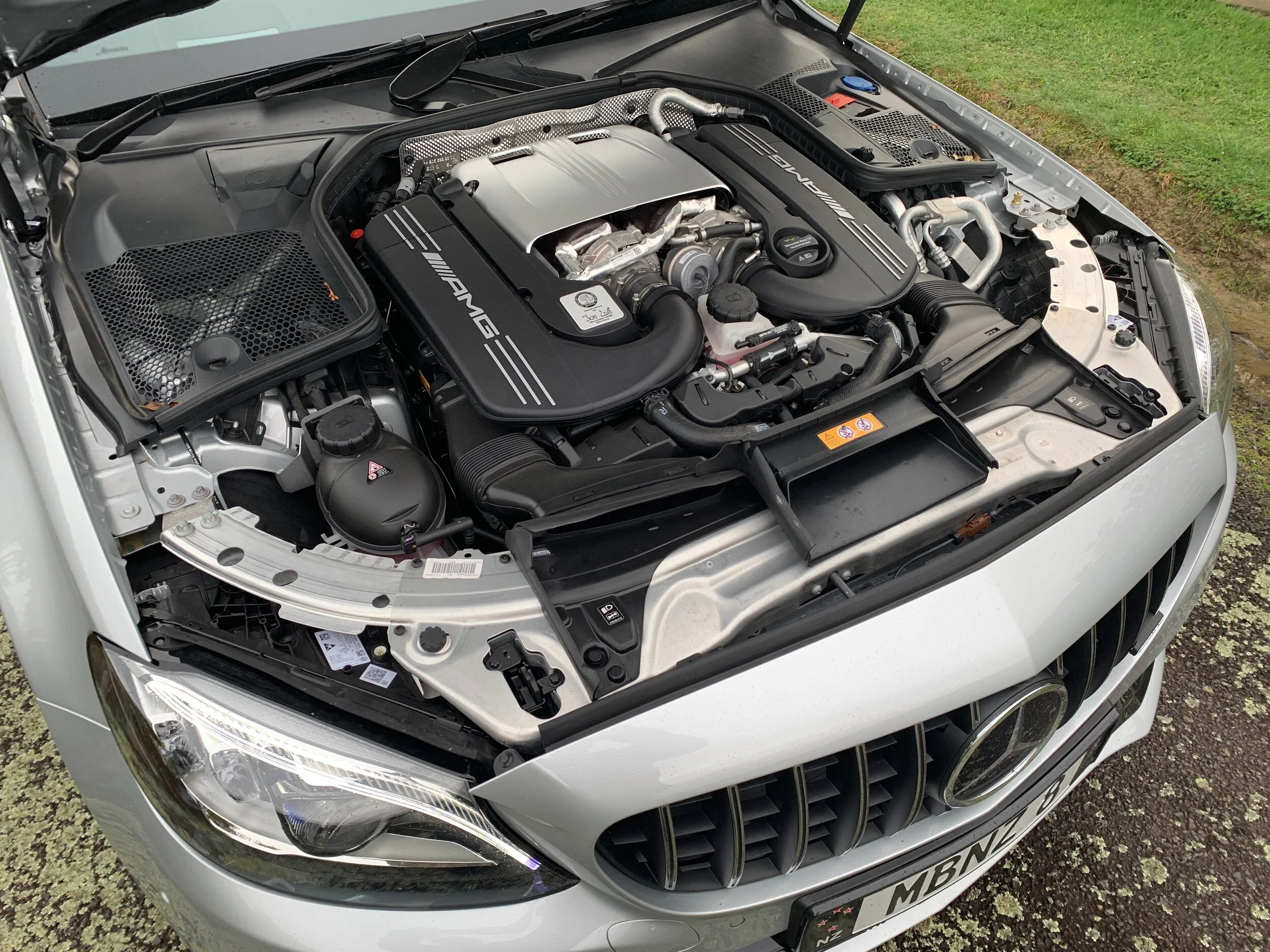
Each delivers an exhaust timbre of such strength in full phwoar footing - the Brit supercharged 5.0-litre pushing out a touch deeper-throated bellow, even more off-throttle crackle-pop and a louder at-idle burble than Germany’s 4.0-litre biturbo bogan – there’s potential they’ll be heard before they are seen.

And yet, when the occasion calls for a less overt ambience … well, they can tone down the trumpeting quite considerably.

Such is life with multi-modal exhausts’ ability to suit the mood of any given moment. From a quiet ‘eco’ setting that’s primarily there to satisfy official sound check tests (and allow neighbourhood meltdown-avoiding early morning starts) to settings that progressively liberate more effusive sounds that are music to enthusiast ears. Perfect, right?

IMG_2733.jpeg

Best make the most of it. News unrolling during the period spent with these cars suggest change in the air will detune today’s high-intensity rumble.

European drive-by noise regulations have become less lenient. What’s okay now won’t be soon. AMG has already admitted future product will be quieter than it could have been as result.

For Jaguar, there’s this plus knowing the raucous AJ engine featuring here will become redundant anyway, with production ending next year. Talk is the replacement will be … gulp … BMW’s 4.4-litre eight. Sad faces at Special Vehicles Operations if M-Division muscles into their patch.

Even with less roar, they’ll still be raw. And yet, offering something you normally don’t expect with high performance. Another ‘p’ word.

Having a big power-operated tailgate and a swag of space behind it doesn’t seem to inhibit how those models go, but it surely must raise their status when fun and family consideration cannot avoid colliding 

Jaguar has an extra edge in respect that the F-Pace meets the market’s SUV fascination, presenting in fully four-wheel-drive and costing $12,900 less than the rear-drive Benz. But either way, if there’s stuff to shift, they’re versatile load swallowers; asking just a little extra care not to besmirch their upmarket leather trims.

As said, the Bunnings-friendly format doesn’t diminish ability to crack on at crazy pace. They also optimal load for brawn and so not only have gold medal potential in their categories but run almost equally for optimal top speed and in the zero-to-100kmh sprint (where the AMG tops, with 4.1 seconds against the Brit’s 4.3). Top speeds are also in the headline-making 280kmh zone.

IMG_3126.jpeg

Fuel burn? Yup, they’re big on that though, surprisingly, with an average 10.6 litres per 100km from test, the AMG was actually 0.1 L/100km under the official combined claim while the Jag sat half a litre above the cited 11.7. Carbon dioxide emissions, another reason why these engines are ultimately doomed? Not flash. Jag at 272g/km, the bonker Benz 237.

The power of pedigree shapes up with extrovert stylings. Wheelarch extensions, rear diffusers, roof spoilers and unique alloys are common ingredients, but it’s the Jaguar that’s most warlike due to large air intakes in the front mudguards, bonnet vents and an incredibly vivid blue paint. The interiors of both also adapt to the task at hand, both running well-bolstered sports seats, the Jag’s with a cool quilted surface, and offering great, low-set driving positions.  

I like that the SVR edition has a regular gear lever in place of the old rotary dial – so much more appropriate than the C-Class stalk shifter – though, in fairness, either way you soon find yourself running in Drive for everyday running then shifting into manual, and using the paddle shifts (AMG’s are better) when wanting to go hands on, which seems appropriate given their abilities. You need not go far to be reminded these are serious cars demanding respect and talent.

The supercharged V8’s strength is the wall of wallop, torque spanning from 2500-5500rpm is so unremitting in its oomph that you just find it hard to believe it is less muscular than the AMG. The all-wheel-drive element is hugely beneficial on winding roads; once through an apex, you can feed in more grunt more quickly than with the Benz, which tail-wags and might even briefly wheelspin if over-hurried.

IMG_2722.jpeg

Given that it carries more mass than the Merc and also has more air between its underside and the seal than any other road-legal performance Jag, you’d think it only fair to cut the F-Pace some slack. Assuredly, it seeks no such sympathy. With uprated dampers, firmer springs, a thicker anti-roll bar, huge brakes, a trick rear-axle mounted electronic active diff and high-performance tyres, it has the goods to undermine thought that SUVs are pushing their luck when being punted hard out.

You do need watch your surfaces. Even though the fronts will ultimately pull as forcefully as the rears push, most of the power goes to the rear wheels untill the system detects slippage. This, and the tyres’ often failing to cut through heavily-metalled sections, made for plenty of oversteer on a 40km of unsealed road I committed to from taking a wrong turn on a route I thought I knew better. The tail-wagging would have been more fun without the unwelcome elements of dizzying drops, blind corners and having to undertake an emergency avoidance of an own-the-road stock truck. 

Using the AMG for an open road trek down country roads to bring back a replacement windscreen for my MX5 race car was a touch nerve-racking; since even on coarse chip in the ‘comfort’ setting, it’s a bit jittery. Would it crack? No. And neither did the screen.

IMG_3114.jpeg

Expensive to buy and keep. That’s how it goes with all performance cars. At least, with these, you get practicality with the polished punch and there’s absolutely no sense they’ve been executed with any less dedication than the sedans and coupes that generally hog the spotlight.


Ford Mustang Bullitt: Gunning for greatness

It’s a closed case. This IS the best factory-delivered edition of the current Pony car.

IMG_0140.jpeg

Base price: $93,490.
Powertrain and performance: 5.0-litre petrol V8, 345kW/556Nm, six-speed manual transmission, RWD, Combined economy 13 litres per 100km, 0-100kmh 5.15sec.
Vital statistics: 4789mm long, 1382mm high, 2720mm wheelbase, luggage capacity 408 litres, 19-inch alloy wheels.
We like: The best distributor-delivered Mustang yet, just 50 on the road. We don't like: Just 50 on the road … and they’re all spoken for.

A Ford Mustang GT 390 Fastback driven by Lieutenant Frank Bullitt (Steve McQueen) duels with a Dodge Charger 440 driven by a pair of assassins down the jagged hills of San Francisco to the soundtrack of squealing tyres and howling V8s.

Actually, there’s more to the plot, but it’s this 10-minute epic duel that lifts Bullitt above being just another 1960s’ lone-wolf-cop-fights-for-justice-in-a –world-gone-bad flick. It still captivates today, despite amusing continuity gaffes: The Charger loses six hub cabs and hugely misses the petrol pumps that trigger a fireball; without wing mirrors getting to the car wash, the Mustang departs with one. And the same green VW Beetle is overtaken repeatedly.

You shrug this off because … well, it’s just so epic, so raw.

The same can be said of the Mustang Bullitt who release is supposedly to celebrate 2018 being the 50th year since the film issued. Could a film in which the most memorable line had McQueen telling a superior “you work your side of the street, I’ll work mine” be THAT crucial? Actually, to Mustang’s image, it was.

Even so, there’s surely a touch of Hollywood to the release timing of this reprise. The Mustang nameplate holds the record for the fastest-selling model in history, yet the latest generation, a white-hot showroom performer when it kicked in, has now starting to drop sales pace. Moreso in North America than places revelling in seeing the Pony Car in right-hand-drive for the first time. Still, this seems a good time for a quick buck blockbuster.

IMG_0148.jpeg

From my time with it, I’d say if any edition can reprise the ‘I want one’ feeling for Ford’s little pony it has to be this Bullitt.

Being based off the best variant, the V8 manual coupe, is an excellent start; I know the shifter’s ‘measured’ action puts off many, but a ‘stick’ is utterly in keeping with the car’s theme.

The car does a great job in announcing itself. Ford NZ only ordered Dark Highland Green, the same colour as McQueen’s ride. It looks amazing, better than the alternate Black (‘as a hitman’s heart?’) they could also have chosen.

The tribute also includes 19-inch aluminium wheels, reminiscent of the original’s Rostyles, and though it bows to the modern in having navigation, all the usual safety assists and air conditioning, it also sharpens fast road (or track) readiness with semi-active suspension, Recaro seats, red, painted Brembo brakes, and a new induction system, specifically the intake manifold from the Shelby GT350. This doesn’t alter the 5.0-litre’s torque and only elevates power output by just 5kW, but it’s nonetheless quite enough to lift the top speed and, just as crucially, make the engine sound meaner.

The only crime against good taste is perpetrated by a swag of Bullitt emblems Stakeout discretion was never likely but the largest - on the steering wheel boss and the tail, mimicking where the original model had its fuel filler – are just too much.

IMG_0133.jpeg

Even emblazoned it’s not a given everyone understands why this car exists. I’d always imagined Bullitt would never misfire, yet I met a few from the Mustang’s traditional 50-plus customer base who honestly had forgotten all about the link. Then there was a mate, too young for the era yet a serious film and car buff, who stunned by fessing he’d heard of, but never seen, the pic. 

Of course, visually the car has enough of what would, back in McQueen’s day, be called a ‘badass’ ambience to achieve kerbside cool. Yet what makes it really worthy is a factor that, admittedly, comes from left field.

Namely that the Mustang in latest form has turned into quite a decent driver’s car. Yes, it’s big and wide and a touch hefty. Yet just this generation being the first with an independent rear suspension is a huge positive. Beyond that, the Bullitt’s calibre is improved by all sorts of further refinements. You might not want to chase Porsches, but it is genuinely good enough to utterly blow apart perception of American cars being wallowy, ponderous and prone to fall off corners.

Here control weights and steering in particular impress, the power is thrilling - you tend to ‘hit the gas’ just to hear it roar - and, though the weight and size are never fully disguised, it is a refreshingly honest car. One that makes you feel connected and happy to be alive. I just loved every minute with it. Even when it rained.

You’d expect nothing less from a ‘special’.  Yet, on that note, another twist. Even though Ford New Zealand has decided to cap the order to just 50 units – all spoken for, sorry – and says it will deliver no more, in theory it could. Because, from what I can tell, the build plan allows the Flat Rock factory to knock out many as it wants for as long as it sees fit.

IMG_0163.jpeg

The Bullitt is not perfect – you’ll not be surprised that it drinks hard and, though I don’t doubt the sincerity of the window sticker attesting to the plant being staffed by world class people, that’s not quite a descriptive that sticks when discussing assembly. However, the fuel burn and the occasional trim rattle are not in any way plot spoilers. They’re just … well, character.

You wonder, of course, what the man himself would think of it. Being a petrolhead, you’d think Terence Steven McQueen – who died in 1980, aged 50 from a rare cancer – would have ultimate interest in Shelby’s 2020 GT500. But hey, that’s not likely set for NZ screening, so best not dwell.

It’s hard to think of any reason why he wouldn’t also enjoy the Bullitt, nonetheless.

One thing everyone who knew the man, not least some big name race drivers, tend to testify is that McQueen loved a fast car and knew how to handle one,

He intended to do all the driving in the film, but a crash rattled McQueen’s wife so much she implored director Peter Yates to bring in stunt ace Bud Ekins. McQueen was furious. (Check the interior shots: When McQueen is driving, the rear view mirror shows his face. When Ekins is driving it is up, so his face is hidden).

Final film fact. There were two Mustangs used for the film; one went to the wreckers’ just after shooting was over but the other – even though it was used for the remarkable hill driving stints - is still around and looking good.

IMG_0154.jpeg


Tesla Model 3: Build it and they will come, right?

The tech impresses, the build quality is okay but forget about the budget pricing Elon once hinted at.

IMG_3383.jpeg

Base price: $101,100.
Powertrain and performance: Performance lithium-ion plug-in battery pack, AWD, range 560km (NEDC), 0-100kmh 3.4 seconds.
Vital statistics: 4694mm long, 1443mm high, 2875mm wheelbase, luggage capacity 423 litres, 20-inch alloy wheels.
We like: The range, roominess, driving feel.
We don't like: Design shortcomings, the price, single display too diverting.


BIG brother was watching. Presumably big sister, too.

“We know where you’ve been,” said the staffer to whom I returned the key, before referencing places I’d indeed passed through. An in-car tracker? No, but as sinister. Hardcore fans. On that day, just a handful of Model 3 sedans were in circulation. I’d been hot news on the supporters’ social network from start to finish.

Old news now, with registrations count for September making bigger headlines. Even if all those 359 cars were pre-ordered, that many on the road in the first full month is worth crowing about.

Is this the start of something big? Actually, I’d be surprised. Even those utterly afflicted by Teslosis would have to accept the editions presently being served up – a base single motor model at just under $74k and the $30 grand-dearer flagship twin-motor Performance I drove - aren’t best candidates to meet the 2016 unveiling pledge about this being an ‘EV for the masses’. Until it hit a more relevant price zone, Tesla is working the same fad-driven consumer crowd as every other player.

How about that desirability? Hate me if you must, Tesla-philes, but I’m not sold on that. Yes, it achieves – utterly nails, in fact – core capability. But so much is left undone; the Supercharger network is awesome, but one sales and support centre for the entire country? Not what I’d like if living well away from Auckland.

IMG_3364.jpeg

Also, there’s what you’re getting. In hindsight, with sedans being such hard sells now, the Model Y would be so much more suited to this entry role. As is, more design flair wouldn’t hurt the Model 3. It’s interesting the designer (who came from VW via Saturn, famous for anodyne America-centric fare) has added extra accents to his personal example. It needs more pizzazz. And bright colours.

The budget quality of some trim, the shapeless seats – the rear bench is exactly that - and doors that close with a clang. These jar. Build quality? If you know of the background of how an attempt to deliver an automated assembly line for this car so derailed it had to revert to an old-school manual assembly line - under canvas – you’d wonder. But it was truly good. But, all in all, it doesn’t sizzle for visual appeal.

Only when you get into the car … are you fully swept up by ‘the show.’ And it’s a magnificent adventure. One beginning with the ‘key’ - a card you waft up and down the B-pillar to find the ‘secret’ spot for unlocking – and continues when you note the lack of an instrument panel, very few buttons, not even orthodox vents. Again, stuff gets quirky and questionable. An electric window control that turns out to be an interior door release, those multi-functional rollerballs on the steering wheel, a gear selector that doubles as the cruise control activator? Boundaries are not stretched. They’re broken.

Love or hate? So much depends on how well you can relate to the central control centre; a monolithic and impressively high-res 15-inch central touchscreen. As in-car displays go, it’s the best I’ve seen. Considering the complexity of the functionality it copes with, the system is easy to fathom and the slick, fast-acting graphics are brilliant.

IMG_3365.jpeg

It’s smart. Maybe too smart. Certainly, an interface dedicating well beyond  core operational functions and driver assist engagements but also being the portal to an astounding span of infotainment options (forget Apple CarPlay, Android Auto and even AM radio, say howdy to net-streaming and a huge music library) AND the famous Tesla toybox containing those initially trendy (surely ultimately tiresome) Easter Eggs (farting indicators, old-school video games and so on) is very busy. It really shouldn’t also have to facilitate functions for opening the glovebox, adjusting the wiper settings and door mirrors and resetting the tripmeter (apparently). But it does.

Driving in poor weather and often heavy traffic was a stern test of potential to distract when driving. A head-up display, in which the most salient data could be relayed, would be massively beneficial, but it’s either too old-school or too orthodox for Tesla.

As for the one tech element that really sets Tesla apart? Having proven to be less than genius overseas, it didn’t really surprise to be advised the self-driving guidance suite, Autopilot, asks for total hands-on involvement here.

That’s probably just as well. Motorways aside, NZ’s roadscape is a challenge for even advanced semi-autonomy and this car’s array of cameras and sensors weren’t behaving well enough to be utterly trustworthy. In traffic the visualisation of surrounding vehicles around was often false-alerting lane intrusions and the active cruise control seemed to be thrown by the rain. At point of overtaking a truck on the motorway in a downpour, the car emergency slowed, having apparently mis-identified the rig’s tyre spray as something more solid. From my experience, other systems don’t do this.

What redeems the car is something I hadn’t really expected; a pleasing engagement under human guidance. As is typical of EVs, it gains speed smoothly and almost silently, with the motors providing strong power. Even though this is the only Tesla not to have Ludicrous mode, it feels massive under full urge.

If anything, though, it’s the dynamic side that pleases more. I didn’t go far or hard enough to establish its credentials as a full-out performance sedan, so if you’re wondering how well it ultimately meets the badge promise … sorry, can’t say. Track day fanging would be an intrigue; surely those Michelin P44S tyres and meaty Brembo brakes aren’t just for show?

The low centre of gravity helps it change direction crisply and feel stable in corners. Though in this car there was sense the rear and front motors were slightly out of synch, I found once I’d finetune a few things, notably the steering, it carried itself well. All it needs is a less harsh ride and improved sound-proofing; the cocoon of quiet requires smooth motorway tarmac. 

Need for battery replenishment was more to try out the Supercharger network than range anxiety. I did get a little jittery when charger didn’t initially disengage, diagnosed as /a system glitch.

The Performance is an opus, no argument. It aces the EV 101 of delivering very good operability and range. It’s largely engaging to drive.

However, it’s not absolutely not the car that delivers on the promise Elon’s acolytes thought they heard. Musk’s vaunted ‘Master Plan’ always called for making expensive vehicles to fund cheaper ones realising less profit but, ultimately, more potential through achieving greater volume. It’s a great idea; car-making 101, in fact. Time to try is fast running out.