Land Rover Defender 110 P240 SE: From the back, to the future

The new Defender is everything it was … and everything it never used to be. Which makes it hugely alluring.

Photos Callum Crawley

Photos Callum Crawley

Price: $114,900 ($120,150 as tested).

Powertrain and performance:  2.0-litre four-cylinder twin turbocharged diesel engine. 240kW/2400rpm, 430Nm/1500rpm. Four-wheel-drive. Combined cycle fuel consumption 7.8L/100km (claim), 8.4L/100km (road test).

Vital statistics: Length 5018mm, height 1969mm, width 2008mm, wheelbase 3022. Wheels: 20-inch alloys with 255/60 R20 tyres.

We like: Smartest Land Rover yet, makes all rivals feel very old indeed.

We don’t like: Seeing it in black, quirky gearshift trigger.

RELEASING any new model inevitably seems to be a tin hat time for Land Rover – everyone’s a ‘know-better’ armchair expert, right?

So, to the Defender. The target painted on a model whose sales success is so vital seems large indeed.

Depending on your degree of pride or prejudice, the oldest and longest-serving nameplate in this  Green badge garage represents all that’s great – and all that grates – about Britain’s famous off-roader brand.

As has so often been said, the original, as ancient and as outdated as it had patently become (even well before it was dropped) nonetheless was so loved it was always going to be a tough act to follow.

So much so that, realistically, Land Rover demonstrated Victoria Cross-earning valour simply by determining to go ahead with a new one, let alone one that is exactly that. New. Not a modernised reproduction but a proper ground-up reinterpretation. That’s bravery beyond the call. Cue the condemnation.

So now it’s out. And now it’s been driven. A delight or a disgrace? The following is based on strength of a week with the 110 (that’s the five-door) in its mid-level SE specification with the 2.0-litre turbodiesel in its most potent state of tune (so, 147kW and 430Nm), an example not quite standard but not too heavily blinged (basically, a $120k example of a car that costs $114,900 bog standard). You can read all the way through or skip to the end.

IMG_6436.jpg

Or you can accept what I say here and now. Basically, it’s advice to stow that vitriol and any enduring vindictiveness and at least give it a chance. This is no half-pie effort by any means. If anything, it’s the most completely-sorted Land Rover I’ve experienced. Truly.

Just me? It was honestly pure happenstance that past close association with truly off-road sorted Land Rover product – so, either the previous Defender or the Discovery – tied almost all those who rode in the test vehicle during its run.

There was a self-avowed tragic for the old car. He seemed quietly impressed after a 20-minute ride in the new. So too, by and large, were the experts in off-roading who allowed access to their farm, and specifically areas they often use to test latest popular models and suspension and drivetrain mods (cos that’s their day business), and also briefly directly tried out its skill set. A wee quibble about the gear selector aside – they’re right, there’s a bit of a knack to its action – they were smiling.  

Final contestant was a mate who was a passenger during the towing exercise (handily, my race car needed taking to the local circuit for testing, so …). He really had least reason of all to lend this brand any more love. He’d just had a pretty torrid time running a two-generations’ old pre-owned Disco (admittedly, he knew it was a risk, given the low price). And yet? Well, after a while, he began to warm as well.  

What touched their hearts? Well, it’s possible more than packaging than the package itself: Like every recent Land Rover, it has opinion-splitting styling, potentially accentuated by the tester being black. In that hue, insofar as handsomeness went, it was more striking when viewed from the front and sides than from the back. Just like a Discovery then? Exactly, though better-looking overall. 

The sheer dimension of the machine takes some getting used to. After a week, it felt less gargantuan than on first meeting. But it is big.

The dimension has pros and cons – it’s tall and offers a fantastically commanding view, and all-round visibility is not too bad (what you can’t see physically is more than adequately covered by sensors and cameras), but although it is not too long to cause issue for parking, it is wide enough to make normal angle, if not so much parallel, parks seem a squeeze. It’s in that latter, though, where the side-opening tailgate mightn’t do you any favours.

IMG_6490.jpg

Likewise, it comes across as being quite a dominant force on urban streets you’re always doubly aware of how close it gets – or, more correctly, you imagine it gets – to parked cars.

So maybe it’s not those aspects that make best impression. What does, though, is the comfort – is really does have brilliantly good seats and there’s heaps of head, shoulder and leg room where ever you place in the main cabin (though yes, the third row seats that pop up from the boot are more child-sized).

 Yes, it’s best to remember – and I didn’t always to – to set the air suspension to its lowest setting so as to make egress and access easier, not least for the vertically challenged. But once you’re in, it’s a good spot, roomy and comfortable; the front chairs are extremely good.

The fact that you can sit naturally in it is, for one, a major improvement over the original, whose driving position in particular required significant and painful contortion.

The interior treatment also steps up; it’s still obviously utilitarian, but takes industrial ruggedness to an art form, mixing bare-metal items with high-grade leathers, mixing soft and hard surfaces, rubber floor mats, a tough-looking carpet … it’s all muddy boot-ready, yet there’s still an air of luxury, more so than you’ll find in a Jeep, easily as much as comes with a Land Cruiser.

The ace card within the cabin is what makes the whole car: The technology loading, mainly running through the Pivi Pro infotainment system, which is a big step forward for Land Rover. Quick responses, a clear and concise display. Going to and from Apple CarPlay can be a trick, but overall it’s a winner. 

Yeah, I know what you old-hands think about all this. You’ll tell me the old Defender being as rudimentary as a tool could be was a strength and that you wish the new was too.

Yes, I agree, the fundamental elements of the old model’s design, with the time-honoured basics like live axles and coil springs, and basic square body bolted onto a steel ladder chassis, really made the previous rig a faithful friend.

But that didn’t mean it couldn’t be bettered by Nature. I’ve been in situations where Defenders have been overcome by situations that haven’t stopped rival models. In its last few years, it was sitting at the back of the pack in as much respect to that as anything else.

Nowadays, Land Rover is heavily committed computer-driven wizardry; the advances with this car are such that the Terrain Response system that in other models is a big dial becomes just a switch here. Other switches are touch screen prompts.  

Will it be 100 percent reliable 100 percent of the time? Well, like you, I’ve seen YouTube footage posted by early owners disgruntled by issues. But, then, I’ve seen lots of films made by lots of people angry with lots of different cars. 

IMG_6535.jpg

All I can is that the Defender didn’t look remotely set to disgrace itself when I had it.

Also, I’d remind that we’re in a technology age. All Land Rover has given us is a machine to suit. Asking for a Land Rover to step back to old-school is like proposing that the Nokia 1100 phone I had 15 years ago is better than the iPhone I have now. It isn’t.

So there’s that. And then there’s the fact that this model was field-tested extremely rigorously all the way up to release.  

Its ambience imparts strength. So, for all that it is likely to settle in as a very useful lifestyle choice, Land Rover doesn’t hide the fact that it has nonetheless tailored this model to also appeal those who will use it for work; everyone from farmers and country vets to outdoors adventure operators. 

So it’s obviously more of a workhorse that the Discovery, let alone anything from Range Rover. A pragmatic vehicle that puts priority on practicality and good honest toil, with stellar off-road ability thrown in for good measure. You don’t expect to get the polish of the more family-minded models and, true enough, in many respects it doesn’t provide it. It’s not rough, but neither is it upper crust schmooze. But it is tough and it is clever. 

When it comes to smarts, well prepared to be as stunned as we all were. What you’re getting is basically the equivalent of a working-class lad who also happens to be a Rhodes Scholar.

It delivers, and in a delightfully no-big-deal manner, features and functions I suspect no other brand that plays in its field – and these days, that’s really just Jeep and Toyota predominantly - had potentially not even given consideration to. But might, now that Land Rover has. 

For example? One that I really useful was the towing assist logic, which crops up as an option on the main display screen. There’s no necessity to use it – the car will happily allow a trailer to be slung on its hook – but I’d advise considering it, because it’s really fascinating.

Basically, once the trailer is attached, you simply slide back into the cockpit, hit the screen prompt and that takes you into a sub-menu which asks, first, what it is you’re. All the usual suspects are identified by icons (boat, caravan, rubbish trailer, and yes, car trailer). Hit that and next question: How many axles? Mine has one, but again everything’s covered. Third: Punch in the dimensions of the trailer. Two minutes with a tape measure, I had that input.

IMG_7294.jpeg

And then? Well, impressive magic. For one, the wing mirrors self-adjusted outward a touch, to give a better view of what’s behind. The surround cameras also sorted their views to take the trailer into account and also give a better view of the tow hitch. The car also adjusted its trailer sway, braking force and stability  control in calibrate for a heavier, longer load (though the weight itself is not required). All in all, it just drove better with this done, than without. I’ve seen anything like this before and neither had my mates.

And that’s just one thing. Taking it off-road was also great fun, even though I really thought I’d pushed my luck too far in the paddocks when striving to ascend a steep hill. We’d come down, there was only one way to get back and this was it. First go, not good. The tyres lost grip, the thing slid backwards, for quite a way. Since I’d already put into the correct mud/grass setting and locked into low range, I thought I’d run out of options. But now; there’s a further low-grip setting. I tried that … and it danced all the way up, the power delivering far more evenly and more precisely to each wheel (and you could see it happening on the screen).

Is that good enough? From the launch drive, I already know so. Buying into the Terrain Response 2 kit – not a retro-fit, unfortunately, but something that has to be implemented during build – gives it more skills and assistance features, including the entire gambit of e-diff options. Giving it brawnier all-terrain tyres would also benefit. The standard rubber’s treads do clog quickly; losing bite on wet grass and mud underneath was half my trouble. 

However, the basic package is really well-engineered. The core reason for the car’s basic shape is to give it best chance of not snagging anything off-road.  The bobtailed rear is brilliant; you achieve a 40 degrees departure angle in off-road mode. Ground clearance measures in at 291mm thanks to the lack of live axles underneath. The wheelbase, relatively long at 3022mm pushes wheels out to each corner. That yields a 38-degree approach angle and 28-degree ramp-over angle. That’s military grade. Likewise the generous amount of ground clearance, which of course is adjustable.

Going to independent all-round suspension shouldn’t allow it to be as outright flexy as something with coil springs and long control arms, and yet the manner in which the Defender copes with ruts, climbs and side angles completely deflates that point of view.  

IMG_7337.jpeg

Those independent control arms, made of cast aluminium, mimic the natural articulation of a live axle by cross-linking air springs, allowing the car to sense the tucking and drooping of each wheel, and compensating accordingly. It all happens so swiftly and accurately the body remains impressively stable. Ultimately, yes, it’ll only stretch and tuck so far, but the underbody is a tidy design, with nothing obviously set to snag and all the fixtures look robust.

Everything’s attached to a modified, heavy-duty aluminium monocoque platform that promises to be 300 percent stiffer than a ladder chassis. Steel is used for strength in important subframe components. A previous driver reckoned the car had rattles. His hearing must be keener than mine. Personal impression was that it is a very tight construct. No shimmy, no shake. So different from the old one.

What you do notice, off road even more than on, is the weight. Even with the lightweight aluminium monocoque design, this Defender weighs at least 400kg heavier than its predecessor, comfortably clocking over two tonnes.

With that in mind, talk – yet to be reconciled – of the current four-cylinder 2.0-litre engines being bumped sometime next year by a 3.0-litre six cylinder diesel, the same engine that already goes into the D300 variant but in lower states of tune, would have weighing up the pros and cons of the current unit.

There’s nothing bad about the four-cylinder; it has decent torque and doesn’t ever seem to feel, let alone sound, strained, but neither does is it up to being especially hustled or rushed. You notice, too, that the eight-speed automatic gearbox shuffles ratios about quickly to cope with demands for acceleration.

In saying that, I’d suspect any version of Defender won’t stand being driven like a hot hatchback. Regardless that roadholding is secure, overly-enthusiastic cornering will have the tall body rolling. It feels easy-going at 100kmh, with a lot more in reser4ves, but charging up to that 225kmh top speed would require special resolve and a high degree of talent, I’d think.

 Still, while the steering is relatively heavy and typically inert for an electrically assisted system, it’s accurate enough, allowing you to place the Defender with ease. From thereon it’s just a matter of having the patience to allow the body time to settle before powering on again. Hey, it’s a large 4x4 yet, in saying that, is tidier than available opponents and certainly worlds ahead of the old Defender.

For all its mass and massiveness, the car has a reassuringly commanding feel and what’s impressive during all this is the rolling refinement. The engine gets gruff as you accelerate, yes, but once you’re holding a steady pace, it settles down. And this allows you to appreciate the isolation of road noise. For a car on 20-inch alloys and 255/60R all-terrain rubber, it’s very good indeed.

IMG_6560.jpg

In summary, and apologies for taking so long to get to it, the Defender is … well, still a Defender, but a much, much better kind. More to the point, it’s a vehicle that not makes it forebear look ancient, but also does much the same to other contenders in the current market. Just compare it with a Land Cruiser in the same price range to get what I mean. Toyota’s erstwhile model is literally from an earlier century.

One aspect I admire about the Defender is that its evolution is set to continue, particularly in respect the drivetrain. Today we have diesel and petrol, next year there will more engines, with better efficiency, and something else new for the class: A plug-in hybrid.

 Another is that, in the time I had, every day brought a new discovery about what it had and could accomplish. And, as each day passed, the attraction and bond seemed to strengthen.

I hope it succeeds beyond all Land Rover’s dreams.

IMG_6408.jpg


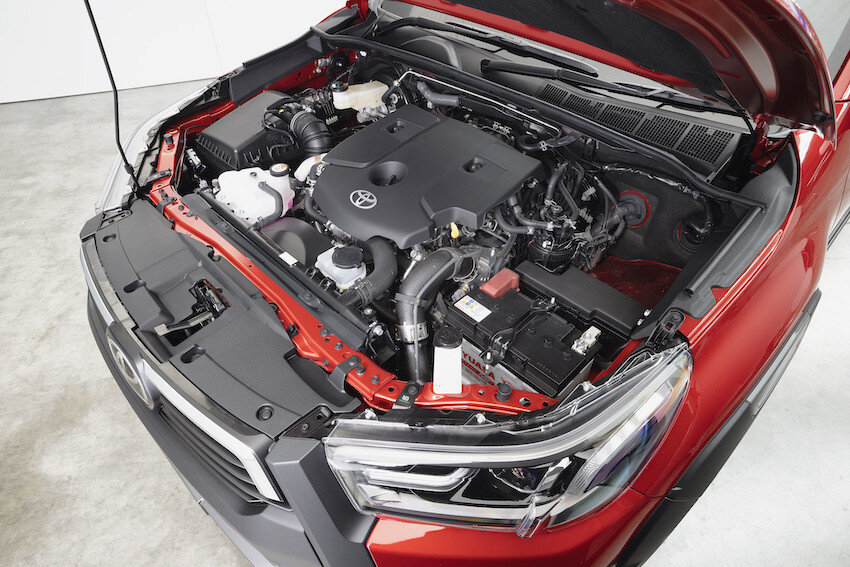
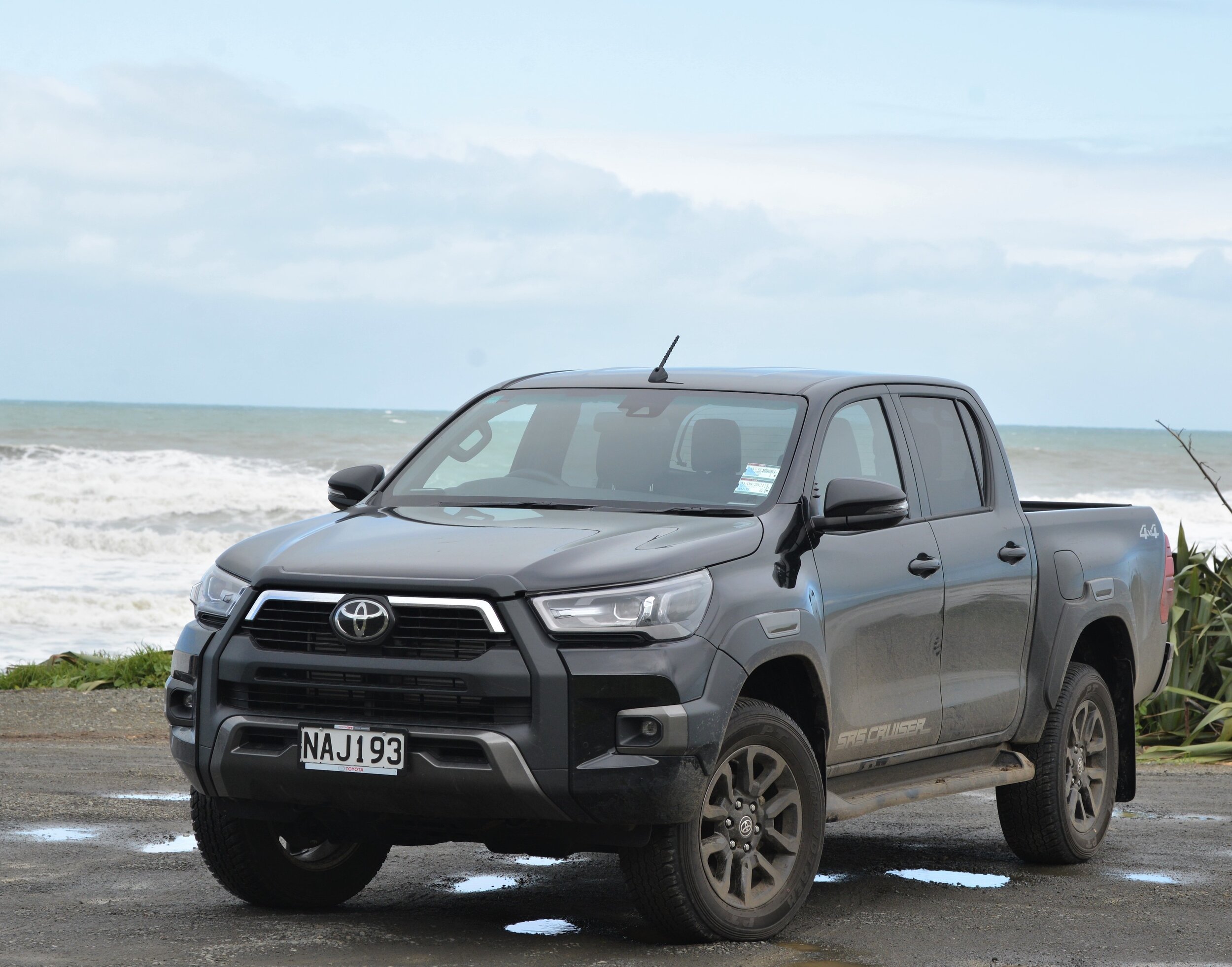
Toyota Hilux 4WD SR5 Cruiser: New tricks for the top dog

The plush edition of this toiler accounts for almost half of Hilux volume. So it needs to be good.

Images: Colin Smith and supplied.

Images: Colin Smith and supplied.

Price:  $58,990

Powertrain and performance:  2.8-litre four-cylinder 16-valve turbocharged diesel engine. 150kW/3000-3400rpm, 500Nm/1600-2800rpm. Four-wheel-drive. Combined cycle fuel consumption 7.9L/100km (claim), 9.3L/100km (road test).

Vital statistics: Length 5325mm, height 1815mm, width 1900mm, wheelbase 3090mm. Wheels: 18-inch alloys with 265/60 R18 Dunlop Grand Trek PT tyres.

We like: Comprehensive safety and driver assist features and improved response from the upgraded diesel engine. Larger touchscreen and long-awaited addition of Apple CarPlay and Android Auto.

We don’t like: Unsure if the claimed fuel consumption improvements are achievable.

IT WAS a very brief reign for the 4WD SR5 Cruiser as the flagship of Toyota’s upgraded 2021 Hilux range.

From an evening press conference till afternoon tea the next day the SR5 Cruiser was king of the hill in the Hilux family.

Then the Raptor-hunting Hilux Mako arrived from out of the sky – slung below a Blackhawk helicopter – and immediately the SR5 Cruiser seemed like just another Hilux.

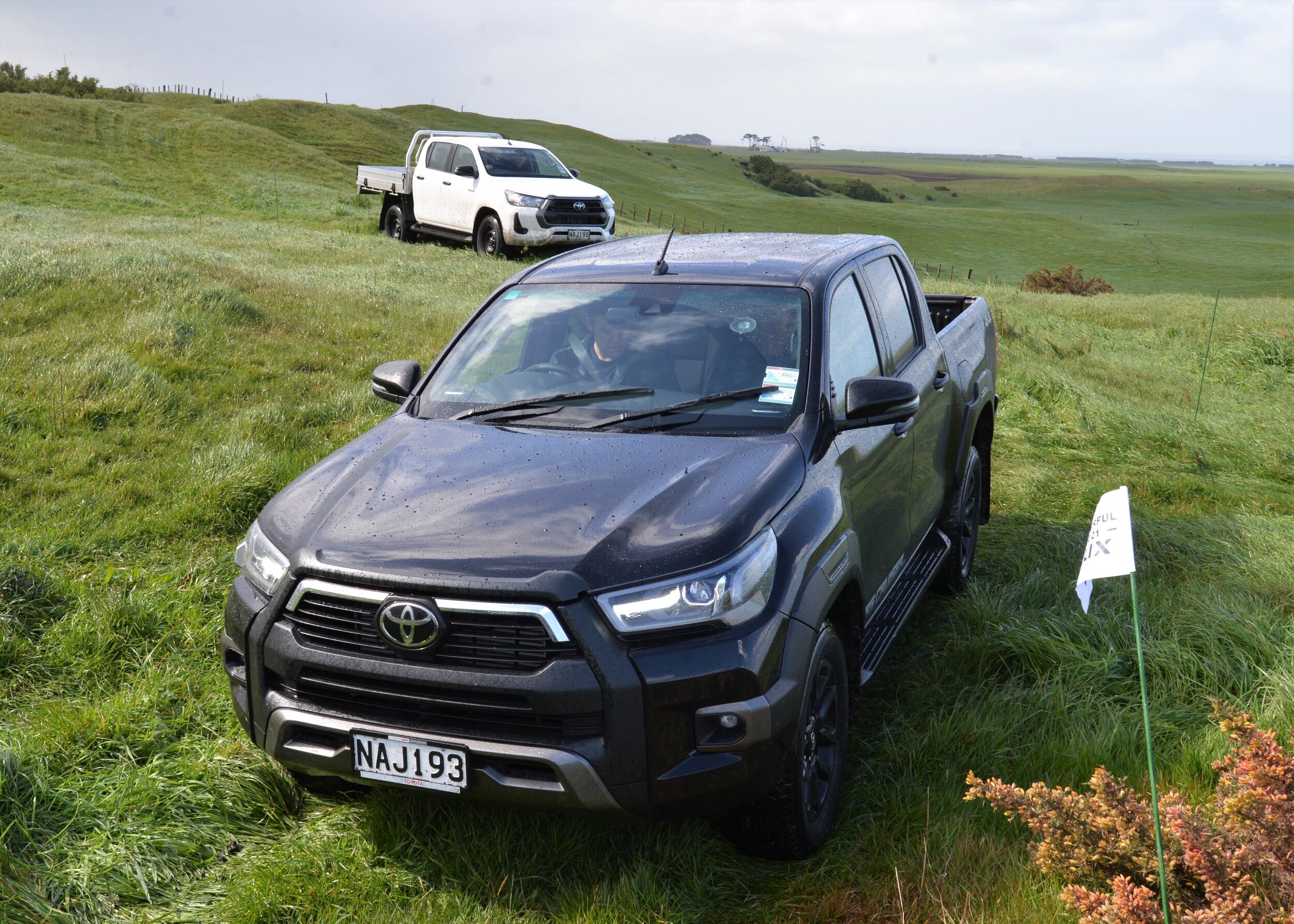
Only available in Double Cab configuration with an automatic transmission, the SR5 Cruiser is positioned to showcase the full extent of 2021 upgrades across the Hilux range.

It’s only in partnership with the six-speed automatic transmission where the latest 50Nm torque boost to 500Nm from the 2.8-litre diesel engine is available.

And it’s the double cab configuration which benefits from the full scope of suspension upgrades that deliver noticeably more settled medium-speed and highway ride comfort.

In spite of a $2500 price increase the MY21 SR5 Cruiser still finds an important sub-$60k price position at $58,990 (including on-road costs and the other benefits of Toyota’s Drive Happy programme).

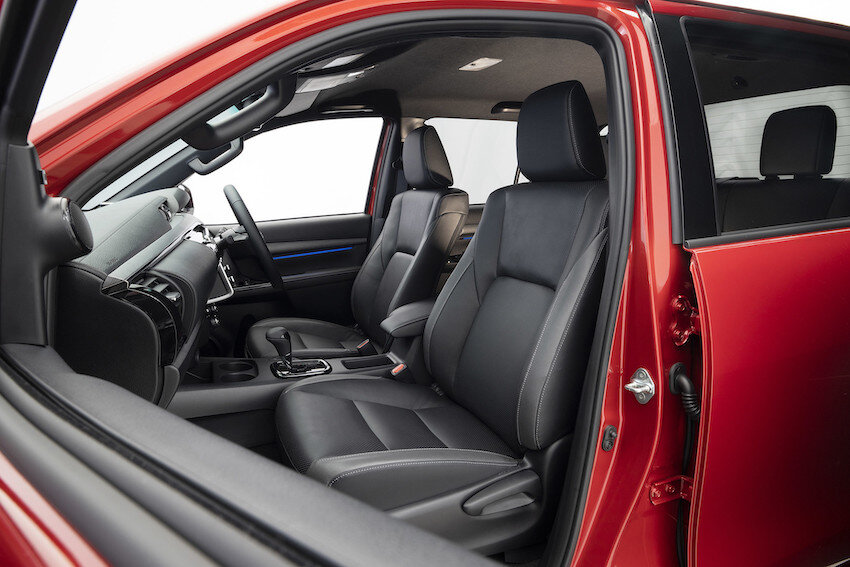
Other aspects of the MY21 upgrade have seen the 4WD SR5 Cruiser specification boosted with the introduction of a nine-speaker JBL audio system, an auto-dimming interior mirror, stylish blue ambient lighting in the door trims, new matte and piano black interior surfaces, an upgraded instrument cluster and multi-info display and a new leather accented two-tone grey/black seat trim.

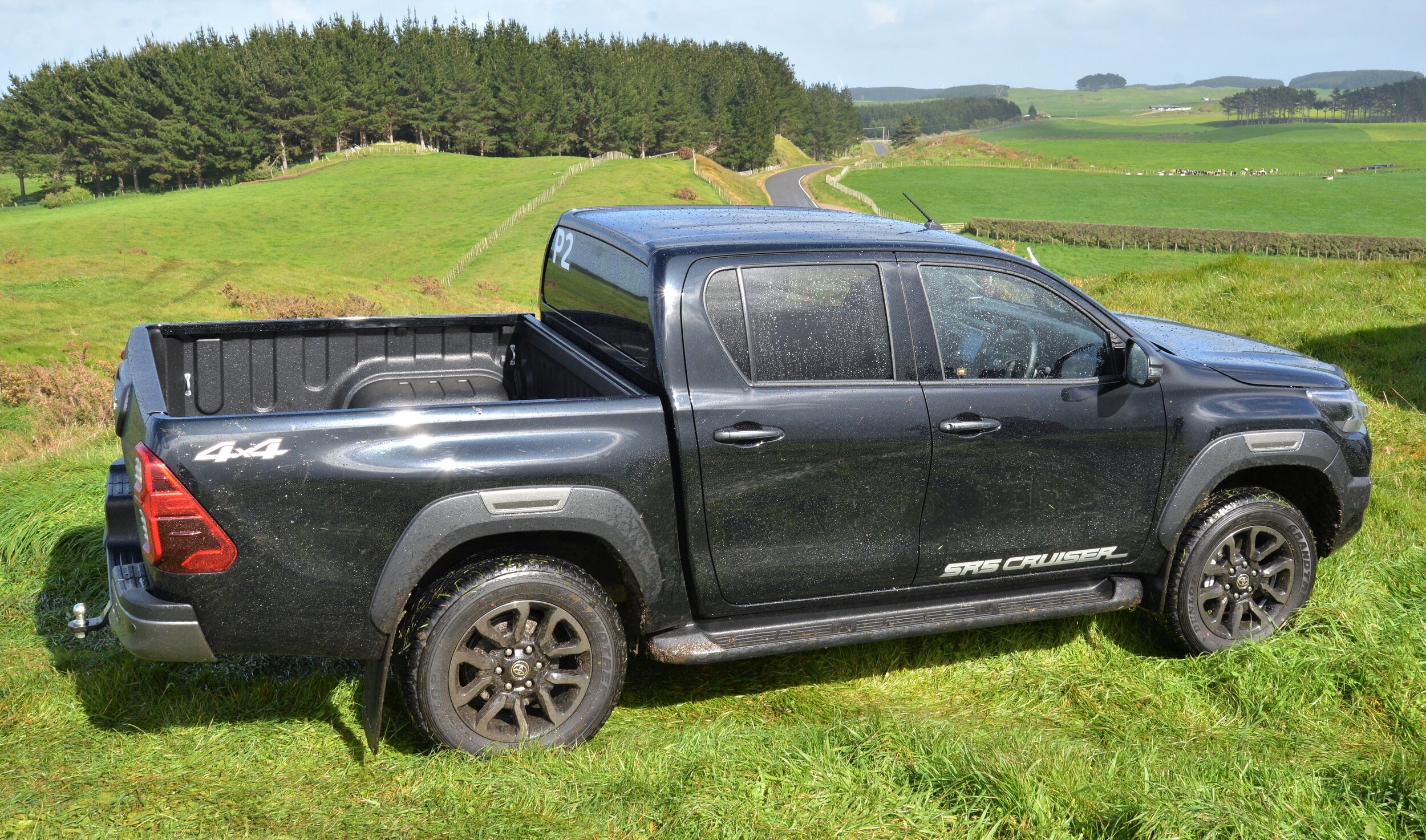
Exterior highlights include new 18-inch alloy wheels in a two-tone grey/black finish, the addition of welcome lights in the door mirrors, a unique black tailgate garnish and Cruiser-specific darkened detailing around the grille, bumper, headlight and fog lamp accents to give a much more defined front-end look to the Hilux.

50381028438_d8606abaa4_k.jpg

It’s not just a 20kW power increase and 50Nm torque boost for the 2.8-litre diesel. It’s more refined with quieter cold start and warm-up idle characteristics.

It’s not only evident the revised engine has stronger low-rpm muscle but it also continues to deliver power toward higher revs which has benefits for highway overtaking response.

The boost in power and torque is achieved by a new cylinder block and pistons, a bigger turbo, new exhaust manifold, increased fuel injection pressure and cooling improvements.

The new output figures are 150kW and 500Nm but the big torque number only applies when the Hilux has the six-speed automatic transmission. With the manual gearbox (not relevant to the SR5 Cruiser grade but available in SR5 level) there is an unchanged 420Nm torque peak.

Improved performance is accompanied by a claimed 10 percent reduction in fuel consumption and 11 percent lower CO2 emissions.

Toyota now claims a combined cycle figure of 7.9L/100km but even with much of my driving on the highway I could only manage 9.3L/100km and was left wondering how much the number would improve with a bit more mileage.

Toyota engineers have made chassis and suspension improvements that achieve more compliance and control from the initial suspension response across bumps and corrugations.

Shock absorbers, spring rates and suspension bushes are all updated for 2021 while a new variable flow power steering pump requires reduced low speed steering effort but provides a pleasingly direct feel on the highway and back roads as the assistance level reduces.  

The more settled feel of the highway ride quality also comes from an extra leaf spring being added to the rear suspension of all diesel double cab models.

The refinement focus is continued with changes to the cab mounting points for improved vibration insulation.

The overall feel of the new SR5 Cruiser is a more refined on-road performer with crisper throttle response. The driving characteristics include a more precise feel and suspension that copes better across both higher frequency corrugations as also single input bumps and broken surfaces.

The other significant MY21 Hilux changes come within the cabin with the immediately noticeable change being a larger 8.0-inch touchscreen – in place for previous 6.0- and 7.0-inch screens – for all models.

That change is accompanied by the long-awaited introduction of Apple CarPlay and Android Auto functionality. That least when Toyota finally makes the move it is adopted as standard across the full range including the entry-level WorkMate models.

The revised 4.2-inch multi-info display now includes a digital speedo readout.

While rugged off-road capability remains a key part of the Hilux 4x4 skillset there is also the on-road benefit of the standard across-the-range Toyota Safety Sense package.

TSS content includes Dynamic Radar Cruise Control with pre-collision safety and autonomous emergency braking, lane departure alert and road sign assist on all models. There are seven airbags and the 2019 5-star ANCAP rating carries over.

Hill-Start Assist Control is standard and all 4x4 models now have Downhill Assist Control (previously the SR Double Cab 4WD manual missed out on this feature).

It’s been interesting to follow the fortunes of the eighth generation Hilux since it launched in late-2015. The Ford Ranger had taken ute market leadership the previous year as the previous generation Hilux became very long in the tooth.

Since then Hilux has sold in record numbers but has never dislodged the Ranger from No.1 spot for more than an occasional month. Yet last month, it’s first in the market, Hilux beat the Ford on count to take the top step. How many of these were old models at an attractive run-out price; how many were dealer demonstrators? Still, it outwardly seems a good start.

The MY21 is the best-looking Hilux yet and with its improved performance and refinement plus new technology features it has the best chance yet of ute market leadership.


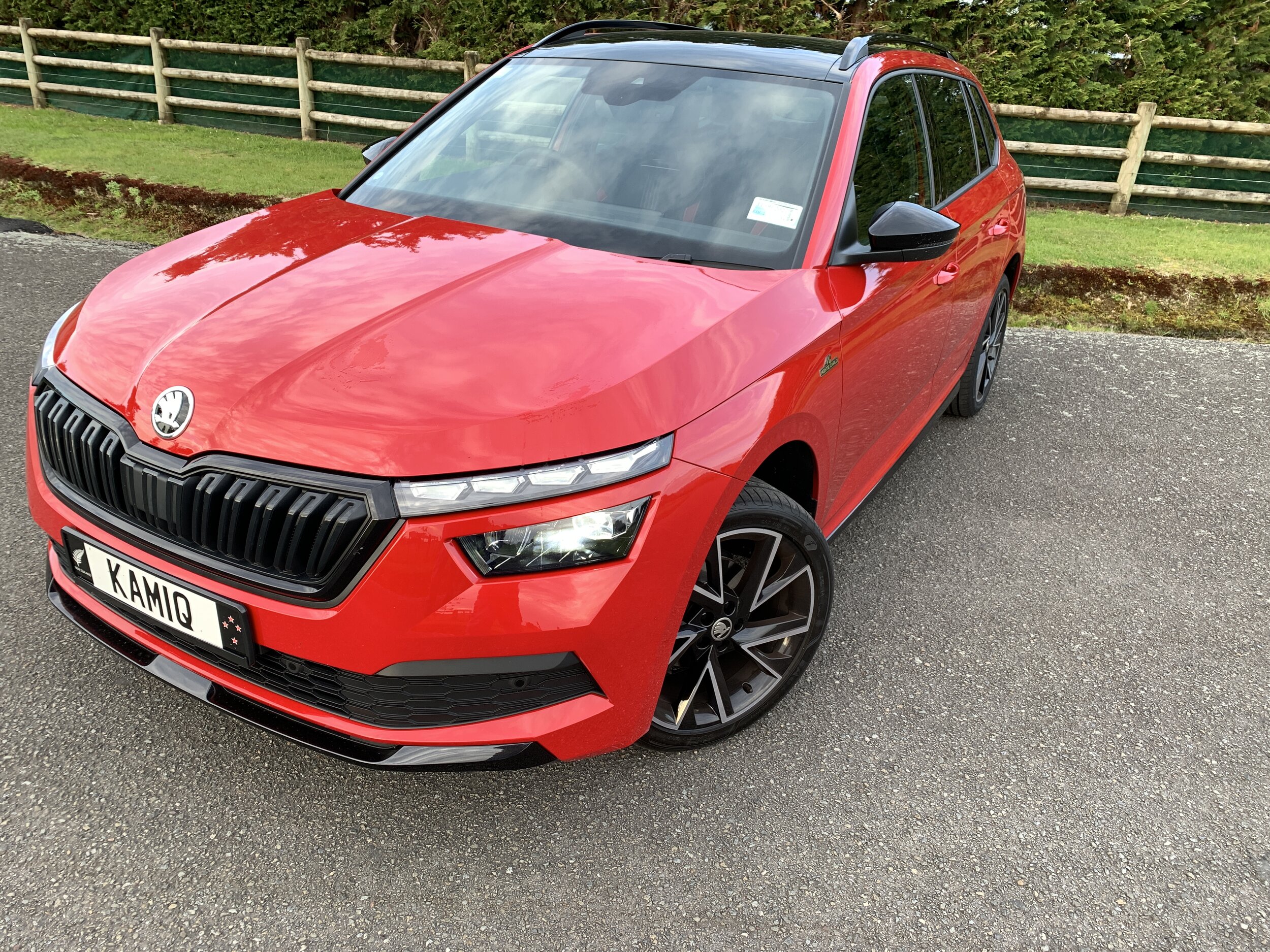
Skoda Kamiq Monte Carlo: It’s no gamble betting high


The flagship edition of Skoda’s smallest crossover delivers strongly for specification and style.

IMG_7276.jpeg

Skoda Kamiq Monte Carlo

Price: $42,990

Powertrain and economy: 1.5-litre turbo-petrol inline-four, 110kW/250Nm, seven-speed dual-clutch automatic, 2WD, combined economy 5.8L/100km, CO2 131g/km.

Vital statistics: 4241mm long, 1988mm wide, 1553mm high, 2651mm wheelbase, luggage capacity 400 litres, 17-inch alloy wheels.

We like: Smartest-styled version, Active Cockpit display.

We don't like: Awkward phone integration.

IF you’re thinking the name is a link to Monaco’s famous casino and intends to suggest the top-flight version of Skoda’s smallest sports utility is some sort of dice-throw gamble? Wrong. 

The reason why the Kamiq takes the ‘Monte Carlo’ in its more fulsome format is entirely do with the brand’s exploits in motorsport.

Most obviously associating with rallying at World Championship level these days, Skoda’s roots in motorsport reach back more than 100 years.  

The first recognised stint was in 1901, when Narcis Podsednicek participated for the first time in the Paris–Berlin race riding a motorcycle from Laurent and Klement, Skoda’s forebear. 

So, it’s the current exploit and past tradition that provide a historic and sporty connotation that will progressively attach to other performance variants, perhaps even those versions that presently identify as RS cars.

Or perhaps not. There’s a distinct difference in temperature separating the Kodiaq RS – which, until the new Octavia arrives, registers as the only Skoda RS on the local distributor’s books - and the Kamiq Monte Carlo.

It’d be unfair to call the Kamiq tepid, yet it really doesn’t stand out as being as fightclub-ready as the special K version of the Kodiaq, just in smaller format.

IMG_7272.jpeg

A 1.5-litre petrol powertrain shared with the Kamiq Ambition Plus tested recently is peppy rather than outright power-packed, so just doesn’t have the visceral oomph that wallops in with the angriest Kodiaq – in which an against-trend turbodiesel really proves why an oiler engine can work very effectively as a performance SUV powerplant - and the suspension tuning being tailored more toward comfort means it won’t carry that dash as sharply through the bends.

Where the two cars do stand equally, though, is in how smartly they present at the kerbside. Regardless that it isn’t any different for performance than the Kamiq Ambition Plus tested recently, the Monte Carlo nonetheless very effectively imparts as looking as though it will be the king-hitter of its three-variant immediate family.

And it’s not just that it looks racier. It also has the air of a better-finished car, simply because the basic design is especially effectively detailed in its most expensive format.

That’s not to bag the Kamiq for its general shape and dimension. Skoda design is less flamboyant than you get from Volkswagen and Audi, true, and even SEAT tends to sneak in a touch more flair. Yet there’s a pleasing aesthetic with the Czech brand’s look. And as much as the Kamiq could be called a mini-me of the Karoq which, in turn, is just really a scaled down Kodiaq, the end result is that all three cars relate coherently and all have a tidy appearance. 

Even so, the fact that the Monte Carlo on test registered much more of a wow factor than the preceding Ambition Plus came down to two factors.

First, the arrival of a Monte Carlo in its hero hue, Corrida Red, really enforced how it’s among those cars that simply step up massively when meted a bold colour. The car straight away looked so much more interesting than the Ambition Plus’s homeware white. 

Influencing that thought, too, was impression that the Monte Carlo just looks better with the additional adornments that restrict to its trim level.

The black roof rails, stronger-styled alloys and LED headlamps are finishing touches that really lift its appearance.

The cabin also benefits from the red interior detailing, ambient interior lighting and a step up to the larger (at 9.2 inches) infotainment system with sat-nav that, along with digital instruments with variable display settings, present a classier look than the analogue dials in the cheaper cars. This is the least expensive model yet to achieve the ‘Active Cockpit’ familiar from others in the VW family and it really sets a nice tone; there’s a lot of benefit from having it and operability-wise, nothing’s too techy. 

IMG_7268.jpeg

The sunroof I could take or leave – it doesn’t inhibit headroom too much but just seems like a fixture that will never be of much benefit - but the privacy glass, power-folding door mirrors, even that it has a height-adjustable passenger seat and front-seat lumbar adjustment. All these model-specific features just make it a more appealing car. 

Unfortunately, yes, they also make it a more expensive one. The $6000 spacing between all three models sees this one sitting at $42,990. As much as this is still less than some others charge for their like-sized equivalents, it is nonetheless comfortably more than could be spent on a front-drive Karoq, albeit with a less flashy trim.

If your eyes are only for the Kamiq, though, and your intent is to achieve a well-equipped small crossover for personal use and don’t mind it only coming in front-wheel-drive, then it really has to resonate all the same.

On the equipment side, the Monte Carlo plays an ace-rich hand. It has all the stuff you might wish wasn’t absent from the mid-range model and a lot more.

Apart from everything else listed, this edition provisions front parking sensors, adaptive dampers and sports-styled, yet comfier, seats, in a cabin that’s far more enticingly trimmed overall, though as in the Ambition Plus I was bugged by the centre tray not being quite large enough to comfortably hold my iPhone (yes, there’s also a phone holder pocket, but in being set up for left hand drive, it sits on the ‘wrong’ side of the transmission tunnel, so just isn’t useful).  

Anyway, plugging in the phone raise an irk relating to the ports to enable phone integration to the screen. Skoda is bang on trend in provisioning USB-C ports (four in all, two in the back) and it’s a nice touch for it to include a standard USB adapter. However, the socket demands the cable plugs in vertically and that makes it an awkward and touchy connection; you need only a slight bump to cut out Apple CarPlay integration.

IMG_7283.jpeg

Those aren’t deal-breaker annoyances, though, and in general design and spaciousness the Kamiq sells itself very confidently. There’s lots of space in the back for two large adults, with good amounts of leg and headroom, and the boot is a good size too. Skoda has always been good at coming up with some nice touches to make life easier; you get the usual umbrella stored in the doors, a removable boot light that acts as a magnetic torch and an ice scraper in the fuel filler cap.

The drivetrain is fine, if short of fiery. This fuel-injected four-cylinder operates well enough with the seven-speed DSG automatic, yet performance is adequate, rather than pacey. Smooth from idle to redline and keen to slip into fuel-saving cylinder deactivation mode when it gets the chance, a sequence that you might not even twig to if it wasn’t signalled on the dash display, because the refinement barely erodes.

The Monte Carlo adds in Drive modes – Eco, Normal, Sport and Individual. Eco softens the throttle to encourage more efficient driving and Normal presents the in much the same feel that you get in the Ambition Plus. Sport adds a buzz to the exhaust and sharpens the throttle response, adds weight to the steering weight and firms up the suspension. Individual, as you’d expect, lets you tinker with each setting as you wish. Sport was the default for most of the test, simply because it made the car feel and sound more characterful.

 Driving-wise? The Kamiq is set up as a comfort-oriented driving experience, but in the Monte Carlo format it’s more vivacious, that’s for sure. It’s not outright zippy or taut-feeling, but is confident through the corners with minimal body roll, and the steering feels suitably weighty and accurate.

It’s an easy car to like and live with and, if you don’t require the additional benefits that a Karoq provisions – like superior towing, an all-wheel-drive option and a roomier cabin still – then you should be happy enough sticking with the family baby.

IMG_7285.jpeg


Suzuki Swift LTD Hybrid: A matter of gainful employment

Making an already frugal car even thriftier sounds like a great idea. But how much cost benefit really comes from going to the country’s cheapest new hybrid when the car it bases off it already so brilliant?

IMG_6831.jpeg

Price: $28,500

Powertrain and economy: 1.2-litre petrol four-cylinder, 61kW/107Nm (plus 50Nm electric motor assist), continuously variable transmission, FWD, combined economy 4.1L/100km, CO2 94g/km.

Vital statistics: 3845mm long, 1735mm wide, 1495mm high, 2450mm wheelbase, luggage capacity 265 litres, 16-inch alloy wheels, 185/55 R16 tyres.

We like: Smooth hybrid-assisted stop-start response, chirpy dynamic character.

We don't like: Impoverished spec, reduced drivetrain sparkle, dubious benefits over the standard Swift.

ALREADY being a paragon of eco goodness hasn’t kept Japan’s biggest small car specialist from avoiding having to enter the electrification age.

Arrival of a hybridised Swift is a big change, but hardly a final step – sooner or later, Suzuki will assuredly have to follow ever other car maker into weaning off fossil fuels, which means either full electrification or hydrogen. 

It’s an unavoidable that won’t be easy to achieve; the cost of change is massive and some brands simply won’t be able to wear it.

What’s potentially galling for Suzuki as it drives toward one of the greatest single changes in motoring ever is that a talent that currently serves it so well might not ultimately count for much in the long run.

Through being a specialist in small servings, Suzuki deserves recognition as a developer of cars that mainly serve as exemplars of how to exact especially decent efficiency from every drop of oil-based fuel.

That talent has long been expressed by its most popular model, the Swift. This compact hatch has historically shone so brightly as a sipper you’d have to think cost efficiency is equal to the chirpy styling when cataloguing the reasons why it has dominated light car sales and been an evergreen hit with private buyers.

 The car’s inability to consume petrol quickly was highlighted this time last year, when the brand reported how a GL CVT auto, powered by a conventional 1.2-litre petrol engine, made a mockery of its factory-cited 5.5 litres per 100km efficiency by averaging 4.5 litres/100 km over an all-weather, mainly open road 636 kilometre drive. 

IMG_6821.jpeg

Impressive, yes, but overshadowed now, with arrival of another 1.2 variant claimed to deliver a 4.1 L/100km on the WLTP (Worldwide Harmonised Light Vehicle Test Procedure) test. That’s a 15 percent improvement over any conventionally-powered edition. Out of the box, without need for soft-shoeing.

One change. That 2019 champ was a $19,990 range-starter model; the one that beats it isn’t. You pay between $26,500 and $28,500 to access its extra frugality. Were you ready for that?

Well, additional cost to save more money at the pumps is still part and parcel of using hybrid tech. Which Suzuki has to, because like every other maker is being increasingly required – in some key markets - to keep reducing its fuel consumption and emissions. That’s why the hybrid exists.

You needn’t have to follow. There are other Swifts still driving with purely conventional drivetrains that cost less and are almost as efficient. However, it won’t be that way forever; in Europe, for instance, the only Swifts sold have hybrid.

Sure, that premium might leave some fans wondering about how much extra frugality an already frugal car needs to deliver when the buy-in alters so considerably, yet at purely technical level a battery-assisted Swift is an interesting development.

As hybrid systems go, the Swift’s isn’t too complex, but no surprise there. Suzuki is a brand that likes to keep things simple and there’s no evidence it’s audience aren’t appreciative of that approach.

IMG_6823.jpeg

The car coming to New Zealand is one tailored for Europe, so there are detail changes – the most being ‘wrong way around’ wiper and indicator want placements – and it also introduces a four-cylinder engine that, while still tagged a 1.2, is a little smaller in capacity than the one we’ve been used to, being a 1179cc unit; as opposed to the 1242cc unit that shone so brightly in the 2019 test and is now defunct.

The smaller capacity engine creates less power than the previous 1.2 but the starter-generator, which contributes up to 50Nm, helps by filling the lower part of the torque delivery.

The other core elements are a 12-volt long-life lithium-ion battery and belt-driven starter-generator assist that gets the car moving from standstill and can provide a brief acceleration boost from low speeds.

The energy recuperated to the battery during deceleration powers the engine management, air conditioning, instrument display and audio system. The integrated starter generator operates the idle stop/stop function. 

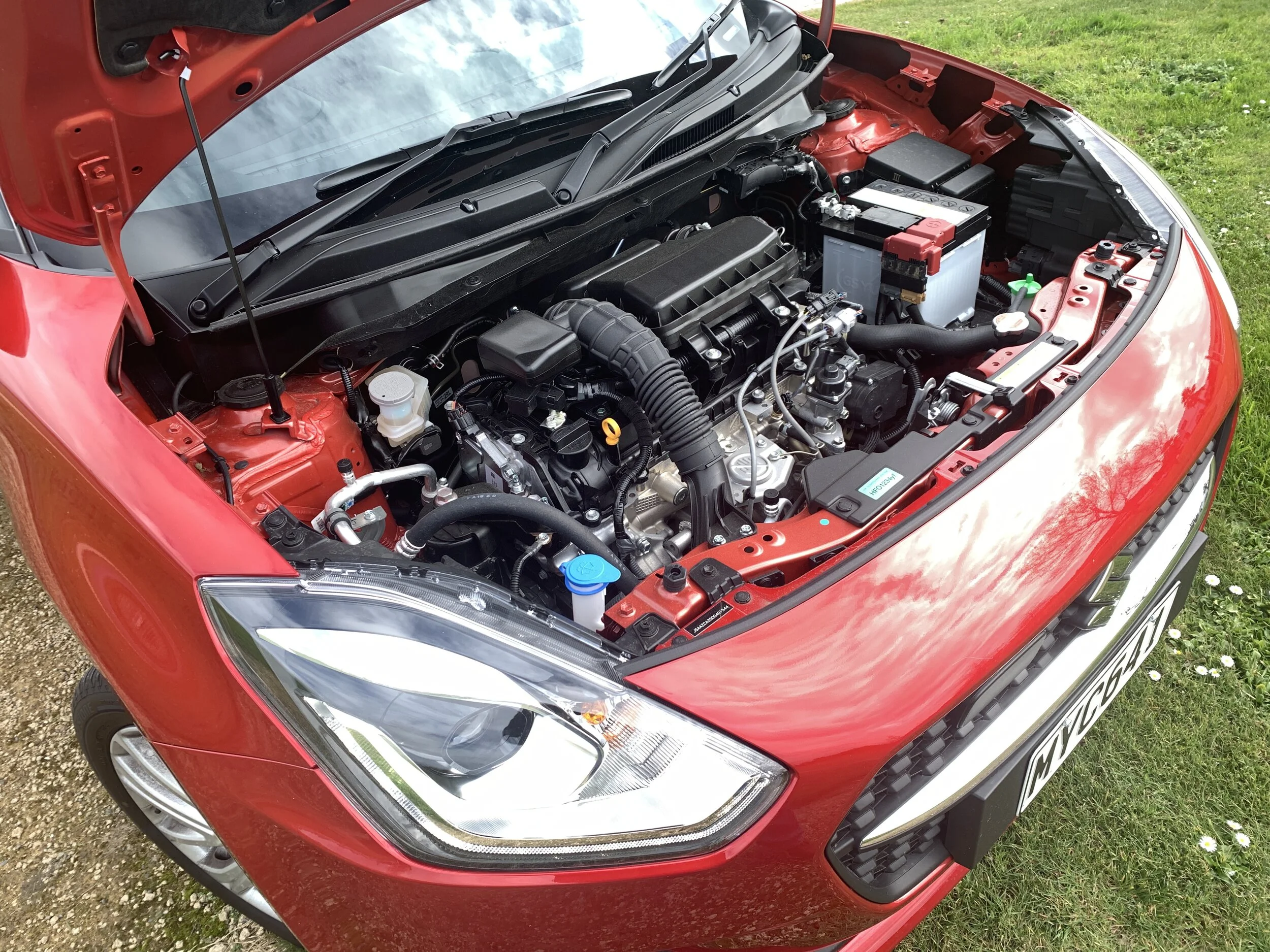
The packaging is neat. The under-bonnet layout is a bit different to the standard car’s, but the biggest ingredients - the battery and its control unit – aren’t under the bonnet, but with you in the cabin, being sited under the front passenger seat, for better weight distribution. It also means the chair sits slightly higher.

Other differentiators are geek-level identifiers: A bespoke wheel style, type specific badges and a unique grille. No body panels were altered. Looking around inside, it’s also very standard in respect to general layout. The dash design is generic, but it has specific instrument cluster displays to show the changes between electric assistance and petrol operation. These also show the amount of fuel saved, how much idle stop time has amassed, instant and average fuel consumption.

About that. My turn with the car was affected by some unexpected issues, all of my own making. Fortunately, contributing writer Colin Smith had driven the same car previously and was able to get a better handle on what it might be expected to deliver.

The pros and cons are fairly evident. First, the system has some pretty obvious impacts on economy, though as is often the case, it depends where you drive it.

On his highway run the car averaged 5.2L/100km. Around his home town, Tauranga, it achieved 4.5L/100km in peak traffic condition. Emissions counts aren’t of much consequence in this market, but these also reduce. So, the two primary targets are met. Another beneficial influence is how particularly smooth the stop-start experience is in busy city traffic with the starter-generator nudging the car forward before the engine starts. It’s more refined than stop-starts that rely on the starter motor to crank into life. 

IMG_6826.jpeg

Yet, there’s also an effect on power and acceleration, enough to result in a different driving sensation than arrives with purely fossil fuel-dependent Swifts.  

 Though the total hybrid system only adds a little extra weight (all up, just 25kg) and the assisted drivetrain generates more torque in a richer stream, it’s still pretty obvious that this is 1.2 has less power than the purely fossil fuel-reliant Swift engines we’ve become used to.

The end result is that there’s less of that zippy effervescence that’s long been a Swift trait. It’s noticeably slower for step-off and never seems to reduce the gap when moving. Swift engines always have an appetite for revs but this one seems to work harder and more vocally.

Energy recuperation is all part of the hybrid game. Grabby brakes and an obvious resistance when lifting off the throttle are sensations that arrive with all hybrid systems; it’s just the car optimising opportunity to reclaim lost power and store it into the battery. Here, though, the sensations are quite strong. Too obtrusive? Well, it’s certainly more committed to the cause than some hybrids and there’s no way to make adjustment.

In  respect to broader driving traits, it’s typical Swift, with an agile road feel, eager turn-in, and light but responsive steering. The suspension absorbs sharp hits pretty well. This generation’s stiffer platform has been massively beneficial to the handling but also makes it a quieter, more refined car and though it is right-sized for the city, that doesn’t make it wrong for taking on long, open road drives. It feels okay for those big adventures.

There’s another factor with this engine that might also require thinking about. It runs at a higher compression than other petrol Swift engines, so demands the highest octane fuel; 95 or better. Sure, it only has a 37-litre tank, so the additional cost over 91 isn’t huge. Yet simply having to use the most expensive choice on the forecourt might seem an anathema to some.

Also worthy of consideration is the specification level; while the Euro spec isn’t too far away from what we are used, there are content differences.

IMG_6824.jpeg

For instance, the hybrids drop a space saver spare wheel for an emergency inflator kit (the plus is that this yields an additional 23 litres of boot space), have manual wind-up windows in the rear – we’re used to electric operation all round – and the push button start and remote key facility that arrives in a NZ-specific high spec is lost. In the hybrids, you put the keys into the ignition. Little things, but also cost-savings that might irk given the cars’ price placement.

Another quirk: The in-built sat nav that’s facilitated across most NZ-spec Swifts is absent. If you want to use a map, it’ll be via the Apple Car play or Android Auto functionality that didn’t seem to want to activate in the test car. 

That’s not to say it’s a pauper. Adaptive cruise control, LED projector and auto levelling headlamps, advanced forward detection system, front fog lamps, reverse camera, speed limiter, hill hold control, brake override system, heated mirrors and tyre pressure monitoring are standard in both hybrid model grades and the LTD grade adds lane departure warning and prevention, door mirror blind spot monitor indicator, Dual-Sensor Brake Support, rear parking sensors and rear cross traffic alert. However, in general ambience, the hybrid does seem a bit downtrodden.

Small hybrids are not in abundance, but it’s hardly fortunate for Suzuki that Toyota’s new Yaris Hybrid has also just the market.

The latter costs a bit more, but is a brand new, more advanced design which delivers better technology and superior fuel consumption – Toyota claims 3.3L/100km, I easily achieved 3.8. In short, it spells trouble with a capital T. 

Driving the Swift Hybrid was intriguing, yet outcomes only enforced something Suzuki itself tacitly concede – that in as much as gains exist, none are massive, given the regular Swift is already a paragon of efficiency anyway.

Comparing a conventional base model Swift GL auto with the GLX Hybrid, for instance, suggests you’re looking at the latter delivering an advantage of 0.7 litres per 100km. The difference in list price buys a lot of petrol.

IMG_6834.jpeg

Suzuki can see potential. Specifically, it expects half of all hybrid sales will be to fleet and business customers and it also considers it likely that 24 percent of all new Swift sales will use this format. Yet in all probability it’ll sell more on strength of having the ‘right’ badge than anything further factor.

This model reminds just how makers have had to bend to international legislative pressure to improve on economy and emissions. It’s a car Suzuki felt compelled to build. But that doesn’t mean you should feel equally compelled to buy in when others in the family still do a great job.


Subaru ‘e’ Forester, Outback X: All the dirt on old school and new

Two core models thrown into the mire; one the last version of an old favourite and the other first of a new electric generation … which does best in an environment potentially ignored by too many owners?

Which Subaru to chose … the Forester E-Boxer Hybrid (left) or the outback X?all images: Callum Crawley.

Which Subaru to chose … the Forester E-Boxer Hybrid (left) or the outback X?

all images: Callum Crawley.


Outback X

Price:  $49,990
Powertrain and performance:  2.5-litre four-cylinder horizontally opposed petrol, 129kW/ 235Nm. CVT automatic, all-wheel drive. 7.3 L/100km.
Vital statistics: Length 4820mm, height 1675mm, width 1840mm, wheelbase 2745mm. Luggage 512 litres. Wheels: 18-inch alloys.
We like: Excellent final fling, has aged well.
We don’t like: Does achieve all updates meted Forester.


Forester Premium E-Boxer Hybrid

Base price: $54,990

Powertrain and economy: 2.0-litre four-cylinder horizontally-opposed turbo petrol , 110kW/196Nm (12.3kW/66Nm electric motor), CVT, AWD, 6.7L/100km.

Vital statistics: 4625mm long, 1815mm wide, 1730mm high, 2670mm wheelbase, luggage 509 litres, 18-inch alloys.

We like: Strong spec, tough look, rigged ambience.

We don't like: Lacks zap, fails to show economy gain, inconsistent ergonomics.

‘COULD do better’ – I saw that one more than once in teacher comments in my school reports.

And, of course, they’re right: I really was a bit of a slacker when it came to some subjects. I’m sure I’m not alone, however; many mates of the period say the same, or worse, on their assessment cards.

In adult life, perhaps, there will be those of us who have owned Subaru products developed to exploit off-road opportunity might give ourselves a similar rating when gauging how we might have under-utilised our cars. 

I’m as guilty as any. As much as  our 18-year-old Forester, aka the ‘dog car’ simply because it’s the chosen canine conveyance (though it could equally be known as the ‘firewood’ car, the ‘paddock car’ and the ‘towing garden detritus to the fire heap’ car) gets to undertake a fair degree of dirty work, I cannot admit to the same occurring with the current-gen Outback turbodiesel, now gone to another owner, we had for a couple of years.

That one rarely went far off the seal and, in hindsight, that’s something I’m slightly ashamed to admit to, given the quality of the torque. But somehow best laid plans never quite eventuated. The best, tackling a Central Otago gold miners’ route, was foiled by a really basic self-perpetrated navigation error. I missed a vital turn to Thomson Track and by the time I realised … well, there was no time. Shame, it would have been brilliant.

As much as it’s always easier to take risk with an old car, worth little, than with a new one, still worth a lot, fact is that when it comes to core competencies, the latest is probably a whole lot more likely to safely see its way through. 

Subaru NZ always makes an effort to include off-road driving whenever they release a product; so I know first-hand that same Outback is great in the sludge (also in Central) and the Forester, too.

 Both cars are specced lavishly, the Forester full to bursting for safety and conform spec, yet that doesn’t diminish their toughness, save that you might like to put down some floor coverings to protect the carpet.

 Generally, speaking, you could take either into the rough with equal confidence. When you’re discussing the models in their standard 2.5-litre formats, they deliver the same symmetrical four wheel drive, have identical 22cm ground clearance, mate to a continuously variable automatic transmission (CVT) that kinda mimics an eight-speed gearbox and run the same Bridgestone Dueller tyre.

Forester is shorter, yes, has slightly superior approach and departure angles and weighes slightly less, but there’s not a lot in it.

IMG_5712.jpg
IMG_6186.jpg

However, the stakes keep changing, don’t they? Now there’s an Outback X and e-Boxer Forester, each arriving with type-specific technical changes.

With Subaru’s largest family wagon, though just in this specific variant, the X-Mode off-roading kit has been enhanced to match one the Forester has always had.

 In achieving the same dual settings for snow, dirt and mud – one a continuation of the format that will be known to Outback drivers, the second a more advanced setting – the Outback X provides a taster of what will become standard on the new-generation Outback, already out in America, coming to New Zealand next year. Conceivably, it should make this car even more adventurous off-seal.

Forester, meantime, is out on a new electric crusade that the larger won’t be drawn into. The hybrid format demands a big alteration; lifting out the usual 2.5-litre petrol shared with Outback and supplanting in an electric motor and batteries in marriage to a 2.0-litre petrol.

It’s a big change, no argument, and one already determined, from trying it in the XV, is objectively found wanting in road driving; in particular, it struggles to achieve the economy improvements you’d expect from a petrol-electric and doesn’t feel as muscular as the alternate engine. How much help would it provide in low-grip, off-seal situations?

Only one way to find out. The drive plan for each included visiting a common playground. A farm on which a course was laid out. A 25-ish degree grassy climb that’d be ascended from a standing start, a slushy gravel pit, some paddocks and a rutted gravel track.

They ran the same route, but never physically crossed paths. Test period timings were almost a month apart. Crossing fingers about conditions being broadly uniform seemed to work.

I’m indebted to Tim and Karyn Crawley for allowing me onto their property and also to their son, Callum, for the excellent photographs and assistance.

Their beef and sheep farm is no stranger to off-road fare; the Crawley business in Palmerston North, Autokraft 4x4, specialises in off-road parts and preparing vehicles. Tricked out to the extreme with Old Man Emu suspension, air-operated diff locks, with a winch and plenty of other gear, Callum’s Toyota Hilux was trailing, ready to become the perfect rescue vehicle.

It was never called into action. While the conditions underfoot were hardly a doddle, with each car slithering from time to time – particularly on the hill start, where they both lost grip as soon as the grass was ripped away –Subaru’s AWD really proved its mettle.

IMG_5766.jpg
IMG_6203.jpg

The X-Mode too. A system that constantly monitors the traction available to each wheel and centralises control of the engine, transmission and brakes is really intuitive. It’s impressive how even the CVT is brought into line, to the extent that it ‘holds’ what passes for a gear.

However, in saying that, it became clear that the first stage, which is the one Outback has in every other variant, was better in the specific conditions encountered that the ‘deep mud/snow’ alternate that has been added. Strange as it might sound, the latter cried out for softer conditions. On the relatively firm ground I was driving, it was often just too aggressive in its interaction.

Yet X-Mode is a great asset. You might argue if it makes a ‘serious’ off-seal vehicle all the more serious – because that logic asks that you see either model as being that to start with – but each setting clearly operates in different and distinct manner. So much so, that, when once fails to do the job, chances are the other won’t. 

Ultimately, though, while it had to be driven more carefully in deference to its size and less agreeable overhangs, the Outback X shone as the more proficient car. It’s agility and get-through aptitude was impressive; it never felt as if it was exerting to the limit and, in fact, was more dextrous in one area than the Hilux. Wow.

The Forester, on the other, was troubled – and, since conditions on its day were slightly better than they were for the Outback, that’s hardly reassuring.

But findings were sobering. First, and most obviously, it lacks initial oomph. Also, when power does come on, it arrives untidily; the lay-in is abrupt and usually occurring much higher in the rev range than with the Outback’s 2.5, with end result that it falls far more easily into going-nowhere wheelspin.

Dissection of the drivetrain relates why. The 2.0-litre develops 110kW at 6000rpm (as opposed to 129kW from the 2.5) and 196Nm at 4000rpm in this application, while the electric motor has peak outputs of 12.3kW and 66Nm. Add those together and it looks strong. But Subaru doesn't quote a combined total of 122.3kW and 262Nm, like some might assume.

In fact, it doesn’t give a combined figure at all. So, you cannot assume one-plus-one equals two or even that it potentially makes more torque than a more conventional 2.5-litre Forester, which delivers 239Nm. 

Indeed, it very likely does not. Something else cropped up. On road, the electric and petrol work in tandem; you sometimes feel an extra jolt of oomph when the electrics join in. With our farm driving, you’d swear the battery-compelled drivetrain was always off-line. Inevitably, then, it came across as a large car with a small engine that always felt (and, ultimately, smelled) as if it had to work harder to haul more kilos – which it is. The e-Boxer carries 67kg more than a Forester 2.5 in the same spec. And that’s with the hybrid losing its spare wheel, to open up stowage space for the battery.

IMG_5824.jpg
IMG_6224.jpg

That’s not to say it isn’t up to expeditionary status. All the same, you’d probably prefer the Outback: It’s no less nimble and, in delicate driving conditions, is less likely to spin those tyres and more likely to deliver strength when it’s required.

 In on-road driving, the e-Boxer Forester provisioned much the experiences as the e-Boxer XV; the electric drive system is generally doing something to supplement the petrol engine, but it’s never enough. Brand contention about it being up to powering the car in EV mode at up to 40kmh never happens; in general, the engine is kicking it at walking speed, not matter light-footed you try to be.

When both work as one, the powertrain is still not as good or smooth as a 2.5-litre Forester; performance is mostly adequate but no more than that. Ask it to accelerate briskly and it struggles; not just because it lacks pep, sometimes there’s a defined lull before the power even arrives.

When the XV was on test, every effort was made to achieve good economy, but largely to no avail. No effort was put into driving the Forester that. It was just treated to the same kind of driving as the Outback. The economy came out remarkably similar; an indicated 8.7 L/100km average from the Forester and 9.0L/100km from the Outback. 

It’s a shame the hybrid isn’t better, because this is the right direction for Subaru and, had it worked, would have been a great off-set to the opinion their boxer engines are more hungry that in-line types. They really aren’t, and they’re also more characterful, but perceptions are hard to shake. Doubtless some will see the ‘e’ badge alone as presenting enough validation for buy-in – especially if they’re a corporate striving to do the right thing – but, with a colleague having worked out you’d needed to clock 380,000kms’ to offset the premium, it’s just too hard to recommend. 

A pity. As with the XV, the one benefit from having the hybrid gear is that it improves the ride. This Forester feels softer and more compliant than the other. Avoid hoofing it and general refinement and noise suppression are good as well. 

Also, of course, if you exempt this powertrain, the Forester generally excels. That NZ Car of the Year title afforded when the range comprised just 2.5-litre models was well-deserved. It’s a roomy and well-equipped car, even if some of the safety watchdog stuff – the lane keep and driver awareness reminders – are way too over-zealous.

IMG_5972.jpg
IMG_6237.jpg

So, back to the Outback X, and what a graceful way for this model to exit the sales stage. Sure, this experience reinforced what own ownership period told me; it’s not in any way an athletic car, but it does have a real grace about how it drive. The suspension provides a docile ride, and its steering is accurate and easy to manage. It’s just a great car for long distance travelling. As this outing reinforced, it’s also a better off-road car than many will give it credit for being. The couple of hours spent on the farm really left me ashamed that I hadn’t tried harder with the version I owned. If anything, the diesel – through having so much ow-rev torque – would have been even better than the X. 

On the other hand, I cannot help but think Subaru has left the best until last with this special edition.

As an effective run-out car – though it’s not called that – it certainly does a good job of keeping up consumer interest.

It only dresses up a bit, yet the ingredients of a bespoke paint job, black treatment of its 18-inch alloys, grille, wing mirrors and rear badging, lime green accents on the side badges and grille really lift its kerbside appearance.

Dropping leather on the seats for a cloth is also not the retrograde move you might imagine it to be; the seats are more comfortable and the material, being water-repellent, is arguably more practical.

So, in this report card, only one deserves a ‘could do better’. Whereas the other will leave the scene having done more than enough.

IMG_5956.jpg


Nissan Juke Ti: Working those quirks

The second-generation Juke has finally reached us, but is entering a far more crowded sector than its predecessor fronted up to on arrival all those years ago.

JukeTi6.JPG

Price:  $44,990

Powertrain and performance:  1.0-litre three-cylinder DOHC 12-valve turbocharged petrol engine. 84kW/5250rpm, 180Nm/2400rpm. Front-wheel-drive. Combined cycle fuel consumption 5.8L/100km (claim), 6.5L/100km (road test).

Vital statistics: Length 4210mm, height 1595mm, width 1800mm, wheelbase 2636mm. Luggage 422 litres. Wheels: 19-inch alloys with 225/45 R19 Hankook Ventus S1 Evo3 tyres.

We like: Supportive front seats, stylish interior, high-grade specification and generous load space.

We don’t like: Low-speed dual clutch hesitations, becomes quite pricey in the Ti grade.

 NOT many years ago a 1.0-litre car riding on 19-inch diameter wheels was unheard of.

With the trend toward engine down-sizing and compact SUVs taking hold of the market that combination becomes a reality with the new Nissan Juke.

The original Juke was a pioneer of the compact SUV segment a decade ago and the recently launched second-gen has increased dimensions to enable a more useful family configuration with enlarged boot space.

And it introduces Nissan’s ‘down-size’ 1.0-litre turbocharged engine and seven-speed dual clutch transmission.

There are three models – all with 1.0-litre turbo power and front-wheel-drive - with the ST providing a $32,490 entry point.

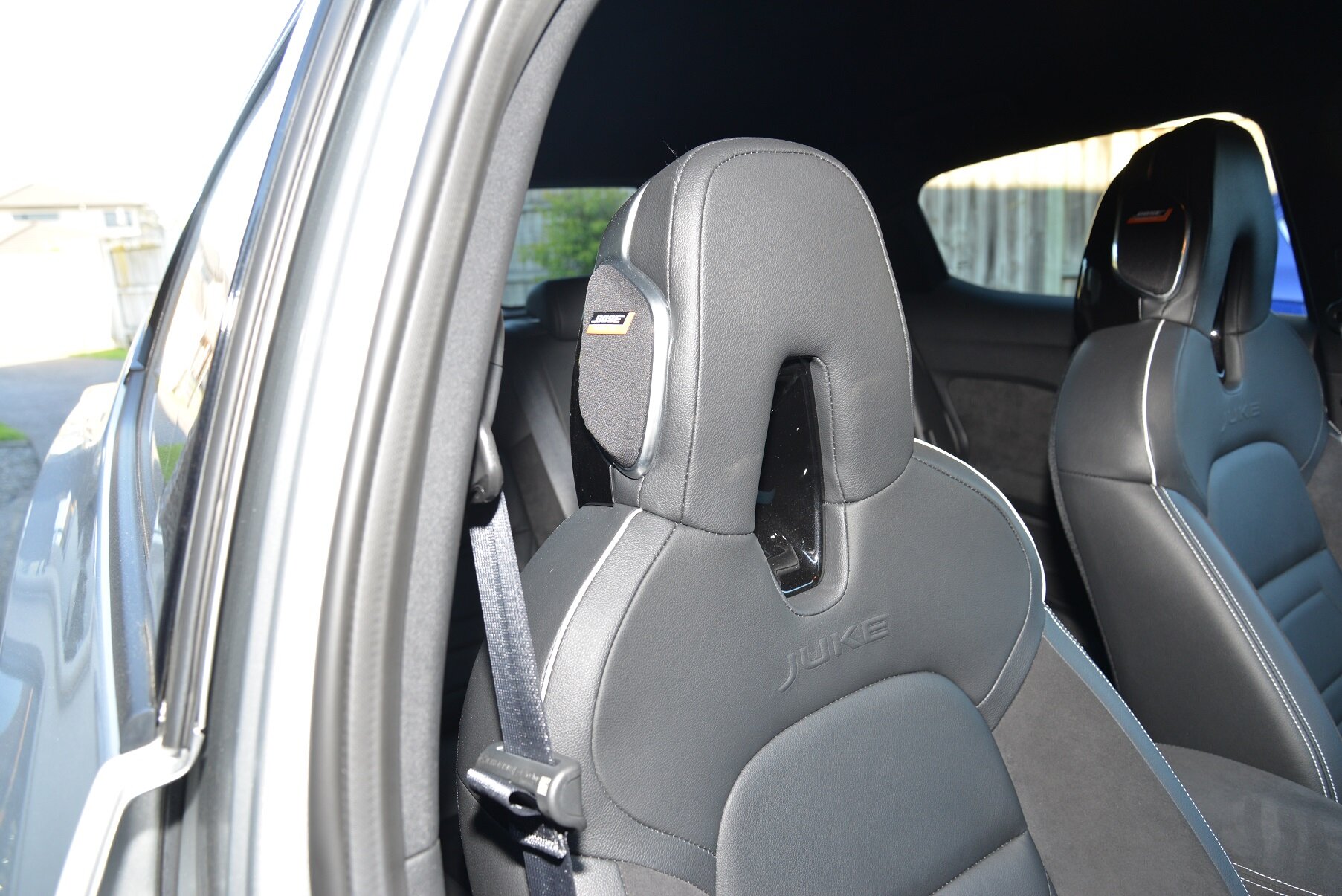
Priced at $44,990 the Juke Ti delivers the flagship specification. The Ti gains multi-spoke Akari-style 19-inch alloys, rear privacy glass, snug-fitting sports seats with combination leather and Alcantara trim, a shark fin antenna, tyre pressure monitoring and an eight-speaker Bose audio system which includes speakers integrated with the front headrests.

JukeTi2.JPG

The mid-grade Juke ST-L with its $38,750 price point looks like the strongest value equation with content including 19-inch alloys, satellite navigation, an Around View camera with 360-degree and left-side view options, single-zone auto climate control, rain sensor wipers, LED fog lamps, two-stage heated front seats, auto fold and heated door mirrors plus Intelligent Key access with push button start.

In design the new Juke evolves the unique look of the original with the ultra-slim indicators and daytime running lights mounted high and large round headlights integrated into the bumper.

But it’s more conventional in its lines and proportions, particularly at the rear, while retaining the floating roof, high waistline and slim glasshouse themes of the original.

The dimension increases have boosted space and practicality. The new Juke sits on a wheelbase that is extended by 106mm while the overall length increases by 75mm.

It’s also 35mm wider and 30mm taller. There’s a little more cabin width and decent headroom front and rear while load space is one of the new Juke’s main benefits with an increase of 68 litres to offer generous 422 litres capacity.

With its slightly raised seating position, large door mirrors and slim A-pillar shape the Juke offers excellent visibility from the front seats. But the narrow glasshouse and large front seats do restrict the visibility from the rear.

The Ti cabin will be a talking point with its smart combination of leather and alcantara surfaces including soft-touch alcantara dash and door trim, front armrest and knee pad surfaces.

JukeTi3.JPG

There’s a flat bottom steering wheel with paddle shifters and an 8.0-inch dashtop touchscreen display with Apple Car Play and Android Auto connectivity.

The 999cc direct-injected and turbocharged triple develops 84kW at 5250rpm with peak torque of 180Nm at 2400rpm. It’s a free-revving triple with a lively engine note when it worked harder.

Close ratio seven-speed gearing allows the engine to settle at 2100rpm in top gear at 100km/h with paddle-prompted downshifts to 2500rpm in sixth gear and 3100rpm in fifth.

During parking manoeuvres, and when making a momentary stop at a roundabout or give way sign, there can be delayed response from the dual clutch transmission. But once up to speed the shifts are quick with minimal interruption to the power flow as the little engine delivers its overtaking response.

On ST-L and Ti models Eco, Standard and Sport drives modes adjust the throttle response and gear shift protocols. Nissan claims combined cycle fuel consumption of 5.8L/100km and road testing revealed a 5.6L/100km average on a relaxed highway run and 6.5L/100km as an overall efficiency number.

The small turbo engine requires 95-octane premium fuel.

JukeTi4.JPG

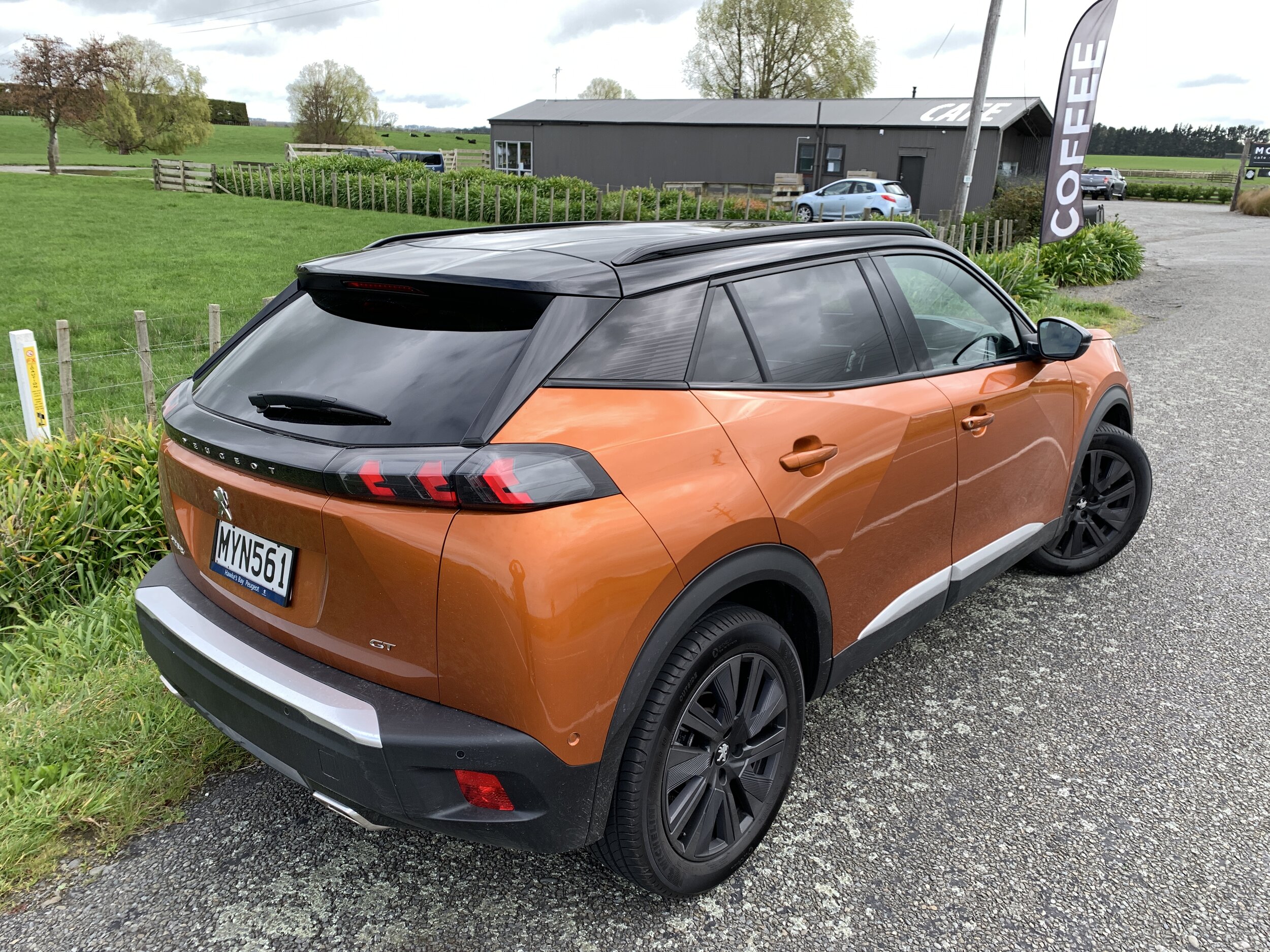
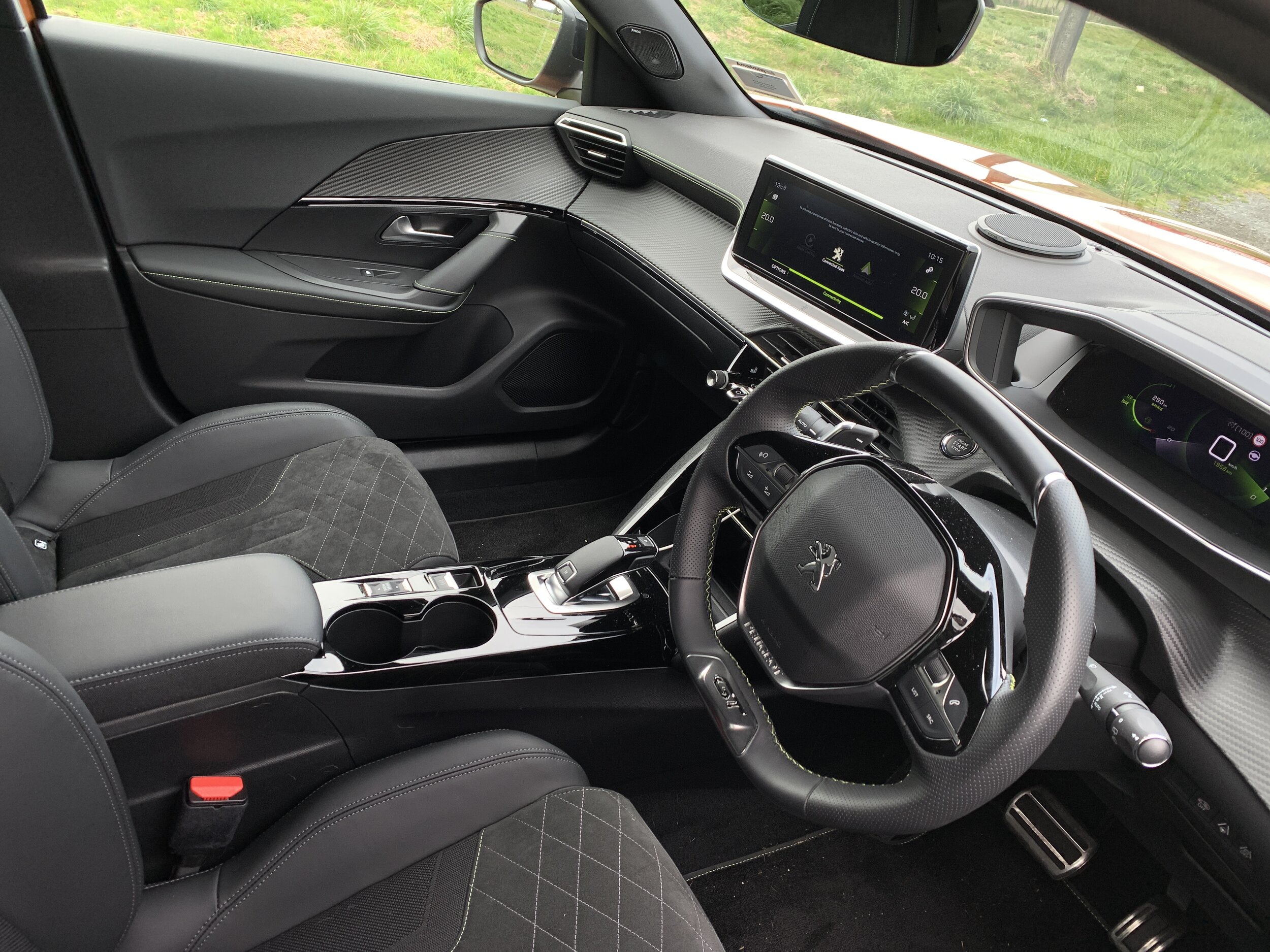
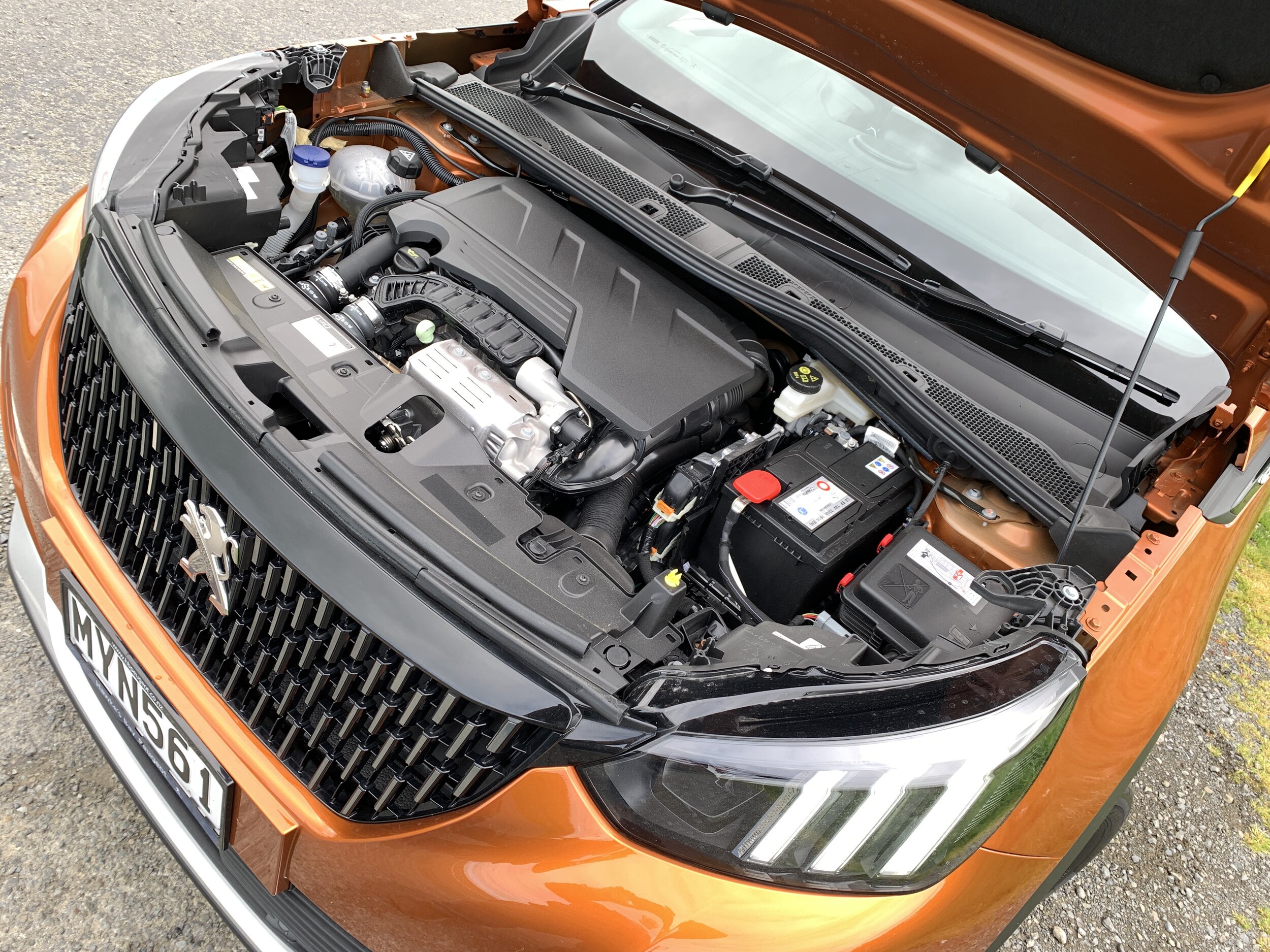
It’s efficient and responsive but in the same size, price and sporty compact crossover category the Juke Ti is out-performed by the new Peugeot 2008 GT with a slightly bigger 1199cc triple that develops 114kW and 240Nm.

On the road the Juke holds true to its wide tyre and wide track appearance by putting a confident footprint on the road. It steers accurately and rides firmly with plenty of grip from the 225/45 R19 Hankook tyres.

Encounter some corrugated surfaces and the large wheels and tyres will produce some abrupt bump-thump responses, mainly from the twist beam rear suspension. And the wide tyres generate some intrusive coarse surface road noise at highway speeds.

Along with increased dimensions and down-sized displacement the other significant change for the new Juke is its enhanced safety and driver assist roster.

All models have LED headlights with High Beam Assist plus LED tail lights and daytime running lights.

ST-L and Ti models also boast intelligent lane intervention, adaptive cruise control and the Around View camera system but all three grades have intelligent braking assist with pedestrian and cyclist detection, traffic sign recognition, lane departure warning, blind spot warning and rear cross traffic alert, driver alert and forward collision warning.

With almost a decade of hindsight it’s interesting how far ahead the original Juke foresaw the growth of the small SUV segment. And while it’s been a long time coming, the gen-two Juke gives Nissan a stylish and competitive alternative to the more recent arrivals.


Mazda MX-5 100th Anniversary: Birthday treat takes the cake

The company that started out as a cork producer has just produced a corker version of their best car.

the start of a grand adventure.

the start of a grand adventure.

Price: $51,095.
Powertrain and performance: 2.0-litre petrol four, 135kW/205Nm, 6-speed manual, RWD, Combined economy 6.8 litres per 100km.
Vital statistics: 3915mm long, 1235mm high, 2310mm wheelbase, luggage capacity 127 litres, 17-inch alloys.
We like: The whole vibe; looks smart.
We don't like: Not owning one.

PERHAPS you’re a founding member of the national cork appreciation society, but I’m guessing not. Just as I’m certain that organisation doesn’t even exist.

Even so, the car here today can be called a celebration of cork’s contribution to the world. And, indirectly, car-making; in that it’s this material that was the making of a car company.

And, in celebration of that having occurred 100 years on, it’s the reason why I’m driving the first example in New Zealand of car that holds a special place in enthusiasts’ hearts. 

It’s a little-known fact that Mazda is thought to be the world’s only vehicle maker that began life as a cork producer.

With cork trees abundant in the region around Hiroshima and the local shipbuilding industry in full swing, sourcing cork from these trees, initially for use in wooden ships, ultimately for many other purposes, was an obvious business to pursue. Toyo Cork Kogyo started up in 1920 and grew fast.

Business prior to World War II was good. Technologies in plastics and rubber had not been developed as far as they are today, so cork was an alternative material for all sorts of uses back then, from gaskets and walls. After 1945, however, production of rubber and plastics on an industrial scale meant cork gradually took a back seat as a large-scale industrial material. From thereon, cork was no longer so buoyant. 

no cork was used in the making of this car.

no cork was used in the making of this car.

Fortunately, Mazda’s founder, Jujiro Matsuda, had a Plan B, that was already proving its worth well before the boom went bust.

He’d been with Toyo Cork Kogyo since 1927, joining after a successful career in engineering in Osaka, where - having started as an apprentice blacksmith - he progressed to forming his own metal casting company. He came on as a board member, rose to be president.

Although, his expertise was in machinery and engineering, Matsuda-san quickly proved his worth with innovations including the production of pressed cork boards, then subsequently insulation and cushioning materials. 

Some of these would prove useful in vehicles, which tied in nicely to his aspiration. As early as 1927 he’d determined to lead the company into machinery manufacturing, which ultimately led to the production of three-wheeled trucks, building the basis of the Mazda we know now.

To present day. This being Mazda’s 100th year in business gives obvious marketing opportunity. Conjure up a 100th Anniversary Special Edition trim, that’ll feature in – you guessed it – 100 cars coming to this country.

Speaking as a total MX-5 tragic – yes, best to admit now this whole story is tinged with that bias - I’m pleased to say a quarter of that count comprises examples of Mazda’s famous two-seater rear-drive sports model. 

I’m even happier to tell you, also, that the subject of this piece is the very first of those, which Mazda NZ plans to keep. 

A manual 2.0-litre roadster, it landed just days before the brand gathered media to try out its SkyActiv-X engine technology, and was mine to drive home from Karapiro, where that event concluded, and hold on to for a little while.

the celebration car was hanging out with its muse, the R360 (above) when at Mazda NZ but also met some more direct relatives at its temporary home.

the celebration car was hanging out with its muse, the R360 (above) when at Mazda NZ but also met some more direct relatives at its temporary home.

IMG_6920.jpeg

I couldn’t believe my luck. I’d seen the car at Mazda NZ headquarters and knew it was tagging along as we tried out the SkyActiv-X Mazda3 and CX-30, but wasn’t really sure about the chances of being able to take it home. Right until the keys were handed over as the group departed the lunch spot; the majority heading back north, me alone heading south.

 This next bit will sound cheesy. However, it’s true. The day literally changed at that point … the incredibly heavy rain that had hammered our run all morning stopped. The sun came out.

 Okay, only for a couple of hours. Well before I got home it was hammering down and freezing again. But surely a good sign and at least the first bit of the drive was as every great MX-5 run should be: Under blue skies and with the roof down. There’s no better way.

There’s no better car (okay, bias again). Driving long distances in a small open car might sound wearying, and I won’t deny the MX-5 redefines the word ‘snug’ and that there are more refined and comfortable cars in the Mazda line-up. Yet it’s also so communicative and wonderfully involving you really don’t notice the kilometres flying by. Well, I didn’t. 

But, then, I’d contend the ND achieves this connect because it so successfully rekindles the essence the original NA (the car we own – actually two of ‘em), moreso than the NB and NC that came between them.

The latter aren’t poor efforts – because, frankly (and, yes, with prejudice), when it comes to MX-5s, you’re always talking levels of greatness rather than flaws - but they did slightly erode the core simple-is-best ethic.

This famous minimalism has returned with the ND and was certainly taken very seriously by the development team. Everything that could possibly be scaled down has been; the stubby gear lever and the teensy seat adjusters being good examples.

This is the first MX-5 in which it’s truly easy to not only neatly fold away the roof in a single arm movement, but also lift it. It feels very enclosed with the top buttoned down, of course, and that condition heightens aware of the paucity of space, including for storage. They’ve done a brilliant job though, invariably, despite best efforts, not all solutions are complete. 

A nice photo of the car with Mt Ruapehu in the background? Erm, not today.

A nice photo of the car with Mt Ruapehu in the background? Erm, not today.

The cup holders are a classic example. These are in the only possible location they could be, up high between the seats, but it’s no great spot all the same; you’ll soon learn to stop with hot drinks as it’s too awkward to reach the holders on the move without high risk of spillage.

Also, there isn’t much storage space for anything, really; only a small cubby in the centre console and a shallow tray in front of the gearlever that cannot be trusted to contain a cellphone when you’re pushing on. But this isn’t a gripe. More like a ‘same as it’s always been’ acceptance. You just get on and live with it.

Checking out, at a MX-5 owner event a few days on, the celebration car against regular-issue NDs confirmed the special is wholly a styling exercise, with no monkeying around with the mechanicals. So no power play or even a more musical exhaust.

Disappointed? As much as the short-lived Abarth 124 proved extra pep and parp certainly does this car no harm, I’m not unhappy with the ND’s power output.

The 2.0-litre has been meted more power and a broader torque span in its latest format, but it’s more set to squeal those Michelin Pilot tyres than smoke ‘em.

That’s fine. The car’s always been more about briskness than absolute kapow and one of the treats of this package is that it is so tightly dimensioned and well-sorted, chassis-wise, as to carry really good speed through curves with total confidence. Also, it’s so light. The ND goes back to the original NA prescription in weighing comfortably less than a tonne, remember. More bark would be cool, though. It’s a shame Mazda doesn’t seem to shop with Akrapovic.

Where it obvious gets loud is with the anniversary colour scheme. I’ve reservations about how well a body literally in white – sorry, Snowflake White Pearl Mica - and a red roof will work on more substantial, solid-roofed Mazdas, however the scheme really pops on the roadster, especially when the top’s dropped.

Sure, When Mazda cites a cabin ‘accented’ by burgundy styling features, they really mean ‘overwhelmed’, cos little isn’t in that hue. It sounds like a blood bath – or, indeed, a bath coated in blood. But in the light of day – and that’s the best time – it’s not too bad, because only the carpets are crimson. The beautifully-finished leather seats have an orangish tinge that’s less galling.

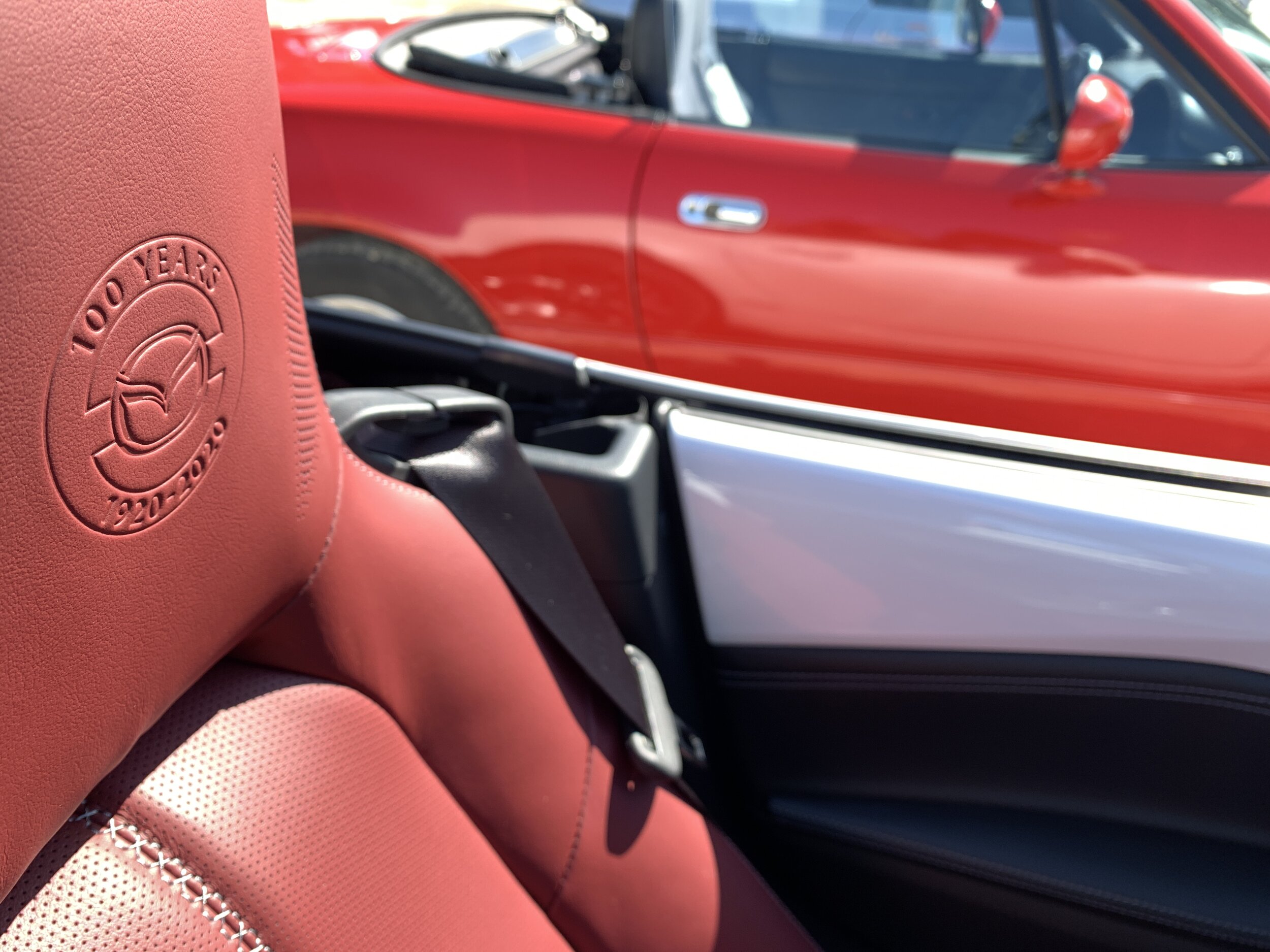
Badges? Of course there are badges, but they’re generally overt. A wee “100 Years 1920 – 2020” emblem on the front wheelarch replicates on the carpets and the wheel centre caps have logoes in red and black. The biggest signature is embossed on the headrests. The key fob is also embossed and comes in a special edition box, held by Mazda NZ. Likely as not it’s in managing director David Hodge’s office desk, given this is going to be his personal drive car for a while.

Anyway, the look has a throwback vibe to it that’s wholly valid; not a throwback to anything from the cork industry, of course, but the brand’s first passenger car, the R360 Coupe. This came along in 1960 – so, quite a bit younger than the brand -  but has arguably now become one of the coolest historic Mazdas ever made.

That nod to heritage works particularly well with the MX-5, because even though the original is very much a city runabout and not very sporty, they are at least both tiny, light two-seaters with a huge dollop of loveable character.

The R360 was never sold here, but incredibly there is one here in private ownership and, impressively, Mazda NZ had it at their premises, parked alongside the MX-5, on the day we were together. It’s a great looking bauble, but not one I’d elect to drive for any distance beyond a quick flit around the block. Truth be told, someone of my height and bulk probably wouldn’t fit into it.

When driving to Castlepoint, take  moment to pay homage at Tinui, birthplace of Anzac Day.

When driving to Castlepoint, take moment to pay homage at Tinui, birthplace of Anzac Day.

Anyway, all in all there’s plenty about the MX-5 to signal it’s special … and honestly, when I took it on a big outing with a bunch of other MX-5ers a few days later, I thought it would be a drawcard that required no explanation. And yet … well, actually, it wasn’t and it did. 

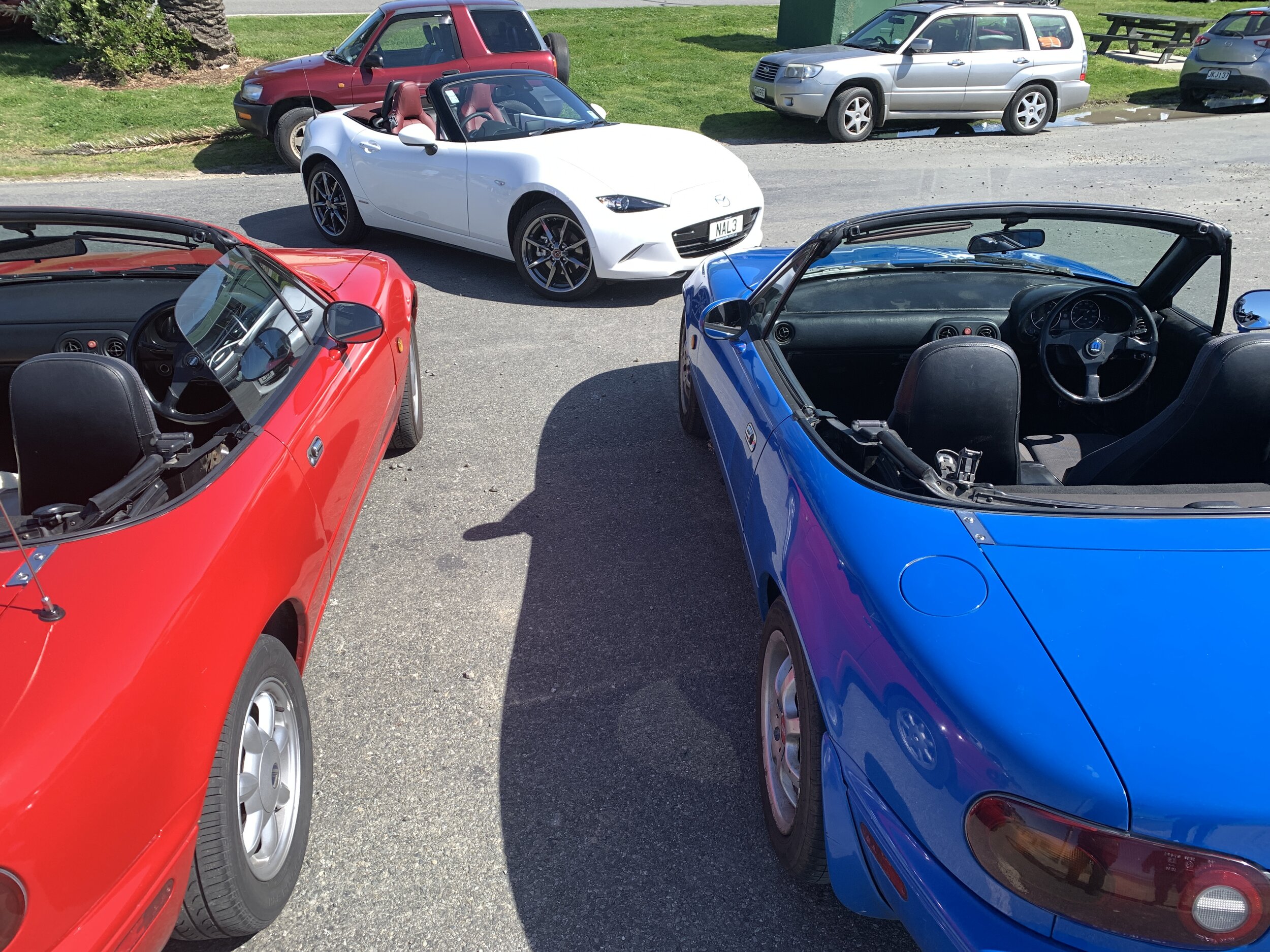
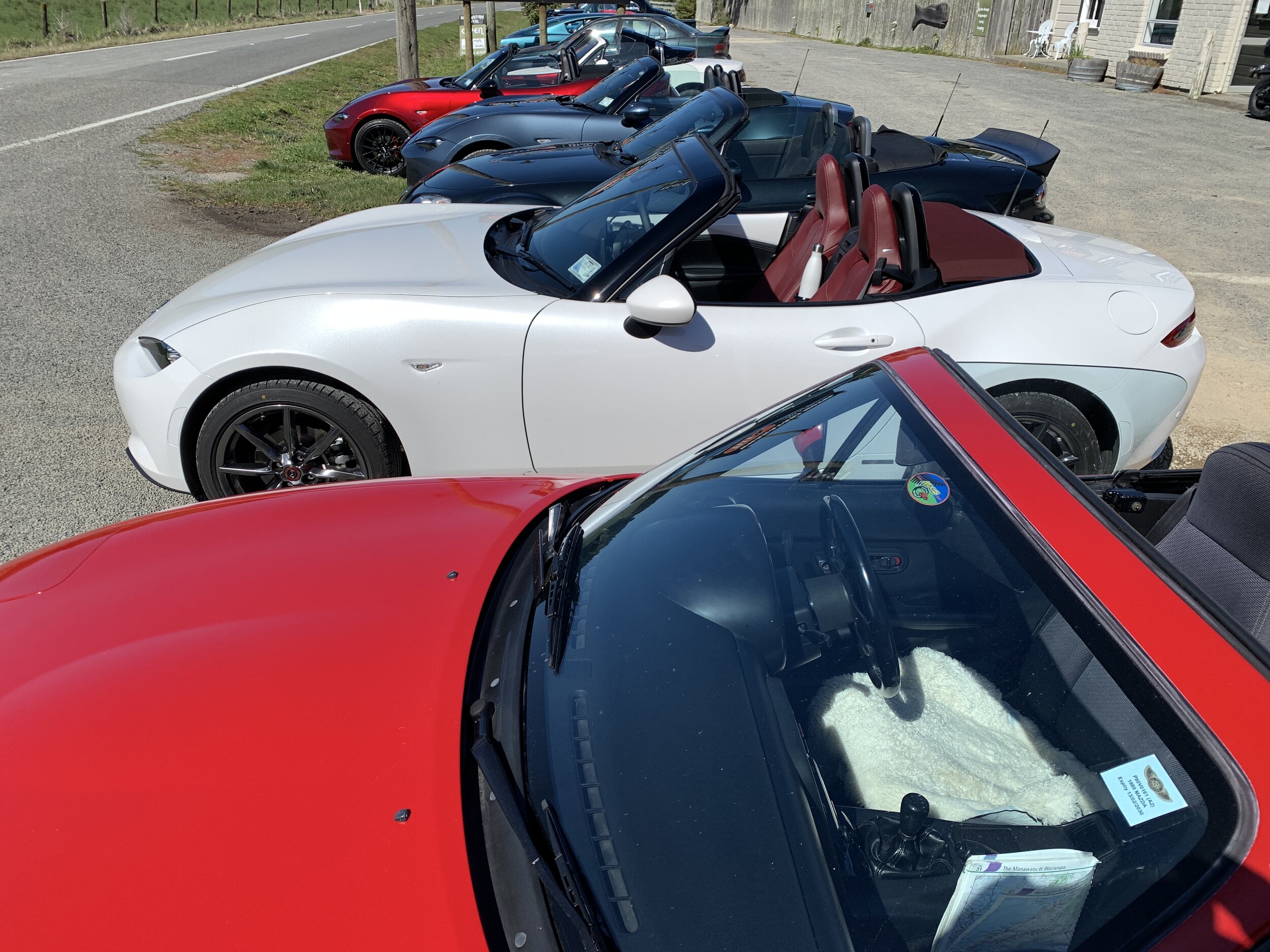
Ironically, the only one who came to check the car out with absolute knowledge about what it represents was the owner of a 1989 NA. I really enjoyed chatting with Stan, an octogenarian teenager who loves cars and wants to keep his absolutely to factory condition and spec, because that’s the ethos he’s rigorously adhered to with the other vintage cars he’s owned. Sorry, vintage? Well, that’s the classification the original MX-5 can now quite validly hold with the national old car movement. He’s got the sticker on his windshield to prove it. 

Perhaps any immediate under-appreciation of the Anniversary car’s standing is understandable. Anyone who knows a bit about this evergreen gem will know the lineage of limited-count versions is pretty rich. It’s received so many special treatments over the years that I’m not sure if anyone, Mazda included, can accurately say how many limited editions there have been.

Still, that hasn’t seemed to stop them from selling and being treasured. Anniversary editions have proven to be highly coveted. Being a tragic I can tell you there have been four previously, all in bespoke colours.

They start with a 10th anniversary car based on a 1.8-litre Mk II, launched in 1999 and limited to 7500 units, finished in Innocent Blue Mica and sporting a six-speed gearbox. A 2009 20th, limited to 2000 units and its home market of Japan only, and, in 2014 a 25th, of which just 1000 units worldwide were built in Soul Red Premium. This is the only one to divert from roadster tradition, being instead based on the folding hard-top RC model. Last year came a 30th edition, with an orange paintjob.

Should the ‘100th’ be considered part of that exclusive pack? Conceivably, it doesn’t qualify, because it isn’t model specific, as the others are.

Yet even though the ‘100th pack’ can be configured on eight other current Mazda models, I don’t think the MX-5’s cred is damaged. It looks so especially charming it’s hard to see it being any less collectible or attractive to cognoscenti. On the other hand, I’m equally sure that status only works for the MX-5. Buying a ‘celebration’ CX-9 in hope of it maintaining or even appreciating in value would be a long shot.

It’s nebulous arguing the $1500 premium over the donor Limited MX-5 is worth it because, well, the orders have been and taken and fulfilled. I’d say it was, especially in manual format. That this one features in the promo shots for the campaign and is really well-loaded reinforces it’s the favourite child.

The Limited-spec car is already a cool thing, and the manual has a limited-slip differential. Plus the ND facelift has introduced Apple CarPlay and Android Auto, heated seats (a must-have for cold weather top-down driving) and a Bose audio system, automatic climate control, and 17- inch dark silver aluminium alloy wheels. The one little extra I really grew to like on the celebration car were the driver and passenger headrest speakers; the sound system needs to be cranked when the roof is down, but this little extra allows something I didn’t think was possible – coherent phone conversations on the move. There’s obviously a microphone cunningly installed as well. But, anyway, at 100kmh I found I could make and take calls with no issue at either end.

Embossed seats are artful … and very comfortable.

Embossed seats are artful … and very comfortable.

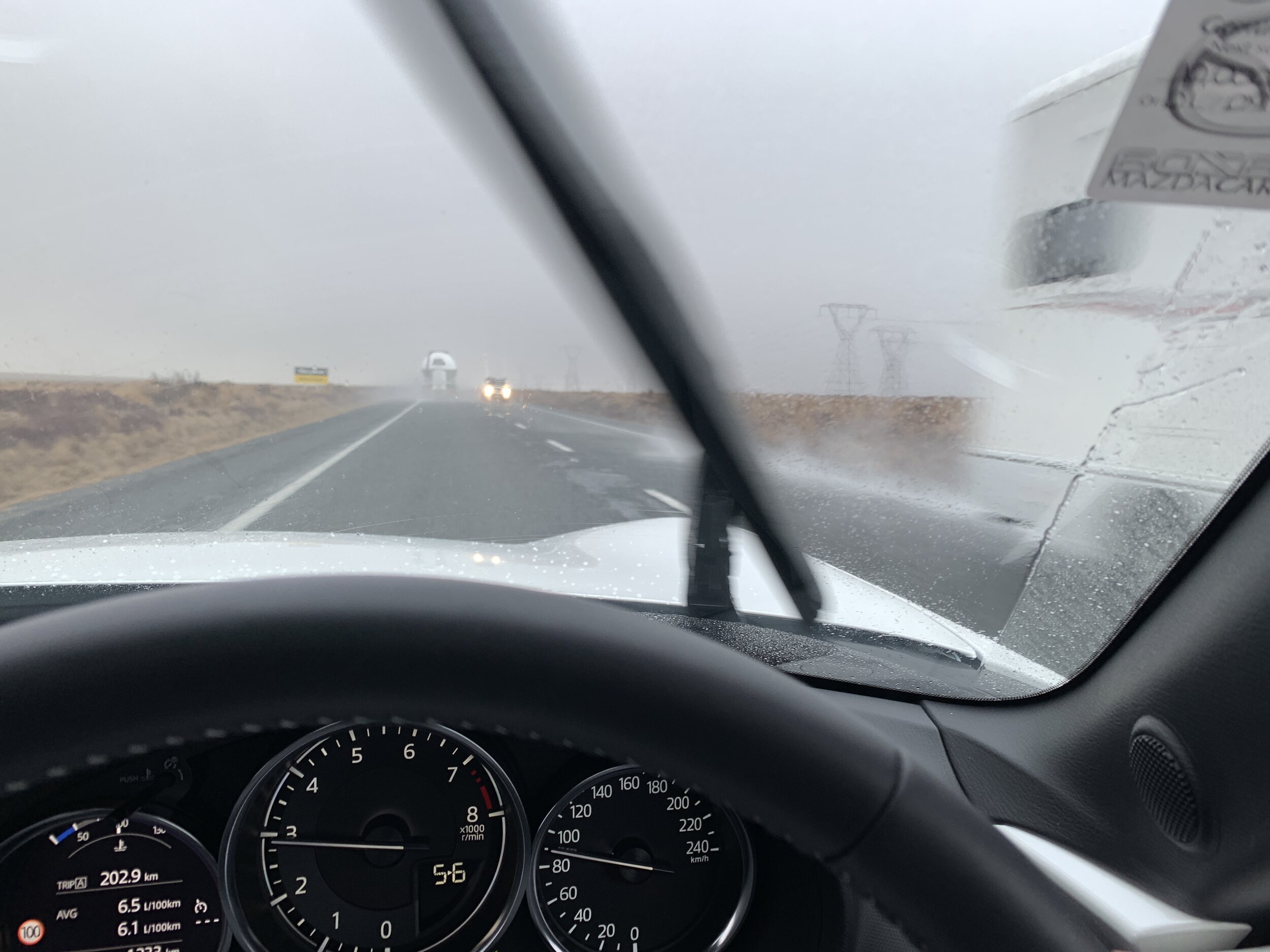
The initial drive home was a classic adventure. I had the roof down almost until Taupo, but then had to close the car. By then it was late afternoon, it was getting cold and there were dark clouds at the southern end of the lake. Sure enough, the weather absolutely closed in on the Desert Rd – hence why no classic shots of the car with Ruapehu and Ngauruhohe in the background. The dominant natural features were totally hidden.

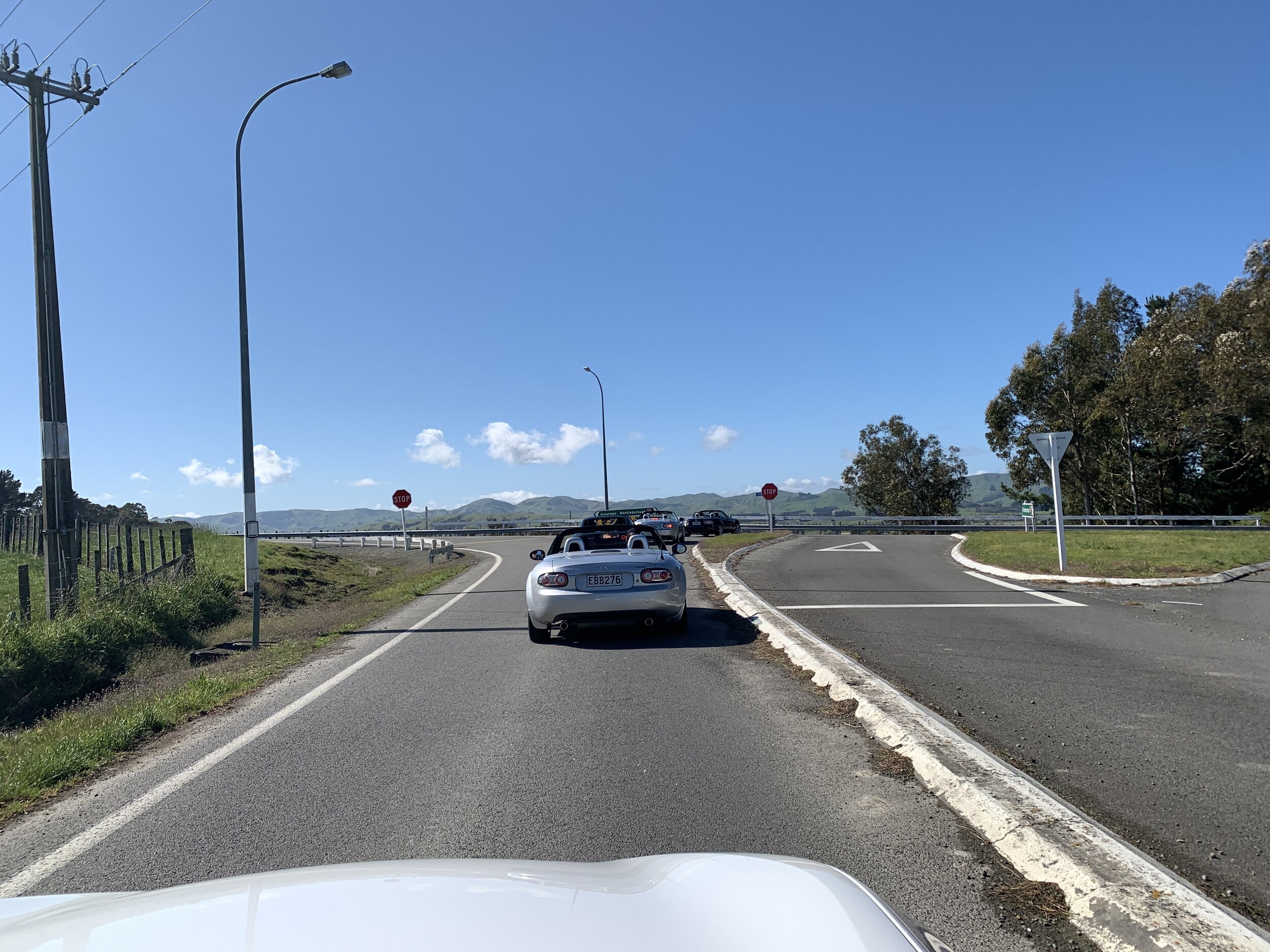
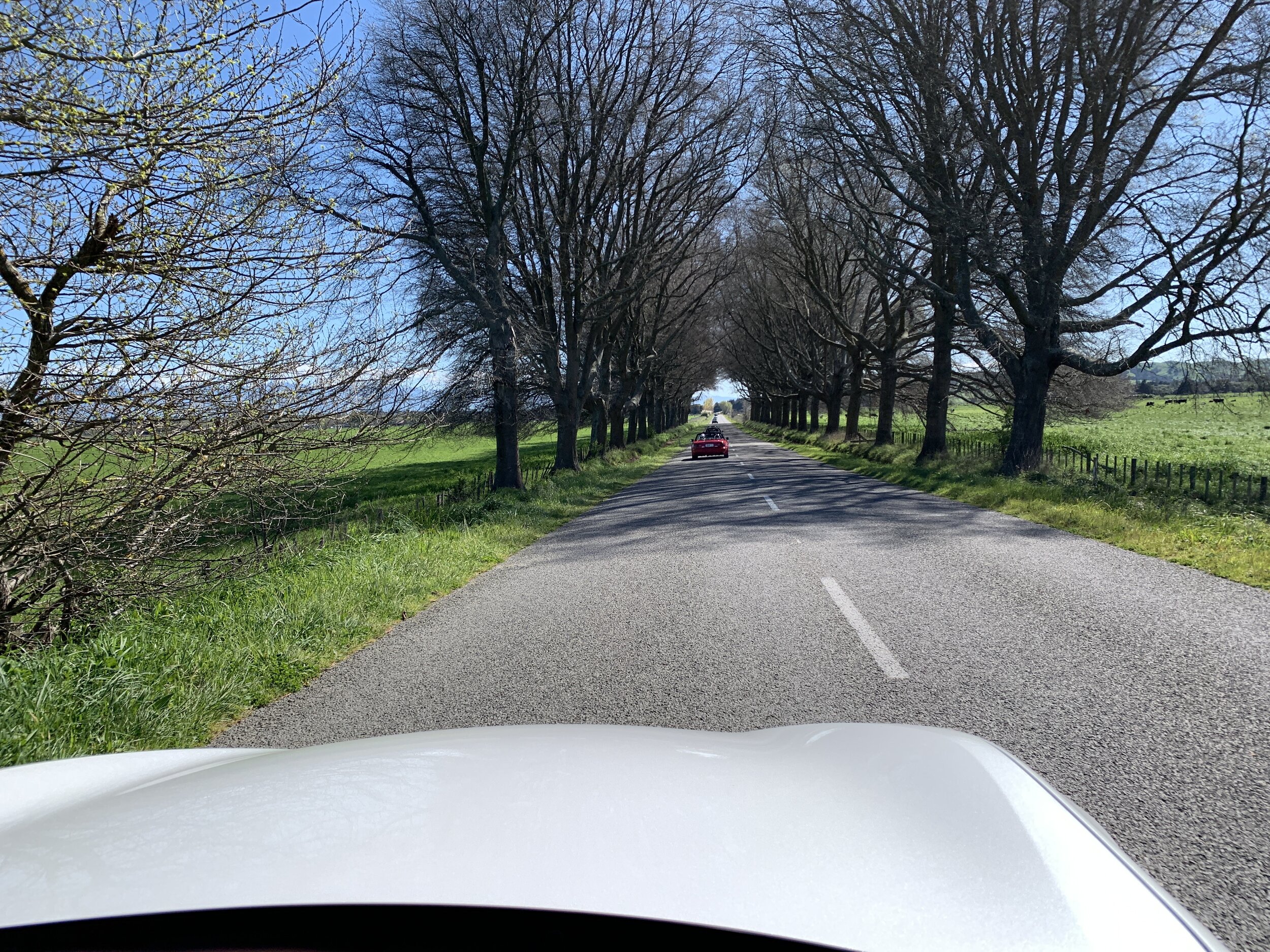
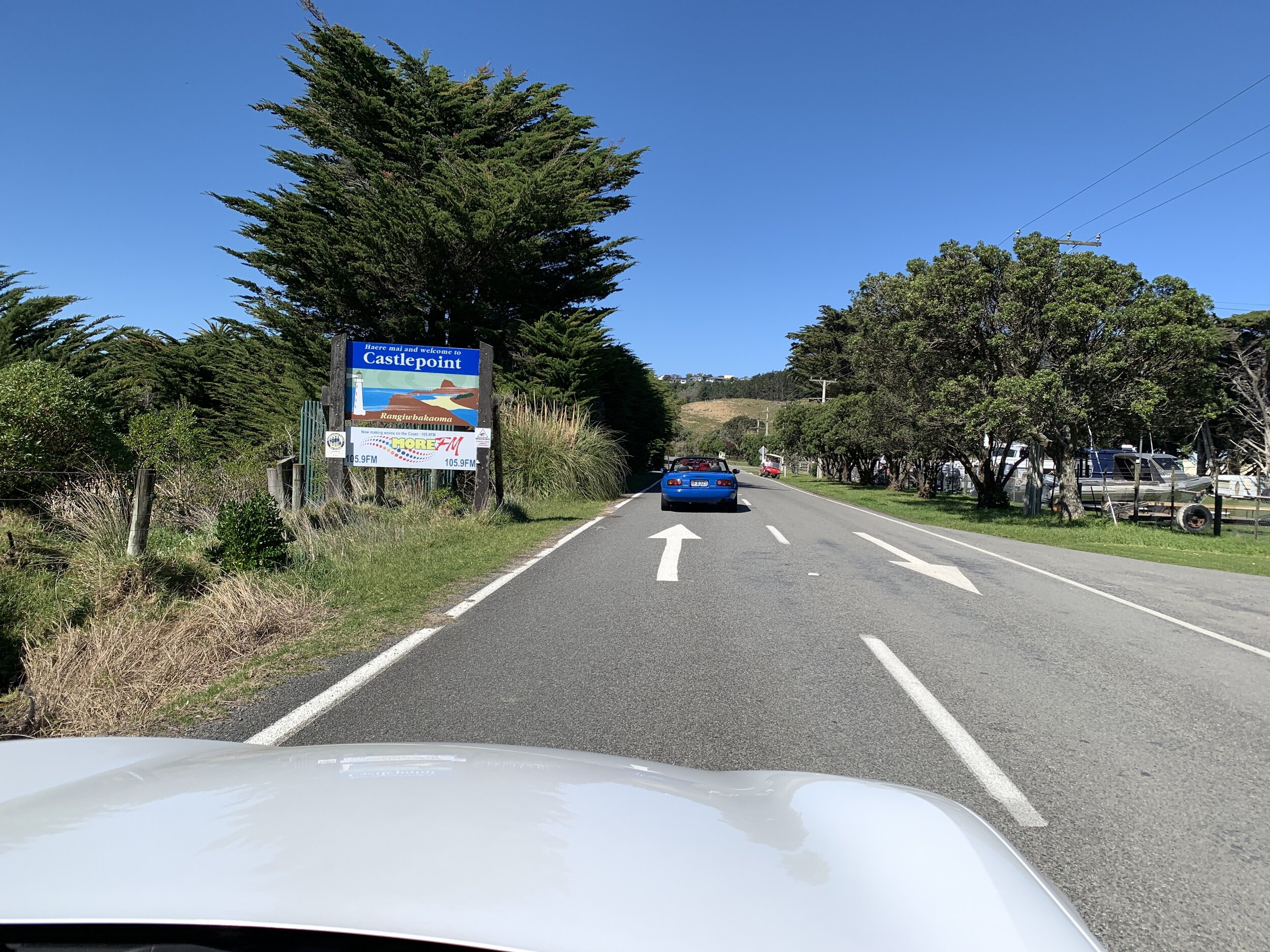
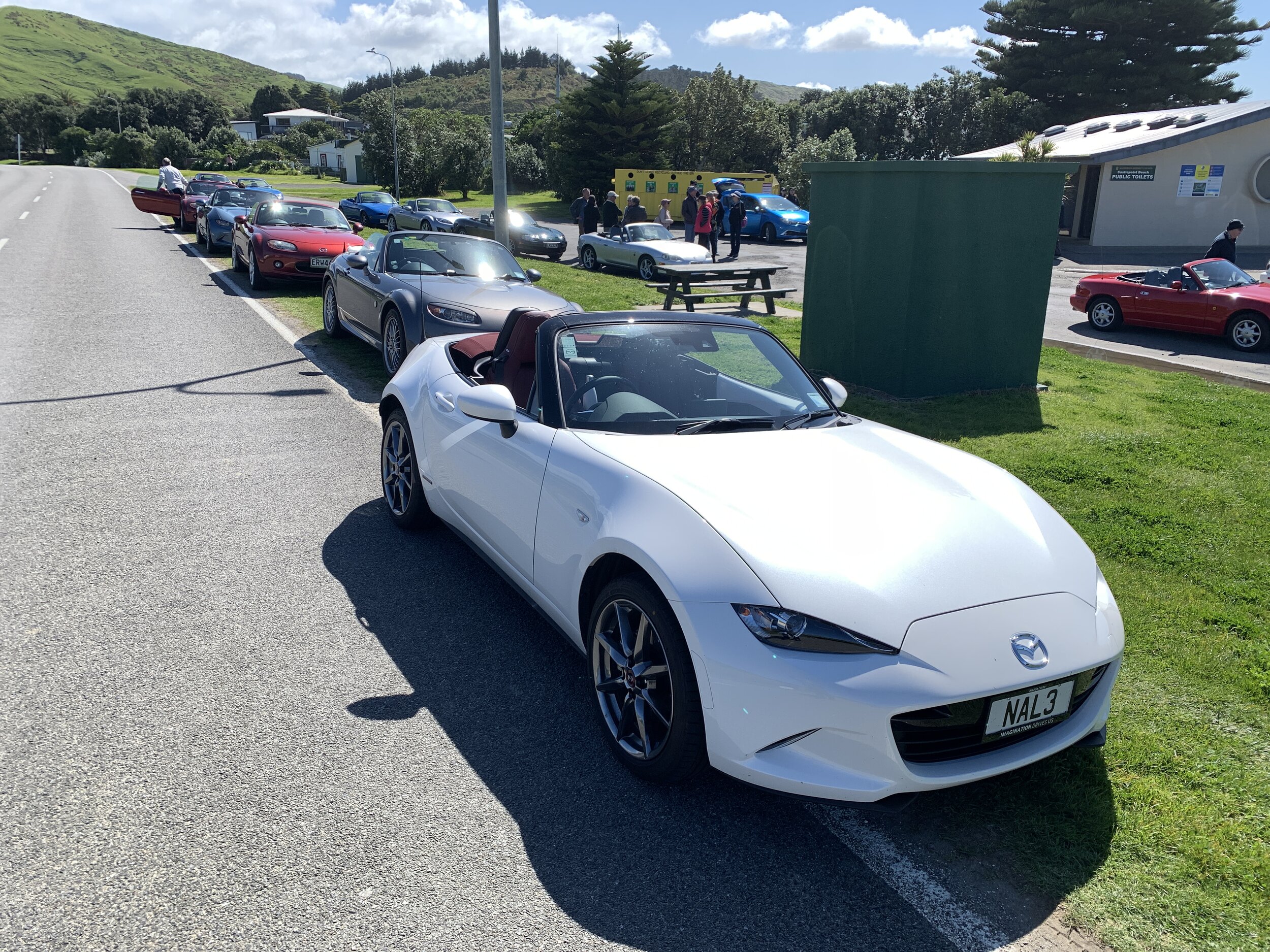
The outing with other owners was the highlight. Sunday dawned bright and clear and it stayed that way; a perfect condition for a full day’s driving – again solo (Mrs B loves her own MX-5, and enjoys driving, but had other stuff to attend to this day)  - from my Manawatu home to Featherston, to then catch up with an enthusiast group on a planned drive out to Castlepoint and return.

It’s a fantastic and classic MX-5 route, quite potentially one of the very best in the lower North Island; packed with the twists and turns and short straights that really bring out the car’s classic character and reminding why weight, or rather the lack of it, is so central to the MX-5 being as good as it is to drive.

I’m not alone in thinking that. MX-5 enthusiast clubs operate throughout the country and are well-supported. I’m indebted to Sharon and Keith Ewing, convenors of the Kapiti register, for allowing me to join in with their monthly run, which with involvers from the Wairarapa and Manawatu chapters drew around three dozen cars onto a cracking route.

It was fantastic to see all generations and formats of the car ducking and diving out to Wairarapa coast and back; some enjoying the outing as a laidback drive, others using it as an occasion to blow out those Covid cobwebs at more energetic pace. For my part, the six-speed box, steering wheel, the tyres and brakes were worked hard enough that, by the end of it all, the car felt quite a bit friskier than it had on pick up.

Mind you, when they handed it over, there was barely 200kms on the clock. When it I handed it back, it was almost about to tip over into its first thousand. So, really, I’d been doing everyone a favour, with a brisk running-in process.

Assuredly, the pleasure was all mine.


Audi S4, RS4, RSQ8: When they’re calling last drinks …

It’s a celebration of performance quattro cars …. from the subtle to the ultimate stomper … as changing times approach.

Audi front.jpeg

WHO will bet against the respective heir apparents to the blitzers here being even quicker off the mark, perhaps faster overall, more aerodynamic, higher tech, a lot cheaper to refuel and … inevitably … a lot less raucous? 

Just reiterating – and not doing so cheerily, in case you’re wondering – that what you see here is doomed. 

Not straight away. Not for ages, actually. But ultimately. They have no future.

Because? Well, I know it’s tiresome and perhaps even disheartening to hear, but the future is electric. And not just partially so, with the 48 volt assist and plug-in tech we have now.

Ultimately, there will be no room for fossil fuels. Perhaps even before there are no fossil fuels. 

But those days have yet to come. In the meantime, we pump on. Perhaps with thought that, if and when you’re personally going to have to face up to making a flying farewell to burning hydrocarbons, it’ll be in roaring style.

There are plenty of old-style performance opportunities to hook up to, but today’s focus is on three common purpose cars from a brand that has made quattro a household name. And, in doing so, has developed a wide spread of fare that often wins credit as being ultimate daily-driver performance cars, through melding sometimes brute force with all-weather traction, comfort, space.

The RSQ8 sports utility, RS4 and S4 Avants have broad commonality in purpose; they’re all aiming to deliver some degree of practicality with pace. In addition, they’re all jam-packed with safety and assistance tech.

Adaptive cruise control with traffic jam assist that can steer, brake and accelerate autonomously at slow speeds, an exit warning system for avoiding dooring cyclists, active lane assist to steer the car between the lines, a swerve avoidance system, autonomous emergency braking (AEB), blind spot warning, high beam assist and rear cross traffic alert … a lot of cars could stop there and look good, but for Audi these are just a few of many common enabling elements spanning all three. Multiple airbags are standard, as are 360-degree surround cameras and auto parking functionality. As well as all that, each delivers a lot of luxury. 

Do the salient points of difference come down to how they perform against the clock? Obviously, that will be considered because … well, that’s the game they play. In saying that, if you’re talking about which makes the heart beat fastest, let’s just agree now that even the tamest, the S4, is still a titan. It has more than enough oomph to run rings around our driving condition.

So there’s this, and of course, there’s the size of spend, which today ranges from a small fortune to … erm … a somewhat larger one. How imperative is that? Is it fair to assume the more you spend, the more you get?

Time to consider the options ….

S4 Avant

Price: $122,500

Powertrain and economy: 3.0-litre twin turbo-petrol V6, 260kW/500Nm, eight-speed automatic, AWD, combined economy 7.9 L/100km, CO2 179g/km.

Vital statistics: 4745mm long, 1842mm wide, 1411mm high, 2825mm wheelbase, luggage capacity 500 litres, 19-inch alloy wheels.

We like: Feistier feel, strong drivetrain, wagon practicality.

We don't like: Dated and awkward infotainment, inevitable dynamic limitations.

 INGOLSTADT’S ‘S’-badged cars tend to ultimately have a tough assignment; they’re obviously more performance-focussed than the standard models they derive from yet are clearly destined to be outshone by the harder-edged RS product.

Even so, it’s reasonable to say the bar keeps rising, and it does so for all. That shows with this model; today’s S4 is as grunty as yesterday’s RS4. So though the 0-100km time of 4.8 seconds has been bettered by the next-step-up Renn Sport edition, by all means the S4 cannot be considered tepid in any way, not for punch, nor for pedigree.

Especially not the latter. If you’re among those who wonder if the S4 is just as much about elegance as it is about being an entertaining drive, bear in mind now that one of the powerplant’s attractions is that it was co-developed with Porsche. Not a brand known for being half-hearted about grunt.

In updated form, this unit is packing significantly more heat than it did previously. You be forgiven for not immediately twigging to this, because it doesn’t explode into existence like the RS’s engine, instead delivering just enough of a subtle thrum to tell you this is no ordinary Audi. Of course, you need just give it a touch of squirt to discover there’s a lot of impatient energy waiting to be released, but even when it is is, there’s nothing too raucous about.

 Which is to be expected. The entire ideology of this breed depends on it. While it’s arguable whether ‘S’ cars are still halfway house choices, it’s still clear that the letter could easily be a shorthand for ‘sleeper’. In look, if not necessarily action. Audi recognises not everyone desires full RS brashness. Some prefer a more civilised, velvet glove approach. That’s this car’s job. And it does it very well.

It’s not so innocuous as to be anonymous, yet the approach is more careful and considered than with anything coming out of RS. Avoiding the outrageous means no flared wheel-arches, no rear wing and only the slightest hint of menace from the quad exhaust pipes, subtle body kit and 19-inch alloy wheels.

A predator hiding in plain sight? You’re onto it. Though, truth be told, the camouflage has slipped a bit in latest form. For one, just the small shift to a racier wheel styling for this mid-life facelift has been enough to less covert in its intentions. No complaint, either; that adjustment – plus some trim and minor styling changes – are good for the car. 

Also, while the idle is refined, that’s not to say it lacks an aural signature. As the revs rise this direct and multipoint injection unit gathers quite a lot of  volume and pitch, not outright Ray Winston gravelly but instead higher-toned, yet nonetheless delivering a beautifully modulated timbre. This time, too, the song is natural rather than computer-enhanced. It’ll rev happily right to redline and you wouldn't know it was turboed, either, if not for a faint whistle, such is the crispness. No exhaust burps, growls and pops, though … it’s just not kind of car.

The car’s laidback styling ambience is blown apart by the acceleration; the thrust is surprisingly mega and, of course, as in the others here, nothing is wasted in wheelspin. The back end hunkers, there’s a bit of squirm and then you’re off. As entertaining as that side is, the better and more informative thrill comes from feeling how effortlessly muscular it is in the 80kmh to … well, best not say, range.

That’s reflective of how it generates peak torque from just 1370rpm and sustains it until 4500rpm. With peak power occurring between 5400rpm and 6400rpm, you might wonder if it has any gaps in the oomph, but I couldn’t discern it. When full boost hits, it pushes with astoundingly resolute determination. The claimed 0-100kmh sprint time now is only just fractionally better than that quoted for its predecessor but don’t sweat that. What’s more worth sharing is that it's on par with the 2015 RS4 Avant, regardless that the latter has more power. 

The eight-speed ZF transmission is a superb accomplice, slipping through gears snappily, though not with the ferocity found in the other models here. Nonetheless, it is a good consort and unafraid of actioning into a sporty driving mood, with rapid downshifts slotting in at 5500rpm.Alternately, it will behave with full civility when cruising.

The full-time quattro AWD system shuffles up to 85 percent torque to the rear axle via a mechanical centre diff, while defaulting to 40/60 front/rear when cruising, and grip levels are compelling.

The rear-end propulsion bias gives the car a nice balance through corners when pushing; that the S4 sits 23mm lower to the ground than regular A4 models and has fat performance-tuned rubber also allows it to have a higher cornering speed threshold. Ultimately, though, it always maintains as a really well-sorted road car; again because that’s just expected of the type. A full-out racer for the road feel is an RS remit. All the same, even at S level there is relatively little body roll or pitch, with ride firmness increasing when the dampers are set to Sport.

 Steering isn’t as brilliant for feel here as with the RS4, but it’s more on top of things in respect to accuracy and the specification delivers decent brakes, notably 350mm front discs with six-piston callipers, so if you need to pull up quickly, it’ll oblige.

In terms of cabin fitout and comfort goes, it’s not quite RS in that there’s carbon fibre inlays but the seats aren’t to the fullest sporty styling, yet you know it’s definitely a step up from the mainstream.

The luxury is right up there and though it has slipped a little on the technology side, mainly in respect to infotainment and instrumentation – the RSQ8 is a generation ahead of both Avants in that respect, with its full glasshouse dash, more advanced MMI interface and integrated wireless charging and Apple CarPlay hook-up (here, you need a USB cable) -  neither does it feel outmoded. Though maybe it will in a year or two. The flat-bottom steering wheel is the same as in the RS4, but without some of features.

The A4 Avant is not quite large enough to come across as being commodious – for that, you need the A6 – but there's reasonable room for rear seat passengers and the luggage space is fair, expanding three-fold with seats down.

Audi’s S models are good go-to cars for getting a sense on how Audi enables improvement; they’re all smarter and sharper than their predecessors. The S4, now, has crept so closely to the RS4’s territory you wonder what the next move could be.

RS4 Avant

Price: $153,500

Powertrain and economy: 3.0-litre twin turbo-petrol V6, 331kW/600Nm, eight-speed automatic, AWD, combined economy 9.2L/100km, CO2 208g/km.

Vital statistics: 4781mm long, 1866mm wide, 1404mm high, 2826mm wheelbase, luggage capacity 505 litres, 20-inch alloy wheels.

We like: Still the best RS, awesome on a windy road, only slightly pricier than an S4.

We don't like: Same infotainment quirks as S4.

ONCE it was The One for our market – now it’s just one of many.

Audi’s performance division has been banging out RS cars since 1994 but they aren’t always as they used to be. The RS badge attaches to a massive family and, with consumer tastes having now swerved tangibly toward sports utilities, the strongest sellers are increasingly based on higher-riding vehicles.

That’s been a bonus for Kiwis. RS car production has steadily bumped up over the years and a fair few have come to New Zealand, enough to often give us the world’s best per capita ownership in any given year, mainly because we seem to embrace everything that joins this clan.

Where does that leave original flavour product such as the RS4? Thankfully, still in the hunt. As much as the swing toward sports utility-based editions is now obvious and these have taken over as the preferred choices, the distributor has never countenanced quietly slipping the Franken-A4-stein wagon out to retirement.

Instead, it remains in the pack, trading less spectacularly than it once did but still solidly enough on strength of provisioning supercar-rivalling stonk and dynamic purity in a package perfectly sized and sorted for our driving condition and style. The world’s best warp-speed wagon? I always thought so and driving the 2020 update does nothing to alter that view.

Even so, the S4 should conceivably have this car rattled, because it has become better than ever. Or so it might seem until driving the RS4. As much as the underling has something of the same panache, practicality and even performance punch, it still doesn’t blend those factors quite as completely and competently as the RS4 manages.

Sure, it has changed, most obviously when the 4.2-litre V8 was dropped, as it had to be. Do we miss the old engine? Logically, we shouldn’t. Today’s biturbo outputs the same power and a lot more torque, drinks less fuel and is demonstrably a better drive. But honestly … well, yeah, there’s still a twinge at emotional level. If I had a chance to reacquaint, well … it’d be hard to say no.

At same token, the RS4 is still a hero and a special thing; a well-crafted, belting monster all-rounder occupying its own rarefied market segment.

What’s changed for the 2020 model year? Not too much, all in all.

Trainspotters will cite those funky LED lamp clusters front and rear, which have distinctive patterns within them, and the triple-slats cut into the nose of the car above the radiator grille as adjustments of significance. Less well-informed punters might not even realise they were absent previously.

Mainly, it’s no more altered than the S4 has been. The 20-inch alloys have been restyled but none of the bodywork. Inside the 12.3-inch 'Virtual Cockpit' dashboard has been refreshed, as have the graphics on the 10.1-inch infotainment touchscreen sitting perched atop the dash. As in the S4, this still looks a bit dated and operationally is a bit of a pain; mainly because it looks like a touch screen but isn’t. Instead, you need work through the menus with a toggle. Such is the pace of change within cockpits, right? A few years ago, this was state of the art. But now fully modern Audis all have three screens and haptic – even touchless – everything, it’s all a bit ancient.

Moving on to the drivetrain. All the core outputs, consumption and performance data appears to be a re-read of the material first issued several years ago. There are technical revisions, but the biggest influence on the way the car performs results from it going on a diet.

The 2020 version is an astounding 45kg lighter than the pre-facelift model. You’d think they’d need to drop something major, perhaps a seat, to achieve that, but in fact it’s all behind the scenes. Or, at least, the door and roof coverings and the firewall as Audi attributes this to a reduction in sound-deadening, in the main. For all that, it’s not a distractingly noisy car when on the move; yes, there’s tyre roar over coarse chip, but that’s always been a factor and doesn’t seem any more intrusive now.

Refined? Not really. Unsurprisingly, because it is a high-tier performer and because Germany has smooth roads, NZ doesn’t (and guess which surfaces the RS was tuned for) even the softest suspension tune is firmer than the equivalent in S4 format.

However it’s not as race car rigid as previously, which reinforces brand contention that the adaptively damped setup has been reworked to engender some amount of elasticity, this to enhance ride comfort without sacrificing an iota of the iron-fisted body control.

Apparently, the gearbox has been recalibrated to improve shift times, while the quattro system is also tweaked, though it continues to favour a 40:60 front-to-rear-torque split, sending as much as 85 percent of torque to the back axle when required.

Little refinements, yes, and in isolation it might be challenging to determine how different the car is now against how it used to be, but what does impress is the high ongoing degree of driver involvement.

Traditional quattro talents are strong with all three cars here, but out of the trio on test it’s the RS4 that has the most naturally gifted handling. Those able to recognise that driver engagement relies just as strongly on dynamic finesse as it does immense traction and grip will have a ball. 

Assuredly, it demands a racetrack if you are of a mind to push it hard enough to make it dance – and, assuredly, too, the hard-out settings that best suit the circuit are too overt for anywhere else - but even at sensible clip on engaging roads, it remains an especially involving car, capable of devastating displays of adhesion, pace and competence. And because it is less jumpy and jittery over surfaces, it is easier to place on the road and point through corners. With that in mind, a shout out for the steering; it's feel will restore faith in Audi Sport's engineers.

The hardest thing is harnessing the pace; once it’s on the boil, this engine really steams. You learn that ‘fast’ translates to something more extreme in German. It demands to be worked and rewards with a stunning soundtrack and impressive punch.
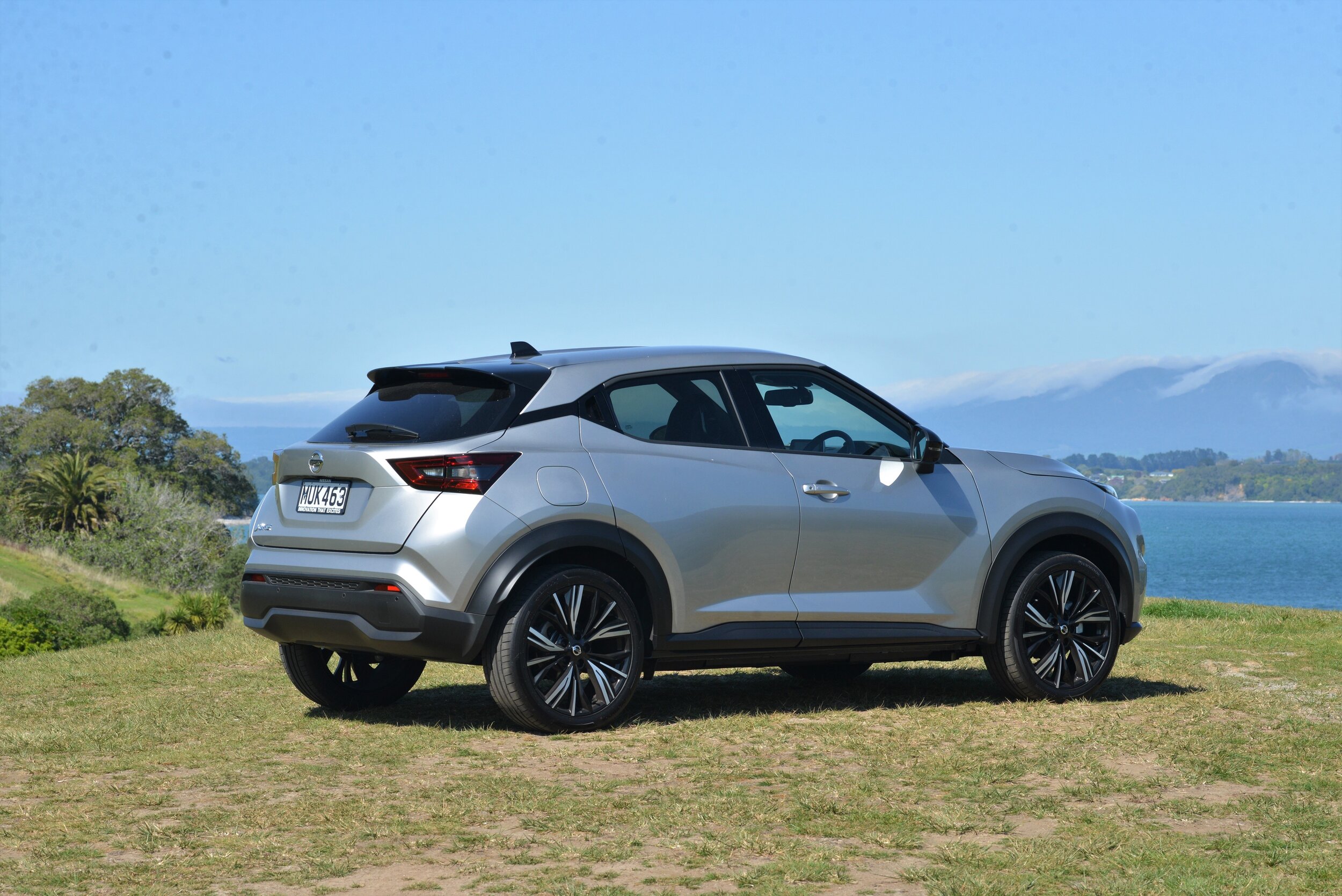
For all that, it needn’t have to be the utter hoon all the time. An ability to ‘mix ‘n match’ the car’s drivetrain and dynamic settings has long been a plus point. You might – actually WILL - want the dynamic engine/exhaust map cos it sounds fantastic, but could also prefer the softer ‘comfort’ suspension and steering. The RS buttons on the steering wheel are memory functions that can be used as shortcuts directly to your favourite settings.

Specific sports displays, a sports steering wheel, sports seats bulky enough to erode rear legroom (who cares, right?) and a few RS logos are all requisite and provided, but beyond that it is trimmed as equally for luxury as for hot-lapping. It feels beautifully put together with quality leathers for the seats and neat carbonfibre/metal trim pieces.

Such is the pace of technology change that the RS4 is fast heading into the realms of ‘old school.’ Yet what appeals, still, is what has appealed previously. As a fast and very serious road car, the RS4 remains very well judged. It’s a fine, thrilling and utterly addictive machine that also happens to be an effective hold-all.

RSQ8

Price: $254,650 as tested.

Powertrain and economy: 4.0-litre twin-turbo V8, 441kW/800Nm, 8-speed automatic, AWD, combined economy 12.1L/100km, CO2 278g.

Vital statistics: 5012mm long, 1998mm wide, 1694mm high, 2998mm wheelbase, luggage capacity 605 litres, 23-inch alloy wheels.

We like: Astounding technology exercise, great looker. 

We don't like: Ultimately, an unconscionable exercise.


BLAME, or thank, Porsche … they took us down this route with the original Cayenne Turbo.

You know the story. Ridiculed on arrival, with purists pondering what damage to brand pedigree and purity this monster might wreck, Cayenne became a saviour, a best-seller and brilliant profit centre. And a pathfinder. 

So many more of its kind since; some specialising in luxury, others trading on that plus, as this one does, hyper-performance. Almost all stomping all over environmental and efficiency sensitivities, every one destined to fall into a folder labelled ‘particularly divisive.’

Volkswagen Group is a dab hand. Q8, the Bentley Bentayga, Lamborghini Urus, the Audi Q7, VW Touareg and, yes, the latest Cayenne? All off a common platform. Smart, right? 

So, quite a big gang of gangsters, then, and in some ways the RSQ8 could well be considered a potential mob leader; it’s basically a Urus with a German accent but shaped and kitted way better. (Sorry Lambo, but a fat SUV with vaguely Murcielago style cues looks even weirder than a Cayenne with a 911 schnooze).

It’s an interesting and intriguing play, not least because it arrives just when Ingolstadt has deeply immersed in the electric car scene. If any Audi stood out as the epitome of an ‘anti e-tron’, it surely has to be this machine: A super swanky, two tonne five-seater SUV coupe battering ram with a thundering 4.0-litre biturbo V8 – plucked from the RS6 Avant and RS7 Sportback –tuned to take it to the far side of 300kmh, possibly downing more fuel in that moment than the Chatham Island’s petrol station dispenses in a day when doing so.

Still, until there’s a law against it, why not? Anyway, setting aside all the ethical arguments, it has to be said that the RSQ8 is a heck of a technical achievement. And not a bad looker, either. All ultra-modern vorsprung with just a hint of villainy, and the classic RS hallmarks of  a giant honeycomb grille, air intakes, body-coloured wheel arch spats, plus a deck spoiler and a pair of oval twin-pipes. Nicely nasty. 

Colossal alloy wheels – 22s as standard, 23s an option that looked real good on the test example – are an awesome finishing touch. As said, if you’re going to end this petrol addiction period with a bang, best make it a big one.

The big rims are requisite; RS cars have big brakes. Or, in this instance, BIG brakes. These are 420mm front discs gripped by 10-piston, callipers, while the rear discs are 370mm items. And that's the standard spec, because RS ceramic brakes are an option, which are stepped up to 440mm rotors at the nose.
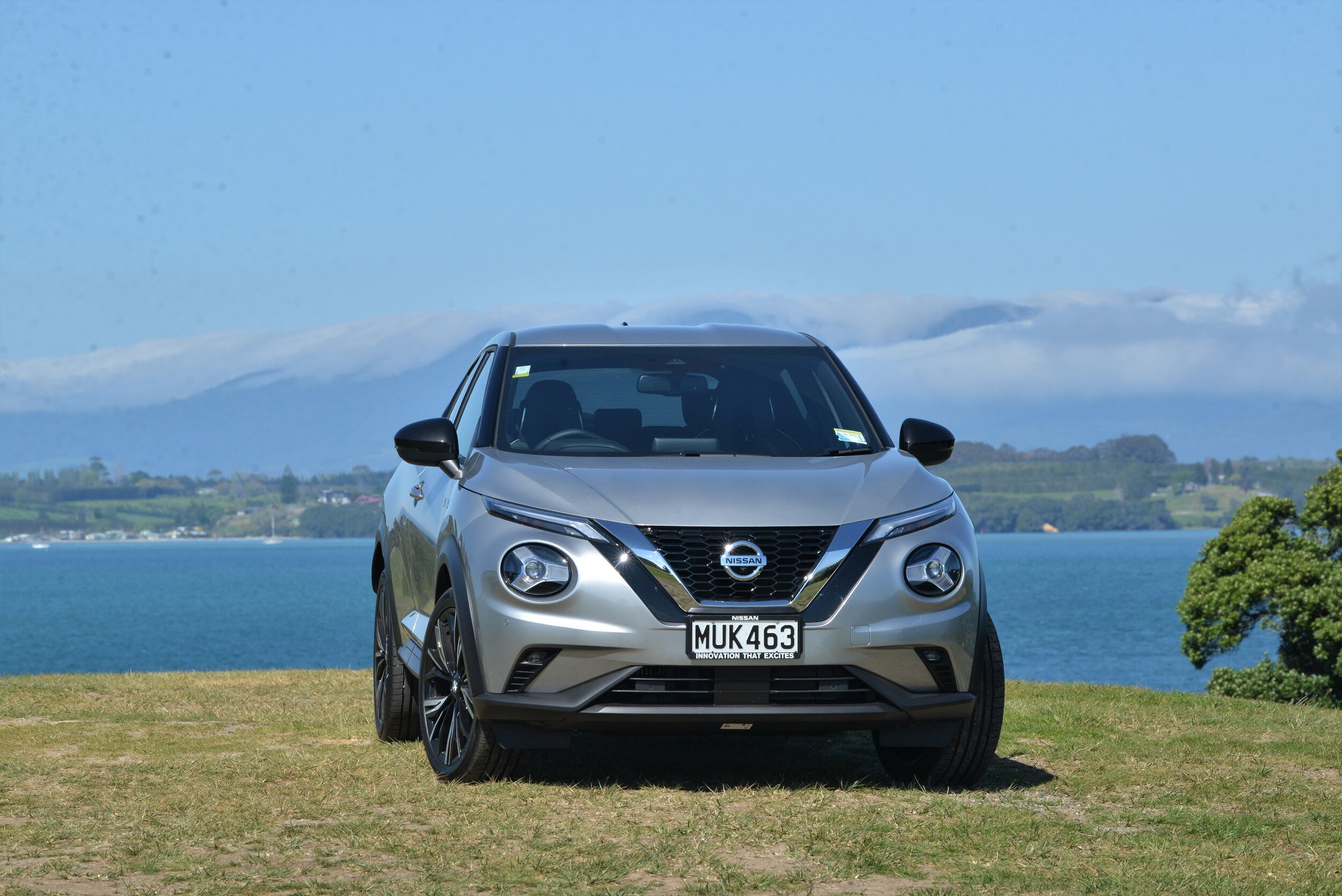
The need to scale up is obvious when this thing is measured or put on the scales; an RSQ8 not only takes up a fair bit of road space – it’s not tall or overly long, but is wide – and also tips the scales at 2315kg without so much as a driver onboard.

It takes a special kind of drivetrain and chassis setup to accomplish the mission of moving this amount of mass at high speed, not just down straights but also safely around corners. That and a whole lot of engineering talent.
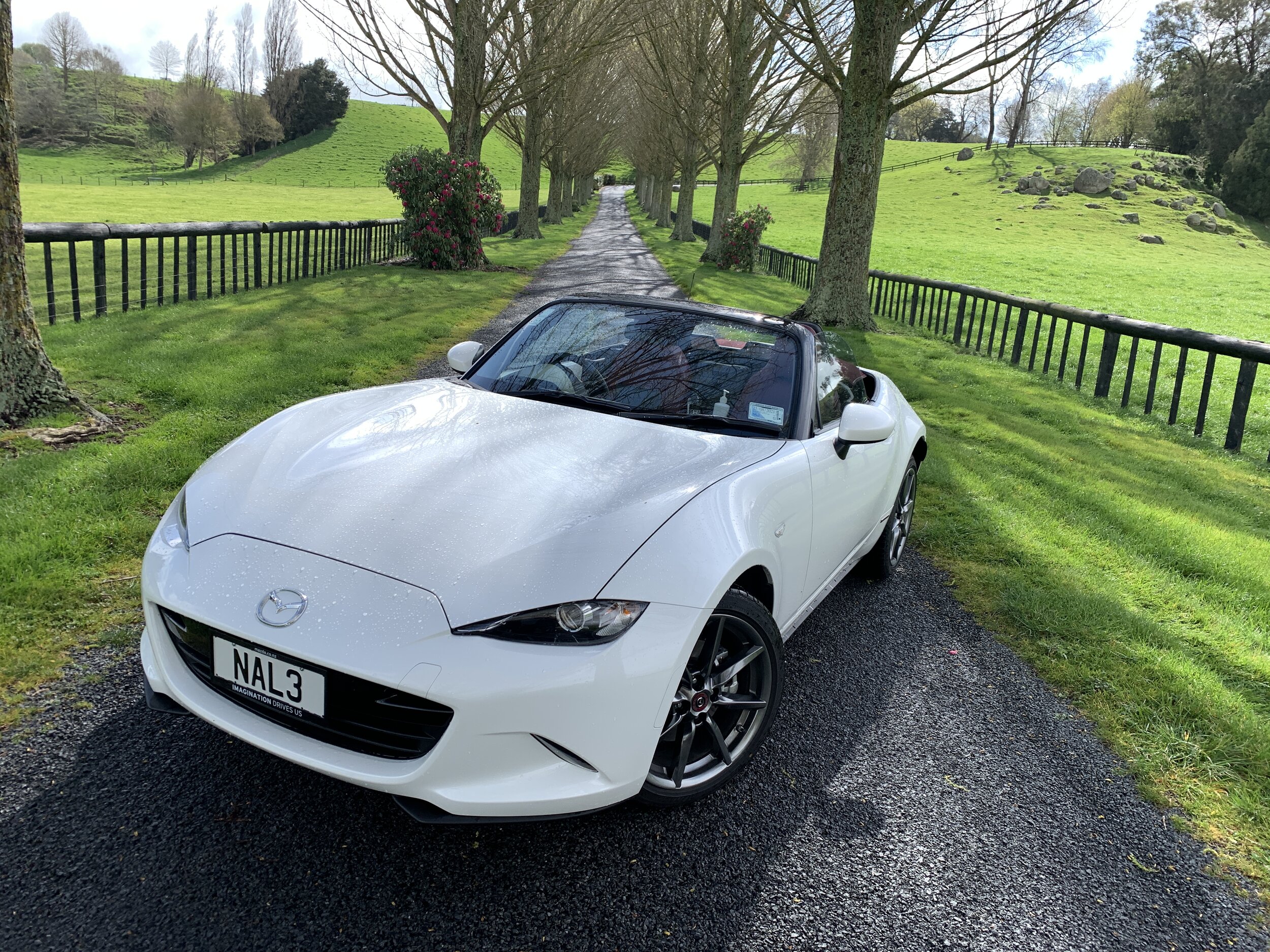
Even taking onboard the engine’s robust outputs, I figured the Audi couldn’t possibly be as whacko wild as the Urus, which I’ve driven. So wrong. The Lamborghini effort is louder (and no surprise there), but you’d need to organise a drag race to sort which was quicker; on gut feel, the RSQ8 is right on the Italian job’s pace. It steps off and charges like holy stink, whipping through the legal highway limit with such insouciance owners might care to travel with a lawyer permanently aboard.

The speedo is calibrated to deliver big numbers and none are likely to be wasted – in the right environment. I cannot think of any place here, other than a particularly long runway, where it could hit the alleged top speed of 305kmh. Seeing and hearing one of these hurtling down the autobahn at its terminal velocity would be hugely memorable, I’m sure of that. I can only imagine how much air it would have to be pushing aside.

For local use, the muscularity that makes it one of the very fastest SUVs on Earth will best demonstrate in the 0-100kmh time, which is comfortably below four seconds, though standing starts are probably not to be overdone: You can only imagine how huge the loadings must be, not least on the eight-speed automatic. In deference to this, I only attempted a couple of rolling starts and even these left powerful impression; hit the throttle full hard and the thing digs in and rockets with such intensity you’d think it would affect the Earth’s rotational forces.
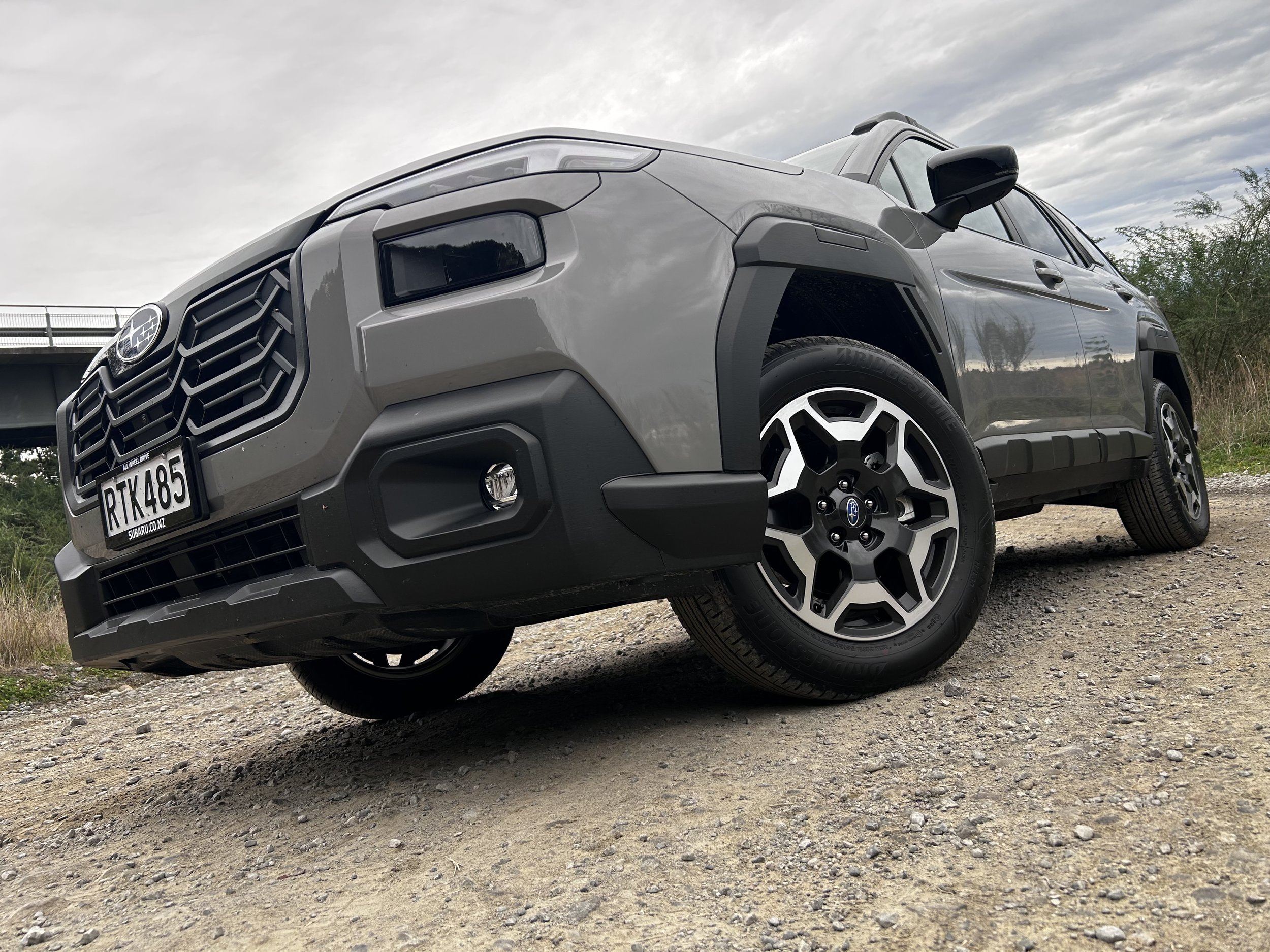
And, as indicated, the greatest plus – and perhaps relief – is that it goes around corners pretty well. Though that’s not say it’s not without challenge; the body’s sheer size, the highish-set seating position, the fact that it’s quarter of a million bucks worth of car … well, as much as the RS Q8 is remorseless at covering all sorts of ground, and covering it at a ferocious pace to boot, and despite it being more involving than a monstrous SUV of this size has any right to be, you’re constantly aware – particularly on narrower, intricate roads – of what a huge responsibility it is.
Thankfully, there’s a lot on its side, beyond the obvious of those massively fat, performance tyres and the quattro Sport differential with a nominal 40:60 front-rear bias, with up to 70 percent of torque able to flow to the front and a maximum 85 percent going to the back. 

Also acting to keep it stable are ingredients special to the type, an active anti-roll bar system and a four-wheel-steering system. Those first can disconnect themselves to improve the ride quality, because the RS Q8 sits on air suspension with a 90mm range of body-height adjustability. Enabling these is the primary reason why it has something else lacking from the other Audis here, a 48-volt supplementary electrical system.

That facility enables the RSQ8 to be categorised as a mild hybrid electric, but anyone imparting that fact in public needs to do so wryly, because even though the battery assist has some positive impact on fuel burn through its coasting and kinetic energy recuperation abilities, in reality any savings (and, at best, it’s a piddling 0.8 litres per km) are likely blown apart by just one decent jab on the throttle. Insofar as economy goes, it’s certainly not as appalling s some old-school American V8s, but neither is it a paragon. An average 14.8 litres per 100km seemed good, but it’s not great, obviously.

So it’s a giant walloper … just unfortunate that it is so overbearingly so that you might feel like one, too. The stiffest price you pay for this car – aside from the sticker, of course – is that it is unavoidably a huge centre of attention. Which is fine, if you’re thick-skinned enough to withstand criticism about how proliferate and wasteful it is.

If more than platitudes are encountered, best just shut yourself in to the cabin … this is a spot in which it is easy to forget the outside world. It's the usual top-notch quality cabin of an Audi Q8, enhanced with RS baubles: So, a flattened-off steering wheel, RS Super Sports seats in Valcona leather, RS-specific displays in two of the three digital screens of the MMI Touch system and an RS Mode button on the steering wheel. You can optionally choose to have bits of Alcantara and carbon fibre added to the surfaces as well. It’s beautiful, utterly affluent and superbly sorted in respect to ergonomics. The operability being is a whole generation ahead of what’s served up in the S4 and RS4 is no particular challenge, everything works sensibly and so much more fluently, for the most part.

And, yet, as technically and mechanically impressive as the RSQ8 is, it’s also really surely just too much for our environment; for the most part, even when pushing on, you’re probably only using a fraction of what has to give.

In respect to that, you’d get better value and joy from the R8 supercar, the only more expensive Audi on sale in New Zealand, and definitely from the RS4, which to me is still the best RS buy-in, or even the e-tron … assuming you’re ready to accept the realities of where we are heading.


Peugeot 2008 GT, Volkswagen T-Cross R-Line: From the clean scene


Compact crossovers are all the rage and there’s nothing wrong with Euro flair, so …

P and V front.jpeg

ONE can but rarely does, the other cannot and simply shouldn’t.

If you’re still confused by the difference between a sports utility and a crossover – and it’s understandable, as both types are going for that achingly trendy rugged and ever-so-slightly bulked look - then that’s a good a disparity as any.

Effectively, it comes down to the first type generally having an off-road ability whereas the others aren’t so much wannabes than never-weres …. presenting in two-wheel-drive in a way that just isn’t tailored for any kind of daily driving surface other than those created by man. They absolutely eschew any kind of off-road gumption, which is okay because you were never going to use it anyway.

The cars on test today are high achievers at the art of looking a touch terrain-trustworthy yet in a manner that relates clear desire to steer clear of icky dirt or grime.

If anything that ambience enhances probable appeal as perfect choices to become hatchback alternates for those seeking a sensible urban and occasionally open road choice with recognition that even all-wheel-drive mightn’t make a jot of difference in those environments.

There’s more going on here, of course. Almost all crossovers have become the Swiss Army knives of the car world through their clever packaging, but there’s no argument that can be a secondary consideration to at-wheel playfulness and how well they present at the kerbside.

In that respect, the two models here do seem to have a certain something more.

VOLKSWAGEN T-CROSS R-Line

Price: $43,490

Powertrain and economy: 1.5-litre four cylinder turbopetrol, 110kWkW/250Nm, 7-speed dual-clutch, FWD, combined economy 5.5 L/100km, CO2 126 g/km

Vital statistics: 4235mm long, 1782mm wide, 1584mm high, 2551mm wheelbase, luggage capacity 455 litres, 18-inch alloy wheels.

We like: Smart but sensible ambience, good ride, nice engine.

We don't like: Some interior plastics, stop/start abruptness.


THINKING small has been a careful process for Volkswagen; basically, it’s taken the best part of a decade for it to arrive at this car, the new baby of its sports utility/crossover family. 

The project started in 2012, when Wolfsburg’s designers created the Taigun concept; basically a quasi rockhopper based off the Up! City hatch. It was greenlit for sale by 2016, but obviously that never happened. After giving it more thought, VW determined the car would be too small. They’ve since junked the Up!, too.

It then started over, shifting focus to what now have, a larger but still tightly dimensioned derivative of the Polo hatchback. The Taigun nameplate hasn’t gone to waste, as it is being reused as a rebadged long-wheelbase T-Cross. But that’s only for the Indian market, so don’t hold hope for local introduction. 

The Cross delivers in 1.0-litre three-cylinder Life and Style formats which certainly sound like fun. Yet assuredly this 1.5-litre four-pot R-Line on test will also do brisk business; so many customers find it easy to buy into a flagship that seems tailored to deliver just that little bit extra verve and visual fizz. In respect to the latter, the R-Line is not as flamboyant as the limited-count 1.0-litre First Edition that’s been snapped by early birders. I wouldn’t be dismayed about that; the R-Line’s body kit embellishments aren’t as loud, yet they lend more coherence to an overall look which I suspect will be a major lure for buyers.

Sure, look at the T-Cross when it’s parked alongside the 2008 GT and there’s no argument which delivers the more drama; that Peugeot is a far more vivacious thing, not just from all exterior angles but also when you slip inside. 

At same token, though, it’s easy to imagine the VW won’t loss too much ground from being less immediately striking. Whether or not we should ever celebrate when a design approach is less likely to axe-split opinion is somewhat moot.

What is more relevant is that, though it’s clearly less outrageous, the T-Cross is hardly a weak design in its own right: All the cues that link it to a wider family spanning through T-Roc, Tiguan and Touareg are there; I quite like how it acknowledges their inspiration by being upright and just a touch square. There is some plastic cladding but it isn’t overdone, in overall shape and stance it very nicely and neatly done and, more importantly, by and large it evidences as class act in ambience.

The latter is important. Small crossovers can risk being considered cheap and generally nasty because of a perception they, and the cars they derive from, are often built down to a price. 

You can hardly sense that with the T-Cross; in large part because it’s derived from a hatch that has always aced on an aura of upmarket appeal but also this sub-sector has so risen in consumer popularity quite often the choices are made simply of impression of quality. In this instance, that is has much of the same dashboard and interior layout as the Polo is far from harmful. While you might only quibble about some of the interior plastics, but that’s really about it. 

Having the same 'MQB-A0' platform as the Polo, the same engines, and the same basic structure also strengthens the proposition. 

It's far roomier than some older small crossover models, with a decent 385-litre boot and good space in the back seats. You get some excellent front seats, the digital instrument screen looks classy and works well, and the central touchscreen is, generally, a model of simple and explicable menu layouts. It has rather handsome graphics, too.

Standard kit for a T-Roc includes a multi-function steering wheel, all-round electric windows, air conditioning, lane keeping assistant, forward collision alert with automated braking, stop-start, a blind spot monitor and LED daytime running lights. Quite a lot, then.

The R-Line upsizes the touchscreen and handily adds a reversing camera, adaptive cruise control, keyless access, digital instruments and a decent stereo system. The steering wheel integrates not only has buttons for the media controls but also for the cruise control, which in older VW’s has always been by stalks. That’s a good improvement that’ll start to transfer to other models. Also new is a wireless recharge pad for your phone; that’s good, but since you have to cable in the enable Apple CarPlay functionality it slighty smacks as a halfway. After all, your device will recharge off the US anyway. Better to to go the whole way and have wireless CarPlay and recharging, really.

The driving side of things is by large VW 101: It’s no hot hatch, of course, and less effervescent than the Peugeot when it comes to chassis balance and steering feel, but there’s a likeable honesty to the actions and it has an air of solid dependability. Those largish rims – everything but the base car runs on 18s - don't wreck the ride, and though it’s certainly not an expedition vehicle, it drives confidently on gravel and will likely not embarrass itself on a grassy field, assuming it’s not a sopping day and there’s minimum mud. 

I’m keen to try this car with the 1.0-litre, because it has an awesome reputation and it’s also potentially enough for this model anyway, but would also say that in isolation, the larger capacity unit on test is going to appeal for its broad torque, sharp throttle responses and pretty decent refinement. It also works comfortably with the seven-speed direct shift transmission that, again, is common to all versions.

PEUGEOT 2008 GT

Price: $45,990

Powertrain and economy: 1.2-litre turbo-petrol inline-three, 114kW/240Nm, 8-speed automatic, FWD, combined economy 6.1L/100km, CO2 138g/km.

Vital statistics: 4300mm long, 1550mm wide, 1530mm high, 2605mm wheelbase, luggage capacity 434 litres, 18-inch alloy wheels.

We like: Effervescent engine, 3D i-cockpit, creative styling.

We don't like: Driving position.


MUM and dad were average height, so too my sister. My brother? Short. So, I of course, have defied the sequence.

My tallness is not sufficient to ensure an NBA selection shortlist, but has definitely refined what I do in motorsport, which I’ve taken up at club level. Even if I had the skill set, the long legs and frame aspect ruled out single seaters.

Road cars aren’t so bad, but some are more challenging that others. For instance, the MX-5 roadster is a bit of tight fit when the top is up, but I’ll always make it work because the car is so good. 

Anyway, now to the 2008. It’s been around a while now, and we’ve met before on two previous occasions, so I knew what to expect when slipping into the driver’s seat. Basically, weirdness. All to do with the iCockpit layout, which features the dials set high on the dashboard. 

I’m sure it’s not a problem for an average-sized driver. And it’s clearly not one for Peugeot, because why else would they make it a signature of all its passenger product? It didn’t become an issue for Mrs B, who is rather less height advantaged than I am (and no, you can’t see the wedding photos), when she drove the car.

But it is a problem for me, and here’s why. The dinky and oddly shaped steering wheel has to be set low, otherwise the rim obscures the dials. When you're tall, that effectively asks for the wheel to place virtually in my lap, which makes for an awkward driving position that any amount of fiddling with the seat and wheel positioning just doesn’t seem to quite rectify. As I say, it’s not something everyone is irked by. I daresay a lot of people won't have a problem. And, just to reinforce, I didn’t find the car outright impossible to drive. But it often just felt awkward. So, I’d have to say it's well worth trying before you buy.

Funny thing is, the car itself is quite roomy and the seats are truly comfortable for someone of my height. Also, I’m also really quite impressed by the new instrument display in the redesigned format that’s among the key upgrade features arriving with the car’s big mid-life facelift.

The display has always been digital but now there’s a 3D effect would be easy to describe as a gimmick, but in reality, it works very well. It’s implemented by combining the 10-inch digital display with a similarly sized screen sitting a couple of centimetres further in front.

That second screen gets key information (speed, navigation, that sort of thing) beamed onto it from above, like an inverted head-up display, while the one behind also runs information. It’s not as complex as it sounds, looks utterly amazing and you don’t need special glasses. Also, there’s nothing else like it in the class nor, as far as I can tell, in any other production car. Though the much, much pricier Mercedes S-Class is promised to deliver something similar. As an option.

 Anyway, where it’s really effective is when delivering the various viewing modes, selected via a roller on the wheel. Go for ‘Driving’ and you get a 3D model of the 2008 within its lane. On either side are lines, which associate with the lane keep and highlight in orange if the car thinks you’re straying into danger. It’ll ultimately intervene at the wheel, this action reminding it’s meted “semi-autonomous driving capability.” Which means hands-off for a short period, but basically it really only suits motorway running.

There’s also a way of delivering the sat nav front and centre, and having the speedo tucked off to the side, plus ‘Personal’ modes that allow you to pick what you want to appear; like a trip computer beside the speed readout. You’re probably imagining there’s every chance of all this instrument screen interaction risks becoming a distraction and yet it really isn’t, in part because the logics are … um, logical.

Not everything else is. Far less so are the row of push-buttons below the centre screen, which all seem to have dual functions, the individual activations depending on how they’re touched. Or, it sometimes seemed, simply how they were looked at. 

Maybe that’s a bit too avant garde, but there are other stabs at achieving a standard of utter modernity that do pay off. One little tweak deserving credit comes with how it considers personal device interaction; in addition to a USB port, there’s another for USB-C, which is set to be the next big thing, yet is still ignored by most makers. The only other one I know of that is also doing this is … well, it’s Mercedes.

Overall, in respect to pure design effectiveness, the 2008 GT’s cabin it’s not as strong as the T-Cross’s, and neither is it as roomy – in the cabin proper, rear seat passengers won’t get the same lower leg space and might find it a touch constrained for head room, in the boot you’ll have to remove the rear parcel tray to fit anything too bulky (for me, it was a standard bbq gas bottle) - but it is rather more flairful. You’ll be more delighted to show it to others simply on that basis.

The 1.2-litre three-cylinder is now a core performer in small Peugeots, although the GT achieves a higher state of tune – so, an extra 18kW and 10Nm above standards - and achieves an eight-speed automatic rather than a six-speed.

It doesn’t seem to be overwhelmed by the extra cogs but can become a little busy; not so much in the ramp up from 50kmh to 100kmh but certainly when you’re buzzing the car down a fun road and running in Drive. The provision of paddle shifters behind the steering wheel is a not-so-subtle reminder that Peugeot’s expectation is for this kind of driving to be totally hands on. Certainly, it’s a better drive when you’re manually changing gears, having also put it into Sport mode. A function that also sharpens the throttle, weighs up the steering and makes the engine sound racier. All in all, in this level of engagement, it’s a proper little scamp and no end of fun. Not that secondary road driving is the only forte. Actually, it has a wide talent when it comes to driving, which might surprise because, relatively speaking, it is a small car. 

Yet it doesn't drive like one. It has very grown up manners especially in terms of damping and stability at speed and under braking. Body control through corners is also good, though the flipside is that the ride is a bit firm, it’s hardly disconcertingly ripply.

Assuming you’re comfortable enough with the driving position to feel wholly confident with the car. And sadly I’m not. I can see the benefit – for one, having such a small steering wheel means don't need to put in the same amount of input due to its size – and yet, it’s just not for me.

 Such a shame because it is, otherwise, a little charmer. C’est la vie, right?


Ford Focus Active: I’m not an SUV, OK?


Here’s a hatch that likes to stick to its knitting as a passenger car– even if it has pinched a few SUV design elements.

IMG_7931.JPG

Price:  $37,990
Powertrain and performance:  1.5-litre three cylinder turbocharged petrol engine, 134kW at 6000rpm, 240Nm at 1750-5000rpm. Eight-speed automatic transmission. Front-wheel drive. 6.4L/100km, 148g/km CO2.
Vital statistics: Length 4398mm, height 1502mm, width 1979mm, wheelbase 2700mm. Luggage 443 litres. Wheels: 17-inch alloys with 215/55R17 tyres.
We Like: Sparkling performance, particularly in Sport mode. Nice ride and handling. Higher ride height for ease of entry and exit. Excellent safety specification. Give the bird to SUV pretenders.
We don’t like: Automatic gets a little confused at times. Vehicle competes in a shrinking market.

ONE of the more under-reported events of New Zealand’s 2020 motoring year has been a substantial reduction in the choice of a long-serving nameplate – the Ford Focus.

We first saw that name close to 22 years ago when the first-generation model was launched here to replace the Mazda 323-derived Laser. Since then, the Focus has regularly been a solid competitor in the small car segment against the likes of Toyota Corolla and Mazda3.

But times change, and the advent of the small SUV is having a massive effect on the ongoing viability of small front-driven hatchbacks and sedans. Year to date to the end of August this year, what are known as compact SUVs have commanded 18 percent of our new vehicle market – while small passenger cars have reduced their share to a measly six percent.

So what to do? Ford New Zealand’s response has been to make some members of the Focus lineup redundant. The entry Trend hatch and Trend wagon have gone, and the Titanium level of specification has disappeared.

IMG_7921.JPG

Instead, there are now just three members of a Focus lineup that Ford New Zealand has dubbed the 2020.75 selection. And interestingly, they’ve all moved away from being standard hatchbacks – instead, the focus (ahem) is on them being a bit special in different ways.

At the top there’s the Focus ST, a 206kW 2.3-litre turbocharged hot hatch that has entered the Kiwi market at $59,990. Then there’s the ST-Line X, which at $42,990 essentially replaces the Titanium but which has a greater driver focus (ahem again) via such things as lowered sports suspension, and sporty interior detailing.

And the entry model is now the $37,990 Focus Active, a hatch which gives the bird to those darned SUVs by pinching various design elements off them, such as increased ground clearance and extended wheel arches with protective cladding, and still claims to be a hatch.

I love it. As a motoring journalist I’m always banging on about how silly it is for some small vehicles to be described as SUVs when they clearly aren’t. They might have jacked-up ride heights, but they’re also front-wheel drive and with hatchback body shapes – and to my eyes that makes them small passenger cars, not sports utility vehicles.

IMG_7928.JPG

But with the Focus Active, Ford doesn’t suite describe it as an SUV. Closest the brand goes is to describe the vehicle as having an SUV-inspired design. And that’s great, because it leaves the real Ford SUVs, such as the upcoming Escape and the smaller Puma, to market themselves as SUVs.

I’ve just spent a week behind the wheel of a Focus Active, and it’s a great compact car. It’s jacked-up ride height – 30mm at the front and 35mm at the rear – means it is easier to get in and out of than a traditional small hatchback, but in just about every other respect it operates like any hatchback should.

Just about. The latest Focus range has a selectable drive mode system that normally offers Normal, Sport and Eco. But in the Active, this has been extended so the system also offers a Slippery mode for low-traction conditions, and a Trail mode for soft surfaces. So that’s another difference that underlines the ‘active’ intent of the Focus Active.

But it still doesn’t make it an SUV.

Powering the Focus Active is a 1.5-litre turbocharged three cylinder EcoBoost engine that develops 134kW of power and 240Nm of torque. The engine is mated to an eight-speed automatic that is operated by using a rotary gearshift dial, which was something that I simply couldn’t get used to.

IMG_7932.JPG

The dial is simple enough to operate – you turn the dial to select Park, Reverse, Neutral or Drive – and there’s a central button to push if you wish to operate the transmission manually using paddles on the steering wheel. But I discovered that I must spend a lot of my driving time with my left hand resting on a gearshift lever, because the lack of one in the Focus felt a bit strange.

It’s a very good engine and transmission combination though. I was fascinated to learn that the little triple engine has cylinder deactivation technology that automatically shuts down one cylinder at times when torque demand is low, such as cruising along a motorway.

Sometimes it feel as if the transmission got a little confused when the Focus was operating in the Normal drive mode. I felt things were much better in Sport, with the auto able to extract quite sparkling performance from what remains a small capacity engine.

A major selling point of the Focus Active when it was first released here was that it has independent rear suspension, whereas the likes of the Focus Trend had a torsion beam setup. But with the 2020.75 rationalisation, all three Focus models now have the IRS.

The Active’s multi-link setup remains a little different however, because the suspension is high-riding to give that little extra ground clearance. But don’t think that translates to any lessening of ride and handling ability, because this vehicle drives really well, helped along by the stability of 17-inch wheels.

The Active theme is carried through into the interior, with all seats featuring an ‘A’ on the seat backs. It also has rear privacy glass, an eight-inch colour touch screen, Ford’s Sync-3 in-vehicle communications system which includes Apple CarPlay/Android Auto smartphone compatibility, wireless smartphone charging, and satellite navigation.

The vehicle also now has the FordPass Connect embedded modem which features an array of remote vehicle functionality and connected services such as remote vehicle lock and unlock.

Perhaps if there is one downside to the Focus Active’s claim to offering the benefits of being a crossover vehicle without calling itself an SUV, is that it doesn’t look like an SUV – and given New Zealand’s current fixation with that vehicle type, it might be a disadvantage.

I hope not, because the Active really does appeal as a vehicle that spans the boundary between a small hatchback and a small SUV. Best of both worlds, you could say.

IMG_7918.JPG