Elemental approach with Solterra

Elemental approach with Solterra

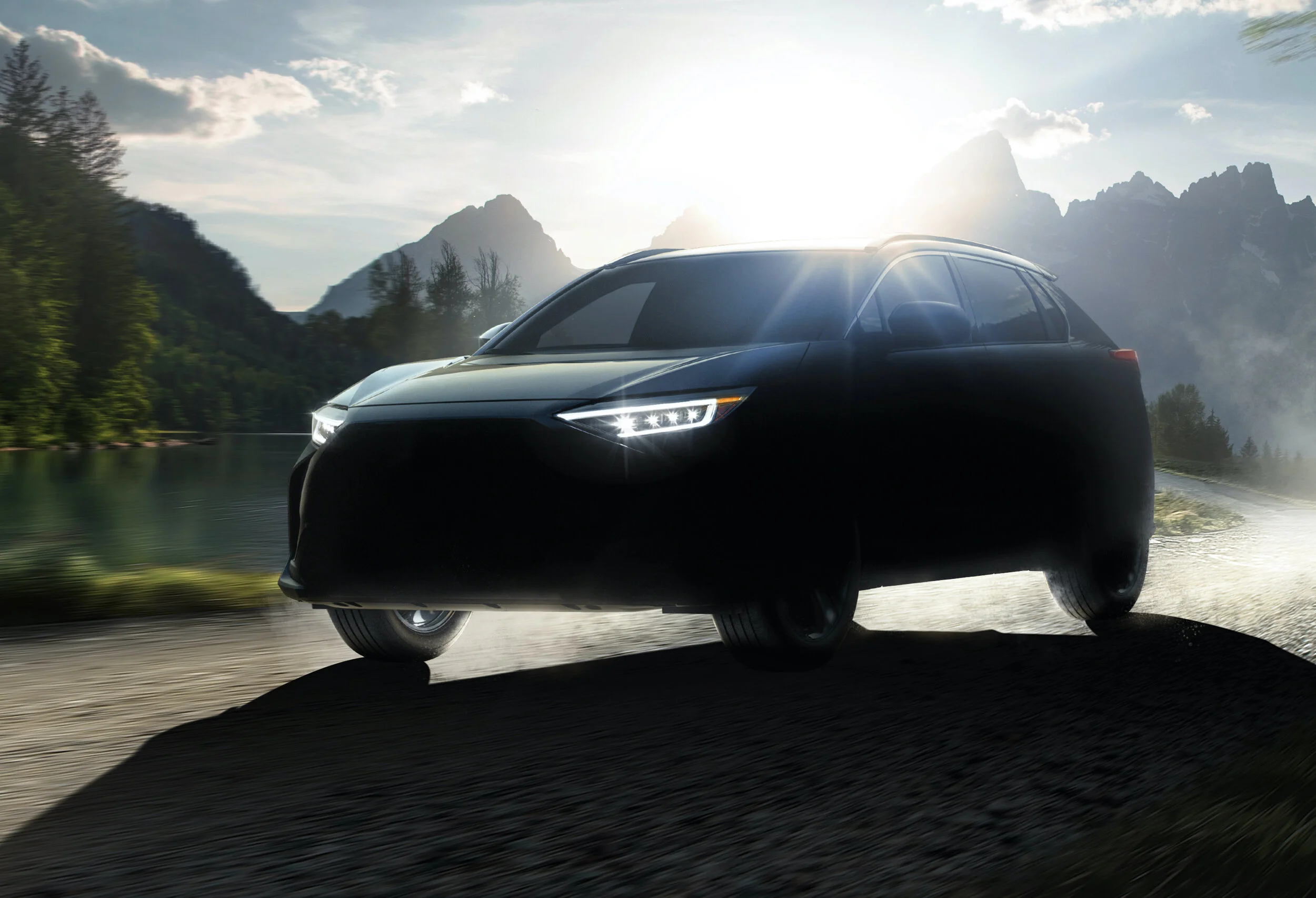
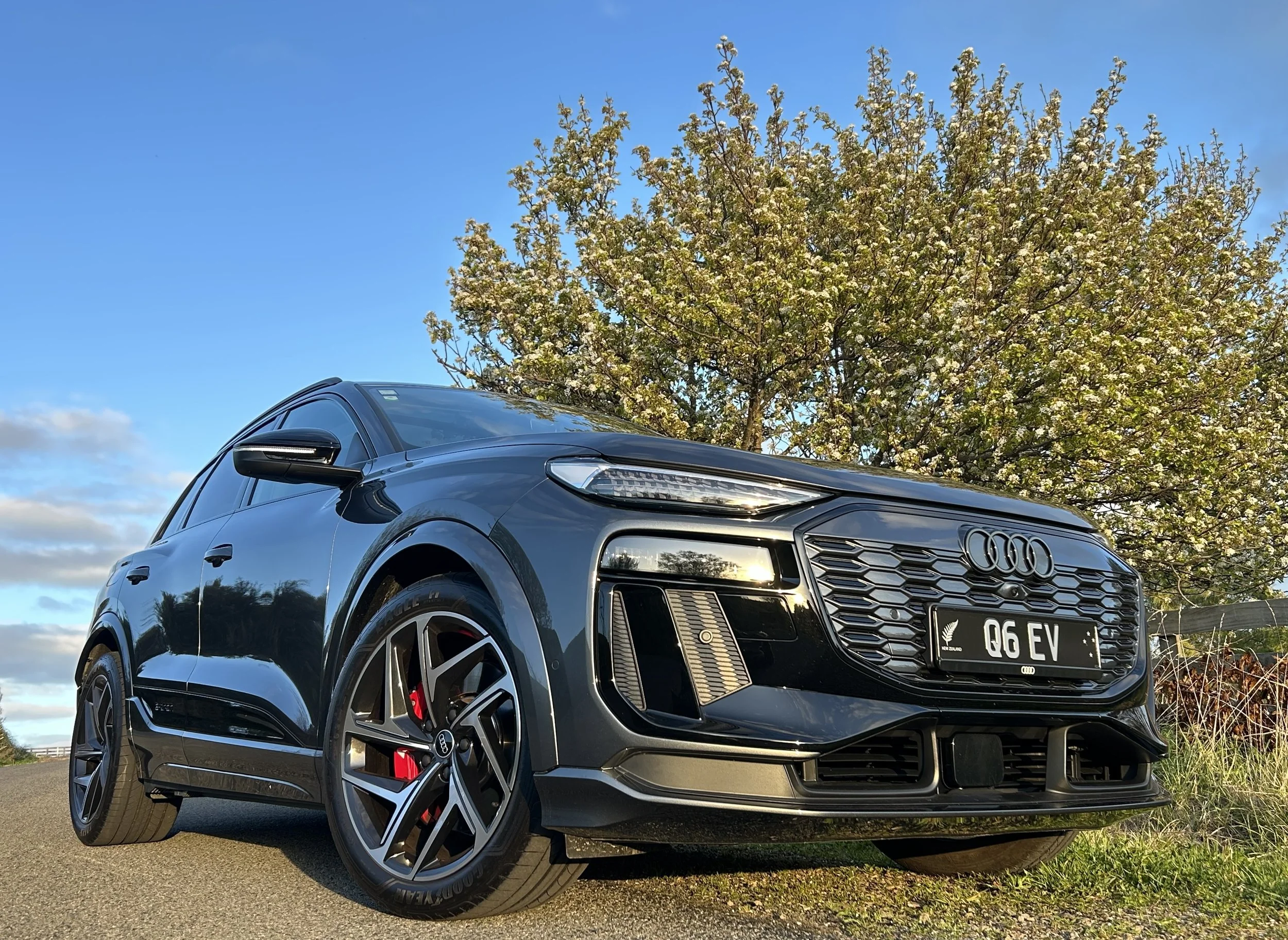
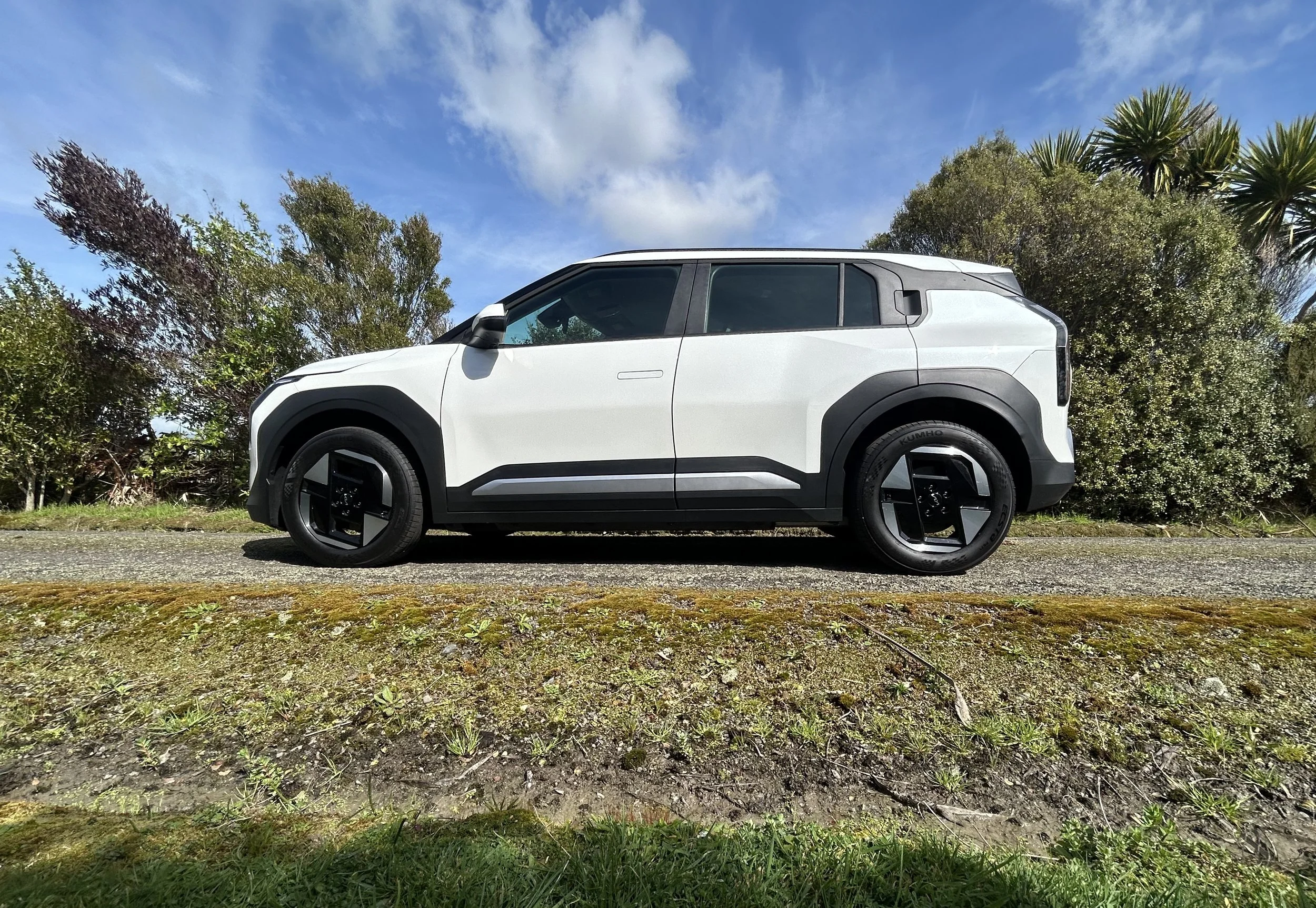
WHEN it comes for a love of the outdoors, Subaru is right up there with the best of them – so quite fittingly, it has given its first electric car, a robust-looking compact crossover, a name that fits.

New Zealand is in line to see the Solterra, a tag that presents as a conjunction of the Latin for ‘Sun’ and ‘Earth’ and emphasise the car's environmentally friendly context.

Read More

TNZ stock shortfall hits 11,000 vehicles

TNZ stock shortfall hits 11,000 vehicles

FORWARD orders for new Toyota and Lexus models have reached 11,000 unites, effectively six months’ sales, and buyers are generally in for prolonged wait times.

An unprecedented accrual for Toyota New Zealand affects every model it represents, general manager of new car sales Steve Prangnell says, including one still to come, the next version of a traditional big seller, the Toyota Highlander.

Read More

Electric Hilux possible, electric world …?

 Batteries could be included for a New Zealand favourite but don’t imagine every future Toyota will go that way, the brand says.

bz4x previews toyota’s first fully electric car, out next year. But it doesn’t mean every future Toyota will power play this way.

bz4x previews toyota’s first fully electric car, out next year. But it doesn’t mean every future Toyota will power play this way.

TOYOTA has fired up focus on the potential for a New Zealand market icon, the Hilux, being battery-driven yet also suggested a fully electric driving world is improbable.

The matters have been addressed by Toyota Australia, which has acknowledged that the push to add hybrid or pure electric power to all models could eventually see the introduction of a battery-compelled version of the top-selling one-tonne ute. 

Additionally, however, the distributor has spoken stridently in suggesting not every vehicle on the planet can ever switch to pure electric power, primarily because this transition would simply shift the problem from tailpipes to power stations.

This viewpoint has spurred Toyota New Zealand to say that it’s a reminder that each country has its own challenges and that our neighbour’s are different to our own.

Says TNZ chief executive Neeraj Lala: “The challenge for Australia and TMCA (Toyota Motor Corporation Australia) is that in transitioning to BEV a large proportion of their electricity is generated by fossil fuels hence the commentary on shifting the problem.”

In comment on Tuesday, a day after the home office of the world’s biggest car maker unveiled the pure-electric BZ4X, a RAV4-sized and styled model that has been confirmed for New Zealand availability from 2022, the Australian operation’s sales and marketing boss contended: “Despite this week’s focus on (pure-electric cars), we cannot achieve carbon neutrality simply by turning all our cars into (pure-electric vehicles).”

The statement from Sean Hanley is potentially a litmus paper to electric vehicle supporters who hold belief there is no reason why New Zealand should not stop the sale of new fossil fuelled vehicles by 2035, as proposed by a Government study, and wholly embrace a mains-fed future.

On this, Lala says: “That is an issue at the source of electricity generation for Australia (albeit it a far smaller issue here in NZ) … we have our own challenges and need to continue to work with the Government and relevant industries to continue our transition to a low emission vehicle fleet in NZ.”

The new car market leader concurs with a view also put by the Australians – namely, that the world of tomorrow will be better served by a choice of future vehicle technologies.

To that end, Toyota says over the next decade it will expand its choice of technology – beyond petrol and diesel vehicles – by introducing more hybrid, plug-in hybrid, pure-electric, and hydrogen models.

A fully electric Hilux? Never say never, apparently.

A fully electric Hilux? Never say never, apparently.

Lala offered that because each country has its own unique challenges in considering models in their market including powertrains and electrification “…the Toyota global view has been to not focus on just one but multiple powertrain options so countries and customers can have a variety of low emission options that suit them.

“As the technologies advance, there is a likelihood that electrified models will span across our whole model range (this is our longer term objective) and if these are developed and introduced as HEV, PHEV or BEV has a dependency on how mature the market is and what benefits the power train can offer the customers in that market.”

While not responding directly to the concept of a battery Hilux, he offered this view. “ … NZ customers want more rugged utes that can go off-road, tow and carry loads so a BEV option would need the support of charging infrastructure in both urban and rural/remote locations to be practical for our customers.” 

The idea of an electric ute fits in with contention from Toyota’s agency in the United States, which this week let slip that pick-up trucks it sells will take this form of propulsion.

The timing is anyone’s guess. Having previously said it wanted to have battery-influenced versions of every important car it makes in circulation by 2025, Toyota Japan this week pushed out that timeframe to 2030.

Also, while Toyota has said a Hilux EV could happen, it also says that it might be a decade before we see it. In the interim, then, a hybrid option could still be in the more immediate future.

The thought out of Australia about the purely battery-fed Hilux has come with a caveat about the need for such a vehicle to be up to surviving Australia’s tough conditions.

However, when asked about the imminent arrival of electric versions of the Tesla Cybertruck, Ford F-150 and Chevrolet Silverado in the US – and the possibility of a Toyota rival – Toyota Australia executives reportedly said an electric Hilux could not be ruled out.

The CarAdvice website has quoted the senior product planner for Toyota Australia, Rod Ferguson, as saying: “We have not ruled out a pure-electric Hilux” and, though such a vehicle would “definitely be a challenge, but until we get to point where we say we can’t do it, we will explore every option”. 

Advancements in battery systems could one day make an electric heavy-duty ute possible, Ferguson said.

bz4x is RAV4-sized, but will it compete directly with the popular sports utility?

bz4x is RAV4-sized, but will it compete directly with the popular sports utility?

“We need to consider the packaging and changing platforms (vehicle architecture). We haven’t ruled it out.”

In respect to the idea of an utterly electric driving world, Toyota Australia’s executives are not so sure.

According to Hanley: “One-quarter of the world’s CO2 emissions today come from electricity generation. Even by 2040, more than half the world’s electricity is expected to be generated by fossil fuels.”

“Therefore, if all cars were to become (pure-electric vehicles), the demand for electricity would increase and carbon neutrality could be a long way off.

“We simply cannot achieve carbon neutrality by only producing electric vehicles,” said Hanley, especially as “more than half the electricity generated by 2040 will still be powered by fossil fuels. 

“In the end, the main driver of electrification (of vehicles) will be … the consumer,” said Hanley, adding that Australians have a “broad use” of vehicles and a vast range of demands, from rural and city use to mining and off-road driving.

“Our vehicles must be fit for purpose. There’s no point bringing a car to market if it can’t do what consumers want.”


Toyota's full electric a 2022 release here

Shanghai concept is a pointer to a breakthrough model set to sell alongside a swathe of hybrids.

02-ZEVConcpt-FR-Globalhr.jpg

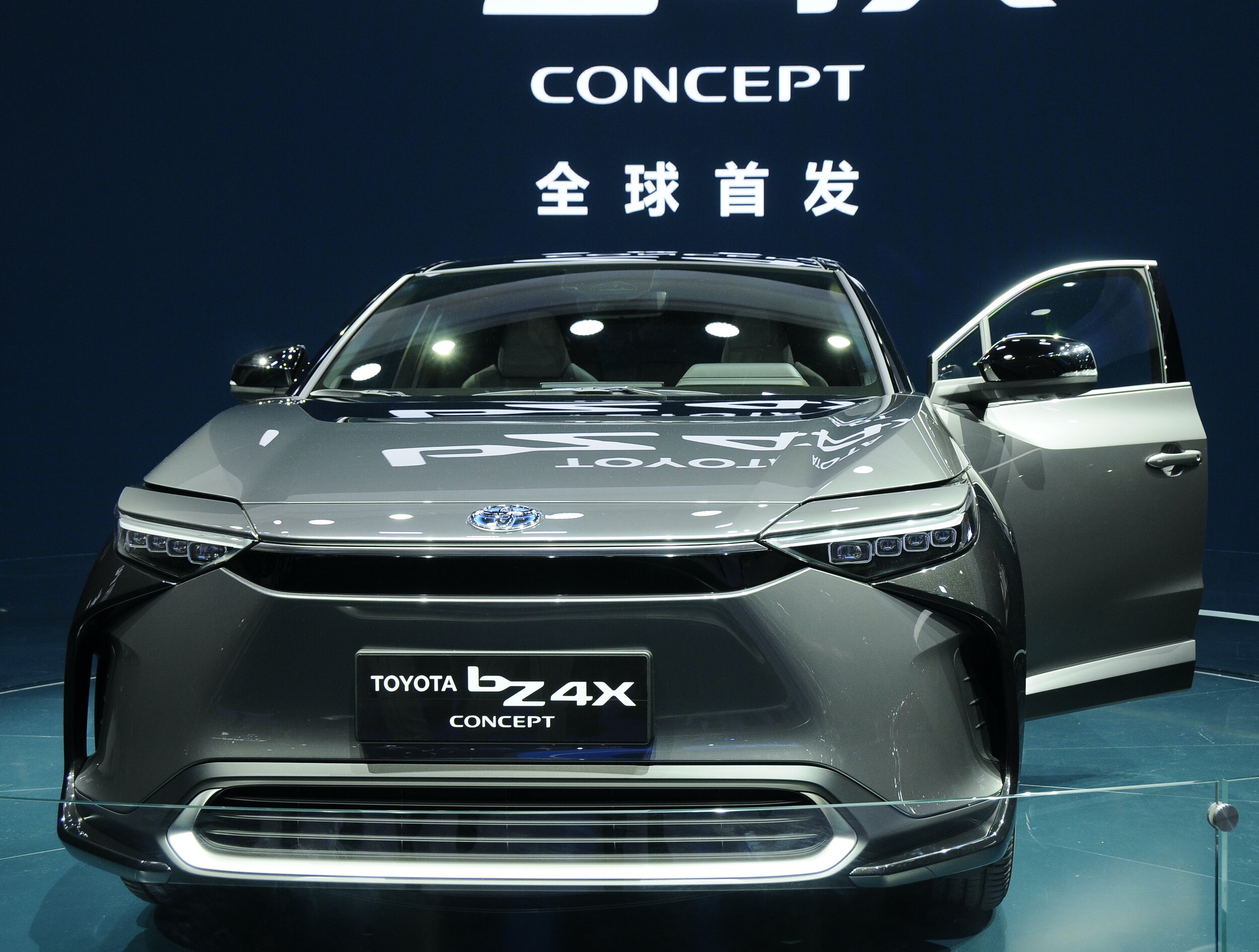
A PRODUCTION variant of a fully electric Toyota concept revealed in China today will release in New Zealand next year, with sister models to follow.

The BZ4X styling study Toyota Japan has revealed at the Shanghai Motor Show has been described as being a “hero” of a global electrification future that will deliver 70 models globally by 2025. 

It’s similar in shape and size to the RAV4 crossover but lower, with a longer wheelbase and sharper styling. From the outside, the concept captures the ethos of bold, futuristic EV looks; the interior … erm, less so. A large touchscreen extends up out of the centre console, which has a rotary shifter placed in the middle and storage underneath.

Shorthand for ‘Beyond Zero’, a catchphrase chosen to highlight the corporate direction, BZ will present as a sub-group of seven fully electric models, with the BZ4X first into production.

Toyota hasn't said anything about battery size or range for this model, the first to use the new e-TNGA electric car platform, which will also underpin product from Subaru, which co-funded and co-engineered the underpinning.

The showroom-ready example is not expected to be much different to the concept, save for perhaps for losing some exotic details. An orthodox steering wheel will likely replace the yoke-style item on the styling study, regardless that Tesla has introduced the latter for its latest version of the Model 3.

TNZ chief executive Neeraj Lala says NZ will take these cars, and he expects them to be well received, though he has also expressed thought it might be some time before these full electrics outsell the hybrid choices it already has here in abundance and will add to.

Comment released today also leaves impression any expectation of the wholly electric fare being priced for mass appeal is probably mis-judged.

Toyota_bZ4X_Concept_002.jpg

With today’s announcements, Toyota has taken to label everything it produces that has a battery-involved impetus as being  an ‘electrification vehicle.’

 This self-concocted descriptive seems to have been created to leave impression its hybrids are of similar calibre as electric cars, though by definition they are not, as an express qualification for electric status vis an ability to enable a mains-replenishment ability.

However, the new label certainly enforces that Japan’s No.1 is the world’s biggest player in electric-assisted drivetrain production, with more hybrids, plug-in hybrids, electric vehicles and fuel cell vehicles to come. Interestingly, according to Toyota US (but not mentioned by Toyota NZ) this reach will include the pickup truck line-up in the near future, including hybrid and BEV powertrains. Does Hilux qualify as a ‘pickup’, or do they mean the larger Tundra?

Lala says Beyond Zero means a variety of options for Kiwis.  

“The Beyond Zero (BZ) range will be introduced in New Zealand to strengthen our range of electrified vehicles and achieve affordable mobility for all.”

05-ZEVConcept-meter-Globalhr.jpg

“As a company committed to mobility for all, our priority is to offer affordable vehicles that meet the needs of all New Zealanders. This means a range of powertrain options to suit consumer needs,” says Lala.  
 
“Like hybrid technology 30 years ago, adoption and affordability will take some time. This will allow time for infrastructure, technical training and servicing to prepare itself for accelerated demand and lower cost alternatives.”
 
“BEVs will eventually become a sustainable means of mobility. However, it will take time as the energy mix, battery technology and infrastructure are still being developed,” Lala says.

Currently the cheapest full electric car offered in NZ is an MG, at just under $50,000. Expectation that Toyota’s status as the world’s most largest car producer will allow it to significantly reduce that premium seems overly optimistic, however.

Says Lala in respect to this: “As there is significant research and development cost recovery on new technology, this first Toyota BEV for New Zealand will not be an affordable BEV for all Kiwi households and businesses. 

Toyota_bZ4X_Concept_006.jpg

“Our focus will also be on how we can transition BZ4X into the used vehicle market as quickly as possible so all Kiwis can become familiar and enjoy this new technology in an affordable manner. This is why we see affordable hybrids and plug-in hybrids as transitional technology and a bridge to a sustainable, low emissions future.

“Adding our first battery electric vehicle (BEV) to our range, continues our journey of offering powertrain choices for customers while helping New Zealand realise a zero-carbon future.”
 
“Toyota has been vocal in our support of the New Zealand Government as we transition to a low emissions economy and we’re excited at the prospect of bringing Toyota’s first pure battery electric car to New Zealand next year,” Lala says.
 
“Currently Toyota New Zealand’s average CO2 emissions sit at 165.9g/km which is almost 7 grams lower than the industry average. We are focused on introducing balanced, lower emission products to our range.”


86 going to be a great Gazoo

GR86_002.jpg

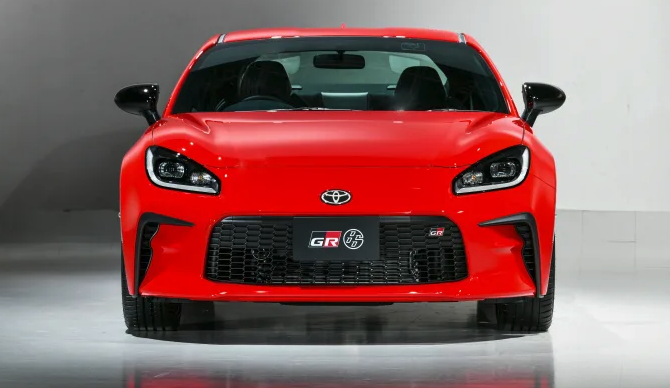
AT last it’s out – the second generation of the Toyota 86 that is, still firmly focused on the same goal as the original: Delivering the dreams and the joy of driving inherent in sports cars.

This promise from an unveiling event in Japan today involving Toyota, via its Gazoo Racing franchise into whose hands the car now falls (so, yes, it’s now a GR 86), and co-developer Subaru.

Though shown in what Toyota Gazoo Racing calls a ‘prototype’ format, the new car is also confirmed as an accurate representation of the car as it goes on sale in Japan soon. No news yet from Toyota New Zealand about when it’ll hit here.

Toyota’s version follows in the tyre tracks of the second-generation BRZ (below), which was unveiled last November in the United States. Subaru NZ has straight out nixed conjecture of another BRZ-86 showdown, as occurred in the first year of the previous cars’ release, back in 2012.

22MY_BRZ-10.jpg

Today’s event suggests Toyota’s car has slightly stronger outputs than the Subaru doppelganger, with press material quoting maximum power of 173kW presented at 7000rpm and top torque of 250Nm, coming on at 7400rpm. That’s 3kW and 1Nm more than Subaru quotes.

 Either way, it’s still a healthy increase over the maximum outputs from the 2.0-litre car – Subaru quotes 11 percent more power and 15 percent more torque – and it shows in the 0-100kmh time of 6.3 seconds, claimed of course for the manual. The previous model delivered in 7.4s. 

The engine has direct injection but forget about a turbocharger; that feature is purely for the North America-only Subaru Ascent SUV from which this engine is more or less plucked.

Toyota says producing optimal grunt at high revs is all part of the fun, but adds the engine’s responsiveness has also been enhanced, providing smooth, stress-free sensations from “low to high rpms.”

The unit continues to run through six-speed transmissions, the auto now having a Sport function, and sending out the oomph through the rear wheels, with the vehicle stability control system offering five settings now to alter the degree of skid-tastic fun.

Macpherson strut front suspension and double-wishbone rear suspension also carries over and even though the chassis is thought to be an improved version of the current cars, the two generations are only identical in 1775mm width.

With a length of 4265mm, height of 1310mm and wheelbase of 2572mm, the GR 86 is 25mm longer, 13mm lower and 6mm longer in wheelbase than the predecessor.

Screen Shot 2021-04-05 at 5.36.46 PM.png

Toyota has quoted a kerb weight of 1270kg (for the manual) and, like Subaru, reminds the car’s roof is now aluminium to bring down the centre of gravity. Aluminum front wings, updated front seats and mufflers contribute to reduced weight.

Body rigidity has been improved, with the goal of offering pleasurable handling in all speed ranges—from urban driving to the upper limits of performance, the maker says. Torsional rigidity has been enhanced by approximately 50 percent over the previous model for greater steering stability.

However, Toyota says the GR86’s shape and aerodynamics have benefitted from the previous model’s immersion into motorsports, such as Toyota NZ’s GR86 (nee TR86) series. 

“The GR 86 features aerodynamic components seen on 86 models that participate in motorsports. These include air outlets, side sill spoilers, and other parts that improve steering responsiveness and stability.”

Recent media speculation about Toyota insisting that the GR86 should have a distinct driving feel appears spot on.

Says the Toyota Gazoo Racing release: “While engaging in friendly rivalry with the BRZ development team, TGR sought to develop a vehicle that would provide happiness to 86 fans, and realise an evolution of the 86’s unique driving sensations.

“As a result, the new GR 86 is specially designed for sports performance, and provides direct and satisfying driving performance of the highest order.”

Screen Shot 2021-04-05 at 5.36.33 PM.png

It also says the model is a result of an agreement, signed by the brands in late 2019, to enter into a new business and capital alliance, “as part of which the two companies committed to jointly engage in making ever-better cars.”

“The new GR 86/BRZ is not only a concrete example of this commitment, but also represents a new challenge for both companies, as they seek to subvert conventional ideas of cooperation in the automotive industry.

“Going forward, Toyota and Subaru intend to further ally their respective strengths, deepen their relationship, and so pursue the possibilities of making ever-better cars.”

Toyota says the car’s interior and exterior designs embrace responsive handling and functional beauty and that the model boasts a stance distinctive of front-engine, rear-wheel-drive vehicles. Its low, horizontal underbody and narrow cabin rear combine to create a broad, low-centre-of-gravity appearance.


The cabin design is all about ensuring the driver can concentrate on driving. There’s a new seven inch display screen whose opening animation sequence is “inspired by the piston movements of the horizontally opposed engine, and fosters a sense of excitement even before the drive begins.”

The automatic GR86 alone appears to pick up Subaru’s Eyesight driver assist technology, which include pre-collision safety technologies that help avoid or reduce collision impacts.

Toyota says a total of more than 200,000 first generation 86s have been sold worldwide.


Is the 86 out for the count?

The skid-tastic sports coupe that kicked off Toyota’s drive back into being a fun brand has gone from NZ – and there’s a question mark over when its replacement will show.

Toyota used the last 86 to celebrate Chris Amon. It’s the rarest of all the editions sold here.

Toyota used the last 86 to celebrate Chris Amon. It’s the rarest of all the editions sold here.

“86 models are no longer available to purchase new.”

As farewells go, the single line announcement on Toyota New Zealand’s new car web page might seem to some enthusiasts to be … well, pretty cold.

Yet it’s all the country’s biggest brand has said in respect to the passing of a great. They’ve been even quieter when it comes to providing clarity in respect to obvious questions.

Like: Will TNZ be keen to take the replacement, presumably now ‘GR86’ – to bring it into the Gazoo Racing fold, alongside the GR Supra and Yaris - model and, if so, when might we expect to see it?

Equally relevant: What’s the future for TR86, the national racing class the distributor created, fosters and funds? Will the current cars race on for another summer or is the series under review?

The TR86 racing series has been a brilliant promotion for the brand and has become an important stepping stone category. Does it have a future?

The TR86 racing series has been a brilliant promotion for the brand and has become an important stepping stone category. Does it have a future?

Exactly when TNZ’s customer stock ran dry is not clear. What is known is that production of the fun-on-a-stick two door which it launched here in August of 2012 with great fanfare finally curtailed in Japan last month.

A heads up about the end being near first aired last August, when Subaru – which builds the 86 and its own BRZ (which didn’t last long in NZ) in its Gunma plant in Japan - told some markets that it was wrapping up build of its own car.

Of course, that news was preceded almost two years ago by announcement from both players that a second-generation car, very much true to the original styling and still with a flat four engine and still rear-drive, had been signed off.

Last November Subaru revealed its new BRZ, with a 170kW/2540Nm 2.4-litre engine replacing the original’s 2.0-litre. Subaru NZ promptly confirmed it will not be sold here – their marketing plan is all about all-wheel-drive, which the coupe does not have.

Now, more twists. From Japan, via America and Australia, conflicting reports.

One is that Toyota is apparently holding back its second-generation 86 in order to make it better. The other, potentially more accurate, suggests it will bring the car’s launch forward, with more announced on April 5.

The second-generation BRZ is out … bu won’t be sold new here. Toyota’s boss has reportedly held back the 86 version so  his engineers can make it less like the Subaru. Can it be done?

The second-generation BRZ is out … bu won’t be sold new here. Toyota’s boss has reportedly held back the 86 version so his engineers can make it less like the Subaru. Can it be done?

The first story is from American website Jalopnik, relying on a translation of a story that appears on a Japanese website called Best Car, known for breaking big stories. It says Toyota boss Akio Toyoda is displeased a car again developed with Subaru once again feels like … a Subaru. Go figure, right?

Anyway, he’s apparently told his development team: “Aim to differentiate performance from the BRZ.”

Differentiating the car from its badge-swapped sibling might be a big challenge and there’s been surprise that Toyoda wants it.

After all the similarities between the old BRZ and 86 never seemed to be much of an issue for Toyota before. Nor has the Supra’s and BMW Z4’s shared development and production.

The original 86 sat on top of a modified Impreza platform and used many Subaru chassis parts. It wasn’t quite Subaru in terms of engine design, however, as while the basics of the 152kW/212Nm 2.0-litre engine were Subaru boxer, it stands as the sole Fuji powerplant with Toyota's variable valve technology.

Jalopnik writer Adam Ismail offered this thought:

“It’s theorised that Toyota could accomplish this (differentiation) by messing with the car’s gearing and engine tuning. However, given that the car is essentially complete, the engineers are reportedly struggling to pull off the feat in the 11th hour. It may also push the car’s release into next year.”

Believe all that? There’s an alternate from Australia’s CarAdvice.com, citing the two brands having confirmed plans for the joint announcement, and providing a link to that page. It works. And that’s what it appears to say. Teasing the upcoming event, an image on the page appears to show the badges of both a Toyota GR 86 and a Subaru BRZ, with the words "Let's make ever-better cars together!"

CarAdvice also cites a statement from Toyota Japan, citing that Gazoo Racing president Koji Sato will take part in this upcoming. It believes that all but confirms earlier reports the new-generation 86 will join the GR family.

The outgoing car’s outputs have always been subject of intense enthusiast interest. Just right? Not enough?

It's fair to say that this has never been a car overly endowed with grunt; Toyota, in fairness, has always said it wanted the chassis to do the talking. As it always did: The reason why the 86 is such a great is that it is one sweet-handling, nimble car.

The 86 came here in a diversity of forms, from an entry $33,986 RC that was aimed at budget-constrained kids bu basically became the basis of the TR86 race car to an extravagant Toyota Racing Development flagship, which was an up-to $70k buy-in and outfitted with Brembo brakes, firmer suspension, bigger forged alloys and a rortier exhaust that added another extra 5kW power.

For all that, the mid-range that sold for under $50k always comfortably trended as the most popular choice with private buyers.

The TRD was the most overt version but, even though it only offered in a run of 20 examples, was not the rarest – or, arguably, the one that deserved most celebration.

That latter honour, in this writer’s view, befalls the Chris Amon GT86, issued in late 2018, two years on from his death and also in the lead-up to celebration of the 50th anniversary of his first New Zealand Grand Prix victory.

The ‘Chris Amon Edition’ delivered in just 10 cars, each for $55,990, all in distinctive orange, called solar flare, that was purely for this run.

Amon enjoyed 16 seasons at the highest level of international motorsport but spent twice as long working for Toyota NZ.

He put in more than 30 years’ involvement as a vehicle development and motorsport consultant to the Palmerston North-based brand, much of that work conducted at the Manfeild racing circuit  – which, shortly after his death, was renamed Manfeild: Circuit Chris Amon.

 

X-Prologue – Toyota’s impending EV teased

Image released internationally today gives a first look at a model that is likely coming to New Zealand.

Screen Shot 2021-03-11 at 4.00.04 PM.png

TOYOTA has released this teaser image of the X Prologue, which is expected to showcase the design language for its upcoming electric vehicle family. 

The introductory model, which will be fully unveiled next week, is expected to present as a sports utility, similar in size to the RAV4 – but with a longer wheelbase together with shorter overhangs.

 It is built on the e-TNGA platform that was co-developed in partnership with Subaru. Toyota has previously indicated this kind of vehicle was on the way and Toyota New Zealand has also indicated willingness to take it.

The e-TNGA architecture is a big deal.

Toyota is planning on using this platform to spawn six electric vehicles, presenting in a diversity of body styles.  These are speculated to be called BZ models. This references ‘Beyond Zero’, the title of Toyota’s public push towards zero-emissions motoring.

The platform is massively flexible. It can be lengthened or shortened, accommodate single or twin motor powertrains and host a range of drivetrain layouts and battery capacities.

Subaru will also have at least one car built off this underpinning; their one is also a SUV and is rumoured to already have a name: Evoltis. And, yes, Subaru NZ is keen to have it.

The teaser image that partially reveals the car’s front end suggests it will have a two-layer style bonnet with the Toyota logo in the middle on a black background. To the sides of the front fascia, there are C-shaped LED headlights that appear to be joined together by a thin light strip positioned between the bonnet and bumper. A closed-off grille conforms with EV design direction.

Screen Shot 2021-03-11 at 4.02.18 PM.png

 When Toyota first talked about e-TNGA, it released another image showing a stylised silhouette of a SUV and another revealing something of the platform layout (above).

The car is designed to go on sale worldwide and will be produced at Toyota’s ZEV factory in Japan.

Toyota says e-TNGA can host a wide range of different-sized battery packs and electric motors to suit models from different segments and allow the development of individual models in parallel.

The rest of the new e-TNGA-based models will include a smaller crossover, a large SUV, a sedan, and an MPV.

When talking up e-TNGA late last year, Koji Toyoshima, deputy chief officer of the ZEV factory was enthusiastic about the potentials.

“The versatility and flexibility of e-TNGA technology allows us to design and create vehicles that are not just battery-electric, but also exciting to drive and beautiful to look at.”


Toyota’s autonomous Supra drift car

When an American university teams up with Toyota’s Research Institute, the outcome is … well, smokin’!

Screen Shot 2021-02-06 at 11.34.41 AM.png

IT’S one of those things every ‘driver’ will claim is dead-easy to do … until they try.

When it comes down to it, achieving a decent drift ain’t half as easy as it looks.

That is, when a human is at the wheel.

When a car is left to do its own thing, turns out big controlled skid action is an utter cinch.

WTF?

Okay, so the car in question isn’t exactly as it departed the production line.

Creating a Toyota Supra that can quite literally drift itself took quite a bit of after-market finetuning. But, wow, as the video shows: Totally worth it!

The prototype, built by engineers from the Toyota Research Institute (TRI) and Stanford University’s ‘Dynamic Design Lab’, is supposed to help the carmaker “develop sophisticated control algorithms that amplify human driving abilities and keep people safe”.

The TRI points out that “while most crashes occur in mundane situations, in other situations drivers may need to make manoeuvres that take their vehicle close to and, at times, exceed normal limits of handling”.

A car that can catch a slide with little to no human intervention would help when drivers “need to make manoeuvres that are beyond their abilities” in order to avoid a collision. In this case, catching a slide brought about by, for example, a driver taking evasive action, their own over-exuberance or poor road conditions.

When it’s up and running, the system will be another tool in the automotive industry’s ever-expanding armoury of driver-assistance systems. Toyota says its active safety technologies will be shared broadly “so that Toyota and other auto manufacturers can deploy it on the road”.


Kiwi racer's version of Toyota hypercar revealed

In pulling the wraps off the new Le Mans racer that Brendon Hartley will compete in, the make has dropped more hints that the road-going version is nearly ready.

Screen Shot 2021-01-16 at 2.49.02 PM.png

 BRENDON Hartley’s new Toyota-provided company car for 2021 has been fully revealed – and it’s a world away from your usual fleet hack Camry or Corolla.

The Kiwi racer has imparted excitement about the GR010 Hybrid, not only Toyota’s new Le Mans Hypercar and World Endurance Championship challenger but also the racing version of a road-going version for public consumption.

Hartley’s car has numbers on the door and nose ad will be tested in the upcoming 2021 FIA World Endurance Championship – whether he ever achieves the road legal version, called the Toyota GR Super Sport, that’s based on the same mechanicals, is as yet unclear. 

The GR Super Sport production car was shown off during celebrations surrounding last year’s Le Mans 24-Hours and has also been previewed by a concept, immediately below. 

Screen Shot 2021-01-17 at 1.57.02 PM.png

The Palmerston North-born and raised driver is pretty fizzed about the competition car, which has only just been fully unveiled by the Toyota Gazoo Racing equipe he now competes with.

The racing car runs a 500kW twin-turbocharged 3.5-litre V6 and a 200kW electric motor. The petrol engine sends drive to the rear wheels via a seven-speed sequential gearbox, while the electric motor powers the front wheels.

 “Fans are going to be pleasantly surprised with the GR010 Hybrid; it looks like a mix of an LMP1 and a road car,” said Hartley, who came to Toyota’s sports car racing team a year ago after a hugely successful career with Porsche, for which he won world endurance titles and the Le Mans race, as well as a stint in Formula One, with the then Torro Rosso team.

“Endurance racing has always been a proving ground for new technology and now it is even more road car relevant; the GR010 Hybrid previews a car which the end user will experience on the road.

“It’s great to drive too, particularly with the hybrid four-wheel-drive which is a nice sensation from a driver’s perspective.” 

Screen Shot 2021-01-16 at 2.49.56 PM.png

The new car has a clear family resemblance to the outgoing TS050 Hybrid LMP1 that claimed the 2018-19 and 2019-20 WEC drivers' and manufacturers' titles, as well as three consecutive Le Mans 24 Hours victories in 2018-20.

But Toyota Gazoo Racing Europe technical director Pascal Vasselon has stressed in an interview with British motorsport magazine Autosport that few components have been retained from its predecessor.

"Except the generic parts like switches, sensors and such, there are hardly any carry-over parts between the two cars because the regulation philosophy is very different," he said. "It is a completely new car."

 Hartley says the big difference when considering his new ride with the TS050 Hybrid is the extra weight and a bit less horsepower and downforce, changes enforced by new rules.

“But it’s still just as much fun to drive. We have a fun challenge ahead of us to extend the Toyota Gazoo Racing legacy at Le Mans and in WEC by continuing our winning run.”

The powertrain is supported by an arsenal of chassis technology, including a mechanical locking differential, independent double wishbone suspension, push-rod dampers and a set of carbon-ceramic brake discs with mono-block calipers.

Screen Shot 2021-01-16 at 2.49.14 PM.png

As the new FIA regulations limit the car’s power output to 500kW, Toyota has had to employ some electronic wizardry to keep the car legal. So, the ECU limits the petrol engine’s power according to the amount of assistance the electric motor can supply. When the battery pack has been depleted, the engine supplies its maximum output.

The striking new look of the racing prototype reflects the appearance of its inspiration, the GR Super Sport hypercar which made its public debut during a demonstration run and ceremonial trophy return at the 2020 Le Mans 24 Hours and is currently in development.

Toyota Gazoo Racing enters its ninth season in WEC with the same driver line-up it fronted for the 2019-2020 campaign.

Newly-crowned world champions Mike Conway, Kamui Kobayashi and José María López will drive the No.7 GR010 Hybrid while Sébastien Buemi, Kazuki Nakajima and Brendon Hartley race the No.8 car. Nyck de Vries continues in his role as test and reserve driver.

They have already started an intense programme of developing the car, with two three-day tests already completed as the team adapts to new regulations which are a significant shift in terms of performance and philosophy.


TNZ still market leader, but Covid hurt

The swift curtailment of rental car business, where it dominated, certainly affected the country’s biggest seller of new cars and light commercial vehicles.

IMAGE_Toyota New Zealand's Palmerston North head office.jpg

MARKET leader Toyota New Zealand has acknowledged a tough coronavirus-smashed 2020 market condition delivered a sobering 31 percent fall in annual volume, though it sees increased private consumer interest during this period as a positive.

 In comment today, the Palmerston North-centred distributor says the depleted return was mostly due to the impacts of the international coronavirus calamity on both rental fleet sales due to the immediate halt of international tourism through the closure of borders, and the local economy.

TNZ has not shared exactly how many car and light and commercial vehicle registrations it achieved in 2020 and that figure might not come out until a full data set of registrations is released by Government’s Land Transport agency next week.

However a 31 percent fall is likely the lowest it has achieved in years – though not a market position-altering knockout, in that the make maintained market leadership for a 32nd consecutive year.

It says it achieved an 18.1 percent share of all new passenger and commercial registrations in 2020; which it says represents a 1.9 percent drop on the 2019 tally. 

Last year TNZ claimed 31026 passenger and light commercial registrations.
 
A positive from the year is greater engagement with private buyers – an aspiration that TNZ has chased since the introduction of its ‘Drive Happy’ retail process in 2018 - which fuelled a rise in new vehicle sales, particularly hybrids, toward the end of 2020. That factor meant that, were lost rental volume to be excluded, TNZ’s market share had improved by 2.4 percent.

Chief Executive Officer Neeraj Lala sees that as being a great result.


His office says TNZ private market share was up 2.6 percent compared to 2019 at the end of November.TNZ says the product range it offers now delivers more to appeal to private buyers.
 
“Toyota has made a real effort over the past few years to inject fun back into the range which is resonating with our customers.”

It also credits wider availability of hybrid powertrains across more models, the next recipient being the new Highlander out soon, though TNZ acknowledged recently in might yet maintain a pure V6 in that family, thus backtracking on an earlier vow to deliver the big SUV in petrol-electric form alone.

Hybrid drivetrains, despite battery involvement, are not considered to qualify as electric systems as they lack facility for external power replenishment yet they still offer a positive in modest respite in emissions and economy. Five Toyota models configure with hybrid. Toyota has one car that holds electric vehicle status, this being the Prius Prime, which has plug-in replenishment capability but also runs a petrol engine. Toyota has a full electric car under development and premium offshoot Lexus will deliver a battery-compelled edition of its NX compact crossover to NZ this year. 

As is, TNZ’s volume of hybrids is vastly greater than the combined sales of all pure electric vehicles available in NZ and Lala says demand remains strong.  

In the year to the end of December, hybrids accounted for 59 percent of Toyota passenger cars sold. SUV hybrid sales were the same ratio within the soft-roader category.

The big seller is the RAV4 Hybrid; of the 5346 RAV4s sold during the year, 3830 were hybrids. The next shipment of 574 vehicles is already sold. 

However, like many industry performers, the demand has outstripped ability to supply. Constrained production lines and delays in provision of vital components are hitting all major car makers, Toyota included.

TNZ presently has more than 5700 customer orders waiting to be filled and most are hybrid models.
 
“If there is a challenge with hybrid sales it is securing enough supply for New Zealand, as there is a global demand for hybrid cars and SUVs, despite the economic impact of COVID-19,” Lala says.

In other news, TNZ has appointed a long-time senior management figure, Steve Prangnell, to general manager of new vehicle sales.


Yaris subject to two recalls


Seatbelt issue, hybrid drivetrain fault affects hundreds of cars.

50171694127_601bfee3be_k.jpg

TWO unrelated recalls within a week have befallen a recently-released Toyota model that was in the running for the country’s top motoring award. 

Subject to the actions is the latest Yaris, in a hatchback form that was under consideration for New Zealand Car of the Year 2020, an award that subsequently went to the Mercedes EQC, and an elevated crossover version, called Yaris Cross, that has just followed it into the showroom. 

A recall notified today requires replacement of rear centre seatbelts in 392 examples of the Yaris Cross.

This follows an action notified two days ago that dedicates to the Yaris hatch and Yaris Cross with a mild hybrid drivetrain and centres on a transmission issue that might cause affected cars to stop suddenly. 

The latter action involves some 513 cars. 

Both faults require dealership repair but the latter is particularly time consuming.

The brand has identified that the remedy requires a repair estimated to take nine hours’ workshop time, because it entails removing the engine in order to reach the affected component, an input damper within the transmission.

The fault raises as a potential for abnormal slippage of the transaxle damper when the driver accelerates rapidly. If this occurs, the vehicle’s warning lights will turn on and there is potential for the hybrid system to enter a ‘fail safe’ mode, Toyota says, that curtails the electric involvement.  

The affected models were manufactured from October 2019 to September 2020. A remedy has been implemented on models manufactured since.

IMG_8288.JPG

Electric Toyota, Lexus just a year away?

A line drawing and a shadowy image are the latest elements of an information rollout about the new platform-sharing products.

The Toyota BZ series (above) and the as yet unnamed Lexus base off a common platform.

The Toyota BZ series (above) and the as yet unnamed Lexus base off a common platform.

Lexus hint.png

TOYOTA and upmarket spin-off, Lexus, have released additional clues about their first bespoke electric cars, developed off a common platform for potential release next year. 

The brands have each released shadowy images giving a hint of how the Toyota BZ - for ‘beyond zero’ – series and the as-yet-unnamed Lexus will look on release, with industry experts immediately seeing some styling connection between the latter and the LF-30, a concept Lexus displayed at the 2019 Tokyo motor show.

Toyota’s been slow to join the electric car field and for a long time was historically disparaging of the technology, saying it was an unnecessary stop on the journey between the mild-hybrid (so, non-mains replenishable) tech that kicked off with the first Pruis and now proliferates its family and is Kiwi-favoured, to the ultimate future of hydrogen fuel cell motivation.

However, that sentiment ceased when new boss Akio Toyoda took the reins; these brands now have more plug-in hybrid cars – which do rate as EVs – and also have developed the NX300e, a fully battery-reliant version of the smallest Lexus crossover, coming on sale in New Zealand next year. 

The latest announcement from Toyota overnight represents further confirmation of a bigger investment into battery driving.

 Even though the platform they build upon appears related to the new TNGA underpinning now used by many popular Toyotas, these are not conversions of existing products but new cars designed from the get-go to only be compelled by batteries. In short, they’re bespoke. 

Overseas’ reports suggest the BZ series and Lexus are timed to make their public emergences at a common time, but no-one yet quite knows when that will be.

However, 2021 is looking good. Toyota says that it will announce final details on the BZ “in the coming months” and that the model “has already been developed and is being readied for production”. 

Toyota New Zealand’s boss Neeraj Lala, in an interview in June on his first day as chief executive, promised “we’ll have an EV here within the next 18 to 24 months. Just in time for demand.”  

He would not be drawn into saying which badge that tech would sit behind. In hindsight, it’d surely have to be both. 

the LF-30 concept was revealed last year.

the LF-30 concept was revealed last year.

A strong styling feature of the Lexus concept is an aggressive bonnet lip over what seems to be a typically complex ‘spindle’ front grille. 

The BZ, meantime, is are expected to roughly the same size as the RAV4 SUV - although the wheelbase is almost certainly likely to be longer than that of the conventionally-powered vehicle, and the front and rear overhangs should be shorter. 

There’s another string to the BZ bow in that it is likely to also be the basis for an electric Subaru; the brands are, of course, partners already with the current and new 86/BRZ – only the latter coming to NZ, next year, as the GR86 (because it’ll be part of the Gazoo Racing tribe).

Onlookers say panel creases highlighted in the BZ sketch make it clear that it and Subaru’s effort, which has been spoken of in the past, are going to share more than their underpinnings.

Says Britain’s AutoExpress: “The lines should translate into a distinctive-looking model with an image unlike anything else in the Toyota range - much as the Prius hybrids have their own identity.”

Toyota calls its new EV platform e-TNGA, and says it is designed to support a wide range of vehicles, since only a few areas of the architecture - notably the space between the front axle and the base of the windscreen - are fixed.

Toyota claims this allows difference widths, lengths, wheelbases and heights - and also says e-TNGA can be fitted with front-, rear- or four-wheel drive, and a range of battery and electric motor capacities. Some of the trademarks registered by Toyota - including BZ4X and BZ5X - would sit easily on a four-wheel-drive vehicle.

Lexus is reportedly hoping that its defined styling and a sophisticated new four-wheel drive system, called DIRECT4, will lend enough distinction between its model and the Toyotas.

The new Lexus set-up uses a motor on each axle and features sophisticated computer hardware and software that can split power and torque depending on the dynamic experience required.

As all this unfolds, Toyota has also stated intention to build another conventional – so petrol and petrol hybrid – SUV to slot between the C-HR and the RAV4.

toyota has displayed various electric car design studies over recent years, including this one from 2018.

toyota has displayed various electric car design studies over recent years, including this one from 2018.

Buddy's winning heaps of mates

Start with a Toyota RAV4, render in classic Chevrolet sports utility cues … and, it’s the start of a special friendship.

Buddy 2.png

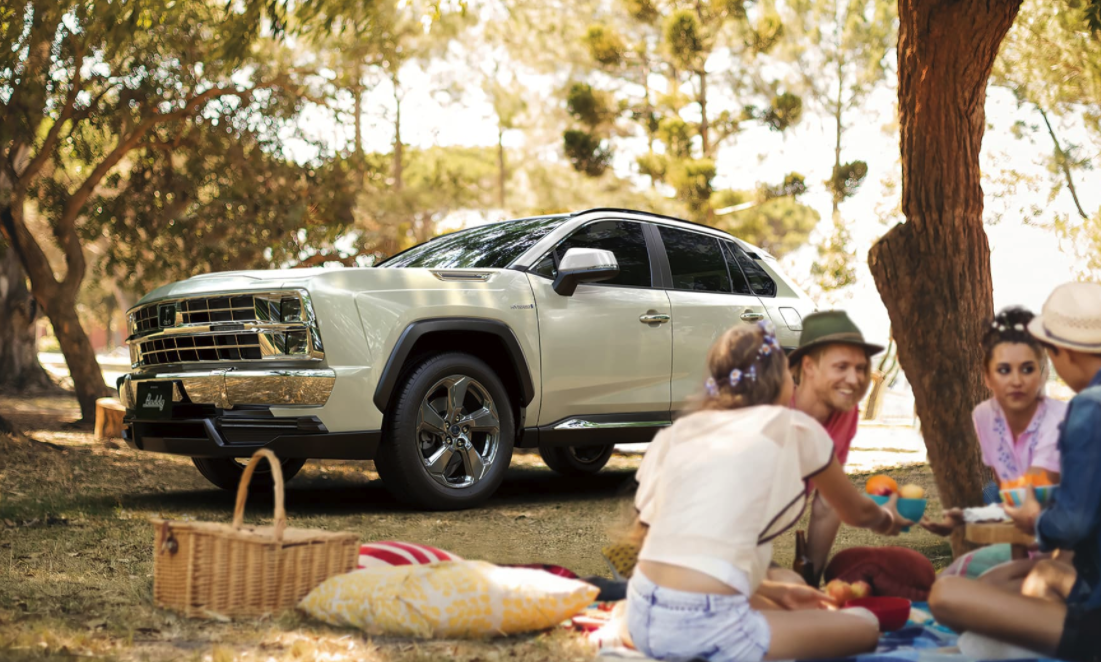
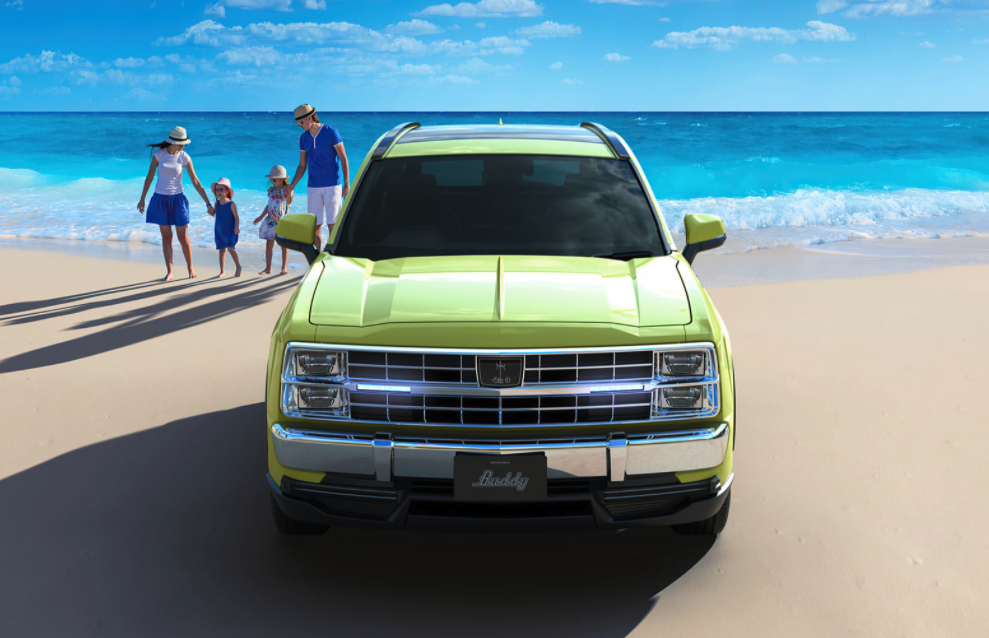
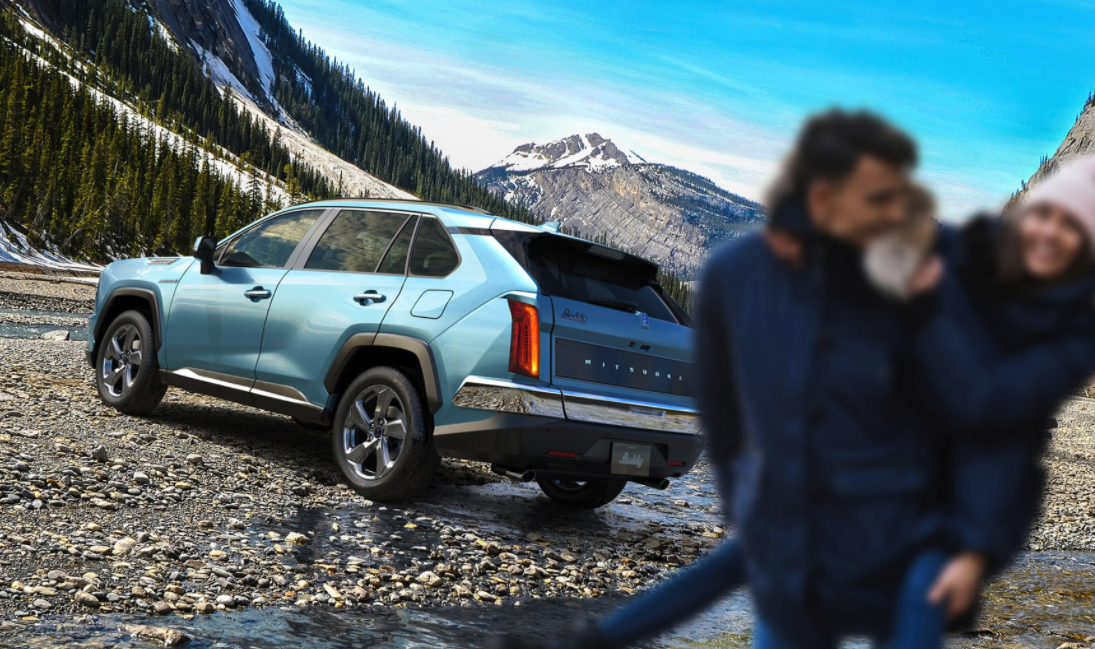
SEEMS everyone wants to meet the Buddy, a Toyota RAV4 alchemised into something like an American Chevrolet sports utility from the 1980s.

It’s the latest work from Japan’s 10th largest passenger vehicle producer, a brand you can only name check from used import rosters, and since being revealed in Japan last month has attracted so much attention the entire production for the next two years is accounted for.

Mitsuoka Motors doesn’t export, yet even so it has developed something of a worldwide reputation for its speciality  - putting a retro spin on popular modern models.  

It’s been busy in recent years with the Himiko, a rebody of the previous generation of the world’s best selling sports car, the Mazda MX-5, so that it looks a bit like a 1980s’ Morgan, and the Viewt, a half-scale homage to the legendary Jaguar Mk II of the 1960s. Based off the Nissan March, which was sold new here as the Micra until five years ago, that one stayed in production for 25 years and achieved sales exceeding 12,000 units. A small number has found their way to NZ.

Those cars are now yesterday’s news. Consumers are now hankering for sports utilities – and so the Buddy was born to meet that demand.

Buddy 1.png

The design influence comes from the Chevrolet Blazer pick up truck-based wagons produced for North America in the early 1980s.

The shiny grille and the two-piece rectangular headlights and the rear-end reshape are particularly reminiscent.

Even though the donor model has a relatively squared silhouette, the Buddy is much boxier still, so quite a few exterior panels have been replaced or at least altered.

The wheels as well. Buyers can order the Buddy with ‘dog dish’ hubcaps and vintage-looking wheels.  

Once again, the reproduction is a physically smaller vehicle than those that it draws inspiration from.

Don't expect to find a 454-cubic-inch V8 in the engine bay or a period-correct column shift  transmission; Mitsuoka has kept the original Toyota drivetrain in place.  

In this respect, though, the Buddy is at the leading edge of technology, in that the top version is provisioned with the electric-assisted 2.5-litre petrol hybrid setup that has become the most popular choice for Kiwi RAV4 buyers. 

AS said, if you’d like an example of this artisan car, be prepared to join a long queue. Mitsuoka doesn’t work in high volumes. They reckon on knocking out 50 next years and 150 in 2022 - and every build slot for the next two years is spoken for.

 Pricing for the Buddy starts at the equivalent of $64,000 for the non-electrified model and rises to just under $84k for the hybrid.

Buddy 4.png


Toyota NZ urges Government to rev up climate stance

Country’s top car seller says a feebate a must to get wheels moving

Neeraj Lala.

Neeraj Lala.

NEW Zealand risks becoming the “Cuba of the South Pacific”, a dumping ground of Europe’s dirty diesels and high carbon-emitting petrol-fuelled cars.

That’s the view of Toyota New Zealand’s chief executive officer, Neeraj Lal, reacting to recent occurrences of political shift toward encouraging a shift from fossil fuels and toward more environmental motoring solutions, including battery-motivated products.

His comments come in the wake of two big headline actions: The move by the United Kingdom to ban sale of new fossil-fuelled cars after 2030 and our own Government’s determination this week to formally joined 32 other countries around the world in declaring a state of climate emergency for New Zealand. 

The NZ initiative brings with it a revitalised focus on electrifying its public service vehicle fleet, thorough prioritising fully electric and hybrid cars, and plans to become carbon neutral by 2025. 

That’s conceivably a switch Toyota NZ cannot leverage to advantage as much as some other brands as even though Toyota hybrid cars are highly favoured by private and fleet buyers, they are not considered electric models, because they lack facility to recharge off the mains.

The Government’s climate response decision has been welcomed by not-for-profit pressure group Drive Electric, though this organisation - which involves 17 new car brands, including TNZ - says the move still doesn’t go far enough.


Mr Lala says the UK’s move is both an encouragement to New Zealand policy-makers and a danger sign that this country could be flooded with used internal combustion engine (ICE) vehicles at the end of this decade.
 
New Zealand needs to work urgently on the right policy settings that encourage much higher take up of electrified vehicles through meaningful financial incentives, he said today. 

“We also need to make sure that we do not end up importing vast numbers of ICE passenger vehicles. Otherwise there is no hope of meeting the Paris Agreement’s 2050 net-zero carbon target.”

A push by new vehicle distributors, via their representative body, the Motor Industry Association, to introduce the ‘feebate’ that incentivises purchase of low and no-emissions cars has TNZ’s support. Mr Lala said the scheme, proposed in the last Parliamentary term by kyboshed by the Government’s then-partner, NZ First, has much merit.

The core element of the scheme is that it incentivises private and fleet buyers of low-emitting vehicles by adding a levy to high-emitting vehicles and using that revenue to reduce the price of low-emitting vehicles costing less than $80,000.

Mr Lala also reminds that the era of Covid-19 has affected car makers ability to produce and ship vehicles.

“As the worldwide supply of hybrid and battery electric vehicles becomes stretched due to global demand, New Zealand will find it harder and harder to access stock without a financial incentive.

“Essentially, we need to get our hybrid and EV numbers up to get higher stock allocations.  

“The feebate scheme should be back on the table, urgently. Toyota New Zealand has opened a dialogue with the Minister of Transport, Michael Wood, and will continue to advocate for financial incentives for electrified vehicles.”

TNZ is easily the biggest seller of mild hybrid vehicles in this country – and is now seeing hybrid editions of popular models outselling their fully fossil-fuelled equivalents. However none will conceivably be considered when Government weans off fossil-fuelled cars in public service use and into electric models, as proposed.

the rav4 hybrid has become massively popular and outsells the fully fossil-fuel alternates.

the rav4 hybrid has become massively popular and outsells the fully fossil-fuel alternates.

The market leader has just one plug-in hybrid car, a version of the Prius, but will add another, in the form of a PHEV edition of its most model of the moment, the RAV4. It has plans to deliver an electric car in 2021.


Mr Lala has applauded Government for confronting environmental issues, but says it needs to put financial resources behind its policy.

“Companies such as Toyota (NZ) would be willing to supply the public sector with low-emitting vehicles, but not at cost – it needs to be a win-win for both parties.
 
“With transport emissions accounting for nearly 20 percent of all carbon output, we have a large influence on how New Zealand will progress to a zero-carbon economy. The transition to a low emissions transport market comes with a price tag, but the cost of not enabling a greater uptake of low emissions vehicle could cost Aotearoa/New Zealand and the planet a lot more.”


Hope for internationals in TRS

Decision time for the summer international motor racing series is close. Simply running the NZGP is an option.

DSC_8152.JPG

TOYOTA New Zealand is continuing to work on the viability of running the 2021 Toyota Racing Series in a national environment in which Covid-19 border restrictions will still be in place, but agrees time for big decisions is passing fast.

``We are working through what the border controls will potentially look like for international drivers,’’ said Toyota New Zealand CEO Neeraj Lala yesterday.

``We’ve had a lot of interest from international drivers wanting to come to New Zealand to race. Border control is the obvious challenge we have to work through. It’s a big hurdle.

``There have been some positive signs we’ve seen with rugby, netball and cricket and we’re hoping we can follow a similar path to those. We are working closely with government officials to see what that position might be.

``We absolutely haven’t given up. We tried making the decision before the end of October but we’ll give ourselves every opportunity and delay it as long as we can.

``I don’t believe we can go past November.’’

Lala isn’t ruling out changes to the calendar or a more compact schedule.

``We are looking at what at series under Covid would look like, whether it be a North Island series only.

``But there are other things to consider. To meet our qualification for Super License points there are criteria around the number of tracks you have to race at. That’s a key requirement.

DSC_9853.JPG

``We are considering a condensed time frame. We are exploring all options and we certainly don’t want to give up on it.’’

In spite of travel restrictions there are signs the Toyota Racing Series has become an even more attractive option for emerging young racing drivers from around the world.

``We have had overwhelming interest this year, more than any other year, for internationals to come to New Zealand and race,’’ Lala said.

Andrew Davis, Toyota’s general manager of marketing and motorsport provided more details on the TRS plans.

``There are lots of options on the table. We have submitted a set of expressions of interest to MBIE [Ministry of Business, Innovation and Employment] and Immigration and we have their support along with Sport New Zealand around being able to review that,’’ Davis said.

``We are encouraging them to review our application as quickly as they can, particularly as other sports are beginning to happen. We need to see how that goes. We haven’t given up.’’

Davis revealed one alternative plan if a full series isn’t viable might be to hold a one-off New Zealand Grand Prix meeting.

``We’ve had positive feedback around running some type of New Zealand Grand Prix. Even if we don’t run a full championship, we are looking at options we can have around a Grand Prix, potentially offering something for the champions that have been racing overseas.’’

He said the Grand Prix idea was one of several alternate plans.

``We’ve got three or four options on the table. We did have the 31st of October as our date to update stakeholders. We’ve pushed that out by a week just to see what happens with Immigration.

``We should have something out early next week and keep people updated as time goes on.

``The cars will be ready to go. We have the people in place and it will all be ready for a full season.’’

At this stage the 2021 Toyota Racing Series is scheduled to start on the January 22-24 weekend. Venues for the originally announced calendar – over five consecutive weekends – hadn’t been confirmed.

The Speedworks NZ Championship calendar currently lists race meetings at Hampton Downs on January 22-24, Taupo’s Bruce McLaren Motorsport Park Feb 5-7, Manfeild Circuit Chris Amon Feb 12-14 and the NZ Grand Prix at the circuit to be confirmed on Feb 19-21.


Supra finally evens power score with Z4

The Supra has extra oomph. There’s a good reason why the new output will seem strangely familiar.

50553773951_9a19f3f95a_c.jpg

WHAT two-seater sports car sold in New Zealand is built by Magna Steyr in Graz, Austria, and runs an in-line six-cylinder petrol engine generating 285kW?

The answer used to be just one car: BMW’s Z4, in M40i trim.

But now it’s two, the other being the Toyota Supra. 

The Japanese product has updated – a year after both it and the Z4 introduced – to the same performance tune that the BMW has had from day one.

Confused? Only if you’ve forgotten – and for marketing purposes, it’s not for these respective brands to remind – that these models are twins, in sense they share common platforms, drivetrains and a lot of hidden stuff.

It’s not fair to say just the bodywork stylings are different, because the BMW does offer a plusher experience and more tech (like, it has a higher grade iDrive, for instance) to justify it costing $35,000 more than the Toyota.

But even so, the other major difference has been in the state of tune of the common engine under their bonnets.

While the turbocharged 3.0-litre created the same 500Nm torque in either installation, the BMW had 35 extra kiloWatts.

This showed on timepieces – with 0-100kmh achieved 0.2 seconds ahead of Supra – and was also felt on the road; the Z4 had more edge.

Back at launch, BMW intimated the reason it had a feistier engine was thanks to involvement from M Division, it’s in-house sports department. Yet even then, there was talk that, in time, Toyota would get the same service.

And so it’s come to being. Having started with 250kW, Supra now has 285kW. Same as the Z4. So now it also clocks 0-100kmh in 4.1 seconds. It aslso, according to Toyota, feels friskier and more alert. Sensations this writer picked up on when driving the BM W and Toyota back-to-back months ago.

How’s the gee-up achieved? Early adopters hoping for their cars to enjoy the extra gee-gees will doubtless be saddened, if not annoyed, it’s not the matter of rechipping an engine management computer.

50553773616_d661c4242d_c.jpg

Toyota cites tweaks to the twin-scroll turbocharger, a new exhaust manifold that now sits separate from the cylinder head, a new piston design that reduce compression ratio, and a raft of other mechanical changes.

Beyond the engine changes, the 2021 Supra also gains new under-bonnet aluminium braces which connect the strut towers to the radiator support for improved rigidity. It’s still paired with an eight-speed automatic.

One nice thing: It’s not just the sprint time that’s reduced. So has GR Supra pricing, albeit by $1000. It now starts from $98,990.

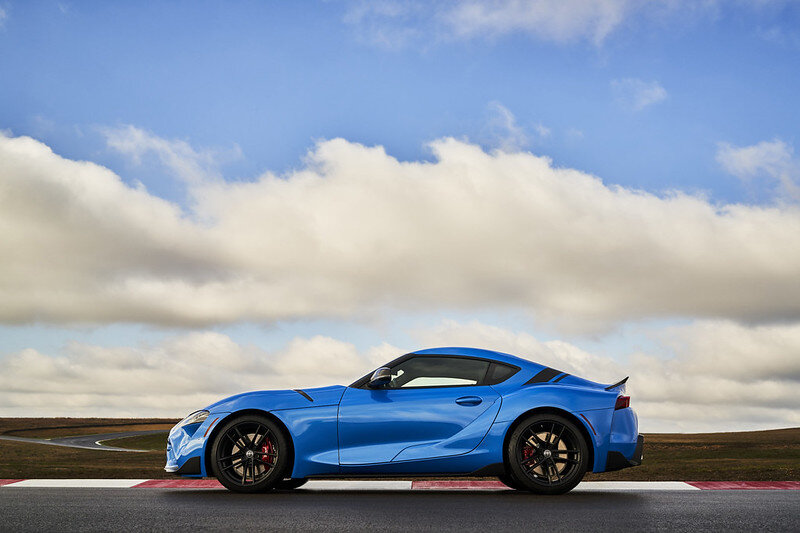
Unless, of course, you manage to secure one a limited edition model, identified by being  painted in Horizon Blue, and paired with 19-inch matte black wheels. That’s trim still commands the old price.

Just two are being brought in. There’s one here already and it has clocked some kays, being the personal drive car of Toyota New Zealand boss Neeraj Lala.

50553041693_415312493a_c.jpg


Dissecting the Mako


Everyone says it’s a Raptor rival – really, though, this special Hilux is about more than Eagle versus Shark.

2021-toyota-hilux-mako_50393244426_o.jpg

TIRED of being second best?

Toyota New Zealand tends to affect an off-hand attitude when subject of how the current generation Hilux has been out-performed by a certain other ute in the sales stakes. They talk about how their truck plays its own game and say they’re more interested in optimising customer well-being than beating the Ford Ranger for registrations.

Well, it’s all just brave talk. Assuredly, they want to even the score in respect to perception of which is the better rig. And they would love to reclaim top spot on the sales chart; a place Hilux hasn’t occupied since 2016.

The updated Hilux is a massive improvement on its forebear. TNZ’s claim that the 2020 edition has turned up the heat on the hotly contested utility market with a more powerful turbo-diesel engine, more capability and a tougher exterior design. The new technology and added safety features also do it proud.

Still, it doesn’t hurt to have a hero. That vehicle is Mako, a local development of the SR5 Cruiser wholly carried out by Kiwis – one particular involver for deciding suspension and tyre choice was Tony Groome, a well-known Manawatu off-roading identity who has been working with the brand for some years.

 Mako carries a $21,000 premium over the donor: So, a $79,990 buy-in.

The obvious rival is the Ford Ranger Raptor, that costs $5000 more, but it could just as reasonably be considered an alternate to the $74,990 Nissan Navara N-TREK Warrior and - though it is basically about to cease local representation - Holden Special Vehicles’ Colorado SportsCat, which sat at $82,990. Perhaps even the $82,990 Volkswagen Amarok V6 Aventura. 

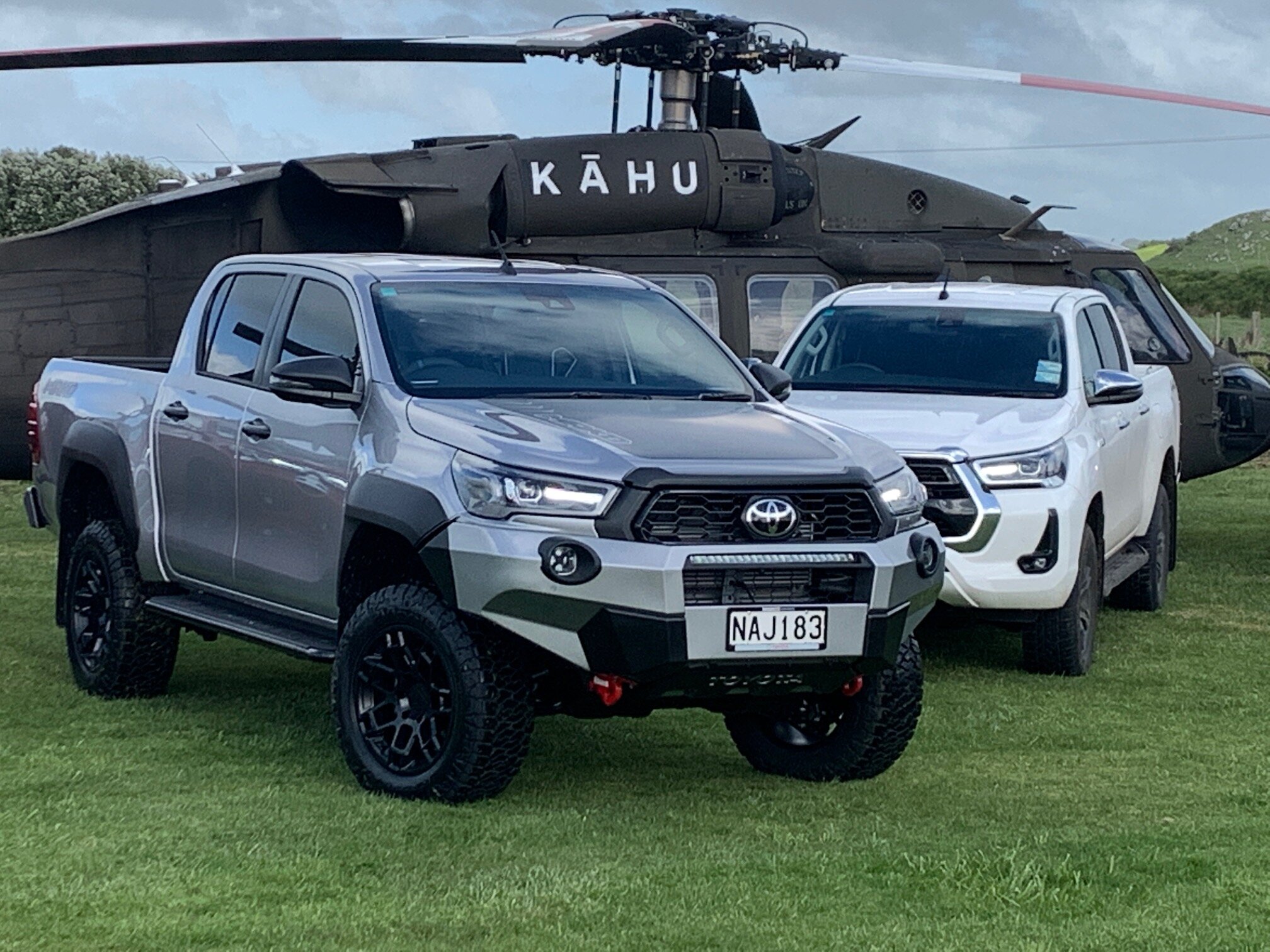
Toyota NZ didn’t so much launch the Hilux Mako as deliver it … by Blackhawk helicopter, to a media stop at the Cape Egmont Boat Club.

 Yesterday’s story gave a brief summary about Mako and TNZ’s hopes; that, despite being available to customer order and technically a “special launch edition”, will be part of the regular range for the foreseeable future.

Today it’s time to dissect the beast.

What’s in a name?

Specifically, why call it Mako rather than re-use Gladiator, the name given to the beefed one-off TNZ created for Fieldays a few years back?

There’s a matter of copyright: You might realise that Jeep’s new Wrangler ute is called the Gladiator. That nameplate is employed worldwide and TNZ realised that now the American model is on sale here, it would assuredly be picking a legal stoush by continuing with a name that had been previously uncontested.

Another reason? A new name imprinted that, even though what we get now does have an association with that special model it created (more in a minute), this is a different deal, being a volume consideration. 

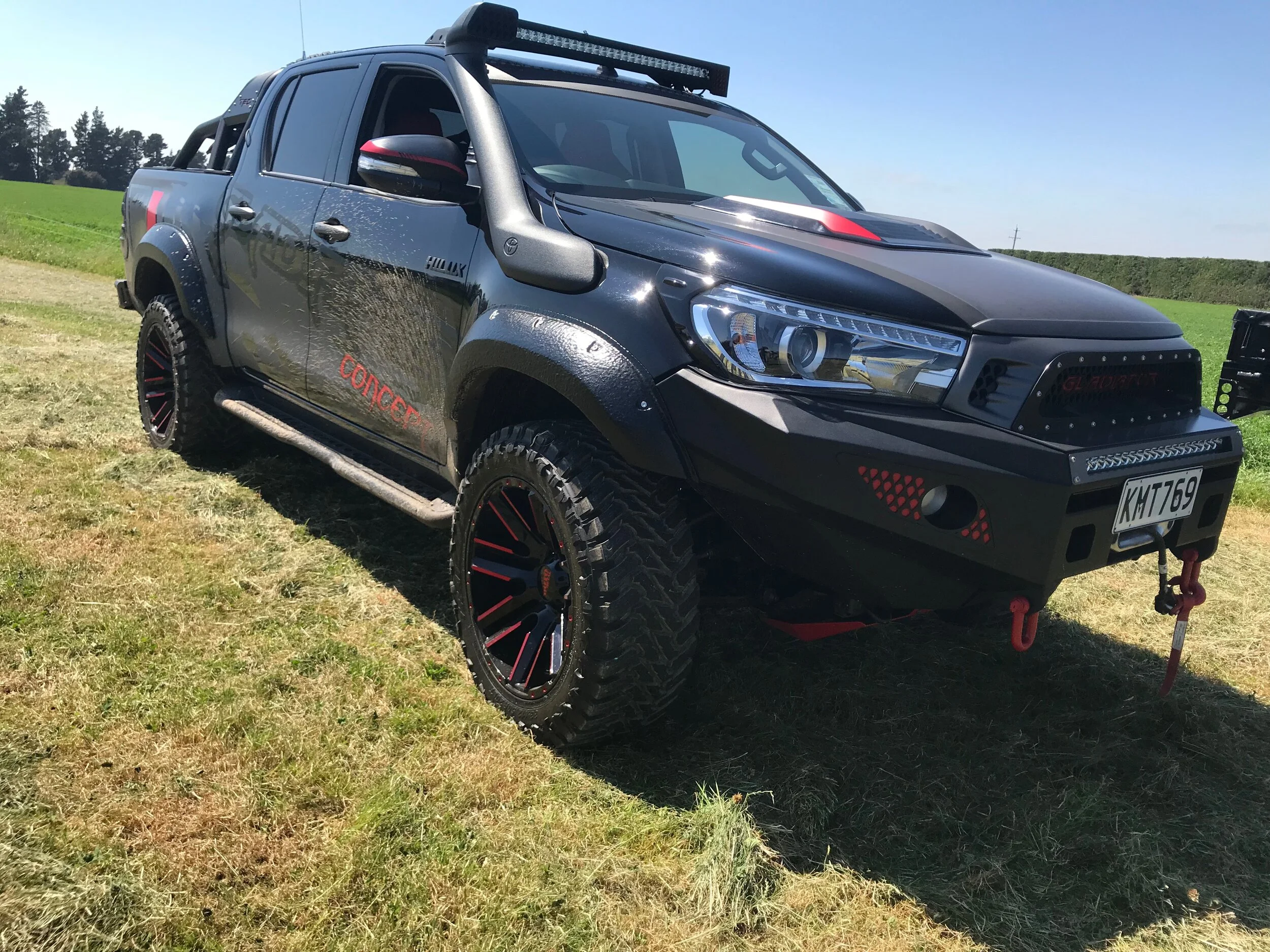
Heres’s the one - or, rather, the one-off - they did earlier … the Hilux Gladiator.

Heres’s the one - or, rather, the one-off - they did earlier … the Hilux Gladiator.

So, anyway, it came down to picking a name that was even tougher. TNZ CEO Neeraj Lala claims credit. He’s got a thing for sharks and one kind in particular: The “toughest, strongest, most aggressive” species roaming the open ocean. 

“If you look at the front of the truck, it actually looks like a shark.” A motif in the front badge logo, and the bonnet decal, represent a shark fin.

 Shouldn’t a shark have extra bite – why no under-bonnet modifications?

Outwardly, TNZ will maintain the 2.8-litre now that it has been upgraded to create 150kW – a 20kW increase over the pre-facelift output – and 500Nm (up 50Nm) is quite enough, with much improved low to mid-range oomph.

Beyond that, retuning the engine would have become an expensive and long-winded exercise, and not a job Toyota Motor Company would have allowed to be left to a local tuner. Japan would have wanted any recalibrations to meet their most stringent requirements. Same goes for any transmission fettling.

So, basically, oily bits were a no-go area though Lala prefers to say it was “an area we didn’t explore. From own our testing we thought the power and torque were quite satisfactory, pretty good.”


Anyway, unchanged performance is par for the course in this category. Raptor shares its 2.0l biturbo engine with other Rangers. The N-TREK and the SportsCat also carry unaltered versions of their donors’ drivetrains.

How much of it is just a dress-up? 

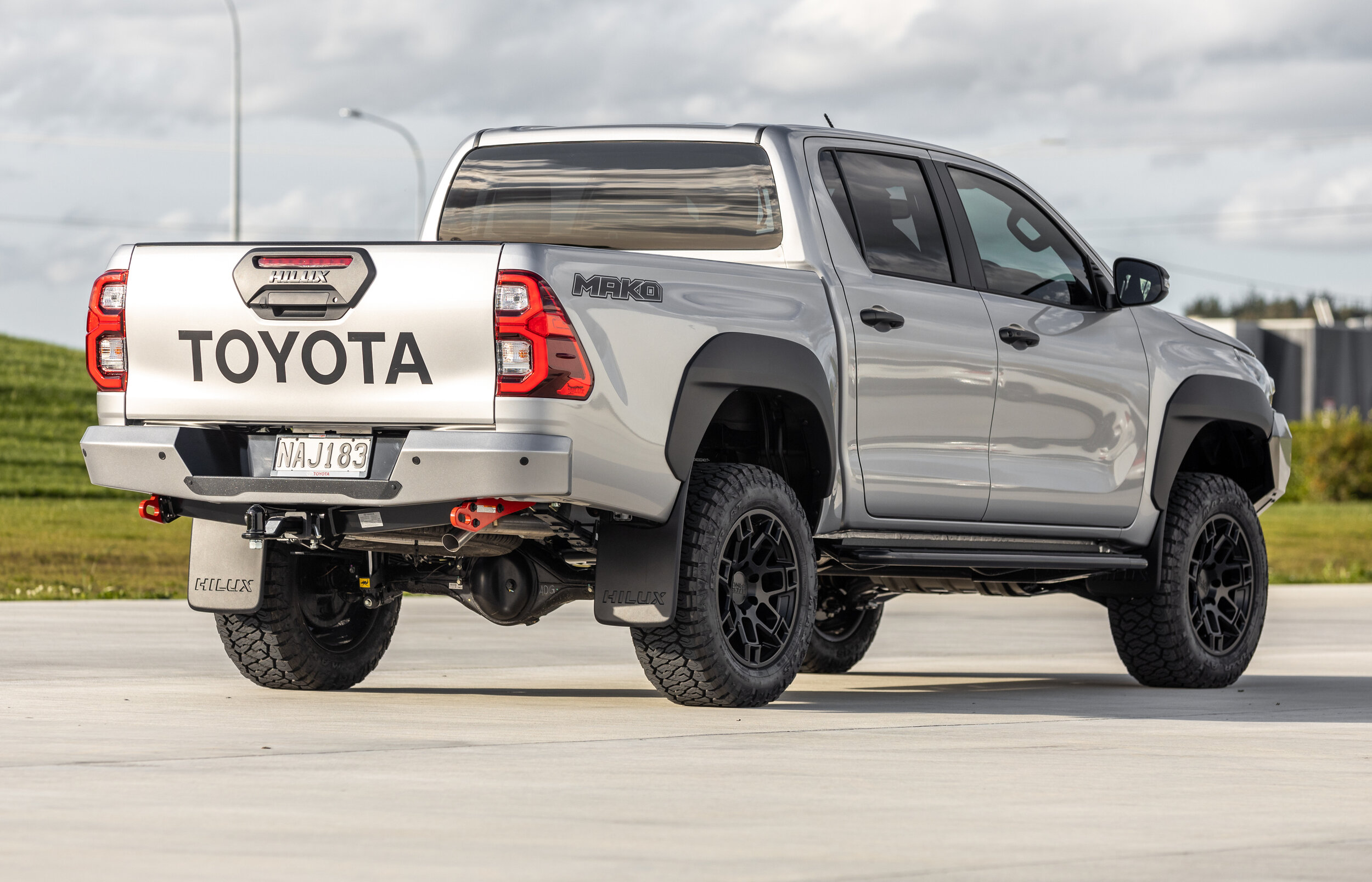
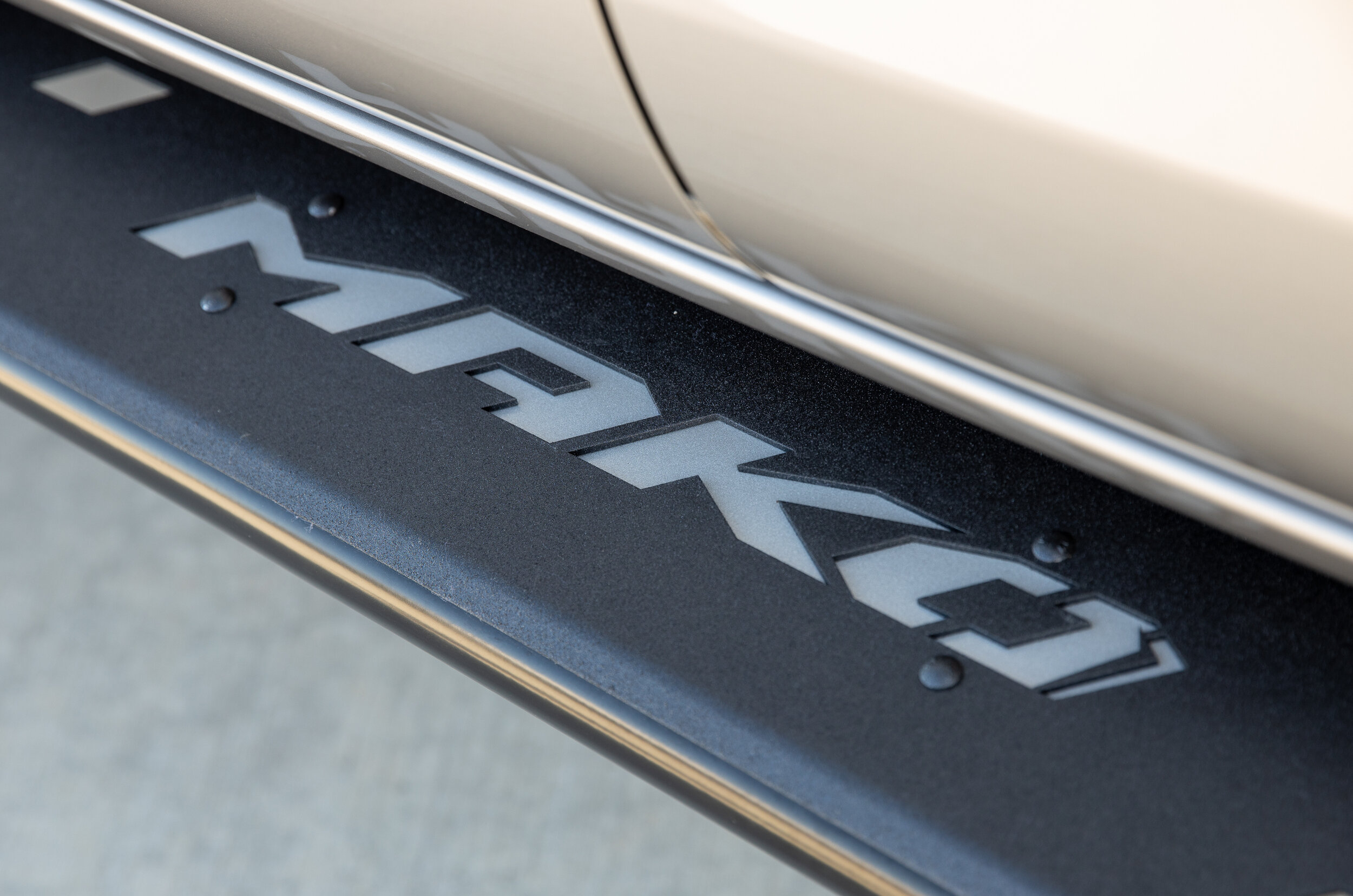
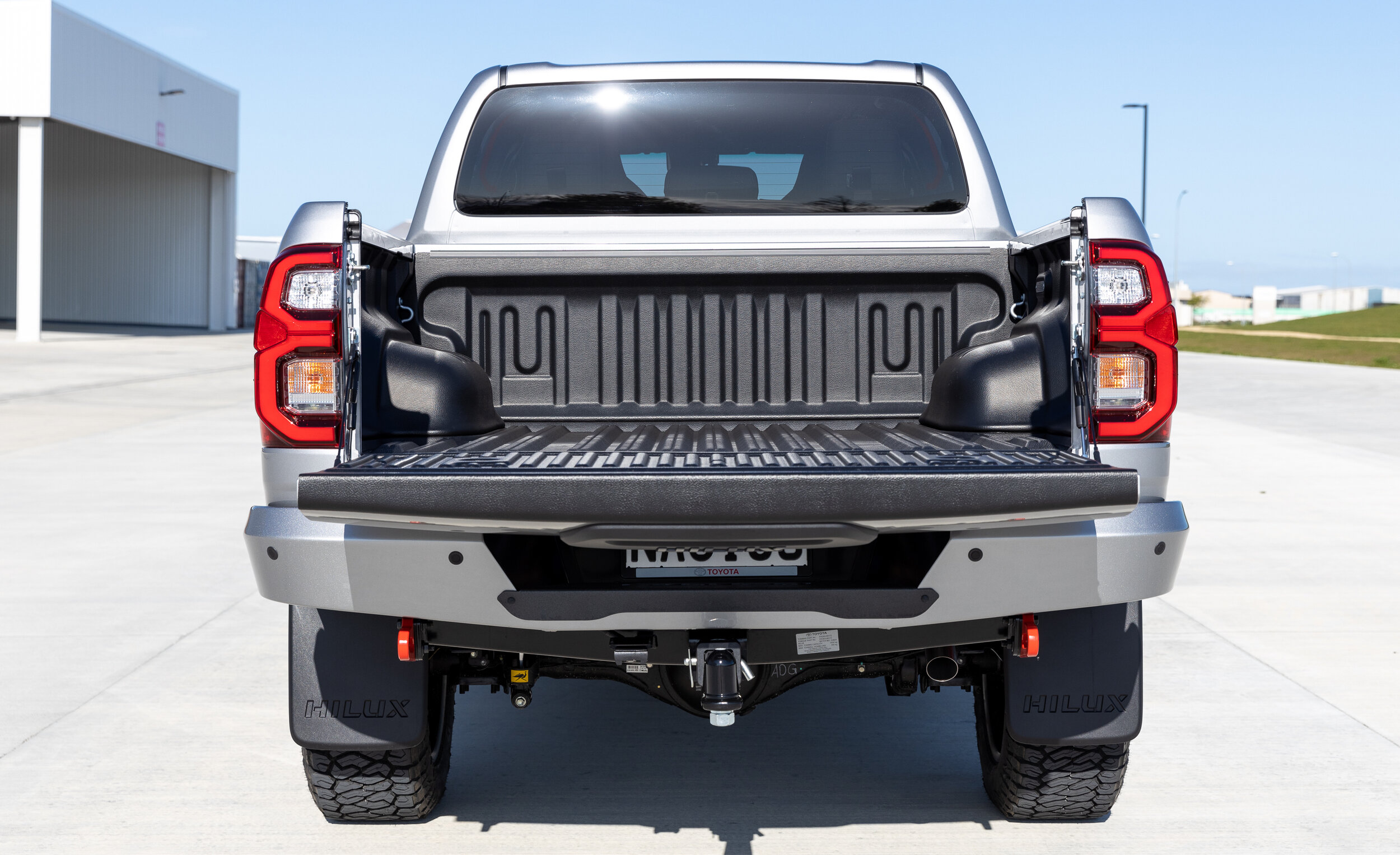
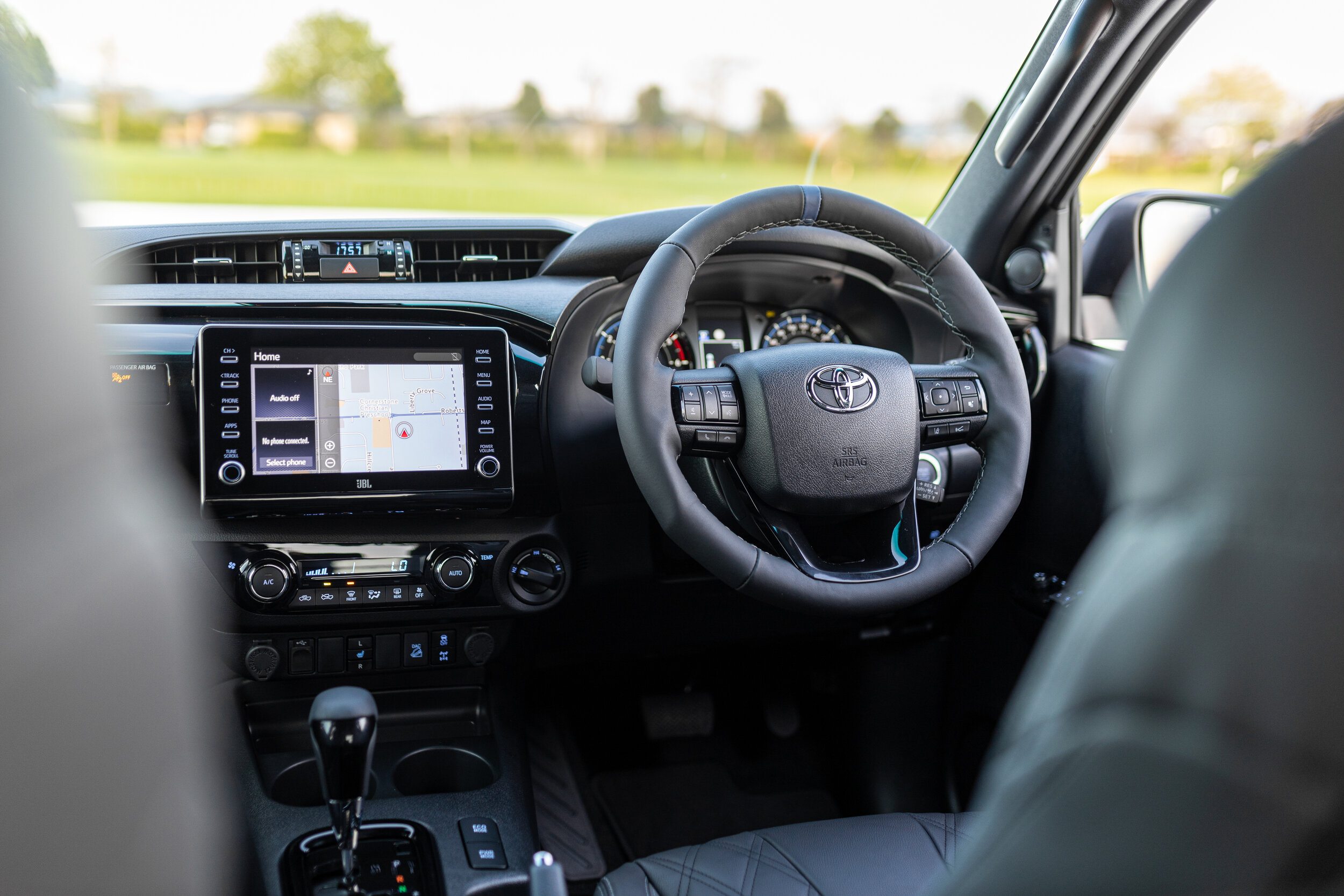
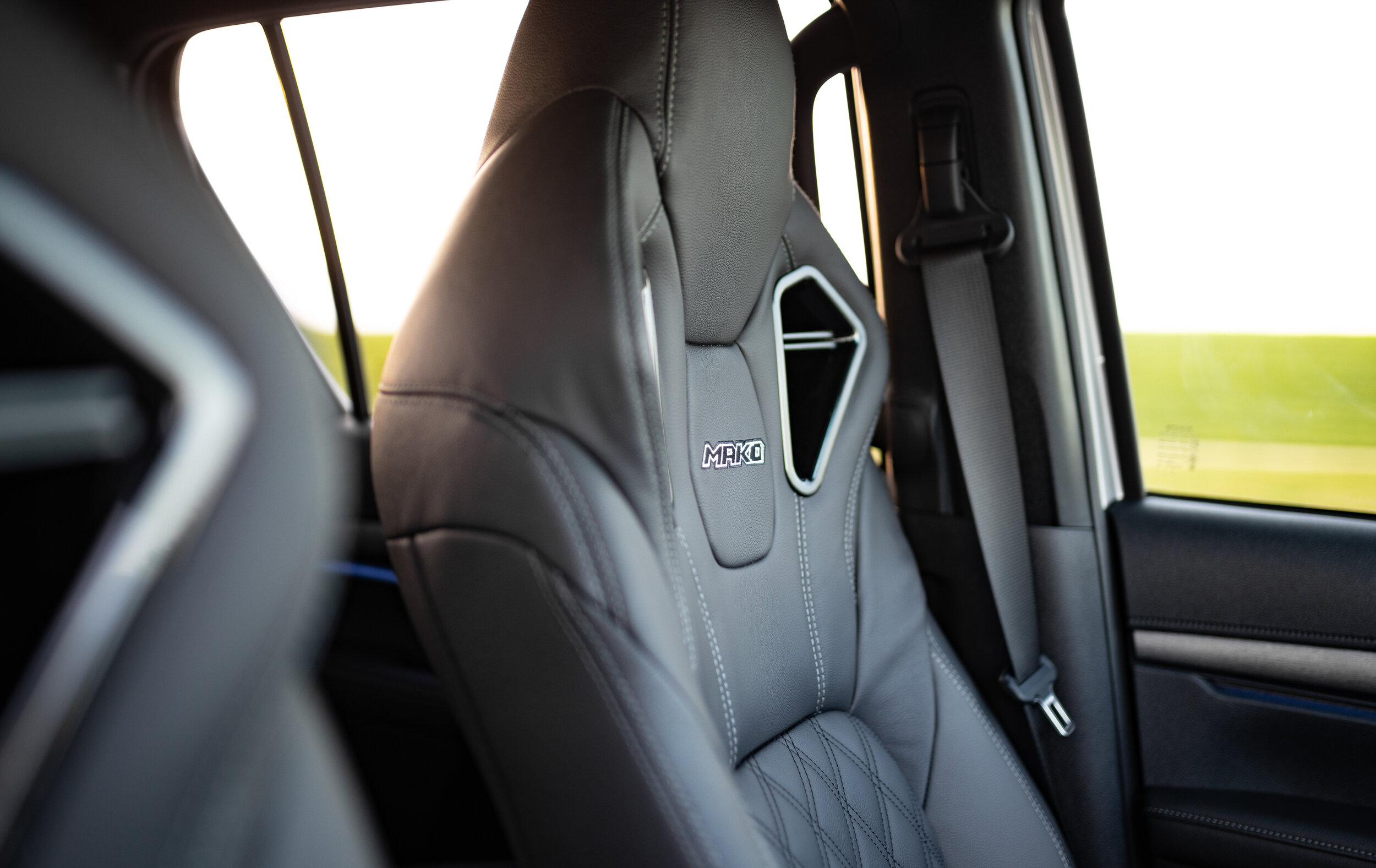
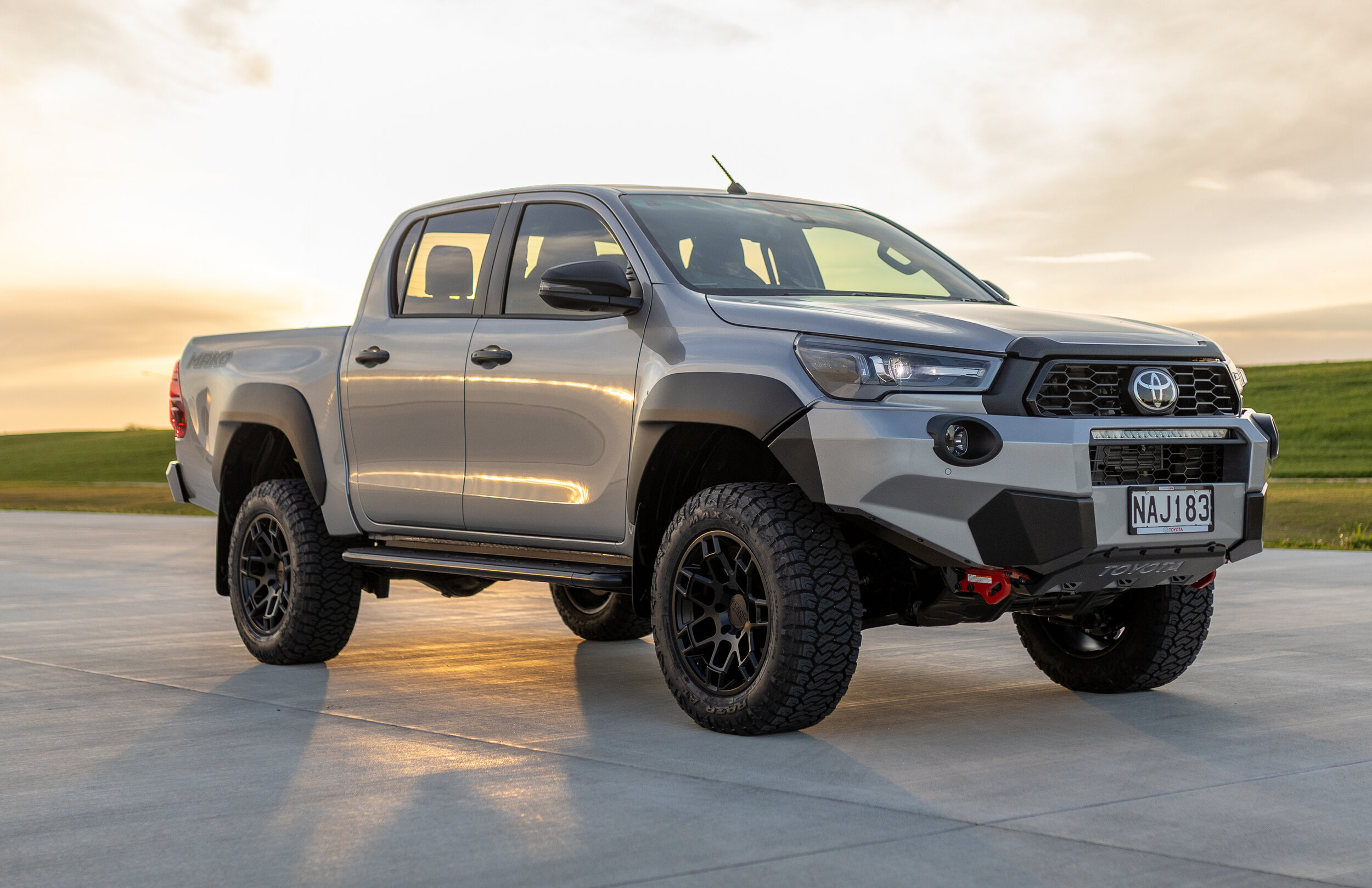
Probably around 50 percent at most. Assuredly, there are extensive body modifications that are basically bolt-ons for visual effect: The unique fender flares, side steps with “Mako” logos, T Custom Sports Guard non-slip deck liner, damper-shocked soft-close tailgate and heavy duty rear step bumper are examples of this. Likewise, on the inside, the front chairs are replaced by higher-backed and bolstered motorsport-style items (akin to Gladiator’s tombstone seats), trimmed in full custom leather by a local supplier. And yes, they’re still heated. It also achieves a bespoke steering wheel that’s thicker-rimmed than the standard item and a leather centre console lid.

However, there are also a lot of specially-engineered bits that make real difference in how it performs. These are the items that will make the Mako feel substantially different to the donor. 

So examples?

Well, most obviously the suspension, the wheels and the tyres.

Lala says the determination to fit out the Mako with a full ARB Old Man Emu BP-51 shock set came from having testing “the key competitor in the segment”. Let’s call it Raptor.

However, their choice was also made through previous experience: It’s been a popular aftermarket kit with Hilux customers who are serious about off-roading. We’ve driven a earlier gen Hilux with it - and were hugely impressed. And yes, you’re correct in assuming TNZ’s first use was with the Gladiator.

A fit-out that has required low volume certification gives a 40mm front and 50mm rear lift and has microcharger adjustable compression and rebound control. No clearance and departure angle information was provided. The rear springs are tweaked, too; they’re now to what’s being called Dakar spec. Says Lala: “This upgrade was the thing that we really needed to work hard on. We think it’s one of the best suspension packages on the market.”

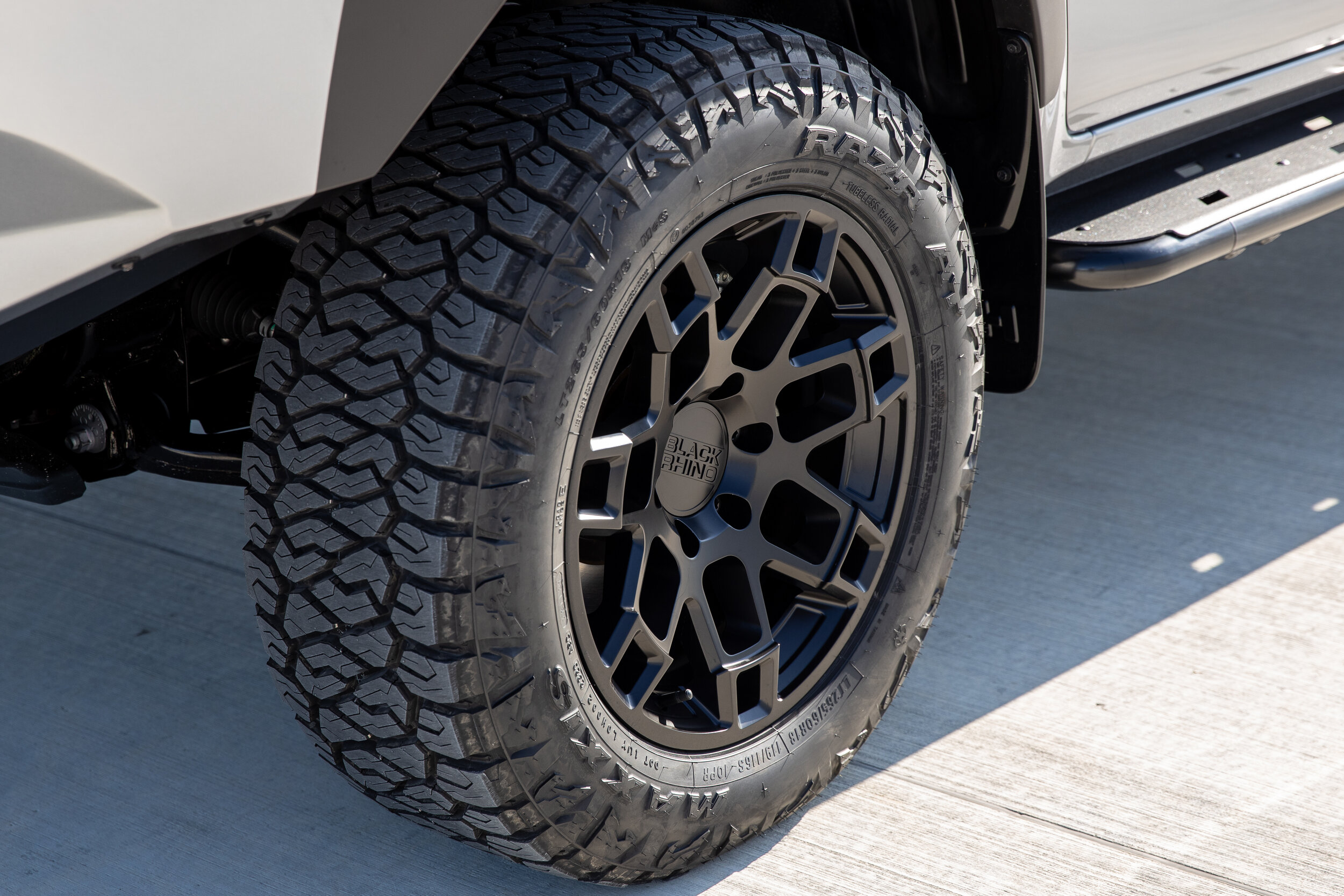
 Going to a bigger wheel and tyre was also a Gladiator 101, but Mako is less extreme. Those 18-inch Black Rhino rims sourced from the US are two inches smaller than the Gladiator’s, though with Maxxis Razr 265/60 all-terrain tyres, the rolling radius is likely around the same as with the show truck, which wore 33 inch by 12.5 inch Atturo Trail Blade M/Ts. Mako’s is a better blend for on and off-road capability, TNZ has decided.

Mako’s brake package is more extreme. The Fortuner SUV is a wagonised Hilux, but it has 15mm larger rotors and four-piston calipers. They’ve been used here. Also, Mako has harder brake pads than a regular Hilux. Braking performance is “significantly improved.” Braided front and rear brake lines are also used, to contribute to improved pedal feel. 

Am I right in thinking that front bullbar looks familiar?

If so, then you’ve been checking out Toyota Australia’s Hilux Rugged-X, which is their own variant – now in its second-generation – homegrown for bush-bashing. The Rugged-X’s hoopless steel front bar is a special piece of kit that the Aussies were previously reluctant to share.

The whole shebang – and that includes an integrated LED light bar and bash plates – is designed to ensure the vehicle’s crash test integrity is exactly the same as it is with the regular bumper; achieving this – and also allowing donor car’s parking sensors to remain operable - has required some incredibly complex engineering.

 The piece was further altered for Mako, says Lala. It’s had a custom modification to account for localised finishing, such as the garnish under the headlight. “That’s unique to here, so we had to modify the bumper to fit.” Side fog lamps were also integrated here. 

In case you’re wondering, other common Mako/ Rugged-X elements are those red recovery tow hooks, fender flares and the heavy-duty rear bar with step.

 Are there any options? 

Just one. The towbar kit, which also includes provision of the rear recovery hooks. We assume buyers could also install diff lockers, which are available with the Old Man Emu kit. Again, we’ve tried a Hilux with these and were stunned by what the rig could do.

Does the rework affect the warranty?

Not at all. It has the same cover as any other Hilux, so up to five years warranty, roadside assistance, WoF coverage and capped-price servicing. Plus the price is fixed and not subject to any fluctuations that might impact of the cost of individual add-ons. So the sticker is a Toyota Driveway Price (TDP) that includes on-road costs. As mentioned yesterday, Mako also maintains the same 940kg payload and 3500kg braked tow rating as other double-cab 4WD Hilux models.
When and how can I buy it?

The second part first. It’s not a showroom model. Vehicles are pre-ordered and then put together, at the company’s refurbishment plant in Thames; so it’s a total custom build. Buyers can get to choose colours and will get updates on the progress of the refettling. At the moment there is just one example in existence and the programme really will take a couple of months to get going. Parts are still arriving and though build begins just before Christmas, the production process won’t really get up to full speed until early next year. Deliveries will probably begin in February.

If the build volume is uncapped how special will it be?

TNZ has decided not to make this a limited-count product but, at same token, even a best-hope forecast is of 400 units a year – and that’s based on pre-Covid market conditions – and the more likely achievement of 250 per annum means it’s hardly going to be a common sight. 

“It is the first time we’ve offered a customer a bespoke, built-to-order product … there’s so much uncertainty in the market in respect to volume. In the current situation, I think we can still achieve 250 plus.”

If you’ve ordered a 2020 update SR5 Cruiser, expect a call from TNZ. That status lends first opportunity to buy into enhancements that the Australian motoring press say likely delivers a better hard-out Hilux than they get.

One has already called it the world’s toughest Hilux.


Shark attack: Hilux Mako seeking prey

Toyota can scent blood in the water … and it’s hungry to eat the opposition.

IMG_7080.JPG


UP to 250 units a year, perhaps even 400 if the market returns to pre-Covid health.

That’s the annual volume prediction Toyota New Zealand’s boss Neeraj Lala has cited for the new top model of the Hilux range, that he helped configure and personally named.

Hilux Mako is a $79,990 re-engineering of the $58,990 SR5 Cruiser doublecab that, until today, was thought to be the market leader’s flagship variant in the refreshed 2020 line launching to the public on Thursday. It’s auto only and the 2.8-litre engine remains in its standard tune, but a lot else changes.

An entirely New Zealand-devised, designed and built creation, that will be built to order at TNZ’s Thamese vehicle operations plant, Mako is obviously tougher-looking than the donor – or any other ‘mainstream’ Hilux – and that’s not just for show: It’s prepped for tougher terrain as well.

IMG_7069.JPG

Lala says the Hilux Mako will be the ultimate bespoke ute, for customers who want a fully kitted out Hilux.

“We’ve taken a great truck and added some kiwi-muscle and flair. I’ve had lots of direct feedback from customers, and they wanted more power, a better ride and premium interior comfort – the Hilux Mako delivers on all those requests.”

 “From my experience in the US with the Scion brand, customisation was the backbone of forming an unbreakable bond with customers. In fact, customers would go to extreme lengths, some legal and some even illegal as they really pushed the boundaries of customisation,” says Neeraj.

“We have pushed the boundaries under the careful watch of local Toyota engineers to produce a unique bespoke truck that I think customers are just going to love..

Toyota will build a few Hilux Makos for demonstration purposes, but every vehicle will be custom-built for the owner.

Customers are able to place their orders now for the vehicles to be built and delivered in the first quarter of next year.

The edition has 18 inch matte black alloy wheels with Maxxis Razr off-road tyres, fender flares, tinted front windows, a replacement front bumper steel bulbar, and a replacement rear heavy duty bumper.

To improve comfort and control – both on and off road – the suspension is upgraded with ARB’s Old Man Emu BP-51 shock absorbers. The BP-51 high-performance by-pass shock absorbers have user adjustable compression and rebound damping control. They provide optimal performance for challenging terrain, towing or carrying loads.

Also, to improve control, the brakes will be upgraded with larger diameter front discs. The brake lines also get an upgrade to stainless steel braided lines that help increase hydraulic pressure on the pedal and the feel and feedback, improves safety, and are more durable in harsh conditions than standard rubber lines.

 Inside, the Mako receives airbag-compatible custom sports leather accented front and rear seats with unique seat stitching and headrest branding.

Underpinning the accessories will be the latest 2021 SR5 Cruiser with its more powerful 2.8L turbo diesel engine, the latest in Hilux safety features and smart phone connectivity. 

The only option is a $1500 towbar/rear tow hook kit.


Hilux 'hammer time' - a hero is rising

EXCLUSIVE: An extra-hardened Hilux for Kiwis is set to be unveiled today.

Toyota New Zealand’s new boss Neeraj Lala has often spoken of his desire to deliver a Hilux equivalent of the performance utes rivals offer - will he deliver today?

Toyota New Zealand’s new boss Neeraj Lala has often spoken of his desire to deliver a Hilux equivalent of the performance utes rivals offer - will he deliver today?

PREPARE to meet a ‘hero’ Hilux that will not only overshadow the extra-hardened editions just released across the Tasman but will also prove tougher than any rival brands’ offers.

That’s the vow made by Toyota New Zealand’s chief executive at an introduction to the updated model line, which goes on sale the day after tomorrow. 

Journalists on a drive programme today that takes them from TNZ headquarters in Palmerston North to New Plymouth have been promised sights along the way will include a specially-fettled double cab model additional to the range already announced for public use.

Lala says the mystery truck set to be unveiled at midday is a hero model quite unlike any offered here before that will become a permanent fixture in the family.

He further vows: “It will be the best halo truck on the market at the moment.”

That’s quite a gauntlet throw down when one of those adversaries is the Ford Ranger Raptor. Is it possible for Toyota here to really create an equal when the major re-engineering process that went into Ford model obviously isn’t on the cards? Hard to believe. We’ll find out soon enough. Watch the MotoringNZ Facebook page for updates.

Certainly, it’s possible to monster up a Hilux. The confirmation of a new image-maker comes just a day after Toyota Australia, which claims to be the architect of all the major improvements that arrive with the 2020 mid-life update, has shown off its own specially-crafted hardcore editions.

The degree of commonality between the Hilux Rogue and Hilux Rugged X that our neighbours are taking and the machine heading to Kiwi customers will become more obvious by tonight. 

are Australia’s latest Rogue (left) and Rugged-X derivatives, revealed just yesterday, pointers to what Toyota NZ can achieve?

are Australia’s latest Rogue (left) and Rugged-X derivatives, revealed just yesterday, pointers to what Toyota NZ can achieve?

However, New Zealand would not be ill-served were we to pluck some of the content enjoyed across the Tasman.

They deliver new features including a motorised remote-control tray roller shutter for the Rogue and a steel front bumper with integrated LED light bar for the Rugged X, which as the name suggests is the more off-road-oriented of the pair. 

The latter also comes with heavy-duty front springs, a snorkel with reversible head, plus red-painted front and rear recovery points and heavy-duty rock rails (aka side steps).

There’s a unique sports bar at the back with multi-purpose attachment points, along with a moulded tub tray, tailgate protection and a heavy-duty rear bumper with an integrated step.

While Lala was coy about letting out too much info about the Kiwi model, he has has made clear before of his intent to use high visibility editions to polish the one-tonne model’s reputation and enhance sales.

Conceivably, these will be created as Australia’s have been. So, base vehicles are produced in Thailand and then kitted out with additional parts locally.

Logically that will happen in Thames where the former Toyota car plant has been repurposed as a refurbishment centre for used car stock under the Signature Class banner.

TNZ has already shown talent for dressing up the current generation Hilux – it has previously delivered versions with Toyota Racing Development guise and also created an extremely pumped one-off for the 2017 national Fieldays, called the Gladiator.

At the moment, the lineup is topped by this SR5 Cruiser doublecab, an almost $59,000 proposition. Raptor plays in the $70k zone … so, room for Toyota to move up.

At the moment, the lineup is topped by this SR5 Cruiser doublecab, an almost $59,000 proposition. Raptor plays in the $70k zone … so, room for Toyota to move up.

Further, at a briefing last night, TNZ’s general manager of parts and service, Spencer Morris, outlined how popular factory accessories are with Hilux owners.

“No-one ever seems to buy a Hilux without ever wanting to accessorise it,” he said. 

The desire to add extras is good business; last year TNZ sold $30 million worth of bolt-ons. That taste is sure to be satisfied with the new model, with has 300 accessories available.

Regardless that it wants Hilux to achieve a market-leading profile, TNZ continues to downplay any desire to return the Hilux to achieve sector leadership, a title it held with ease for more than 20 years until the pesky Ranger turned up. 

Hilux has been class runner-up since 2016 and its popularity against the Ranger’s has seemed to widen most years.

It was well beaten last year, with 7126 registrations against Ranger’s 9483, and looks set to stay in the No.2 spot this year as well, barring a surprise upset.

Year to date, as at the end of August, the Toyota model has taken 3725 registrations against 4961 for the Ford in the same period. 

Toyota conceivably has a chance to get back on top next year, as that is when Ford ends sale of the current Ranger and swaps to a new model that becomes a co-share with Volkswagen. Ford is leading that project, so the new Amarok will be a Ranger in engineering though probably not in look.

The 2020 Hilux presents as a hefty mid-life refresh that will likely see it through until potential replacement, in perhaps 2023 or even later.

The latest enhancement delivers more equipment and more grunt and also improves the dynamics and resolves diesel a particulate filter issue that might have blackened the reputation of the mainstay 2.8-litre four-cylinder turbodiesel engine.

Development and evaluation of this engine is in latest state of tune means it now develops 150kW and up to 500Nm with a recalibrated six-speed electronic automatic transmission (and 420Nm with the six-speed manual).

That work, along with retuning of the suspension and steering, was conducted in Australia, in collaboration with teams from Japan and Thailand, as well as representatives from other markets.

The 2020 Hilux also has the usual full range of electronic braking and traction-control technologies, emergency stop signal (hazard lights), reversing camera (pick-ups), seven airbags, and seatbelt reminders for all seats. On double-cab variants, the rear seats have two top tether anchors and two ISOFIX points.

Downhill Assist Control is standard on all 4x4 SR5 variants and 4x4 automatic SR double cabs (including cab-chassis).

Toyota Safety Sense technologies in Hilux run to pre-collision system that can also detect pedestrians (day and night) and cyclist (daytime); high-speed active cruise control, and lane-departure alert that offers steering assist (via the brakes) to prevent unintended wandering into another lane. Road-sign assist can now recognise speed advisory signs. New for SR5 double and extra-cab pick-ups are front and four rear sonars to support parking. When the system detects objects, it alerts the driver with a buzzer and a message in the multi information display.

Toyota NZ has launched with 18 Hilux variants, evenly split in rear and four-wheel-drive.

The rear drive models start with a 2.7-litre Workmate single cab chassis with automatic at $28,990 and topping with a 2.8TD PreRunner SR5 Cruiser double cab automatic for $47,490. The cheapest have maintained price parity with their predecessors but others have increased in price by $1500.

The four-wheel-drive range is totally wed to the 2.8-litre and starts with a single cab chassis at $44,990 and tops with a $58,990 SR5 Cruiser double cab auto. All 4wd models are more expensive than their predecessors, the biggest increase being a $2500 hike for the SR5 auto.