NZ pulled into BMW PHEV fire risk recall

An urgent global remedial action for plug-in hybrid BMWs and MINI cars has hit this market.

P90389041-highRes.jpg


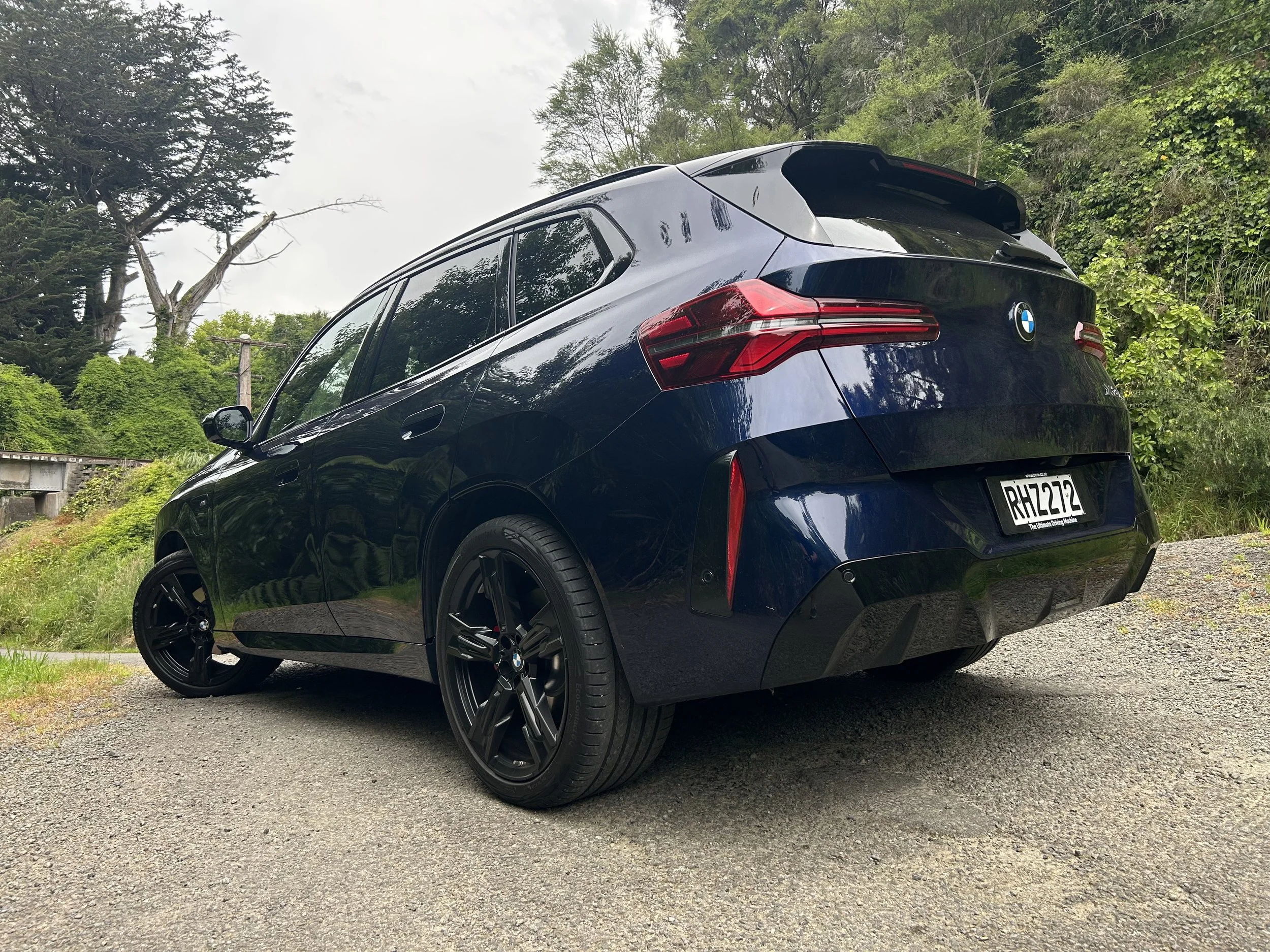
JUST a handful of plug-in hybrid BMW cars in New Zealand are thought to be drawn into a battery pack problem which could result in a short circuit and potentially cause a fire.

The maker has nonetheless issued a widespread recall for all of its plug-in hybrid vehicles.

The list of affected models includes the X1, X2, X3 and X5 SUVs, the 3, 5 and 7 Series saloons, the 2 Series Active Tourer, the i8 and the MINI Countryman.

The recall applies to any of these PHEV models that were built between 20 January and 18 September this year.

BMW estimates roughly 26,700 vehicles have been affected worldwide, but it seems just 12 of these are in this country.

Comment in respect to the New Zealand situation has come from BMW’s regional head office in Australia.

“We can confirm this safety recall relates to a small limited amount of PHEV variants of the BMW 3 Series, 3 Series Touring, X1, X2, X3, X5, 2 Series Active Tourer, 7 Series, 5 Series, 5 Series Touring and MINI Countryman models,” a spokesman related today.

“An inspection of the parts involved is currently being carried out.”

Any customer who wishes to check if their car is affected by a recall can visit the recalls section of the BMW New Zealand website now and key in their 17-digit VIN numbers to find out. 

Asked how many vehicles were subject to the recall, he said the count was 12, and all owners have been contacted. 

“Replacement loaned vehicles have been provided to these customers while their vehicle currently undergoes an inspection.” 

The initial remedial action comprised a 30 minute quality inspection. “Further action may be taken if needed.”

The spokesman did not respond to the proposal that some vehicles are expected to be off the road for weeks, due to delay in securing components.

Asked if BMW/MINI has suspended sale of PHEV product and what impact, if any, this issue had on the brand’s fully electric cars, the BMW i3 and the e-Mini, the spokesman responded: “This action does not affect full EVs, only PHEV models listed. This safety precaution recall does not affect all PHEV products. 

“It affects only a small amount of vehicles from one specific production line produced in the period 13/03/2020 – 06/08/2020.”

BMW Germany announced overnight its engineers have found some discrepancies in the manufacturing process of its battery packs, which the company sources from the third-party supplier Northvolt. 

The concern is that foreign contaminants may have been sealed into the units during their assembly, which have the potential to short circuit the battery pack and cause a fire.

A spokesperson for the brand in Germany said: "BMW Group has launched a worldwide safety recall and stopped delivery of a small number of plug-in hybrid vehicles as a preventative measure to check the high voltage battery.

“Internal analysis has shown that in very rare cases particles may have entered the battery during the production process.  

“When the battery is fully charged this could lead to a short circuit within the battery cells, which may lead to a fire. BMW apologises for the inconvenience caused to customers, but of course safety must come first."

German media reports that a fix is expected to start being rolled out by the end of the month. 

It is not the first recall to affect BMW's plug-in models. All of the above models bar the i8 were subject to a recall earlier this year to remove welding beads left on the battery.

Of course, BMW isn’t the only company plagued by battery-motivated recall issues, though. Ford, who uses the same battery supplier as BMW, issued a similar notice for the Escape PHEV after four vehicles short circuited and caught fire. 

Hyundai also issued a  recall for the Kona Electric after 16 reported cases of cars catching fire, which forced the Korean brand to recall more than 25,000 vehicles in South Korea. Whether the issue concerns NZ-delivered vehicles has not been made clear.


Eclipse Cross updates revealed

A battery-assisted drivetrain is among extra features coming for Mitsubishi’s compact crossover.

ECLIPSECROSSGasolinemodelexteriorforAustralia.jpg

INCORPORATION of a hybrid powertrain – but not straight away - is a core change with an update to Mitsubishi’s compact sports utility, the Eclipse Cross.

 Detail of this inclusion has been aired with the brand having now unveiled the refresh, which is thought to be close to introduction to New Zealand, though no exact date has been announced.

In addition to the powertrain revision, the vehicle achieves fresh looks, a revised chassis, new suspension – with a new rear shock to improve handling characteristics - and some specification alterations.

The model’s exterior lines and details have also altered, to attune to the brand’s latest design language.

A new alternating-pattern mesh grille design is featured up front, flanked by slender new LED daytime lamps that replace the larger headlights of the outgoing model – leaving the lower lighting assembly to act as driving lights.

The cat also gets a redesigned hatch and rear window for improved visibility, integrating with updated tail-lights. 

The interior has not altered much, save that the centre display housing an 8.0-inch infotainment screen with Apple CarPlay and Android Auto capability has become more prominent and the previous model's touchpad has been discarded.

The car initially continues to represent with a 110kW/250Nm 1.5-litre four-cylinder turbo petrol engine matched to a CVT gearbox with all-wheel drive. 

The plug-in hybrid powertrain is reportedly coming in late 2021. This comprises a 2.4-litre non-turbo petrol four-cylinder mated to electric motors mounted on each axle; so, a similar – if not the same – drivetrain as that featuring in the next size up Outlander PHEV, which is also about to undergo change.

A new Outlander is set to launch in 2021, with a PHEV variant coming in 2022.

Meantime, Mitsubishi is also looking to replace the ASX, which is the oldest of its crossovers by some margin.

 Images released by Mitsubishi Japan seem to suggest the Eclipse Cross might include a sporty GSR appearance.

Comment about the Eclipse Cross has yet to come from Mitsubishi Motors New Zealand.

ECLIPSECROSSPHEVmodelinteriorforJapan.jpg


NZ COTY contenders revealed

The countdown to New Zealand Car of the Year is under way, with announcement of 10 finalists.

NZCOTY_CARS_2020.jpg

VEHICLES with varying ability to conquer beyond-seal conditions are dominating the count of finalists in a showdown to win the national car of the year title.

 Of the 10 candidates for the New Zealand Car of the Year award, which has been given out annually by the New Zealand Motoring Writers’ Guild since 1988, just two are not suited for some degree of off road work – these being a pair of small hatchbacks, the Ford Fiesta and Toyota Yaris. 

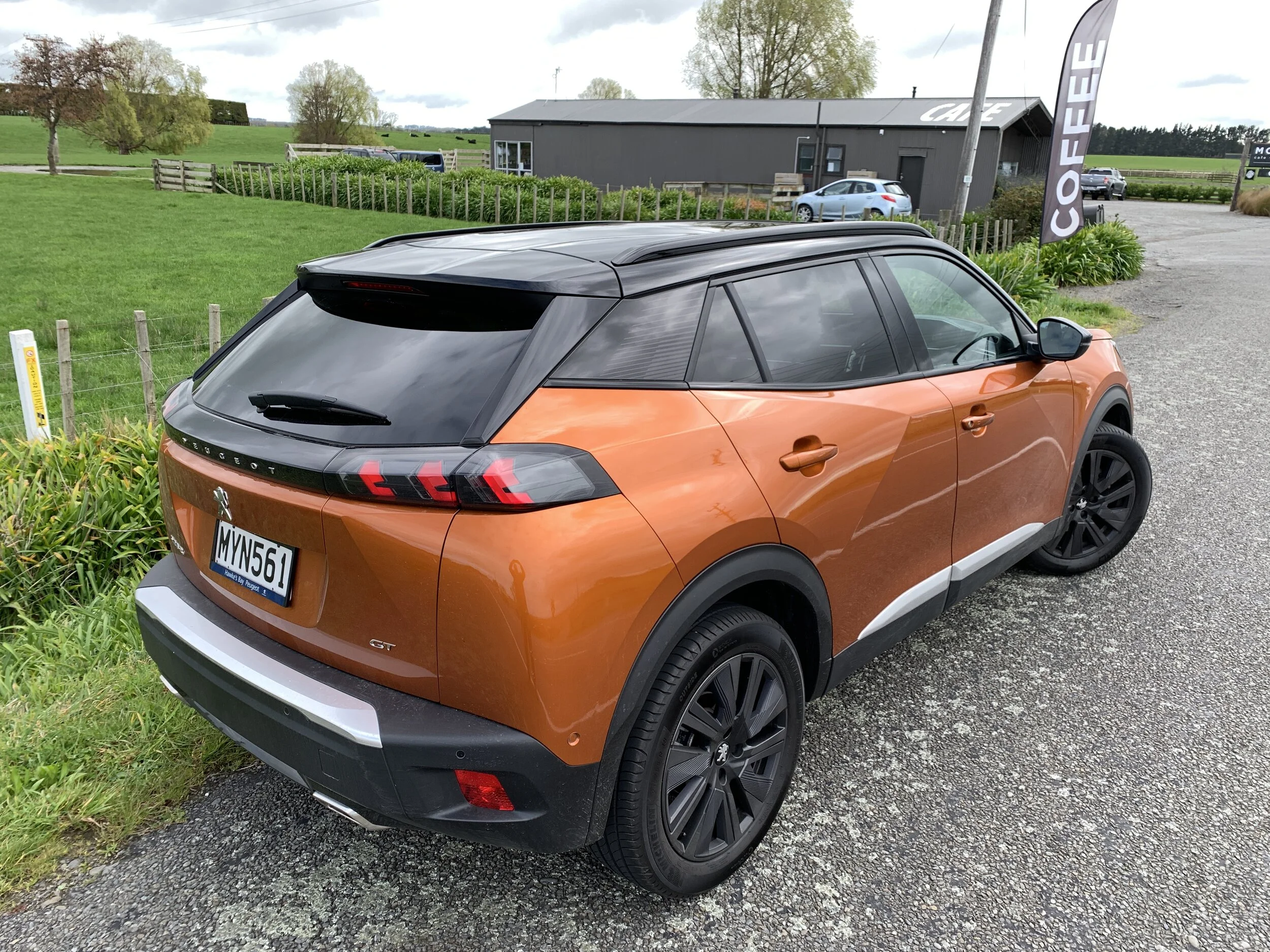
Otherwise it’s between crossovers and sports utilities: In alphabetical order these being the Audi Q3, Kia Seltos, Land Rover Defender, Mazda CX-30, Mercedes-Benz EQC, Mercedes-Benz GLB, Peugeot 2008 and Skoda Kamiq.

The 33rd winner of the nation’s most coveted and longest-lived automotive award will be decided by more than 20 journalists, this writer included, representing a wide span of national printed and on-line publications, with announcement on TVNZ’s Seven Sharp current affairs’ programme in early December.

Guild president Richard Edwards, of Auckland, says the announcement will mean a positive finish to 2020 for whichever brand is fortunate to achieve this prize.

“After many tumultuous months full of Covid-related twists and turns, it will be a welcome relief to farewell what has been a challenging period with the announcement.”

He noted that the top 10 reflects the strong influence that SUV and crossover variants now have on the total new vehicle market.

The global coronavirus pandemic had made this a tough year for the car industry, with brand facing supply restrictions. In most years, it was common for more than 50 new models from more than 30 different brands to be released nationally every year, but that rate reduced in 2020. 

He said the Guild took great responsibility in determining the winner of its accolade, with voting journalists understanding their determination likely “contributes to and influences the buying decision of many Kiwi motorists.”

“New car buyers can rest assured that the winner is absolutely deserving of the title as it will have undergone extensive testing and excelled across a wide variety of measures, especially when compared with other finalists.

“It takes a very special vehicle to be crowned the New Zealand Motoring Writers’ Guild Car of the Year, an endorsement which represents a significant accomplishment for any new model.”

Comment from the chosen models’ brand representatives is as follows:

Audi RSQ3

Audi RSQ3

Audi Q3

“Being acknowledged as a contender of the Car of the Year title is a huge accolade for the Audi Q3,” says Audi New Zealand general manager Dean Sheed.

“The Q3 has been part of the Audi SUV stable for many years and has a wide range of offerings from two-wheel-drive to Quattro all-wheel drive and petrol and diesel powertrains.

“Importantly, Kiwis love of performance is delivered through the SQ3 which makes up 50 percent of our sales. Now the SUV has been joined by its design focussed brother, the Sportback, offering a coupe style which will allow the family to grow further.” 

Ford Fiesta ST

Ford Fiesta ST

Ford Fiesta

“It’s great news that the Ford Fiesta made the Top 10 list this year and is heartening to know driving excitement and pure, gear-changing fun still matters,” says Ford New Zealand spokesman Tom Clancy.

“The Ford Fiesta ST stands out in this regard, especially in a world where SUVs dominate and the manual transmission is becoming increasingly rare.”

kia seltos.JPG

Kia Seltos

According to Kia Motors NZ managing director Todd McDonald: “The strong reaction from the public ahead of the introduction of Seltos clearly indicates that we have another winner on our hands.”

Land Rover Defender

Land Rover Defender

Land Rover Defender

“To have the new Defender 110 acknowledged for the New Zealand Car of The Year Award is a true testament to the excellent capability, durability, design and technology of this vehicle,” comments Jaguar Land Rover New Zealand general manager Steve Kenchington.

“The new model represents 70-years of innovation and improvement; honouring the vehicle's history for rugged solidity whilst remaining a Defender for the 21st century.

“Since launch, the Defender has shook the SUV market and seen remarkable sales success, selling out of our first two vehicle shipments in just weeks. The launch of the new Defender is one of the biggest automotive launches of the year and one of the most memorable of my career. This is a vehicle I am incredibly proud of.” 

Mazda CX-30

Mazda CX-30

Mazda CX-30

“We’re delighted the Mazda CX-30 is a finalist. It is recognition of the amazing job the Mazda design team did in creating an outstanding looking vehicle that brings together the flowing proportions of a coupe with the versatility of an SUV,” says Dave Hodge, Mazda NZ managing director.

 “Reaction from NZ motorists has been very positive as it has provided a great alternative for people who want the versatility of SUV without the need to move into a larger vehicle.” 

Mercedes Benz EQC (above) and GLB.

Mercedes Benz EQC (above) and GLB.

glb.JPG

Mercedes Benz EQC and GLB

From Lance Bennett, Mercedes Benz NZ general manager: “As New Zealand’s best-selling luxury vehicle company, we are honoured to be acknowledged by the New Zealand Motoring Writers’ Guild in 2020. 

“Both the EQC and GLB are part of Mercedes-Benz new SUV offensive, contributing to the biggest range of SUVs for sale in New Zealand. To have two models in the running … is immensely satisfying, and I thank the entire team that helped bring these models to market.”

Peugeot 2008

Peugeot 2008

 Peugeot 2008

“We are ecstatic the all-new Peugeot 2008 SUV has been recognised by the New Zealand Motoring Writers’ Guild as a top 10  finalist in their annual Car of the Year award,” says Chris Brown, chief executive of marque rights’ holder, Auto Distributors New Zealand.

“We said at launch the 2008 SUV is anything but ordinary, and this nomination is proof that the judges agree.

“The nomination builds on international accolades bestowed on the new model and we’re quietly confident it could enjoy similar success here in New Zealand when the winner is announced.

“It’s been more than 30 years since Peugeot last claimed the prestigious title when the 405 won in 1989, so it would mean a lot for the brand if the 2008 SUV was to be presented with the award.”

Skoda Kamiq

Skoda Kamiq

Skoda Kamiq

“We are thrilled that our first compact SUV to our family of Skoda models has made the New Zealand Motoring Writers’ Guild Car of the Year top 10,” commented Skoda NZ general manager Rodney Gillard.

“Kamiq is the ‘perfect fit’ to our SUV line-up, one which is set to become a pillar of our Skoda model range as a whole.”

Toyota Yaris

Toyota Yaris

Toyota Yaris

 “It’s great to see Toyota featuring again in the top 10 for Car of the Year, as we continue to strengthen our range,” says Toyota NZ chief executive Neeraj Lala.

“The Yaris hybrid is spearheading a whole range of new product, which is the best range of vehicles we have ever offered.”


Speed of sound – Mach 1 for NZ

A historic Mustang nameplate is being dished up locally …. but it’s a modest portion, so buyers need to move fast.

2021_FORD_MUSTANG_MACH_1_BONNETmedres.jpg

KIWI Mustang fans are getting opportunity to enjoy life at Mach 1 from early next year – but once the order book opens they’ll need to quick.

Ford New Zealand’s announcement today intent to offer that a limited-edition version of the current Mustang built as modern equivalent of the hallowed 1969 Mach 1 Mustang comes with news that somewhere between 50 and 80 examples will likely come here.

A spokesman for the distributor says that count has yet to be finalised.

However, he affirms this country will certainly not be achieving anything like the 700-unit consignment signed off for Australia.

“It’s a limited amount of vehicles … we’re doing less than 100,” says Tom Clancy.

“It’s still up in the air. It’s less than 100, probably around 50 initially but if there’s massive demand we might get more, but not too many more, maybe another 30.”

2021_FORD_MUSTANG_MACH_1_TOPmedres.jpg

That’s not to say the build run will be open-ended, he adds. Only so many Mach 1s will be produced for global consumption.

The template for this market appears to be the $93,490 Mustang Bullitt edition, created as a homage to the Steve McQueen movie of the same name, which was capped at 50 units – though more could have been sourced – and sold out well before the first one landed. Used examples now tend to sell for above the original RRP.

 The Bullitt’s appeal ran beyond it having tribute paintwork and wheels – it was delivered with suspension changes and 345kW/556Nm 5.0-litre V8 was upgraded with an Open Air induction and intake manifold, Ford Racing air-filter and a PCM (Powertrain Control Module) shared with the Shelby Mustang GT3.

Clancy says it’s too early to say what tweaks will arrive with the Mach 1 – pricing and full specifications won’t be rolled out quite yet.

However, special content is a given as this is a unique heritage model that pays full homage to the legendary 1969 original. 

Today’s announcement promises that “the all-new Mach 1 delivers additional V8 power, driver-focused cockpit and a track-focused upgrades above the Mustang GT.”

Though cars aren’t being delivered until next year, the buy-in begins virtually immediately.

2021_FORD_MUSTANG_MACH_1_SILL_PLATEmedres.jpg

Customers are able to secure their individual unit though a dedicated online reservation process over the coming weeks, before delivery at their preferred Ford dealership upon arrival in 2021

The Mach 1 designation was previously used from 1969 to 1974.

Chuck Yeager’s historic flight in the Bell X-1, in which he became the first pilot to break the sound barrier – Mach 1 – inspired the name, though it was something of a tardy celebration by Ford as Yeager’s feat occurred in 1948.

Even so, today’s announcement comes 73 years since that day.

“Achieving Mach 1 for the first time was a significant human feat,” says Simon Rutherford, Ford NZ’s managing director.

“That spirit and determination to keep pushing, never settling and always trying to go further is what the Mach 1 Mustang was all about – and it’s fitting that we can bring our customers, who’ve made Mustang part of our motoring landscape, a 2021 Mustang Mach 1 of their very own.” 

This is of course the first-ever factory right-hand drive Mach 1. It will be produced at the same Flat Rock, Michigan, plant that provisions NZ-market 2.3-litre and V8 GT models.

 Mustang has been on sale here since 2015 and since then has cemented as the country’s best-selling sports car and has built a passionate customer base. 

2021_FORD_MUSTANG_MACH_1_DASH_PLAQUEmedres.jpg

The car’s pedigree is also built on its racing success. In this part of the world it has dominated the Virgin Australia Supercars Championship, through the efforts of Scott McLaughlin and the Shell-backed DJR Team Penske outfit, wrapping up at Bathurst on Sunday. The car has won the 2019 and 2020 manufacturer titles for Ford.


Safety auditor pummels Gladiator

Designed to take all that Nature can throw at it, the Jeep Gladiator has taken a punishing blow from our crash-testing agency.

Gladiator_NZ_77.JPG

THREE stars: Jeep’s first production ute sold here, the Gladiator, has been given the same middling crash test score by the national vehicle safety auditor as the Wrangler it is based off.

In determining this result, the Australasian New Vehicle Assessment Programme – aka ANCAP – has noted that the same “structural issues” that kept Wrangler from doing better are also pinning back the just-released traydeck variant. 

In a report issued today, it has also highlighted a lack of protection for other road users, pedestrians and cyclists.

The model’s safety assessment from the New Zealand Government-funding and NZ Automobile Association-supported independent testing agency hasn’t come from putting a Gladiator to the sword in its Melbourne laboratory.

No direct testing was carried out by ANCAP. Rather, it has applied the same rating it awarded the Wrangler last December, when the addition of autonomous emergency braking (AEB) and blind spot monitoring lifted that model’s safety rating from one star to three.

Gladiator’s test result was based on how the Wrangler performed in 2019.

Gladiator’s test result was based on how the Wrangler performed in 2019.

Gladiator versions has AEB as standard, however ANCAP criticised it for a lack of pedestrian and cyclist detection or lane keeping assist.

According to the safety report, the Wrangler/Gladiator bonnet affords only 'poor' or 'adequate' protection to the head of a struck pedestrian over most of its surface.

"Autonomous emergency braking (AEB) is available on the Jeep Gladiator; however, the system is not designed to react to vulnerable road users such as pedestrians and cyclists," the report states.

Plus, ANCAP said, the model has the same “structural issues” it found with the Wrangler.

As the vehicles share the same core structural underpinnings, engine configuration and restraint package – and therefore provide similar structural crash performance – the ute was awarded the same sub-standard scores in all key testing areas. 

These include 60 percent for adult occupant protection, 49 percent for vulnerable road user protection and 51 per cent for Safety Assist.

 “The structural issues we saw with the originally-tested Wrangler also apply to the Gladiator including A-pillar and cross-fascia beam failure, footwell intrusion, high seatbelt loads and excessive pedal movement. These remain an increased risk for occupants,” said ANCAP director of communications and advocacy, Rhianne Robson. 

“Consumers have come to expect a high level of safety regardless of price-point and market segment. 

“Safety should remain a priority in all vehicle purchases, and this is no different for a vehicle of this type – particularly at this price-point,” Robson added.

In response, Jeep’s distributor in Australia has cited that the Gladiator “is a specialist off-road performance vehicle that has more than 70 advanced safety systems.

"This includes front and side airbags, blind-spot monitoring, rear cross-path detection, parking sensors, a rear-view camera and autonomous emergency braking."

Jeep’s New Zealand distributor, Ateco Group, has yet to comment.


Kia SUV line hits full house with Stonic

Kia’s smallest crossover has been confirmed and has a sharp starter price.

New 2021 Kia Stonic SUV - on its way to NZ.jpg

EXPECTATION a sub-Seltos sports utility, the Stonic, will join the Kia line-up here has finally been confirmed.

The brand’s New Zealand distributor has at last opened up on plans to have the car on sale from $21,990 from the start of 2021, though dealers will have demonstrators from next month.

The base price buys the car with a 1.4-litre engine and six-speed automatic in a LX entry trim, with similar fit-out to a Rio LX – which is on the same platform - and is being cited as an introductory offer, so could well be relatively short-term.

Stonic is also set to provision a 1.0-litre petrol unit that trades off losing capacity by picking up a mild hybrid enhancement. Augmentation of a 48volt integrated belt-driven starter generator and a small lithium-ion battery requires marriage to a seven speed dual clutch transmission.

Local market outputs for the powerplants has not been shared, however the cited output for the 1.0-litre in the United Kingdom, where Stonic has represented for some time, is 88kW and 200Nm. The DCT is Kia’s bespoke iMT ‘box which uses ‘drive-by-wire’ to electronically manage the clutch operation. 

There’s no indication how much the 1.0-litre will cost, when that price will be announced or even when this derivative will come. Kia NZ’s public relations’ spokesman says the initial shipment is purely comprised of 1.4s. 

Stonic’s availability to New Zealand has occurred to time with a mid-life facelift. The potential of it coming here was covered by MotoringNZ.com on August 10. (https://www.motoringnz.com/news/2020/8/10/stonic-sizing-up-for-nz)  

The car’s aim in its existing markets has been to conquer customers who remain stubbornly loyal to European volume brands. 

Kia identified the subcompact SUV/crossover segment as a niche market that had become Europe's fastest-growing sector, accounting for seven percent of the total SUV and crossover market and also displaying the lowest brand loyalty, with customers open to change and with no tradition or history.

Design has been the main purchasing driver in the sector, Kia says, and effort has been made to make this model stand out. Hence, for instance, why it has the highest customisation options of any Kia with 20 two-tone body colour combinations in nine body colours and five roof colours. 

Although Kia calls the Stonic an SUV, it lacks four-wheel-drive. And hasn’t suffered for it. Uptake of four-wheel-drive models was less than 10 percent in the subcompact market three years ago and it has since fallen further.

print-cmyk-3600x2400-interior-1.jpg

The NZ specification has not been shared, but it could be fulsome. Safety credentials for the Rio now include autonomous emergency braking (AEB) with pedestrian and cyclist detection, adaptive cruise control, lane keep assist, rear cross-traffic alert, blind-spot monitoring and automatic high beams and wipers.

Todd McDonald, Kia Motors’ NZ’s managing director, has yet to share volume expectations, however comment provided today exudes confidence, with his thought that the car meets up to the promise of his brand’s ‘power to surprise’ marketing slogan.

 “Stonic is a vehicle that is going to surprise a lot of people – not just because of our special introductory price. It really does bring fresh excitement to the crossover experience.”

The car’s local provision means every SUV that Kia builds is not availed here and, Mr McDonald contends, means that Kia now offers one of the strongest vehicle line-ups nationally. 

And if you’re wondering about the etymology of the name? According to Kia it’s a name is a portmanteau of ‘speedy’ and ‘tonic.’ The first apparently refers to the car’s small size and agility. Meanwhile, the tonic is referenced here is the first or primary note in a diatonic musical scale, not the stuff that works with gin.


Cannon ready to fire at big guns?

China’s high calibre ute seems close to releasing in New Zealand, the launch tying to a maker rebrand.

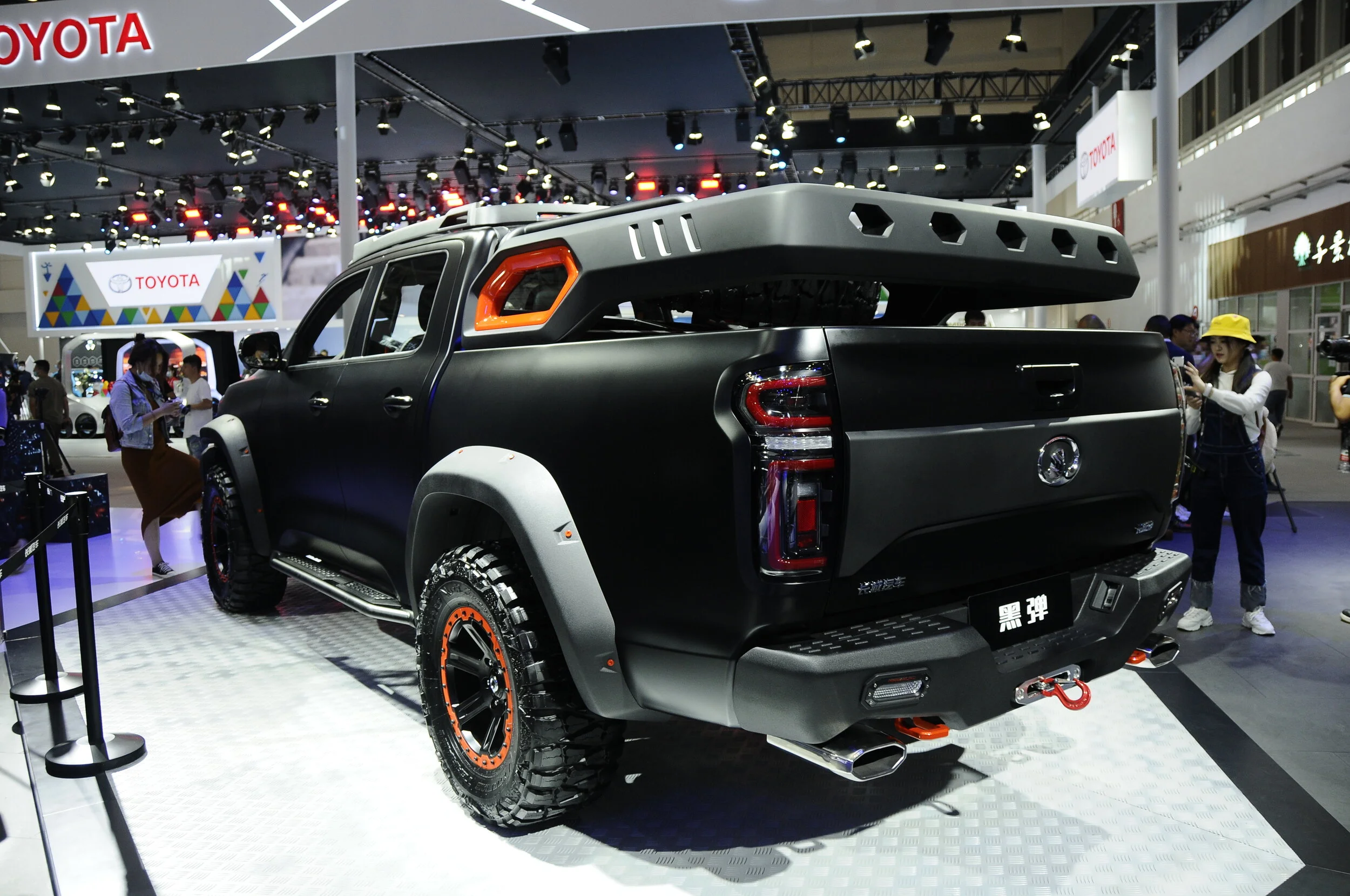
GWM’s latest shot … the Black Bullet edition of the Cannon/Ute was revealed at the Beijing motor show several days ago.

GWM’s latest shot … the Black Bullet edition of the Cannon/Ute was revealed at the Beijing motor show several days ago.

SO it’s the Cannon though the family might be simply called ‘Ute’, the maker has shortened its name from Great Wall Motors to simply GWM …. and expectation is that it will fire into New Zealand by the end of the year, in three double cab derivatives.

That’s the latest about the long-awaited big one-tonne wellside that was first shown to media, including this writer, at the international Shanghai motor show in April in 2019.

Back then it was designated a concept, yet appeared 100 percent production-ready, and it’s now at that state. 

The showroom fit versions look basically identically to the design study and have already spawned a special edition, called the Black Bullet, that was a star of last week’s Beijing motor show.

A replacement for the Great Wall Steed line that has been offered in New Zealand for some years, the Cannon/Ute is nonetheless a wholly fresh start, with no significant carry-over components.

The Ute unveiled in this Adventure specification last year. The kit-out was comprehensive and impressive.

The Ute unveiled in this Adventure specification last year. The kit-out was comprehensive and impressive.

Its promise is such that Great Wall Motors has also decided to rename as well; so, from end of year, it’ll be GWM, selling via the sales network established for Haval, GWM’s parent.

Haval has contributed the ute’s basic underpinning – it’s shared with the H9 H9 sports utility that came on sale in New Zealand in 2018.

Impression from considering the models at Shanghai – which ran from a hard-out off-road flagship (tagged Adventure on the stand) to a more streetwise ‘Urban Spec’ cruiser edition, both with a 120kW 2.0-litre turbodiesel and in four-wheel-drive, and something new to the sector, a full-out electric edition, in rear-drive – suggests Cannon/Ute has the size, drivetrains and equipment provision to be considered much more of a threat within the sector than its predecessor. 

Reports overnight from Australia suggest GWM, which runs out of Australia but with Auckland-sited representation consisting of just two employees with former Sime Darby and Jeep senior exec Todd Groves in charge, is good to go.

Pricing for Australia and NZ is understood to have been settled and the prospect is that both countries will share common specifications, spanning three distinct trim levels.

First examples are seemingly set to arrive in December, though launch proper might be delayed until January. 

The Black Bullet appears to keep many of the features seen on the Adventure.

The Black Bullet appears to keep many of the features seen on the Adventure.

China has been coy about releasing too much detail about the powerplant, though reports say a torque figure of around 400Nm seems likely. The transmission choice is as indicated at Shanghai; so a six-speed manual and eight-speed automatic transmission. Steed was manual-only.

A teaser site for the new ute operating in Australia suggests a 9.0-inch infotainment system with Apple CarPlay and Android Auto capabilities will be standard.

Lane-keep assist, front and rear parking sensors and an extendable ladder to access the tray will be available for some variants.

Best in class leg room is also promised. The Adventure concept was impressively spacious in the rear and the bench seat was comfortable for a ute, largely though the seat back being set at an angle, rather than placed fully upright as it common it utes.

Suspension is independent up front, with a leaf-sprung axle at the rear, typical of the dual-cab segment.

Bosch all-terrain technology for the 4x4 system is promised. A year ago GWM promised their production edition would deliver a seven setting All-Terrain Control System, three diff locks and a feature you generally have to purchase from an after-market specialist: A built-in winch.

 Groves has been approached for comment.

the ‘Urban Spec’ edition was also shown at Shanghai.

the ‘Urban Spec’ edition was also shown at Shanghai.


EQC shaking strife as sister ships announced

A slower local start than expected for Benz’s electric division pathfinder model hasn’t diminished distributor belief in this broadening power play.

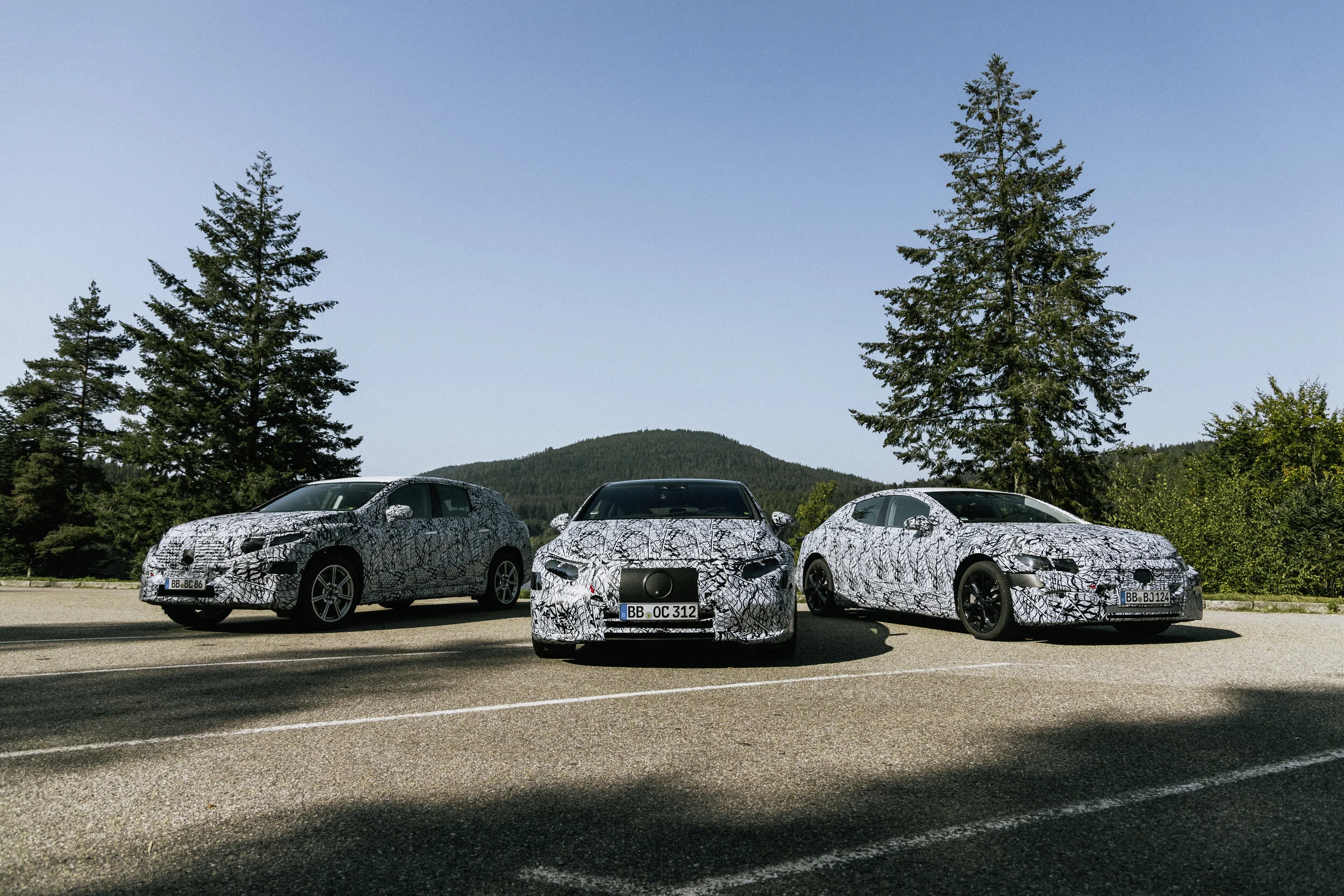
Yet to be unwrapped but all almost certainly due to present in New Zealand - here are three future EQ models under test.

Yet to be unwrapped but all almost certainly due to present in New Zealand - here are three future EQ models under test.

MORE electric cars are coming from Mercedes – and, once supply constraints are lifted, more effort is going to be put into achieving additional market involvement for the one already here.

 In acknowledging interest in the six additional EQ models that the parent brand has confirmed, Mercedes Benz New Zealand has also confirmed it would love to have seen more than 23 registrations to date for the EQC that has been available since January and presently is the sole standard bearer for the brand’s electric mobility division.

The modest count – which places the model at level pegging with the Tesla Model S and Kia Niro as the country’s 11th most popular brand-new electric cars represented by distributors – is not down to consumer disinterest, the local operator insists. 

Quite the opposite. Definite buy-in is perceived for the NZ edition, provisioned as a EQC 400 4matic, costing $142,900.

However, emergent constraints on the medium-sized sports utility’s production and availability has hindered local distribution and been a blow given that New Zealand was among the first countries in the world to receive the EQC.

Even though the production rate of this car (and others) has picked up in recent months, the supply chain has yet to recover.

restricted supply has pegged back the EQC sales expectation - but more cars are coming.

restricted supply has pegged back the EQC sales expectation - but more cars are coming.

Interestingly, Benz refuses to specifically cite the coronavirus pandemic as being the big issue; though it obviously has been for all car makers.

Nonetheless, the Auckland-based outfit has seen few cars arrive since securing an initial shipment to time with national release at the start of the year. 

“The EQC has been a success for us so far in New Zealand, selling out all available units,” a local spokesman said.

“We knew that the supply ramp up would take time due to the global demand for the vehicle, and we look forward to fulfilling more of the current customer demand in the near future.”

 The car will be subject to more intense push soon; a shipment of additional stock is reportedly already en route. A fresh push seems set to be timed for the start of 2021.

 The renewed campaign will ultimately potentially time with the emergent availability of more EQ family members, confirmed by head office just this week. 

Germany has cited six new full-electrics as being incoming for production, four of which will be underpinned by a new modular platform still under development.

The NZ office has shied from saying when the cars might avail here.

EV uptake in New Zealand is still modest.

EV uptake in New Zealand is still modest.

“We’re optimistic and excited about the growth of the EV portfolio and we hope to bring these new variants to the New Zealand market in the next few years. For the moment it is too early to confirm when the next EQ variant will arrive on our shores.” 

As a sign of the how far the programme surrounding the EVA2 common scalable architecture has progressed, Benz released images of disguised cars undergoing trials in public. These have since been identified as the EQE and EQS luxury sedans and EQS sports utility.

The EQS sedan – which can be called an electric S-Class – is set to be in build next year, the others in 2022. 

Before all that happens, the brand will launch two electrified versions of vehicles that provision now in fossil-fuelled form – the EQA, which spins off the GLA, and the EQB, derived from the GLB.

Also on the electric release roster are a fully battery-reliant version of the rugged G-Class as well as a EQS in Maybach format. The uber-plush ultra-premium brand has not really represented in NZ to date; the closest market for Maybach being Australia. However, it seems possible that might change now that it has electric and also with the GLS large SUV also provisioning as a Maybach model.

In addition to all this, the make has unfolded plans for a new fully electric architect designed for compact and medium-sized vehicles, called MMA, arriving in 2025, and has used the Beijing motor show to display a concept, the EQXX prototype, which promises the world’s longest electric car range.

That’s a bold statement, given the maker has already cited expectation of the

EQS achieving 700 kilometres’ range, based on the European WLTP testing standards, when provisioned with a 100kWh battery. It's likely that a range of smaller battery options will also be made available.

The production centre for the luxury electrics is the brand’s Sindelfingen ‘Factory 56,’ which is one of the world’s most technically advanced manufacturing facilities. Factory 56 is also home to the new S-Class, incoming here soon, in standard and hybrid forms. 

Mercedes ideas about EQ styling has been expressed by concepts, such as the 2019 Vision EQ Silver Arrow.

Mercedes ideas about EQ styling has been expressed by concepts, such as the 2019 Vision EQ Silver Arrow.

As much as EQS is considered part of the S-Class family, Ola Kallenius – chairman of the board of management of Daimler AG, and head of Mercedes-Benz – has assured it will have its own distinct entity: “It’s not our goal to say here’s another S-Class that looks exactly the same, it’s just a powertrain difference. It will be a different luxury tech proposition.”

The Benz push aligns with a public pledge to achieve carbon neutrality by 2030 and is another reminder about how serious this and other makes are about divesting from fossil fuels. The world’s oldest make is going hard; it claims all-electric and plug-in hybrid vehicles will account for more than 50 percent of its sales before the end of this decade.

 It’s a shift that New Zealand could conceivably find relatively unchallenging to accept, in that our electricity production infrastructure is so obviously Green-minded, far more so than in most countries thanks to our high reliance on hydro, wind and geothermal generation.

The lack of Government incentive to help consumers buy into brand-new EVs, plus the market being open to used and grey import electrics that are often perceived – usually wrongly - to be better value, and even the relatively low price of petrol and diesel is patently inhibiting any serious swing toward plug-ins.

To date this year, just 1084 brand-new electric passenger vehicles have found homes; a fraction of the total count of new cars registered this year, in a market condition that is down almost 25 percent on the same period of 2019.

The model with the highest count of registrations is the Tesla Model3, with 414 plated-up to date. That’s not necessarily down to a rush on the car now; it’s effectively Tesla making good on orders that might be placed at least a year.

The Hyundai Kona comes second, with 171 units, then the Nissan Leaf, with 116 – though many of these might have been parallel imports. The VW Golf has achieved 69 placements, the Jaguar i-Pace and Tesla Model X 47 each and the Audi e-tron 38, a count also accrued by the Hyundai Ioniq. Next come the Mini hatch, on 31 and BMW i3, with 24.

Under-performing the EQC, Model S and Niro are the Renault Zoe (six), LDV EV80 (four), Porsche Taycan (three, though availability has just begun), Renault Kangoo (two), the list rounding out with three models the general public is likely to be unfamiliar with taking one registration apiece. These being the Factory Built EV10, the Factory Built Souzhou and the Polaris Groupil.


From Holden NZ to GMSV – new jobs for Ebolo, Aquilina

Two Aussies who’ve commanded Holden’s operation here are about to report for duty with General Motors.

Talk is that two performance Cadillac cars, the CT5-V (pictured) and the CT4-V in optimised Blackwing tim, might join the Chevrolet Corvette and Silverado 1500 as GMSV products here.

Talk is that two performance Cadillac cars, the CT5-V (pictured) and the CT4-V in optimised Blackwing tim, might join the Chevrolet Corvette and Silverado 1500 as GMSV products here.

THE present boss of Holden New Zealand and his predecessor have progressed to senior positions in the organisation that takes over General Motors’ interests in a post-Holden world.

Marc Ebolo, who has had the unenviable task of being the top Holden exec in New Zealand as the Australian make dismantles, has been appointed managing director of GM Australia and New Zealand.

The two-decade General Motors commercial and product veteran’s new task is effective from November 1.

 GM Senior Vice President and President GM International, Steve Kiefer, said Ebolo would lead GM’s operations across Australia and New Zealand.

These comprise the newly formed GM Specialty Vehicles (GMSV) as well as Isuzu New Zealand – this being the heavy vehicle side, not the one-tonne ute business, which is in independent hands – and the Holden Aftersales operation for Australia and New Zealand.

Marc Ebolo

Marc Ebolo

Ebolo became Managing Director of Holden New Zealand in June 2018, succeeding Kristian Aquilina, who returned to Australia to at short notice in April of that year to take over Holden’s marketing push.

Now Aquilina is moving again, this time to a new role in GM – as managing director Cadillac International Operations and Cadillac Middle East, based in Dubai, United Arab Emirates.

It is not clear where Ebolo will be based but odds on it will be in Australia.

He joined joined Holden in 2001 and came to NZ with a wealth of experience from Holden and General Motors, having returned to Australia in 2017 as general manager – revenue strategies, from a posting where he managed GM’s regional operations across Malaysia, Brunei and Fiji. 

Kiefer cited Ebolo’s “deep experience” in leading markets and working across sales, strategy and product planning in Australia, New Zealand and Southeast Asia will be significant assets through the launch and development of GMSV, as well as driving performance in the aftersales and Isuzu businesses.

“GM continues to see significant opportunity in Australia and New Zealand,” said Kiefer. 

“We are confident that under Marc’s leadership, our GMSV business is ready to compete in key niche segments, including the Silverado light and heavy duty, as well as the C8 Corvette, coming next year.” 

Kristian Aquilina

Kristian Aquilina

The transition to GMSV spells an end to Holden Special Vehicles, here and in Australia. There is no word about the future of the specialist make’s NZ regional manager, Andrew Lamb.

GMSV has already confirmed it will take over HSV’s stake in the joint venture between Walkinshaw Group and GM based in Melbourne.

Its task initially will be to continue exactly what HSV has been doing up until now; take North American-built, left-hand-drive GM product and convert it to right-hand drive in Melbourne.

Specifically, that’s just the Silverado 1500. HSV ceased remanufacturing of the Camaro performance coupe into right-hand drive in April. There’s no plan to restart this. However, there has been talk that two Cadillac performance models, the twin-turbo 3.6-litre V6 CT4-V Blackwing and the 6.2-litre V8 CT5-V Blackwing, could yet undergo the process.

The rumour stems from a trademark filing made in Australia on August 31, in which GM seemed to be looking to secure the Cadillac name and logo under the Class 12 and Class 37 goods and services groups. The trademark will be applied towards “vehicles including motor vehicles; engines for motor vehicles; cars,” as well as “maintenance, servicing and repair of motor vehicles.”

The Corvette, of course, is being built in right hand drive at the famed Bowling Green assembly plant in the US.

new Corvette with be GMSV’s halo model.

new Corvette with be GMSV’s halo model.

Ebolo said that customers and partnerships were his main priorities stepping into the role.

“In Australia and New Zealand, we will work very closely with our key partners – the soon-to-be-appointed GMSV dealers, Holden service outlets, Walkinshaw Automotive Group and Isuzu – to grow our businesses and theirs,” he said. 

“I look forward to working with our partners and to bringing to Australia and New Zealand exciting new vehicles from GM’s global portfolio, to compete in niche segments.”

Aquilina said he and Ebolo would work on a detailed transition to ensure continuity for teams, partners and customers.

“I am privileged to have worked with so many talented people who, among other things, have implemented a challenging but significant transformation of our business in Australia and New Zealand. Now is the right time to hand over to Marc,” said Aquilina.

“I have every confidence that under Marc’s leadership, the team will be successful well into the future.”


Bonkers now in blue

Honda’s hard-as hottie achieves dynamic updates – and a noise-maker.

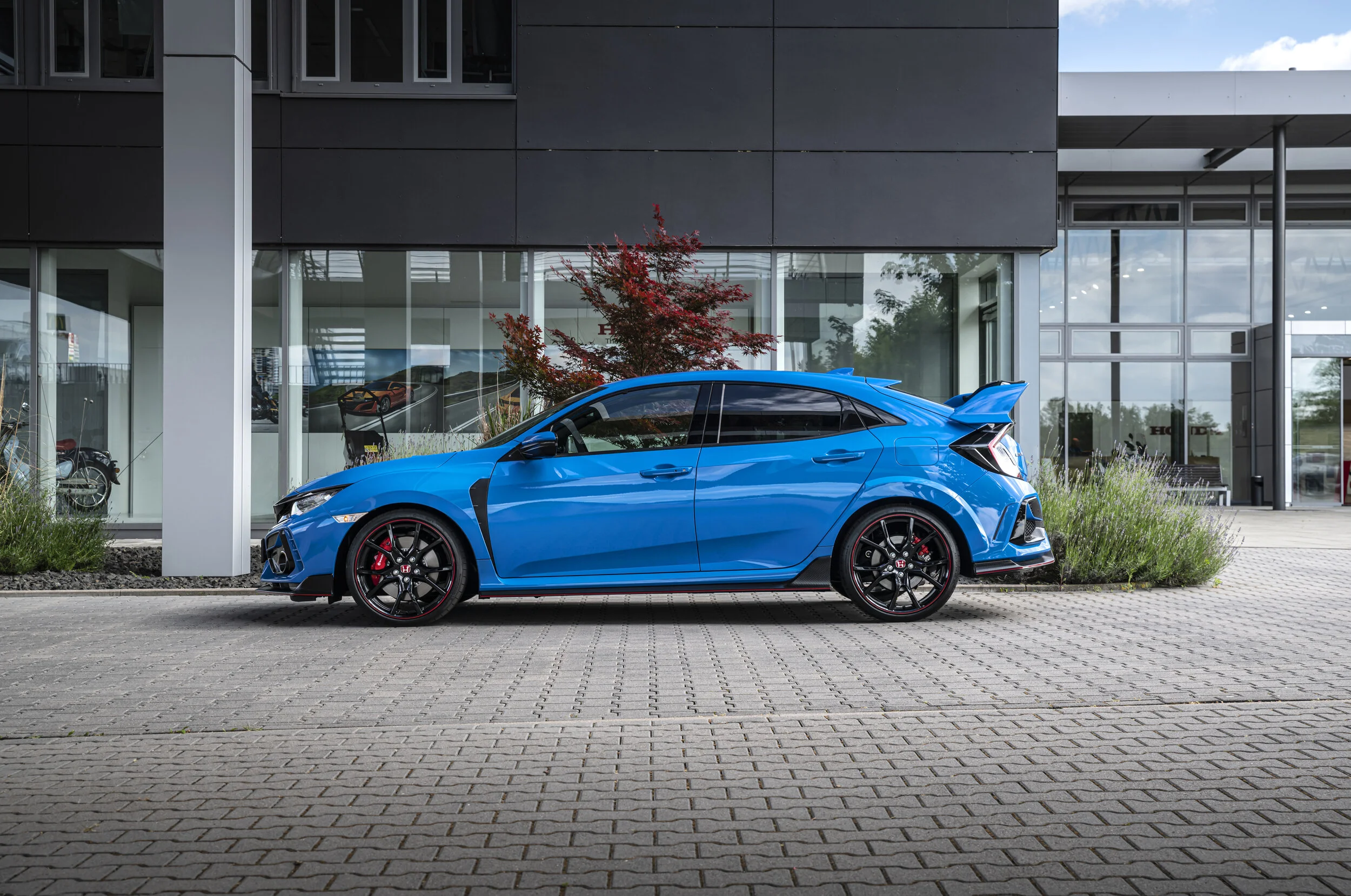
2020HondaCivicTypeR-overseasmodelshown(2).jpg

STILL plenty of edge – in every sense, including visual – but perhaps a less remitting ride. 

That’s the deal with the MY20 update of the Civic Type R hot hatch in a New Zealand specification announced today, a week ahead of public release.

Revised pricing is also part of the update; at $62,990 the incoming variant costs $3000 more than the pre-facelift edition did at launch in 2017, but is also $2000 cheaper than the ‘Mugen-Equipped’ runout variant. 

General rule for a mid-life refresh is to tweak under the bonnet and perhaps alter the styling, but that doesn’t seem to be Honda’s way for a model that achieved 55 registrations in 2019 and a further 41 this year to date.

Unless you spot one in the one new colour, an effervescent sky blue, the best way to distinguish the MY21 Type R might be by driving feel. In that sense, it’ll be more about the dynamics than the power delivery.

The revision bypasses engine bay alteration, so it’s the same 2.0-litre still creating 228kW at 6500rpm and 400Nm from 2500rpm to 4500rpm, continuing to operate purely through a six-speed manual.

The origami styling is also largely unaltered, save for minor tweaks – perhapsonly the sharp-eyed will even spot the reshaped bumpers, an altered grille, the addition of some body-coloured accent blades, different surrounds for the driving lights.

2020HondaCivicTypeR-overseasmodelshown(6).jpg

So how has Honda’s team earned its dough?

Mainly through reworking the dynamics, which admittedly were already pretty good, and improving the ride quality – which, in original form, was a touch f-f-f-f-firm.

Aiming to reconcile the latter and further sweeten the first is the revised adaptive suspension, which now evaluates road conditions 10 times faster thanks to a damper software update. Result? Better handling response, better ride quality, Honda claims. 

The company also says stiffer front and rear bushings have resulted in sharper steering feel for better control and improved toe-in characteristics when cornering respectively, with the former achieved alongside new lower-friction ball joints.

An upgraded braking system is also implemented, with new two-piece floating front discs fitted alongside fresh pads with a more fade-resistant material.

Brake stroke has been reduced by about 17 percent (or 15mm) under heavy loads, leading to a more immediate pedal feel, according to the company. The updated set-up decreases unsprung mass by around 2.3kg. 

2020HondaCivicTypeR-overseasmodelshown(10).jpg

The altered grille improves engine cooling and a revised radiator core also helps to reduce coolant temperature by up to 10 percent in high-demand scenarios.

Inside, the car now has an Alcantara-trimmed steering wheel and a new shift lever for the six-speed manual with a teardrop-style knob and an Alcantara boot. A 90g internal counterpart has been added to the latter to better feel and accuracy.

An updated 7.0-inch touchscreen infotainment system is also implemented, with physical shortcut buttons and a volume control knob now part of the package.

That might not excite rev-heads, but how about the following?

Drivers keen to keep track of their driving data will doubtless delight in the new LogR software, an app for an Apple or Android phone which can monitor performance, log lap times and score drive behaviour.

Also, though the engine hasn’t been altered, the impression of the sound it makes has.

An Active Sound Control is an exhaust noise enhancer; the idea seems to be that the sound system’s speakers emit additional and artificial noise during aggressive driving in the Sport and  Plus R modes but refines it further in the Comfort setting.

And, yeah, there’s the new colour, seen here: Boost Blue Pearl.

2020HondaCivicTypeR-overseasmodelshown(5).jpg


Market almost a quarter down on 2019

The new car market’s slump is becoming more pronounced.

Ford Ranger.jpg

DECLINING consumer interest, diminishing supply, a reflection of how a market looks when it isn’t being influenced by rental fleet demand? 

All have been cited by various sources within the motor industry as latest registrations data, the count for August, further supports a hefty drop in new vehicle registrations year-to-date compared to the same period last year.

“Year to date the market is down 23.8 percent, which is consistent with recent months data confirming our expectations that 2020 will finish about 25 percent down on 2019 volumes,” says David Crawford, chief executive of the Motor Industry Association, which represents new vehicle distributors.

His thought about why? Well, it all comes back to coronavirus, of course – the pandemic has slowed the vehicle industry and purchasing globally.

Specifically, Crawford ventures, it reflects a weaker economy affected by Covid-19. As for local influences? Well, the MIA hasn’t ventured that far, but others within the industry, speaking on condition of anonymity, have.

One says it’s pretty clear, now, that some brands are having trouble achieving supply of new products. Looking at more precise datasets than those shared by the MIA reveals a lot more, he suggests.

Another says the year to date decline reduces significantly when rental counts are excluded. “August can be a big month for rentals. Take them out and the decline is more like eight percent year-on-year, which isn’t so bad all things considered.”

Fair call? Well, when rentals are under the spotlight, really just one brand is affected more than any other, and that’s Toyota New Zealand. Interestingly enough, in a state of the national chat with motoring writers during last week’s MY21 Hilux event, TNZ CEO Neeraj Lala touched on the impact the collapse of the rental market had on his volume, noting that the rental count year to date in 2020 was about 90 percent down on the same period last year. 

In total, some 10,902 vehicles were registered last month, a decrease of 3623 units compared to September 2019.  

The top three plate-ups were the Ford Ranger (663 units) leading the Toyota RAV4 (464 units), and the Mitsubishi Triton (360 units).

The MIA also note a spike in electric vehicle registrations, due mainly to the Tesla Model 3; dissemination of the latest shipment of presumably pre-ordered cars accounted for 139 of the 243 fully electric vehicle registrations. Additionally, 54 plug-in hybrids and 927 hybrids – the latter mostly Toyotas - hit the road. 

Toyota was the market leader for passenger and SUV registrations with 16 percent market share (1,217 units) followed by Kia with 10 percent (801) and then Suzuki with 8 percent (625).

In the commercial sector, Ford retained the market lead with 25 percent market share (803 units) followed by Toyota with 13 percent (406) and Mitsubishi third with 11 percent (360).


Three-point plug

Mercedes has entered its smallest passenger model into the plug-in hybrid club.

19C0524_008.jpg

PLUG-in hybrids are a small - 496 units this year to the end of August - and technically fascinating market segment that sometimes looks poised for expansion.

And at other times it seems destined to remain a specialised niche, somewhere in the no-man’s land between hybrid-assisted models and battery EVs.

So far Mitsubishi has been the only brand to find traction in the PHEV sector.

Outlander PHEV sales account for well over half of all plug-in hybrid sales in New Zealand this year. And that’s a market with 20 different models on sale – and quite a few more on the horizon.

The Mini Countryman PHEV is the number two seller, but at about one-sixth the volume achieved by the Outlander.

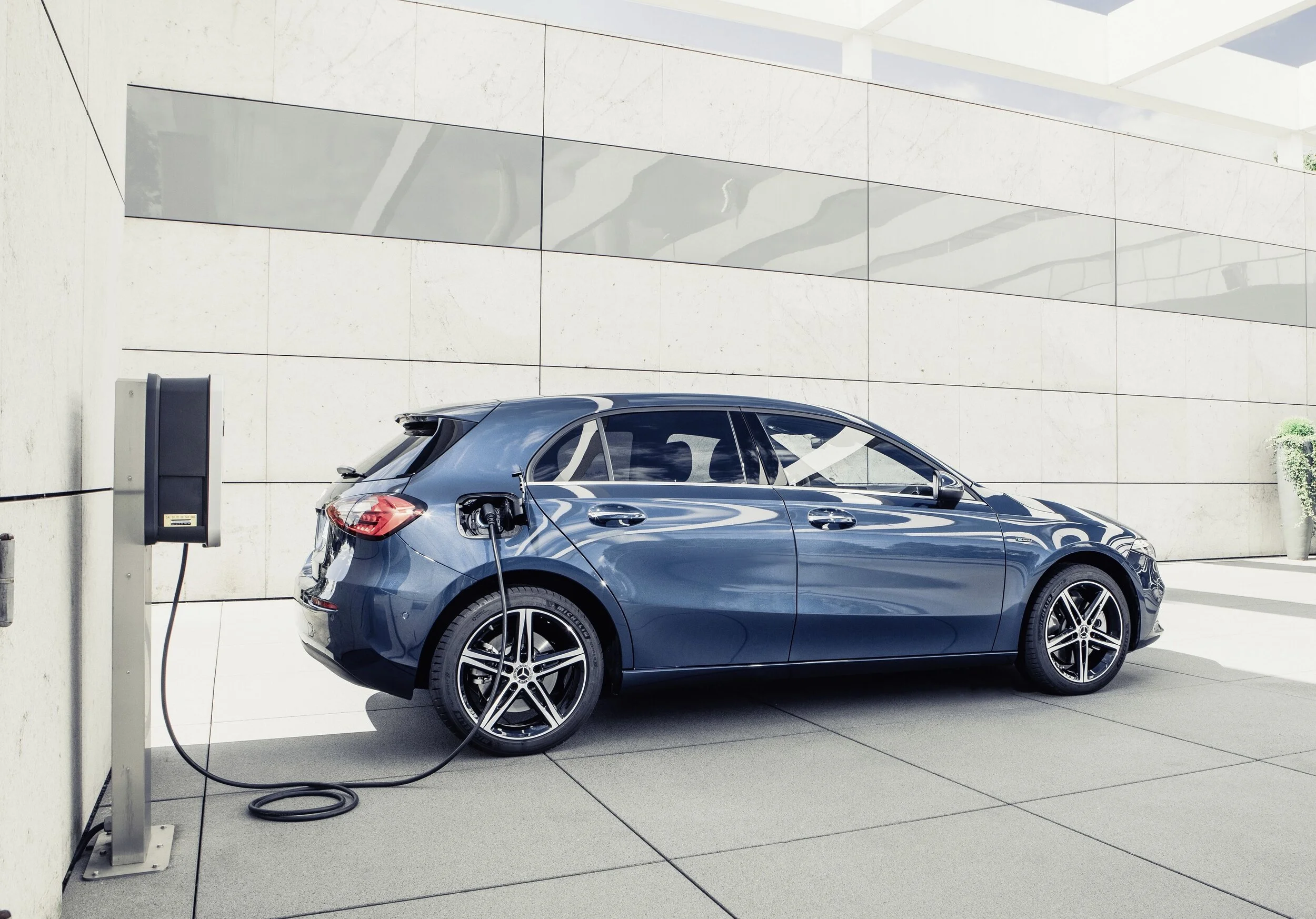
Luxury brands also dabble in plug-ins and Mercedes-Benz has so far offered C-Class sedan and GLC SUV plug-ins. The third offering in its so-called EQ Power family is the A 250e hatchback just announced for the New Zealand market.

19C0524_003.jpg

A further addition to the A-Class family - that now stretches from A 180 to ballistic AMG 45 S 4Matic - the A 250e hits a $72,300 price point. That makes the plug-in version $1900 more than the A 250 4Matic but still considerably more affordable than the hot Mercedes-AMG A 35 4Matic.

With a 15.6kWh battery the A 250e will travel further than most PHEVs on a single charge - an ADR-rated EV range of up to 73km.

A 1.3-litre four-cylinder turbocharged engine develops 118kW output and 250Nm of torque working in tandem with a 75kW/300Nm electric motor which can also recoup additional energy during braking.

The combined output of the hybrid powertrain is rated at 160kW and 450Nm. Acceleration from 0-100km/h is brisk at 6.6 seconds and combined cycle fuel consumption (ADR test) is 1.6L/100km with tailpipe emissions measured at 34 grams/km CO2.

The architecture beneath the fourth-generation A-Class was engineered from the outset to accommodate PHEV components.

The water-cooled lithium-ion, high voltage battery is mounted in the rear of the A-Class hatch and weighs 150kg. Thanks to a smaller 35-litre fuel tank and a repackaged exhaust system - with a rear muffler housed in the transmission tunnel and a centrally positioned exhaust outlet under the floor – there is only a small compromise of load space to 310 litres.

19C0524_014.jpg

The A 250e delivers power to the front wheels via an 8G-DCT Hybrid eight-speed auto designed to maximise the all-electric range. There are ‘Electric’, ‘Battery Level’, `Comfort’, `ECO’ and `Sport’ drive modes.

In the Electric programme the braking recuperation strength can be selected via paddles behind the steering wheel.

For the first time on a Mercedes-Benz vehicle, the combustion engine is started by the electric motor – the A 250e does not have a separate 12-volt starter. And the A 250e is also the first Mercedes-Benz plug-in passenger model to offer DC charging capability.

The A 250e is equipped with a Type 2 plug capable of delivering charge via AC power at a rate of up to 3.7kW.

To maximise the speed of charging at home or work, customers can install a Mercedes-Benz Wallbox Home charger.

This can be installed on regular single-phase power (by a qualified electrician) to deliver up to 7.4kW, or up to 22kW on three-phase power.

As a $1990 option, customers can purchase a DC Charging Package which enables DC fast-charging at 24kW via a Type 2 CCS plug.

19C0524_030.jpg

Using DC charging, it may be possible to charge from 10 per cent capacity to 80 per cent in as little as 25 minutes. The Charging Package also doubles the AC charging capability to 7.4kW.

Aside from its powertrain and charging technologies the A 250e offers a familiar package to premium hatch customers.

Standard equipment includes 18-inch Aero alloy wheels, the intuitive MBUX infotainment system with voice control and a fully digital widescreen cockpit, NTG6 navigation, Artico upholstery, smartphone integration including wireless charging and LED headlights.

Pre-entry climate control can cool or heat the vehicle before it’s started thanks to the fitment of an electric refrigerant compressor. This can be controlled via the Mercedes me Connect suite of services from a connected smart phone, which also includes remote vehicle status monitoring.

Standard safety equipment includes Blind Spot Assist, Active Lane Keep Assist, Traffic Sign Assist, nine airbags, Pre-Safe accident anticipation system and Adaptive High Beam Assist head lights.


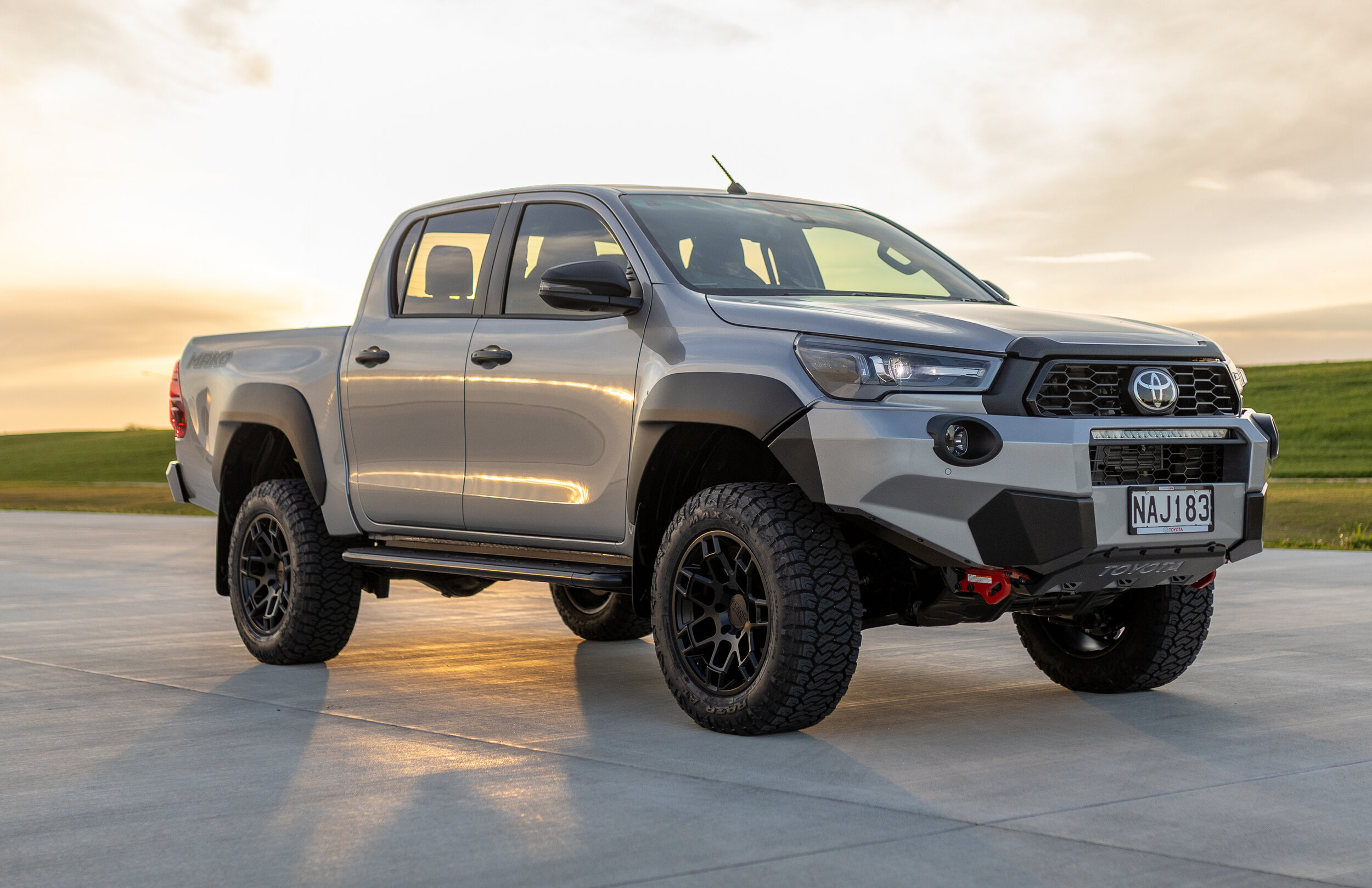
Dissecting the Mako


Everyone says it’s a Raptor rival – really, though, this special Hilux is about more than Eagle versus Shark.

2021-toyota-hilux-mako_50393244426_o.jpg

TIRED of being second best?

Toyota New Zealand tends to affect an off-hand attitude when subject of how the current generation Hilux has been out-performed by a certain other ute in the sales stakes. They talk about how their truck plays its own game and say they’re more interested in optimising customer well-being than beating the Ford Ranger for registrations.

Well, it’s all just brave talk. Assuredly, they want to even the score in respect to perception of which is the better rig. And they would love to reclaim top spot on the sales chart; a place Hilux hasn’t occupied since 2016.

The updated Hilux is a massive improvement on its forebear. TNZ’s claim that the 2020 edition has turned up the heat on the hotly contested utility market with a more powerful turbo-diesel engine, more capability and a tougher exterior design. The new technology and added safety features also do it proud.

Still, it doesn’t hurt to have a hero. That vehicle is Mako, a local development of the SR5 Cruiser wholly carried out by Kiwis – one particular involver for deciding suspension and tyre choice was Tony Groome, a well-known Manawatu off-roading identity who has been working with the brand for some years.

 Mako carries a $21,000 premium over the donor: So, a $79,990 buy-in.

The obvious rival is the Ford Ranger Raptor, that costs $5000 more, but it could just as reasonably be considered an alternate to the $74,990 Nissan Navara N-TREK Warrior and - though it is basically about to cease local representation - Holden Special Vehicles’ Colorado SportsCat, which sat at $82,990. Perhaps even the $82,990 Volkswagen Amarok V6 Aventura. 

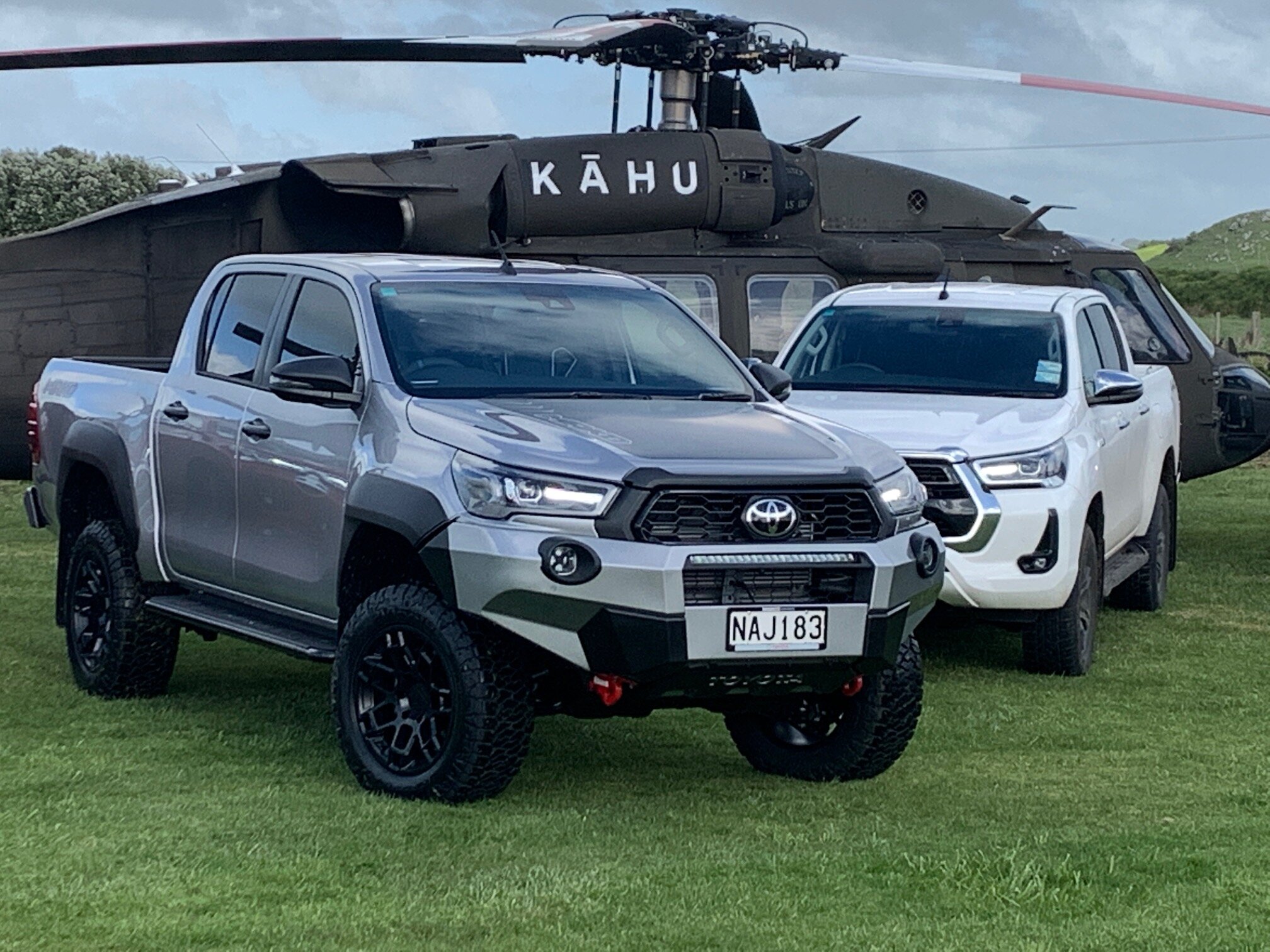
Toyota NZ didn’t so much launch the Hilux Mako as deliver it … by Blackhawk helicopter, to a media stop at the Cape Egmont Boat Club.

 Yesterday’s story gave a brief summary about Mako and TNZ’s hopes; that, despite being available to customer order and technically a “special launch edition”, will be part of the regular range for the foreseeable future.

Today it’s time to dissect the beast.

What’s in a name?

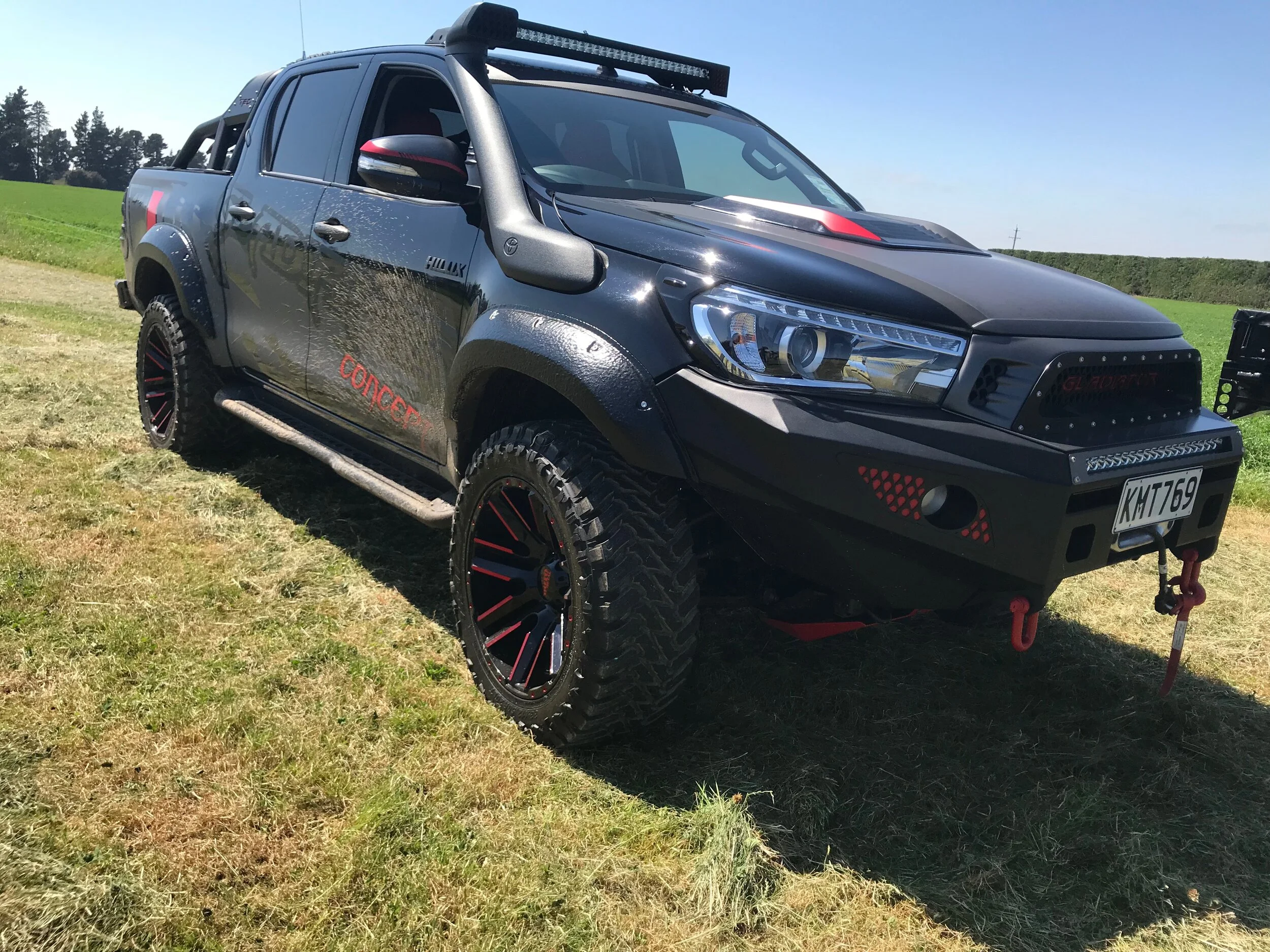
Specifically, why call it Mako rather than re-use Gladiator, the name given to the beefed one-off TNZ created for Fieldays a few years back?

There’s a matter of copyright: You might realise that Jeep’s new Wrangler ute is called the Gladiator. That nameplate is employed worldwide and TNZ realised that now the American model is on sale here, it would assuredly be picking a legal stoush by continuing with a name that had been previously uncontested.

Another reason? A new name imprinted that, even though what we get now does have an association with that special model it created (more in a minute), this is a different deal, being a volume consideration. 

Heres’s the one - or, rather, the one-off - they did earlier … the Hilux Gladiator.

Heres’s the one - or, rather, the one-off - they did earlier … the Hilux Gladiator.

So, anyway, it came down to picking a name that was even tougher. TNZ CEO Neeraj Lala claims credit. He’s got a thing for sharks and one kind in particular: The “toughest, strongest, most aggressive” species roaming the open ocean. 

“If you look at the front of the truck, it actually looks like a shark.” A motif in the front badge logo, and the bonnet decal, represent a shark fin.

 Shouldn’t a shark have extra bite – why no under-bonnet modifications?

Outwardly, TNZ will maintain the 2.8-litre now that it has been upgraded to create 150kW – a 20kW increase over the pre-facelift output – and 500Nm (up 50Nm) is quite enough, with much improved low to mid-range oomph.

Beyond that, retuning the engine would have become an expensive and long-winded exercise, and not a job Toyota Motor Company would have allowed to be left to a local tuner. Japan would have wanted any recalibrations to meet their most stringent requirements. Same goes for any transmission fettling.

So, basically, oily bits were a no-go area though Lala prefers to say it was “an area we didn’t explore. From own our testing we thought the power and torque were quite satisfactory, pretty good.”


Anyway, unchanged performance is par for the course in this category. Raptor shares its 2.0l biturbo engine with other Rangers. The N-TREK and the SportsCat also carry unaltered versions of their donors’ drivetrains.

How much of it is just a dress-up? 

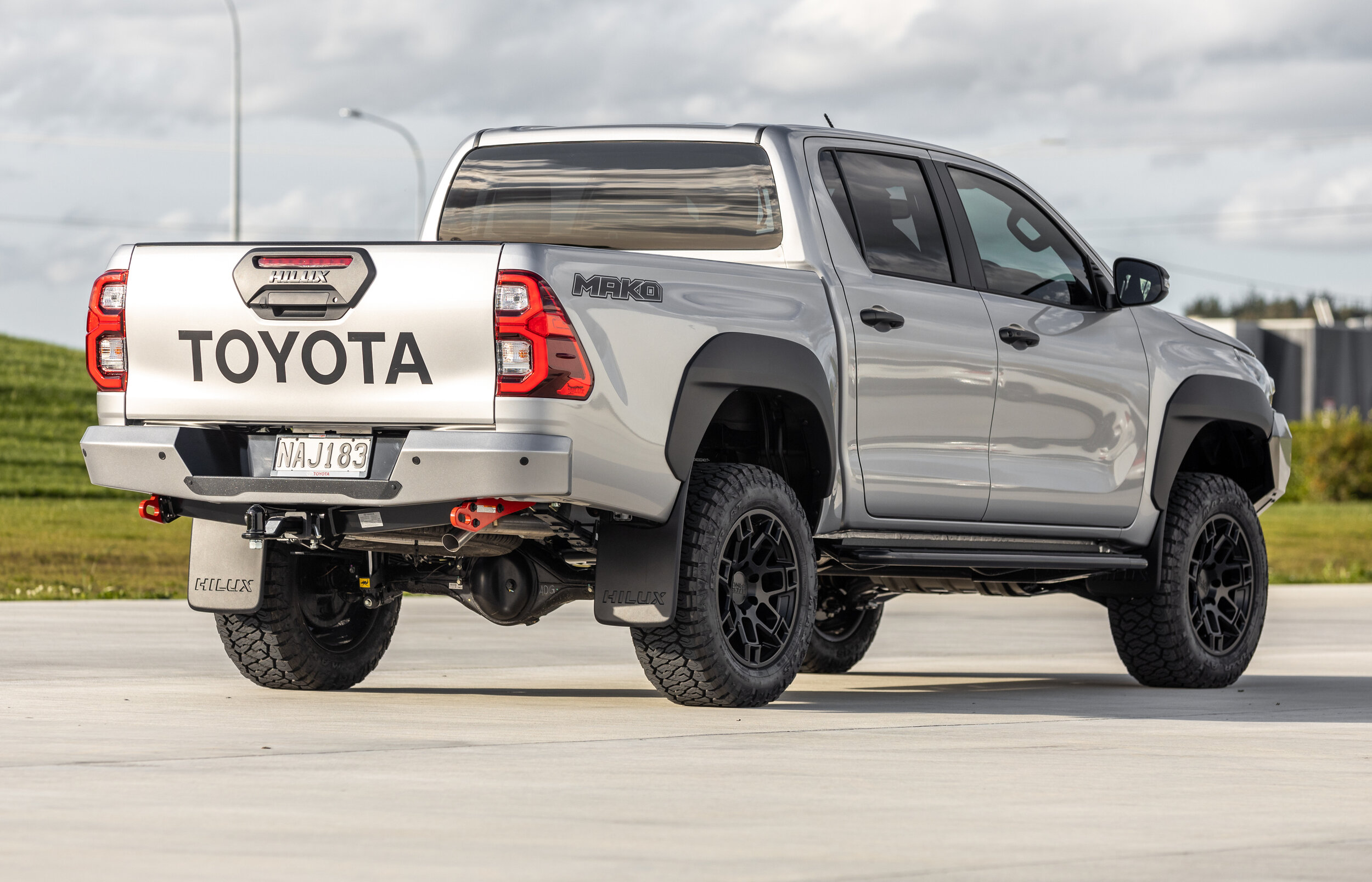
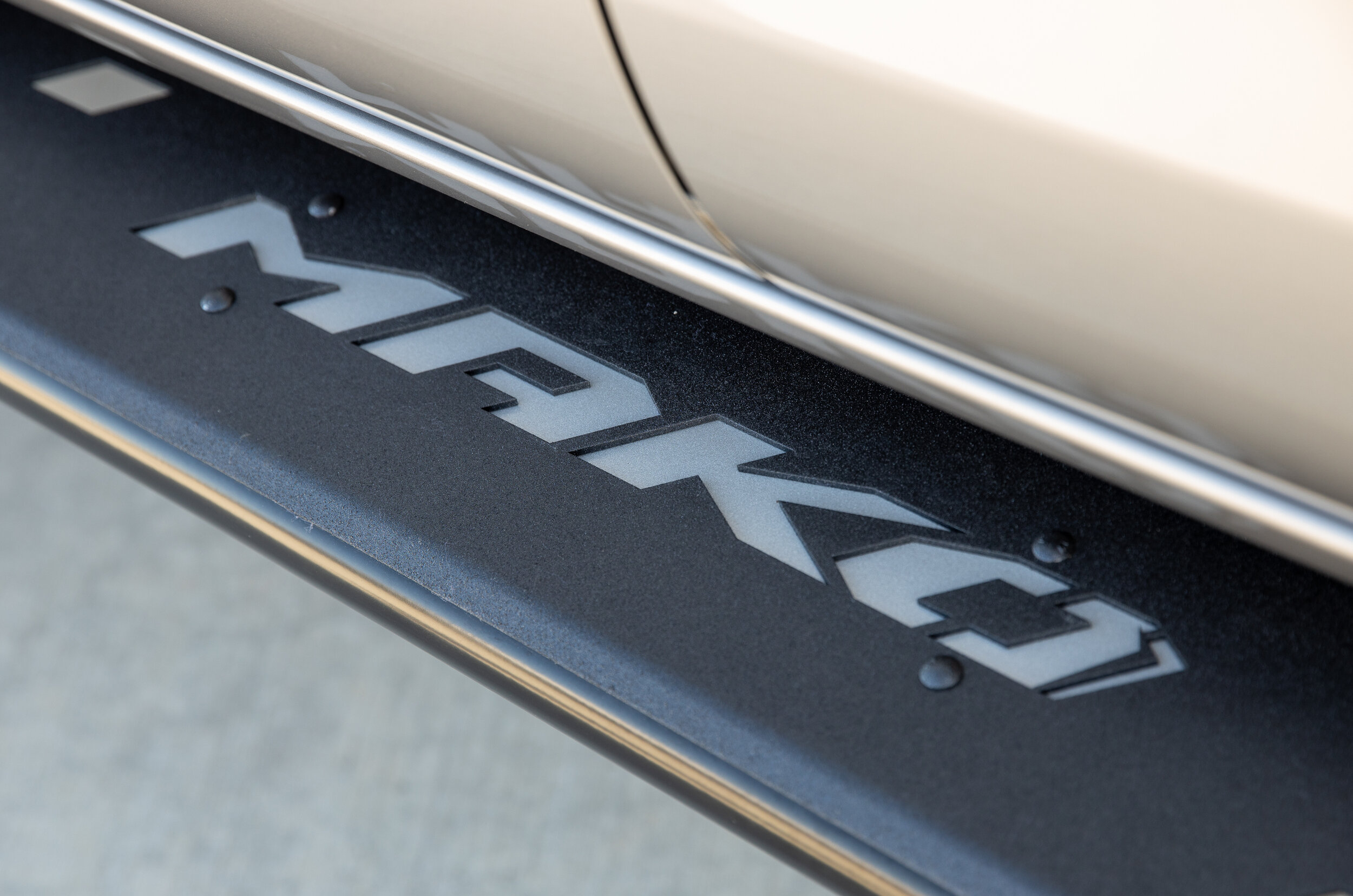
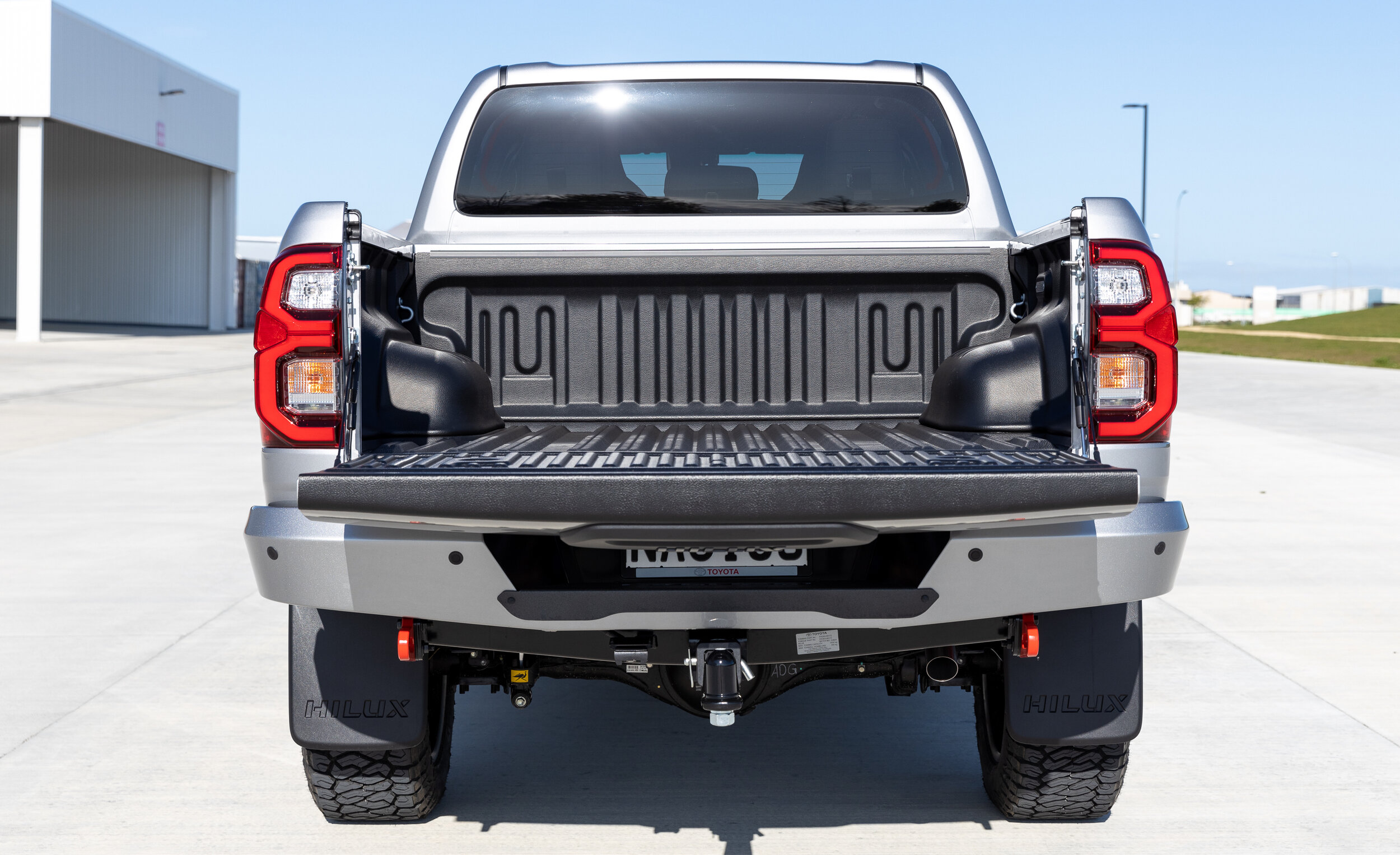
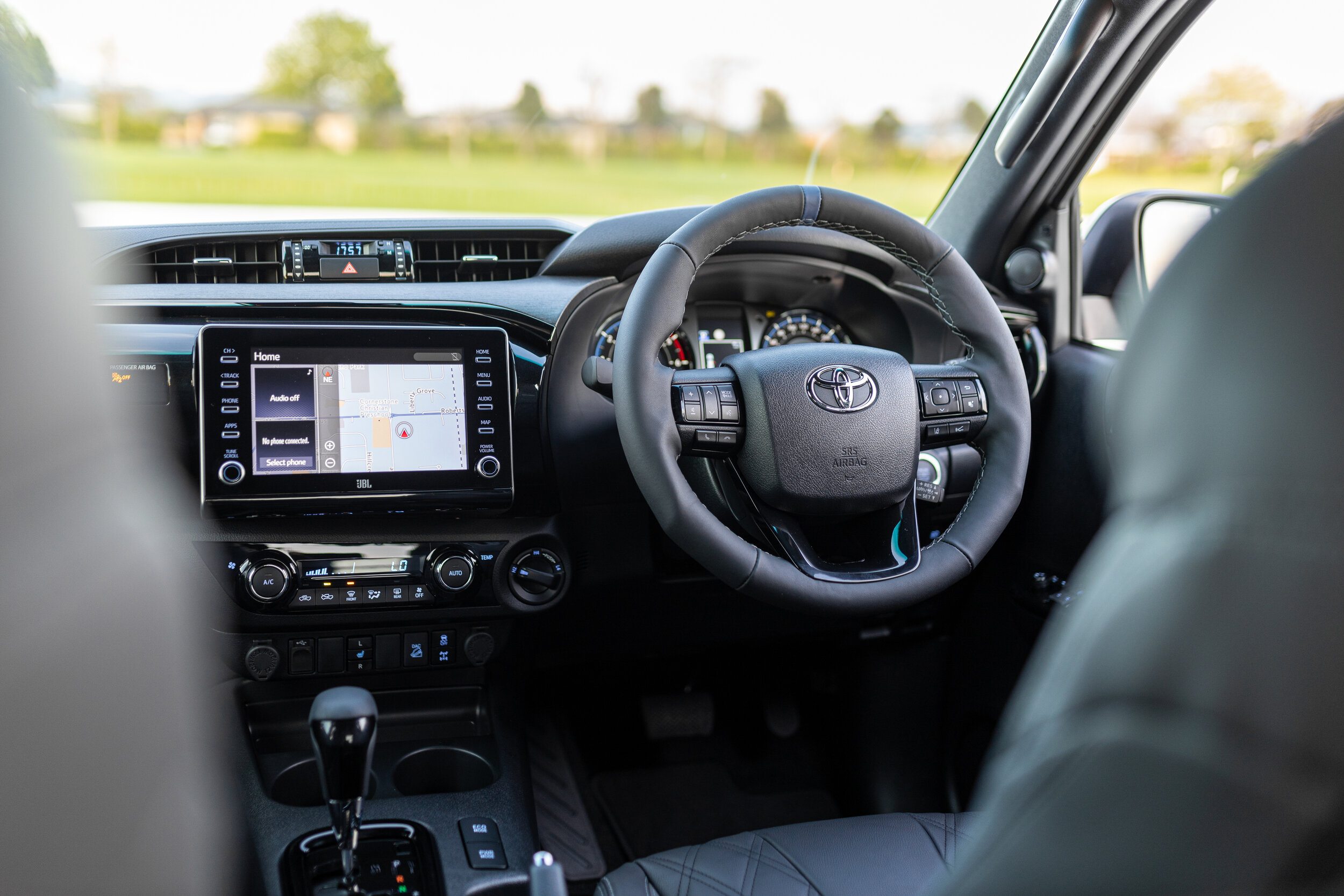
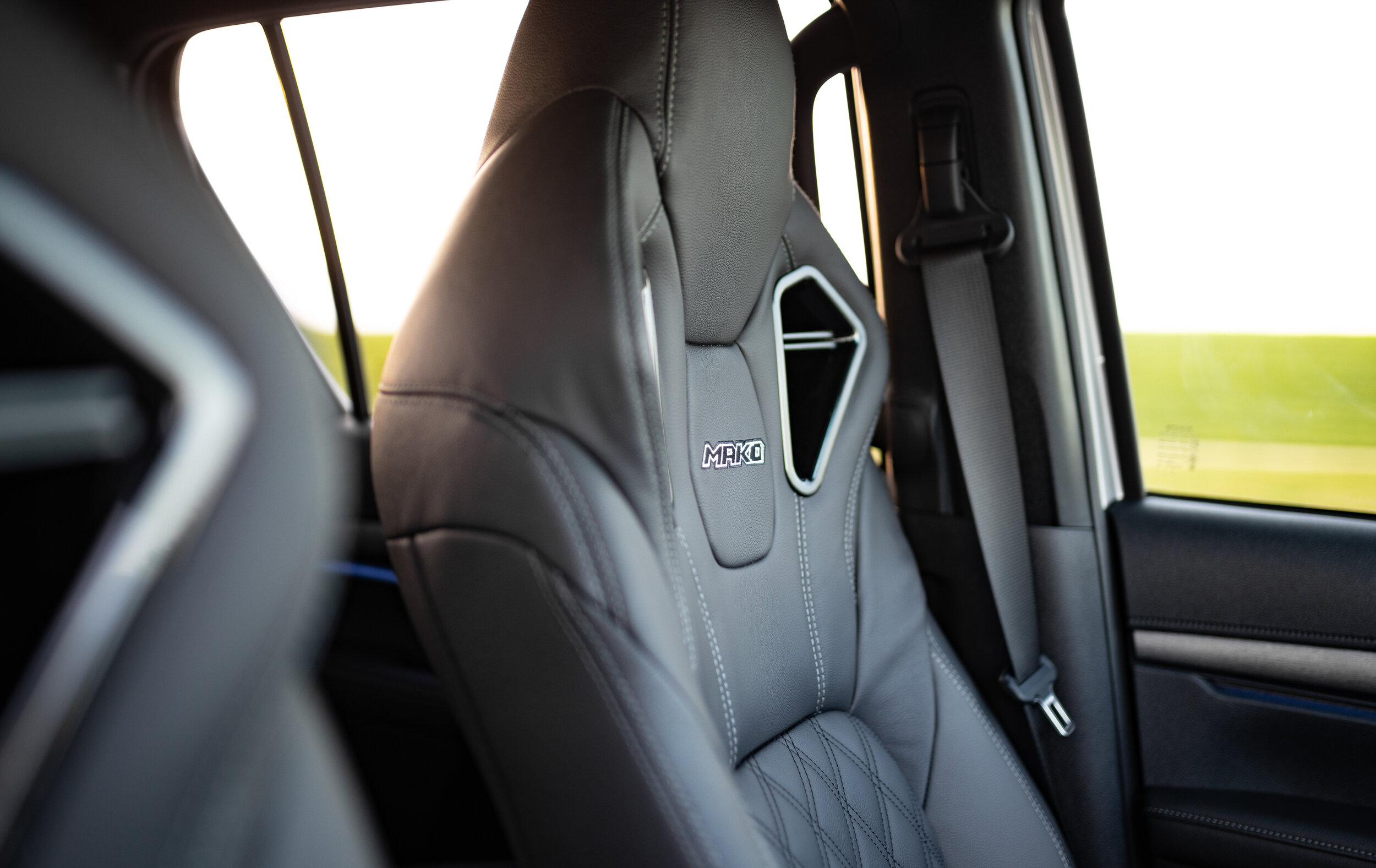
Probably around 50 percent at most. Assuredly, there are extensive body modifications that are basically bolt-ons for visual effect: The unique fender flares, side steps with “Mako” logos, T Custom Sports Guard non-slip deck liner, damper-shocked soft-close tailgate and heavy duty rear step bumper are examples of this. Likewise, on the inside, the front chairs are replaced by higher-backed and bolstered motorsport-style items (akin to Gladiator’s tombstone seats), trimmed in full custom leather by a local supplier. And yes, they’re still heated. It also achieves a bespoke steering wheel that’s thicker-rimmed than the standard item and a leather centre console lid.

However, there are also a lot of specially-engineered bits that make real difference in how it performs. These are the items that will make the Mako feel substantially different to the donor. 

So examples?

Well, most obviously the suspension, the wheels and the tyres.

Lala says the determination to fit out the Mako with a full ARB Old Man Emu BP-51 shock set came from having testing “the key competitor in the segment”. Let’s call it Raptor.

However, their choice was also made through previous experience: It’s been a popular aftermarket kit with Hilux customers who are serious about off-roading. We’ve driven a earlier gen Hilux with it - and were hugely impressed. And yes, you’re correct in assuming TNZ’s first use was with the Gladiator.

A fit-out that has required low volume certification gives a 40mm front and 50mm rear lift and has microcharger adjustable compression and rebound control. No clearance and departure angle information was provided. The rear springs are tweaked, too; they’re now to what’s being called Dakar spec. Says Lala: “This upgrade was the thing that we really needed to work hard on. We think it’s one of the best suspension packages on the market.”

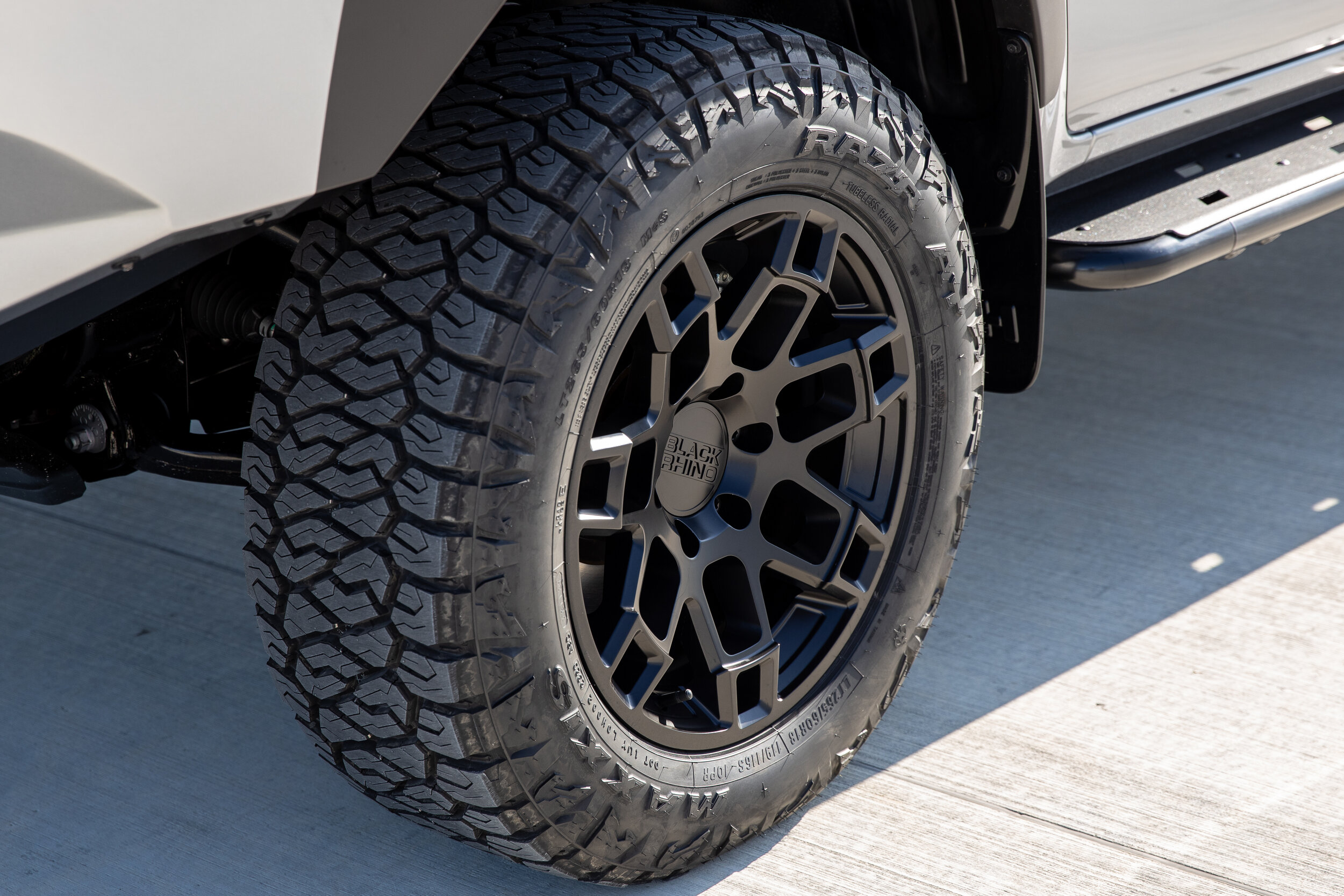
 Going to a bigger wheel and tyre was also a Gladiator 101, but Mako is less extreme. Those 18-inch Black Rhino rims sourced from the US are two inches smaller than the Gladiator’s, though with Maxxis Razr 265/60 all-terrain tyres, the rolling radius is likely around the same as with the show truck, which wore 33 inch by 12.5 inch Atturo Trail Blade M/Ts. Mako’s is a better blend for on and off-road capability, TNZ has decided.

Mako’s brake package is more extreme. The Fortuner SUV is a wagonised Hilux, but it has 15mm larger rotors and four-piston calipers. They’ve been used here. Also, Mako has harder brake pads than a regular Hilux. Braking performance is “significantly improved.” Braided front and rear brake lines are also used, to contribute to improved pedal feel. 

Am I right in thinking that front bullbar looks familiar?

If so, then you’ve been checking out Toyota Australia’s Hilux Rugged-X, which is their own variant – now in its second-generation – homegrown for bush-bashing. The Rugged-X’s hoopless steel front bar is a special piece of kit that the Aussies were previously reluctant to share.

The whole shebang – and that includes an integrated LED light bar and bash plates – is designed to ensure the vehicle’s crash test integrity is exactly the same as it is with the regular bumper; achieving this – and also allowing donor car’s parking sensors to remain operable - has required some incredibly complex engineering.

 The piece was further altered for Mako, says Lala. It’s had a custom modification to account for localised finishing, such as the garnish under the headlight. “That’s unique to here, so we had to modify the bumper to fit.” Side fog lamps were also integrated here. 

In case you’re wondering, other common Mako/ Rugged-X elements are those red recovery tow hooks, fender flares and the heavy-duty rear bar with step.

 Are there any options? 

Just one. The towbar kit, which also includes provision of the rear recovery hooks. We assume buyers could also install diff lockers, which are available with the Old Man Emu kit. Again, we’ve tried a Hilux with these and were stunned by what the rig could do.

Does the rework affect the warranty?

Not at all. It has the same cover as any other Hilux, so up to five years warranty, roadside assistance, WoF coverage and capped-price servicing. Plus the price is fixed and not subject to any fluctuations that might impact of the cost of individual add-ons. So the sticker is a Toyota Driveway Price (TDP) that includes on-road costs. As mentioned yesterday, Mako also maintains the same 940kg payload and 3500kg braked tow rating as other double-cab 4WD Hilux models.
When and how can I buy it?

The second part first. It’s not a showroom model. Vehicles are pre-ordered and then put together, at the company’s refurbishment plant in Thames; so it’s a total custom build. Buyers can get to choose colours and will get updates on the progress of the refettling. At the moment there is just one example in existence and the programme really will take a couple of months to get going. Parts are still arriving and though build begins just before Christmas, the production process won’t really get up to full speed until early next year. Deliveries will probably begin in February.

If the build volume is uncapped how special will it be?

TNZ has decided not to make this a limited-count product but, at same token, even a best-hope forecast is of 400 units a year – and that’s based on pre-Covid market conditions – and the more likely achievement of 250 per annum means it’s hardly going to be a common sight. 

“It is the first time we’ve offered a customer a bespoke, built-to-order product … there’s so much uncertainty in the market in respect to volume. In the current situation, I think we can still achieve 250 plus.”

If you’ve ordered a 2020 update SR5 Cruiser, expect a call from TNZ. That status lends first opportunity to buy into enhancements that the Australian motoring press say likely delivers a better hard-out Hilux than they get.

One has already called it the world’s toughest Hilux.


Shark attack: Hilux Mako seeking prey

Toyota can scent blood in the water … and it’s hungry to eat the opposition.

IMG_7080.JPG


UP to 250 units a year, perhaps even 400 if the market returns to pre-Covid health.

That’s the annual volume prediction Toyota New Zealand’s boss Neeraj Lala has cited for the new top model of the Hilux range, that he helped configure and personally named.

Hilux Mako is a $79,990 re-engineering of the $58,990 SR5 Cruiser doublecab that, until today, was thought to be the market leader’s flagship variant in the refreshed 2020 line launching to the public on Thursday. It’s auto only and the 2.8-litre engine remains in its standard tune, but a lot else changes.

An entirely New Zealand-devised, designed and built creation, that will be built to order at TNZ’s Thamese vehicle operations plant, Mako is obviously tougher-looking than the donor – or any other ‘mainstream’ Hilux – and that’s not just for show: It’s prepped for tougher terrain as well.

IMG_7069.JPG

Lala says the Hilux Mako will be the ultimate bespoke ute, for customers who want a fully kitted out Hilux.

“We’ve taken a great truck and added some kiwi-muscle and flair. I’ve had lots of direct feedback from customers, and they wanted more power, a better ride and premium interior comfort – the Hilux Mako delivers on all those requests.”

 “From my experience in the US with the Scion brand, customisation was the backbone of forming an unbreakable bond with customers. In fact, customers would go to extreme lengths, some legal and some even illegal as they really pushed the boundaries of customisation,” says Neeraj.

“We have pushed the boundaries under the careful watch of local Toyota engineers to produce a unique bespoke truck that I think customers are just going to love..

Toyota will build a few Hilux Makos for demonstration purposes, but every vehicle will be custom-built for the owner.

Customers are able to place their orders now for the vehicles to be built and delivered in the first quarter of next year.

The edition has 18 inch matte black alloy wheels with Maxxis Razr off-road tyres, fender flares, tinted front windows, a replacement front bumper steel bulbar, and a replacement rear heavy duty bumper.

To improve comfort and control – both on and off road – the suspension is upgraded with ARB’s Old Man Emu BP-51 shock absorbers. The BP-51 high-performance by-pass shock absorbers have user adjustable compression and rebound damping control. They provide optimal performance for challenging terrain, towing or carrying loads.

Also, to improve control, the brakes will be upgraded with larger diameter front discs. The brake lines also get an upgrade to stainless steel braided lines that help increase hydraulic pressure on the pedal and the feel and feedback, improves safety, and are more durable in harsh conditions than standard rubber lines.

 Inside, the Mako receives airbag-compatible custom sports leather accented front and rear seats with unique seat stitching and headrest branding.

Underpinning the accessories will be the latest 2021 SR5 Cruiser with its more powerful 2.8L turbo diesel engine, the latest in Hilux safety features and smart phone connectivity. 

The only option is a $1500 towbar/rear tow hook kit.


Hilux 'hammer time' - a hero is rising

EXCLUSIVE: An extra-hardened Hilux for Kiwis is set to be unveiled today.

Toyota New Zealand’s new boss Neeraj Lala has often spoken of his desire to deliver a Hilux equivalent of the performance utes rivals offer - will he deliver today?

Toyota New Zealand’s new boss Neeraj Lala has often spoken of his desire to deliver a Hilux equivalent of the performance utes rivals offer - will he deliver today?

PREPARE to meet a ‘hero’ Hilux that will not only overshadow the extra-hardened editions just released across the Tasman but will also prove tougher than any rival brands’ offers.

That’s the vow made by Toyota New Zealand’s chief executive at an introduction to the updated model line, which goes on sale the day after tomorrow. 

Journalists on a drive programme today that takes them from TNZ headquarters in Palmerston North to New Plymouth have been promised sights along the way will include a specially-fettled double cab model additional to the range already announced for public use.

Lala says the mystery truck set to be unveiled at midday is a hero model quite unlike any offered here before that will become a permanent fixture in the family.

He further vows: “It will be the best halo truck on the market at the moment.”

That’s quite a gauntlet throw down when one of those adversaries is the Ford Ranger Raptor. Is it possible for Toyota here to really create an equal when the major re-engineering process that went into Ford model obviously isn’t on the cards? Hard to believe. We’ll find out soon enough. Watch the MotoringNZ Facebook page for updates.

Certainly, it’s possible to monster up a Hilux. The confirmation of a new image-maker comes just a day after Toyota Australia, which claims to be the architect of all the major improvements that arrive with the 2020 mid-life update, has shown off its own specially-crafted hardcore editions.

The degree of commonality between the Hilux Rogue and Hilux Rugged X that our neighbours are taking and the machine heading to Kiwi customers will become more obvious by tonight. 

are Australia’s latest Rogue (left) and Rugged-X derivatives, revealed just yesterday, pointers to what Toyota NZ can achieve?

are Australia’s latest Rogue (left) and Rugged-X derivatives, revealed just yesterday, pointers to what Toyota NZ can achieve?

However, New Zealand would not be ill-served were we to pluck some of the content enjoyed across the Tasman.

They deliver new features including a motorised remote-control tray roller shutter for the Rogue and a steel front bumper with integrated LED light bar for the Rugged X, which as the name suggests is the more off-road-oriented of the pair. 

The latter also comes with heavy-duty front springs, a snorkel with reversible head, plus red-painted front and rear recovery points and heavy-duty rock rails (aka side steps).

There’s a unique sports bar at the back with multi-purpose attachment points, along with a moulded tub tray, tailgate protection and a heavy-duty rear bumper with an integrated step.

While Lala was coy about letting out too much info about the Kiwi model, he has has made clear before of his intent to use high visibility editions to polish the one-tonne model’s reputation and enhance sales.

Conceivably, these will be created as Australia’s have been. So, base vehicles are produced in Thailand and then kitted out with additional parts locally.

Logically that will happen in Thames where the former Toyota car plant has been repurposed as a refurbishment centre for used car stock under the Signature Class banner.

TNZ has already shown talent for dressing up the current generation Hilux – it has previously delivered versions with Toyota Racing Development guise and also created an extremely pumped one-off for the 2017 national Fieldays, called the Gladiator.

At the moment, the lineup is topped by this SR5 Cruiser doublecab, an almost $59,000 proposition. Raptor plays in the $70k zone … so, room for Toyota to move up.

At the moment, the lineup is topped by this SR5 Cruiser doublecab, an almost $59,000 proposition. Raptor plays in the $70k zone … so, room for Toyota to move up.

Further, at a briefing last night, TNZ’s general manager of parts and service, Spencer Morris, outlined how popular factory accessories are with Hilux owners.

“No-one ever seems to buy a Hilux without ever wanting to accessorise it,” he said. 

The desire to add extras is good business; last year TNZ sold $30 million worth of bolt-ons. That taste is sure to be satisfied with the new model, with has 300 accessories available.

Regardless that it wants Hilux to achieve a market-leading profile, TNZ continues to downplay any desire to return the Hilux to achieve sector leadership, a title it held with ease for more than 20 years until the pesky Ranger turned up. 

Hilux has been class runner-up since 2016 and its popularity against the Ranger’s has seemed to widen most years.

It was well beaten last year, with 7126 registrations against Ranger’s 9483, and looks set to stay in the No.2 spot this year as well, barring a surprise upset.

Year to date, as at the end of August, the Toyota model has taken 3725 registrations against 4961 for the Ford in the same period. 

Toyota conceivably has a chance to get back on top next year, as that is when Ford ends sale of the current Ranger and swaps to a new model that becomes a co-share with Volkswagen. Ford is leading that project, so the new Amarok will be a Ranger in engineering though probably not in look.

The 2020 Hilux presents as a hefty mid-life refresh that will likely see it through until potential replacement, in perhaps 2023 or even later.

The latest enhancement delivers more equipment and more grunt and also improves the dynamics and resolves diesel a particulate filter issue that might have blackened the reputation of the mainstay 2.8-litre four-cylinder turbodiesel engine.

Development and evaluation of this engine is in latest state of tune means it now develops 150kW and up to 500Nm with a recalibrated six-speed electronic automatic transmission (and 420Nm with the six-speed manual).

That work, along with retuning of the suspension and steering, was conducted in Australia, in collaboration with teams from Japan and Thailand, as well as representatives from other markets.

The 2020 Hilux also has the usual full range of electronic braking and traction-control technologies, emergency stop signal (hazard lights), reversing camera (pick-ups), seven airbags, and seatbelt reminders for all seats. On double-cab variants, the rear seats have two top tether anchors and two ISOFIX points.

Downhill Assist Control is standard on all 4x4 SR5 variants and 4x4 automatic SR double cabs (including cab-chassis).

Toyota Safety Sense technologies in Hilux run to pre-collision system that can also detect pedestrians (day and night) and cyclist (daytime); high-speed active cruise control, and lane-departure alert that offers steering assist (via the brakes) to prevent unintended wandering into another lane. Road-sign assist can now recognise speed advisory signs. New for SR5 double and extra-cab pick-ups are front and four rear sonars to support parking. When the system detects objects, it alerts the driver with a buzzer and a message in the multi information display.

Toyota NZ has launched with 18 Hilux variants, evenly split in rear and four-wheel-drive.

The rear drive models start with a 2.7-litre Workmate single cab chassis with automatic at $28,990 and topping with a 2.8TD PreRunner SR5 Cruiser double cab automatic for $47,490. The cheapest have maintained price parity with their predecessors but others have increased in price by $1500.

The four-wheel-drive range is totally wed to the 2.8-litre and starts with a single cab chassis at $44,990 and tops with a $58,990 SR5 Cruiser double cab auto. All 4wd models are more expensive than their predecessors, the biggest increase being a $2500 hike for the SR5 auto.


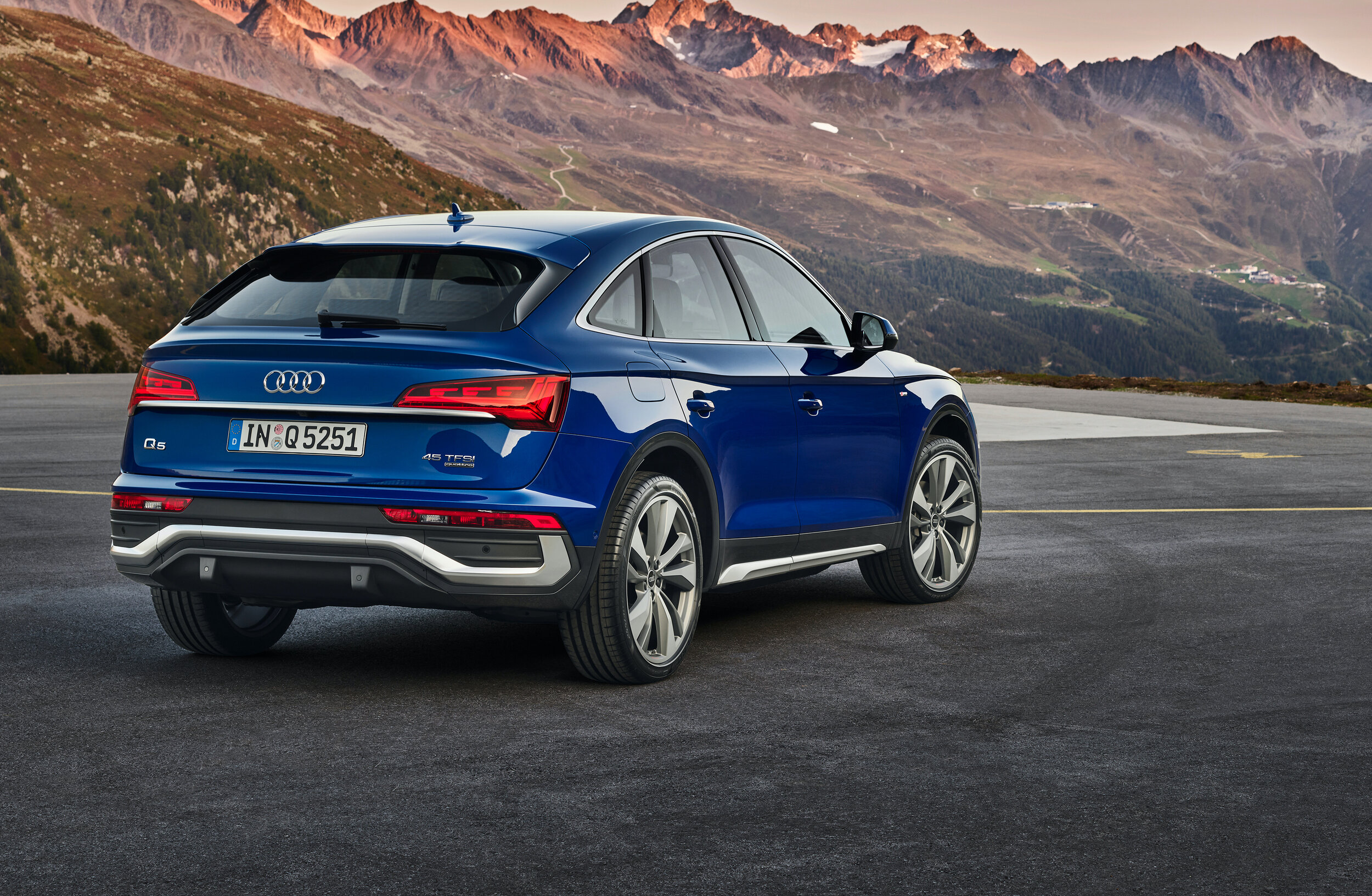
Q5 latest to join Audi coupe club

A more rakish body styling for the Q5 is coming.

Q5SB_000013.jpg

PLENTY of time to consider the specification and colour choice you prefer for the new Sportback edition Audi Q5 – this coupe sibling to the well-established sports utility model is still a year away from New Zealand release.

Unveiled by Germany at the weekend, this is the third Audi SUV to receive a coupe-style look, following the Q3 – which released here earlier in the year and is doing well – and the e-tron, which is just weeks from becoming available locally.

Audi New Zealand has confirmed it will achieve the Q5 Sportback, but from late 2021. By then the engine choice will have assuredly broadened from the launch provision for Europe.

The headline act there is a 150kW/400Nm 2.0-litre four-cylinder turbodiesel, with a mild hybrid system to enhance efficiency and in marriage to a seven-speed dual clutch transmission.

This will be later joined by an entry-level version of the TDI diesel engine making 120kW. This is the sole front-drive edition.

Also in the wings, but not for immediate provision, are a 3.0-litre V6 TDI engine making 210kW and two four-cylinder 2.0-litre TFSI petrol engines, one producing 150kW, the other making 195kW.

Eventually – and perhaps this will time in nicely for our market - plug-in hybrid powertrains will also be offered across two output variants, as well as an SQ5 Sportback performance variant.

Q5SB_00009.jpg

Customers have the choice of Audi’s standard steel spring suspension or a sports suspension, with adaptive air suspension available as an option, allowing the ride height to be adjusted over a range of 60mm. A towing rate of 2.4 tonnes has been suggested.

Styling cues and equipment levels don’t wholly tie to the SUV. Sportbacks gain a new honeycomb grille reminiscent of Audi’s RS cars, plus new air intakes at the front, the option of 21-inch Sportback-specific wheels. Patently, the shoulder line from the B-pillar onwards is all new. The tail-lights are OLED.

The Sportback adds 7mm to the length of the Q5 SUV, bringing the total length to 4.69 metres, but the overall height and width are common.

The boot boasts a capacity of 510 litres, which can be improved to 1480L with the rear seats folded.

The has an ambient light package, the 10.3-inch infotainment system features a new split-screen capability and a reworked version of the menu available on the Q5 SUV.

It’s joined by a second 12.3-inch digital driver’s display, or “virtual cockpit”, and a head-up display.


Power-packed Pug set for NZ?

Peugeot’s new hotshot hero might find a home here.

PEUGEOT_508SWPERFO_2009RC_013.jpg

 ‘PERFORMANCE-tuned sleek Euro with electrifying edge’ – a descriptive ticking these many boxes is bound to win a lot of attention.

So good news is that the rights holder to Peugeot in New Zealand is striving to get the latest hot ticket item from France out here.

In comment relating to the announcement of the 508 PSE, Auto Distributors’ NZ commercial manager Arek Zywot says: “ADNZ is working closely with PSA to bring the 508 PSE to NZ, more details yet to be announced at the beginning of next year.”

 A car that broke cover at the weekend is a special treat by Peugeot to itself, developed to mark the launch of the make’s new Sport Engineered division.

PEUGEOT_508PERFO_2009STYP_102.jpg

In staying wholly in tune with these changing times, PSA’s premier player has ignored slotting in a petrol-hungry V6, the choice it might have taken a few years back, and instead gone for a performance plug-in hybrid set-up.

 The powertrain comprises a turbocharged 1.6-litre four-cylinder petrol engine and an electric motor mounted on each axle. The system generates a combined output of 263kW and 520Nm of torque – making it the most powerful powertrain Peugeot has ever fitted to a production vehicle.

Peugeot says the car will dispatch the 0–100kmh sprint in 5.2 seconds, before reaching an electronically limited top speed of 250km. Thanks to the instant torque from the electric motors, the car’s claimed in-gear acceleration is spectacular. For instance, it’ll nail 80kmh to 120kmh in three seconds flat. Hold onto those berets, right!

The 508 PHEV’s 11.5kWh battery pack provides a maximum pure-electric range of 42km, while recharging from a domestic wallbox charger will top up the battery in less than two hours. What’s more, with a full charge, the powertrain will deliver a claimed WLTP fuel economy figure of 59 km per litre and generate just 46g/km of CO2.

To support the extra power, Peugeot has fitted the 508 with quite a number of chassis tweaks, including new adjustable dampers, a widened track and larger diameter front brakes with fixed four-piston calipers. It has 20-inch alloy wheels shod in Michelin Pilot Sport 4S tyres.

There’s some restyling, too, with an aggressive front bumper, a gloss black rear diffuser, a new radiator grille and twin exhausts. Naturally, it achieves “Sport Engineered” badges and there are three unique paint finishes.

The interior makeover includes sports seats clad in Alcantara and leather upholstery and the 12.3-inch digital instrument cluster and 10-inch infotainment system have Sport Engineered displays.


Paddon power play seen soon?

Talk about an assault with batteries … in addition to the ‘Kiwi Kona’ courtesy of Paddon Motorsport, Hyundai itself has shown off a slick electric racer and Ken Block has scored an ohm run!

the RM20e reminds that Hyundai Motor Company is also racing with electric power

the RM20e reminds that Hyundai Motor Company is also racing with electric power

ESSENTIALLY identical core components and closely-aligned performances, common basic aims … both behind the same badge.

As much as they are, quite literally worlds, apart each is being developed at a leading motorsport facility with intent to create race-winning performance, starting with some astounding grunt: Up to 745kW.

The timeline trajectories are uncannily close. Announcements about one seem to always be followed by an update on the other.

Who will be first? Is it a race? Who else might be competing?

As the days toward each project achieving readiness for full-out field testing draw closer, the nation’s interest in Haydon Paddon’s groundbreaking Hyundai Kona electric rally car is set to grow.

Meantime, in South Korea and in Europe, all eyes seem to be on a car that, while not a doppelganger, is clearly also from the same broad breeding, the RM20e Prototype.

Meantime, anyone taken notice yet of the Ford Fiesta ERX, an early starter in the FIA’s new World Rallycross Project E race series, recently subject of a wild run to victory with the world’s greatest hoonigan at the wheel? 

All remind how motorsport is heading fast toward where every day motoring is unavoidably gravitating … a future that involves electric assistance.

Paddon’s car deserves priority mention, being ‘local’ and all that. Even so, it’s the one we know least about, technically speaking.

This image of the Paddon Kona was run on the DirtFish website last week.

This image of the Paddon Kona was run on the DirtFish website last week.

Yes, everyone knows it’s a massively reworked edition of the electric Kona crossover Hyundai has been knocking out for road use; delivering with four-wheel-drive, raised suspension and all the other addenda required for rallying.

But in terms of the exact spec of the drivetrain, the battery size and capability … that’s still under wraps. The team website continues to talk of up to 1100Nm torque, and more than one motor – as few as two, up to four, each making 220kW – through a single speed drivetrain.

There’s been talk of offering around 670kW in hillclimb mode and around half that for longer rallies, to improve range.

Any lack of detail does nothing to diminish the achievement: A car driven by our best known and most credentialed rally talent and created by a handful of hand-picked Kiwi engineers, working from a lock-up at Highlands Motorsport Park at Cromwell, developed alongside Hyundai New Zealand with the assistance of the University of Canterbury, Yes Power and STARD, an Austrian racing team that specialises in electric rallycross cars and has supplied the battery, inverter, and motor  … well, it’s a heck of a thing.

We do know it works. It ran for the first time last week and, according to a report from international rally web site Dirtfish, remains on target for a November 4 launch in Auckland – so, just over two years since project start. 

Hayden Paddon has big plans for the ‘Kiwi Kona’.

Hayden Paddon has big plans for the ‘Kiwi Kona’.

The car will be seen in public for the first time when Paddon completes demonstration runs at the Battle of Jacks Ridge on November 15.

“It was 100 percent pride when I drove the car for the first time,” Paddon told DirtFish several days ago.

“Everybody’s been working so hard here to make this happen – some of the guys have been putting in 100-hour weeks to get here … and it went absolutely to plan, no problems at all. We were only running the car at 30 percent power, but the responsiveness from the car is so obvious.

 “The other thing that became obvious is how much more straightforward the Kona EV is compared with a conventional rally car – the number of mechanical, moving parts is significantly less.”

Paddon told DirtFish the aim is to have the car out on a full-length rally this time next year. In other reports, he has spoken of hope to run it in selected rounds of the New Zealand Rally Championship in 2020; a hope that, to be realised, will require some rewriting of motorsport regulations.

Various safety issues have yet to be satisfied but, beyond that, there’s another question: Is it fair – or even conceivable – to expect parity between fossil-fuelled race machinery and electrics?

 Paddon asserts he doesn’t want an electric car for an electric championship. “We want to showcase this against current cars, to show electric can be fast, cool and hold its own. Motorsport should be any car against any car. 

That thinking is built on a solid foundation; like it or not, electric propulsion has a place in rallying at local and international level.

Hyundai says the RM20e will serve as a development tool for a future electric N performance road car.

Hyundai says the RM20e will serve as a development tool for a future electric N performance road car.

Patently, this programme is not just to prove a point on local roads. Paddon is keen to exploit the car’s potential for his own driving career and, apparently, as a commercial venture. How many examples are created and to what aim has yet to be fully spelled, but the South Canterbury instigator has always seen a global market potential. He certainly hopes the Kona will give him an advantage as the World Rally Championship heads down an electrified path.

As Kona readies for its big day, so too comes news of another Hyundai headliner, this one from the brand proper. 

No shying with the stats in respect to the RM20e. Everything but the range has been provisioned. So, it has 598kW and 959Nm of torque deployed to its rear wheels, will smash 0-100kmh in less than three seconds and be travelling at 200kmh after just 9.88s. For the purposes of public road driving, top speed limits to 250kmh. Hyundai says it balances these “race-car-like levels of performance, balance, braking and grip” with “daily-driver quietness, responsiveness and road-going capability.”

The drivetrain has developed by an electric vehicle maker whose star power is somewhat brighter than STARD’s.

Rimac is a Croatian car manufacturer that develops and produces electric sports cars, drivetrains and battery systems. Founded just 11 years ago, it rocketed to world interest with the Concept One, the slinky realisation of ambition to create the world’s fastest production electric vehicle. It gained even more notoriety when Richard Hammond crashed it during filming for the Grand Tour Season 2. Was the car too hot to handle? Well, it’s a tame tabby compared with Rimac’s next electric performance flagship, the C-Two, will touch down in 2021 with 1490kW and a top speed of 415kmh.  

Eighteen months ago HMC paid 80 million Euros for an undisclosed share in Rimac, with intent to develop two models – a sports car for itself and a fuel cell car, likely for Kia. The investment represents a 14 percent shareholding for HMC; Porsche, another investor, has a 10 percent share. A Chinese battery maker, Camel Group, is Rimac's second biggest stakeholder with 19 percent, while Rimac founder Mate Rimac owns 43 percent.

the rm20e’s development programme was undertaken at the Nurburgring, home base of Hyundai’s N operation.

the rm20e’s development programme was undertaken at the Nurburgring, home base of Hyundai’s N operation.

As revealed at the Beijing international Automotive Exhibition 2020 last week, the RM20e appears in readiness for track racing, just like the Veloster N eTCR, designed to take on a new eTCR electric touring car series. 

However, motorsport is not the end game in this instance. The factory says the car’s primary purpose is to act as a development tool and test bed for the N-branded performance road car division. It has the remit of being the basis of what yet one day become Hyundai’s equivalent of the Porsche Taycan.

The name is explained thus: RM stands for ‘racing midship’, and refers to the car’s mid-mounted electric motor, which is said to offer “ideal balance and agility from a low polar-moment of inertia.” Meaning it is easier to rotate the car about its axis. The numerical? Well, it’s a bit of a muddle, but effectively it’s the latest of a lineage. There have been four previous incarnations, the first being the RM16.

Back to the Fiesta ERX, which screamed – in a way only electric cars can – into motorsport history the other day by winning the first World Rallycross e-racing event at the famous Holjes circuit in Sweden, ahead of two identical Fords. 

Directly developed by STARD, this car is also a monster: 0-100km in just 1.8 seconds is a blistering time huge horsepower fossil-fuelled rallycross cars with anti-lag systems have been chasing off the start line for years.

What gets the ERX going is a giant 450-kWh battery pack liquid-cooled by dry ice. It delivers oomph through a pair of independent two-speed gearboxes that operate as single-speeds in race mode. Will the Kona go the same way?


Ford Puma - five stars but no comet for NZ

Sorry Puma fans – we’re only getting the tame versions, not the wildcat flagship.

2020_FORD_PUMA-ST_04.jpg

GOOD news about the new Ford compact crossover soon on sale here if you’re interested in safety – not so much if sizzle is more your turn-on.

The positive is a top marks safety score for the Puma, decided by an independent crash testing agency whose opinion is most relevant to New Zealand drivers as it is the only organisation that has our Government’s sanction and to be fuelled by NZ tax funding.

The Australasian New Car Assessment Programme’s decision to give the new five-seater a five-star rating has thrilled Ford New Zealand.

It’s a positive for potential buyers, too. ANCAP says the car’s inclusion of autobraking with pedestrian and cyclist detection, lane departure warning and lane keeping, traffic sign recognition, driver impairment monitoring, rear parking sensors, TPM, Isofix and provision of six airbags across the range all weighed into the result.

FORD_2020_Puma_ST-Line_X_014.jpg

That kit is available to all versions of the Puma – including one that was announced within a day of the ANCAP score being publicly shared.

The Puma ST, the green car pictured today, is set to stand as the family’s performance flagship, offering a peppier alternate to the one litre model that lands within weeks in two forms.

To refresh your memory, there’s a standard edition going for $29,990 plus ORCs as a launch special. The full RRP is $33,990. The higher specified Puma ST-Line (the blue car) adds adaptive cruise control, sports suspension, seats and body kit, hands-free tailgate, paddle shifters and other gear besides. It will go for $37,990 plus ORCs.

The ST obviously sits above that, being a taller-standing equivalent of the Fiesta ST and Focus ST, which have become popular here though are currently subject to supply disruption.

No good asking about the potential premium, though. As much as it might seem like good addition to the ST push, the performance Puma won’t be coming here any time soon.

The reason why comes down to the transmission. For now the Puma ST only comes with an orthodox, three-pedal manual. Ford NZ doesn’t see it finding it sufficient favour with that choice – they’d prefer it to have the two-pedal automated manual that is solely offered with the Focus ST now. There’s no sign of that happening, sadly.

The decision might leave ST fans a bit confused, given that the Fiesta ST is only available with an orthodox manual and seems to do just fine, regardless.

Ford New Zealand’s comms man, Tom Clancy, steered clear of going into the issue, instead simply stating: “….. no plans for the Puma ST for NZ.”

In respect to Fiesta ST and Focus ST supply, he said both had been affected “initially and again due to hurricanes delaying boats. However, supply is getting back online.

“More Fiesta STs are arriving next month, and dealers have Focus STs available. All of our initial stock of Fiesta ST sold out.”

Focus ST sales ramped up in August, with the type account for more than 30 percent of Focus sales. 

“We’ve seen the hot hatch faithful come in as customers but also new customers.”

The Puma versions signed up for duty here run a 1.0 litre three pot turbo petrol, good for 92kW and 170Nm from 1400rpm and in marriage to a seven-speed auto.

The ST, meantime, has a 1.5-litre three-pot engine with radial-axle turbo and the same 147kW as the Fiesta ST, but with an even beefier 320Nm – up 30Nm.

The extra shove in grunt gives the Puma ST the same 6.7 seconds 0-100kmh time of the Fiesta version, despite a more portly curb mass. 

Power is sent to the front wheels via a six-speed manual. It has a mechanical LSD and torque vectoring to reduce understeer and the same force-vectoring springs of the Fiesta ST. The steering rack is also 25 percent quicker, and the brakes larger than standard. Oh yes, and it sits on 19-inch black alloys with Michelin Pilot Sport 4S rubber.

On offer for the driving experience are Normal, Eco, and Sport driving modes and a new Track mode which disables traction control while limited stability control.  Optional is a launch control function. ST Recaro sports seats make their way inside alongside a flat-bottomed steering wheel and ST gearknob.

Surely it looks worthy of a petition, right? 

Meantime, back to the Puma’s ANCAP score. One interesting aspect is that it is was based on the latest examination standard, the barometer the Isuzu D-Max (for example) faced up so well.

Because? Well, while the Puma is only arriving now, the car launched in Europe in 2019 and subsequently went through Euro NCAP crash testing in December that year. 

That same five-star rating has carried over to the Puma here despite ANCAP changing its testing criteria this year to include a more stringent frontal offset crash, side impact crash and far-side impact crash tests.

ANCAP says the ‘Euro’ rating has carried over because it is still applicable to the Puma despite the tweak in local testing.


MG confirms second electric car, for early 2021

A competitor for the country’s favourite new plug-in hybrid is coming. 

IMG_8836.jpeg

AN electrified variant of MG’s flagship sports utility, the HS, will arrive here in early 2021 to become the second model in an increasingly battery-involved product strategy.

Unveiled just yesterday, the HS EV will present here from the first quarter in highest-trimmed Essence spec with a primary target being a car that has basically had this sub-sector all to itself, the popular choice Mitsubishi Outlander PHEV.

The models’ facedown in present formats will likely rage for all of 2021, as even though the current Outlander is set to be replaced next year by a new generation car, with greater involvement from technology partner Nissan. The next PHEV is more likely arriving in 2022. 

They seem sure to become intriguing rivals.

For the past year the Outlander has had a 2.4-litre petrol engine, replacing the original’s 2.0-litre, and updated to a higher capacity (13.8kWh) battery, sells for $52,490 in XLS and $58,990 in VRX, has a claimed full electric range of 55 kilometres, achieves fast charge replenishment in 25 minutes and delivers 1.9 litres per 100km optimal fuel burn, according to the factory. 

No price has been set for the HS yet and the local specification has not been finalised, however the drivetrain is known – it pairs a 119kW 1.5-litre turbocharged petrol engine with a 90kW electric motor for a combined output of 189kW and a 0-100kmh time of 7.5 seconds.

IMG_8734.jpeg

 Power is sent to the front wheels from both power sources through a newly developed 10-speed gearbox. This involves a six-speed orthodox automatic gearbox while the electric motor uses a four-speed drive unit.

A 16.6kWh battery pack gives an electric-only range of 51km and can be charged to full capacity in three hours using a Type 2 charger. It and emits 43g/km.

Equipment levels are high. The standard car, which is not being considered for introduction, takes 18-inch alloy wheels, electrically adjustable heated front seats, a 360-degree camera, keyless entry and climate control. The flagship trim adds a panoramic sunroof, electric tailgate, leather upholstery, ambient lighting and LED headlights in the specification offered in the United Kingdom, the car’s first right hand drive market. Whether the NZ spec will mirror the British market’s remains to be seen.

Safety features equipped as standard across the range include adaptive cruise control, traffic jam assist, automatic emergency braking, forward collision warning and blind-spot detection.  

While MG has so far based its market presence around petrol cars, the corporate aim is to go increasingly electric. How well that realises in New Zealand, however, will ultimately rest on political interest in battery driving, country manager Antony MacLean says. 

_MG_8857.jpeg

“The groundwork is there but at the moment it seems the country has taken a breath in respect to deciding what to do next.

“I think no-one (among political parties) has quite decided that so the election and its outcome is going to be interesting.”

MG here has, of course, already started its electric journey with the MG ZS EV, a smaller crossover car that will go on sale soon. That model has already attracted Government interest as a potential fleet car; the HS is also already on the all-of-Government list, from which tender vehicles are selected.

The medium crossover will release for $55,990 plus on-roads, a sticker that will make it the country’s cheapest wholly battery-driven car – a title presently held by two contenders, the Nissan Leaf and Volkswagen e-Golf. Both currently listed at $61,990.

The only potential hindrance to acceptance, if more than local driving is intended on regular basis, is range: A factory-cited 262kms betters the Golf but bows to size-equivalents the Leaf and Hyundai Kona. 

Though full economy and ultimate range figures for the HS EV have yet to be given, MacLean is confident it will be the model that assuages any such concerns.

He also sees the car as having a very solid volume potential. “I’m really excited about this product … it will do an excellent job bridging the gap between pure electric and petrol cars.”

IMG_9064.jpeg

Also potentially available to MG here but unlikely to be taken up unless market conditions change is another full electric, the MG5 (above), which is spun off a fossil-fuelled station wagon sold by sister brand Rowe.

The front-wheel-drive electric edition is powered by a 114kW electric motor and features a 52.2kWh battery, giving a range of 344km. It can accelerate from 0-100kmh in just over eight seconds and can be charged from zero to 80 percent in 50 minutes using a rapid charger.

A large luggage capacity of 580 litres is a positive, but MacLean is wary of offering a station wagon in a strongly SUV-centric market.

 “My feeling is that we are an SUV market and ZS EV is better suited. However we are always looking for opportunities so if customers show preference, who knows.”