Honda Prelude roadtest review: Sound and lite show
/When its heart seems little different to that in nan’s shopping basket how much soul remains?
Price: $69,990
Powertrain: Front drive, 2.0 litre four-cylinder turbo with dual electric motor integration, maximum power 135kW, maximum torque 315Nm; CVT with simulated eight-speed mode.
How big: Length, 4532mm; width, 1880mm; height, 1349mm.
We like: Well-sorted chassis; strong styling; efficiency; decent boot.
Not so much: Powertrain lacks true character; messy drive controls; not even basic electric adjust on seats.
MUCH comment about the latest Prelude has focused on the radical change to a hybrid drivetrain - is it technically a bit too much and performance-wise a bit too little?
To the first? No, not at all. Hybrid is just a reality of motoring life and also a deeply-embedded Honda 101, for good reason. Analysis by a well-known market involver suggests petrol-electric has high consideration among new vehicle buyers. Ostensibly, then, Honda is on safe ground bringing its sports coupe into that fold.
And, yet …. as much as Prelude has historically never been a tip-of-the-spear kind of car when it comes to zoom and zest, a week spent with it left me thinking it wouldn’t be exactly ruined by having a bit more oomph to go with those avant garde looks and its impressive chassis.
Still, if you’re looking for an example of a Honda engine that’s not quite meeting expectation, the one running in the back of the Aston Martin Formula One car is a far better candidate.
In the British Grand Prix held at Silverstone on the first weekend of July, poor Fernando Alonso and Lance Stroll ran four seconds a lap slower than the pace-setters that day. No fun for them.
Honda has promised to smarten up its F1 act. Likewise it seems to be also coming up with ways to sharpen up the Prelude.
The weekend following Silverstone brought the annual Festival of Speed at Goodwood estate, at which all sorts of remarkable cars display and often run up the driveway of Lord March’s historic West Sussex estate.
Among those was the Prelude HRC (below). Ostensibly a concept, almost certainly set for introduction and a variant of what we have now that is worth keeping an eye out for.
HRC stands for Honda Racing Corporation, an emergent in-house performance division in the ilk of Hyundai N, Toyota GR and NISMO.
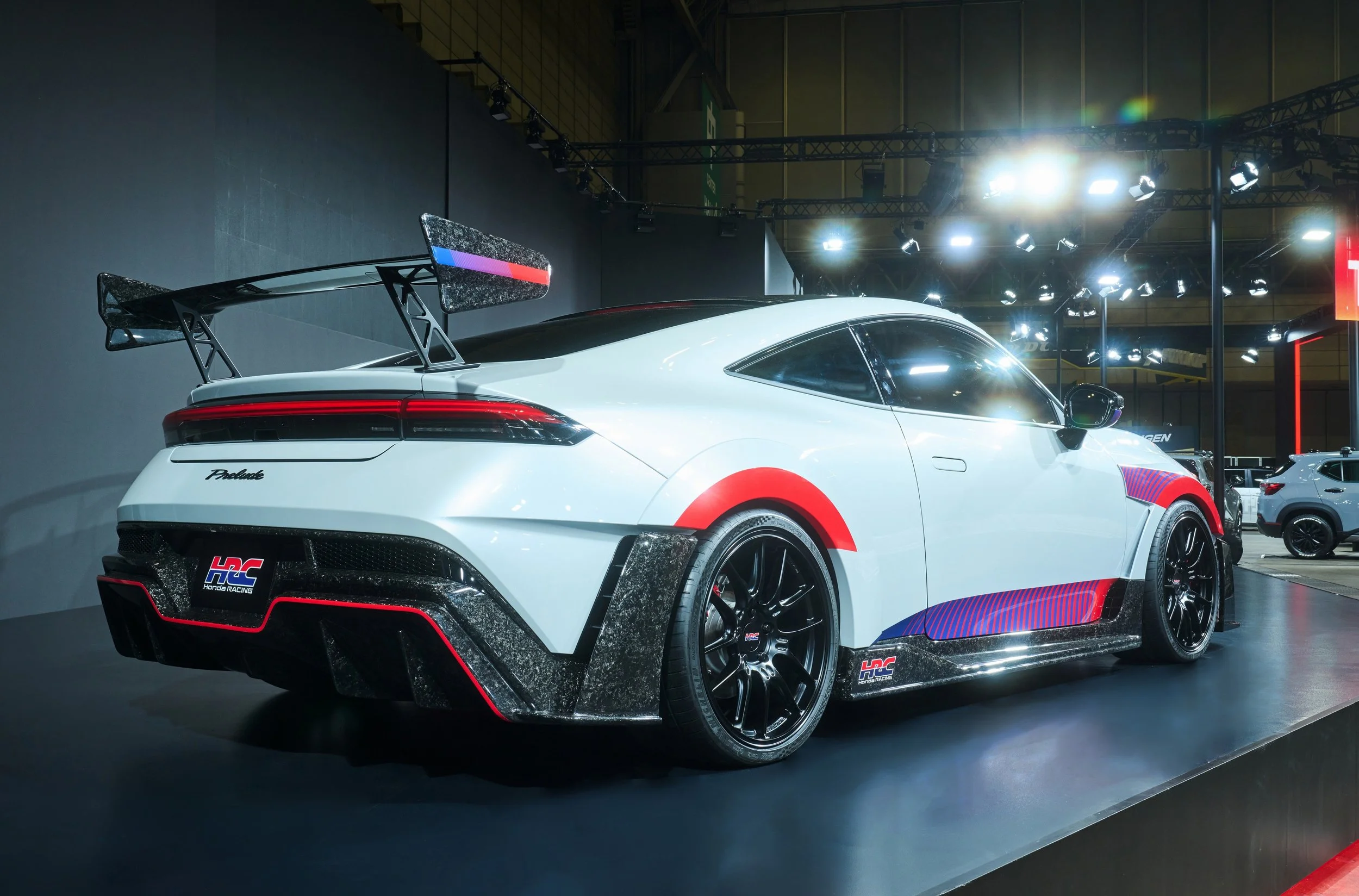
The Prelude HRC has a styling kit comprising front and rear bumpers with side air intakes, extended side skirts, a massive rear spoiler and large rear diffuser.
In addition the HRC was apparently also debuting some mechanical tweaks, designed to further enhance the standard car’s already excellent poise and dynamic prowess.
So it’s exciting news, though one that doesn’t seem to answer the most pressing question. Revisions to the drivetrain? No-one was saying. The obvious change, of course, would be to amp it up to the turbocharged 2.0-litre petrol engine and manual gearbox from the Civic Type R.
This gen six car being on a Civic platform, and already utilising the Type R’s suspension, albeit in different geometry, and Type R level brakes and tyres doesn’t seem to make that sort of job inconceivable.
Yet the odds seem long, for all sorts of reasons. Some practical - remarkable as it might sound, Prelude was never designed for the fizziest four-cylinder engine Honda has conceived for a road car - and some political.
The Type R engine is in itself on borrowed time. Moreover it doesn’t conform to Honda thinking about what powertrains are best suited from now.
It also doesn’t conform to Honda’s traditional thinking about what a Prelude has ever been. Obviously it’s always come across as being sporty-looking. But has if ever been absolutely sports-minded? In Honda’s past logic, Prelude’s aptitude was more Grand Tourer than Gran Turismo.
That thinking appears to maintain, if not elevate, this time around. Performance is good, but not gutsy. Simply because it now has electric assist? Not necessarily. There are other hybrid sports models out there that have genuine kapow.
Honda’s proprietary e:HEV petrol-electric powertrain, with constantly variable transmission is quite a step up from the drivetrains for previous petrol-electric coupes, the Insight from way back and the CR-Z that followed.
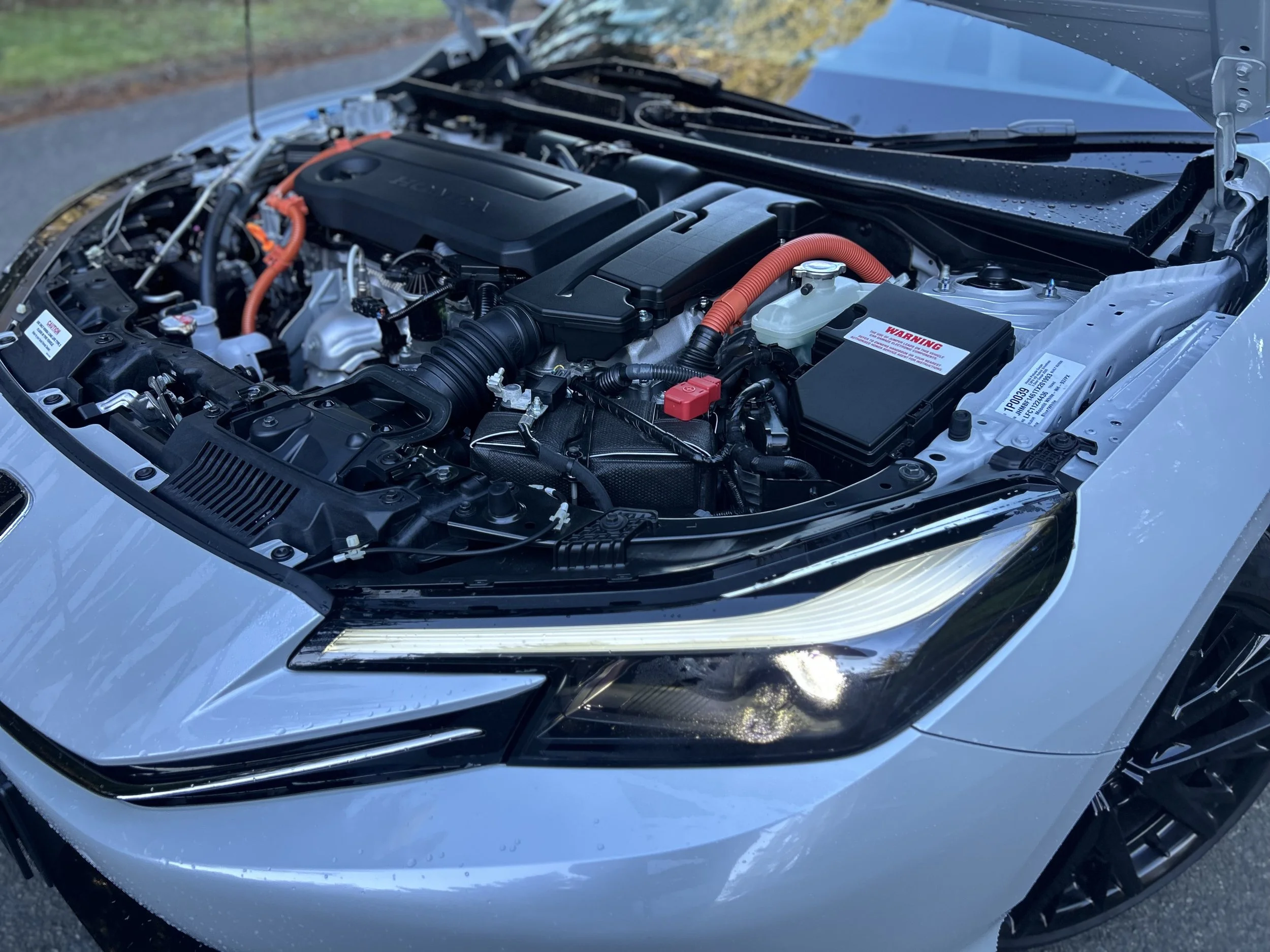
Prelude has the 2.0-litre four cylinder with two electric motors that goes into the Civic. But added in here is ’S plus Shift’, an electronic phwoar fare designed to mimic the sound and feel of a responsive multi-ratio automatic transmission.
With this, you’d think it would be all about rocket ship zap. But Honda wants to sell grr with a Green tinge. So, as with every other version of e:HEV, the louder buzz is in respect to efficiency.
The brand attested 4.3 litre per 100km optimal economy is simply so extraordinary for this class I almost felt I’d let the side down with a 5.5L/100km average for the week. Though, of course, even that is exceptional for this kind of vehicle.
The car’s high degree of quiet, smooth capability in everyday driving is easily explained. The combustion element, an Atkinson cycle engine, is normally acting as a generator that produces electricity then fed through a 1.06kWh battery and to the drive motor than turns the front wheels wheels via a fixed gear ratio.
All this means is that, most of the time the traction motor is driving, not the engine and the end result is, as said, thrift almost unnatural to this kind of car.
You can see why Honda was relaxed about retaining the Civic’s smaller-than-average 40 litre fuel tank in this new setting. More good news in that respect is that the engine accepts 91RON petrol.
If you intend to drive the Prelude quietly then this side of things will doubtless count for something, especially given how shaky pump prices are right now.
Challenge arises if expectation lends more toward the other extreme.
In saying it has engineered the car to deliver a more involving driving experience than any of its predecessors, Honda was cautious. They’re talked up the soul, but were careful not to go too hyperbolic about the heart.
For good reason. On paper outputs of 135kW and 315Nm are modest. Being 100kW and 75Nm down on the Civic Type R is one thing, but what might impact more is learning the previous Prelude’s pure 2.0-litre petrol was also markedly stronger. The predecessor was also quicker, by a full two seconds, in the 0-100kmh sprint, for which a time of 7.3s is now cited.
This Prelude is also the runt of the litter when other sports coupe contenders are concerned. That crowd, admittedly, is rather eclectic; everything from a Toyota GR86 to a Nissan Z and Ford Mustang. Widen the net and you could include the common engine GR Yaris and Corolla. If you’re bringing a Prelude to that playgroup, it’d pay not get get too mouthy.
With close to 4000 kilometres on its clock, the example on test felt somewhat livelier than examples availed at launch, which had come straight off the boat.
But hard to say that it felt any fiestier. Mid-range is fairly decent, but the limited sharpness to step-off is unavoidable and the search for top end pull also comes up short.
Going through the different drive modes is modestly beneficial to the degree of effervescence you hope to find - in manual shifting it’s slower through that 0-100kmh sprint than in auto - but you’ll play along anyway.
From Sport the steering feel becomes a bit firmer and it begins creating more engine/exhaust noise via the ‘active sound control’ device that can only be heard from within the cabin, to point of blipping the throttle while downshifting.
Pressing the large S+ button on the centre console also changes the role of those metal steering paddles. Having in lesser modes being the conduit for sorting the (no less than seven) levels of regeneration severity, they in the optimal performance thematic achieve a manual shift - left for down, right for up - that almost leaves you convinced it really does have gears. Almost.
You can chart when to go up or down a cog by keeping watch on a rev counter, which also only appears on the digital dial display in this mode and is also faked. This ‘redlines’ at 6000rpm and gets there awfully fast, probably quicker than it would were it registering what an actual engine was doing. But still…
By comparison, the other drive settings - Economy, GT, Sport and Individual - are far more straight-laced, though also smart, in that all tailor to different road and driving conditions. Yet while all have their nuances, and in all the engine is uniformly smoother, it’s also progressively less frisky and nowhere as interesting to listen to.
Regardless how you feel about the level of kapow, what becomes evident is that every other element of its design and presentation could cope with even more.
Those who sorted the chassis and driving dynamics would likely lead any in-house push for more power as they have already lavished this car with a suspension, tyre choice and Brembo-provisioned brake set that’s deserving of just that.
As a front-wheel drive car with a wide track, low centre of gravity, dual-axis front struts and wide tyres, it has the right stuff. With a kerb weight of 1438kg, it’s obviously not the ultimate light weight dream like a Mazda MX-5, but neither does it feel burdened.
There’s enough competence for carrying whatever straight-line pace it can muster into, through and out of any challenging corners and bends to imagine it could at least keep in sight of that Civic Type R.
It has ability to track the road predictably, swinging easily and briskly into any apex. Even when it’s wet, you can trust those 235/40 R19s will grip and bite. Driving briskly also highlights well-judged the steering and brake feel is.
And while the suspension tune is more supple than from the hatch, in some ways that’s fine, given how forgiving it is on coarse chip, where the man bugbear is the level of tyre roar.
So much more about the car speaks to it being locked and loaded to become a better kind of belter - should Honda allow it to be.
The low-set, almost straight-armed driving position. The steering wheel being a thick-rimmed, leather trimmed item with a slightly flat bottom, a subtle 12 o'clock marker. The bolstered front seating also ensuring you're held firmly in place. Cruisey cars don’t need these, but driver’s cars do, so what are we to make of Prelude having them?
It’s not just this that make it more of a shame the powertrain isn’t quite up to the standards the rest of the car sets.
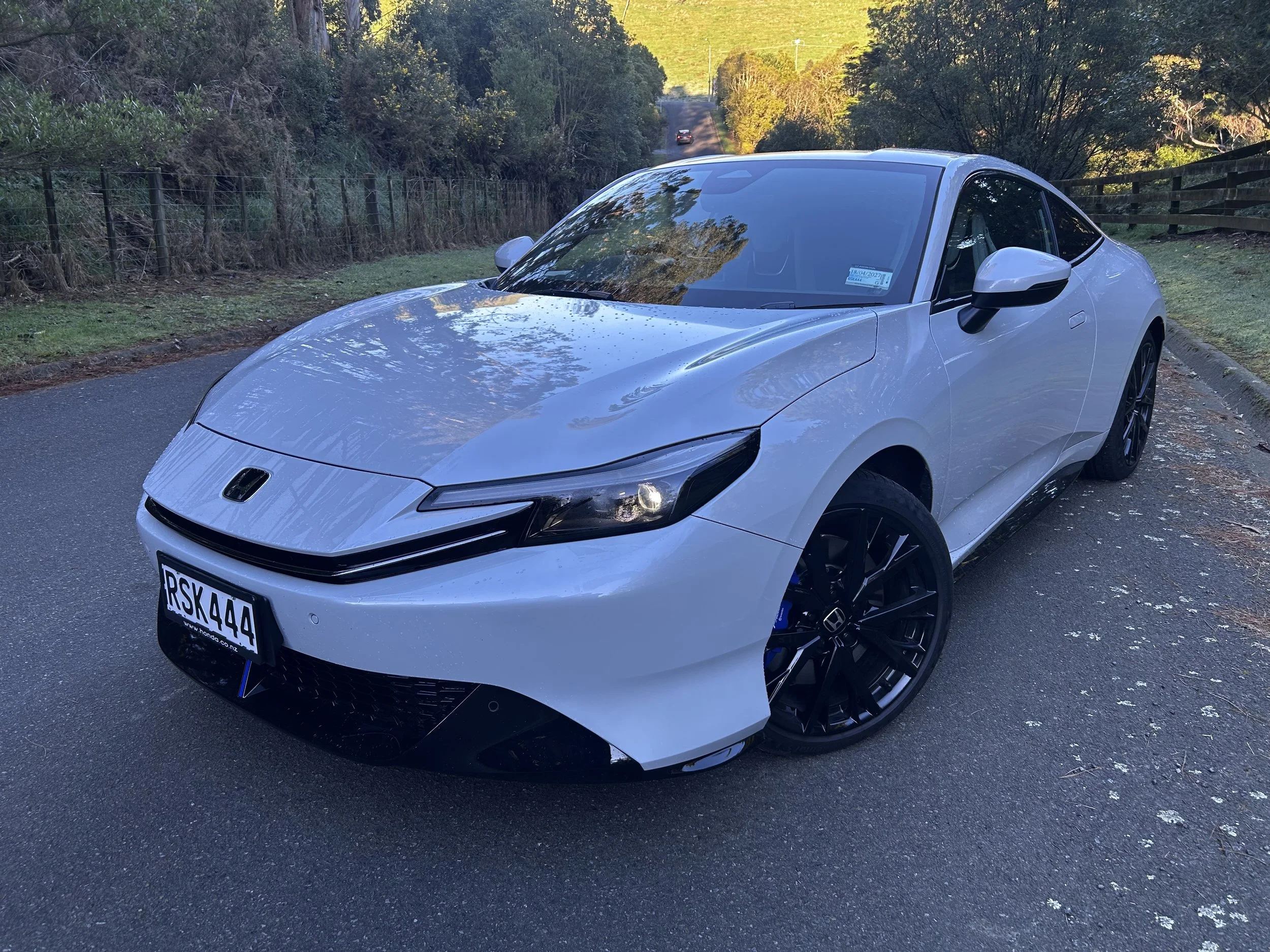
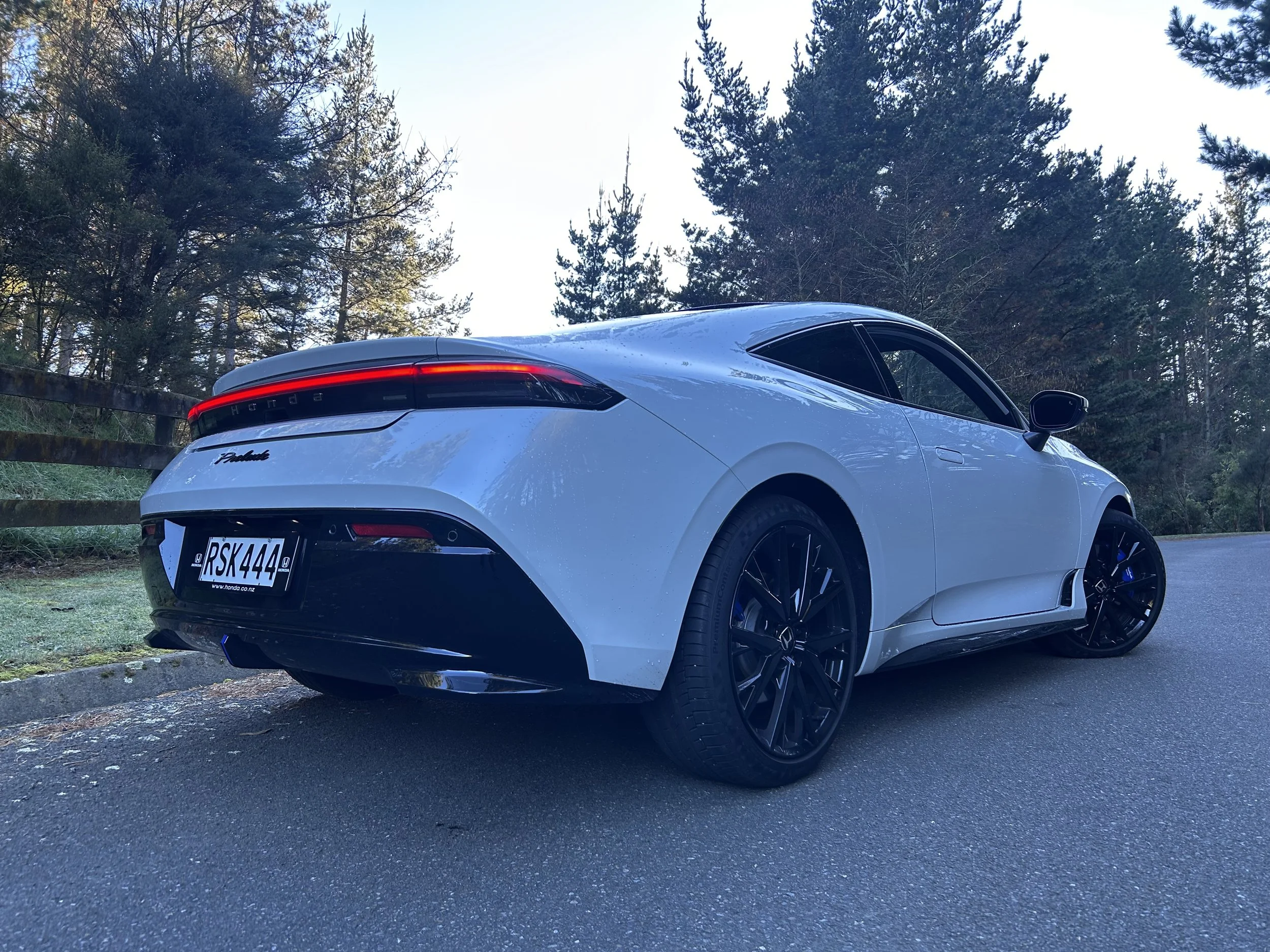
Just soak up the exterior styling, wide stanced, impossibly low, inspired by the look of modern gliders, apparently. It’s stunning and a big, big part of the temptation.
Up front, there's a familial look with a protruding centre section, large lower air inlet and sharp LED daytime running lights.
The double bubble roof that resolves the poor headroom that blighted all predecessors also harks back to Italian sports cars of yesteryear. Low vents behind the front wheels give it a technical detail, the dark 19-inch alloys fill the arches, those pop-out door handles integrate perfectly into the smooth sides.
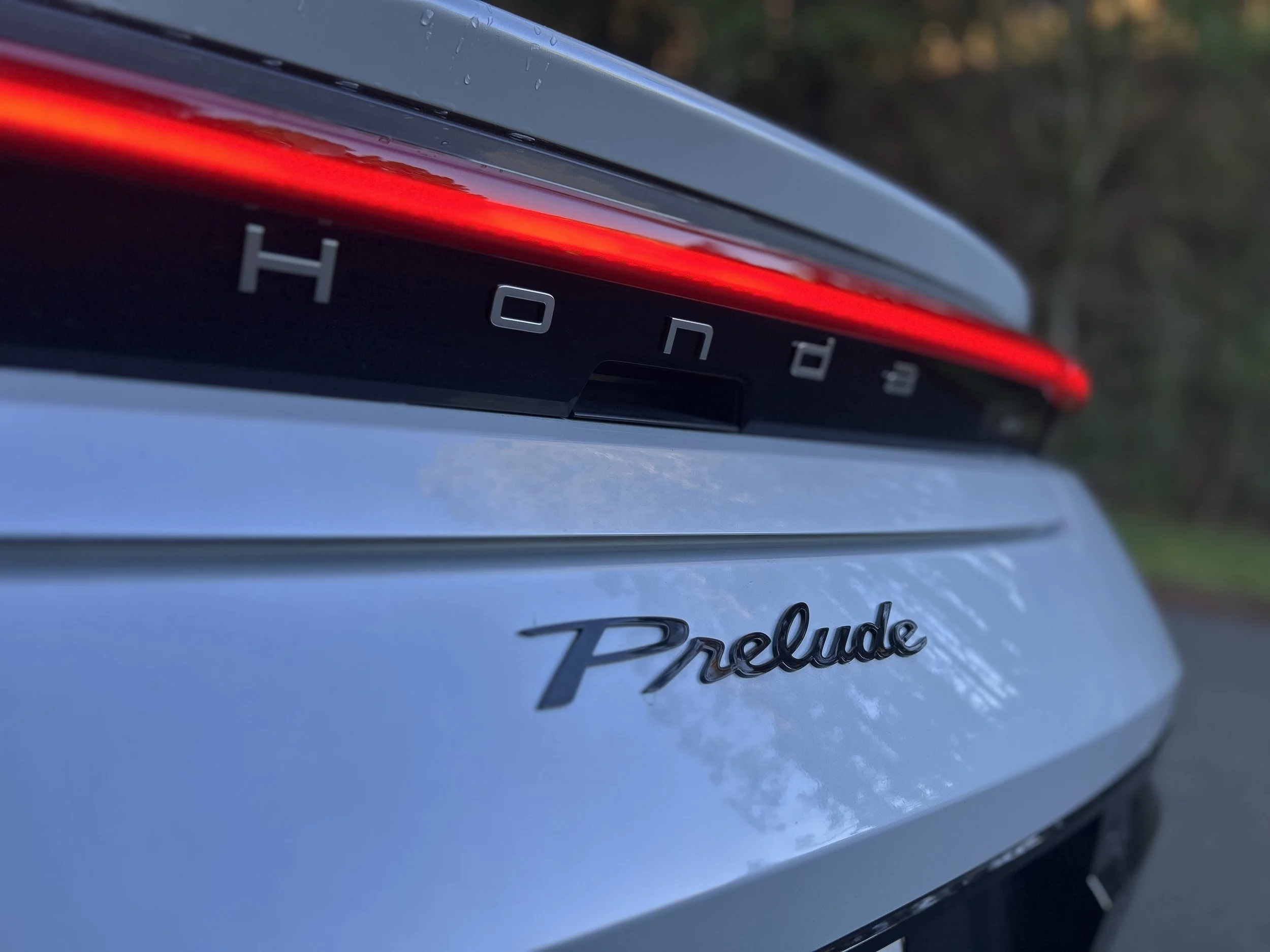
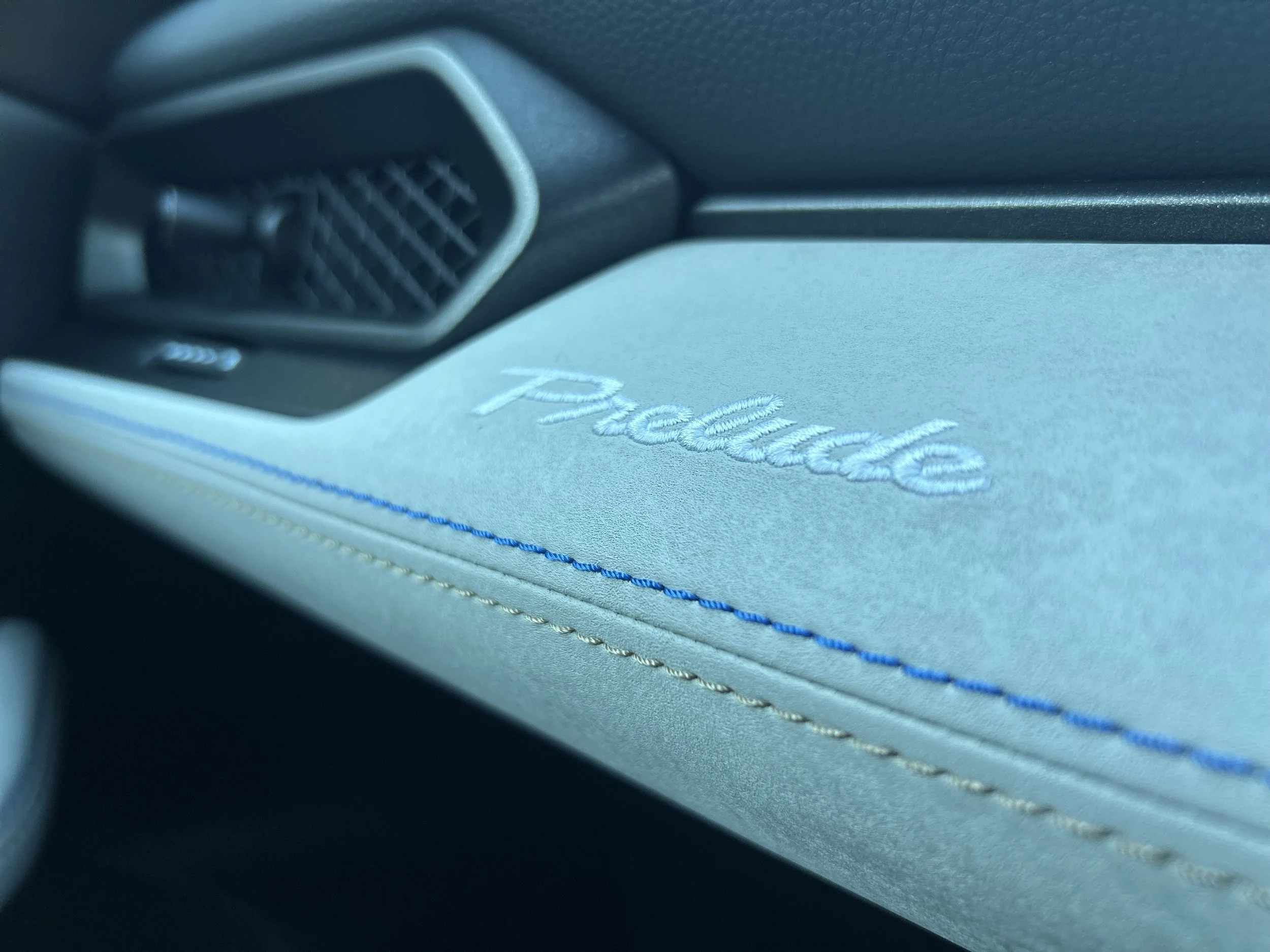
The full-width rear lighting with a 'Honda' word mark right below it, the distinctive 'Prelude' script on the car's body work (replicated on the dash) are artisan.
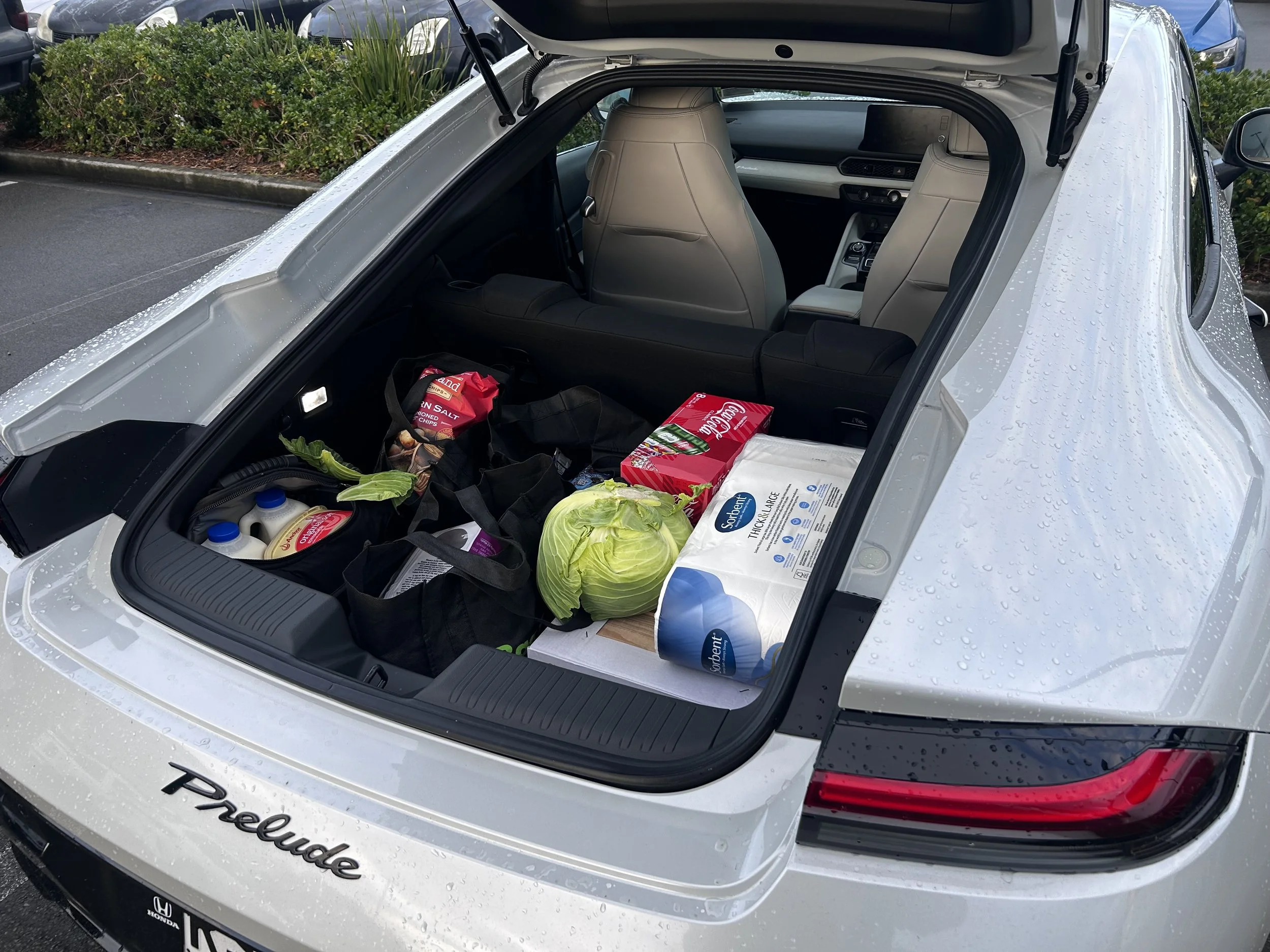
Interior room wise, it’s sports coupe typical in that you look through steepled raked glass front and back, and have quite small side windows as well. Plus you can forget the laughably small rear seat as being of much, if any use, for human occupancy. How often that area will be used as an extension of the luggage area right behind could be moot, as the boot is surprisingly large and also sensibly sized even before you think about folding the rear seat backs away. The luggage compartment is deep because there’s no spare tyre, just a repair kit.
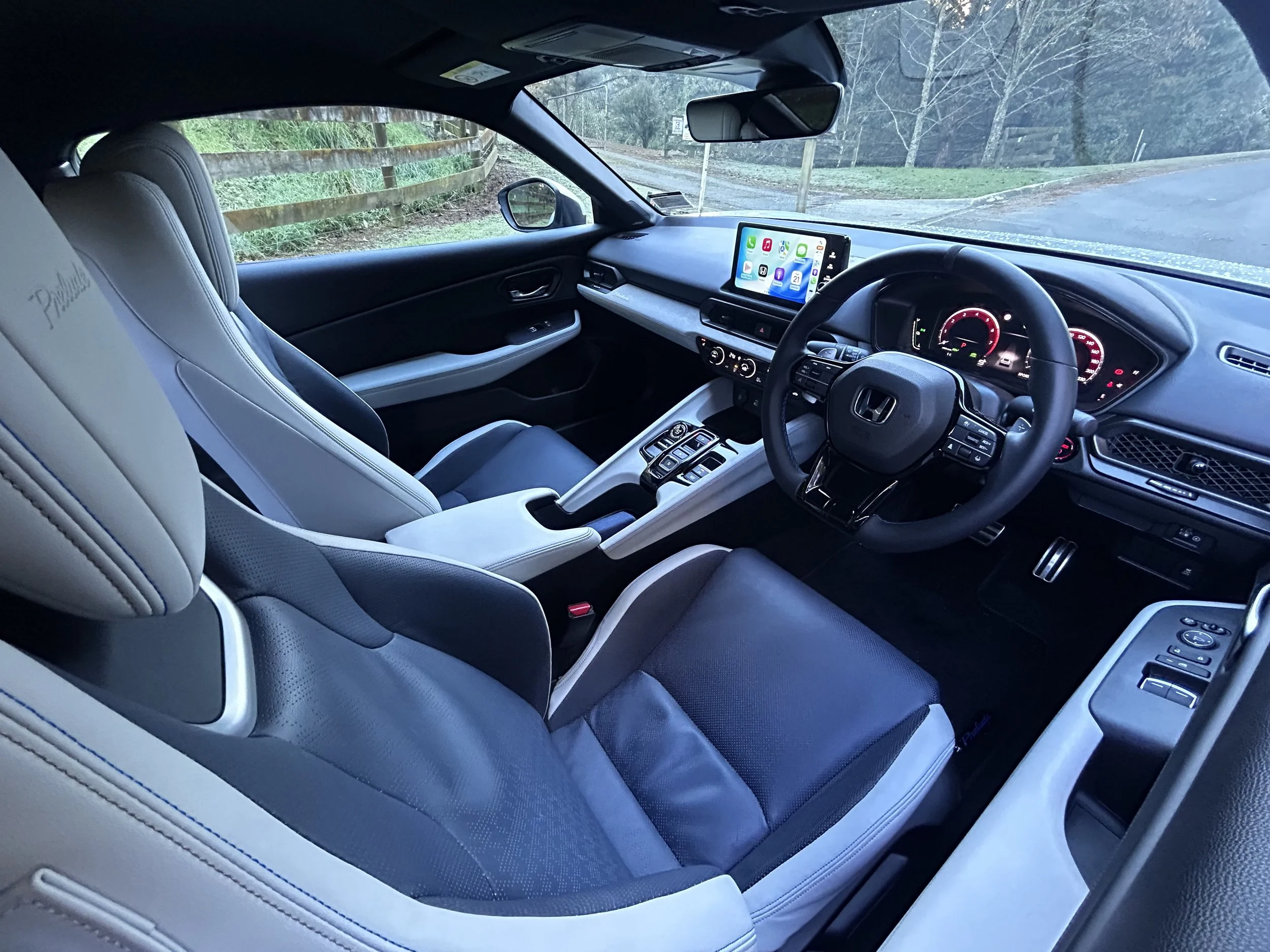
Prelude’s interior flavour isn’t quite as upmarket as you might have expected. The padded leatherette adorning the armrests and soft-touch plastics up top and the front seats being trimmed in a mix of navy blue leather and white leatherette leave impression is all five star, but you don’t have to look to hard to find cheaper materials in particular. Also, the way in which the driver’s seat covering was already showing sign of stretch marks doesn’t bode well.
The chairs requiring manual adjustment is a faff as you’ll find it’s best to get them just right once seated and, in that situation, the controls are really awkward to access. It’s quirky not to have any kind of electric adjust for a chair when three-phase heating is standard. The driver's seat is firmer and more bolstered than the passenger’s. Honda’s thinking is that the person at the wheel will prioritise lateral support, whereas anyone sitting alongside will put comfort first. Smart.
The switches and so on are all logically laid out and, though it’s a pity Honda seems resistant to updating its screen fonts, the driver’s display and the central one containing the infotainment, mapping and so on are easy to navigate. Honda’s infotainment system has Google Built-in and wireless smartphone mirroring and the latest iteration of Honda Connect services. If wireless connectivity isn't your thing, two USB-C outlets can be found near the base of the centre stack, directly above the charging pad. It’s a shame it doesn’t have a heads up display, simply because that kind of technology would suit the car’s image.
With a proper armrest compartment, wide door bins, an overhead cubby for sunglasses, and a conventional glovebox, the Prelude has more storage options than many coupes.
It all adds up to a highly intriguing car that should fit pretty easily into everyday life, where it will be an easy-care asset. I cannot say it ever felt utterly intoxicating, but the handling and the look are great and the technology reach is impressive. Plus it’s just good to see Prelude back after 25 years of hibernation.
The Sport+ element is no substitute for the real thing, but if this was your first Honda sports model, you might well be thrilled by the theatre.
On the other hand, those with memory of the high-revving models they used to serve up might be troubled. If you’ve had a full-out Honda performance car in your past, the synthesised theatrics this Prelude presents might seem a touch too much like a poor illusion, a cheap trick even given that, even in its most ardent setting, the whole stimulation through simulation thing is really only ever heard within the cabin. To anyone on the outside, it’s little more aurally ferocious than a Jazz.
But who is to say Honda won’t raise its game? The Prelude HRC is clearly on their minds and, Japan being Japan, perhaps someone’s signature might slip onto signing off a road-going version of the Prelude that has taken over from Civic in competing in Japan’s GT500 racing category.
The regs for that mean that it has to drop the hybrid system and deploy a 2.0-litre turbocharged four-cylinder engine that sends out 484kw … to the rear wheels. Nice.
It gets a full carbon body and an absolutely monstrous rear wing. Reckon Honda should work on a homologation-spec road car? There’s bound to be an on-line petition.