BMW 420i Convertible road test review: Amiably open-minded
/A model now heading into its sunset years still conspires to brighten your day.
Price: $123,900
Powertrain: 1998cc four-cylinder turbocharged petrol, 135kW@5000-6500rpm, 300Nm@1350-4000rpm, eight speed automatic, rear wheel drive.
How big: 4768mm long, 1852mm wide, 1384mm high, 2851mm wheelbase.
We like: Engineering quality; excellent driving position.
Not so much: Performance more subdued than looks; barely a four-seater; dated infotainment.
SUNSHINE, blue skies and balmy temperatures are perceived as must-have ingredients for driving any convertible.
Even when those are laid on, the question of whether a soft-top make any sense to drive and own is still set to be raised by many.
When such a car rolls up for test in the last week of winter?
Well, chances are any jury of the dubious will have returned a verdict even before the engine is fired, let alone before thought goes into lowering the roof.
Actually, it all worked out fine. During ownership of a Mazda MX-5, I always operated on the rule that so long as it isn’t absolutely pelting down, and preferably if the air temp is up to approaching double digits Celsius, then it’s hard to find a good reason not to enjoy open-top driving.
When the BMW 420i convertible arrived, the long-term forecast for the seven days I’d have it to enjoy seemed reasonably positive. So it transpired. Spring wasn’t quite reached on the calendar, but it was definitely in the air.
What also made it an interesting time to drive this car was knowing it is very much in the autumn of its production cycle.
BMW’s plans for the future for this size and style of vehicle are well known. An open top successor is coming, but will it land with a petrol engine or an electric motor? Times are very much changing.
In feel, the 4-Series is starting to come across as a product of an earlier time. No argument, it has aged well all the same, yet such is the pace of advancement from Munich, while still modern and meted the latest infotainment software, in respect to its technology allowance it is not as avant garde as once was the case.
Same could be sad about the styling, though if anything age has perhaps tempered our view of that for the better. BMW’s design language for some time now has tended toward controversy, not least in regard to the adoption of large, and upright grilles.
While not quite the full-on 'Atomic Beaver Teeth' look as essayed by the big electric iX SUVs, the 4 Series certainly isn’t a shy-looking product from head-on.
Has that put buyers off? In a market where almost 70 percent of passenger products sold are SUVs, and less than one percent of the remaining body styles are convertibles, it is hard to judge whether looks that might be considered desirous by some or disastrous by others make any difference one way or the other. But from my point of view, I’ve seen prettier faces from Munich.
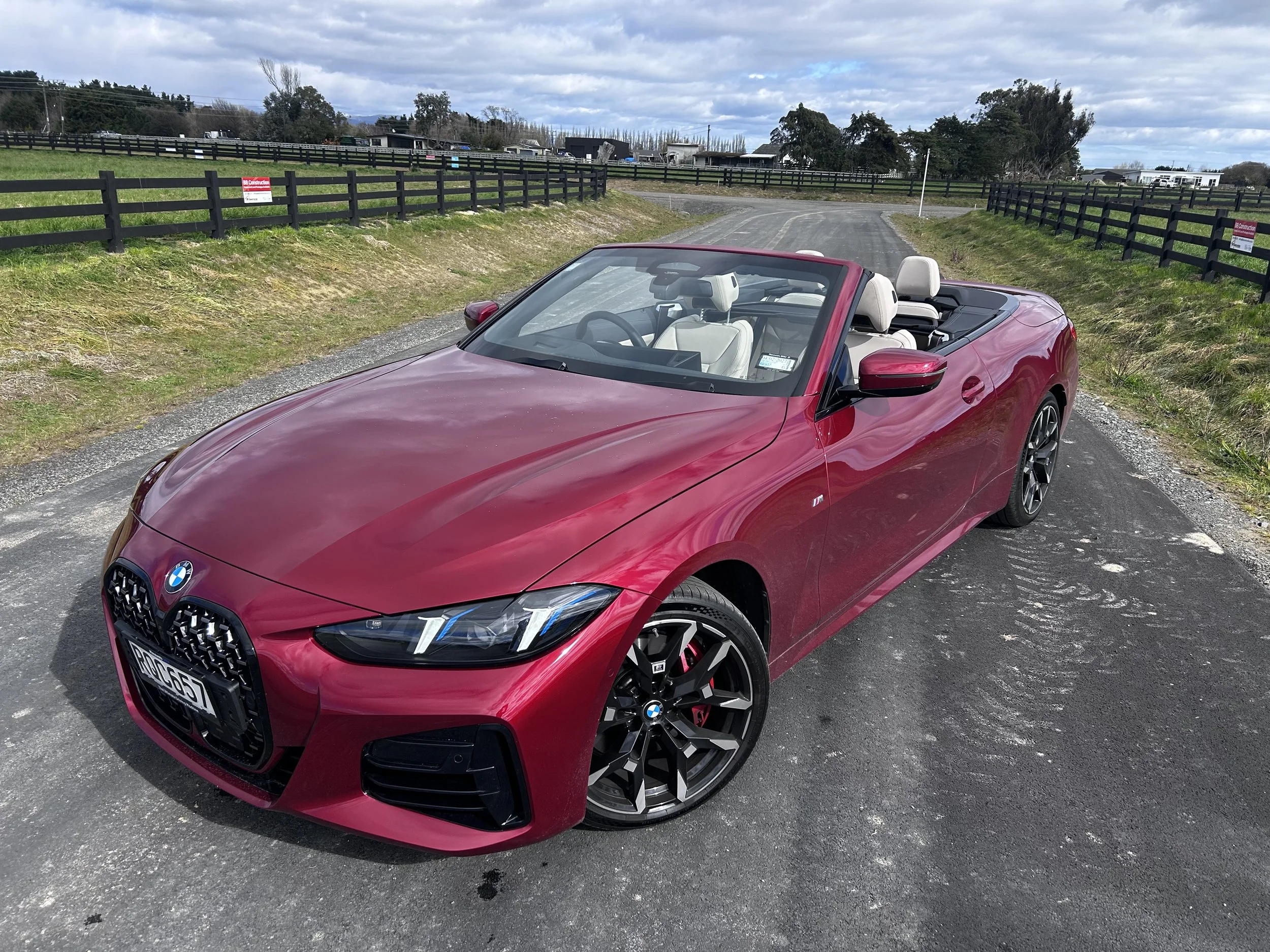
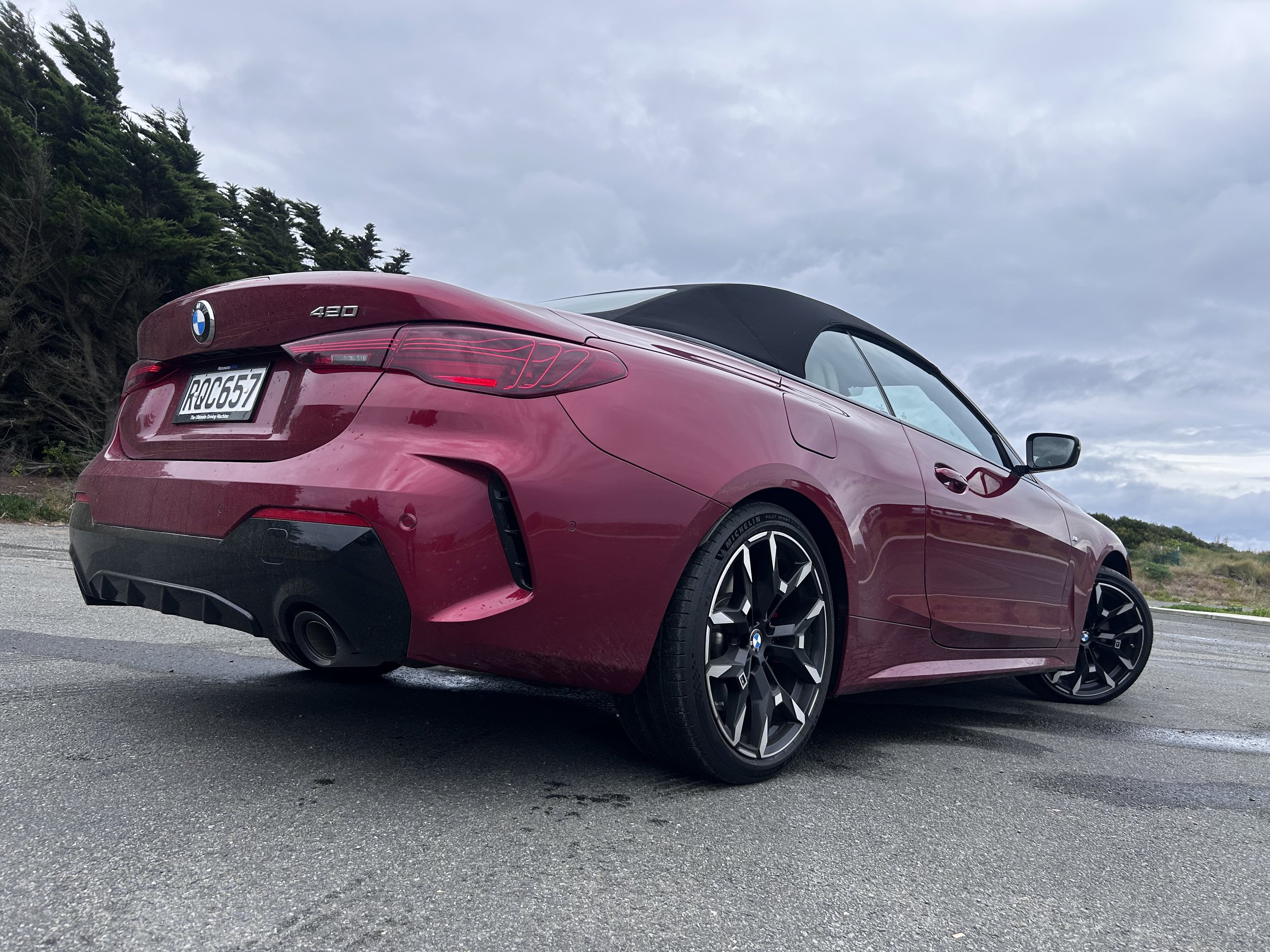
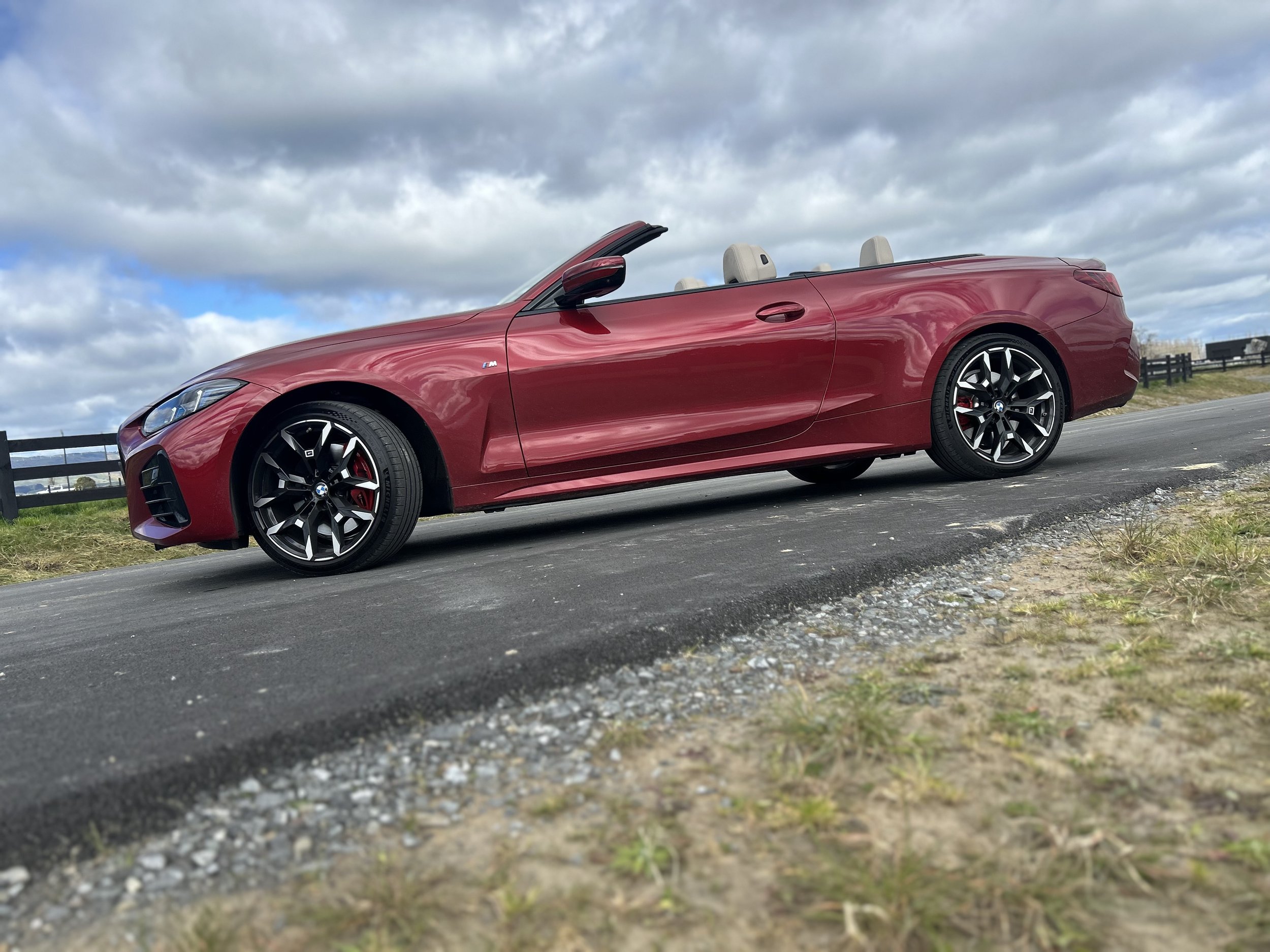
From almost every other angle that directly front on, though, this is a car that captures genuinely positive attention. Some convertibles look best roof down; others roof up. This BMW is in a select group in that it looks fine either way.
It also benefits from having less metal above the rear wheelarches - an area that looks unnaturally bulky on the 4 Series Coupe.
What also elevates the kerbside appeal is the colour palette. There’s absolutely no shyness to the Fire Red metallic and a light interior - I’d call it white , BMW says ‘Vernasca Oyster’ - but when a car is purpose-designed to turn heads …. well, why not?
This model is offered as standard with the M Sport Package, which includes adaptive suspension, M-accented interior components, and a M steering wheel. Other standard equipment includes the 19-inch alloy wheels. This example also had the $2700 M Sport Pro applications (red brake calibers, shoreline M lights and M seatbelts, an Enhancement package, into which the paint falls (along with tyre pressure monitoring, adaptive LED headlights, “crafted clarity’ glass and the Harmon Kardon surround stereo) for $5700, and some carbon fibre interior finishes, for $1200.
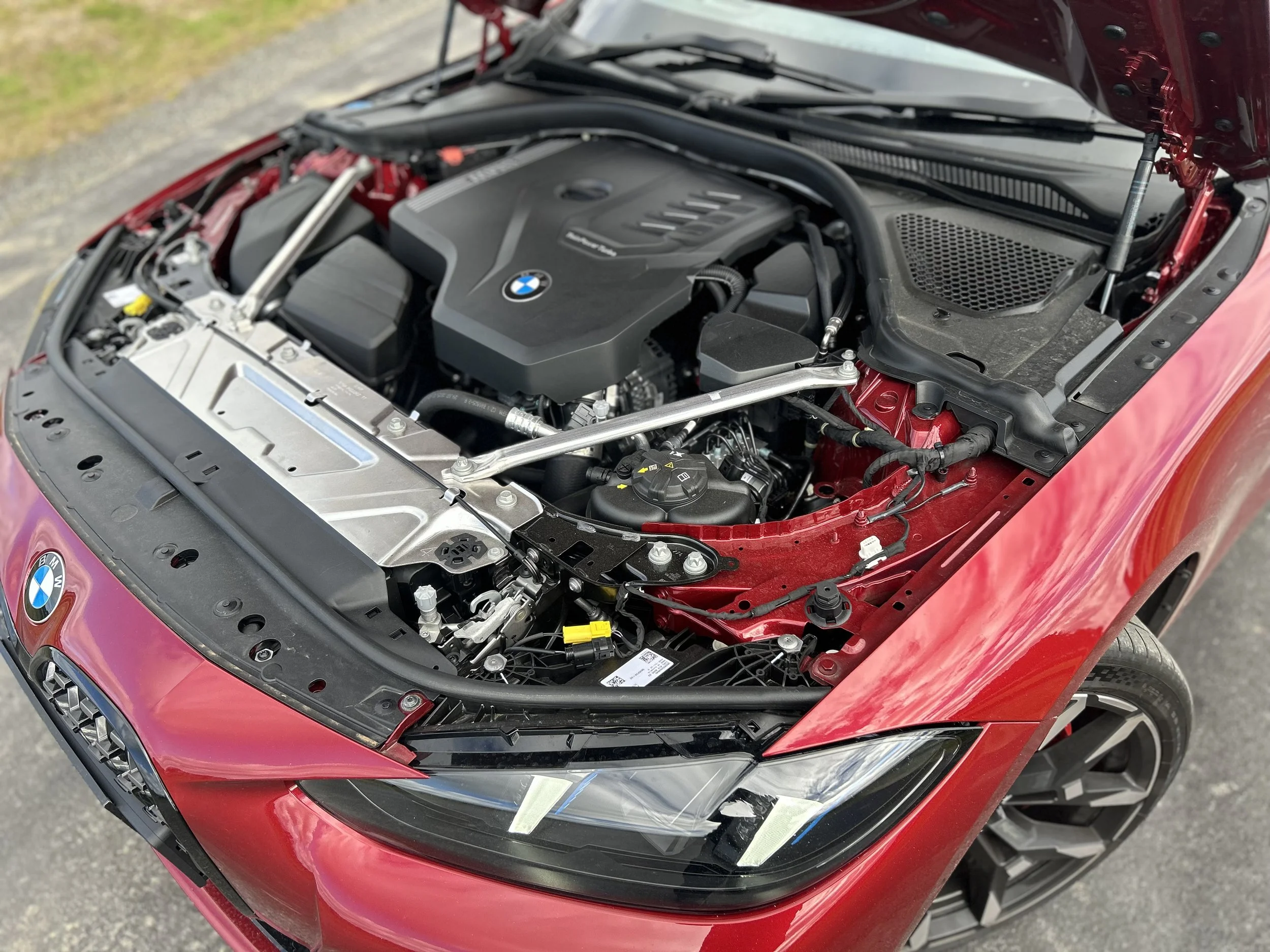
Once was the time when BMWs of this size would deliver with straight sixes and even the occasional V8, but not now. A 2.0-litre turbo four-cylinder might seem a bit tame for the badge, but in this context it’s okay. Sure, it won’t knock your socks off. You find fairly quickly it’s not tuned to immolate the tyres or threaten to overwhelm this chassis, but it’s still more than adequate and definitely does not lack in everyday performance. Moreover, it’s suave and smooth, which surely suits the kind of lifestyle driving a convertible is most committed to. You won’t be overly awed, but will also agree it is not a bad fit.
Engagement with the eight-speed automatic transmission which sends power exclusively to the rear wheels is extremely convivial. This is a really good transmission, one that rarely misjudged a ratio and adept at ensuring revs are kept sensible and the engine all but silent unless you floor the throttle.
The change in character when you engage a Sport setting is pronounced and gearchanges are swifter, too; there’s a manual-shift mode but it’s more or less redundant in this setting as all in all it’s working to be a lover of an easy-going Sunday drive than a fighter for pole position in the traffic light Grand Prix.
One reason why there are few more effective status symbols that an open-top car from a premium German brand is that they not only look good but are engineered to exceptionally high level.
This is the first time in two generations that BMW's mid-size convertible has had a soft roof, rather than a folding hard-top. It's some 40 percent lighter and folds into a smaller space, to the benefit of both packaging and the car's styling, and because it’s a BMW, the engineering is extremely good.
Opening the car up is swish; just a press of a single button. It folds back in just 18 seconds, and closing just as elegant; you can cycle the roof up or down at speeds of up to 50kmh. Everything fits together so perfectly; when all buttoned up, it’s not just that there’s no fear of wind or water egress. There are no rattles and it isolates the road noise and insulates from the cold.
One trick to alfresco driving on a coldish day is how much less buffet there is when the side glass is kept up. BMW also supplies a nifty fold-out wind deflecting mesh panel that reduces the amount of deflected air swirling back.
Whereas some systems site this behind the rear seats, this one fits in atop the rear passenger compartment, so obviously can only be used if those are occupied. How often that’ll occur is worth mulling. I’d say hardly ever, as the even with the front seats moved forward, legroom back there isn't great.
If it’s just you and a front-seat occupant, then it definitely is the worth the effort to pull out the deflector out of its bag in the boot, unfold and install - which is a bit tricky at first try - as it does a stable job of preventing any noticeable wind buffeting inside the car.
In addition to this, when it's colder, there’s an Airscarf system that blows warm air around the back of the neck of front-seat passengers. Along with the heated seats, it all combines to make open-top driving, even on a crisp morning, quite a pleasant experience.
As per the norm, with the roof stowed, there is an impact on boot space; 385 litres is no better than what you get in a modest-sized hatchback. But the rear seat does split-fold 40:20:40, so you can expand that a bit and load through longer, slimmer items. There's a well into which the convertible roof folds away, which eats into that boot space to the tune of 85 litres, however even then it's still a useful enough size to swallow a few bags and other items.
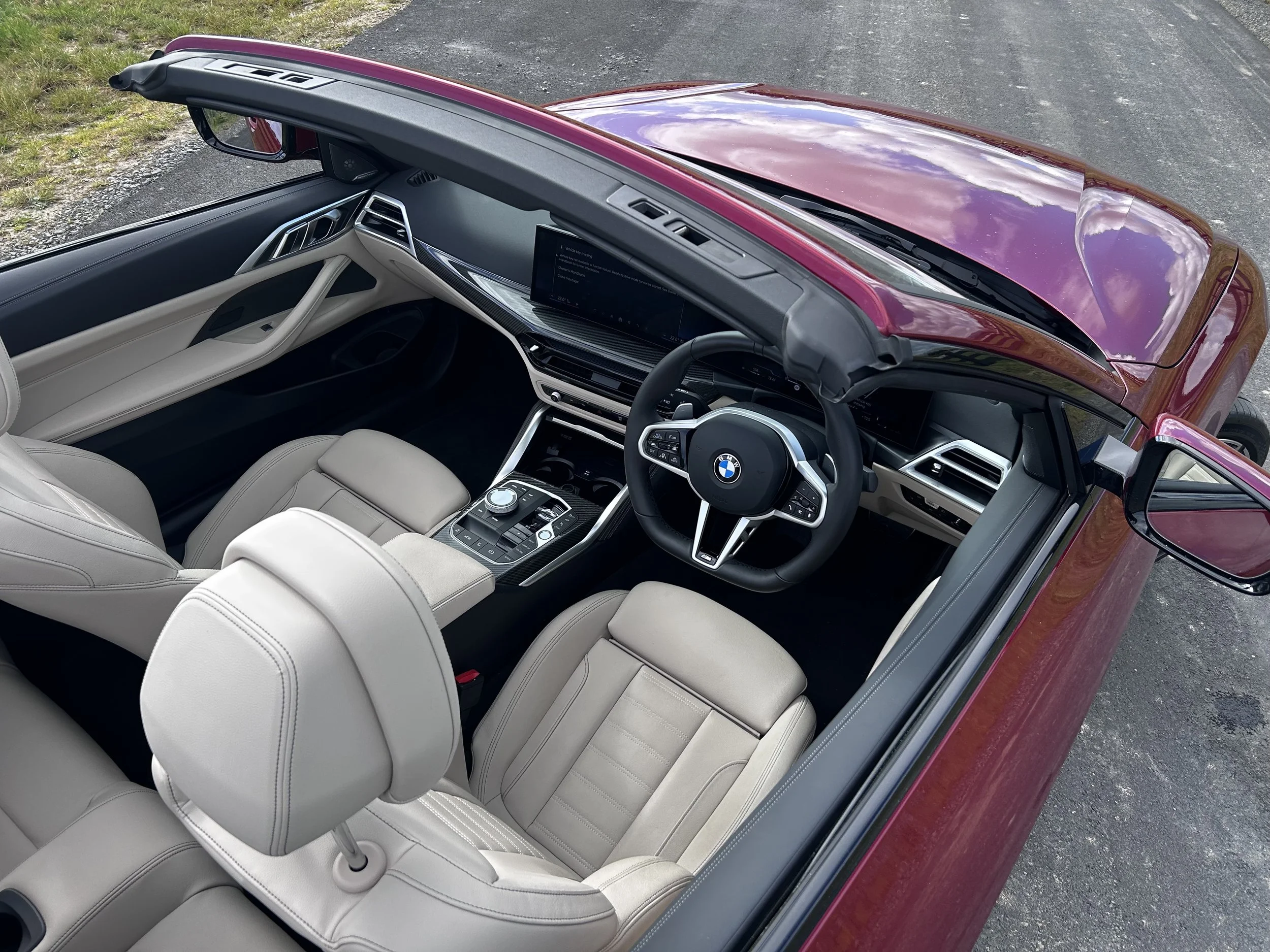
The cabin per se is appreciably upmarket and generally reflective on the expectation of this level of product not only being mechanically polished but also technically astute, but it is the one place that most immediately betrays the model’s design age. While it has picked up some new infotainment features, all in all a Four-Series isn’t by any means the place to see the very latest in Munich’s interior design and tech thinking.
To experience that, try the new iX3 or even the i4. The latter’s curved infotainment screen and more recent iDrive infotainment software is a rung above the separate instrument binnacle and 10.25-inch central infotainment screen that serves up in the 420i. Which isn’t to say the petrol-wed model's layout is outdated - some might say it’s retention of proper physical controls for the heating, ventilation and air conditioning is a plus. But this, retention of a 'pistol' style automatic gear selector and it keeping a large click wheel for the iDrive system, even though the display is also a touchscreen, are signs of design age.
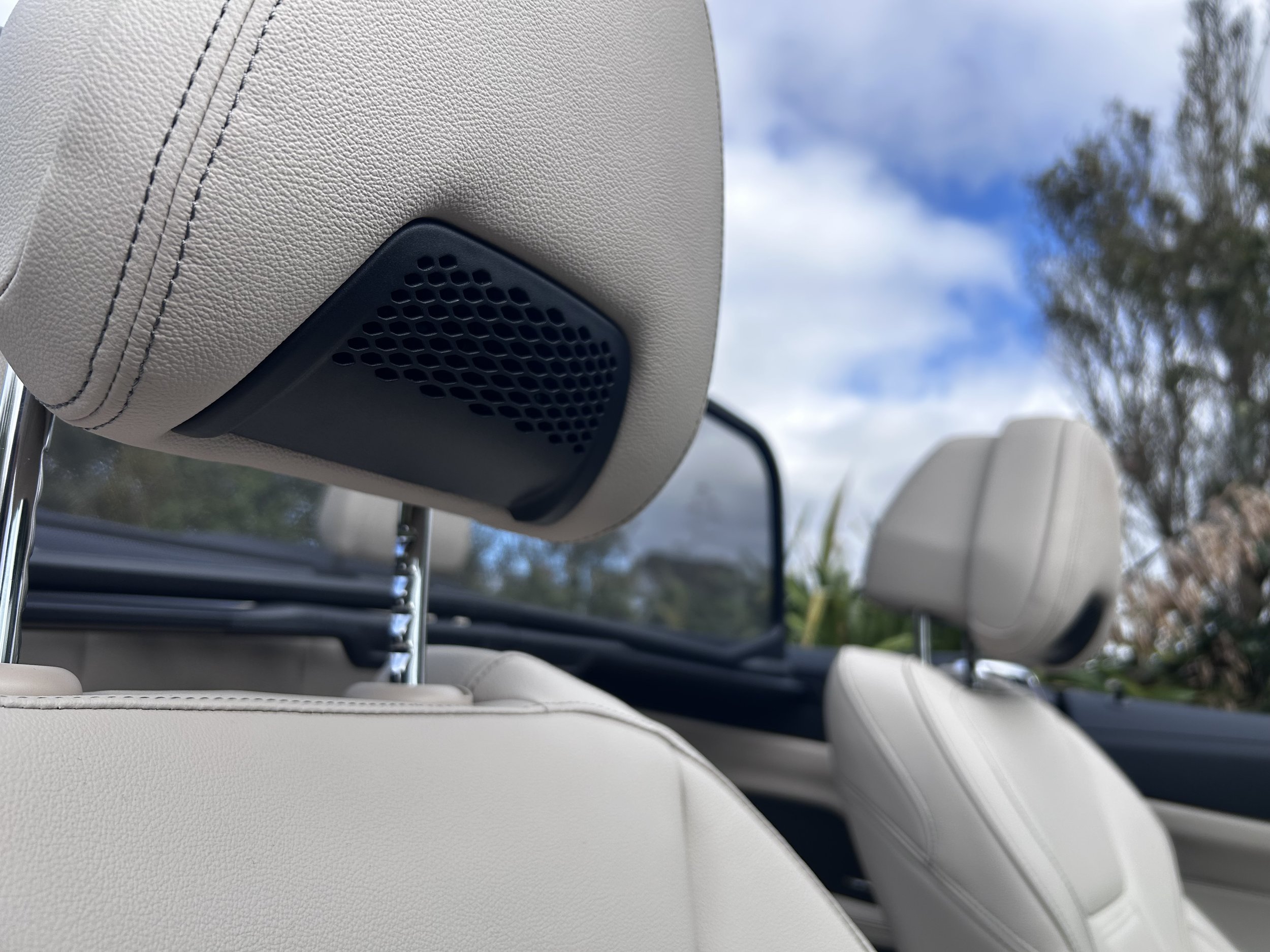
This car had the optional gesture control, which allows you to waggle your hand about in front of the screen to control the stereo volume and swipe between music tracks or radio stations and, more usefully, s large full-colour head-up display that projects speed, navigation and other data onto the windscreen.
It’s a four-seater car, but there isn't all that much space in the rear for legs and, of course, is also the worst place to be on an open air jaunt, as you’ll cop the full effect of the slipstream that goes above the front area.
Seat comfort is excellent, although the driving position is slightly offset to the left. The little 'seatbelt butler' that stretches the belt forwards as you sit down is helpful, as the longer doors push the belt mounting points further back than they would be in a sedan.
With open-air cars, it’s not just the power on hand but also the weight being hauled that tends to flavour conversation. And, yes, there’s no denying the 420i in this format is heavier than its fixed-roof counterpart. All up the extra chassis reinforcement adds 165kg, so the car as a whole clocks in at 1.7-tonnes.
Those of enthusiastic bent might fear what this could lead to. And, yes, there is a built-in sense of weight and heft, but to a point it’s a veil. Beneath it is still enough lightness and agility to make it feel frisky and fun, and it has one of the best electrically assisted steering setups around.
Even with the M Sport Pro pack the ride quality is good enough to keep the worst road surfaces from upsetting you, and while you'd never describe this model as being softly sprung, neither is it ever even approaching harsh nor uncomfortable.
You will notice a slight difference when the roof is down, though. Chopping the top off a coupe inevitably affects structural rigidity.
BMW says that this model's structural strength has been improved by four percent compared to its predecessor, in part thanks to an aluminium shear panel at the bottom of the front end, and side skirts with extremely high torsional rigidity, and though there’s nothing as uncouth as actual scuttle shake, it’s probably not as as at-one as the hard-topped products. It's the age-old compromise of the convertible - if you want the sun on your head, you've got to give up something, somewhere.
Still, buying any convertible is a subjective purchase, and many would-be buyers will be swayed as much by how it looks as by how it drives.
On that score, the 420i is very much placed to do well and, though a bit more oomph wouldn’t go amiss, who’s going to be in a hurry on a nice day?
As much as this car will clearly be most enjoyable when the roof is down, your shades are on, and the sun is out, it does nonetheless seem to stack up as perfectly practical proposition all year round.