Dongfeng 007 first drive: From China, with shove
/Nobody does it better? In respect to value verve, this new brand’s flagship sets the pace. But cost containment also influences this fast fling.
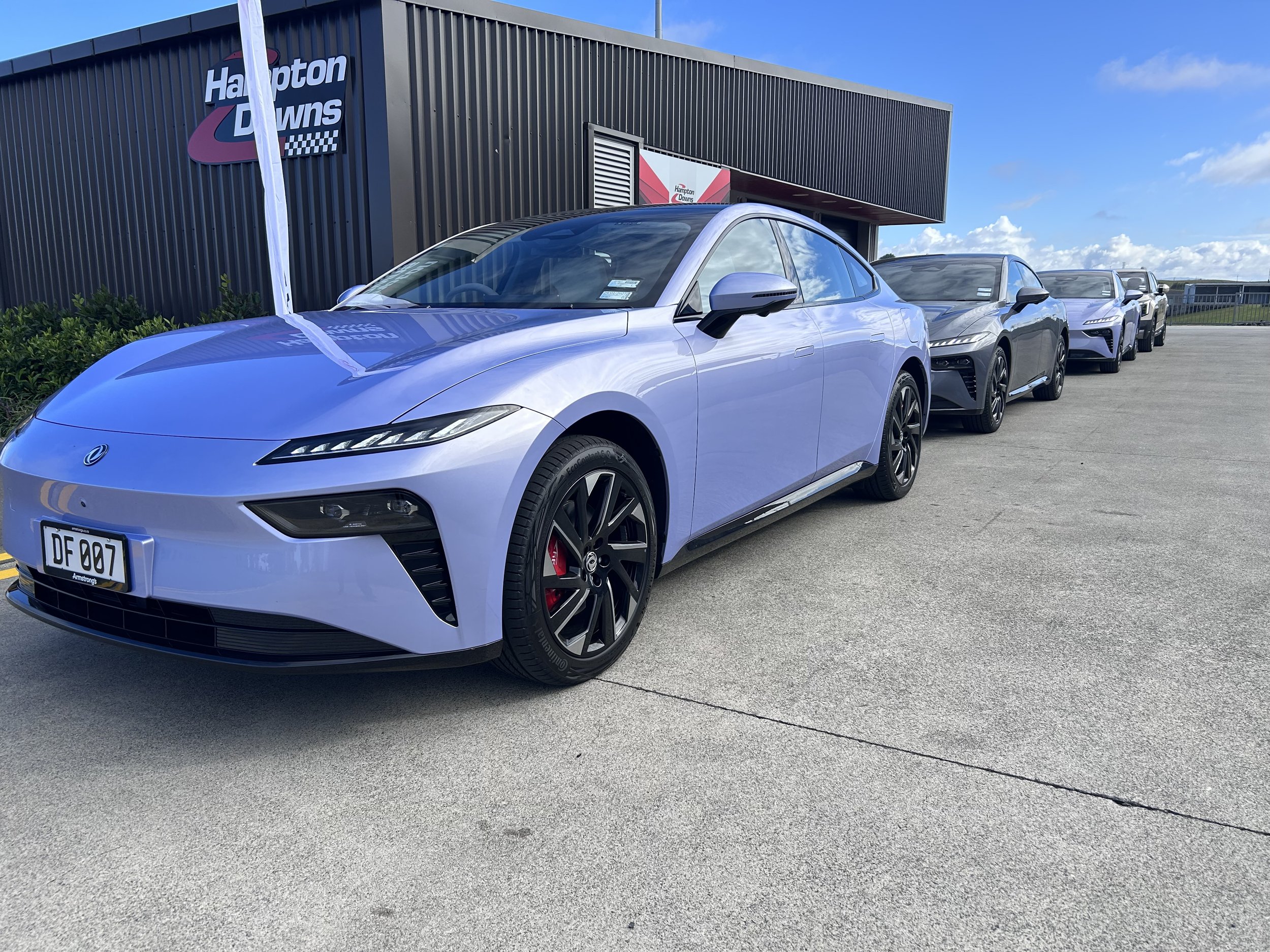
TRULY rapid enough to be considered a bone fide performance car, but perhaps best not categorised as an outright serious sports model.
Lending full attention to the specifications and looking beyond the stirring data relevant to its step off reveals why the Dongfeng 007 sits in that interesting position.
Without doubt, this new svelte and low-slung five seater is very powerful and very rapid. The quickest by stopwatch edition is in the full dual motor Performance format.
With 400kW and 640Nm the low-slung coupe-roofed five-seater is right up with one obvious rival out of China, the even more powerful Zeekr 7X Performance AWD (475kW/710Nm), but might even be compared to some fare from esteemed German makes.
The claimed standing start to legal open road limit time of 3.9 seconds is 0.1s behind the Zeekr and 0.4s off that cited for the Tesla Model Y Performance, but will embarrass the entry version of the Porsche Taycan and sits close to more feral editions of that car and its Audi equivalent, the e-tron GT. Those can get down to 3.3s, but it’s down to the very exotic Taycan Turbo GT with Weissach Package to restore truly clear air honour to Germany. That edition can achieve 0-100kmh in a barely believable 2.2s.
In its own right, nonetheless, the 007 Performance is a sprint demon.
All electric cars have smart step-off, but Dongfeng’s special agent has licence to thrill in standing firmly with a relatively select pool that will thump you back into the seat with such force as to whump air from your lungs.
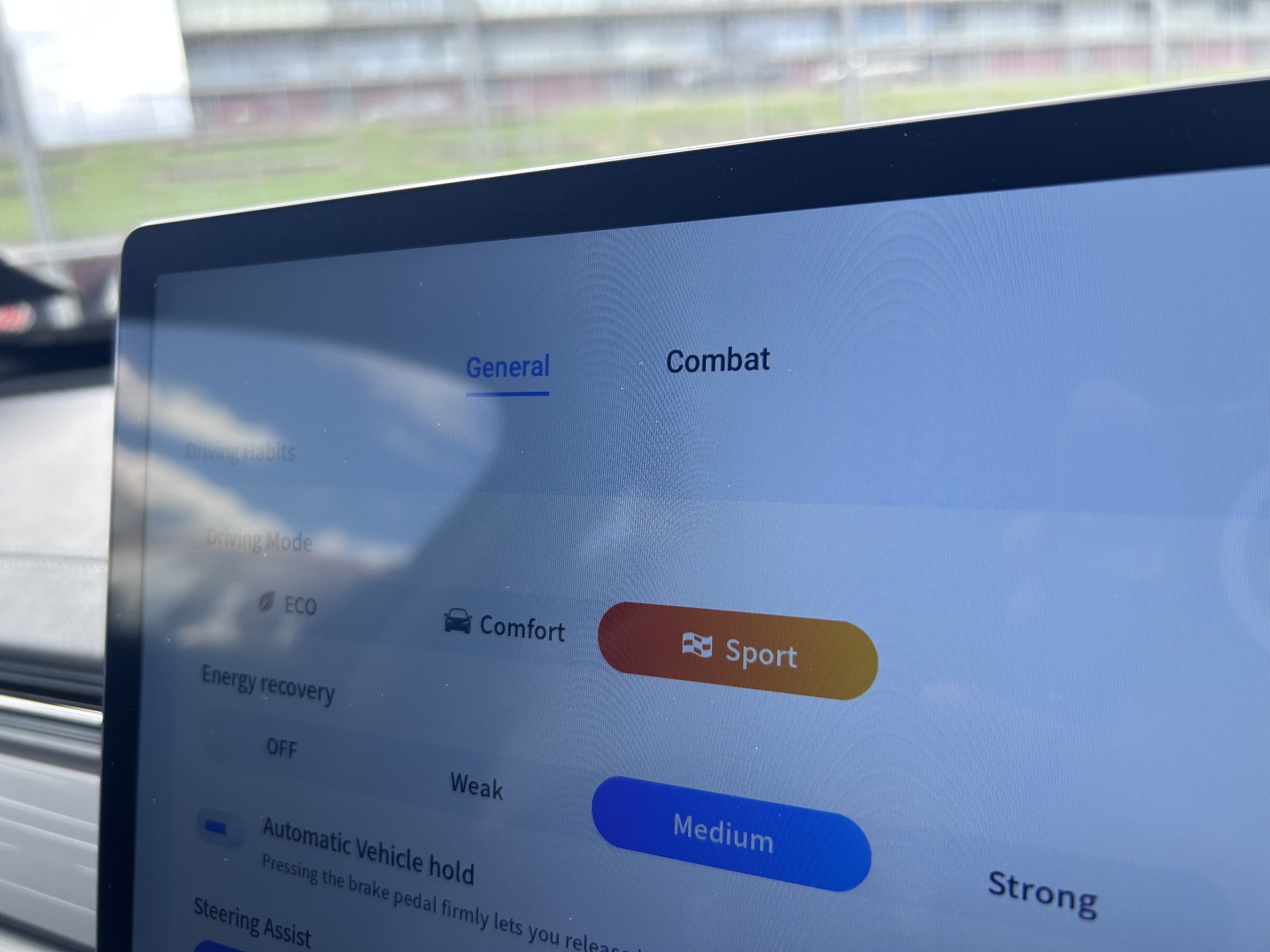
Effecting that wallow means putting it into an ‘optimal’ setting beyond its ‘Sport’ mode.
‘Combat’ mode brings up a special centre screen display - including a G-meter, steering sensor and 0-100kmh timer - all in blood red across a black background, and also alters the display ahead of the driver, with a graphic urging the driver to ‘fight’.( If you didn’t already realise Dongfeng was a Chinese brand, it’s stuff like this that sets you right).
So, lots of fury and forcefulness to match the world’s finest in this specialist corner.
And so much cheaper.
At $59,990 in the fastest format, and $5000 less as a rear-drive with a lot less punch (but far better range), the 007 is way less expensive than the other mentioned cars.
The Tesla is $101k; the full ask for the cheapest Taycan would put three 007s in the driveway; the same buy-in for a single Turbo with Weissach would achieve 007s in all six colour choices.
Given the strength of its argument, it might seem curious why Dongfeng’s distributor, the Armstrong Group’s Automotive Distributors’ Limited, didn’t offer any comparative performance material at yesterday’s launch.
I suspect it’s because of the car’s provisions outside of its electric architecture.
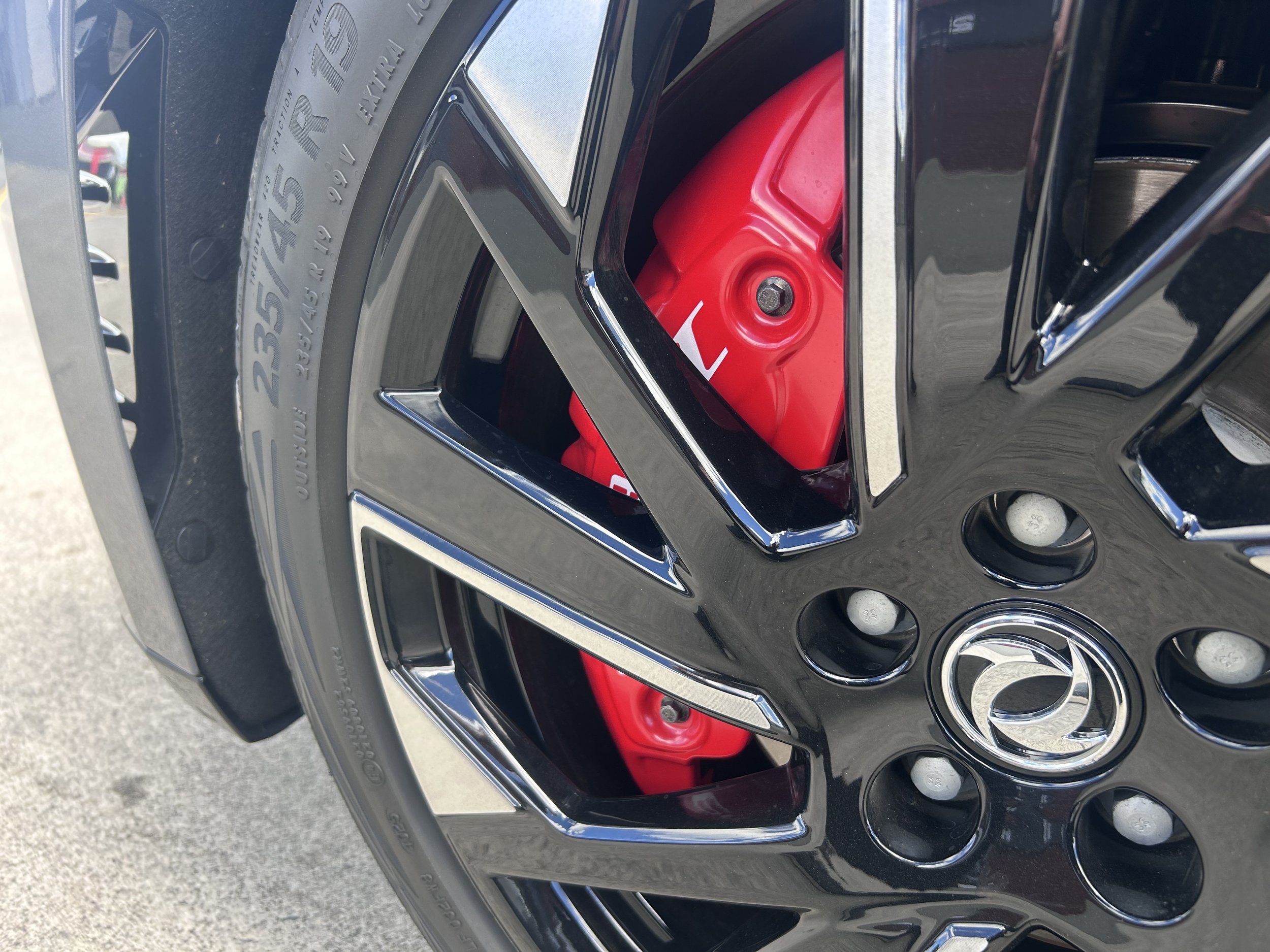
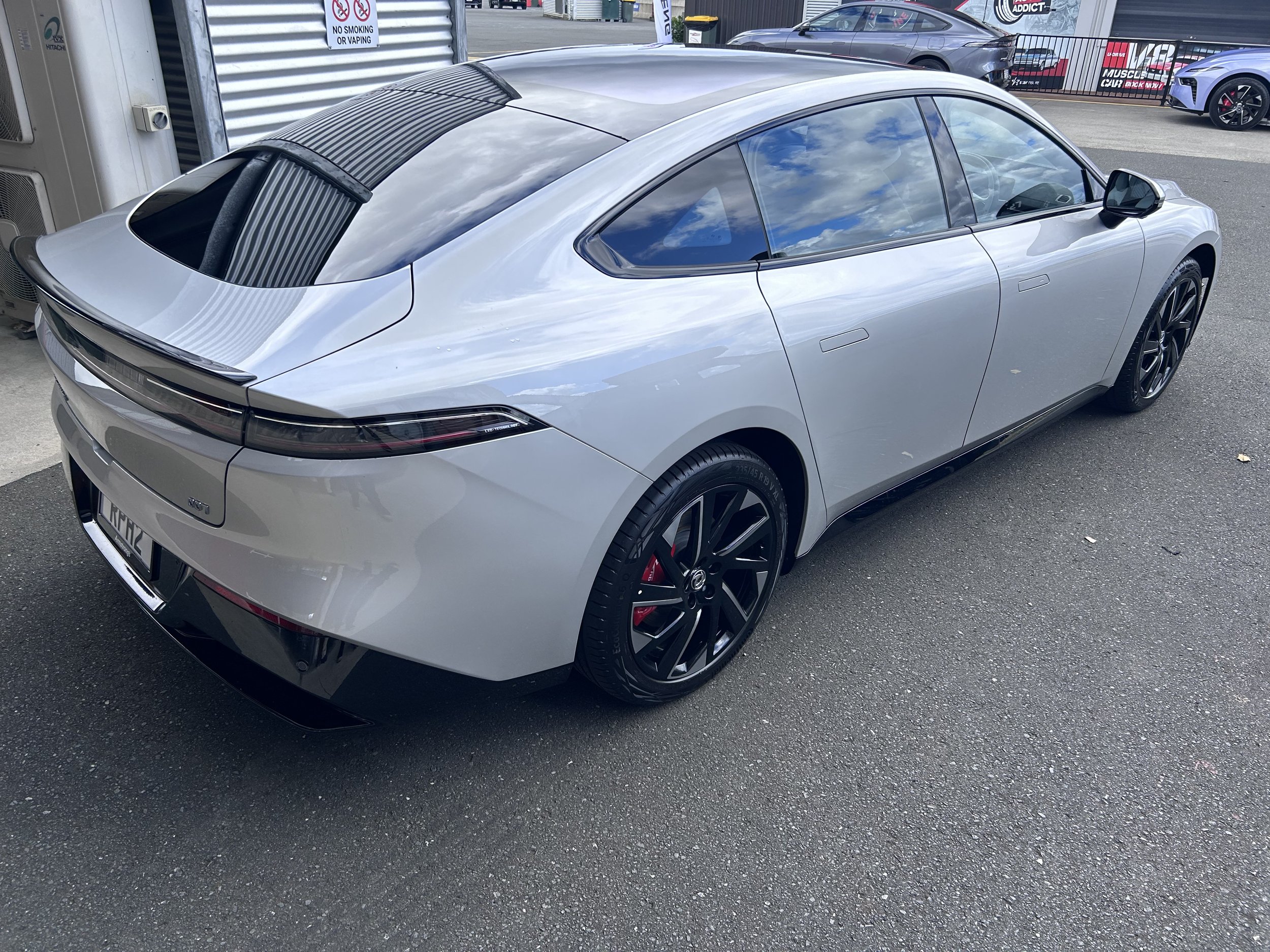
That the 007 runs a 19-inch wheel is curious, because generally hard-edged performance fare have bigger hoops, to allow room for enormous rotors.
The 007’s brakes look sporty, in that it has discs all around and the calipers have exotic looking covers, in vibrant red with an stylish script.
Behind these, though, are single pistons. And wrapping those rims? Continental EcoContact 6 tyres, a type designed to deliver low-resistance efficiency. And the brakes are factory, rather than from a specialist performance shop.
The Model Y Performance I recently drove had fat 21-inch Z-rated Michelins; all Porsches also run at that level. The Taycan and Tesla run specialist Brembo brakes.
The launch day plotted a short road stint then running at Hampton Downs racing circuit, but the latter venue was driven under very controlled conditions.
The road driving and exercises of an acceleration test, emergency stoping in a straight line and cone dodging through a zig zag handling layout were in our hands.
A hot lap finale required riding with Liam Sceats, a very accomplished single seater racer. You might recall he ran as a wild card in the recent 2026 NZGP. To place third having come into that showdown at Cromwell’s Highlands Park facing a highly international field - including five drivers on the F1 shortlist - and without no-event testing seems hugely credible. But not good enough for Sceats. “I wanted to win.” Another name to watch.
It would have been brilliant to have our own chance at running the car hard on the track, but I could understand why this wasn’t a goer.
Electric car events at race circuits here are basically unheard of, for every simple reason. Most venues don’t want a bar of them, for fear of ‘what if’ issues should one crash and thereafter self immolate - a very low possibility, but enough to kibosh.
Hampton Downs does allow EV running, but with tight restrictions.
For this day, that meant a single fast lap, then a cool down for the 007, with an accredited driver.
I’d say that was enough for it anyway, given the calibre of the brakes and tyres. It was a great experience, but perhaps as much a testimony to driver skill as the delivered technology.
That the Contis were not pumped up super-hard, but kept at road pressure, that while the brake fluid had been replaced to a type more suited to high temperature operation, standard road pads were retained seemed …. brave.
Electrics are heavy, adding passengers increases the load. As fast as it was out of corners, the real eye-opener was how the 007 reacted when piled into the high intensity bends.
Put it this way; Sceats was earning his keep. The car squirmed significantly under hard stopping, with some rather pitching, not just lateral but also fore-aft, and no small amount of tyre protest. It seemed to me momentum and mass were very close to overwhelming the inbuilt defences. Given the heat coming from the wheel bays afterward, the 007 was potentially not having as much fun as we were.
More than host responsibility put the car on track. With the 007, there’s genuine motorsport cred.
Six wins from six starts in its debut in the electric category of China’s domestic touring car championship.
Surely the competition car’s top speed was pushed beyond the road tuned models’ cited 191kmh maximum, which is below that for the Tesla and well behind the top velocities achieved by the German stuff. More specialist tyres, race brakes? I’d love to know.
Dongfeng’s local tech head says the EcoContacts are a factory-preferred provision, but on a recent visit there he learned it can come with another tyre, provenance unknown.
Also, he has discovered Dongfeng dealers in China have sorted, and are selling, a brake upgrade kit. Six pots up front, four at the rear seems to be over-egging for normal road use. But would be preferable for any owners keen to rag the car hard for prolonged period.
Expectation for the 007 is that it probably won’t win on the sales charts, but that’s neither here nor there. It’s role is to stand as a statement of intent, to showcase the full talent of a brand that, overall, is about selling on value. In this case, value that comes with a lot of verve.
So committed are manufacturers to SUVs that it’s almost a surprise when a brand debuts what appears to be a conventional sedan. Which turns out to actually be an artfully-disguised hatchback.
Cars that looks like cars aren’t anything like as popular was they once were. But local boss Simon Rutherford says that could yet be a strength; when the first car here went on show, it attracted the eye of a performance Commodore owner who simply didn’t like SUVs.
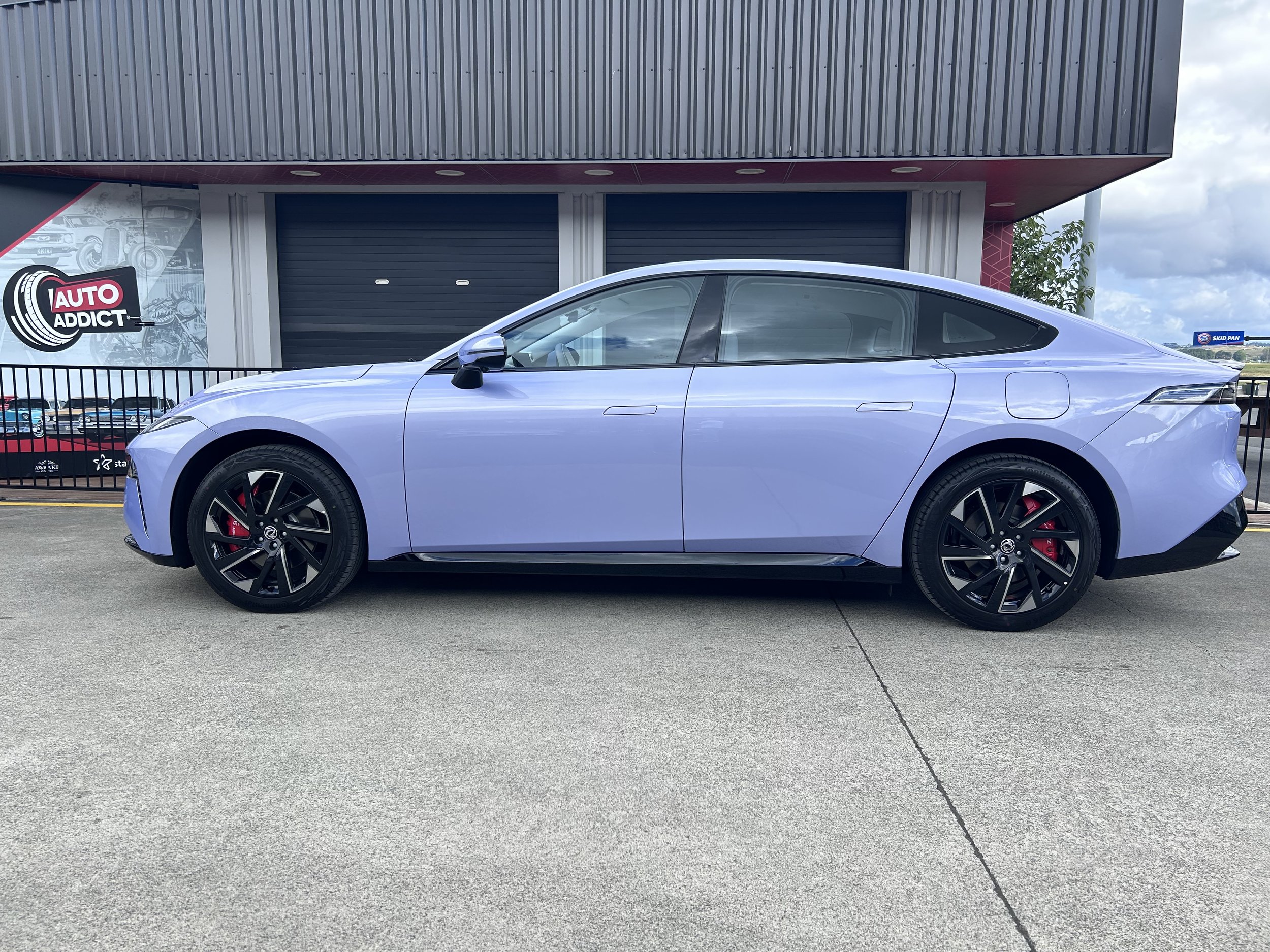
The smooth shape is designed not just to look good (job done) but also to be very slippery. A low drag coefficient is great for any EV; any shape that’s not properly aero will lose efficiency and therefore range while it’s pushing through the air.
The optimal edition is the rear drive car, but even the dual motor has a cD count bettering that of a Tesla Model 3. The related figure suggests it competes with the established best-in-class Hyundai Ioniq 6 and Mercedes-Benz EQE.
The launch arrangement being restricted to a mid-morning start and 1pm wrap-up, and also asking for two cars to be driven (aside from the 007, there was the Vigo compact SUV that is also now rolling out) allowed for only fleeting public road excursions and no useful analysis of strengths and weaknesses in that environment.
Insofar as the 007 is concerned, it is yet another product from China that strives to impress as being far more premium in respect to build, finish and interior fit-out than the price band normally entertains.
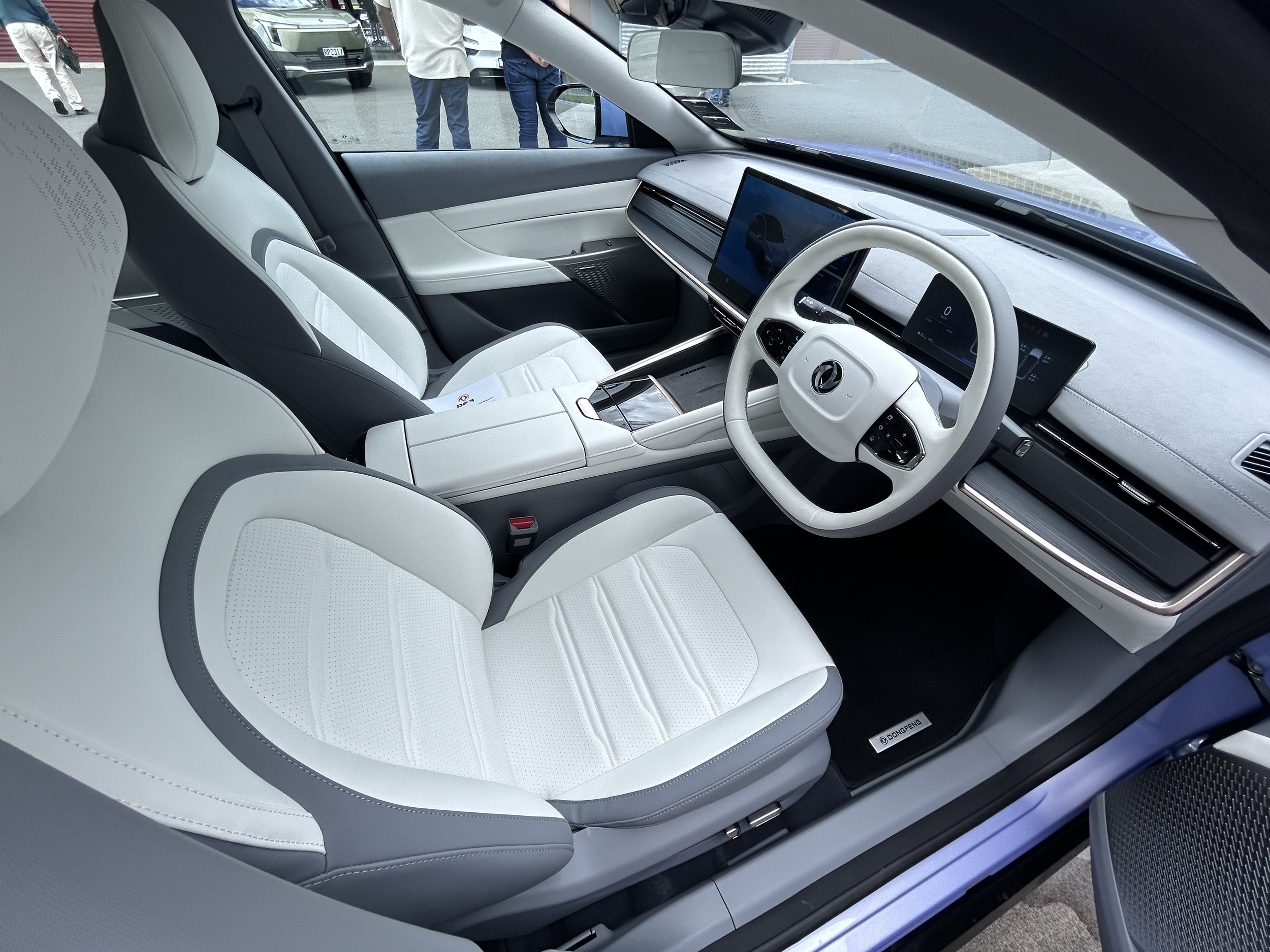
In respect to the general ambience, it makes you appreciate how quickly Chinese cars have developed. Here’s there is widespread use of tactile materials, soft-touch surfaces, and a notable focus on infotainment, running via an ever-distracting screen, with the usual over-abundance of operability options, some useful, some potentially set to be deemed useless. It has tech dedicated to supporting self-driveing up to Level Two, but there was no time to explore that.
Dongfeng takes pride in this being a button-less environment. They might yet regret it; so many others are starting to. Unlike some rivals, it at least retains a manual wiper control, a multi-speed element at the tip of the orthodox indicator stalk. That’s a well-proven design from Mercedes Benz product. Discovering this was a relief when a brief rain squall hit halfway through the 15 minute road drive. A shame that every other function you might regularly need to access - such as drive mode settings, climate controls, head light and mirror adjustment - seems to be buried in an encyclopaedia of sub-menus.
Our run was over coarse chip, and road noise did seem quite intrusive, but doubtless it’ll be quieter on motorway tarmac.
The 2915mm wheelbase provides a roomy interior. Sitting in the back for the feast lap, I found plenty of foot and legroom for my lanky frame. But the sleek profile does impinges on head room.
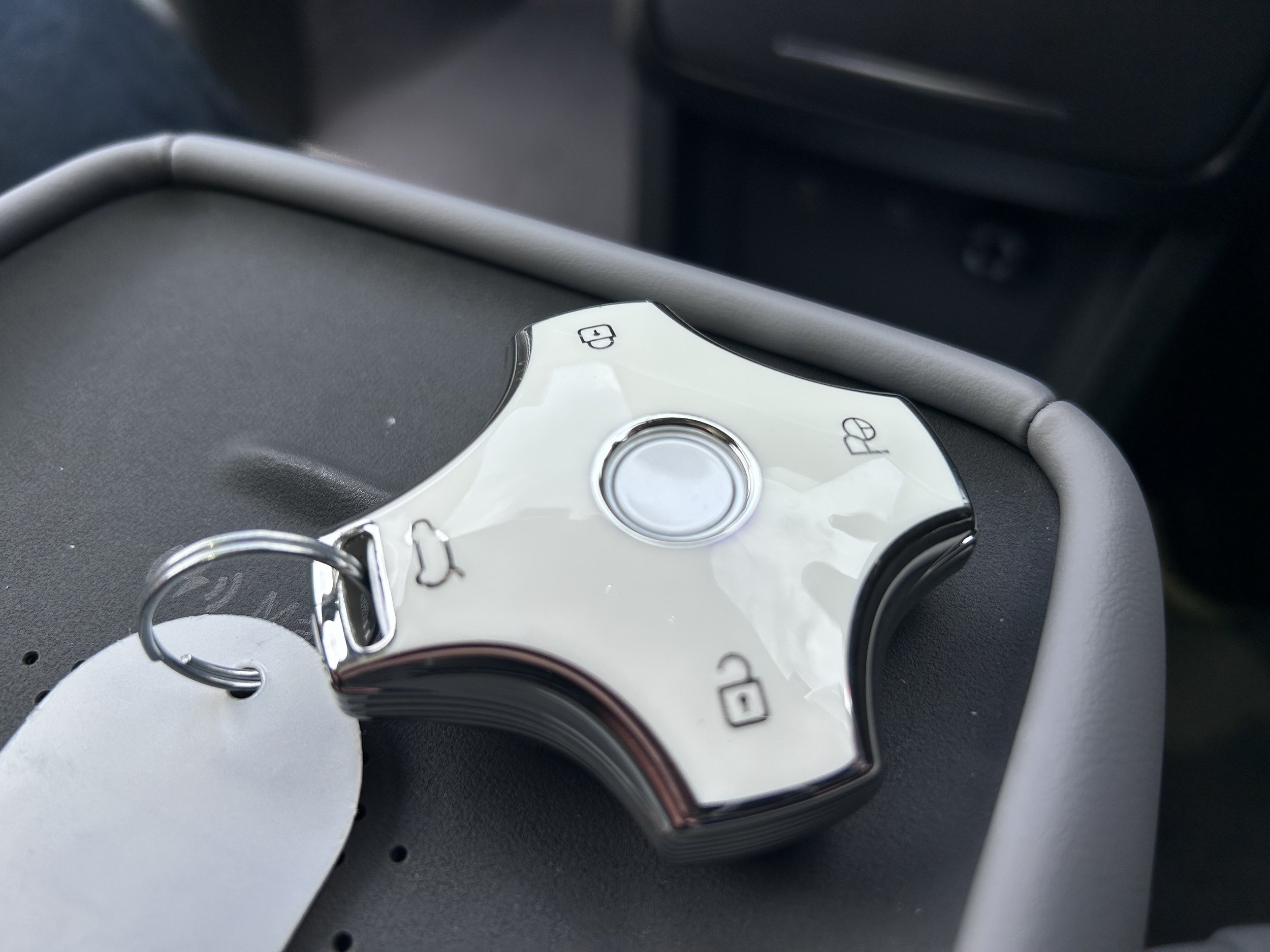
Start up is simply a matter of sitting at the wheel and keeping in your pocket one of the weirder-looking keys fobs I’ve seen.
Both editions rely on a 70kWh LFP battery supporting DC fast charging at up to 200kW. Dongfeng cites 520 kilometres’ from the Long Range using the WLTP calibration that is now mandatory here.
The Performance runs out of zap at 389km, which is well short of the Model Y Performance, for which around 580kms’ is cited. Tesla does not share battery sizes, but it is understood the Model Y Performance has a 79kWh unit.
The 007’s design features frameless doors with the kind of hidden handles that are about to be outlawed in China; whether than means export product will in time update to protruding handles has yet to be explained.
Both variants take a huge panoramic glass roof, have ventilated front seats and a 15.6-inch digital interface powered by a Qualcomm Snapdragon 8155 computing chip. The system also supports the vehicle’s built-in recording function using onboard cameras. It’s not clear if that footage retains in the car or is shared back to Dongfeng headquarters.
Interestingly, while Apple CarPlay is standard, Android Auto will avail as an option. Sound presents through a 19-speaker WANOS theatre-grade sound system with integrated headrest speakers and ambient lighting synchronisation.
Standard safety equipment runs to just six airbags, which seems a bit light by modern standards. Dongfeng’s representatives were unable to elaborate on what provides; we’d assume two frontal, and perhaps dual side protection devices. The absence of a centre airbag between the front seat occupants puts it behind modern thinking.
Driver assistance systems include autonomous emergency braking, adaptive cruise control and blind spot monitoring. It also has a lane keeping assist that seemed very overzealous in its activity on narrow roads outside the circuit. It’s one of the those systems that pulls on the steering and curiously, and frustratingly, the degree to which it sought to do this intensified once the car went into its Sport setting. It’s a trait that will irk quickly.
In respect to crash test credibility, because Dongfeng is among the very few Chinese makes yet to enter Australia, it lacks a rating from our countries’ mutual independent assessor, the Australasian New Car Assessment programme (ANCAP).
Instead, it must make do with a Vehicle Safety Risk rating; that’s a five star score, but is defined by assessment of probability of outcome, rather than actual performance in a testing scenario.
The 007 comes with a six-year/200000km vehicle warranty, eight-year/200000km battery warranty, and six-year roadside assistance coverage.
The writer attended this event as a guest of Auto Distributors Limited with flights and a meal accepted.