
Emergency services’ auto dial push for NZ
/ANCAP pushing for higher eCall take-up as it also promises closer consideration of ADAS next year.
TECHNOLOGY enabling cars to automatically connect with emergency services following a serious accident has become prioritised by the national crash test auditor.
The provision of eCall technology has historically been a point of contention in New Zealand, as emergency service alerts have always been a human to human interaction.
It is not a mandated standard and just 10 percent of new vehicle sold here last year came with the capability. Australia has been more receptive and the proliferation is at 40 percent.
Improvement to the NZ scene was signalled earlier this year, when Intelematics, a Melbourne-based company owned by the Royal Automobile Club of Victoria, said it would bring its system here.
Today ANCAP, the Australasian New Car Assessment Programme, which operates in Australia but is heavily funded by New Zealand agencies, believes it is high time NZ came up to speed.
Accordingly, from next year the systems will be given greater attention as part of announced revisions of the crash testing protocols it conducts in Melbourne.
Ecall is common in Europe and many cars have an SOS button, but often it is inactive.
When working, the system in event of a big crash, the car can self-dial an emergency number and relay to emergency services a data set with the crashed vehicle's location, time, and direction of travel.
The car’s sensors determine the severity of the crash but occupants can also manually activate the system by pressing the SOS button.
Either way, the ideal is for a trained triage agent to be able to communicate with the vehicle occupants within eight seconds and alert emergency services if needed.
Intent to move into NZ was announced by Intelematics in March. At that point the company pointed out that with the majority of crashes in NZ taking place in rural areas and often far from hospitals, this technology could prove critical in helping to reduce road trauma.
ANCAP seems to agree with that sentiment.
“Our updated protocols set a clear benchmark for emergency call systems fitted in vehicles,” the organisation’s chief executive Carla Hoorweg said today.
“We want to encourage manufacturers to enhance existing systems and provide an incentive for all brands to fit this life-saving technology.”
She raised concern about eCall deployment being limited here.
“New Zealanders should not be left behind when it comes to life saving technologies such as eCall, the potential for it to make a difference on New Zealand’s road is too big for manufacturers to ignore.
“Through these upgraded protocols, ANCAP is setting a clear bar that will continue to challenge industry beyond regulation, inform consumers, and help reduce road trauma.
“Our goal remains focussed: helping you stay safe, every drive.
“We look forward to seeing vehicle manufacturers continue to meet the highest levels of safety in a competitive market,” Ms Hoorweg added.
Other changes to ANCAP’s protocols effecting from next year are intent to put more effort into considering driver monitoring systems, which have proven controversial.
ANCAP says several changes to ints methodology have been made specifically in response to consumer feedback.
It promises active driver assistance systems – often criticised for their abrupt or irritating interventions – will be rewarded for smooth, intuitive operation as well as technical performance.
Focus is also to intensify on increasingly popular electrically-operated door handles – which sit flush with bodywork when not in use. ANCAP says these should remain operable after any crash.
It also highlights that electric cars should isolate their high-voltage battery after a serious crash, and that vehicles should be able to notify first responders of the crash.
ANCAP says its rethink is in line with meeting a new concept, the Haddon Injury Prevention Matrix, which examines what happens before, during and after a crash.
“Vehicle safety is entering a new era,” it announced today.
“Over the past 30 years, manufacturers have responded well to the safety demands of consumers, improving the structural integrity of their vehicles and, more recently, the safety technology on board.”
However, this approach is only part of the picture when it comes to making sure road users are protected at all stages of their journey.
It says last year 1592 New Zealanders and Australians lost their lives in vehicle-related crashes.That was a bleak reminder of the need for policymakers, infrastructure providers, vehicle manufacturers, enforcement agencies, advocacy groups, employers, and everyday road users to keep pushing for improved outcomes.
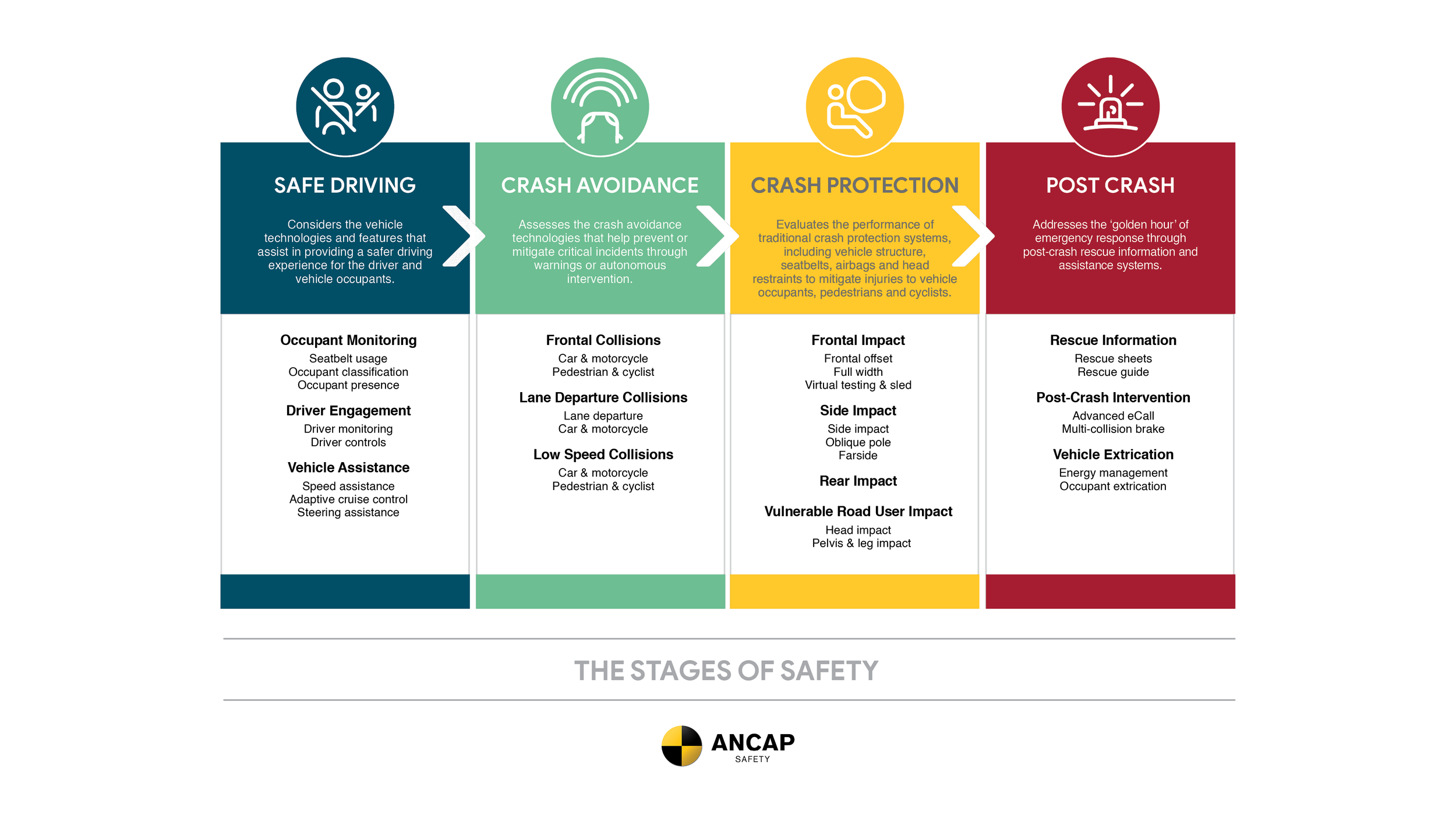
ANCAP’s response is to refresh its criteria to consider what it calls the ‘stages of safety’ - safe driving, crash avoidance, crash protection and post-crash.
“This new approach also provides a structure that can adapt to the technological developments that will shape the automated driving future,” Hoorweg says.
As part of aligning testing with the consumers’ experience, ANCAP will be performing more on-road testing to better track the real-world capability of the technology on board.
“This on-road evaluation will examine how well the vehicle’s technology reads and responds to road conditions, and will give ANCAP more detailed insights into a driver’s experience beyond the test track.”
The Stages of Safety, are:
Safe driving: This considers the vehicle technologies and features that assist in providing a safer driving experience for the driver and vehicle occupants.
Crash avoidance: This assesses the crash avoidance systems that help prevent or mitigate critical incidents through warnings or autonomous intervention.
Crash protection: This evaluates the performance of traditional crash protection elements, including vehicle structure, seatbelts, airbags and head restraints to mitigate injuries to vehicle occupants, pedestrians and cyclists.
Post crash: This addresses the ‘golden hour’ of emergency response through post-crash rescue information and assistance systems.
Each of the four stages will be scored out of 100 points and - as is currently the case - expressed as a percentage for consumers seeking that next level of information beyond the simple star rating. Minimum thresholds will also continue to apply for each stage – determining the overall star rating.