
More space, lots of stars for GLB
/Electric involvement is now total for Germany’s car-based compact family bus.

ELECTRIC and electrified is the choice, but this time less in respect to naming convention - meaning the Mercedes GLB won’t take any special ‘EQ’ badging in its wholly battery-fed format.
As before, the latest edition of the SUV, unveiled internationally and expected here in 2026, will avail in a five- or seven-seat layout, both more spacious.
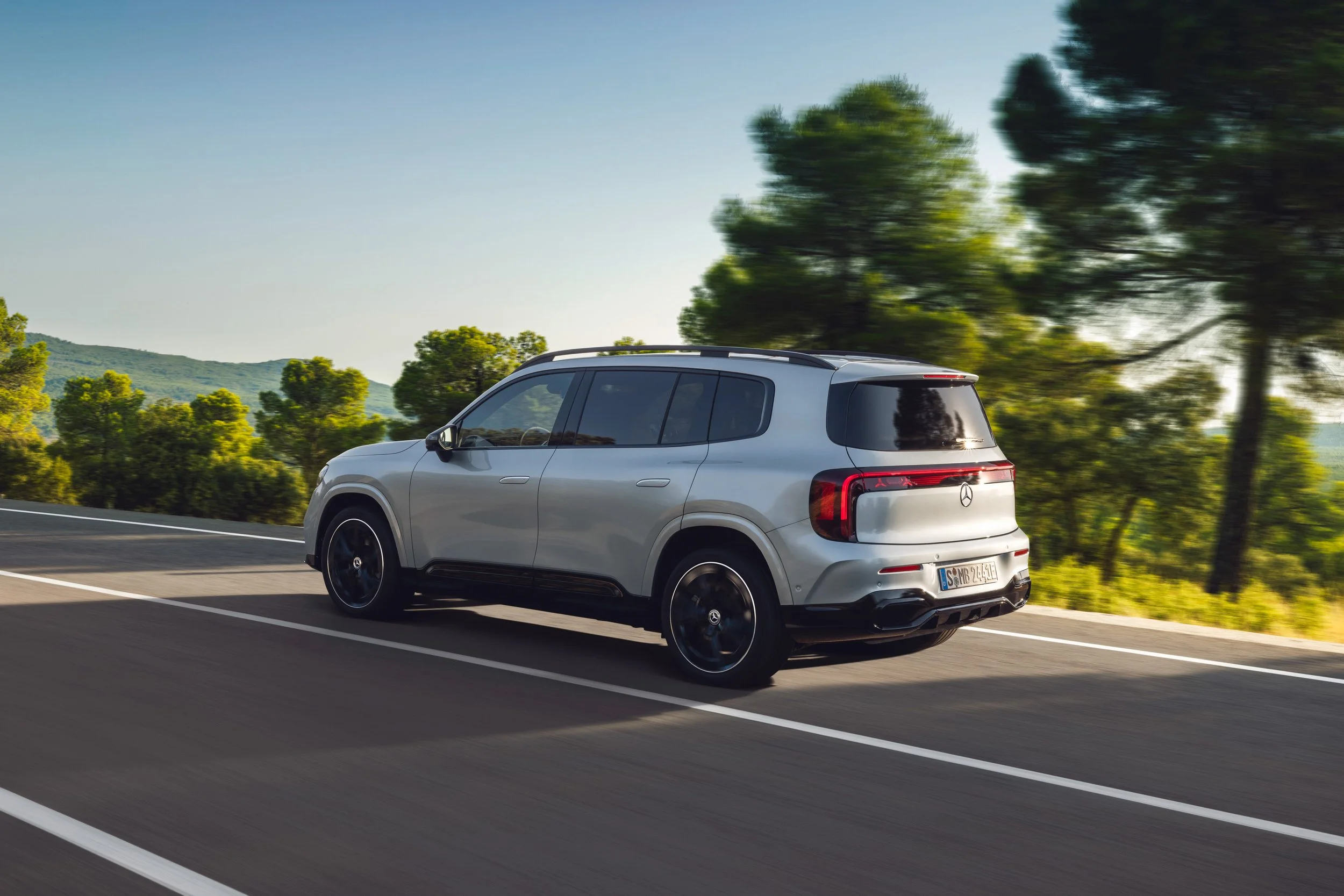
The best way to identify the electrics at a glance is check out the lighting signatures. The electric is far more star-struck.
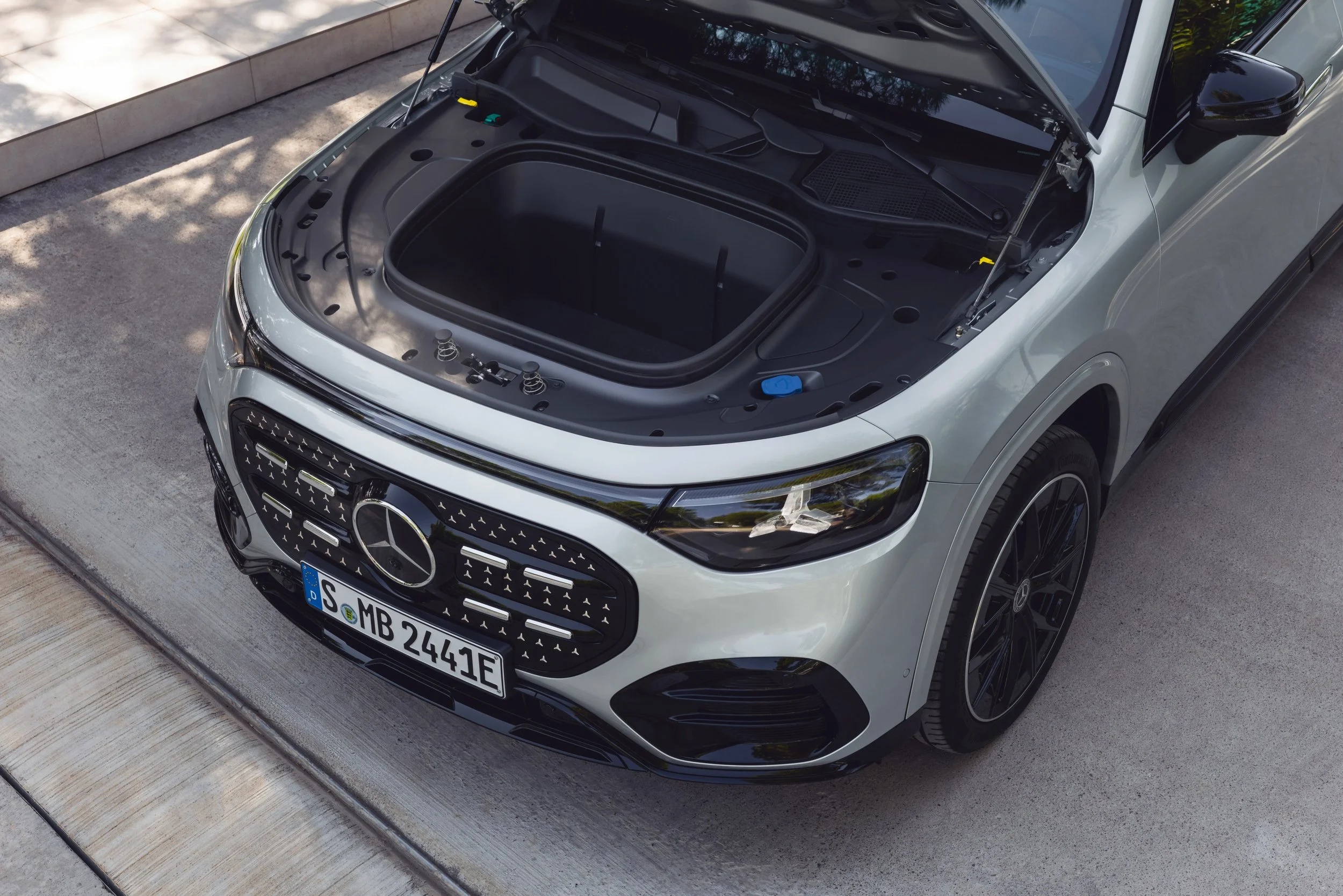
Which means? The brand’s three-pointed-star motif integrates into the front and rear lights - and there are even 94 stars in the grille.
On the electric GLB these illuminate, as does the central Mercedes badge.
That, and the hybrid variants' radiator grille differing very slightly, is said to be the only visual difference between the two kinds of GLB, incidentally.
Mercedes has so far released more details for two of the electric GLBs, while confirming that an entry-level option is also in the pipeline, than the hybrid.
First up in the battery-pure corner is the GLB 250 Plus with EQ Technology, powered by a rear-mounted, 200kW electric motor. That means 202kW and 335Nm to the rear wheels. A cited 0-100kmh time of 7.4 seconds is zippy for a family bus.
The GLB 350 4Matic with EQ Technology gets an extra electric motor, which drives the front wheels when required. It has a decoupling feature to enhance efficiency. Peak power and torque are 263kW and 515Nm, respectively. It’ll knock out 0-100kmh in 5.5s.
These models use the same nickel-manganese-cobalt battery packs with 85kWh of usable energy capacity.
The GLB 250 Plus manages up to 631 kilometres on a charge (in WLTP conditions), while the GLB 350 4Matic's figure is 614km. Benz claims the car can operate with between 18.6 and 15.8kWh/100km efficiency (depending on variant).
Both come with variable brake energy regeneration to the driver's preference, with analysis of the road and even cars ahead taken into consideration when in fully automatic mode.
In part because of adoption of a two-speed transmission for the electric motor, the 4Matic model can tow up to 2000kg.
Thanks to an 800-volt electrical architecture, the electrics can charge at up to 320kW on a suitably powerful DC charger, and up to 22kW on a three-phase AC supply.
The GLB is due to get bidirectional charging, to enable vehicle-to-home and vehicle-to-grid bi-directional charging, as part of a later over-the-air update. But it’s not clear if that is market specific.
The hybrid isn’t a plug-in and full details have yet to be confirmed.
So far it’s only clear it uses a 1.5-litre, four-cylinder petrol engine, assisted by a 48-volt system integrated with a new eight-speed, dual-clutch, automatic transmission.
The same engine is found in the new Mercedes-Benz CLA range, where it offers output between 100kW/200Nm (CLA180) and 140kW/300Nm (CLA220).
The battery pack is a modest 1.3kWh in capacity, enough to allow for low-speed, engine-off driving and 'coasting' at up to 100kmh. It will recuperate energy when the car is slowing down. A sub 5L per 100km optimal economy is expected.
The front end of the new GLB mixes styling cues from the new Mercedes CLA with a larger grille inspired by the new Mercedes GLC - though without all of its bling.
The side profile is familiar enough (though the GLB is an all-new car sitting on a longer wheelbase) except perhaps for the flush-fitting door handles and prominent wraparound rear lights.

Viewed from the rear, those lights span the entire width of the GLB, though it's quite a smooth finish in general at the back, with the tailgate opened via the Mercedes logo.
The new car is 98mm longer and 27mm wider than the previous, with an additional 60mm found between the wheels. That and significant repackaging means there's more space, particularly where the old one needed it most: In the back.
In the five-seat GLB, the boot volume behind the rear seats is quoted as 540 litres, though that drops to 480 litres if the car has seven seats and the rearmost ones are folded down.
Seat down capacities expand to 1715L and 1605L respectively. Those capacities are up on the previous EQB (495L/1710L) but down on the previous GLB (565L/1800L). Electric models now also have a 127-litre storage tub under the bonnet.
With the three-row format, the second row slides so the available space can be divvied up. There are ISOFIX child-seat mountings in both rear rows in the seven-seater.
All versions appear to get a panoramic glass roof, while some get the option to 'dim' the roof electrically.
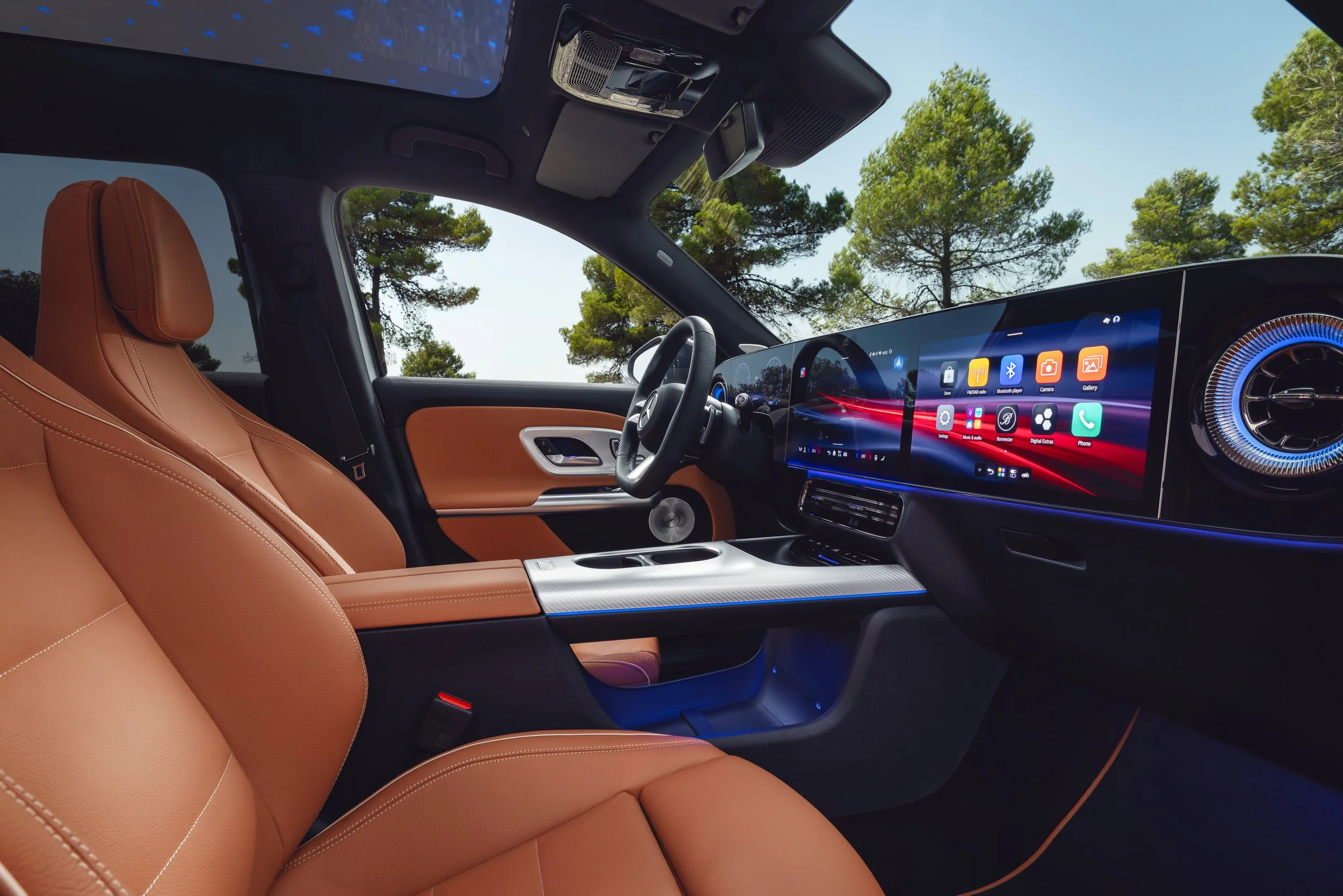
potential buyers will no doubt gravitate toward the impressive-looking ‘MBUX Superscreen’.
It includes a 10.25-inch display for the digital instruments, a 14-inch central touchscreen and another 14-inch touchscreen ahead of the front-seat passenger all integrated in one surface. Large, round air vents protrude through this on either end.
Safety and assistance technology is extensive and includes eight cameras, five radars and 12 ultrasonic sensors.