
Five alive - special edition RS 3 coming here!
/NZ set to snare 10 examples of valedictory model of Audi’s fab hot hatch.
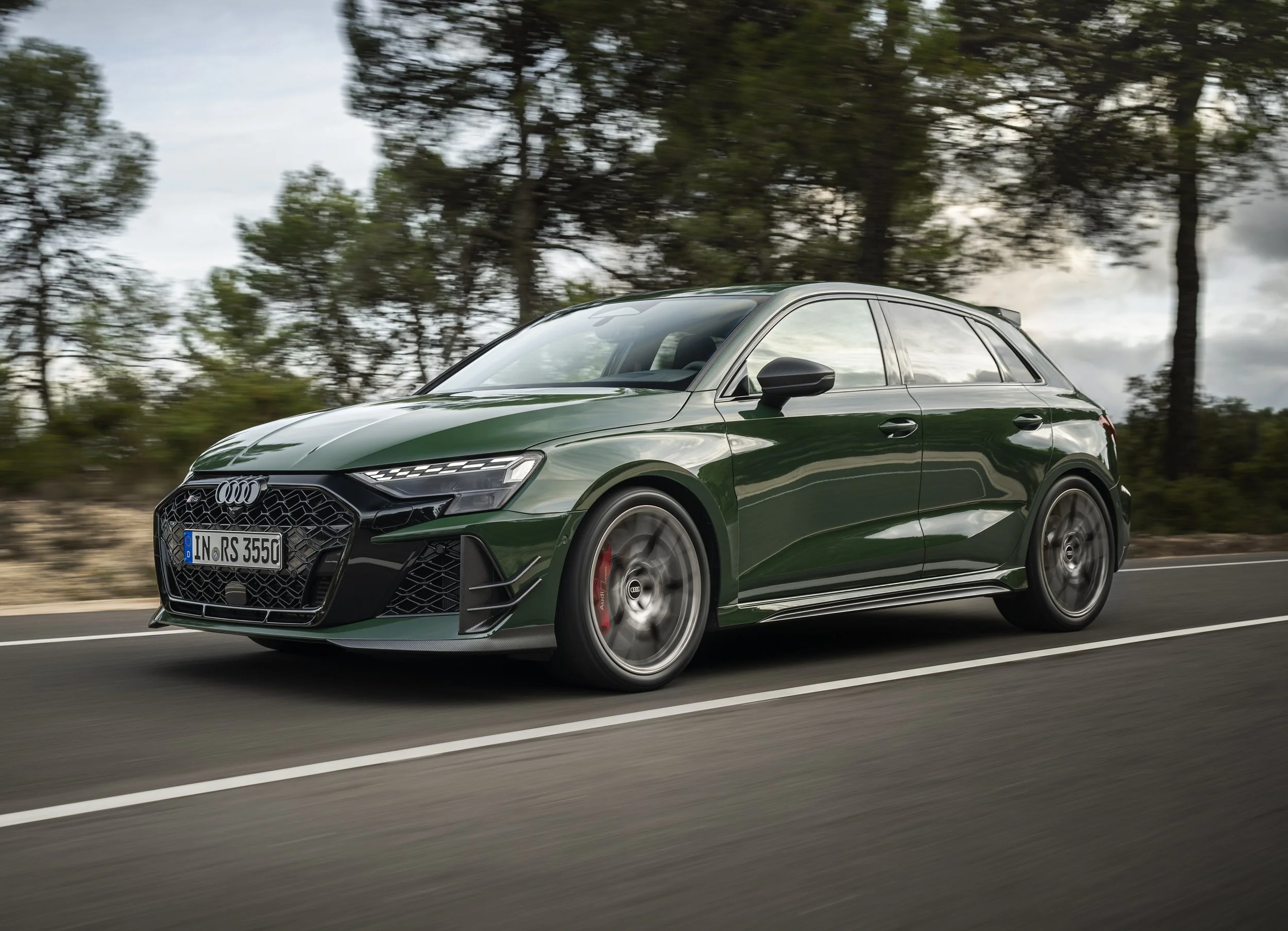
KIWI enthusiasm for Audi’s RS product has been rewarded, with the factory allocating 10 example of its a super special performance model here.
The RS 3 Competition Limited announced internationally yesterday stands as a last blast in two regards.
For one, it almost certainly signs the end of the three-generation RS 3 line. Also, it also signals the end of five decades of service for the brand’s signature line of petrol five cylinder engines.
With just 750 cars built for all worldwide markets, it's a highly limited edition and whether any were absolutely earmarked for New Zealand was not yet clear when the car unveiled.
However, 24 hours on, Audi NZ has great news - 10 examples have been signed off for our market, five in the Sportback format that has been a historic favourite and five as sedans, a rarer sight here.
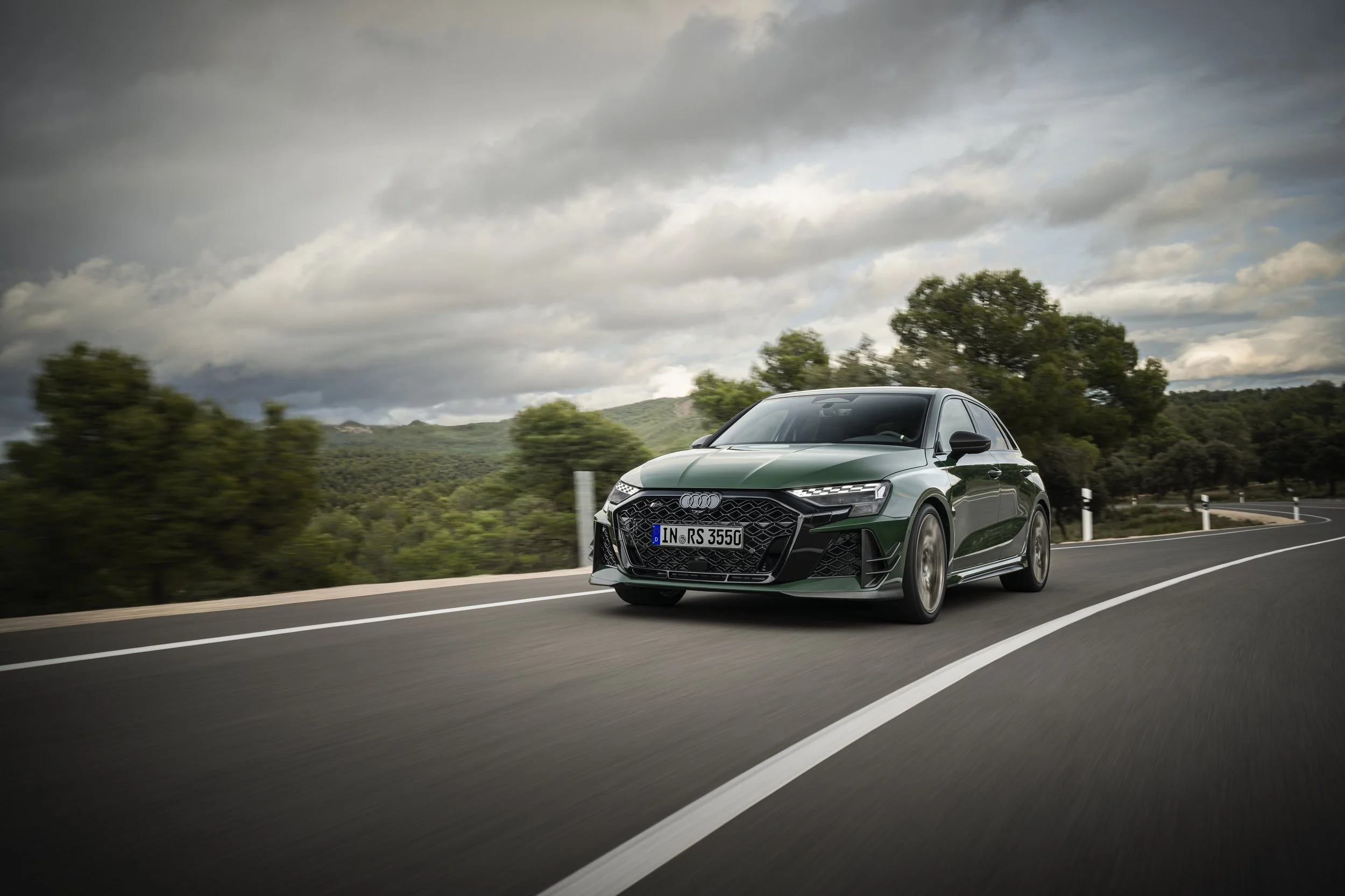
Colour choice is restricted to Glacier White and Malachite Green a shade last seen on Audi's legendary Sport Quattro short-wheelbase road car of the 1980s.
When they come and how much they will cost has yet to be clarified, but expressions of interest are being taken now.
All the cars are numbered; the details are in a graphic down on the transmission tunnel.
Audi NZ general manager Greg Leet says the car is a real celebration of Audi Sport heritage.
“It honours five decades of our iconic five‑cylinder history and brings our motorsport DNA to the road in a way only Audi Sport can.
“With its exclusive specification and unmistakable character, this limited edition model represents a rare opportunity for New Zealand customers to own a piece of Audi history.”
NZ buy-in to RS product has always been strong; per head of capita our take-up is world-leading.
That seems to have been recognised by Germany; the NZ allocation is just one short of the provision meted the United Kingdom, for instance. Australia is taking 18. Japan could be an option for those who miss out on the Kiwi cache - they’re getting 100 cars.
Audi Germany intends to produce 585 Competition Sportbacks, 165 in four door.
The turbocharged 2.5-litre maintains the same 294kW and 500Nm as the standard RS 3, so has an equivalent 0-100kmh time of 3.8 seconds, but peak top of speed of 290kmh is higher and other stuff makes this edition special.
One big allure is that it has 'coilover' suspension, something you can't fit to any other RS 3.
Here the setup is composed of twin-tube dampers all round, constructed of stainless steel at the front and aluminium at the rear. The front shocks have external reservoirs, while the rear items have larger-diameter tubes and thicker piston rods as well, along with an uprated, stiffer anti-roll bar.
There are three modes of (old-school physical) adjustment, with 12 settings for low-speed compression, 15 settings of high-speed compression and 16 settings of rebound. The car provisions the relevant toolkit plus full instructions on how to fine-tune it. Ride height can be dropped 10mm closer to the deck than any other RS 3.
The CL continues with a torque-splitting rear differential to give it lively handling, but the carbon-ceramic brakes that are a cost-option on the regular RS 3 is standard. Just for the fronts, of course. The rear brakes are steel discs.
The 19-inch wheels can be clad in semi-slick Pirelli P Zero Trofeo R tyres, should an owner determine issues with the regular P Zero rubber.
The styling incorporates matte-effect carbon fibre on the side skirts, door-mirror caps and the insert above the rear diffuser. It’s also used for the CL’s unique features of a big roof spoiler a front splitter and aero-improving 'canards' on the outer edges of the front bumper.
At start up, the lights mimic the firing order of the five-cylinder engine with an animation in a 1-2-4-5-3 formation.
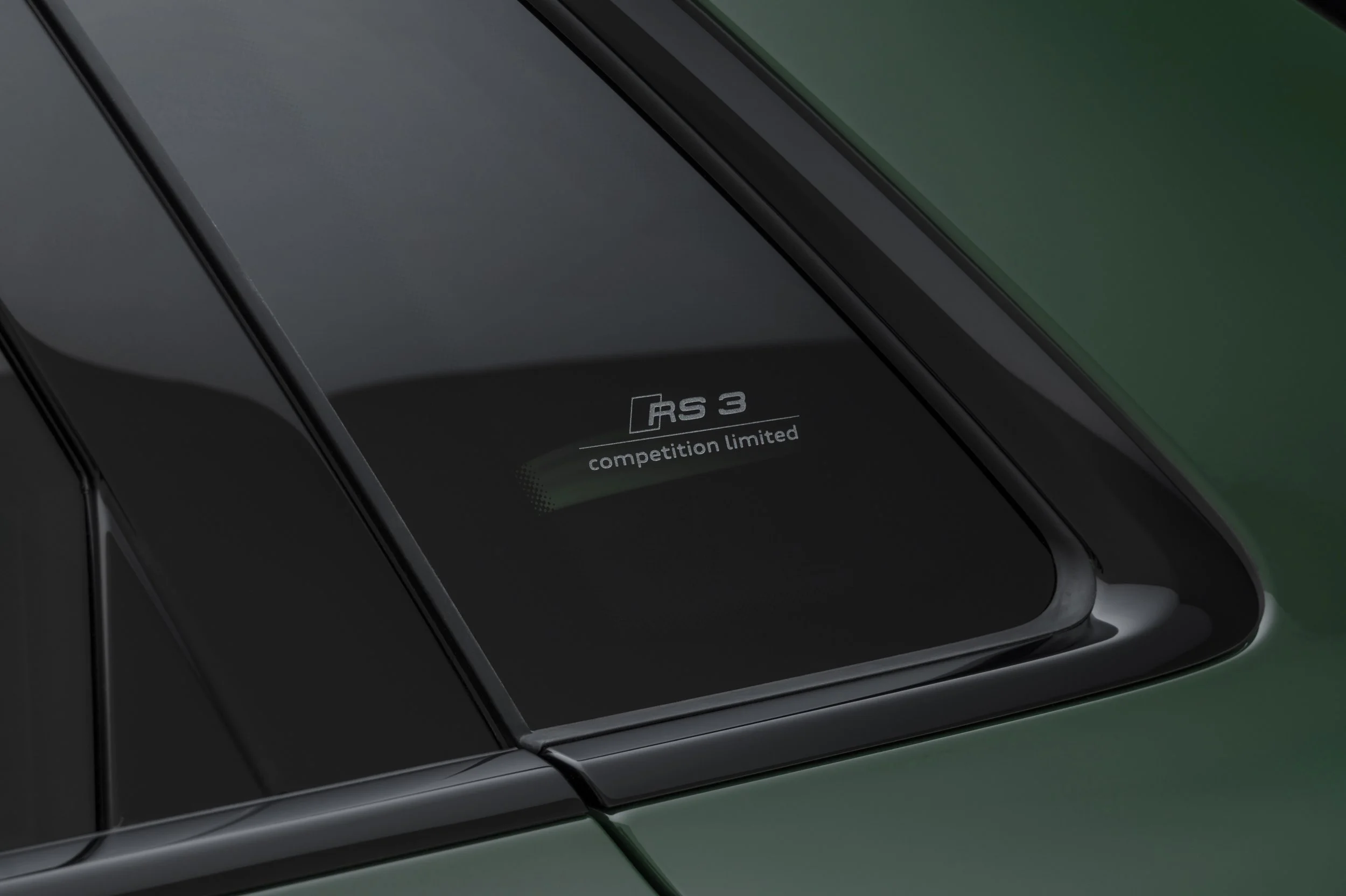
The wheels are in Neodymium Gold and the model has RS Heritage 'RS 3' logos on the front and rear being in black (with a red, white and black stripe motif alongside) and a discreet legend in the quarterlight glass of the rear doors which reads 'RS 3 Competition Limited’.
Gold also runs into the the central seat fabric and parts of the door cards, with Ginger White (yup, that’s apparently a thing), is used for the contrast stitching, the seatbelts and some of the 'RS 3 Competition Limited' logos.
The carbon-backed RS Sports bucket seats and the digital Virtual Cockpit cluster of the Competition Limited are Easter eggs for fans. The dials' background is white, which is a direct homage to the 1994 Audi RS 2 Avant, which had the same thing (albeit analogue).
The sports exhaust was already an option on other RS 3s, but in the CL Audi Sport has cut away some of the sound-deadening in the firewall. While the car is no louder from the outside, on the inside the engine’s howl is more pronounced.
The RS 3 is the last Audi to sport a five-cylinder engine and the CL will likely be the final evolution of this car.
Audi five-pot history traces back to 1976, when it debuted in the second-generation 100 5E. It originally had a swept capacity of 2144cc and delivered 101kW, and made do without any form of forced induction. By 1979 Audi had bolted on a turbo, for the 126kW flagship 200 5T.
However, arguably the most famous application of the Audi five-cylinder arrived in 1980, in the form of the Quattro. Through various iterations, both on-road and in competition, this engine powered all varieties of the boxy legend. It was originally a 10-valve unit with 149kW, although later four-valve tech in the Quattro 20v turbo saw the output increase to 164kW.
At its peak for road-going machines to this point, the Audi five-cylinder delivered 228kW for the short-wheelbase Sport Quattro of 1983. That output made it the most-powerful car ever offered by a German company for use on the road car that time.
The Sport Quattro was the street version of some of Audi's monster 1980s rally competitors, like the 335kW Group B iteration and the utterly bonkers demented 447kW Sport Quattro S1 (E2) that conquered the 1987 Pikes Peak Hillclimb in the hands of Walter Röhrl.