Palisade punches into big spend space

All but entry model is over $100k – the base offer is just $10 below – while the top spend is almost in BMW X5 territory.

PalisadeHighlander-10.jpg

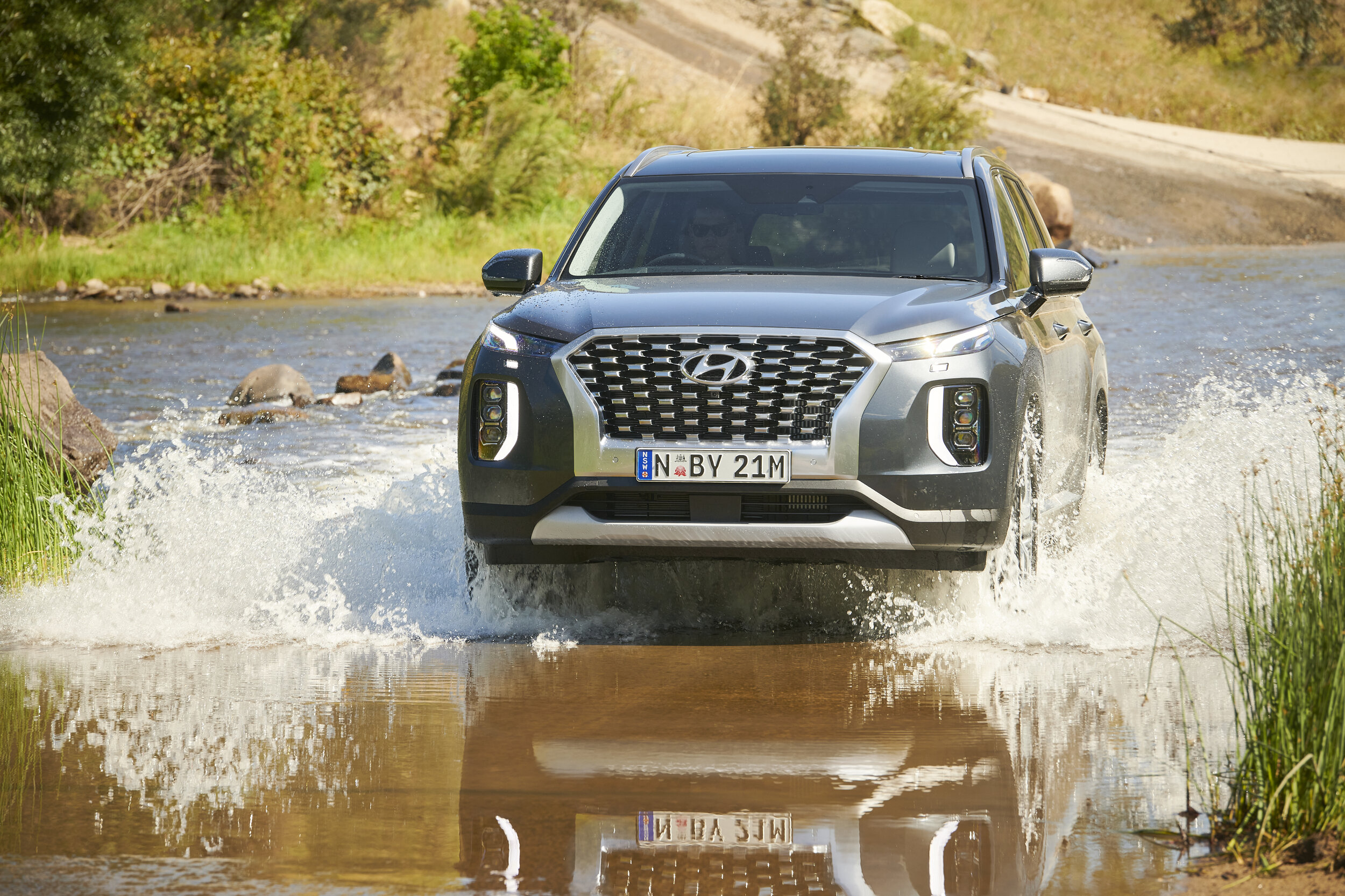
SIX figure price tags attach to all but the entry edition of Hyundai’s first full-sized seven seater sports utility, the Palisade.

The brand’s announcement of the model line-up, finalised specification and pricing confirms Palisade will hold status as the most expensive vehicle any Korean maker has offered to Kiwis – the spend topping out at an almost BMW X5-hunting $119,900. 

The sharing of information also reinforces that a vehicle that offers in right-hand-drive to just Australasia at the moment is a much more expensive choice here than across the Tasman.

Hyundai NZ has three variants - Elite, Limited and Limited Nappa Edition – whereas our neighbour has two, but both countries achieve all the same choices. The difference is that a Nappe leather update that is optional to Australians packages as a specific model choice here.

The base model here is better kitted than Australia’s – here, for instance, every Palisade is on 20 inch rims while the cheapest in Australia is on 18s – but parity seems to accomplish at flagship level. There is parity in seat counts (eight in Elite, seven for Limited) engine and drivetrain choices. 

So, here, as there, a 3.8-litre petrol V6 driving the front wheels and a 2.2-litre four-cylinder turbodiesel, running through all-wheel-drive. 

The line here starts at $99,990 for the Elite petrol, with the range topping out at $119,990 for the Nappa Edition, which is only provisioned with the diesel.  

The other choices - Elite diesel, Limited petrol, and Limited diesel - are priced at $106,990, $107,990, and $114,990 respectively. 

At today’s exchange rate, Palisade RRPs (excluding, as here, delivery costs) are much lower across the Tasman.

 There the V6s sell for the equivalent of $NZ64,490 through to $NZ76,290, while diesel variants span from $NZ68,770 to $NZ80,590.

Large-37498-2020Palisade.jpg

Hyundai NZ has not given explanation for its pricing strategy in material sent out today.

However, it recently reiterated to MotoringNZ that the Palisade would cost more than the SUV that has previously been its largest and most expensive offer here, the Santa Fe, which now peaks at $89,990.

The two models will likely stand comparison, given they share some common technology, though the recent refresh for Santa Fe has left it with more driver assists and a newer, more efficient version of the turbodiesel.  

The diesel Santa Fe also has dropped the orthodox eight-speed automatic that goes into Palisade for a direct-shift unit, also eight-speed.

Though both run V6s, the Santa Fe’s is a 3.6. The Palisade’s 3.8-litre, meantime, is from the Genesis luxury sedan that Hyundai NZ was unsuccessful in installing into the NZ market in 2016. The car was, then, the most expensive Korean model sold here.

Hyundai NZ cites outputs of 217kW/355Nm from the petrol and 147kW/440Nm from the diesel.

Hyundai says the Palisade’s V6 uses 10.7 litres of fuel per 100 kilometres, which is just 0.2L.100km worse that a six cylinder Santa Fe’s claimed optimal. The diesel’s economy suffers in the Palisade – Hyundai cites 7.3L/100km for the larger unit, against 6.1L/100km in a Santa Fe. 

Palisade’s size doesn’t reflect in it being brawnier for towing – quite the opposite, in fact. Towing is capped at 2200kg, whereas new Santa Fe can tow 2500kg.

 The eight-seater has two separate seats up front then two bench seat rows behind and the seven-seater provides with a bench in the very back and otherwise has captains’ chairs. 

The entry-level Palisade Elite comes with a 10.25 touchscreen, 12-speaker Infinity audio, motorised tailgate, heads-up display, three-zone climate, leather appointments, and 20-inch wheels.

The full SmartSense safety suite is also standard, inclusive of stop-go radar cruise control, lane keeping and lane following, and more.

There’s no ANCAP safety rating yet, but it’s unclear if it will achieve a four, or five-star rating with the lack of a centre airbag, deemed a new requirement by some manufacturers to achieve top safety marks.

Palisade was originally made for two big left-hand-drive markets, North America and the Middle East. It was re-engineered into right-hand-drive after Australia petitioned for it to be reconfigured.

Hyundai subordinate brand Kia also has a model based off the Palisade, but there is no likelihood of that car, called the Telluride, challenging the same turf, as Sorento does against Santa Fe, as there are no plans to make Kia’s biggest model in right-hand-drive.

 “The all-new Hyundai Palisade has a certain presence about it, making it worthy of Hyundai’s flagship SUV. Palisade indulges on every level – from space to connectivity to capability, all packaged in a cutting-edge design,” says Hyundai New Zealand General Manager, Andy Sinclair.

“This new upper-large SUV is the ultimate vehicle for practical, comfortable daily use, as well as open road adventures.”

 

Conan of Konas confirmed

Performance SUV teased, full debut just weeks away.

Screen Shot 2021-01-12 at 2.31.35 PM.png

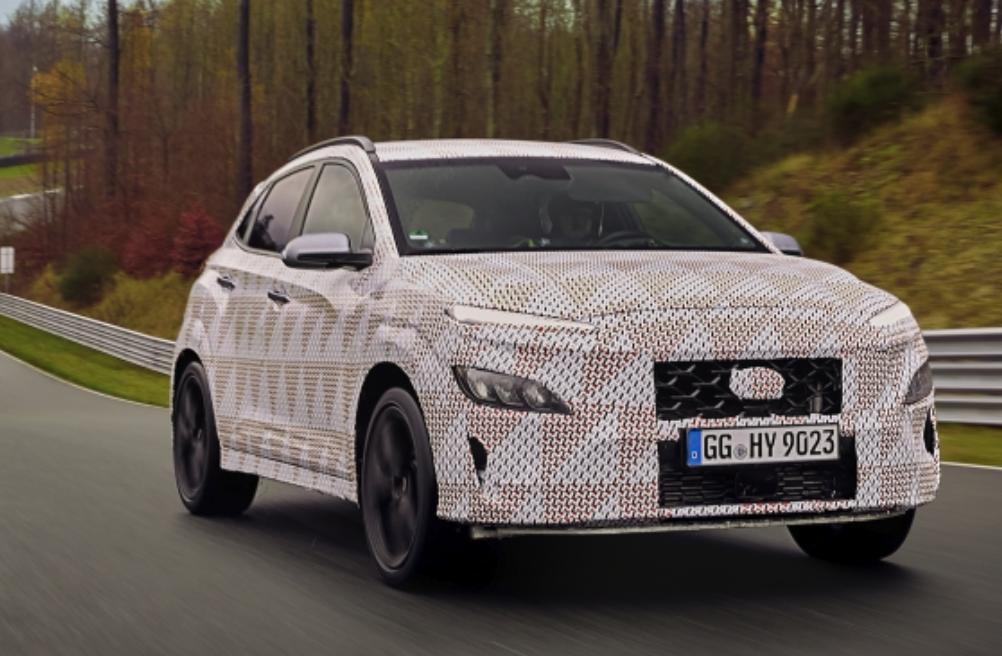
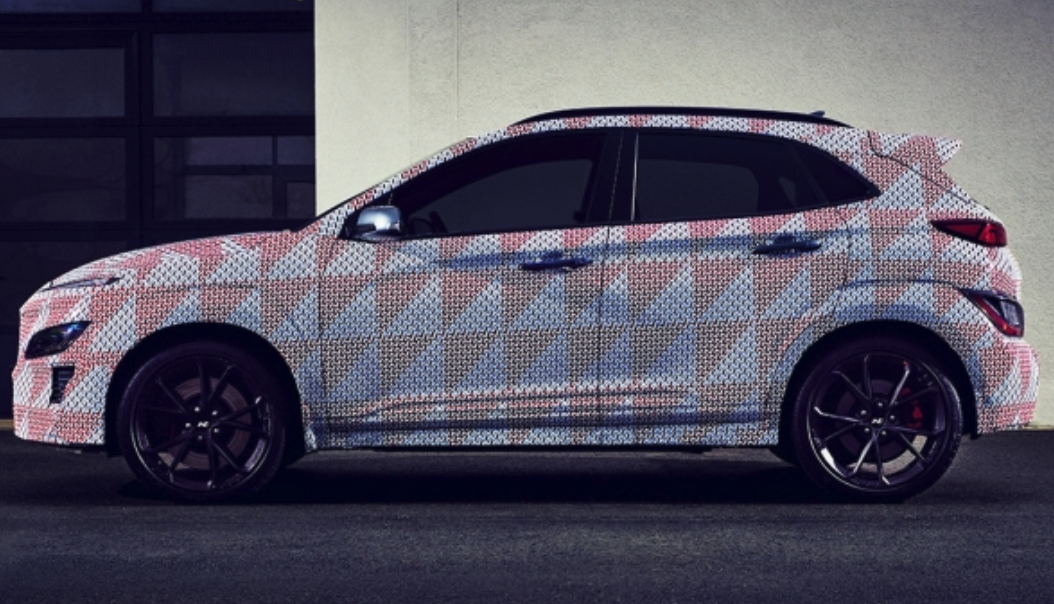
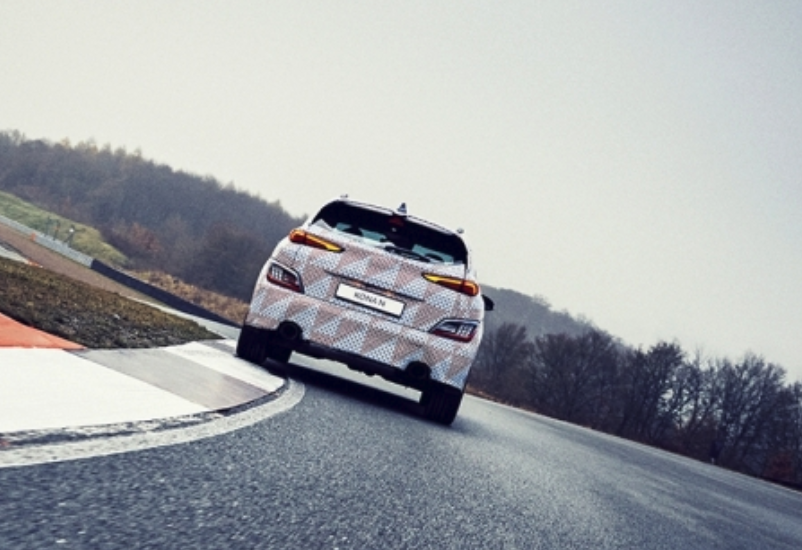
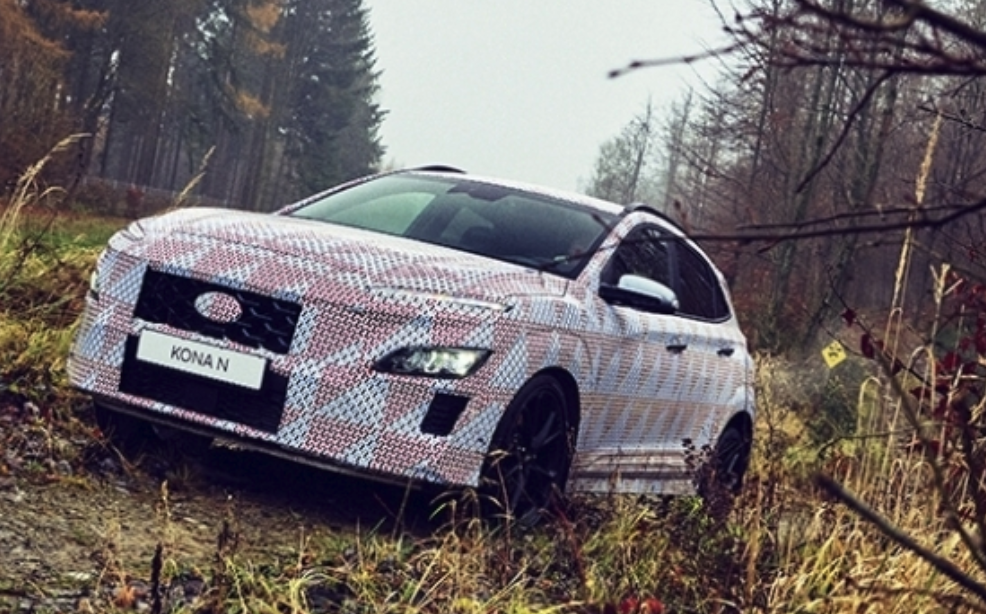
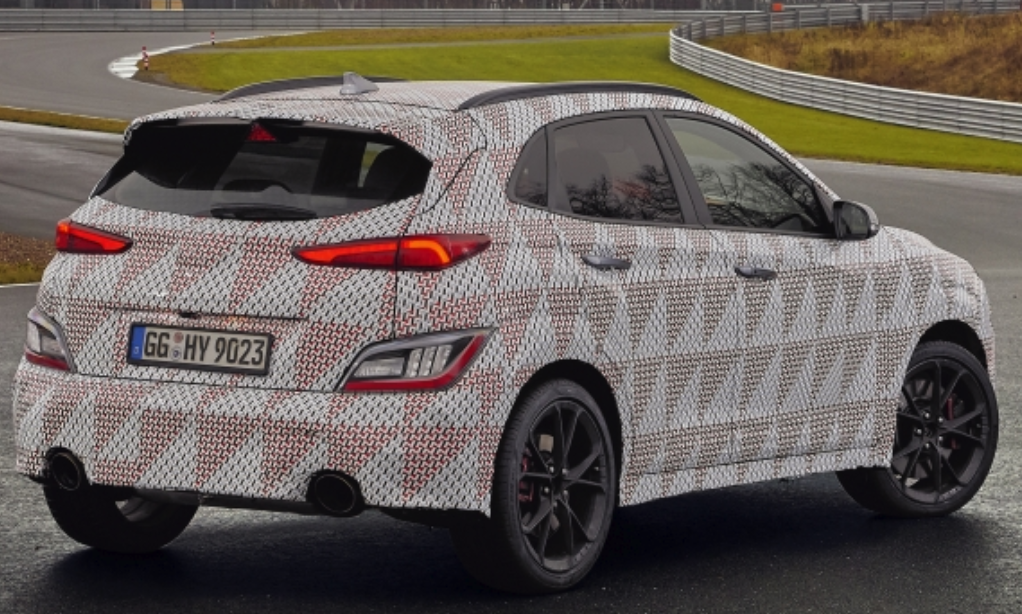
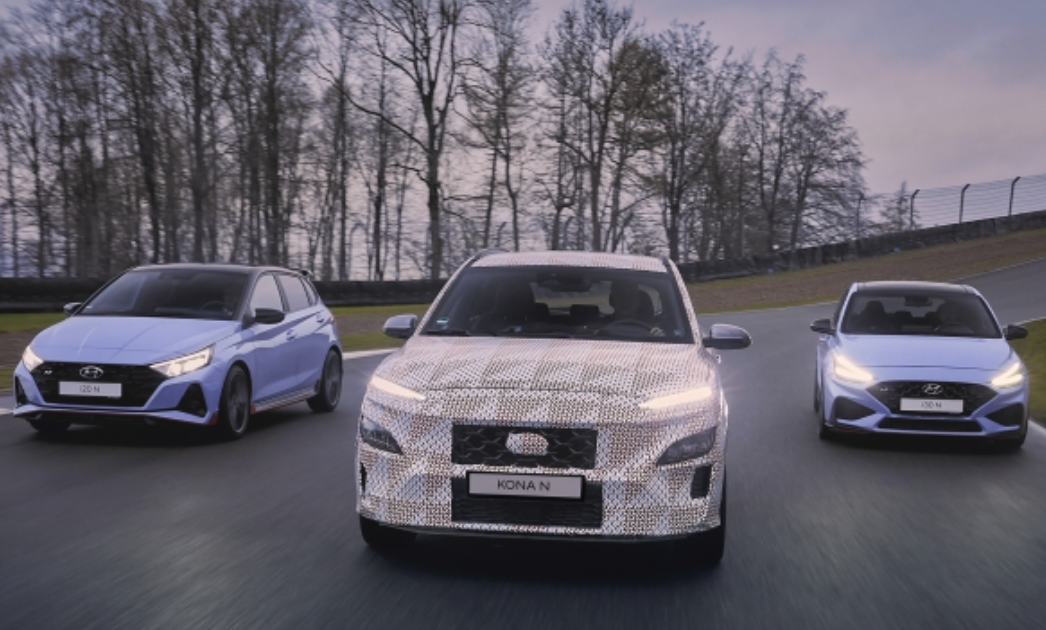
THE performance flagship version of the Kona compact sports utility has been revealed undergoing testing in Germany.

Hyundai has provisioned images of the new variant, and while the car’s camouflage obviously destroys opportunity to achieve an unexpurgated view, they do reveal some details, one being that the high-performance SUV will ride on 19-inch forged alloy wheels shared with the i30 N hatch.

Hyundai has also officially confirmed that the model will run a 2.0-litre turbocharged petrol engine, mated to an eight-speed dual-clutch automatic transmission.

While outputs have yet to be announced, it's fully expected they will match the 206kW and 392Nm extracted from the same engine under the bonnet of the facelifted i30 N. 

As for transmission choices? The hatch is about to pick up an eight-speed direct shift transmission as an alternate to the six-speed manual it has run with since launch two years ago. There’s talk the Kona might follow the same course. What’s still also subject to conjecture is whether it is running all-wheel-drive; some say it will be front-wheel-drive.

The powertrain will accompanied by "a variety of high-performance driving features" including launch control and a sports exhaust, according to an international release from the brand.

 Today’s release also promises the car will make its full debut “in the coming weeks”, with production beginning soon after. Hyundai NZ has yet to offer comment on these images, but has previous expressed strong interest in achieving a performance Kona.

Power games – the local EV rollout for 2021

More brands, more cars, more choice – expect plenty of action as the battery car charge intensifies all the more in NZ this year.

259180_Volvo_XC40_Recharge_Battery_Package.jpg

 LAST year brought some astounding introductions to the electric vehicle sector – not only brilliant new prestige models for those unrestricted by budget consideration.

We also witnessed the cheapest new electric car in the market getting even cheaper; a repricing of the MG ZS EV to $48,990 was a surprise bombshell – that sticker being  $7000 below a price first proposed that, in itself, would have positioned this model advantageously. 

As is, NZ motorists are now enjoying their first sub-$50,000 brand-new fully electric car, retailing for $1000 less than the ‘special introductory price’ that was offered to the first 50 orders, when that book was opened in 2019.

It’s hard to see that feat being bettered in 2021, but perhaps it might.

 Certainly, we’ll have even more electric cars to consider this year, several  from mainstream makers, including a market leader which is fully versed in the art of successful sales craft.

So, anyway, here in alphabetical order are the new EV models slated to arrive within the next 12 months.

 Audi RS e-Tron GT

E-Tron GT RS.jpg

AN electric fan blowing down a long metal cylinder … captured by specialists and further modified and built on was among a total of 32 individual audio elements that have gone in creating the special sound track that gives Audi’s performance EV rather special aural signature. It’s said to be something similar to a jet engine powering up, with the noise modulating based on the engine data, before it is projected from a loudspeaker at the front of the vehicle. Speed and throttle position change the tone.

Sounding a bit strange? Well, noise is important to cars, but for a different reason in respect to EVs. For sure, Audi would like to create a frisson of excitement, but also they’re having to bear in mind that the European Union and the United States have introduced regulations mandating all electric cars emit an external sound for the benefit of pedestrians – up to 20kmh and 32kmh respectively.

It’s doubtless an element of the first Audi RS model to go fully electric, skipping the plug-in hybrid stage altogether and beating hi-po rivals BMW M and Mercedes-AMG to market with emissions-free motoring, that will be a subject of some discussion when this hot shot lands around mid-year.

In terms of performance temperature, think an obvious barometer. The RS E-Tron GT is very closely related t the Porsche Taycan; they are not doppelgangers in styling nor in technology application, outputs alter as do even electric motor count (plus they’re built in different factories), but they do use a common platform.

The GT will deliver is two formats, the RS being the top dog. In the latter power comes from high-energy 83.7kWh (93kWh gross) battery that feeds two synchronous motors – a 175kW motor powers the front axle and is shared with the regular e-Tron GT, but the rear is larger and more powerful, at 335kW. Just like the Taycan, there’s a two-speed transmission on the rear axle, and a focus on coasting rather than recuperation to extend battery range. 

Charge times will also be equivalent to the Taycan, with a maximum DC charging capacity of 270kW, for a theoretical 100km of range in 5 minutes. A 50kW DC charger boosts the battery from five to 80 percent in around 1.5 hours, or 22kW AC charger from 0-100 percent in around 4.5 hours.  

As with Porsche, Audi is also about impressing how the GT’s seriousness by reminding that not only is it coming out of the same high-tech plant as the R8 supercar north of Stuttgart in Germany but (and take this as a thinly-disguised swipe at Tesla) the build quality will be superb. For instance, Audi is employing precision machines that can measure surface inaccuracies on the bodywork within 0.2 of a millimetre.

 BMW iX

BMW iX.jpg

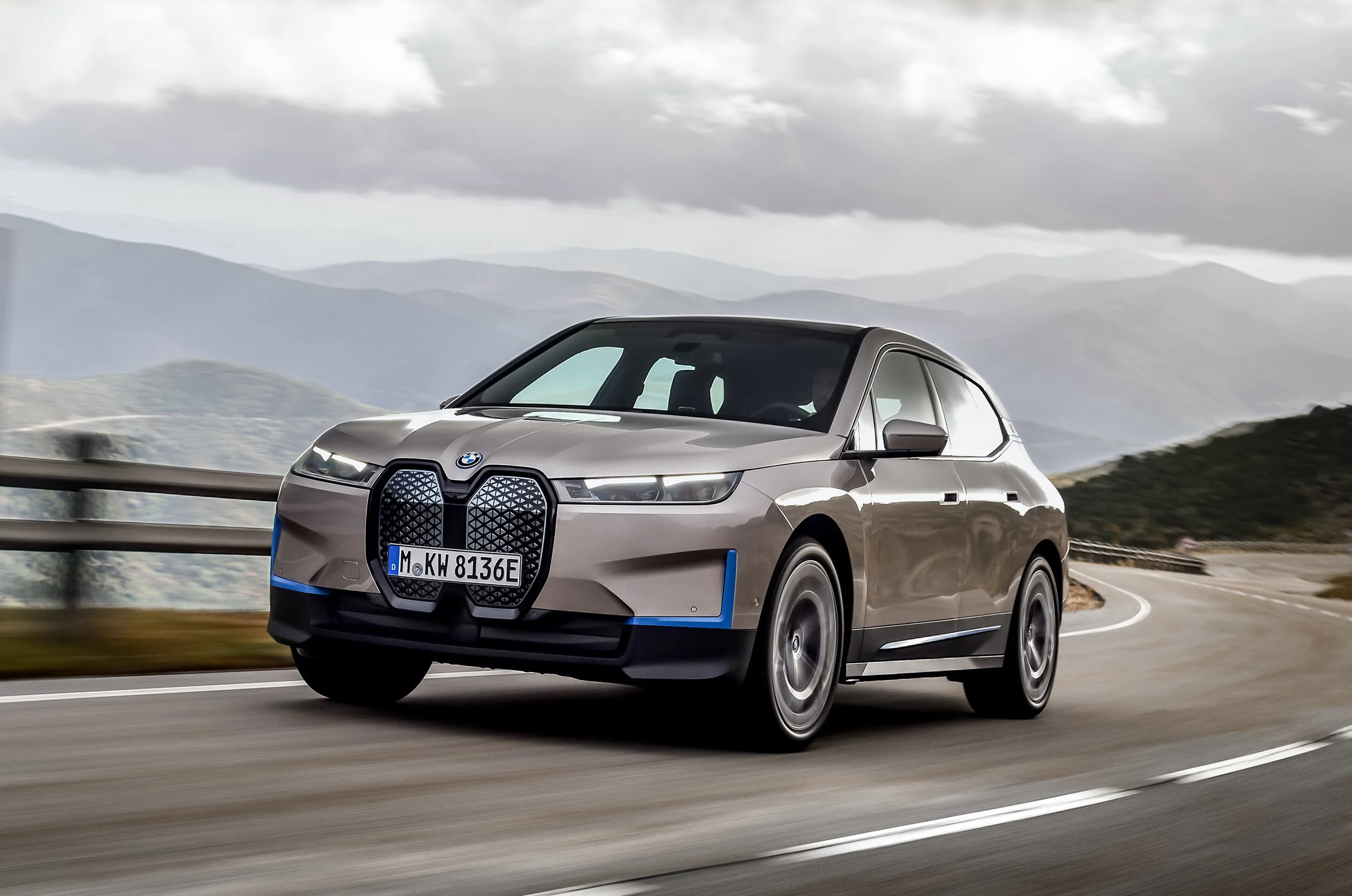
BMW'S first electric SUV built from the ground up on a new EV platform shares exterior dimensions of an X5, is as tall as an X6 and has the wheelbase of an X7, with very high specification and plush appointments in two levels of bodywork, a standard look and a sport enhancement with more rakish styling elements.

The cockpit uses a lot of inspiration from the iNext concept, including a hexagonal steering wheel and a vast curved digital displays for the driver and front passenger to use.  

It also features BMW's new ‘fifth-generation’ electric powertrain tech. We are told that the car will be powered by two electric motors (with no rare earth elements), producing 'more than' 370kW, which comprehensively beats the 300kW EQC and e-tron 50 and 55 (respectively 230kW and 300kW).  

Apparently the iX will do 0-100kmh in under five seconds, but of greater importance is the efficiency and range between charges. BMW expects the car will average 21kWh per 100km on the WLTP cycle, resulting in a range of more than 600km from its 100kWh battery pack.

Recharging times are also impressive … when the right hardware is in place. The iX3 can be DC fast-charged at up to 200kW, allowing 10-80 percent charging in under 40 minutes, or 120km range for 10 minutes of charge.  

The car premieres a new aluminium space frame that supports an inner carbon cage fabricated from CFRP – for composite plastic and carbon-fibre-reinforced-plastic – covered with a body made out of a combination of aluminium and CFRP. The latter is a material BMW has become accustomed to working with as it features intensively in the i3 and now discontinued i8 plug-in hybrid sports car.

For the first time in a modern-day BMW model, the iX will feature a fixed clamshell style bonnet. A series of aerodynamic developments, including the blanked-off grille, minimal air ducting within the front bumper, flat underbody panelling, integrated door handles with an electronic opening mechanism and the tapered glasshouse, contribute to a claimed drag coefficient of 0.25.

Full LED main beams are standard, though buyers will also be able to specify BMW’s Laser lights as an option. At the rear, the iX’s narrow tail lamps receive LED functionality as standard.

Look for it in the second half of 2021.

BMW iX3

BMW iX3.jpg

 Likely to be pitched as a competitor for three like-sorted models already on sale here - the Mercedes EQC, Audi e-tron and Tesla Model X – though differing from those in being more obviously based on an existing model.

The iX3 nonetheless represents an important step. It’s not just BMW’s first electric SUV, but also the first BMW to be available with either pure combustion, plug-in hybrid or pure electric power. 

 The X3’s platform has been adapted with a new rear sub-frame that houses a single electric motor and an 80Wh battery pack – yes, it’s exclusively rear-drive - that, BMW says, is 20 percent more energy dense than any battery it has used before.  

Output is to the tune of 210kW and 400Nm and a 6.8-second 0-100kmh sprint is claimed. BMW says it’ll provide an impressive 460km range, as determined on a WLTP test cycle. Using fast-charging, the iX3 is capable of receiving 80 percent charge in 34 minutes. 

BMW is talking up the car’s adaptive energy recuperation system, which it claims automatically enhances efficiency on longer drives. Using location data from BMW’s latest cloud-based navigation system, the iX3 can autonomously change the level of braking recuperation on the move and according to the road ahead. For instance, if the car recognises that a stop sign is ahead, full recuperation will be deployed without any need for the driver to select it. 

Alternately, the driver can take manual control of the regenerative braking, with three levels of resistance availed. A ‘B’ position on the Drive selector enables high enough energy recovery for one-pedal driving around town, a trick the brand appears to have nabbed from Toyota/Lexus.  

The iX3 gets a unique tune for its standard adaptive suspension system with electronically controlled dampers. Alternately, buyers will be able to specify a sportier Adaptive M suspension setup. 

The front grilles are closed off for aerodynamic purposes and the bumpers have been reprofiled and it gets set of aerodynamic wheels styled to reduce the drag coefficient by around five percent compared with regular X3 wheels. 

Arrival? We’re thinking it’ll time pretty much with iNext. 

Ford Mustang Mach E

Mach-E.jpg

Okay, so this one’s a bit of a punt. Ford New Zealand says the only electric car it can officially confirm as a definite 2021 starter here is the plug-in hybrid version of the Escape. And, of course, they’re looking at a fully battery-propelled Transit in 2022.

When asked about the Mach-E, spokesman Tom Clancy replied: “I would love to confirm Mach-E for New Zealand – from all reports it’s an excellent and exciting vehicle – but can’t at this time.”

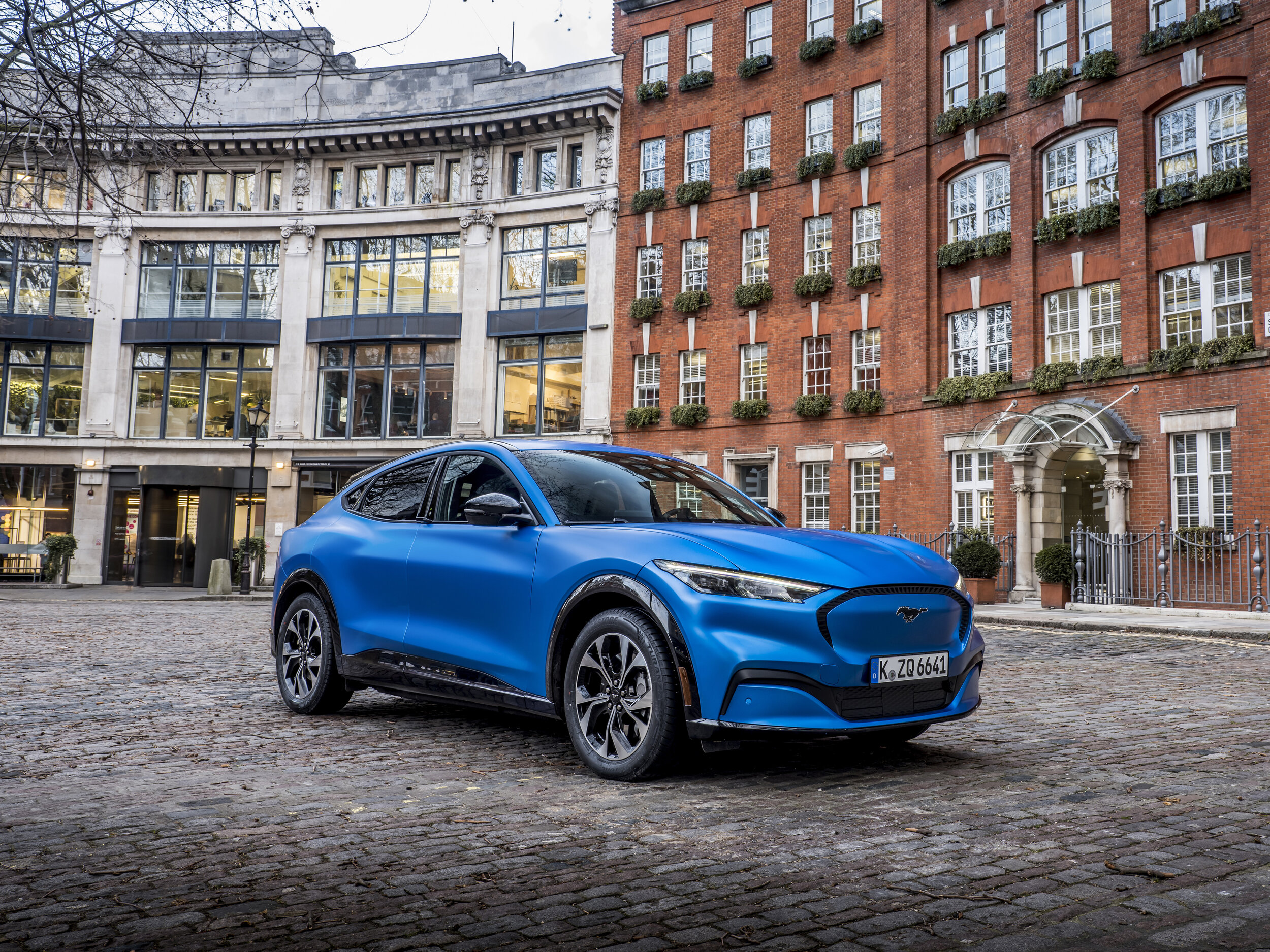
So that’s not a no, and the reason why there’s a chance the electric Mustang (and yes, petrolheads, like it or not, that is what it officially is) sports utility could be coming is because it’s starting to reach the United Kingdom and, also, there’s growing conviction from Australia that they’ll achieve the car before next Christmas.

What is for sure is that, whether it’s a 2021 arrival or later, there’s every likelihood NZ will at some stage be down to take Ford’s first mass-market electric car in its 116-year history.

You should be excited.  Ford says this all-new car is a true pony express; the range-topping Mach-E GT will hit 100kmh in under four seconds, thanks to an all-wheel drive layout channelling the 342kW and 830Nm outputs of a 75.7kWh lithium-ion battery (a 98.8kWh extended range battery is available).

Ford is claiming a range of 480 kilometres from a full charge using its extended-range rear-wheel-drive car.

Hyundai Kona Electric 

Kona electric.jpg

This is the mid-life update version of the car that NZ has known for more than a year. The refresh delivers a cleaner front-end design, aerodynamic tweaks and a restocked safety suite that complements improved interior technology.

It retains the single 64kWh lithium-ion battery pack, but the charging port has moved to place asymmetrically between the front headlights, having previous been sited slightly to the passenger side. Charge time is claimed to take 47 minutes when done with a 100kW DC fast charger.

We’d expect to see this in the first half of 2021.  

Kia e-Niro

Kia e-Niro.jpg

Where Hyundai goes, the subordinate marque generally follows.

Once again, this is a facelift. There’s not too much info around, but as with the original pitch, it’s likely to be outdone by its Hyundai Kona cousin for style but  

Chances are NZ will see only the more powerful of two battery options, which should see it travel 450kms between charges. 

Lexus UX300e

Lexus UX300e.jpg

Built on Toyota’s GA-C platform, this version of the smallest Lexus crossover runs a front-mounted motor that produces 150kW and 300Nm of torque.

Energy comes from a 54.3kWh underfloor lithium ion battery offering a claimed range of around 315km on the official WLTP testing regime. It's capable of 0-100kmh in 7.5 seconds, has a top speed of 160kmh and an optimal range of 400km.

The model’s high-rate lithium ion battery is capable of DC replenishment and rapid-charging from zero to 80 percent takes 52 minutes. It features a number of driving modes so that the performance of the motor can be better managed, along with paddles to alter the strength of the regenerative braking.

 Lexus says the drivetrain has been developed with a focus on on-road performance and the goal of offering a quiet and refined driving experience. Extra bracing has been added over the regular UX hybrid and the dampers reworked to maintain optimum weight distribution.

Prioing has yet to be discussed, but the plan is for the UX300e to form a new “flagship” of this family range so expect to pay more than the $70,300 asked for the current line-topping UX250h AWD F-Sport.

Mazda MX-30

MAZDA_MX30_2769.jpg

Two flavours for 2021 – mild hybrid and full-out electric – with a third, this delivering as a full electric but with a small petrol-fuelled engine (yes, a rotary) likely to follow perhaps next year. 

The Hybrid is powered by a 2.0-litre, four-cylinder petrol engine paired to Mazda's M Hybrid system, producing maximum outputs of 114kW and 200Nm through a six-speed automatic transmission sending power to the front wheels only.

The addition of the mild-hybrid system means the model's official fuel consumption figure is reduced to a claimed 6.4L/100km on a combined cycle.

The MX-30 Electric, meanwhile, looks much the same as the mild hybrid car, save for some subtle electric badging on the exterior and a combined AC/DC charging point where the fuel cap would normally be – on the rear right-hand side of the vehicle.

 The electric model is powered by a 107kW/271Nm electric motor on the front axle and boasts a 35.5kWh lithium-ion battery pack mounted beneath the floor. Range is modest, up to 200km on a single charge according to the World harmonised Light vehicle Testing Procedure (WLTP). That’s less than some of the MX-30's key competitors, but Mazda’s not sweating it. A smaller battery means quick recharging; three hours to recharge on an AC socket, or roughly 36 minutes on a 50kWh DC fast charger 

In terms of sizing, at 4395mm long, 1795mm wide and 1555mm tall, the MX-30 is in the same category as the CX-30, with a 311-litre boot on both the electric and mild-hybrid variants.

The model’s most discussed design feature are pillar-less freestyle doors, inspired by those on the Mazda RX-8 sports coupe (and kinda like those on the BMW i3), which open outwards from the central B-pillar point, hinged at the rear. 

The MX-30 has won a 2020 five-star rating from Europe's New Car Assessment Programme. Standard safety kit includes 10 airbags – front, curtain, front-side, rear-side, front far-side (driver) and a driver’s knee – plus emergency lane keeping with blind-spot assist and something called road keep assist, which helps you stay on track even in the absence of lane markings.

There’s also ‘turn-across traffic functionality’ which can intervene in collisions at intersections by activating the smart-brake support system.  

The cabins of both variants are alike. An 8.8-inch screen that sits at the top of the dashboard controls the infotainment system via a rotary dial, while a second lower 7.0-inch touchscreen provides access to the climate controls.

The floating centre console has cork accents as a nod to the brand's history as a cork manufacturer.

The majority of materials used in the MX-30's interior are sustainably sourced or recycled, from the vegan leatherette upholstery om the seats, to the door trim materials which are made from recycled plastic bottles.

Nissan Leaf e Plus

Nisasan Leaf e Plus.jpg

The latest Leaf but featuring a 62kWh battery (up from 40kWh) that can propel the small five-door 384 kilometres on a single charge, representing a 110-kilometre improvement over the standard edition.

Skoda Enyaq iV

201125_SKODA_ENYAQ_SOP-1_JPG.jpg

In addition to the ‘E’ also referencing ‘electric’ and the ‘q’ conforming to an in-house naming practice, the name also derives from the Gaelic girl’s name Enya (which means ‘fire’ and ‘kernel’). The iV part is less clear.

 Good background to chuck into the inevitable discussion owners of this five-seater medium crossover will enter into with those curious to know more about what will not only be the first fully electric Skoda to come on sale here but also the first of numerous cars utilising a Volkswagen Group underpinning that are set to hit New Zealand, not just as VWs but also as Audis and a SEAT.

Skoda’s status as the debutante for the MEB platform on local turf is a happenstance that hasn’t occurred in most places; but fact is VW New Zealand has resigned to not seeing the ID models that advance this tech until at least 2022, starting with the ID 4. Same goes for SEAT, with its car, the El Born.

Enyaq’s NZ release (and price) has yet to be shared, but the local distributor has already started the pre-launch build up. Insofar as specification goes? Well, there’s likely to be plenty to think about; the factory is prepping Enyaq with the options of three battery sizes, five power variants and a driving range of up to 500 kilometres. It also provisions in rear-drive in entry form and four-wheel-drive further up the range and a performance all-paw RS edition with 225kW is on the cards.

In size Skoda’s EV slots between the Karoq and the Kodiaq, being 4648mm long, 1877mm wide and 1618mm tall, on a 2765mm wheelbase.  It classes as an SUV, though realistically that’s just a convenience. There isn't a great deal of ground clearance so don't expect to go very far off-road in it.

However, it is designed to tow (if only up to 1200kg) and will is as roomy as the Kodiaq, with a big cabin – made all the more spacious by the lack of a transmission tunnel – and a 585-litre boot. Unlike some other electric SUVs, there isn't a storage area under the bonnet.

The line starts with the 109kW Enyaq iV 50, driven by a rear-mounted electric motor (so, rear-wheel drive) with a 55kWh battery pack and a maximum driving range of 340 kilometres.

Above this is the Enyaq iV 60, also rear-wheel drive but with a 62kWh battery and a 390km driving range, then the Enyaq iV 80, the highest choice in the rear-motored set. It has an 82kWh battery offering 150kW and up to 500 kilometres’ range.

Beyond this are dual-motor all-wheel-drive 80X and RS variants, also with the 82kWh battery pack, but with a second electric motor driving the front wheels. In this form the 80X has 195kW and the RS another 30kW more. The extra grunt comes at expense of range, but not greatly, with 460km claimed. The RS is the only variant that Skoda has announced a 0-100kmh time for; claiming it’ll smash that in 6.2 seconds. That’s 0.8s better than the fastest current Kodiaq, the RS.

Fast charging is also promised with an 80 percent 'fill' possible from 40 minutes at a 125kW DC-powered station … if talking about the 82kWh models. The onboard 11kW charging unit will enable users with a suitable domestic wallbox to replenish the battery charge in six to nine hours, depending on battery size.

The cabin eschews the usual Skoda instrument displays and instead takes a small digital display ahead of a two-spoke steering wheel plus an augmented head-up display that projects onto the windscreen, as in the Volkswagen ID.3 hatch (which isn’t being considered for NZ incidentally). A centrally mounted freestanding touchscreen sits atop the dashboard, and this will come in two sizes, 10- or 13-inch, depending on model.

Skoda’s bent for practicality reveals with decent interior storage, including a generous console between the front seats. It gets a large wireless charging pad that can charge two phones simultaneously. Oh yes, and it has the trad umbrella.

Skoda has a wide variety of specification grades, starting with Studio, available in the Enyaq 50 alone. Additional Loft, Lodge, Suite and Eco Suite trim levels will be available on the 60 and 80 models, and Eco Suite features more sustainably sourced materials. The 60 and 80 versions will gain the largest touchscreen display, a 13-incher.

Tesla Model Y

Model Y.png

Again, a bit of a punt with this one, at least in respect to timing, as Tesla no longer bothers communicating with media about its cars.

The model, of course, is not secret; the Model Y is a five-seat crossover all-electric vehicle built on the same third-generation platform as the Model 3; think of it as being a more practical, higher-riding stablemate that stands as a smaller alternate to the Model X, albeit not as wacky – so a conventional set of doors here.

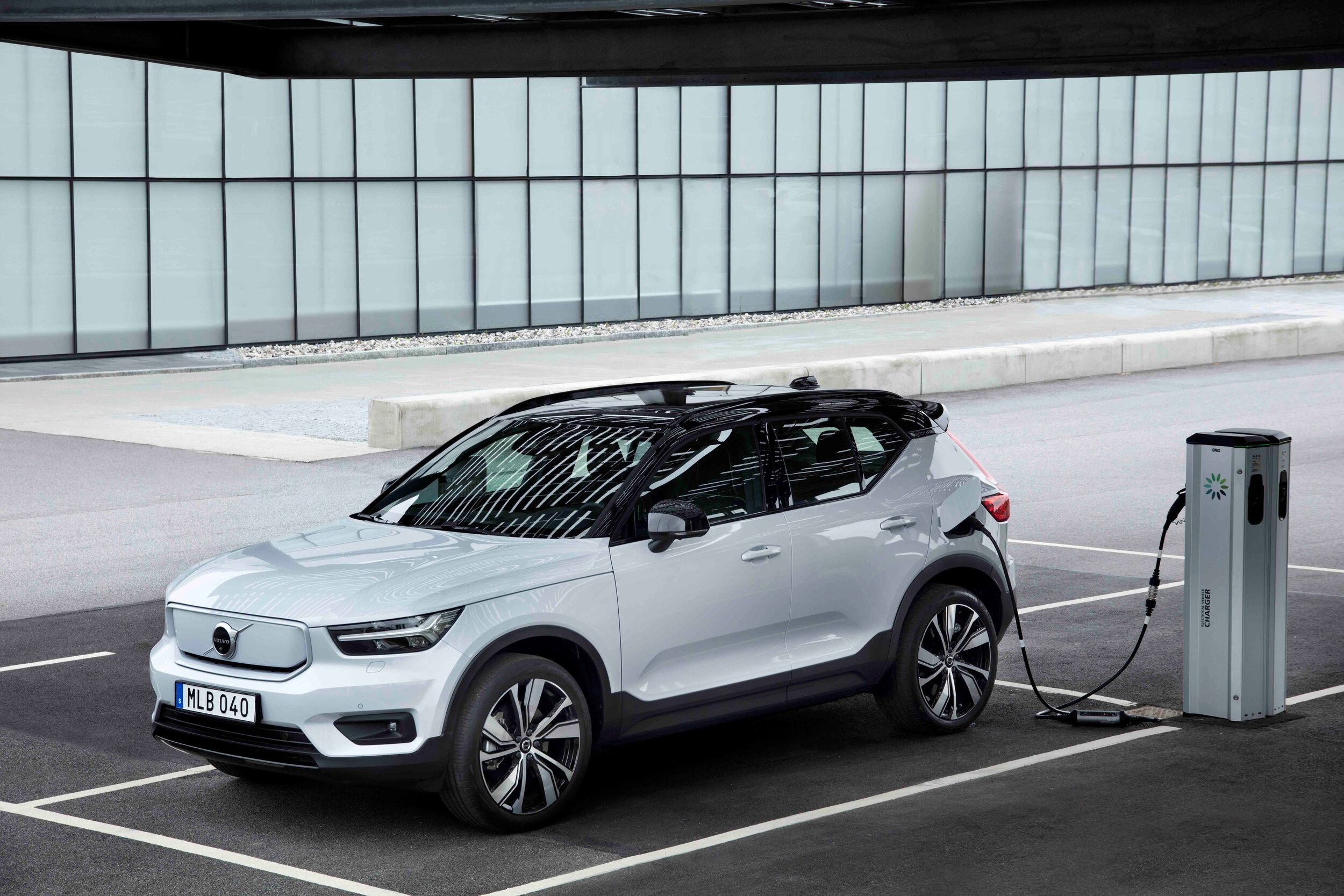
Volvo XC40 Recharge 

Volvo XC40 Recharge.jpg

A dead-ringer to the fossil-fuelled XC40 from the kerbside, and from overseas’ reports, it’s not so different in driving feel, either.

Of course, it is a radical departure, in being the first Volvo to sell here – arriving mid-year or so, by the way – to forego hooking up to Big Oil.

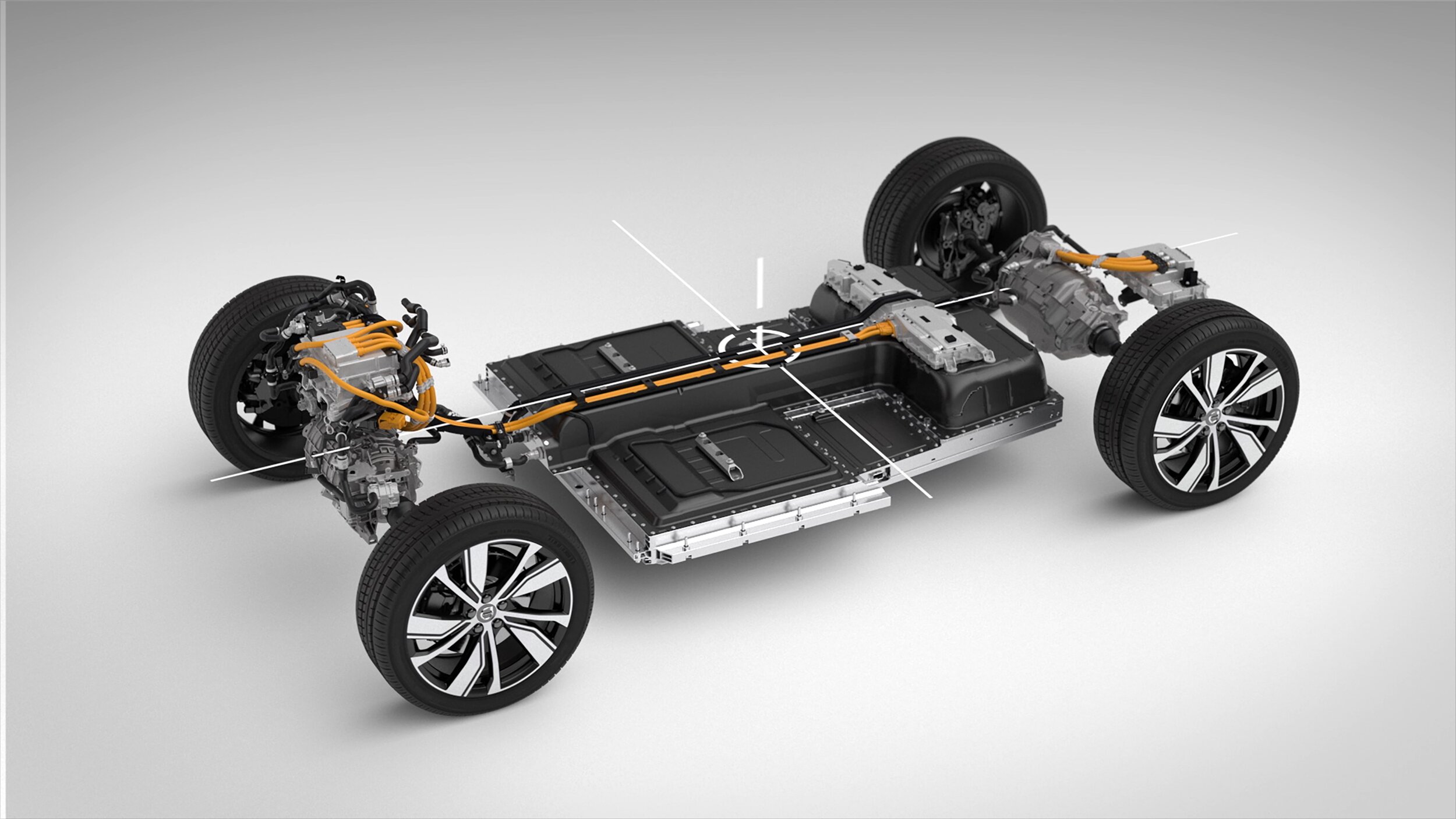
Here two electric motors provide a very healthy 304kW and 660Nm to all four wheels. A 78kWh battery (that can charge to 80 percent on a fast charger in 40 minutes) should provide enough juice for the XC40 Recharge to travel between 350-400kms in the real world. 

The strength of the powertrain is sufficient for a claimed 0-100kmh time of 4.9 seconds.

When discussing Volvo, you’ll be wondering about the chances of seeing anything from Polestar, an offshoot which is all about passenger EVs with a performance twist.

Good news. Volvo NZ is in discussion with Polestar with intent to furnish the  Polestar 2 (below) which, unlike the preceding Polestar 1 is produced in right-hand drive.

It will feature 300kW of full electric power and boast a range of 560km. But it won’t be available before 2022, says Volvo NZ boss Coby Duggan.

Polestar 2.jpg


Gen five Jeep Grand Cherokee revealed

New ‘L’ model is the first to offer third row seating.

Screen Shot 2021-01-07 at 7.25.46 PM.png

SEATING for six or seven passengers across three rows, at least two powertrain options, three different drive systems, air suspension and loads of new technology.

Those are among highlights of a Jeep that has been the longest-time coming, a new Grand Cherokee. 

The fifth generation car, called the Grand Cherokee L, has been revealed today in the United States, with comment about New Zealand market provision and launch timing yet to come from distributor Ateco, though on that front talk is that Australia will see it around August-September. By that time, Fiat Chrysler will have been subsumed into a new marriage, with Peugeot parent PSA, under the Stellantis brand name. 

Codenamed 'WL75', the Grand Cherokee L is expected to be sold alongside the current five-seater WK2 Grand Cherokee that has been on sale here since 2011.

Remarkably, the WK2 is expected to slog on for another two years, according to overseas’ reports, before it also switches to the L’s all-new unibody platform.

Screen Shot 2021-01-07 at 7.26.16 PM.png

However, in the interim, it’s likely Jeep will also produce the properly new model in a five-seat format. That edition is expected to go into production before the end of 2021, offering first in North America, which will also be the first candidate for a plug-in hybrid variant.

Jeep and parent Fiat Chrysler are emphasising that the information availed internationally today is specific to North America; more information about international plans will be delivered in due course.

Americans see the Grand Cherokee L in Laredo, Limited, Overland and Summit trims, the latter also reaching to a extra-spiffy Summit Reserve package that puts it on super-sized 21 inch rims (Overland and Summit are on 20s, the others on 18s) and adds glam trimmings Jeep admits are as unsited to off-roading as those big hoops.

The general shape has been inspired by the Grand Wagoneer luxury SUV, revealed late last year in concept form.

Screen Shot 2021-01-07 at 7.26.32 PM.png

Powertrain options for the American market initially restrict to the 216kW/350Nm 3.6-litre 'Pentastar' V6 and 266kW/530Nm 5.7-litre Hemi V8 petrol engines.

The new platform is said to be stronger and lighter than the fourth-generation WK2 Grand Cherokee, with more than 60 percent of the body comprising high-strength steel.

Off-road hardware comes in three varieties, ranging from a single-speed transfer case up to a 2.72:1 low-range reduction and rear electronic limited-slip differential.

There is more off-road ground clearance and water fording capability compared with previous generations, and Jeep’s own ‘Quadra-lift' air suspension is touted to return, joined by adaptive dampers to improve on-road and off-road dynamics.

The Quadra-lift system will also improve off-road ground clearance through an adjustable ride height, with up to 277mm in its highest mode.

A 36mm wider wheel track will improve the stance of the Grand Cherokee L, as well as benefitting off-road stability.

Screen Shot 2021-01-07 at 7.25.31 PM.png

Grand Cherokee L safety technologies include autonomous emergency braking, adaptive cruise control, lane-keep assist, blind-spot monitoring, rear cross-traffic alert, a reversing camera and a 360-degree camera.

The model has a digital rear view mirror, 10.25-inch digital instrument display, 10-inch infotainment display, heads-up display and up to twelve USB-A and USB-C power outlets.

 The 10-inch screen runs FCA's Android Automotive-based Uconnect 5 infotainment system, with wireless Apple CarPlay and Android Auto and a 19-speaker sound system.

Screen Shot 2021-01-07 at 7.26.02 PM.png


Get more, pay more with MY21 Outback

Subaru NZ’s announcement of local spec and prices confirms the performance engine availed in its biggest market is a no-go here.

Subaru Press Imagery 2_MY21 Outback Touring_1..jpg

AN enhanced specification arriving with the next, sixth generation of Subaru’s national sales staple, the Outback, appears to have impacted on the car’s pricing, especially at flagship level. 

With the 3.6-litre six-cylinder engine having been retired, and the new performance powerplant that goes into the car in North America - a feisty 2.0-litre turbo petrol outputting, in US market format, 193kW and 360Nm - having failed to make the right-hand-drive conversion, the focus at least for now falls wholly on one engine, a 2.5-litre normally aspirated, direct injection flat four that has a touch more power and torque than its outgoing equivalent.

This powerplant avails in three levels of specification, though model naming conventions have changed for two of those cars.

The entry consideration that was previously called the Sport is now simply the Outback, while at the top of the line comes a Touring, whose equivalent in the outgoing family was the Premium.

Between those is an Outback X, that derivative only arriving in the current shape last year. 

The new versions price respectively at $49,990, $54,990 and $57,490.

In the outgoing line, the entry 2.5-litre car cost $47,490, the medium spec was $49,990 and the 2.5-litre Premium cost $52,490. The most expensive model in the outgoing line was the 3.6-litre Premium, a $59,990 car.

Although Subaru NZ has announced prices and specification details today, it will not have the new car on sale until mid-February.

Subaru Press Imagery 3_MY21 Outback interior..jpg

There is no mystery about the MY21’s look and details as it has been on sale Stateside for more than 12 months, with the world getting its first look when it was revealed at the 2019 Detroit motor show.

The recipe is highly familiar: A high-riding wagon with a constantly variable transmission always full-time all-wheel-drive, with styling that is very derivative of the outgoing car’s look, though the body is slightly larger and roomier and the car bases on a new underpinning, the Subaru Global Platform (SGP) that debuted with the latest Impreza. 

In developing 135kW of power and 245Nm of torque, the new engine makes 6kW and 10Nm more than the outgoing engine, yet Subaru says this belies that it is a 90 percent new unit.

 The MY21 car has an uprated towing capacity of 2000kg – an increase of 25 percent over the current model.

Subaru New Zealand’s managing director, Wallis Dumper, has used today’s announcement to again reinforce that the new car is a step up for sophistication; to the point where it will be marketed as ‘the greatest Outback of all time.’

 “Subaru has made a conscious decision to take the Outback considerably upmarket, confirming its status as the flagship in the Subaru range. It’s certainly the biggest, safest, most technologically advanced and luxurious Outback ever.

Subaru Press Imagery 4_MY21 Outback X_1..jpg

“The aggressive, rugged design, along with the suite of luxury features, technology, infotainment and safety inherent in every Outback will only add to its rock-solid reputation for value and whole-of-life costs,” he says.

The new car delivers a 11.6-inch infotainment touchscreen and the latest generation of the company's 'EyeSight' driver assist system, including a driver awareness monitoring system using facial recognition software that arrived with the Forester.  

Lane centring, autonomous emergency steering, emergency lane keep assist, speed sign recognition with intelligent speed limiter, lane departure warning with steering wheel vibration and lane departure prevention are standard.

Other available technologies include forward and reverse autonomous emergency braking, adaptive cruise control and a 360-degree camera. 

The model adopts as standard the updated X-Mode selectable terrain response system that has been an ingredient of the current Outback X and also first showed in the current Forester.

This combines driver-selectable drive modes for terrain and weather management with differential locks and hill descent control to simplify and improve capability on non-optimal driving surfaces.


The year ahead - an insider view

What will 2021 bring for the new vehicle industry – how hard will it be to secure, let alone sell, new products?

Screen Shot 2021-01-06 at 5.33.40 PM.png

THE count is in and conjecture that 2020 would become a tough year for the new vehicle industry has proven correct – an almost 25 percent slump on the 2019 outcome is sobering news.

 So, anyway, that’s the past – what’s the prognosis for the year we’ve now just rolled into; what will 2021 deliver?

It’s always interesting to get the views of an industry figure on such matters. So thanks to Anthony Maclean, who has nearly 30 years automotive experience gained in the United Kingdom and New Zealand.

In his home territory of the United Kingdom, MacLean had an extensive career with Volkswagen and Skoda.

In New Zealand he has held senior roles with Nissan, Blue Wing Honda, Tourism Holdings Limited and Mercedes-Benz and, most recently, with SAIC Motor’s MG marque.

As MG’s country manager, MacLean brought the reborn British make back to the local market, bringing it up to speed as a Top 10 brand, with 13 dealers and more than three percent market share.

He’s just departed this role to launch his own automotive consultancy. This new company, BoostAuto, will focus on marketing and planning services for distributors and dealers.

You can find more about BoostAuto at https://www.boostauto.co.nz

Anyway, BoostAuto’s first undertaking is a blog, kindly shared with MotoringNZ, that offers his top 10 predictions of the changes that will affect the national new vehicle industry this year. So, here we go ….

1 - January sales result will surprise.

January’s sales month will be huge; there was significant port congestion in December, and vehicles arrived late as a result; some brands were severely supply constrained last year, and one major brand held sales back as the year closed. January’s sales will exceed the combined 9092 registrations (2570 passenger cars and 6522 SUV sales) recorded in January 2020.

Screen Shot 2021-01-06 at 5.19.56 PM.png

2 - Selling through Agency Model.

Mercedes-Benz in New Zealand will transition to agency model sales, and more will follow. This gives the distributors more control over the quality of the purchase experience (brand experience becomes more important than sales process; dealers lose the ability to discount, the distributor owns the stock, and dealers are paid a fee for selling). Five years ago, only Honda in NZ used the brand experience, others scoffed. In 2018 Toyota moved to agency model in New Zealand. Tesla has only been agency. Other brands will seriously start to consider the agency model locally. Honda in Australia move to agency in 2021. The shift has started and will gain pace. Some brands may take an ‘Agency Lite’ approach trying to test the idea without a full leap.
3 - Luxury Vehicle Price War

Maybe the word choice of ‘war’ is a little over-zealous. However, one of the effects of the agency model is that it brings retail pricing down. Kia already uses fixed margin to pre-sell Stonic and some Sportage. When it introduced Drive Happy pricing because of their agency model, Toyota NZ reduced the price of some models by as much as $15,000 (for a Hilux SR5 Limited 4x4 auto). While we might not see this level of price reduction for Mercedes-Benz, you can be sure of some price reductions. BMW will look expensive when their product team in Pacific Rise do their PVA (Price Value Analysis). So their question to answer will be, do we want to be perhaps five percent more expensive, or do we come closer? If they decide the latter route, expect the same conversation over at Great North Road at Audi HQ, and maybe even Lexus (and therefore by default Volvo).

4 - Internet Sales

 Through the lock downs we saw many businesses pivot to sell online. In the United States, a country that has long resisted internet sales in automotive, necessity – as they say – was the mother of invention. Dealerships moved much closer to transacting online to facilitate sales they would not have been able to do otherwise. The process might not have been seamless and polished but it worked. Additionally, with the shift to agency online sales become more likely. Tesla, ever the innovator has paved the way, and now reserving models online has become more common for multiple brands. Consumers do it for products that five years ago we would have not considered could be bought online. Expect a major brand to offer a model or two that can be ordered and collected without going into a dealership (and without having to haggle over pricing). It will be seen as a breakthrough; it is more of an evolution.

Screen Shot 2021-01-06 at 5.22.19 PM.png

5 - Scrappage Scheme or Emissions Testing Spring Cleans the Vehicle Park.

It’s not news that our fleet (at around 15 years old) is ancient compared to Australia, UK or US (8-10 years old); our remoteness and love affair with older used imports are to blame. Whether an emissions testing standard or a vehicle scrappage scheme is introduced, the government will make tentative steps to tidy up the oldest, least safe vehicles and worst polluters.

6 - The March of the PHEVS

Plug In Hybrids are coming – and coming in volume. 2020 was the year we talked about PHEVs, sometimes scratching our head about their purpose. As they become more common their benefits will become more understood. PHEV batteries are roughly 10x the size of a mild hybrid battery; they have real electric and zero emissions range yet without the range anxiety. Every major brand will have at least one PHEV in 2021. New PHEV models are likely to include Hyundai Tucson and Santa Fe, Ford Escape, Kia Sorento and Seltos, MG HS, Skoda Octavia and Kodiaq, Toyota RAV-4 Prime, new Highlander VW Tiguan. Oh and market leader Mitsubishi Outlander gets a full replacement at the end of the year.

7 - Rapid uplift in BEV and PHEV sales volumes

This will be the year of greener transport. The Government has already signalled it wants most of its fleet to be EV. The PHEVs are coming from virtually all the big brands. BEVS will follow later in the year and early in 2022. Virtually every month will see a new PHEV or BEV model entering the market. The shot in the arm will be some kind of feebate scheme, potentially supported by a scrappage scheme late in the year.

BYD is a big player in China. This is the HAN electric car.

BYD is a big player in China. This is the HAN electric car.


8 - Hello Geely. Or BYD or Proton

We know the Chinese brands are coming – some of these brands are the biggest car companies you have never heard of. They have scale, a BEV, PHEV focus and a desire to expand into international markets. Which one will make it here first is tough to call, but expect at least one new brand you have never heard of to arrive this year.

9 - Goodbye Holden. Who is next?

February last year saw the shock announcement that GM would quit the local market. Manufacturing groups are signalling consolidation where they have multiple brands in one market. It is likely that a smaller brand will leave in 2021.

10 - The market bounces back – almost

 2021 will see a market volume rebound to around 145,000 vehicles. Here’s the logic. Retail demand is strong, business confidence has improved, but rental company volume is soft. The economy’s resilience has surprised us, but the closed borders has restricted incoming tourists and with-it rental car demand. Rental cars account for 16-17,000 vehicles a year. Borders will re-open for next summer’s peak period and with it, rental car demand will soar as companies re-stock their depleted fleets. What’s more businesses will see increased confidence for the year ahead and will plan their capital expenditure accordingly. But some caution will remain, and it’s possible that we may have another localised lock-down and community COVID-19 cluster.


Amazing ACS is a desert stormer reprised

Singer’s homage to famous Porsche rally raid machine is just as monstrous.

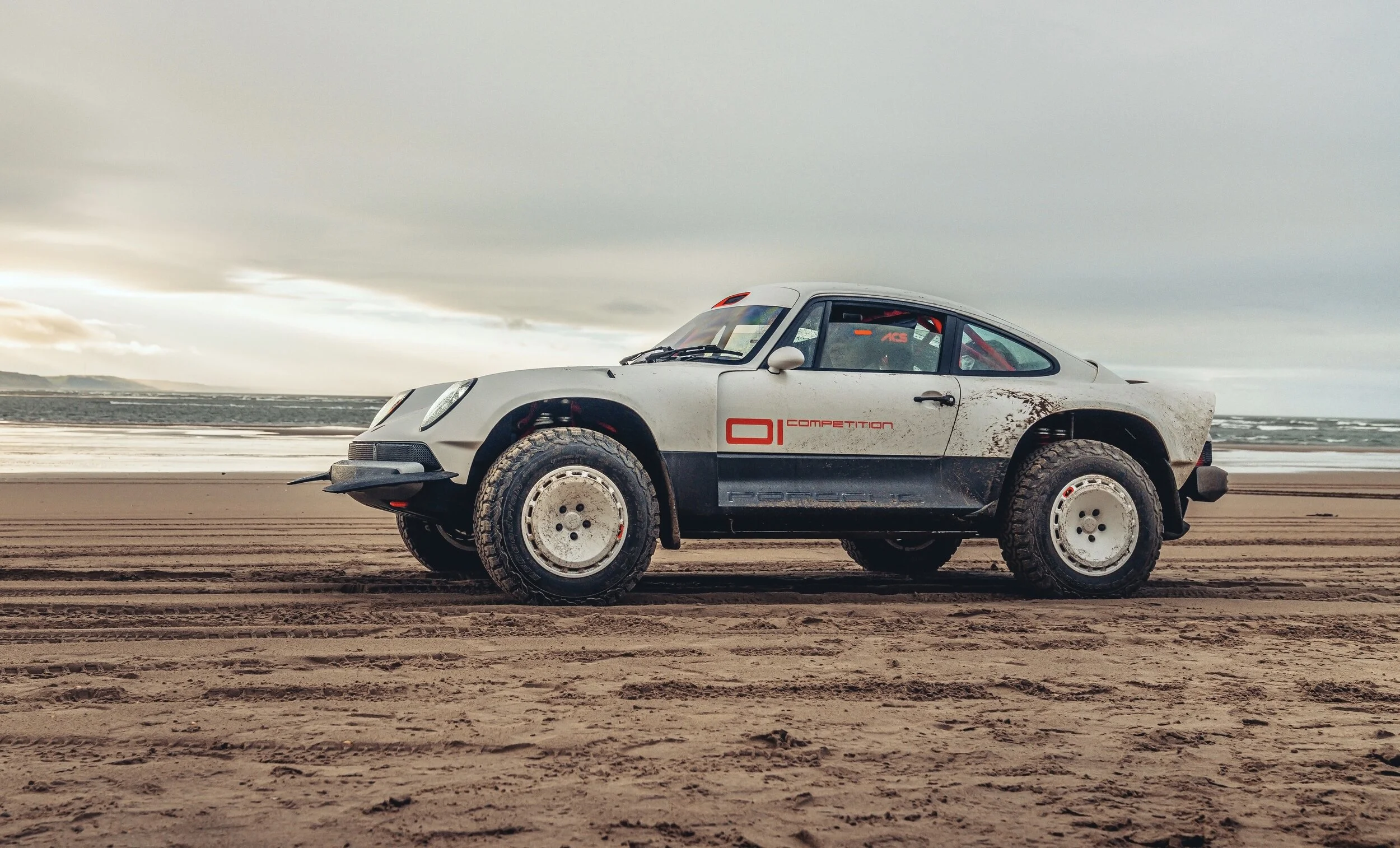
Homage to history …. the Singer ACS takes inspiration from Porsche’s incredible 959 (below), a Group B rally machine that made huge imprint in the Paris-Dakar rallies in the 1980s.

Homage to history …. the Singer ACS takes inspiration from Porsche’s incredible 959 (below), a Group B rally machine that made huge imprint in the Paris-Dakar rallies in the 1980s.

959_1986_porsche_ag_.jpg

PICTURE this: A Porsche 911 with extensive off-road modifications and a highly-tuned engine banging out mammoth horsepower, capable of surviving in the toughest terrain.

The brand did exactly that back in the 1980s, when creating the berserk 959, a car originally developed as a Group B world rally championship car – which, when that was kyboshed, proved particularly useful in hard-out long-distance desert racing ‘raids’, particularly the Paris-Dakar in the days when it was actually that. The 959 subsequently also rendered in a limited-run road car form and is now a highly-prized collectible. 

Now California-based Singer has revealed its latest creations: a pair of all-terrain models offering a 2021 interpretation of the famous factory model. 

The Singer ACS (which stands for All-terrain Competition Study) consists of a pair of rally-prepped machines that take inspiration from the 959 as well as the 911 SC/RS that Porsche also rallied. 

Commissioned by one of Singer’s long-term clients, ACS has been co-developed in the United Kingdom by Richard Tuthill, whose operation specialises in motorsport and rally preparation for classic Porsches.

Last year, Tuthill Porsche constructed the car that won the 2019 East African Safari Classic - a 5000km event that runs through Kenya and Tanzania. Back in the 1980s, Tuthill partnered with Prodrive to develop the original World Rally-prepped 911 SC/RS. 

Two cars have been built: the first, white car seen today is adapted for “high-speed desert rallying” while a second, lower-slung, car is designed for tarmac rallying.

Both remind that, while is Singer is often touted as a restoration specialist, it really often goes well beyond that role and reaches well into total re-engineering. 

Newswire02.jpg

The ACS cars are exemplars of that. AS is almost always the case qwith Singers, the starting point is a 1990 964-generation 911, which is reskinned in a carbon fibre body.

However, as the wild looks suggest, these are unique to the ACS and are designed for two main purposes, says British website AutoExpress, which has gained access to the project.

The on-line edition says the body rework takes into account the increased cooling demands required in harsh off-road environments. It allow easy access to important mechanical components which may need to be examined during service stops. As a result, the entire front and rear sections both open up like huge clamshells. 

The panels wrap around an extensively reinforced monocoque, and one which accommodates a significantly raised ride height. Bumpers front and rear are simple bars, which enable even greater approach and departure angles.

Tough rally-spec suspension is then attached to the bulked-up chassis. Twin dampers - each five-way adjustable - are mounted at all four corners, in order to control the shocks endured by the new long-travel suspension. Contact to the ground is through chunky BF-Goodrich all-terrain tyres, wrapped around 8x16” forged aluminium wheels. Brakes discs are steel, and are gripped by four piston calipers all round.

Porsche’s ‘Metzger’ flat six remains Singer’s start point for the engine, but its configuration here is new. Capacity is 3.6-litres, but it’s boosted by a pair of intercooler-fed turbochargers. Total power can be adjusted based on the demands of the specific rally, but the new unit offers at least 355kW and 569Nm of torque. 

Drive is sent to all four wheels via front, centre and rear limited slip differentials, and a five-speed sequential dog-box, which allows the driver to shift up without lifting the throttle. The gears can be operated through either an extended gear lever on the transmission tunnel, or by steering wheel-mounted paddles.

Other modifications to the standard Singer formula include a long range fuel tank and two full size spare wheels. 

Inside, the ACS sports a much more contemporary appearance than Singer’s retro-inspired road cars, Auto Express says.

Newswire03.jpg

Accessed through shorter doors (a result of the significantly reinforced sill area) the cabin reveals a pared-back dashboard, constructed from carbon fibre. This houses a digital instrument panel in front of the driver, and a huge GPS race navigation system ahead of the passenger. 

 Many of the controls are housed on a unique steering wheel, while a huge hydraulic handbrake stands taller than the extended gear lever. Safety is provided by unique seats, harnesses and a roll cage - all certified by motorsport’s governing body, the FIA. Both driver and passenger benefit from their own in-built drinks system.

Price? No-one’s gone into that and likely as not, you’ll never know. Just settle on “a lot … and then some.”


New car market hammered in coronavirus condition

The new vehicle industry took a big hit in 2020, registrations falling almost by a quarter.

Toyota’s RAV4 was the top-selling passenger model for the year.

Toyota’s RAV4 was the top-selling passenger model for the year.

NEW passenger and light commercial registrations for 2020 were down 22.7 percent on the 2019 tally, a publication specialising in industry news is reporting.

That means overall registrations dropped a massive 35,121 units to 119,620 for the year, says Autotalk.co.nz, citing data it has sourced from New Zealand Transport Agency. 

Report author Richard Edwards says this translates into a sobering impact for distributors and their dealers.

“Assuming an average of $3000 in margin, finance and insurance commissions and accessory sales per vehicle, those figures represent in excess of $100 million in turnover lost to the dealer segment of the trade alone for the year.”

The report has posted ahead of official notification from the Motor Industry Association, which generally posts monthly and annual outcomes on behalf of new vehicle distributors.

Autotalk.co.nz’s  report https://autotalk.co.nz/news/new-market-down-23-for-2020 says passenger registrations were down 23.3 percent for the year to 80,860 units, while commercial registrations fell 22.7 percent to around 39,000 units.

Toyota topped the passenger car segment with 12,795 registrations, followed by Kia on 7985, Mitsubishi on 6479, Mazda on 6289 and Suzuki on 5935.

The most popular passenger car last year was the Toyota RAV4 with 5350 registrations, followed by two Kias, the Sportage (2916) and Seltos (2611).

The Toyota Corolla, a previous pace-setter in previous years, was next with 2570; presumably a victim of the rental car business having collapsed when New Zealand was hit by the global coronavirus crisis.

In commercials, Ford was the top brand on 9124 vehicles, followed by Toyota on 8004 units, Mitsubishi on 3842, Holden – which ceased existence on December 31 - on 2533 and Nissan on 2376.

The Ford Ranger was the top commercial model for the year, and top vehicle overall, with a count of 7986 vehicles. The Toyota Hilux placed second, with 5808 units, followed by the Mitsubishi Triton (3694), Holden Colorado (2495) and Nissan Navara (2376).

The annual tallies arrived once December registration data was delivered; that showed 5572 vehicles being registered, a 31.75 percent drop on the same month in 2019. The Toyota RAV4 was the month’s top passenger model, with 387 registrations, and the Ranger the top commercial, and top-selling single model, with 662 units registered.


TNZ still market leader, but Covid hurt

The swift curtailment of rental car business, where it dominated, certainly affected the country’s biggest seller of new cars and light commercial vehicles.

IMAGE_Toyota New Zealand's Palmerston North head office.jpg

MARKET leader Toyota New Zealand has acknowledged a tough coronavirus-smashed 2020 market condition delivered a sobering 31 percent fall in annual volume, though it sees increased private consumer interest during this period as a positive.

 In comment today, the Palmerston North-centred distributor says the depleted return was mostly due to the impacts of the international coronavirus calamity on both rental fleet sales due to the immediate halt of international tourism through the closure of borders, and the local economy.

TNZ has not shared exactly how many car and light and commercial vehicle registrations it achieved in 2020 and that figure might not come out until a full data set of registrations is released by Government’s Land Transport agency next week.

However a 31 percent fall is likely the lowest it has achieved in years – though not a market position-altering knockout, in that the make maintained market leadership for a 32nd consecutive year.

It says it achieved an 18.1 percent share of all new passenger and commercial registrations in 2020; which it says represents a 1.9 percent drop on the 2019 tally. 

Last year TNZ claimed 31026 passenger and light commercial registrations.
 
A positive from the year is greater engagement with private buyers – an aspiration that TNZ has chased since the introduction of its ‘Drive Happy’ retail process in 2018 - which fuelled a rise in new vehicle sales, particularly hybrids, toward the end of 2020. That factor meant that, were lost rental volume to be excluded, TNZ’s market share had improved by 2.4 percent.

Chief Executive Officer Neeraj Lala sees that as being a great result.


His office says TNZ private market share was up 2.6 percent compared to 2019 at the end of November.TNZ says the product range it offers now delivers more to appeal to private buyers.
 
“Toyota has made a real effort over the past few years to inject fun back into the range which is resonating with our customers.”

It also credits wider availability of hybrid powertrains across more models, the next recipient being the new Highlander out soon, though TNZ acknowledged recently in might yet maintain a pure V6 in that family, thus backtracking on an earlier vow to deliver the big SUV in petrol-electric form alone.

Hybrid drivetrains, despite battery involvement, are not considered to qualify as electric systems as they lack facility for external power replenishment yet they still offer a positive in modest respite in emissions and economy. Five Toyota models configure with hybrid. Toyota has one car that holds electric vehicle status, this being the Prius Prime, which has plug-in replenishment capability but also runs a petrol engine. Toyota has a full electric car under development and premium offshoot Lexus will deliver a battery-compelled edition of its NX compact crossover to NZ this year. 

As is, TNZ’s volume of hybrids is vastly greater than the combined sales of all pure electric vehicles available in NZ and Lala says demand remains strong.  

In the year to the end of December, hybrids accounted for 59 percent of Toyota passenger cars sold. SUV hybrid sales were the same ratio within the soft-roader category.

The big seller is the RAV4 Hybrid; of the 5346 RAV4s sold during the year, 3830 were hybrids. The next shipment of 574 vehicles is already sold. 

However, like many industry performers, the demand has outstripped ability to supply. Constrained production lines and delays in provision of vital components are hitting all major car makers, Toyota included.

TNZ presently has more than 5700 customer orders waiting to be filled and most are hybrid models.
 
“If there is a challenge with hybrid sales it is securing enough supply for New Zealand, as there is a global demand for hybrid cars and SUVs, despite the economic impact of COVID-19,” Lala says.

In other news, TNZ has appointed a long-time senior management figure, Steve Prangnell, to general manager of new vehicle sales.


Big power play from Volvo this year


Diesel is departing and battery-influenced drivetrains are the future for the Swedish premium make here in 2021; including their first fully electric car.

The XC40 Recharge is the first Volvo electric for New Zealand.

The XC40 Recharge is the first Volvo electric for New Zealand.

WITHIN eight months Volvo here will release the first of a family of cars on which its future depends and have farewelled a fuel type that presently accounts for 50 percent of sales of a core popular sports utility.

The newcomer is – obviously – the make’s first full electric model, a version of the XC40 compact crossover.

Already available in its priority right-hand-drive market, the United Kingdom, but likely to come here around August-September, the XC40 Recharge packs 300kW from two motors that will power all four wheels.  

A 78kWh battery that can charge to 80 percent on a fast charger in 40 minutes is expected to deliver 350-400kms in the real world. 

The model is the only fully electric Volvo set to be available here this year, but assuredly the Geely-owned Swedish brand’s local range is in for a series of shock treatments as the distributor comes up to speed with the make’s global electrification strategy.

Volvo Cars was the first established car maker to commit to all-out electrification and is the only brand to offer a plug-in hybrid variant on every model in its line-up.

By 2025 the company aims to have sold one million electrified cars and it will launch five fully electric models between 2021 and 2025.

For New Zealand, this means additional mild hybrids and plug-in hybrids with the make’s latest efficiency-oriented battery-supported petrol engines are to roll in. Some would already be here, had not it been for delays in stock delivery caused by Covid-19.

Anyway, as Volvo NZ increases this battery push, it will also decrease its count of vehicles that are wholly fossil fuel-reliant; the ultimate aim being to expunge these entirely in favour of powertrains that will feature some form of electrification.

First to depart will be diesel models; all going to plan, says Volvo New Zealand boss Coby Duggan, combustion ignition powertrains will be removed from all Volvo models offered in NZ from as early as mid-2021, replaced by MY2022 mild hybrid petrols.

 It’s a determination the brand acknowledges carries some risk locally, because diesel has been a popular choice, not least in its largest sports utility, the XC90.

In 2020, half of all examples of this seven-seater sold were with diesel. That powertrain choice also offers in the next-size down XC60 and the V90 Crosscountry wagon. Diesel has never offered in the XC40.

However, the XC90 is by far the strongest diesel performer. Volvo NZ is confident it can achieve consumer swing away from the black stuff, however, and has already started this hearts and minds campaign by introducing an XC90 petrol in the same spec, and for the same money, as the XC90 diesel that has been doing well.

“Once we can offer MY2022 mild hybrid XC60 and XC90 (we will no longer offer any diesel in the range. That’s quite a significant shift for us. 

“I’m relaxed about phasing it out in XC60 product as it is has not accounted for much there but it’s different with XC90, as it has generated quite a lot of volume. This year, it has given us, in round terms, around 50 percent of XC90 volume.”

He wonders if a lot of that interest comes down diesel being at an entry level price point. The new petrol tests this.

“What we’ve started doing now is to introduce a T6 petrol at the same price point, and thus create a petrol entry point we have not had before. It’s a way for use to test whether the loyalty to diesel has been about torque, and economy and towing and all the things Kiwis say they love about diesels or whether the price point is also a key contributor.”

Volvo’s ultimate plan, at least until it can create more fully electric models, is to increasingly proliferate the hybrid powertrains it has in readiness that supersede those it has offered in the past.

The mild-hybrid technology pairs a turbocharged petrol engine to a 48-volt battery and an integrated starter-generator (ISG) unit – a compact electric motor replacing a car's traditional starter motor and alternator – to both sharpen engine response at low speeds thanks to a boost from the electrical system, while also, crucially, improving fuel economy. 

Volvo has struggled to build enough mild hybrid, PHEV and full electric cars in 2020

Volvo has struggled to build enough mild hybrid, PHEV and full electric cars in 2020

The battery is then recharged through regenerative braking, which recuperates energy 'lost' under deceleration, and not requiring the system to be externally recharged via a plug. 

The ISG also allows for quicker activation of the start-stop system when taking off from a standstill.

Above that option will be a range of improved plug-in hybrid (PHEV) powertrains – also badged under the Recharge sub-brand that identifies full electrics – which pair a turbo petrol engine with a larger lithium-ion battery pack and a more powerful electric motor, enabling them to drive on electric power alone for distances up to 50km.

Volvo already offers a plug-in hybrid option on the S60 and V60, plus the XC90 Recharge, but additional PHEV options at different price points and performance levels are anticipated for introduction, the next arriving being a PHEV XC40. Whereas the other PHEV cars have a T8 designation, this one will be a T5.

“The XC40 plug-in will be here in the first half of the year, with a 1.5-litre three-cylinder engine with an electric motor, and that will complete the plug-in hybrid lineup.

“The mild hybrid lineup will start to come in the second part of the year, as Model Year 2022 cars, with the 48 volt system. This will be in the 60s and 90s models but not in the 40s until the following model year.”

“The tricky thing for us has been around timing,” Duggan says. “It has taken longer than I personally expected for this technology to get to this part of the world.”

Is this entirely due to Covid-19? There’s no doubt coronavirus has hurt the entire car industry and Volvo hasn’t been immune by any means in 2020.

Says Duggan: “Supply and meeting demand has been incredibly difficult for everyone in every industry, but the plug-in product has been the most difficult for us to lay hands on and it’s likely that will continue into 2021.”

 What also hurts NZ is its size and geographic location – we’re very much at the far end of the supply chain – our modest volume requirement and that other markets in which emissions regulations are more rigorously enforced, and where penalties and rewards apply, have been given higher priority.

“We’re hoping that as production capacity ramps up again we can secure as many (vehicles) as we need … at the moment the only thing that will hold us back in respect to plug-in volumes in particular is ability to supply; the demand is there.”

Volvo Sweden’s electric motivation has also been reinforced by the factory announcing that it will invest around $NZ110 million to set up its own in-house manufacturing of motors for electric cars. 

This programme will see it equip its existing powertrain plant in Skovde, Sweden, to assemble and eventually manufacture e-motors before the middle of the decade.

272997_Volvo_XC40_Rehcharge_P8_Google_Infotainment_System.jpg

While other car companies rely on outsourcing parts for electric powertrains, Volvo will follow in the footsteps of Tesla by bringing at least some of these operations in-house.

The new chapter of change for Volvo here also affects its management. Duggan is leaving the brand on January 15, to start a new role with Toyota New Zealand that’ll keep him in Auckland; a return to a familiar territory as he has held a previous role with Lexus. His replacement is Ben Montgomery, who has been with Volvo briefly previously and has subsequently held roles with Renault, Jaguar and Land Rover.


2020 new vehicle market set to be down 20 percent?

The global drop in new vehicle production during 2020 has been sobering – and is bound to affect NZ’s registrations count for the year.

Covid-19’s impact on car production was unavoidable in 2020.

Covid-19’s impact on car production was unavoidable in 2020.

ABSOLUTE clarity about the state of the New Zealand new car market in 2020 might be weeks away from resolution, but first indications about how the industry fared globally are sobering reading.

Gut feeling from within the industry here is that there’ll be no surprise should the year-total new car and light vehicle registrations count come to around 117,000 units, so around 20 percent down on the 2019 tally and the lowest annual count since 2013.

That kind of decline would be slightly greater than those predicted for the world’s three largest car markets – the United States, China and Germany.

But all has yet to be clear. New Zealand industry participants are awaiting one more set of figures, the registrations count for December, before they can achieve a total picture of the year’s trends and activity. 

As is always the case, this data doesn’t come easily - simply because the Government department involved in the accrual process, Land Transport, closes down over Christmas and New Year.

It is likely that provisional counts might be availed on January 5, but unlikely that full counts will be availed before January 11 – a much slower turnout than for any other month of the year, when normal business conditions apply.

That won’t inhibit individual brands from calculating their own in-house data – they, of course, know exactly how many cars they have retailed at any given time – but does make the achievement of a big picture view much more challenging, as competing brands are quite naturally loath to share.

Even so, the global picture is starting to take shape and it might well provide a pointer as to how the NZ scenario will shape up. 

In which case: Don’t expect an easy ride. The impression that NZ has done okay, simply because we experienced an unexpected surge in new vehicle purchasing activity in the months immediately following the easing of national lockdown conditions from April, does not mean that the market is set to show a decent result.

The big problem, evidenced especially within the final quarter of the year, has been one that should be pretty obvious to anyone who has been visiting new car franchises these past few months. The decreasing count of vehicles on display – and the increasingly obvious amount of unfilled display space -speaks volumes about how constrained supply has become.

Fact is, the vehicles that were bought during that sales rush were all easy pickings, being by and large, examples held in the national stockpile.

What’s become more challenging is achieving replacements for those units – Covid’s interference with not only car-making but component provision and then supply networks has been dramatic. Plants might still be making vehicles, but the rate of production has slowed and, often, so too the processes.

Coronavirus has given the world’s car makers a really rough ride in 2020; according to one report just out from an analyst based in the United Kingdom, all signs are that global car sales were down by $612 billion in 2020 and the entire market appears to be down by 10 percent. 

Data presented by StockApps.com, based on collations by a specialist, Statista, confirm what has long been accepted fact – that the Covid-19 pandemic hit the industry hard, causing supply chain disruptions, factory closures, and huge sales and revenue drops. 

StockApps picks the downsizing trend is set to continue this year and next, pointing out that even before the pandemic, the world’s car makers were already coping with a downshift in global demand.

In 2019 global passenger car sales revenues amounted to $US2.29 trillion. Small SUVs sales, as the largest revenue stream, generated almost 30 percent of that value or $US647 billion.  

Large SUVs and large cars segments followed with $US362bn and $US275bn in revenue, respectively.

However, the COVID-19 pandemic caused a huge hit, with total car sales revenues falling by almost 20 percent year-over-year to $US1.85trn in 2020.

Statista says its data suggests revenues in the large cars segment are expected to drop by 25 percent year-on-year, to $233bn.

Large SUV sales are set to witness a 24 percent cut, with revenues falling to $US275bn in 2020. Small SUVs follow with a 20 percent drop and $525bn in revenue. 

Analysed by carmakers, Toyota represented the market leader with a 10.6 percent global market share in 2020. Volkswagen ranked second with a 7.4 percent market share. Nissan, Ford, and Hyundai follow, with 6.6, 6.2 and 5.6 percent shares respectively. 

Statistics show the downsizing trend is set to continue in 2021, with global passenger car sales revenues falling to $US1.65trn. In 2022, this figure is expected to decrease by another six percent to $US1.55trn.

Statista data also revealed that all of the leading car markets are expected to witness a two-digit revenue drop this year.

As the largest market globally, the car sales revenue in the United States is forecast to fall by almost 18 percent year-on-year to $US507bn. This figure is expected to plunge to $US385bn in the next two years, nearly 40 percent less than in 2019. 

China, the second-largest market globally, achieved $US452bn in revenue in 2020, an 18 percent fall year-over-year. By 2022, total car sales revenues in China are set to drop to $US405bn.

As the third-largest market, Japan witnessed an almost 19 percent year-on-year drop when comparing 2020 and 2019 data sets, with passenger car sales revenues falling to $US92bn in 2020. Germany follows with $US86.5bn in revenue, 17 percent less than in 2019. 

In all, the three leading markets have likely lost $US231.5bn in car sales revenues in 2020 due to the Covid-19 crisis.  


Palisade order book open, no price yet

Hyundai NZ clarifies that the new SUV will price above the Sante Fe, which raises prospect of it breaching the $100k barrier.

PalisadeHighlander-14.jpg

FIVE hundred dollars down will secure an order for the largest sports utility yet produced in right hand drive by a South Korean car maker. 

Hyundai New Zealand’s order book for the new Palisade, a sports utility wagon based on the same underpinning as the Sante Fe but physically larger in all pertinent dimensions, has recently opened.

The Auckland-based distributor has made clear it is going for a full house provision and also indicated that the potential of it undercutting the Sante Fe on price won’t occur.

That scenario was raised in a recent MotoringNZ story, which pointed out that if Palisade entered NZ costing as much as it does in Australia, it would be cheaper than the smaller SUV – by up to $15,000 when comparing the respective flagships.

Hyundai NZ says that conjecture is off the mark.

“Australia pricing … (is) not indicative of NZ pricing. As our new flagship SUV Palisade sits above the Santa Fe and pricing will also reflect that,” brand spokeswoman Kimberly Waters said.

She added that Palisade pricing will come out in January “when the vehicles start arriving in dealership (s).” 

PalisadeHighlander-42.jpg

Palisade also sits above the Sante Fe in Australia’s pricing structure.

MotoringNZ’s story, posted on December 11 said that across the water, Palisade will sell for the equivalent of $NZ63,850 in entry form and $NZ79,800 in a flagship trim, those recommended retails precluding on-road costs. It also pointed out that the top-end Sante Fe, the Limited, is a $89,990 ask in NZ.

If Palisade is sitting above the Sante Fe Limited, as Waters suggests, then it could conceivably price up to and even beyond $100,000 – an uncharted territory for South Korean SUV product offered here.

The page dedicated to Palisade on HNZ’s website indicates we’ll see it as Australia does - with the choice of a 2.2-litre four-cylinder diesel and a 3.8-litre V6 petrol, in rear-wheel-drive and all-wheel-drive formats and with two different occupant count arrangements.

There’s an eight-seater that shows with two separate seats up front then two bench seat rows behind and a seven-seater that provides with a bench in the very back and otherwise has captains’ chairs.

New Zealand and Australia might well become the only right-hand-drive markets for the car, which was originally made for North America and the Middle East, which is also left-hand-drive. It was re-engineered into RHD after Australia petitioned for it to be reconfigured.

Australia’s media speak of it being quite a different experience to the Sante FE, describing it as being a more laidback drive and evidencing as being designed to to appeal to families who need a large SUV but don't want a heavy-duty off-roader – or need to tow heavy loads.  

PalisadeHighlander-05.jpg

The specification encompasses a full suite of advanced safety technology including radar cruise control with stop-start, lane-keeping assistance, rear cross-traffic alert, and blind zone warning with intervention if a driver is about to cut across someone in an adjacent lane.

The flagship – which presumably cannot be called Highlander, as it is in Australia, due to Toyota already having dibs on that name - gains a digital dash that displays images from the blind zone cameras.

Tyre pressure monitors and a digital speed display are standard, however Palisade does not yet have speed sign recognition. Instead, the speed warnings rely on the navigation data.

There’s no ANCAP safety rating yet for the Hyundai Palisade, but it’s unclear if it will achieve a four, or five-star rating with the lack of a centre airbag, deemed a new requirement by some manufacturers to achieve top safety marks.

Palisade’s 2.2-litre turbo diesel four-cylinder is the older Hyundai design, as used by the previous Sante Fe, rather than the updated alloy block engine that the new Sante Fe has gone to. The engines have similar outputs – 247kW in Palisade, 148kW in Sante Fe, torque of 440Nm in either - but the new design is said to feel perkier. The Palisade also pairs its engine to a conventional eight speed auto (and on-demand all-wheel-drive), whereas the new Sante Ge has moved to an eight-speed twin-clutch auto.

Palisade’s alternate V6 is a 3.8-litre, creating 217kW and 355Nm, whereas Santa Fe runs a 3.5-litre V6 good for 200kW/331Nm. 

Palisade-14.jpg

Hyundai says the Palisade’s V6 uses 10.7 litres of fuel per 100 kilometres, which is just 0.2L.100km worse that the Santa Fe’s claimed optimal. The diesel’s economy suffers in the Palisade – Hyundai cites 7.3L/100km for the larger unit, against 6.1L/100km in a Santa Fe. 

Palisade’s size doesn’t reflect in it being brawnier for towing – quite the opposite, in fact. Towing is capped at 2200kg, whereas new Santa Fe can tow 2500kg. The other eight-seaters in it might be compared with are heavy duty off-roaders, the Toyota Land Cruiser 200-Series being the obvious rival, and it can haul 3500kg.

The exterior is to Hyundai’s current design language, but clearly distinctly different to the latest Sante FE look and reminding of larger American SUVs, according to Australian website CarAdvice.

The entry car runs on 18-inch wheels, the high-end car on 20-inch wheels for the Highlander, together with bi-LED headlights and tail-lights.

Inside, buyers get a choice of black leather with metallic-look trim and a knit headliner in the Palisade, while the high-end model - which, for sake of clarity, we’ll call Highlander - gets burgundy or beige Nappa leather with beech wood-look trim and a suede headliner.

A 10.25-inch infotainment screen featuring satellite navigation, Apple CarPlay and Android Auto capability, and multi-connection Bluetooth, which runs through a 12-speaker Infinity premium audio system, is a common fixture.

Due to the expansive cabin, the Palisade also offers 'Driver Talk', which allows the driver to speak to second- and third-row occupants through the car's audio system. The system also has a 'Quiet Mode' which mutes the rear speakers, and sets the front speakers to a low maximum volume.

Front occupants get wireless smartphone charging in the centre console, while second-row passengers have access to USB ports.

As well as three ISOFIX child seat restraints, the Palisade also features four top tether child seat anchor points in the seven-seat Highlander, and five anchor points in eight-seat configuration (all variants). The second-row of seats features one-touch folding to help with third-row loading.

Front occupants get to enjoy heated and ventilated power seats, while the driver gains a 7.0-inch LCD digital instrument cluster. The 10.25-inch, all-digital instrument cluster offered in overseas markets doesn’t feature in right-hand-drive, but a head-up display goes into the flagship.

PalisadeHighlander-10.jpg

On the Highlander, a blind-spot view monitor shows a live feed of the Palisade's left and right blind-spot zones within the instrument cluster when the indicator is engaged, as well as a surround view monitor with guidance provides a 360-degree birds-eye view when parking.

A dual-panel power sunroof and hands-free power tailgate are also standard on the more expensive model.

Hyundai subordinate brand Kia also has a model based off the Palisade, however it insists there are no plans to produce that model, called the Telluride, in right hand drive.


Tesla update turns horn sounds into farts

It uses the external speaker to project noise at other motorists and pedestrians

Tesla Model S.jpg

TESLA cars have been able to create fart sounds inside the cabin for some time – now they can share that ‘talent’ with the wider public.

The facility to fart at other drivers and pedestrians as its horn arrives with providing a new ‘Boombox’ feature that can broadcast custom audio.

 If the sound of the expulsion of intestinal gas doesn’t captivate, it can also make lots of other sounds - a baaing goat, applause, ‘La Cucaracha’ and a number of others; even someone speaking posh.

The facility to broadcast alternate noises in lieu of normal honking sounds car horns usually make rolled out with a number of other updates as part of Tesla’s firmware 2020.48.26 update, though it’ll only work if the speakers are fitted, which occurs during assembly.  

US media have reported that Tesla cars manufactured after September 1, 2019, have the speaker built in. 

The sound menu is basically endless, because in addition to the pre-loaded standard sounds, Tesla allows you to upload up to five custom sounds into the system.

The broadcast mechanism is an enhanced version of the external speaker mounted toward the front of the car that is normally used to emit a humming sound to alert pedestrians that a vehicle is nearby.

Most EVs emits a low frequency sound at low speeds, but Tesla is the first automaker to apply extracurricular noises to this piece, reports America’s Autoblog website.

It says  Tesla began to install these speakers on its cars at some point in 2019, so you’ll need a newer Tesla to take advantage of this update. 

The site says Tesla owners will be able to activate their noises of choice by simply pressing the horn once they set it up in the car’s infotainment system.

It understands rhe cars make these noises via the horn press when the vehicle is at a standstill, but will sound the traditional horn when moving, for safety’s sake. After all, as Autoblog notes, “farting at a semi-truck moving into your lane on the highway probably won’t do much of anything.”

However, anybody on the side of the road or walking along near a stopped Tesla will be subject to whatever whimsy the driver decides to cook up.

Autoblog notes that America’s federal and state regulations surrounding horn use in passenger cars are “shockingly light” for a safety feature.

“There’s no federal requirement for a horn or horn sound, though the placement of the horn button is regulated — it must be designated with a clear symbol/marking if it’s not activated by pressing the steering wheel.”

Also included in the latest updates are improvements to the driving visualizer, cabin preconditioning when unplugged, Supercharger display enhancements and new games. The new games include The Battle of Polytopia, Cat Quest and Solitaire.


The Beetle – it all began 75 years ago


Volkswagen is celebrating the birth of a global icon.

DB2020NR00667_large.jpg

SEVENTY-five years ago yesterday, a Christmas automotive miracle occurred.

Well, okay, in picking December 27, 1945, as the day when the original shape Beetle was born, Volkswagen is obviously navigating delicately around a turbulent prior period in history.

Like, the birth of the brand itself: Volkswagen is German for ‘people’s car’ and was coined by … well, never mind that.

Even though the history of the car – and, indeed Wolfsburg, the home town of the mighty VW Group that has risen to become Europe’s biggest car making operation – can be traced back to certain political determinations during the 1930s, fact is there were few Beetles made before 1945 under National Socialism and none left Germany.

We’re talking about a day in history that started this wee rear-engined budget car on a post World War II adventure drive that would take it around the world into the hearts of millions.

So, the story goes thus: At the end of 1945, the factory and the car faced a grim future.

Although the car was developed before World War II, only 630 units (then called Kdf-Wagens) were built during the conflict as the factory shifted its attention to the war effort. It was consequently bombed by Allied air forces several times during 1944.

When peace returned, it would have been much easier to level the factory, scrap the Beetle – or ‘Type 1’ as it was then being called - and do something else with the site.

That's almost what happened, but the British government — which controlled the zone Wolfsburg was in after the war — desperately needed vehicles for its personnel to get around.

After examining an early Beetle, officials ordered a batch of 20,000 cars from the factory in August 1945, and they doubled that number several weeks later.

Initially, the goal was to produce 1000 cars a month, meaning filling the order should have taken over three years. It likely wasn't lost on officials that the sizable order would keep workers in a job until at least 1948.

That production even got under way was down to the talent of the British officers put in charge of the programme, Major Ivan Hirst.

It was his farsightedness and talent for improvisation that made it possible to start automobile production in the years of rationing under conditions dominated by shortages, VW says.

“With his enthusiasm for technology and cars, his purposefulness and distinct attitude, he succeeded in transforming a former armaments plant into a civilian industrial company in an impressively short space of time,” the brand says.

Launching production was challenging; raw materials and fuel were difficult to come by, and finding ways to house and feed the workers was a logistical nightmare.

DB2020NR00666_large.jpg

Despite the hurdles, Volkswagen launched series production of the Type 1 two days after Christmas in 1945, and it built a total of 55 cars before December 31.

Cars were largely assembled by hand, so the factory didn't reach the 1000-cars-per-month goal until early 1946. At the time, exceeding that number wasn't possible due to the aforementioned shortages, but production increased significantly as the situation improved.

Introducing the Beetle to the United States in 1949 dramatically increased its popularity, and it helped turn the model into an icon.

Wolfsburg wasn't the only factory that built the Beetle; production also took place in several other German plants, including one in Ingolstadt (Audi’s home town), plus overseas - in New Zealand, Australia, Brazil, Mexico and South Africa, among other countries.

All told, 21,529,464 units were built during a 56-year run, a figure that's nothing short of exceptional when bearing in mind that the first one looked an awful lot like the last one. Volkswagen made thousands of changes to the car, but it never altered the basic design or tweaked the mechanical layout.


Juke recall gives new meaning to sticker shock

Don’t worry, it seems only the neighbours are upset by this issue.

JukeTi2.JPG

COULD it legitimately be called a jack-up? 

A recall action for the latest Nissan Juke, that seems not to have impact on examples shipped to New Zealand, is certainly something out of the ordinary.

It seems the car has become subject to a precautionary check-over action across the Tasman because the jack that comes with the car does not comply with Australian safety standards.

The problem isn’t with the device itself – it’s in perfect condition to undertake the job of lifting the vehicle off the ground to change tyres. 

It’s all down to it not having a label that passes muster with the Australian Competition and Consumer Commission (ACCC).

It says the jacks do not comply with Australian safety standards due to the omission of a correct instruction label. Not having this could potentially cause an accident if a vehicle is not jacked correctly by the operator.

Affected vehicles were sold between 20 May 2020 and 2 September 2020. Nissan Australia is contacting owners to organise inspection and repair of the defect. 

As for New Zealand? Well, we take the same stock as Australia, but there has been no word from Nissan New Zealand – whose new boss in still stuck in Australia, due to coronavirus travel restrictions – and, from a quick check with a local dealer, the consternation raised across the Tasman has not been felt here. ‘All news to me’ was the local comment, with thought no action is required here.


C8 Corvette’s design and engineering story told

Fascinating YouTube video series a must for rev-heads

2021-Chevrolet-Corvette-Stingray-Coupe-Convertible.jpg

JUST because it’s still the best part of a year away from touching New Zealand soil doesn’t mean it’s too early to bone up on the C8 Corvette’s background.

To assist with that, Chevrolet has helpfully created a series of backgrounder videos about the car that, by being mid-engined, represents the biggest shift in the nameplate's decades-long history.

"Revolution: The Mid-Engine Corvette Development Story" is a two-part documentary hosted on YouTube.

Chevrolet has just released the first piece, which focuses on the Corvette's interior and exterior design.

It’s a fascinating insight for car fans, regardless of how close your interest in America’s best-known sports car.

Plenty of involvement from the people who took the model into mid-engined territory for the first time.

The roster of stylists who appear in it includes Tom Peters, the former exterior design director of General Motors’ Performance Car Studio, Brett Golliff, Chevrolet's design and trim manager, Vlad Kapitonov, the Corvette's lead exterior designer, and Kirk Bennion, the model's exterior design manager.

Development work quietly started in 2011, but the idea of putting the engine behind the passenger compartment isn't new, and Chevrolet has experimented with this configuration many times since the 1960s. One 1973 prototype was even powered by a twin-rotor Wankel engine. Putting a rotary engine into the gen-eight car wasn’t considered.

Peters, Golliff, and others explained inspiration the latest car’s shape came from fighter jets and racing cars, among other sources. Jets are quick and purpose-driven, so the design team naturally looked at what members of the US Air Force fly as they sketched the car's finer details, like vents. Racing has been an official part of the Corvette's history since Chevrolet entered five cars in the 1956 edition of the 24 Hours of Sebring.

The series doesn’t give insight into what car might follow the C8, but has given a few hints about the processes that could apply from this point, with Peters commenting: “I'm here to tell you that it's just the tip of the iceberg. Just imagine where it can go from this point. This is just the beginning."


SsangYong files for bankruptcy, continues trading

National distributor Great Lake Motors assures Kiwis it’s ‘business as usual.’

Korando   019.jpg

SOUTH KOREAN recreational vehicle specialist SsangYong Motor has secured protection under South Korea’s bankruptcy administration process after it failed to repay creditors a loan worth roughly $NZ76,000,000.

The company has been given three months to work through its affairs, in hope that it will be bought during that time, and will continue to operate normally during that period, says Andrew Bayliss, general manager for the New Zealand distributor, Great Lake Motor Distributors.

Insofar as the brand’s affairs in NZ are concerned, it is business as usual, he says.

He is also confident the situation will end well, asserting “there is a buyer in the wings” for the make.

“We expect that deal to go ahead.

“For New Zealand it is business as usual. As it is in other markets. We are still getting product, we are still getting cars produced. We have got cars being despatched today, in fact.

“For New Zealand, we do not anticipate any interruption.”

Mr Bayliss disputes the brand has filed for bankruptcy, though this has been reported globally. The Korean administration process is, however, similar to the American Chapter 11 administration processes which is used to assist a business restructure often prior to a sale.

Entering into receivership in South Korea means SsangYong has volunteered to be dramatically restructured, according to a report on the website of Forbes magazine. 

It said all of SsangYong Motor’s assets have been frozen under the receivership programme, which protect it from action over its outstanding debts and receivables.

A report on the website of British weekly motoring publication Autoexpress cites SsangYong as claiming it has delayed the repayment due to worsening business conditions globally, and having failed to come to an agreement to extend repayment deadlines with foreign lenders has applied for receivership. 

“The company plans to resolve the current liquidity issue early before the rehabilitation procedures are commenced by applying for Autonomous Restructuring Support,” read a statement.

Autonomous Restructuring Support gives the brand a further three months to agree resolutions with creditors before court action. 

Indian automotive giant Mahindra and Mahindra has owned a 70 percent stake in SsangYong since 2011, and currently owns 75 percent of the business. It has been looking to sell on the brand.

The make, South Korea’s fourth largest car maker, has sustained 15 straight losing quarters. Its main creditor is the Korea Development Bank (KDB), though foreign financial institutions are also owed money. 

SsangYong sales globally for 2020 are around20 percent down on 2019. 

A SsangYong spokesperson in South Korea said: “We very much regret this situation which is the result of the difficulties being experienced from the worldwide COVID-19 situation, and the concern caused to our partners and stakeholders, especially our employees, sales networks and financial institutions.  

“We are making every effort to transform the situation, and to build a more robust and competitive company for the future.”

Great Lake Motors has held SsangYong distribution rights in NZ since 2010. GWM is run by Taupo father and son Rick and Deon Cooper. Models represented in this market include the Rexton, Tivoli and Korando SUVs and the Rhino utility.


Tiguan update: Prepare to say R

VW’s medium SUV is about to undergo a mid-life update, but the four versions arriving in March aren’t the biggest surprise.

DB2020AU01521_medium.jpg

FOUR mainstream models in March - an exciting and fresh-to-type new hotshot flagship toward the end of the year. 

That’s the gameplan laid out by Volkswagen New Zealand in respect to the 2021 five-seater Tiguan, a mid-life update introducing four years after this generation went on sale. 

The first-time option of a high-performance model introduces with the flagship Tiguan R (above), which delivers a 2.0-litre turbo petrol four-cylinder engine producing 235kW and 420Nm and zero to 100kmh in 4.9 seconds and an electronically-limited top speed of 250kmh.

Astute VW fans will pick this variant is packing the same engine that features in the Golf R, whose latest version – based on the gen eight hatchback – will likely land in NZ around the same time as the fastest-ever Tiguan.

As with the Golf, the ‘Titan Tig’s’ power is sent to an all-wheel drive system through a seven-speed 'DSG' dual-clutch transmission.

The model’s R-Performance Torque Vectoring system can vary the torque split between the front and rear axles as well as the two rear wheels, like Audi's Sport Differential.

The hero model also wears 21-inch alloy wheels, has 18-inch brakes and a 10mm reduced ride height and features a barking Akrapovic exhaust system.

Further details, including pricing, won’t reveal until much closer to release, but VW New Zealand has expressed excitement about the car’s potential. 

DB2020AU01516_large.jpg

“We think this model will do very well,” marketing and communications executive Shannon Pentecost said.

“For the first time VW will have an impressive R performance range including Golf, Tiguan and Touareg all destined for NZ toward the end of 2021.”

VW NZ’s confirmation of intent to land the R-spec model comes in the wake of it announcing details, including pricing, the four mainstream petrol Tiguans it will have in dealerships from March, these in two trim levels and with or without all-wheel-drive.

The front-drive choices, with a 110kW/250Nm 1.4-litre turbocharged engine, are the $46,900 TSI Life entry-level and next-step up $55,900 TSI R-Line.

Those preferring all-wheel-drive have the choice of a $59,990 TSI Style and $68,900 TSI R-Line. These run with a 2.0-litre turbo four-cylinder, putting out 132kW/320Nm in the Style and 162kW/350Nm in the higher-end variant.

The latter also steps up on the suspension department, with inclusion of the Adaptive Chassis Control system with its electronically controlled dampers to go with its sportier styling. Both four-wheel-drive editions have drive modes. 

The new models are identified by their adoption of VW’s new frontal appearance, notably the chiselled headlights and wide grille that brings it into line with the newest family members. 

They also deliver higher content than the current cars. All models arrive with automated emergency braking, pedestrian detection, adaptive cruise control, blind-spot monitoring, and parking assist, plus hill-descent control.

The interior again features a 10.25-inch digital instrument display and an 8-inch high-resolution touchscreen- standard throughout the range save in the top-spec AWD, with has a 9.2-inch screen - a new steering wheel design with new touch controls, as well as some trim changes and new charging ports, including USB-C. VW’s new MIB3 infotainment system also features. 

It’s not yet clear if any NZ-bound Tiguan variants will feature the new Travel Assist feature, which offers a degree of automated driving, though it requires a driver to keep contact with the steering wheel – even if with a light touch - when it is active and uses touch detection to ensure that happens.

DB2020AU01515_large.jpg

The system uses radar cruise control and lane keeping assistance technology and takes into account local speed limit information, town boundary signs, junctions and roundabouts, and will adjust the vehicle’s speed accordingly.

VW believes this is a safer avenue than actual hands-off autonomy, saying: “Touch detection is a great deal more reliable than steering angle-based systems even on long and very flat stretches of road.”

Also subject of conjecture in respect to right-hand drive availability is another body style option – a sleeker coupe-SUV profile.

So far this fastback shape is only available to Volkswagen’s China line-up, where it is badged as the Tiguan X.


Golf tees off in three hatch models

VW has announced pricing and details of the new Golf, landing in March

GOLF TSI will front with 1.4-litre petrol in two trim levels.

GOLF TSI will front with 1.4-litre petrol in two trim levels.

MIGHT one of the world’s most famous hatchbacks be immune to the general consumer shift away from orthodox road cars in favour of crossovers and sports utilities?

Volkswagen New Zealand seems to be suggesting that could be the case for the next generation of its Golf; they say pre-registrations of interest in next year’s new car has been strong.

Greg Leet, general manager of Volkswagen passenger vehicles, says there has been a lot of customer interest in the gen eight, whose introduction has been delayed by coronavirus.

The distributor has today confirmed a car once touted as a 2020 introduction will be on sale in March, three hatch formats - mainstream $37,990 TSi Life and $47,990 TSi R-Line plus the  $61,490 GTI – preceding another, the four-wheel-drive Golf R flagship. That’s coming toward the end of year. 

Not on the consignment list for New Zealand is the GTI Clubsport, the replacement for the Golf TCR, which runs the gen eight GTI’s EA888 engine, but in a peppier evo four tune that puts it above the TCR. The gen eight GTI, meantime, makes 180kW and 370Nm.

 The TSi cars adopt a 110kW/250Nm 1.4-litre four-cylinder petrol, married to an eight-speed auto. The Life is on 17-inch rims,  the R-Line takes 18s. The GTI also runs on 18s, but has 19s as a $1750 option.

Golf GTI will land with mainstream models

Golf GTI will land with mainstream models

VW impresses the new-generation car will be the most technically advanced Golf to date – with a full suite of advanced safety features as standard across the range, packaged as IQ driver assistance. This includes city and highway speed autonomous emergency braking (AEB), intersection AEB, radar cruise control and blind zone warning. The Life misses out on rear cross-traffic alert, has a slightly lower grade of adaptive cruise control and doesn’t have park assist.

A digital instrument cluster and a large infotainment screen is standard, as well as wireless Apple Car Play and wireless Android Auto – and fast-charging USB-C ports. All but the base car have factory sat nav.

The direct shift automatics are shift-by-wire so have a smaller toggle to select forward and reverse, creating more space in the centre console.

Although Golf also presents as a wagon, only the hatch has been discussed for NZ and while the range of powertrains spans diesel and an electric-assisted plug-in hybrid, these have not been mentioned. The fully electric e-Golf has been retired because VW now makes the ID line of electric cars, though these are not set to reach NZ until at least the end of 2022.

Golf R will land toward the end of 2021.

Golf R will land toward the end of 2021.


In sickness or in health – what’s the impact of Covid on car distributors?

Look around many new car dealerships and it seems clear some are running short of stock. So how hard hit are distributors?

Generic toyota caryard.jpg

TEN days ago Toyota New Zealand’s chief executive acknowledged the effects of Covid-19, closed borders and delayed shipping and logistics into NZ are “severely” impacting on all operational areas of his business. 

Which means? Specifically, said Neeraj Lala, availability of most new popular Toyota models is impacted. Many popular models are subject to waiting lists, with potential for delays to continue into the middle of next year.

This was not news to MotoringNZ. From mid-year, we’ve been reporting the emergent issues stemming from Covid-19, notably that the big unexpected run in new car sales had severely depleted the national stockpile.

Toyota’s bold admission raised a question: Would the market leader’s bold and frank attitude encourage others to lend insight into their own situations?

Turns out they needed some encouragement. Last Thursday this writer contacted a slew of brands distributors – not all, but mainly the higher-profile players - as well the national body representing the new vehicle performers, the Motor Industry Association, to gauge their mood. The specific questions were: “What is the situation for your brand(s); what policies are in place and what message can you send your customers?”

Some provided in-depth responses. Some said they would not comment. Several did not respond at all. 

First, those who were happy to offer insight: 

A202378_medium.jpg

Audi New Zealand, general manager Dean Sheed: 

“The issue is threefold.

First, local demand post Covid is stronger than anyone anticipated and what is arriving was ordered and forecasted four months ago – hence we are running down local (dealer and importer stock).

“ Also, factories can’t ramp up instantly – it takes time and the shipping takes six to eight weeks. We forecast a more balanced situation in March, 2021. 

“Also, though this has less impact, shipping is not back to 100 percent capacity. The shipping companies are not sailing all ships yet, hence capacity constrained. 

“Our messaging to customers is simple. ‘Don’t expect the dealer network to have the perfect car for you in the feature level you desire in stock. You may need to compromise if you want it today and are not planned.’ 

“We have launched a “new car” all dealer stock search locator on our website to assist with consumers finding a car – not due to this situation but for a better customer experience – in addition to the usual “used car” locator. https://search.audi.co.nz/new

“Many premium customers still like to order their specific car to their specification. That’s business as usual for us.”

FX4 MAX - GRILLE - Feat_640x548.jpg

Ford New Zealand, managing director Simon Rutherford: 

“At Ford we have seen higher than anticipated levels of demand across our range – especially on Ranger, Everest, all-new Puma and Escape as evidenced by increased shares of those segments.  

“Our dealers are at historically low levels of stock and our supply chain is more under strain from COVID demand recovery and sales across multiple markets than COVID supply chain issues specifically although they are a factor when you have a 4-6 month lead time(dependent on source) from order to arrival in market. 

“We would love to have more stock on the ground right now to support our customers and minimise the order to delivery time for our customers – they are having to wait longer than we would like.

“Thankfully, we have good supply “on the water” and are getting the support we need to gain additional production capacity/allocation where needed from our various plants around the world ranging across the US, Germany, Spain, Romania, Turkey and Thailand.

“We have strong order-banks going into January and on vehicles lines such as Puma where supply is tight (only 13 unregistered in market today) we are only allocating future arrival vehicles to dealers on the basis of a signed customer order.
“We have seen further disruption at the port which is a further factor impacting delivery of vehicles already built. The COVID challenges are far from over as we anticipate further disruption with supply chain capacities being squeezed by markets competing for capacity, supplier capacity ramp up challenges and distribution capacity hampering the movement of parts globally to support production and service operations. Container shortages, air freight capacity and port disruption are not new but they become more pronounced when demand is in recovery. 

“We have been working closely with our dealers to support customers with loan cars if their vehicle is off road to ensure they are kept mobile over the holidays and have placed additional loan cars at dealers.

“We track and publish vehicle ETA’s to our dealers and provide our customers with their order details so they know they have an allocated unit on the way.  

“At Ford we’re here to help so we encourage our customers to keep in touch and we’ve got their back – we thank them for their patience and understanding.” 

IMG_8023.JPG

Mitsubishi Motors NZ, chief operating officer Daniel Cook: 

“There are two major factors influencing our new vehicle stock levels, supply and demand.

“On the supply side, we are experiencing only minor supply shortages out of the Mitsubishi factories, due to the impact on global supply chains. 

“There is also a challenge getting vehicles onto boats, and offloaded in a timely fashion due to the severe congestion at ports globally as general consumer demand resumes. This is being accentuated by the Christmas retail period in NZ.  

“Overall, our stock levels are lower than normal, however we are still receiving good deliveries, and in December alone we will have over 1500 units land, which is much more than a month’s supply. 

 “Most customers are presently waiting a month for their choice of vehicle and seem understanding of the shipping issues facing all importers.”

In respect to demand?

“Right now, we are experiencing unprecedented customer demand for our vehicles. Over the past two months (October and November) our retail sales have increased significantly on 2019, and are now limited only by our ability to supply everything our customers want.

 “Our brand is doing exceptionally well this year, due to our great value offerings, relatively strong stock levels and introduction of new models like Eclipse Cross and Express van. We are strongly growing market-share, peaking at 11 percent last month.

“I expect stock will remain tight over the next six months as our growth continues.”
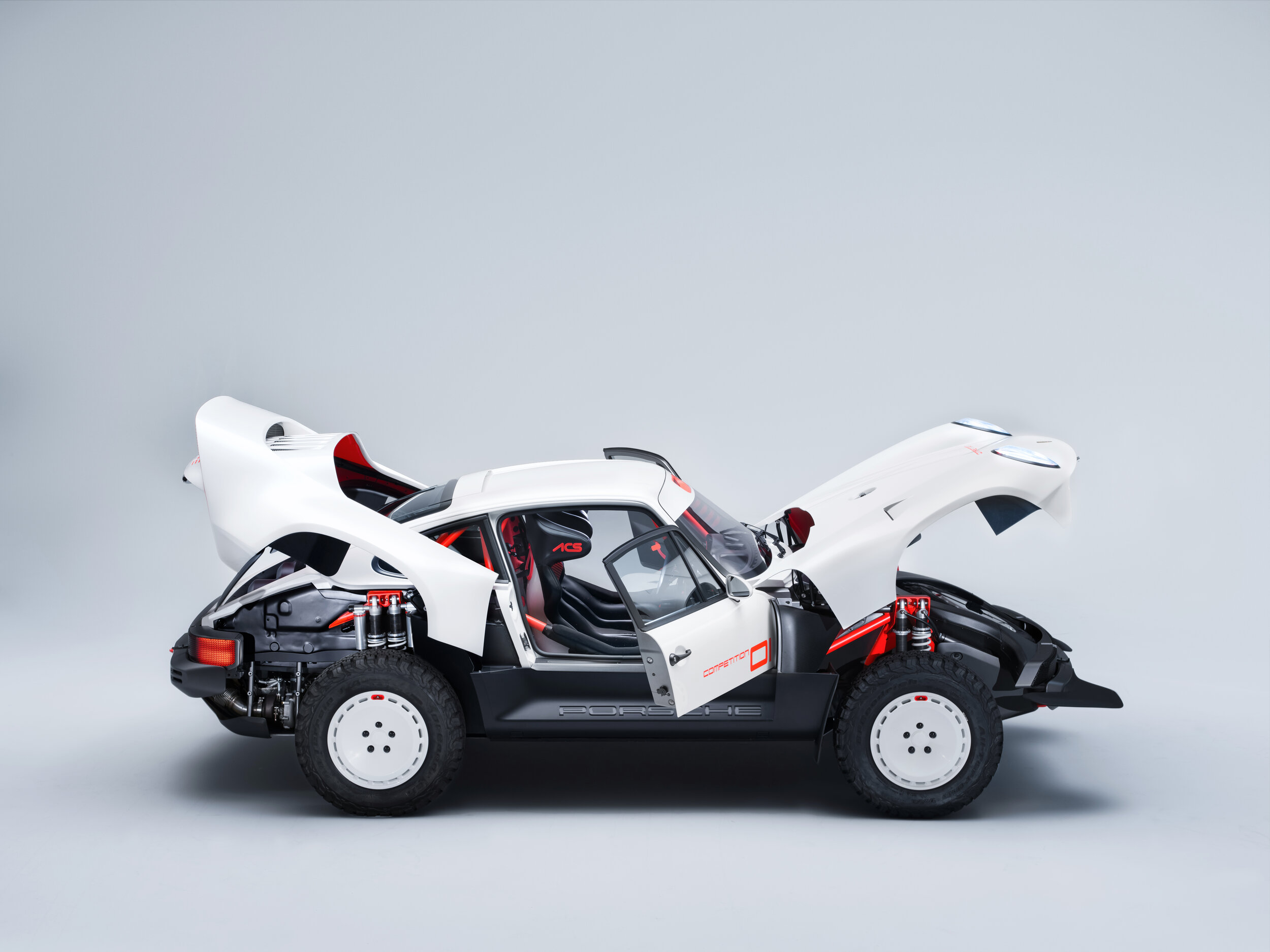
Forester_X_Sport Press Imagery 7.jpg

Subaru New Zealand, managing director  Wallis Dumper

“We have been running a just in time process for decades that has fostered strong customer service and expectations plus naturally held residual values.

“ Covid19 had potential to be devastating. It did have an immediate impact and ‘just in time’ potentially became ‘just too many’. Like everyone else, we predicted the market would slow or even stop due to Covid.

“We were wrong in that assumption. The impact was not as bad as envisaged after the initial lockdown was over.

 “But then the world impacts started to hit us via factory allocation shortages - so we have endured massive impact by other larger scale markets influence on the Japan factory supply.

“We have had months with not enough cars but now the good news is our new model launches in 2021 have been supported by a Subaru Corporation allocation promise. 

“Based on this allocation all we can do is plan accordingly and maximise any opportunity to secure any extra stock that might become available.

“We are optimistic that we will get what the factory have promised us thus our hope is to launch the new models, like our completely new Outback, successfully and be able to deliver what customers order.

“We will strive to hold our position as the No.11 distributor in the world for Subaru. Despite all the impacts Subaru in New Zealand with only five million Kiwis is still selling more Subarus than countries like the UK with 60 million.

“My guess is that there will be various model shortages from time to time in 2021 as a result of our scale which is simply not able to influence things like a downturn in massive scale markets impact on the factory production.

 “We even launched our hybrids e-Boxer models in the middle of the year despite lockdowns. We are fortunate that we go into 2021 with all models being of the  21MY model designation so that’s XV and Forester and Impreza and WRX, already arriving for 2021. 

“It is all looking okay and reality is that I think other brands might start copying our business model of having customers forward order their brand new vehicle in the specific model choice knowing its  … actually brand new fresh off the factory floor.

“Then we will start planning for 2022 as my guess is there will be more exciting All Wheel Drive Subaru models on the way and we will make sure we get a solid factory allocation for our loyal Kiwi customers and strive to keep all those Kiwis in our business and Subaru dealers nationwide employed too.”

DB2019AU00434_medium.jpg

Volkswagen NZ, general manager Greg Leet.

“The Volkswagen brand, like other vehicle manufactures, is experiencing supply constraints due to the impact of Covid-19 in Europe.

“Thankfully it is a very different situation here in NZ.

“We have been fortunate that the timing has coincided with the run out of the Golf and the launch of the all-new Golf 8 (expected to land in February). The same situation with Tiguan, as we run down the current model with the arrival of the new facelift in February.  

“Our German colleagues have managed the situation well and as a consequence we have picked up production of other models from other markets effected with further lockdown measures.  

“Supply matching demand is key to our brand, we have seen a re-set of the industry in 2020 with stocks in such short supply and I would predict manufacturers will focus heavily on this moving forward.  

“We are very thankful to our loyal Volkswagen customers who have been understanding of the stock limitations. 2021 is very looking very positive with new stock arriving and we are seeing a big appetite for these new models, with a large number of customers pre-registering their interest.

Motor Industry Association, chief executive David Crawford:

“Stock arriving now was ordered three to seven months ago.

 “Factors affecting supply are that markets are stronger now than when the vehicles were ordered, so demand has exceeded supply; that the source markets are still experiencing partial shut down at some factories (this disruption is reoccurring when outbreaks of Covid-19 occur in source markets) and that shipping capacity has been constrained, timeliness disrupted and so on. 

“I would expect to see this pattern continue until the vaccine takes hold and Covid-19 comes under control. It may take to the end of 2021 to settle down properly. 

“None of this is a surprise, apart from stronger NZ demand for cars. We predicted the current hiccups in supply back in April. 

“Stronger demand has come from the $4 billion Kiwis usually spend on overseas’ travel each year instead going on cars, bikes, boats, caravans, home renovations and so on.

Hyundai New Zealand offered a single sentence response: “Certain models have been affected at certain times due to the global ramification of COVID, thus reducing production supply, however we have had and continue to have a steady supply of stock coming in.”

BMW NZ, Mercedes Benz NZ and Kia Motors NZ declined opportunity to take part. Ateco NZ (Alfa Romeo, Fiat Chrysler, Jeep, RAM, Maserati), Mazda NZ and Volvo Cars NZ did not respond.