MINI JCW Cooper/Aceman electric: Big buzz babies
/Can these tot-sized titans live up to historic reputation without a petrol engine under the bonnet?

Prices: Cooper $72,990; Aceman $75,990.
Powertrain: Single synchronous motor, 170kW/340Nm standard mode (190kW/350Nm Boost; 200kW/356Nm launch mode); 54.2 kWh (49.8 usable) lithium ion battery, front drive.
How big: Cooper, 3858mm long, 1756mm wide, 1460mm tall; Aceman, 4079mm long; 1754mm wide; 1514mm tall.
We like: Electric integration suits their zippy style; expressive design; sharp handling; Aceman seems ‘just right’.
Not so much: Cooper’s ruinous ride; big stickers for small stuff; no home charger included; how good with simulated gears?
TRANSPLANTING the original internal combustion engine from an old classic car for an electric drivetrain is surefire way to ignite enthusiast opprobrium …. but engineer electric into a classic that though born in the same era has endured into modernity?
Well, that simply seems to be a totally prescient idea.
So much about what Brit-born, now BMW-owned MINI represents traces to when it was a fun-loving darling wild child of the Swinging Sixties. But electric is of this new age and, having dabbled with the previous generation Cooper, it’s time for full scale immersion.
That Cooper SE aimed primarily at efficiency, yet firmly related credibility as a fun drive. All the same, there always sense more could be done. Call up the the performance department.
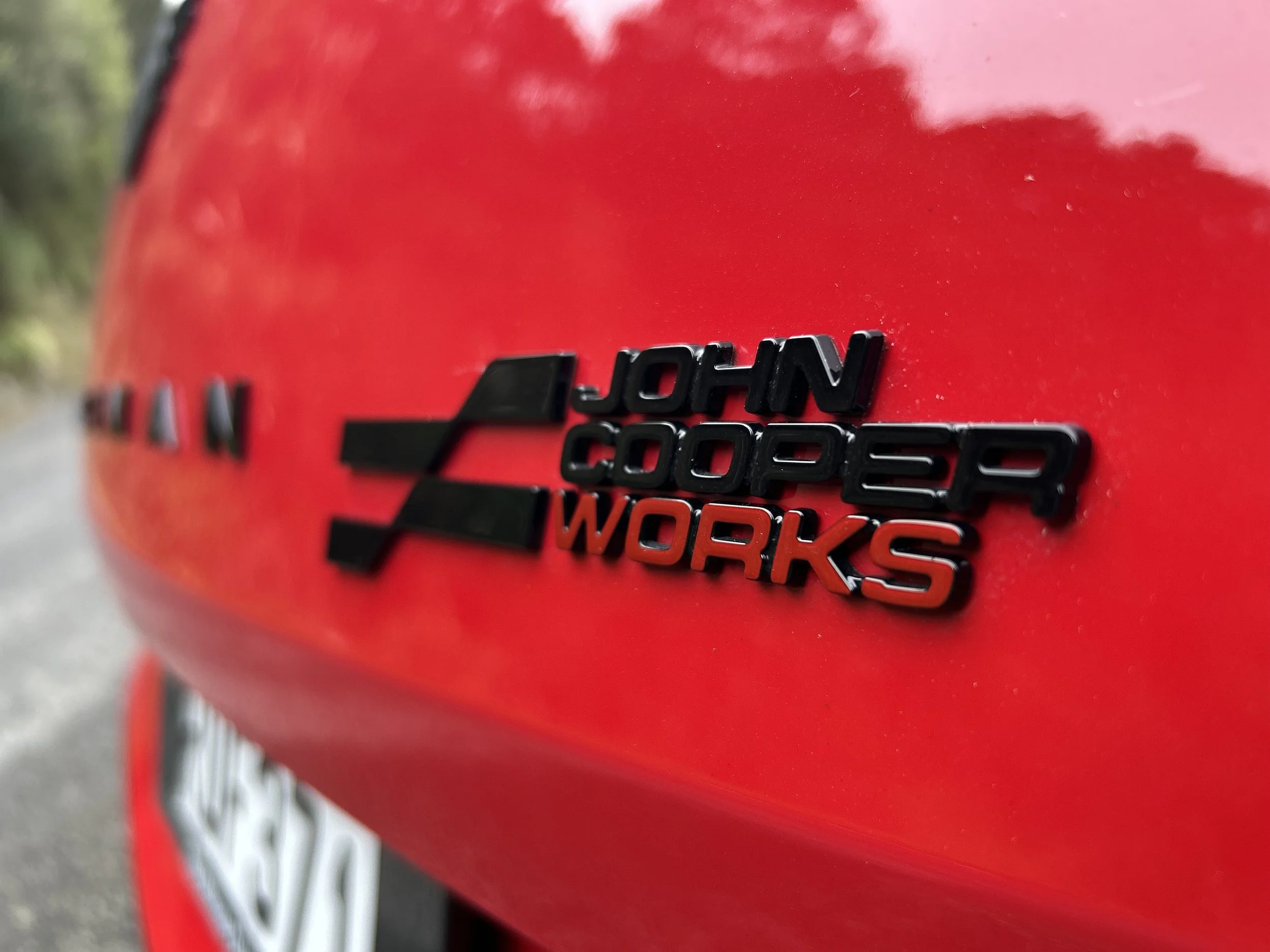
MINI's fabled John Cooper Works badging has long signified the most exciting and highest performing models in its line-up.
JCWs present a big leap up from the mainstream types, with more power, stiffer suspension and beefed up styling all there to make them the enthusiast's choice.
On paper and in look, the conjoined Cooper and Aceman JCW electrics fit the bill as tearaway tot titans, albeit not without the usual caveats.
If the price of going electric has seemed a barrier, then MINI only raises it. Fossil fuelled MINIs are cheaper and if your primary goals are proficiency and practicality, then the JCWs also wilt under comparison with other battery pure products of similar price.
BMW cares not for that argument. If want to buy more sensible, more functional in bigger presentations? Go for it. If you want genuine panache and pedigree? For those flavours, it feels it has a right to charge accordingly. Hence stickers that are best not shared until the potential buyer sits down first.
MINI production still maintains in Oxford, England, but just for the three-door. Otherwise ‘best of BMW British’ has hailed from Europe. Now there’s a new name and location for the Paddy Hopkirk Appreciation Society to get its head around.
Zhangjiagang is home of Great Wall Motor, a long-time partner in China. Now the brands have gone international, to build all BMW’s electrics, including the JCWs, save the Countryman, (which is ex-Dusseldorf).
While they may look very similar, with only small details – pop-out versus hand-through door handles, a traditional versus ‘clamshell’ bonnet – setting them apart at a glance, the petrol-powered MINI Cooper and the MINI Cooper Electric are different cars. The petrol continues the fundamentals of the previous-generation car, while the Electric is designed to be an EV from the ground up, so gets a fresh platform.
Notwithstanding that JCW cars have motorsport heritage to uphold, sub-Countryman-sized Minis are at admirable everyday best as city cars. The previous electric excelled in that role, plus it rally didn’t have to range to do much else anyway.
Respective WLTP-cited ranges of 371 (Cooper) and 355 kilometres (Aceman) out of a 54.2kWh battery pack, with 49.2kWh of usable energy, translated to 300km-ish real world on test. Not enough, really, for prolonged adventures but understandable.
A comparatively short range is unavoidable when effort is being made to keep the weight of the car down, and its costs, and also as a direct result of packaging constraints in a vehicle which is compact; Aceman at 4.07 metres is obviously longer than the absolutely truncated - to point the rear wheels appear to hang off the back - 3.85m Cooper.
Probability these might well drain out well before the internal combustion JCW could empty its own tank in a track day scenario is moot when NZ circuit admins presently pretty much make their venues no-go zones for electric.
But it reminds that if out to have fun on a wending sealed country road - the sort that would, in state of closure, make an excellent rally stage - you’d not want to stay too far from a public charger. Preferably one grunty enough to maximise the 95kW DC peak, which allows for a 10-80 percent top-up in just 31 minutes. (Against at least half a day on the AC connection, which you’ll have to sort, as these cars lack home chargers).
Hoof it hard and there’s certainly fun to be had. Back in the late Fifties, the story goes that the engineers behind the original British Mini proposed to Austin company chairman Leonard Lord that a faster version should be introduced with a 950cc engine and a top speed of 90mph (144kmh). He declared it excessive, limiting production versions to a far more sensible 75mph (120kmh).
What on earth then, might he have made of electrics with substantially more on-paper power and torque than any factory spec petrol special has ever had. These are not the fastest ever, due to top speeds capping at 200kmh, but assuredly they seem eager to get there ASAP.
Claim to hit 100kmh from a standing start in 5.9 seconds makes the Cooper JCW electric two tenths quicker than the Cooper JCW petrol. With 90kg more to heft, the Aceman is half a second behind, but nearly a second quicker than the next quickest Aceman. And when they are on the roll, there is plenty of punch left to explore; to point they feel more than slightly unhinged.
The powertrain always feels responsive regardless of drive setting, but optimal on-the move power requires trying out something new for JCW. Boost function is a fun little red-coloured paddle on the left hand side of the steering wheel, active only when you’re in John Cooper Works mode. It unleashes an additional 20kW and 10Nm for 10 seconds (there’s a countdown clock). The car’s absolutely full grunt of 200kW and 356Nm is reserved for eLaunch mode. Poor tyres.
Battery burden shows in the electrics kerb counts. You’re aware of how much weight is being pitched around, but if anything the lower centre of gravity improves that grippy, go-kart feeling MINI always bangs on about.
Both deliver fine, nicely weighted steering, with that typical slightly-heavier-than-normal feel that is a signature of sporty MINIs, and the brakes are superb. You can dare to be quite brave in entering corners and enjoying a level of competence that anyone time-warping out of an original JCW from British Motor Corporation days simply wouldn't believe possible.
As always, JCW uses bespoke springs and dampers. This time it’s brought more negative camber on the front wheels, to accentuate that natural keenness to point you into corners. It also fits low-profile performance tyres, the Cooper enjoying the standard fare 18 inch choice while this Aceman was on optional 19s.
Both cars are firm, but one far more tolerably than the other. Aceman having having longer suspension travel seems to allow semblance of fluidity absent from the Cooper. It was genuinely shocking how unsettled, nervous and frenetic the smaller car was. You expect liveliness, but it’s stupidly harsh. On surfaces that might have raised a jiggle from Aceman, the three-door was a bouncing, jostling mess. It just never calmed down.
Being so busy all the time hardly helps when you’ve this much power at easy call. Torque steer is a reality easier contained in the larger car. Deploying hefty acceleration on a heavily cambered road in the Cooper was risky.
Both also had traction issues if accelerated sharply from low speeds. A form of electronic limited-slip differential could resolve that, but the JCW doesn't have such a thing.
As much as the electrics feel faster, and more reactive, you do have to accept they simply aren’t as hands on as the petrol types. Those were always all about thrashing the engine, working the gearbox; keeping everything on song, not just figuratively but also aurally.
The electrics are much easier to bring up to pace and it’s still all point, squirt and brake. But there’s far less manual intervention; your feet can be busy but your hands are often not.
Going electric means saying goodbye to old school snap-crackle-pop; and there’s no denying that is going to spit opinion. The distinctive note and feel of an engine can contribute heavily to the overall emotional connection a driver feels with a vehicle.
There’s been so much study into how auditory and neurological responses to engine sounds can shape subjective preferences.The electric JCWs aren’t anodyne, but if you tend to judge wholly on acoustic characteristics, or lack of them, they don’t stand up well.
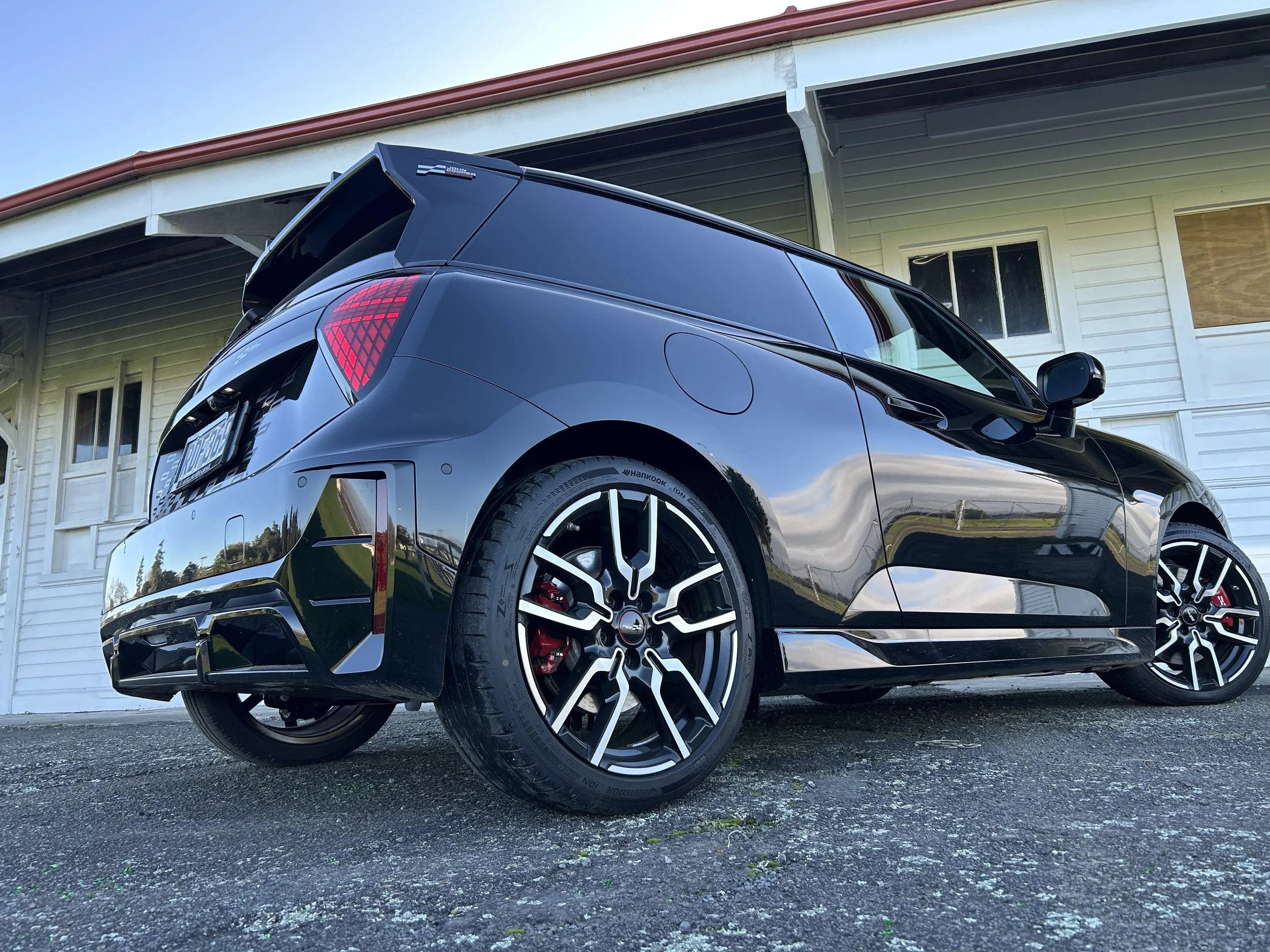
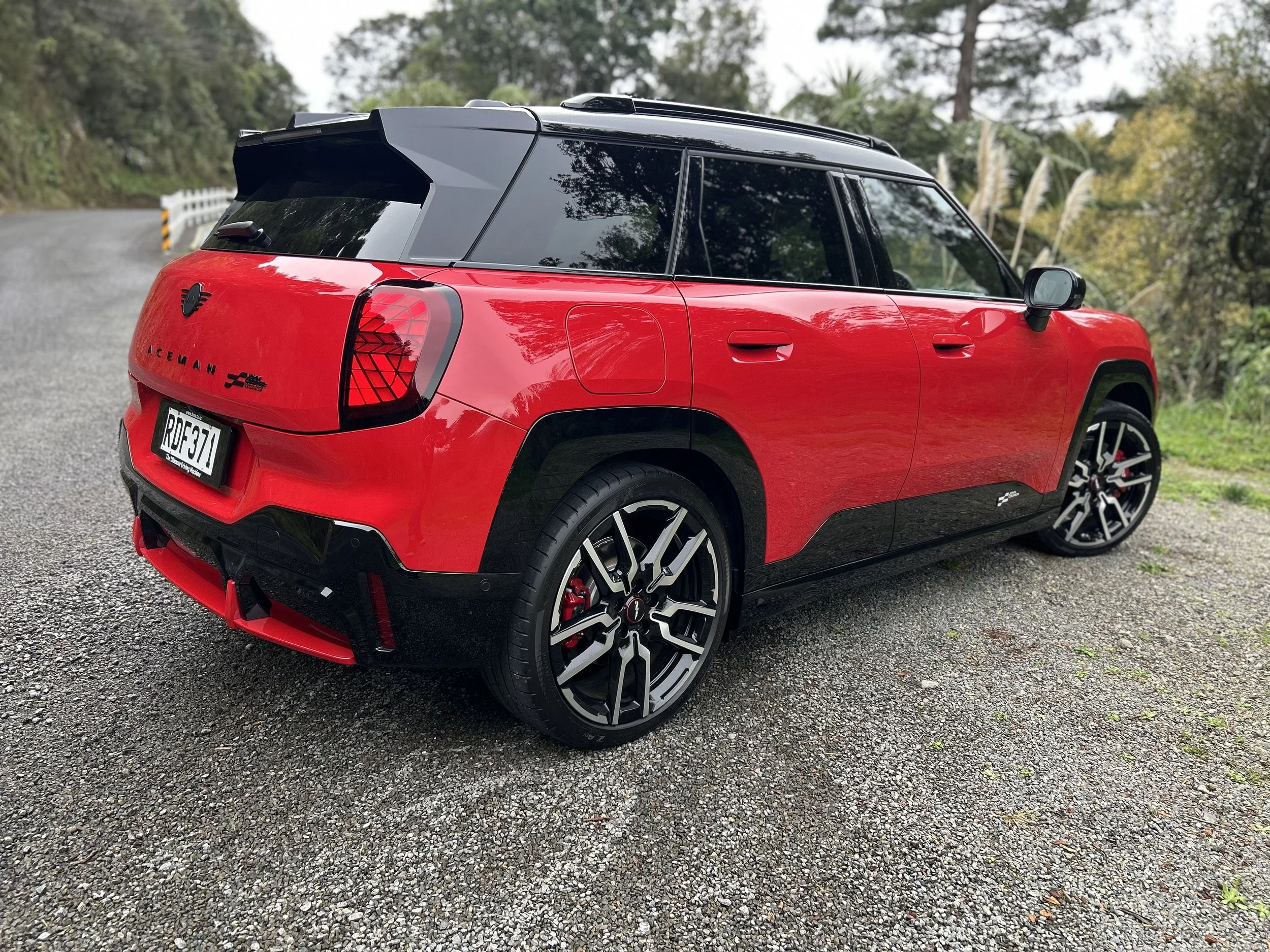
Visually, of course, they play equally. BMW some years ago decided on uber-exploiting every possible Swinging Sixties’ thematic relevant to this car and that ideal is still being pushed to the max here. Gotta dig those triangular Union Jack tail-light clusters, right?
Aceman’s commitment to the brand’s evolutionary retro-inspired styling is as fulsome as Cooper’s. Smoother shaping is the big change now; it looks fine on the three-door but really suits the larger model, and might accentuate sense that it is proportionally just right.
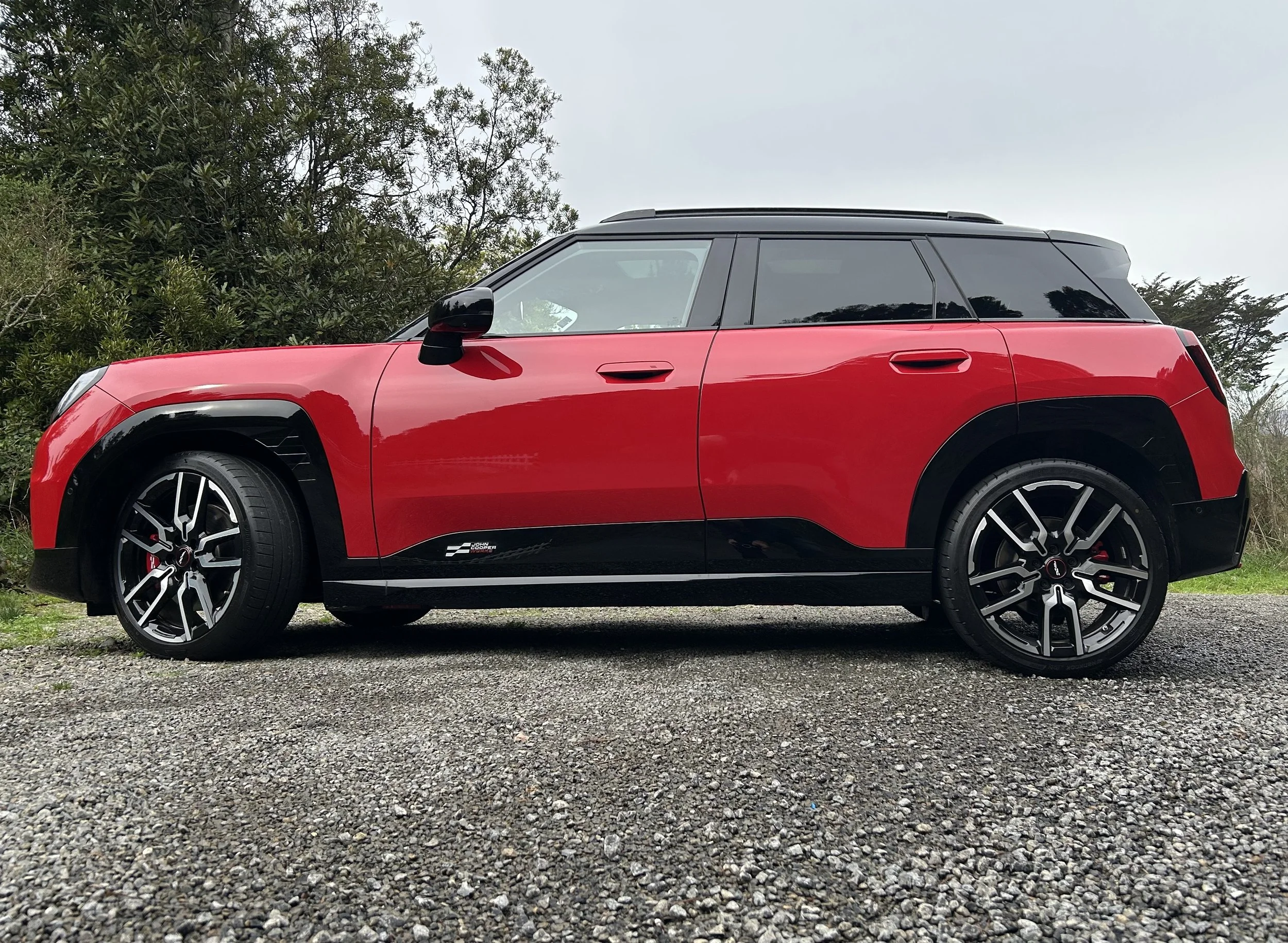
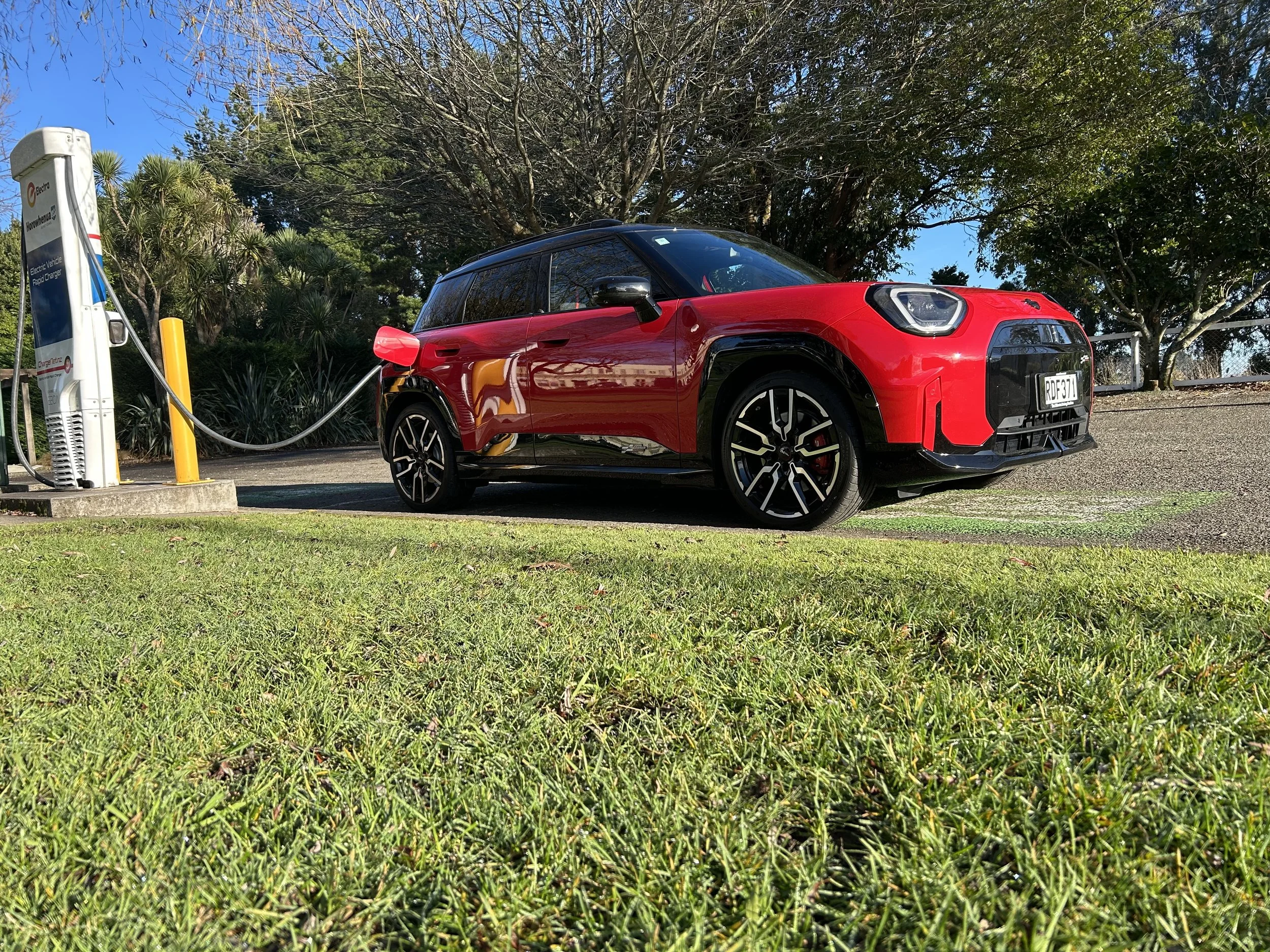
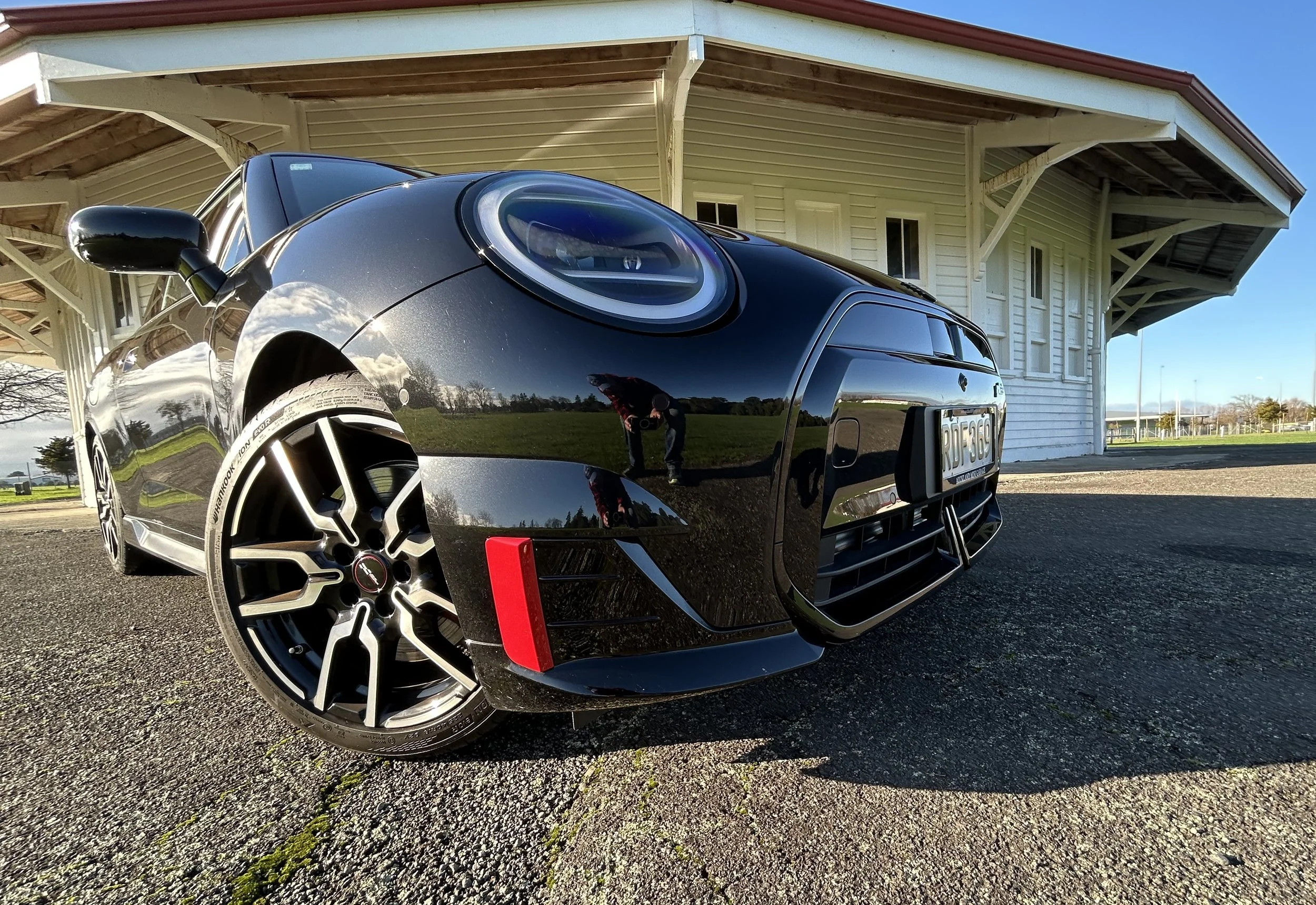
JCWs are easily identified; meatier front and rear bumpers, enlarged side skirts, gloss-black exterior trim, red highlights (including on the brake callipers), LED headlights, aerodynamically optimised 18-inch alloy wheels and an aeroblades-and-spoiler combination sitting atop the tailgates.
The red, white and black JCW logo places on this, the front bumper and rear hatch badging strip. Plus there are bespoke body colours - Chili Red II was stunning on the Aceman - teamed with a contrast roof.
JCW-specific touches inside include sports seats with a black upholstery offset by red stitching are reflected by the chunky steering wheel, again rendered with red stitching and also a red 12 o'clock marker, plus a smattering of further JCW emblems inside, such as on the base of the steering wheel and on the door sills.
Kit runs to connected and nav-enabled infotainment with wireless Apple CarPlay and Android Auto functionality, a Harman Kardon uprated surround-sound system, dual-zone climate control, wireless smartphone charging, Comfort Access (keyless entry/exit and go), heated front seats - which are sports-style buckets - and a heated steering wheel, a head up display plus a healthy roster of advanced driver assistance systems to promote safety.
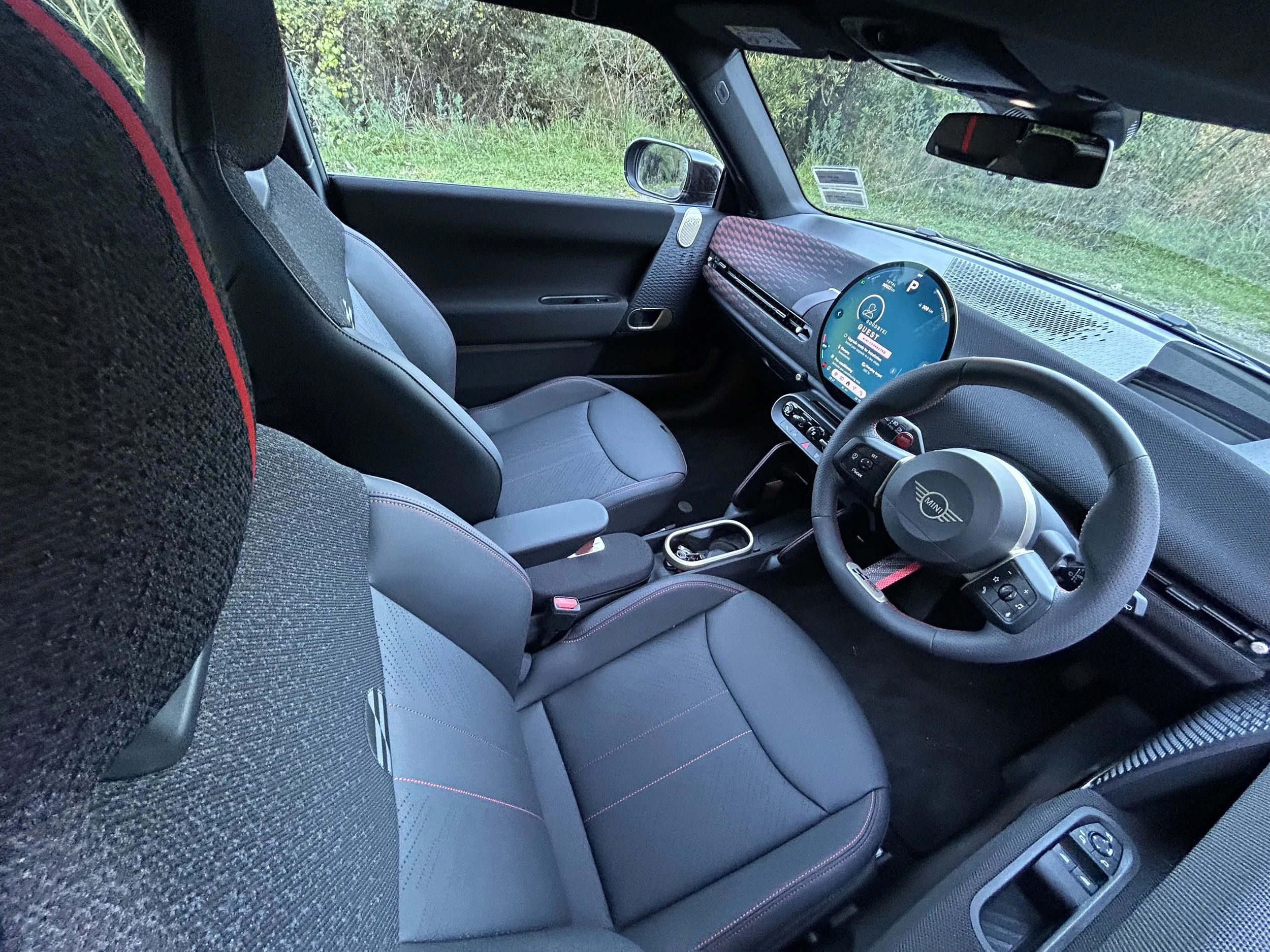
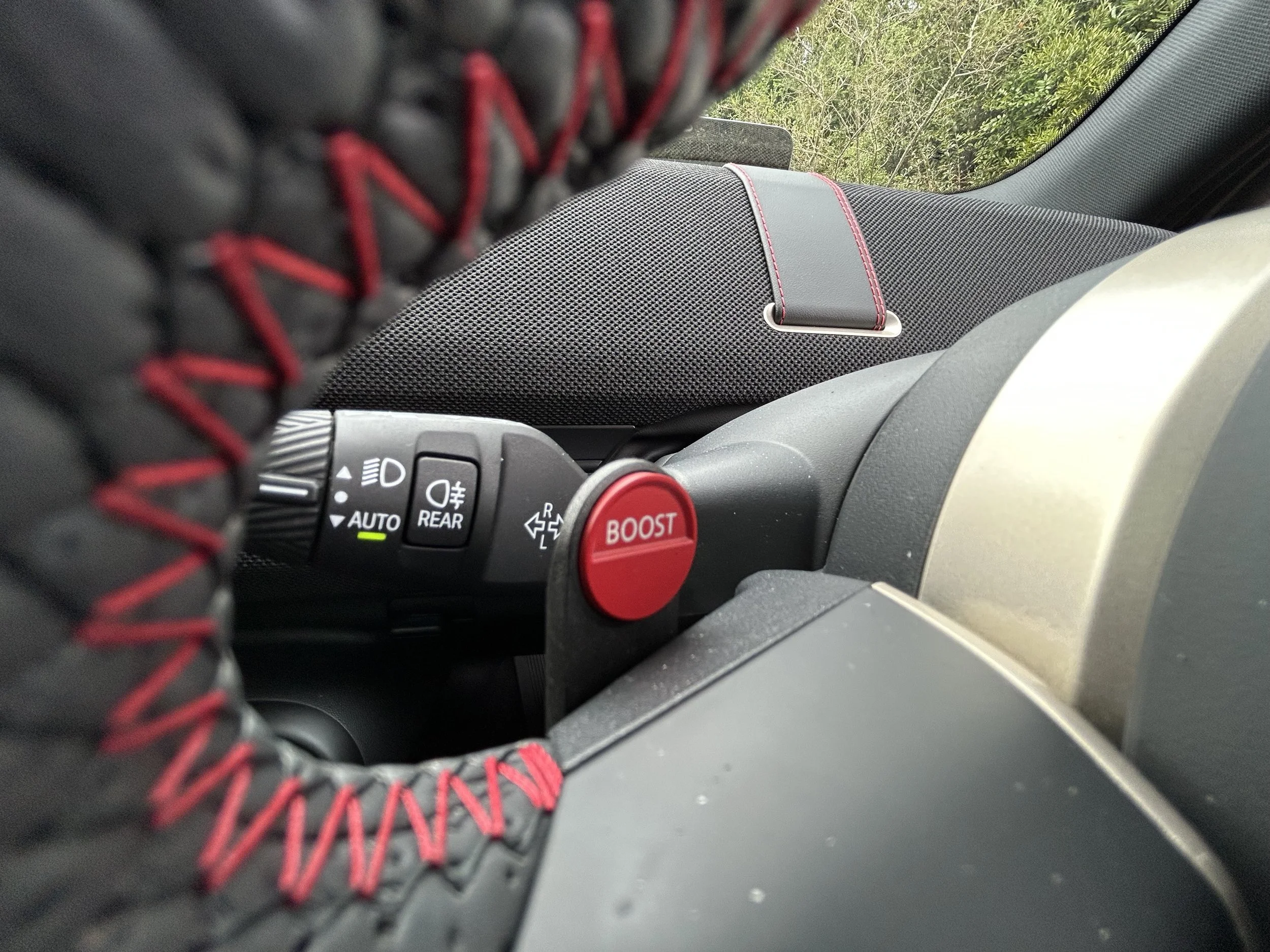
Both cars deliver a high-quality place to have to spend some time, Aceman having an edge with a slightly higher driving position and slightly more shapely seats.
In either, extreme design expression is at full noise. A colleague’s ‘bouquet of idiosyncrasy’ descriptive nails this environment.
Material choices are confident and bold; everything is highly stylised and most of all, if you’re not having fun straight away, it’ll do everything it can to brighten your mood. It’s like the automotive equivalent of an impossibly cheery life coach; you’re either going to be won over or worn down.
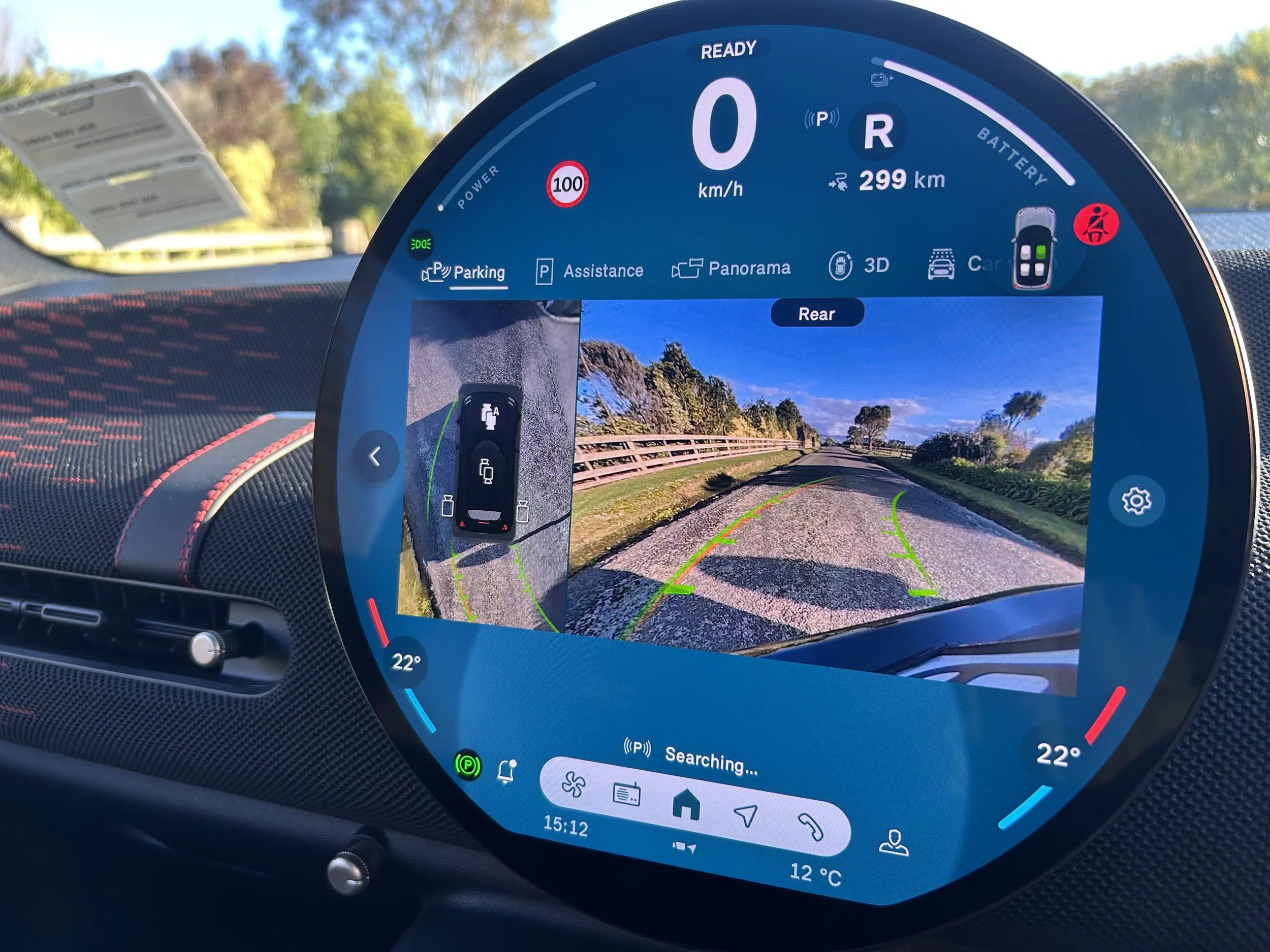
But if supercilious, it is very stylish and generally cleverly done. The 24cm (think dinner plate-sized) circular infotainment screen has long been a MINI thing. As a high-quality OLEOD that is bright and clear it is also very much a portal for nearly everything, including the heating controls, closely related to BMW’s iDrive and yet going its own way for operability and look.
The idea of making interfacing with the audio, navigation, communication and app systems more intuitive is solid, and if you’re daunted, dig into the menus and an icon marked ‘welcome’. This activates a fast-paced animation in which ‘infotainment mascot’ Spike the dog takes you through a system 101. Prepare to adjust the volume; the funky soundtrack is loud. One onboard mystery spanning both cars that remains unresolved is why my phone connection had to be completely re-established on each fresh drive.
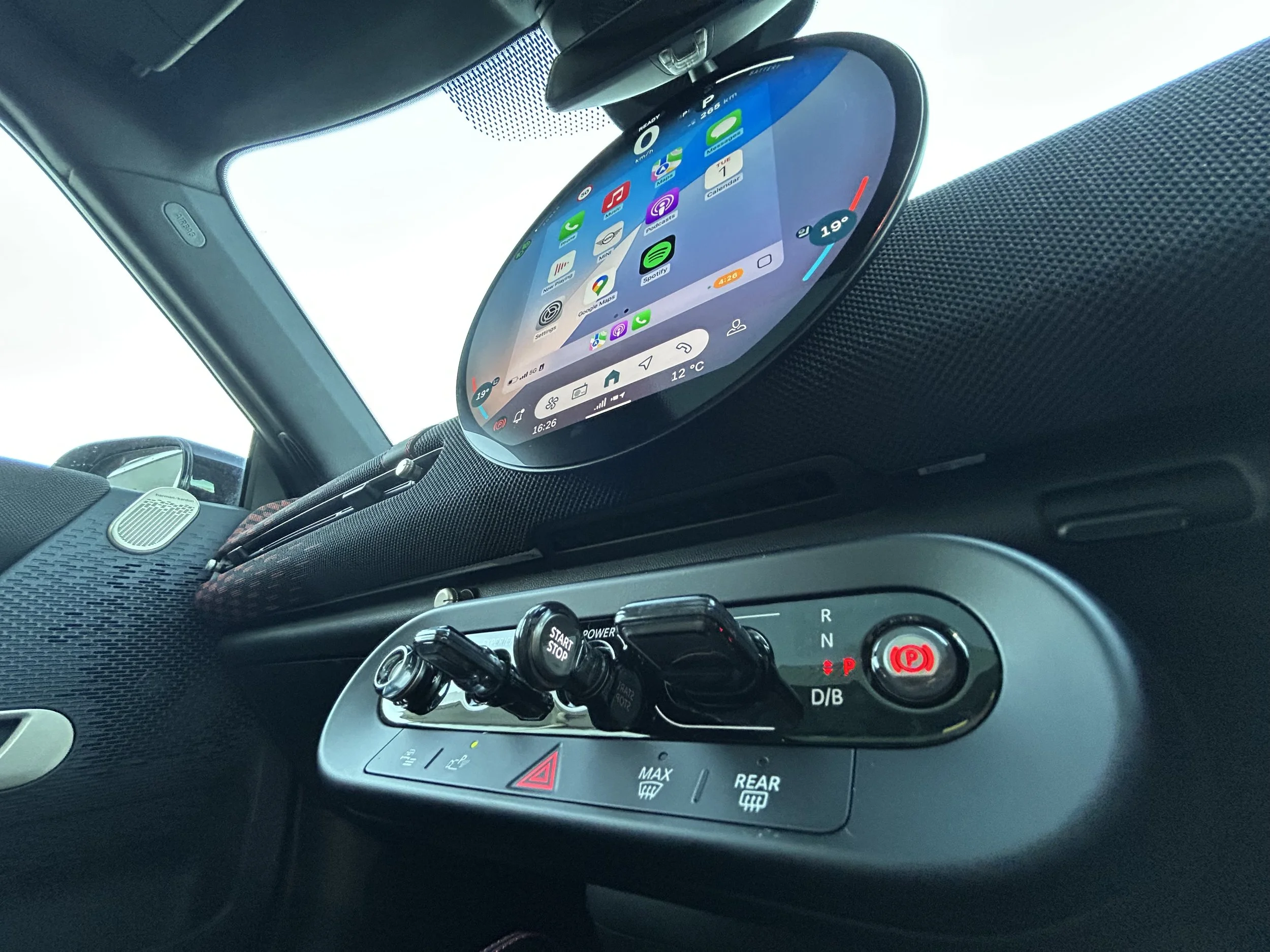
A car that went all Cessna-esque previously with banks of switches - some even directly above - now a much cleaner layout in which core functionality rests with three main click-around controllers. One for ignition, another to engage Drive, Reverse and Neutral (with a button for Park alongside) and the third, Experiences, accessing the drive modes and cabin ambiences.
In respect to the drive affecting functions, Core is the factory default and ‘Green’ - which animates either a hummingbird or cheetah on the screen depending on how efficiently (or otherwise) you’re driving - and JCW, which used to be called Go-Kart and engages with a ‘wahooo!’, are the extremes. There’s also a Trail setting, which suggests some degree of off-road beyond anything you’d conceivably ever consider prudent, given how obviously seal-oriented they are.
Aceman’s other, erm … ace … is that it makes a truly reasonable stab at accomodating four adults.
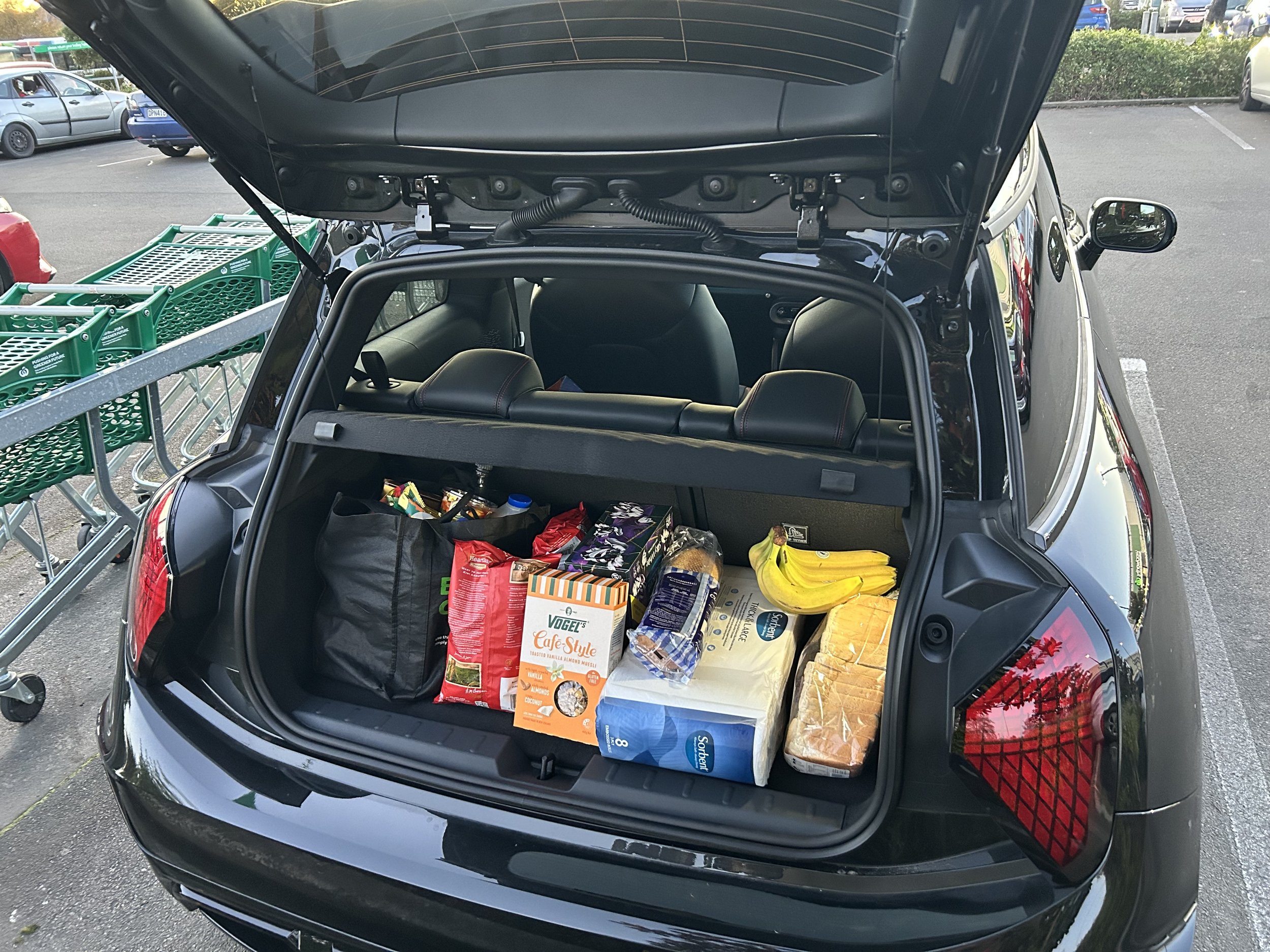
It’s still a very compact car and no wider than the Cooper, but that 221mm extra length and 54mm additional height at least allow it to offer some level of rear leg and headroom. The limited access to the Cooper’s back seats will make it a pain for the school run and other family errands. It's best to only think of that area as somewhere to throw a bag, perhaps when the boot is full, which won’t take much: It offers but 210 litres’ capacity (rising to 800 litres seats down). Groceries for a day did it for us.
Aceman’s compartment is only 90 litres’ larger, though seats folded is a stronger 1001, but what also helps is it being more conveniently shaped. Again, though, it’s not the car to take for a splurge at Bunnings.
‘German’ MINI has been much more successful commercially than BMC’s original ever managed; a lot of is down to it reaching further. Going electric at JCW is example of that.
With Aceman, it’s the only way to go; there is no internal combustion alternate, but that’s okay.
It has feel of an accomplished product, one lending vibrant zip and zap in convenient and good-looking package. It looks good, is beautifully-presented, creates a new niche and surely has a solid future.
The Cooper is the the car you could simply not imagine MINI ever being without. An unremittingly concrete ride is an impediment it didn’t need, but conceivably the other issue it faces is having a petrol twin that has a higher top speed, is powered by a highly characterful engine and is up to $7000 cheaper. That difference still buys a lot of fuel. And as much fun.