
NZ on fast track for Volvo’s smartest EV
/The brand whose name means “I roll’ in Latin is picking up the pace here - and the EX60 is expected to hasten its ascendance.
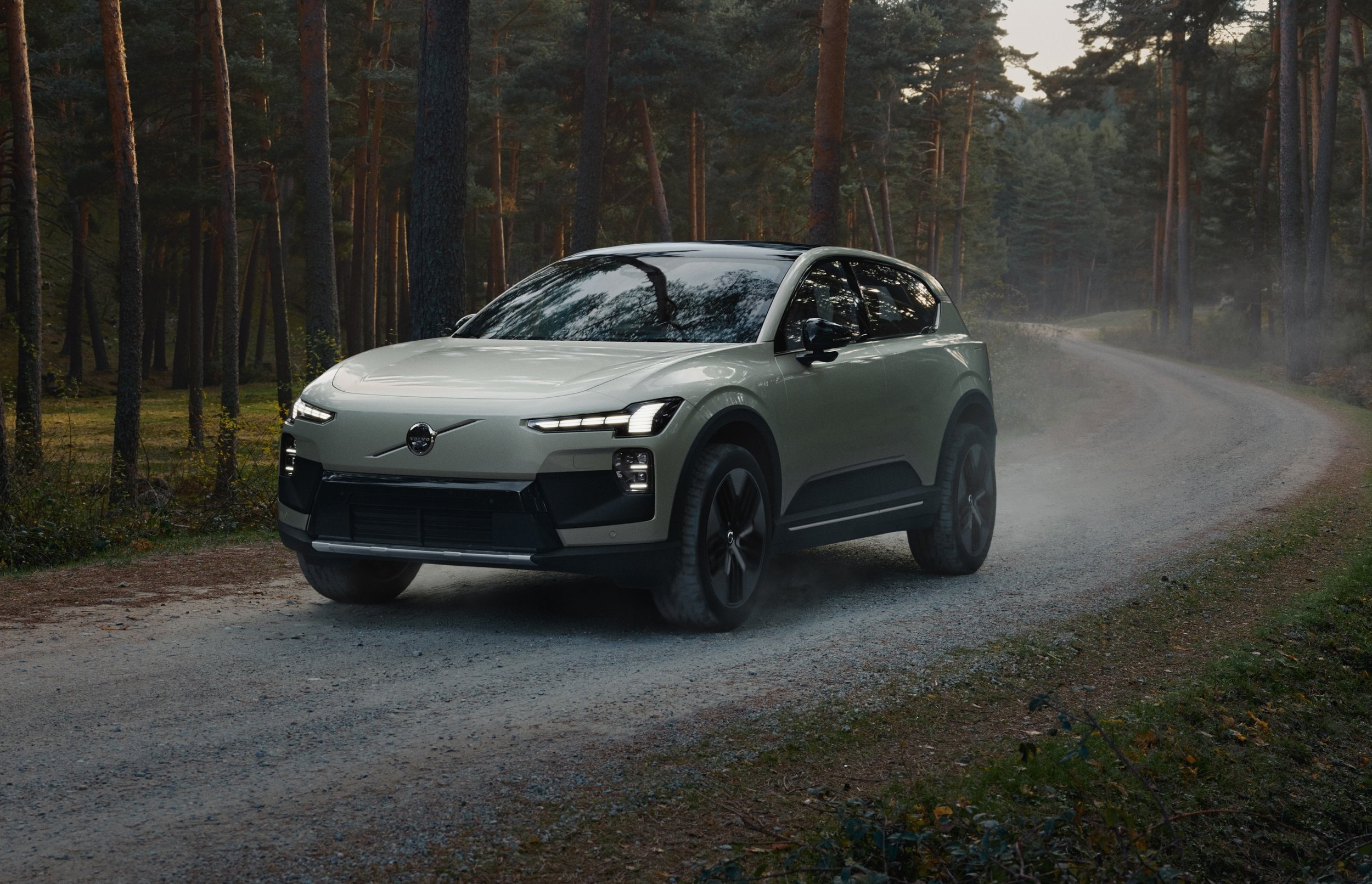
PLANNED late year availability here of Volvo’s next full electric, the world’s first true software-defined car, suggests New Zealand will be among very first export recipients - and the distributor couldn’t be happier.
As much as Volvo New Zealand is excited to launch the EX90, a large seven seat luxury electric SUV available from today, it sees the smaller sister EX60 coming around November being all the more important for volume.
The Geely-owned make’s head office is also enthused about the car’s potential - hence why its arrival timing for here is effectively 12 months ahead of the usual regional schedule.
Included in the EX60 pitch, but likely not to be seen until early 2027, is a special family star with higher standing.
Volvo’s Cross Country model lineage spans a succession of station wagons, but the EX60 variant (above) using that famous product designation is expected to really fire up Kiwis.
While the EX60 Cross Country could become a specific winner, enthusiasm for the entire EX60 family, which only unveiled in January, is strong.
The car is built on a new architecture aimed at making the vehicle a continuously evolving, intelligent platform. It transcends current tech in combining centralised computing, AI integration and over the air capabilities in a single production model.

That level of tech edge is why the local brand, part of the Giltrap Group’s Nord East operation, is confident of being a stronger force within the premium end of the EV sector, which in general has taken a hammering since start of 2024.
They say consumers are attracted by latest electric fare having price parity with internal combustion equivalents. Impact recent and potentially ongoing political issues elsewhere is having on fossil fuel prices here might also sway interest, but Volvo NZ is wary of mentioning that as a factor.
“People are considering electric because they want it and they see that price is no longer a barrier,” says Volvo Cars NZ brand manager Daile Stephens (below).
The full local line-up for EX60 has yet to be sorted, and pricing isn’t settled, but internationally the medium five-seater is setting its sights on the latest generation of premium electric SUVs, the BMW iX3 and Mercedes-Benz GLC included.
It and the next-size up, seven seater EX90, which media drove from Auckland to the Bay of Islands today, are respectively electric equivalents of the XC60 and XC90 fossil fuel-reliant sports utilities that have become the backbone cars for the Sino-Swede make and will continue.

As much as its internal combustion offers - the refreshed XC60 and XC90 and the all-wheel-drive XC40 that returned last year - have been been fundamental to growth for Volvo here, the electrics are set to become increasingly important.
Stephens is heralding the EX60 being a “step change” for the brand and wholly feeds intent to establish Volvo as a leader in premium electric mobility, a sector showing promise.
The make’s all-wheel-drive SUVs are particularly positioned to do well; the demand for those products is climbing “and continues to grow.”
“We are well positioned for the NZ market. Essentially we play in the right segments. EX60 and EX90 are new products entering growing segment …
“In 2024 we played in 61 percent of the market … and we weren’t competitive across the entire premium SUV market.
“In 2025 we saw improvement, but with EX90 and EX60 we are going to play in 88 percent of that market, which obviously gives us much more opportunity.”
She says that with sales growth of more than 40 percent in 2025 and by more than 45 percent year to date, growth is no longer an aspiration for the Volvo brand here “it’s our trajectory.”
The new electrics are closely matched to the comparable internal combustion fare in size and set out to be just as appealing for comfort, specification, plus also performance and even range, with up to 810 kilometres’ claimed for the EX60.
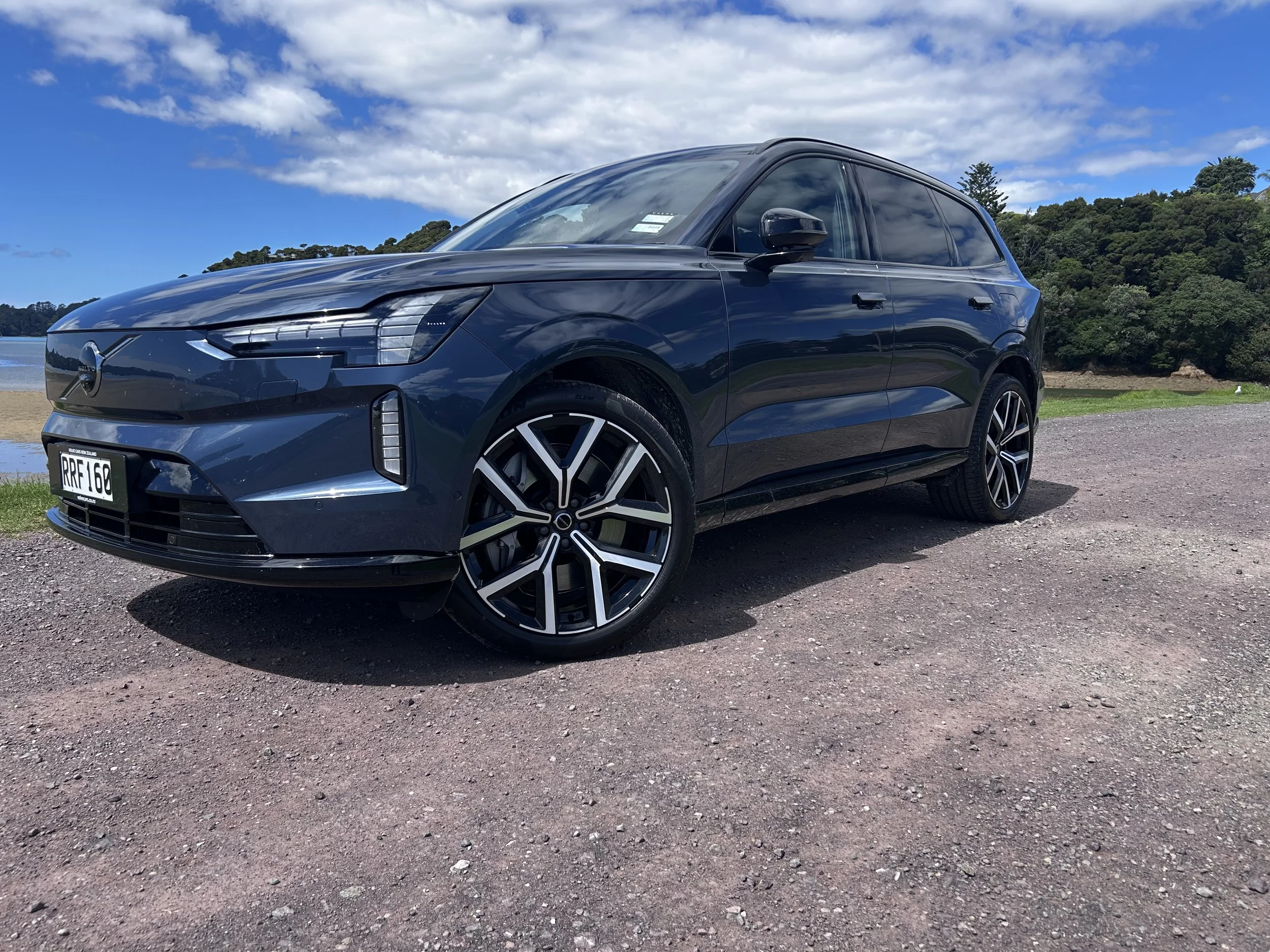
EX90 is here in Twin Motor editions, in $149,990 Plus and $159,990 Ultra (above) formats, proposing as the market’s only full-sized premium wholly electric seven-seater now that the much pricier Mercedes Benz EQS has dropped out. There are no volume predictions, but it is expected to win attention.
The medium sector in which EX60 will place is the most popular SUV segment, and while overall EV sales have not been brilliant since 2023 - they only account for 6.5 percent of overall NZ registrations - the premium medium-SUV segment is 50 percent electric. So EX60 can potentially can be a big sales builder.
Overseas’ media reports suggests production out of the new factory in Torslanda, Sweden, is slated to begin only relatively shortly before NZ stands first chance of seeing the car.
It avails in three powertrain options - called P6, P10 and P12, each with different battery and motor performance.
All versions will be initially offered in Plus or Ultra specifications.
A more affordable Core equipment grade might well be added to the range at a later date, though that has not been the case with EX90, as with that Core comes as rear drive.
Sentiment is that Kiwi buyers simply prefer high specification cars and are also now box-ticking all-wheel-drive whenever possible.
The Cross Country is the ultimate example. It has a wider track, 20mm increased ride height and air suspension that lifts the car a further 20mm when needed.
It also looks the part with contrasting black panels and embossed 'Cross Country' lettering, along with robust stainless steel skid plates. Along the sides, there is additional black plastic cladding, and the C-pillar includes a stainless-steel Cross Country nameplate.
The EX60’s 'SPA3' platform architecture is a significant step beyond the SPA2 underpinning used by the EX90 (and Polestar 2). Both feature an 800V system for faster charging, advanced Nvidia computing, and software defined architecture for over-the-air updates.
SPA3 uses 'mega casting' production methods for the first time to reduce complexity and boost interior space.
Integral to the EX60 being able to achieve a long driving range is its aerodynamics. There are numerous minute details that contribute to a low drag figure including the small tabs on the tops of the door that act as the door release. A short roof spoiler at the rear also forms part of the aero package.
EX60 runs an entirely new and redesigned infotainment system that's powered by the latest Qualcomm 8255 CPU. Volvoe promises the kind of processing power that ought to future-proof the car. In addition to Google Maps, it also has Google's Gemini AI technology baked in, which is said to provide a more conversational digital assistant.
The EX60 is the first model to use Volvo's multi-adaptive safety belt. It works in conjunction with seat sensors and a cabin-facing camera to determine how each seat belt should react in an accident.
A cell-to-body construction for the batteries is said to contribute to a 20 percent weight reduction compared to previous electric Volvos. This approach also results in a 37 percent lower CO2 footprint, according to Volvo.
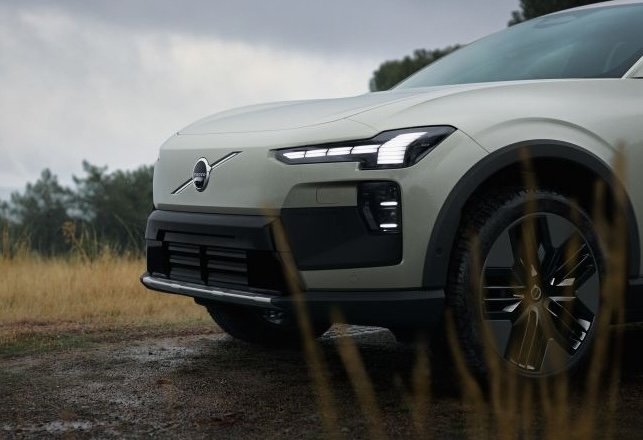
The international line kicks in with a EX60 P6, the only single-motor variant of the line-up and uses an 80kWh battery paired with a 278kW electric motor that generates up to 480Nm of torque.
It can accelerate from 0-100kmh in 5.9 seconds and is fitted with passive suspension. A WLTP combined range of 620 kilometres is claimed and it has a peak 320kW DC charging rate.
The P10 is the first of two dual-motor, all-wheel-drive powertrains and it also comes equipped with adaptive suspension. It uses a 91kWh battery to provide a WLTP driving range of 660 kilometres. Peak outputs of 380kW and 710Nm of torque avail, accelerating the car to 100kmh from rest in 4.6 seconds. The P10 is the basis for the Cross Country, which clocks 100kmh from a standing start in on 4.7 seconds.
Topping the range is the P12 AWD, which gets a 112kWh battery and maximum outputs of 507kW and 790Nm, resulting in acceleration from 0-100kmh in 3.9 seconds - while the WLTP range is 810 kilometres.
P10 and P12 are capable of charging at up to 370kW on DC power, which, in optimum conditions, can add 340 kilometres of driving range in 10 minutes. There will be 22kW AC charging, and the option of bi-directional charging.