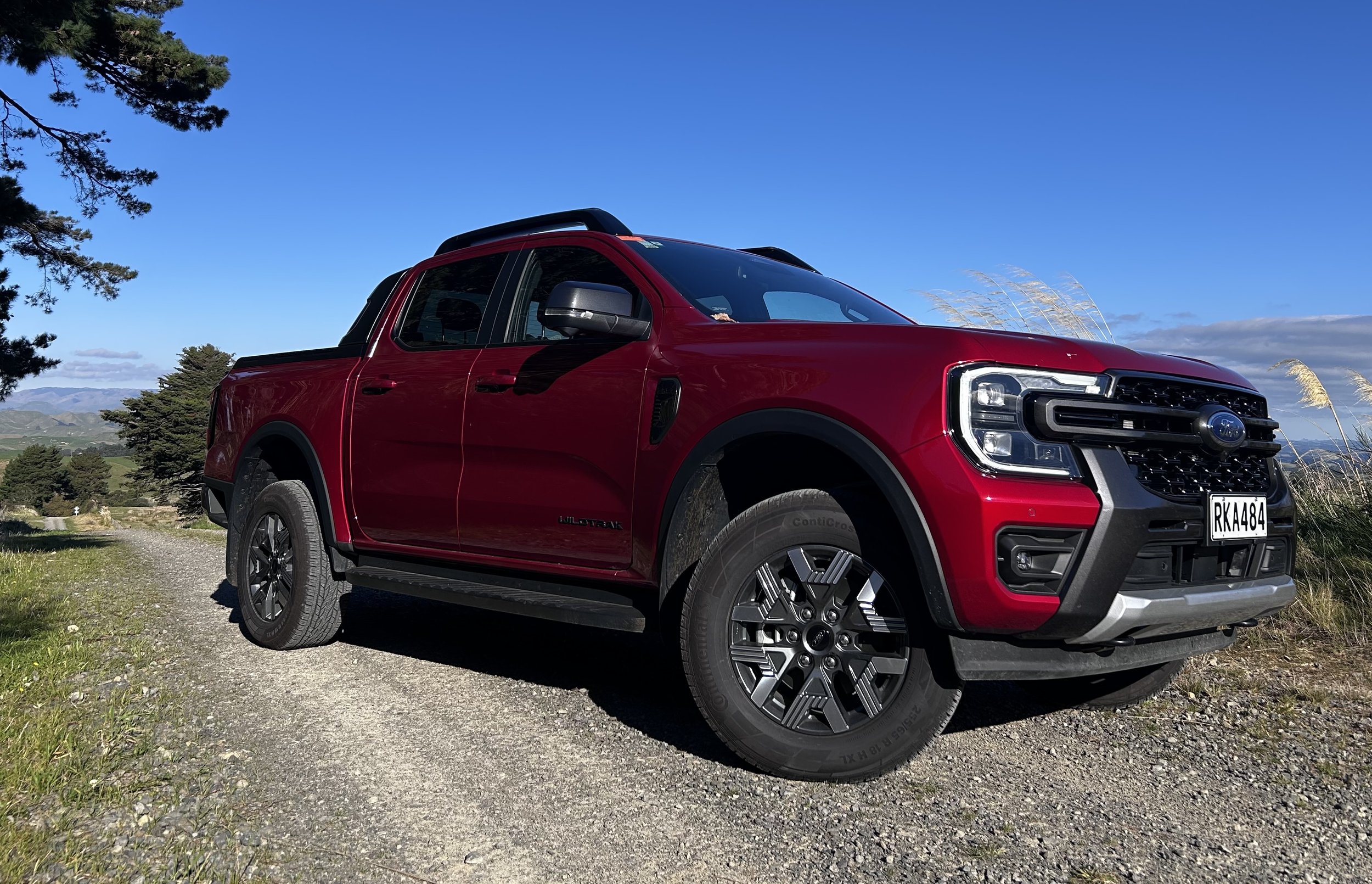
Ioniq brand delights Hyundai NZ

The Ioniq car has become an EV brand – but Hyundai-badged electrics are also set to keep coming out.

IONIQ Brand_2.jpg

THE answer is yes – it’s just the arrival timing that remains uncertain.

That’s Hyundai New Zealand’s response to the parent brand’s determination to turn a model name into a full-blown electric vehicle sub-brand, while continuing to produce EVs with Hyundai badges as well. 

The Auckland-based operation is hugely enthusiastic about the potentials that Ioniq will bring and is excited by Hyundai Motor’s intent to release three new models, each identified by a numerical designation.

It further affirms it is fully on board with the South Korean giant’s intent to fast-track its strategy of becoming a global giant of EV-dom, in part because Kiwi enthusiasm for battery-driven products is strong and continues to climb, and has expressed its desire to offer every Ioniq model that is made available in right-hand drive.

However, at the moment it knows too little detail to say when and how it will involve.

So even though the make has vowed to deliver the first of this new breed, the Ioniq 5 - a crossover SUV inspired by the 45 concept car (below) from the 2019 Frankfurt motor show – within 12 months, the local operation says it cannot yet offer specific comment about whether this means that car will avail locally in 2021, simply because it’ll be in production by then. 

Hyundai 45.jpg

Company public relations manager Kimberley Waters says there’s optimism more information will come out soon.

“At the moment, though, we just cannot offer any specific comment about when product might be available to us. We just don’t know that yet.

“However, yes, we have made a commitment to electric so are keen to see these products. The potential they offer is obvious.

“With Hyundai Motors commitment to developing a dedicated EV range with the customer experience in mind, it in turn will enable us to provide our customers with more EV choice that suits their Kiwi lifestyle.”

In making the branding announcement that could not have come as a surprise to anyone, Hyundai Motor released images here that lend suggestion to what its immediate fleet of three vehicles could look like.

The suggestion is that these will be in showrooms by 2025, or perhaps even a year earlier.

The model identification strategy is simple, if rather BMW-esque. All Ioniqs will be identified by numerical badges - even numbers for sedans, wagons and sports cars, and odd numbers for SUVs. Ioniq, by the way, is a fusion between “ion” and “unique”.

The cars will place on an all-new electric-vehicle underpinning, called the Electric Global Modular Platform. This brings up to 800 volt fast charging, long-range driving, spacious packaging ability, and new-age connected technologies, Hyundai Motor says.

prophecyesterior_2.JPG

The international roll-out time frame suggested by head office is for the ‘5’ to be followed in 2022 by the Ioniq 6, which is styled with lines and inspiration of the Prophecy concept electric sports sedan, above. The Ioniq 7 SUV is expected to go into production in 2024.

Exactly how Ioniq will present is another issue for Hyundai NZ to address.

The tenor of head office comment suggests expectation that this branding exercise is expected to stand apart from the Hyundai push, just as the Genesis luxury brand was intended to.

Whether that means a dedicated space in a shared showroom – as per the failed Genesis experiment - or something more extreme remains to be seen. Conceivably, given the size of the national Hyundai dealer chain, the modest volumes our market entertains and the cost involved in creating separate retail operations, it would be logical for head office to cut NZ some slack, and allow sales from regular outlets.

One thing is for sure, you won’t be challenged picking what’s coming with the two Hyundai electrics that already sell here.

What will happen to those? Somewhat ironically, the Ioniq as it currently offers in NZ – that is, as a compact hatchback in hybrid, plug-in and full-electric guises – is not going to transfer to this platform. 

Moreover, talk is that it and the Kona EV will also not form part of the Ioniq-sphere, according to overseas’ reports, but remain – assuming they still have a long-term role - as a Hyundai. So is it possible there could be as many – if not more – Hyundai electric models as Ioniqs?

The rollout is in line with Hyundai Motor Group's ‘Strategy 2025’, which sets a target of achieving one million battery-electric vehicle sales and at least 10 percent of the global EV market by 2025.

The latter would see HMG become one of the top three global EV manufacturers, with around 560,000 produced each year by mid-decade.   

The term itself is a with the current Ioniq being the result of Project Ioniq – a long-term research and development project focused on eco-friendly mobility.

To help commemorate the launch of the new brand, HMC took to the London Eye with dozens of illuminated lights to turn the landmark into a giant letter Q at the tourist attraction’s official reopening to the public after being closed as a result of the coronavirus pandemic.


Diesel only for Sorento’s start

Kindred Koreans the Kia Sorento and Hyundai Santa Fe remain in a race to reach New Zealand. Which will be first with a breakthrough hybrid drivetrain?

Europe has first dibs on these Kia Sorento hybrids heading down the production line.

Europe has first dibs on these Kia Sorento hybrids heading down the production line.

FACTORY determination to give Europe priority means headline-making high-tech hybrid petrol drivetrains will not include on the launch menu for Kia’s Sorento here.

This has been made clear in additional information provisioned in the wake of a recent media update about the car from the New Zealand distributor.

The extra comment confirms the model’s local release is running late, as result of the factory having retuned production to favour larger more important, left-hand-drive markets, but also reiterates the model will be here before year-end, though in respect to actual timing the only comment is “fourth quarter.”

Nonetheless, Kia NZ opened the order book on August 3 and has advised potential customers to lodge their interest on a dedicated web channel. 

The Auckland-sited make has not discounted getting the hybrid powertrains, according to the information received, but when is not clear. 

“The hybrid only just went into production recently in Korea and Europe has first dibs of initial supplies.”

The petrol-electric units format in mild and plug-in recharged formats and marry to a 1.6-litre petrol engine, and Hyundai New Zealand is also chasing them for Sorento’s sister ship, the Santa Fe, which is also arriving here soon in an altered 2021 guise.

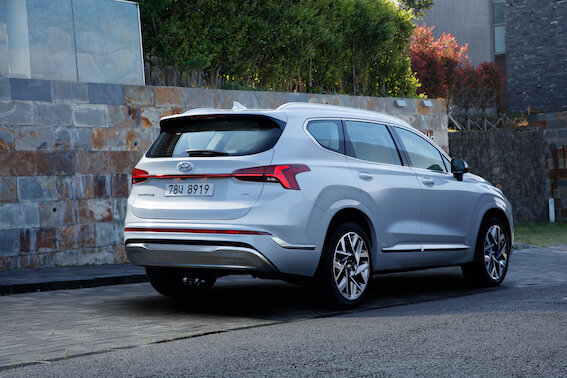
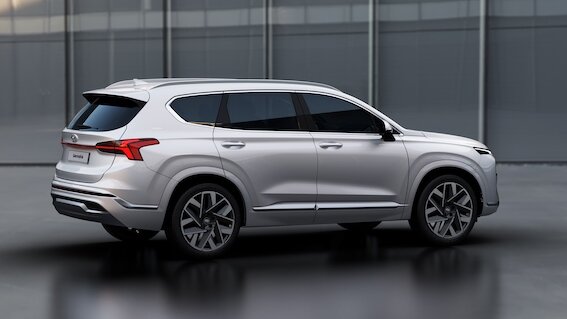
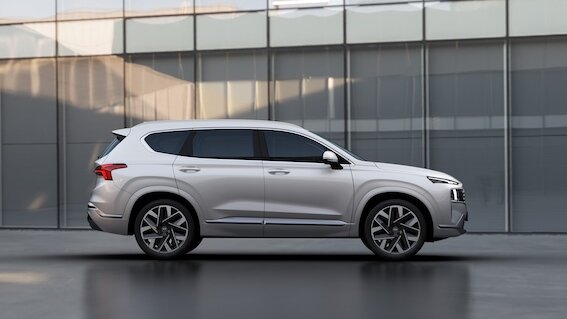
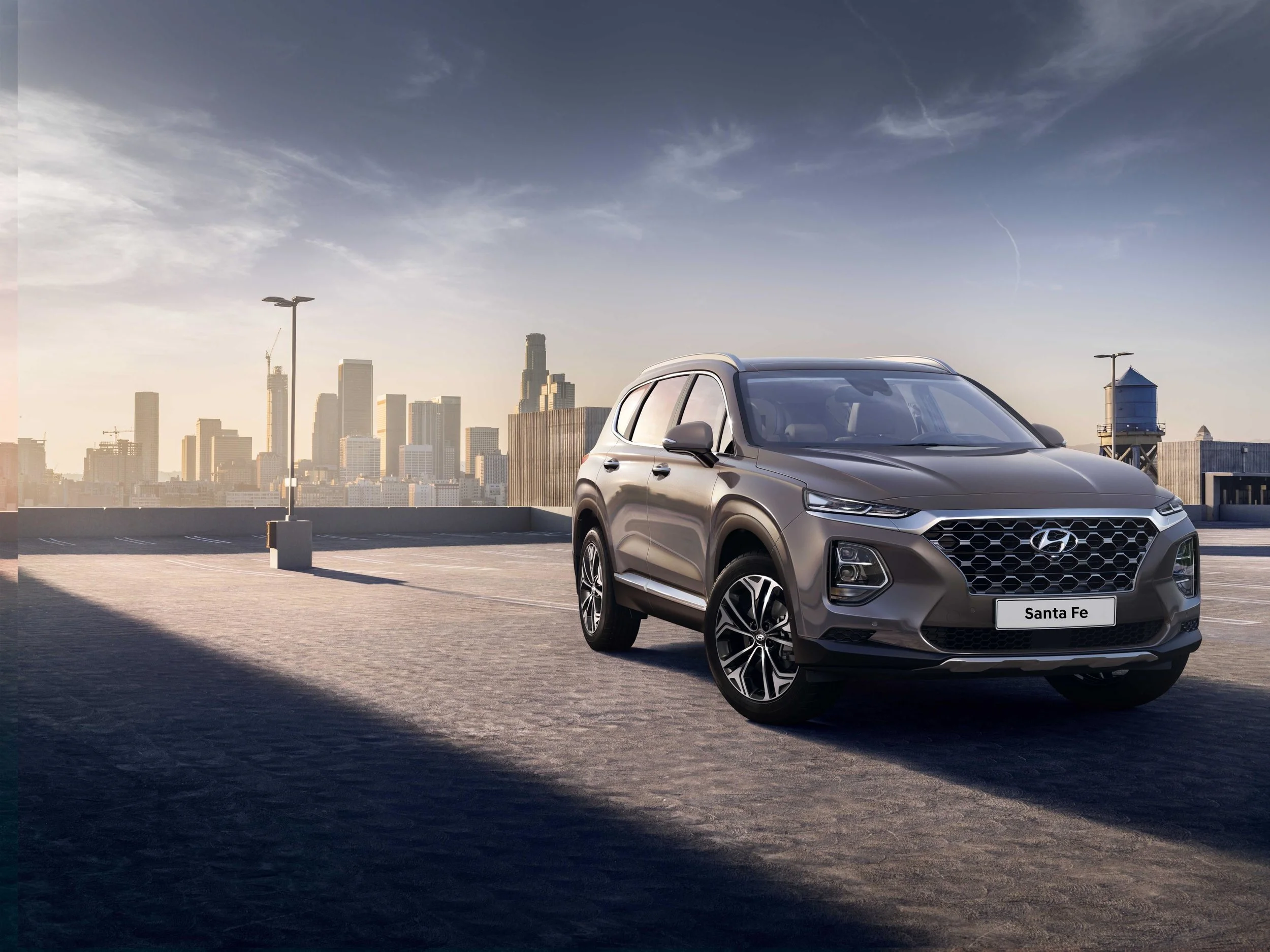
the updated Sorento (above) and Sante Fe (below) move to a new platform and adopt fresh technologies.

the updated Sorento (above) and Sante Fe (below) move to a new platform and adopt fresh technologies.

Hyundai Santa Fe.jpg

The hybrids give the brands opportunity to retire the long-serving 2.4-litre four-cylinder engine but the cars still configure with a 3.5-litre V6 engine, though the latter has not featured in the NZ spec for some time.

The conjoined brands international view is that the hybrid units have potential to ultimately become the key choice for the seven-seater sports utilities, on strength of their performance and efficiency.

In June Hyundai New Zealand’s boss, Andy Sinclair, expressed particular enthusiasm for the powertrains, seeing them as a key factor in elevating Santa Fe’s status, particularly as a foil for the Toyota Highlander, which will become a hybrid model when it arrives in a new generation next year.

“We’d definitely take hybrid. I think it is very important to give our customers a choice,” Sinclair said at the time.

 The Sorento and Santa Fe still continue with the 2.2-litre turbodiesel that’s been the core choice for the past three generations of both lines. It has a new fuel injection system and improved internal components, which help to reduce the engine’s friction and improve fuel economy. Power is 148kW and torque stands at 440Nm.

It mates to a new eight-speed dual-clutch automatic gearbox, called Smartstream. A video about how this operates is attached today. 

The information relating to Kia’s strategy also says it has been affected by supply constraints from the ongoing effects of Covid19 that are being shaken out. 

“So shortages of some models are inevitable, but Kia is working hard to smooth these out.

“The run-out of current Sorento is going well and should be pretty well exhausted as the new model arrives, so timing shouldn’t be too much of an issue there. Always a bit of a balancing act, regardless of the market conditions.”

The new Sorento marketing programme that started on Monday is to build awareness of the new model ahead of its arrival and elicit forward orders, much like Kia did very successfully with the Seltos last year, the information states. 

the hybrid drivetrain, seen here in a Sorento, is a big pitch by the conjoined Korean makes.

the hybrid drivetrain, seen here in a Sorento, is a big pitch by the conjoined Korean makes.

The 1.6-litre is the smallest-capacity engine yet for the Santa Fe and Sorento yet is hardly a weakling, being turbocharged. Though efficiency data has yet to be released, its maker – Hyundai, of course - has indicated a huge improvement in respect to economy and emissions. 

The unit has been designed expressly to work in a hybrid setting and initially comes in a ‘mild’ format, outputting 169kW. The plug-in rechargeable format has even more oomph. It swaps out the 1.49kWh lithium ion battery for a 13.9kWh unit that can be replenished off household mains or a fast charger.

The PHEV model’s electric motor makes 97kW in isolation, but the drivetrain’s combined maximum output is 194kW and 350Nm of torque.

Both hybrid powertrains are hitched to a newly developed six-speed automatic transmission.

They feature a new low-pressure exhaust gas recirculation system and continuously variable valve timing, which Hyundai claims improves fuel efficiency by five percent and decreases emissions by 12 percent in its own right.

The hybrids also have the same four-wheel-drive system as the diesel, but are also being built in front-drive format.

The models’ all-wheel drive now takes a terrain mode selector, which offers specific setups for snow, gravel and mud. The drivetrain also comes with three driving modes – Eco, Comfort and Sport – which can deactivate drive to the rear axle to improve fuel efficiency or distribute the engine’s torque across the  axles for extra stability, sending either 35 percent or 50 percent of the engine’s power to the rear wheels.

kia sorento (above) and Hyundai Santa Fe (below). Which do you prefer?

kia sorento (above) and Hyundai Santa Fe (below). Which do you prefer?

Hyundai Santa Fe profile.jpg

The new models are easily picked in the streetscape, with much updated styling for each. What is not so obvious is that they have switched to a completely different platform to that underpinning the outgoing cars, this being a platform developed for a Hyundai Sonata sedan sold in the United States and China. The footprint has grown slightly, but more importantly the change unlocks additional interior room.

The national distributors have yet to provision specification details however some inkling about what’s coming, at least for Sorento, can likely be gleaned from detail shared out of Australia, where the car is launching in a couple of weeks.

The line there spans four derivatives. Standard fare includes a “segment-first” front centre side airbag, between driver and passenger. A 10.25 inch touchscreen with Apple CarPlay, Android Auto and Multi Connection Bluetooth also configures. Australia’s flagship, called GT-Line, represents with a 12.3 inch digital instrument cluster, Blind Spot View Monitor, a shift-by-wire dial instead of a gear lever and remote smart parking assist.

Smartstream - 8 speed Dual Wet Clutch transmission explained


Santa Fe for an electric age?

Hyundai’s local distributor is keen on the hybrid petrol drivetrains confirmed for the next-generation edition of its popular sports utility.

TM Santa Fe is earmarked for a last quarter arrival here, but nothing’s concrete yet.

TM Santa Fe is earmarked for a last quarter arrival here, but nothing’s concrete yet.

MILD hybrid and plug-in hybrid petrol powerplants will fuel Hyundai New Zealand’s ambition with the updated Santa Fe coming later this year.

Assuming, at least, that brand boss Andy Sinclair’s wish list to include those 1.6-litre powerplants alongside a new version of the 2.2-litre turbodiesel that’s been the core choice for the past three generations is fulfilled by Seoul head office.

Hyundai New Zealand’s general manager says he definitely can see merit in taking his vehicle in a battery-supported direction, and not just because that’s where a big rival – Toyota Highlander – will wholly commit in a new-generation line coming early next year.

“We’d definitely take hybrid. I think it is very important to give our customers a choice.

the new 1.6-litre is designed to marry with hybrid technology

the new 1.6-litre is designed to marry with hybrid technology

“I think it’s great to offer different drivetrains. And being a market leader with electric models already, anything that is available in that format we’d be keen to look at.

“We’re absolutely keen … if it’s available. There is no confirmation yet. Until we get to the final part of actually having spec and price available to us – which will be quite close to the (new model’s) release.”

The car’s release timing is also fluid, thanks to the impact of Covid-19 on car making in South Korea.

All Sinclair can say at the moment is that he expects to have it here by “quarter four.” All going well.

“With Covid-19 a lot of production schedules have understandably changed and because Covid is still strong overseas it has potential for more change, so we really don’t know.”

One likely outcome from the assembly line holdups created by coronavirus closing the Hyundai Group factories and restricting supply of vital components which they outsource from – would you believe – specialists based around Wuhan, in China, is that the Santa Fe might now beat its Kia equivalent to market.

The original gameplan that gave the Sorento a clear head start – which is why the current edition of Kia’s car is in a runout phase that Santa Fe has yet to enter – is now derailed, according to industry informants. Their understanding is that Hyundai sub-brand’s factory having retuned its production to favour larger more important, left-hand-drive markets has pushed Sorento’s local introduction back significantly.

SantaFe(TM)PE-02.jpg

Sinclair said that development was news to him. “My understanding was that it would be out before the Santa Fe.” Not that was important. “We don’t plan around other brands so it never really came into the discussion.”

Having revealed the next Santa Fe’s new look and something about its specification in February, Hyundai has now chosen to release much more detail about the drivetrains.

News about the four-cylinder 2.2-litre diesel is that it has a new fuel injection system and improved internal components, which help to reduce the engine’s friction and improve fuel economy. It mates to a new eight-speed dual-clutch automatic gearbox.

The 1.6-litre is the smallest-capacity engine yet for into the SUV and might seem a world away from the V6 or even 2.4-litre four-cylinder petrols that have powered this model in the past.

Yet the new until hardly a weakling, being turbocharged and though efficiency data has yet to be released, Hyundai has indicated a huge improvement in respect to economy and emissions.

The unit has been designed expressly to work in a hybrid setting and initially comes in a ‘mild’ format, outputting 169kW. This will be in production from the start but will joined next year by the plug-in rechargeable format, which swaps out the 1.49kWh lithium ion battery for a 13.9kWh unit that can be replenished off household mains or a fast charger. The PHEV model’s electric motor makes 97kW in isolation, but the drivetrain’s combined maximum output is 194kW and 350Nm of torque.

Both hybrid powertrains are hitched to a newly developed six-speed automatic transmission, which Hyundai says is both smoother and more fuel efficient than the previous model’s gearbox.

The two engines also feature a new low-pressure exhaust gas recirculation system and continuously variable valve timing, which Hyundai claims improves fuel efficiency by five percent and decreases emissions by 12 percent in its own right.

SantaFe(TM)PE-03.jpg

The hybrids also have the same four-wheel-drive system as the diesel, but are also being built in front-drive format.

The all-wheel drive now takes a terrain mode selector, which offers specific setups for snow, gravel and mud. The drivetrain also comes with three driving modes – Eco, Comfort and Sport – which can deactivate drive to the rear axle to improve fuel efficiency or distribute the engine’s torque across the SUV’s axles for extra stability, sending either 35 percent or 50 percent of the engine’s power to the rear wheels.

The new model is easily picked in the streetscape. What is not so obvious is that it has switched to a completely different platform to that underpinning today’s car. It is going to a platform developed for a Sonata sedan sold in the United States and China.

Due to the platform switch, the Santa Fe has increased in size. It’s 15mm longer, 10mm wider and 5mm taller than the model it replaces, with dimensions of 4785mm, 1900mm and 1685mm respectively. Hyundai says this has unlocked more space in the cabin for passengers, adding an extra 34mm of legroom for rear-seat occupants.

It would seem improbable that the major changes won’t avoid a price impact, but Sinclair says that the current flagship Limited diesel, a $83,990 proposition, firmly holding as the most popular version sold suggests consumers perceive Hyundai as a premium brand.

Santa Fe’s pricing potentially points to the next-size-up Palisade sports utility, an eight-seater that arrives at year-end, standing good chance of becoming the first Hyundai to price above $100,000.

Sinclair would not be drawn on that, but acknowledged “it will take us into a new pricing territory, there’s no doubt. But just what that will be, I don’t know. We have not got any indication from HMC (Hyundai Motor Company) on price.”

So, is comfortable with the prospect? “Well, our biggest-selling Santa Fe is our most expensive one. That’s a fact. Hyundai is a brand that has a premium over Japanese brands. Our customers can see our quality.”


Palisade confirmed for NZ

You think the Santa Fe is substantial? Wait until you meet its big brother.

Large-36538-2020Palisade.jpg

SIXTEEN cupholders, seven USB ports and up to eight seats – plus a brash styling that simply cannot be ignored and potentially a sticker that takes Hyundai into a pricing zone it has never previously breached.

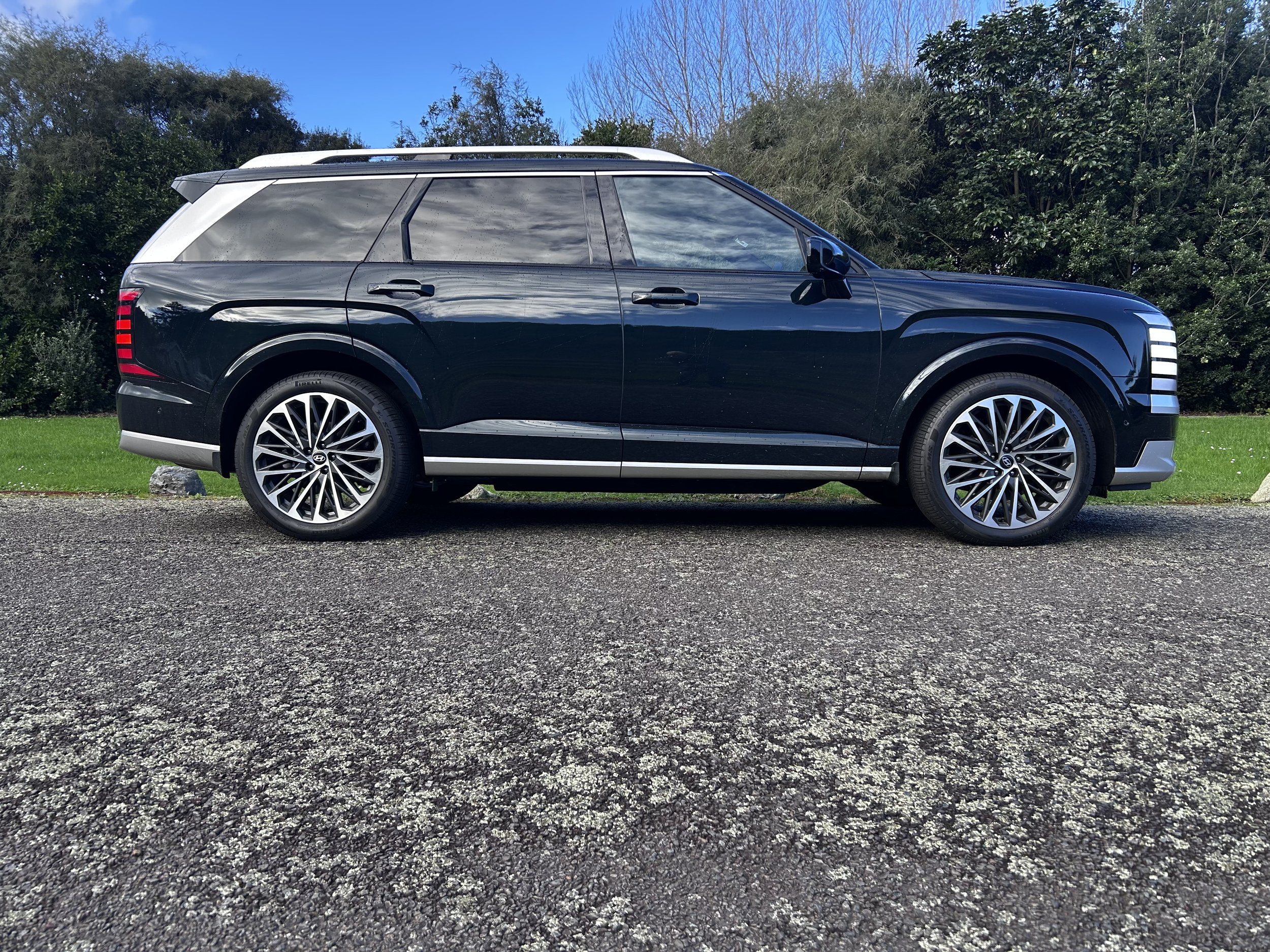
Those are features of the Hyundai Palisade, an even larger sports utility than the well-received Santa Fe that has been confirmed as an addition to the brand’s local line-up, arriving at year-end. 

Designed and initially only designated for North America, but now being made available through South Korea finally bending to a campaign by Australia to put it into right-hand-drive, Palisade is built in front-drive V6 and also provisions in the same mechanical spec preferred by most Santa Fe buyers – so four-wheel-drive, a 2.2-litre turbodiesel and an eight-speed auto.

Auckland-centred Hyundai New Zealand confirmed some months ago it was mulling adding in the Palisade to become the fifth SUV in its line-up and the first to offer eight seats. 

That process has cemented with last week’s confirmation that it will be going into Australia from year-end, coming off the same production line in South Korea that produces NZ-market Santa Fe.

Today the national distributor said it had still to decide on the exact spec and powertrain choices – but conceivably you need only examine what Australia is getting to see the full selection of choice.

Large-36537-2020Palisade.jpg

 It seems safe to assume NZ will take the 2.2-litre four-cylinder turbodiesel, which is in the same tune as it features in the Santa Fe, so cracks out 147kW and 440Nm.

Our neighbour has decided to take the petrol, a 3.8-litre V6 producing 213kW and 355Nm. Given that Hyundai NZ has discontinued the same layout, albeit with a smaller-capacity six, in the latest Santa Fe, this version of Palisade would seem  less likely.

Timing? Not exact dates are being given, but HNZ general manager Andy Sinclair says it’ll be here in time for summer.

So, we’re picking December. As for price? Well They’ve also indicated – and no surprise with this – it’ll sit above Santa Fe, which tops out at $83,990, so expect to spend at least $85,000, if not more. Could it even become the first Hyundai to sell here for more than $100,000?

Hyundai NZ has expressed confidence it can find a ready market for a model that is much larger than the Santa Fe, measuring around 210mm longer with a 180mm longer wheelbase and boot that offers 311 litres space with all three rows up (so, more than double Santa Fe’s capacity in that configuration), or 704L with two rows of seating in use. It is slightly shorter and narrower than the Mazda CX-9 and longer and wider than the current Toyota Highlander, which is set to go into a new generation in early 2021.

Sinclair is calling the Palisade “the ultimate family vehicle for practical, comfortable daily use and venturing further afield for a family roadie” and says it will provide Kiwis “more choice when it comes to buying a vehicle to meet their lifestyle needs.”

The model also stands out as being one of a relative few Hyundai vehicles unlikely to be troubled by a Kia equivalent here. Yes, there certainly is a twin under the skin. Yet the award-winning Telluride is only made in in North America and has been discounted for reconfirmation in left-hand-drive.

Expectation is that Palisade will add a higher, comfort-oriented specification than Santa Fe as well as an extra seat.

Apart from all those cup holders and USB ports, it delivers roof ventilation for all rows, heating and ventilated front and second-row seats and middle-seat delete for the second-row (as a seven-seater with ‘walkthrough’ aisle).

Large-37498-2020Palisade.jpg

There’s also a digital instrument cluster with blind-spot video streaming and a 10.25-inch infotainment screen with Apple CarPlay and Android Auto connectivity, reversing camera and 360-degree cameras. Also expect a host of safety technology including AEB, adaptive cruise control, lane-keeping assist, passenger detection monitors, and more 

Comfort comes via electrically adjustable seats and plenty of Nappa leather. Both second and third-rows get Isofix anchors for child seats, plus tether points, including for the third row. 

North America’s status as the priority market dictated why it launched at the 2018 Los Angeles Motor Show.

The US market is not wholly pinned to an eight-seater configuration. Over Stateside the car also offers as an opulent six-seater, with power folding captain’s chairs in the second and third rows and a ‘sleep mode’ that can mute the back speakers for snoozing passengers also befit its flagship status.

Like the Santa Fe, it features a rear occupant alert system that will beep the horn if ultrasonic sensors detect movement inside the vehicle once locked, helping look after pets and small children.

Large-36545-2020Palisade.jpg


Next Santa Fe – a bit of old, a lot of new

The new Santa Fe has finally been revealed and will be here in late 2020.

SantaFe(TM)PE-01.jpg

NEW body, new interior, new tech and heavily revised underpinnings - the next generation of Hyundai’s crucial big sports utility is certainly a significant departure from the current edition’s design direction.

And, yet, strictly speaking, the ‘gen four’ coming in the final quarter of this year is essentially a revision, the maker admitting it still uses core elements of the current-generation seven-seater. Not that this shouldn’t keep it from winning plenty of attention.

 “We modernised the new Santa Fe with premium features and appealing aesthetics that are sure to add value,” said SangYup Lee, the senior vice president who also heads the brand’s Global Design Centre and is been elevated to becoming the brand’s design spokesman in wake of the recent sudden departure of Luc Donckerwolke as design chief. 

“The bold lines that extend from one side to the other and from front to back give Santa Fe a rugged yet refined look that SUV customers want. Besides, we’ve added numerous features and functions to create a truly family-focused SUV that is a pleasure to drive.”

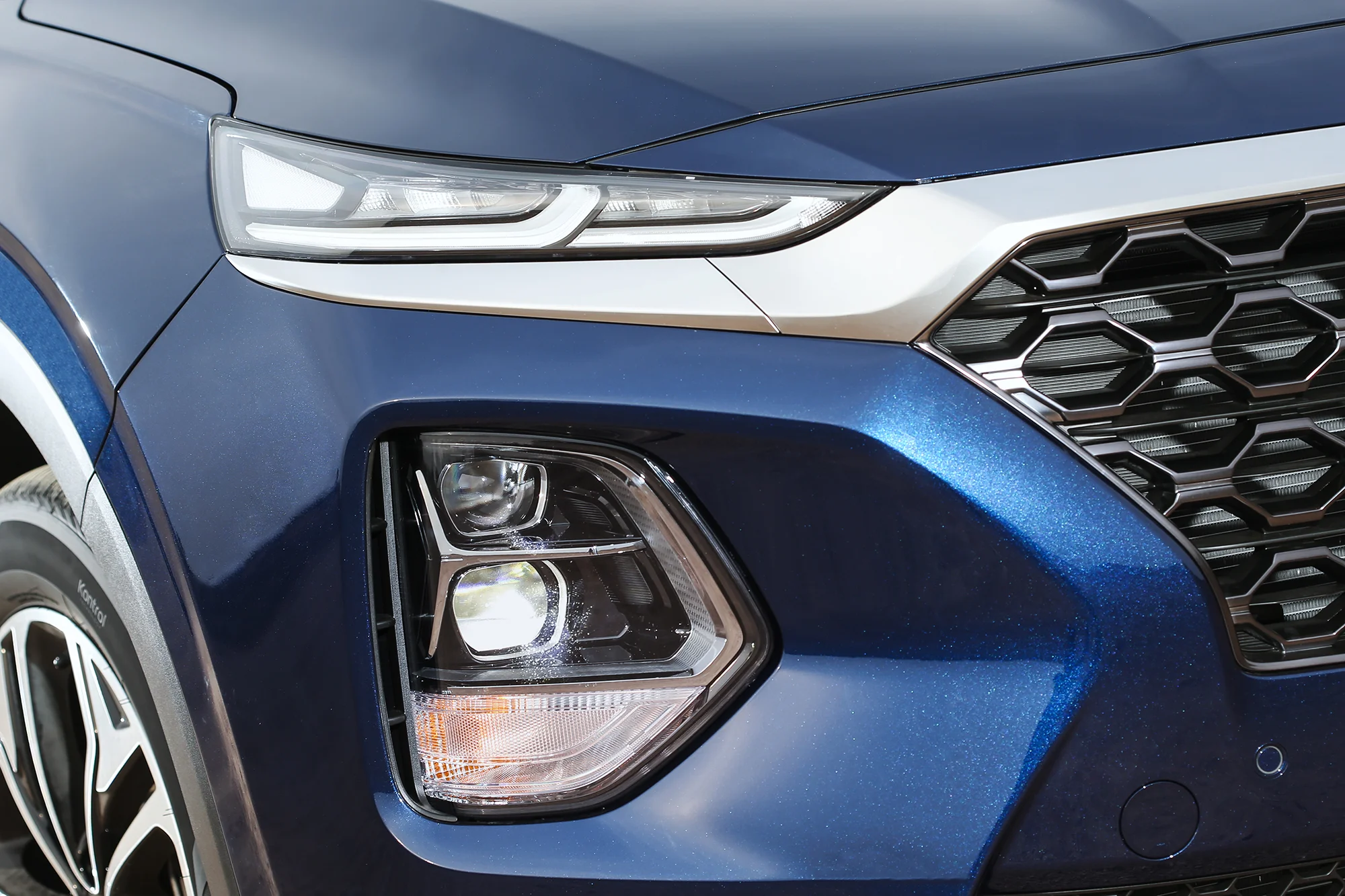
The new Santa Fe’s front section is defined by the wide grille that extends across the entire width of the vehicle. The brand suggests the ‘clamped shape’ of the lower air intake harmoniously extends the horizontal line to accentuate the vehicle’s wide and well-balanced stance.

The grille – or grilles, as there are two designs, the more intricate pictured here being reserved for the new flagship - also integrates the headlamps, a signature style found on many Hyundai cars. LED Daytime Running Lights (DRLs) start at the top of the grille and cut through it to create T-shapes at each corner when lit.

Each side section of the New Santa Fe is characterised by a seamless line that connects the DRL to the taillights, this to lend the car ‘a sensuously sporty look’. The increased width on wheel arches accentuate the SUV’s rugged and powerful character, which is also emphasised by 20-inch wheels.

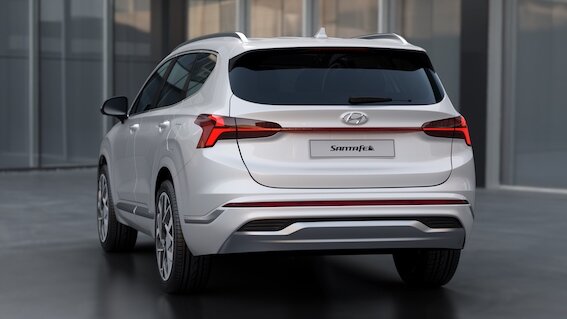
The new Santa Fe’s redesigned taillights are connected across the rear hatch by a slim illuminated bar that complements the horizontal design theme on the front and sides of the vehicle. The theme is once again expressed by the wide rear reflector and skid plate, creating a unique three-layer look. 

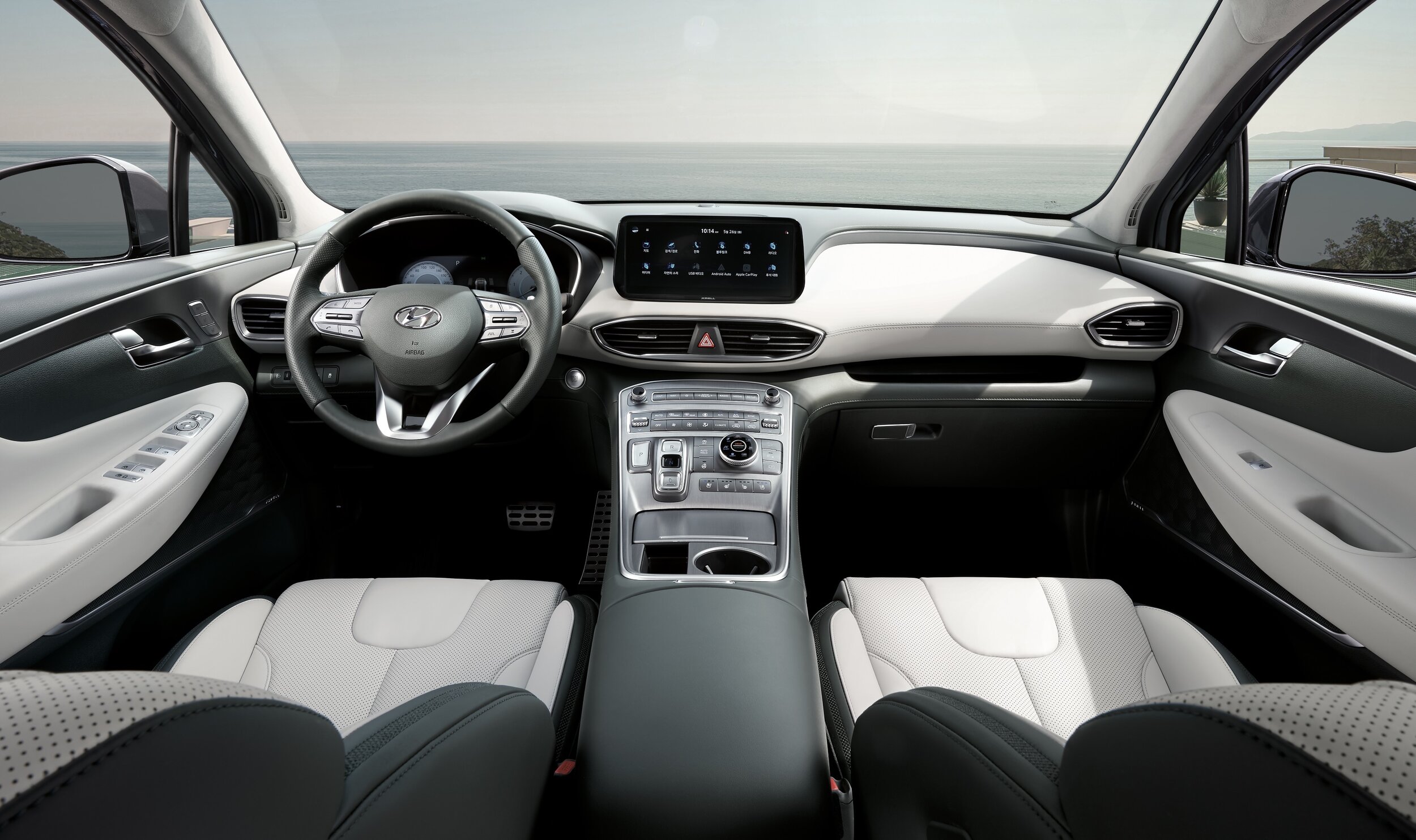
Hyundai says the redesigned interior now provides more space, comfort, and convenience compared to the previous model and also takes the car to ‘a new level of luxury’ with every component finished in premium soft-touch materials. The centre console sits high, giving the driver and front passenger the feeling of sitting in an armchair, according to information released today.

The buttons are all centred for intuitive and ergonomic use. In the middle of the redesigned centre console sits gear shift buttons along with other functions that are used often. Hyundai says a ‘shift-by-wire system’ allowed the designers to put buttons instead of the conventional shift knob.

For the first time, the new Santa Fe comes with a Terrain Mode selector: a control knob located in the centre console to conveniently switch between different drive modes, optimising performance and ‘HTRAC’ all-wheel-drive settings for a variety of driving situations. This feature includes unique modes for sand, snow and mud, as well as eco, sport, comfort and smart modes, the last of which automatically recognises the driving style and selects a mode so the driver does not have to.

The new centre console’s layout freed up space for more storage in the redesigned lower dashboard. The console also accommodates a new 10.25-inch AVN (audio, video, navigation) touchscreen display with pre-loaded maps, satellite-based voice guided navigation, rear camera display, and complete in-car entertainment and connectivity features.

As for the mechanical package? tjhat’s still be be explained, but it could be that Hyundai also moves to adopt a hybrid set-up that is going into the Kia Sorento, a sister ship despite any corporate claims to the contrary.

The latter is taking a 1.6-litre petrol with battery assist – in ultimate form this being a 44.2kW electric motor and a 1.49kWh lithium ion polymer battery, for a total output of 169kW and 350Nm.

The new powertrain is presented under a new mantle, ‘Smartstream’, that also applies to the purely fossil fuel-reliant engines also confugring, these being a 206kW/421Nm 2.5-litre petrol and a refined version of the outgoing cars’ 2.2 turbodiesel, making 148kW and 440Nm. These marry to an eight-speed wet double-clutch automatic.
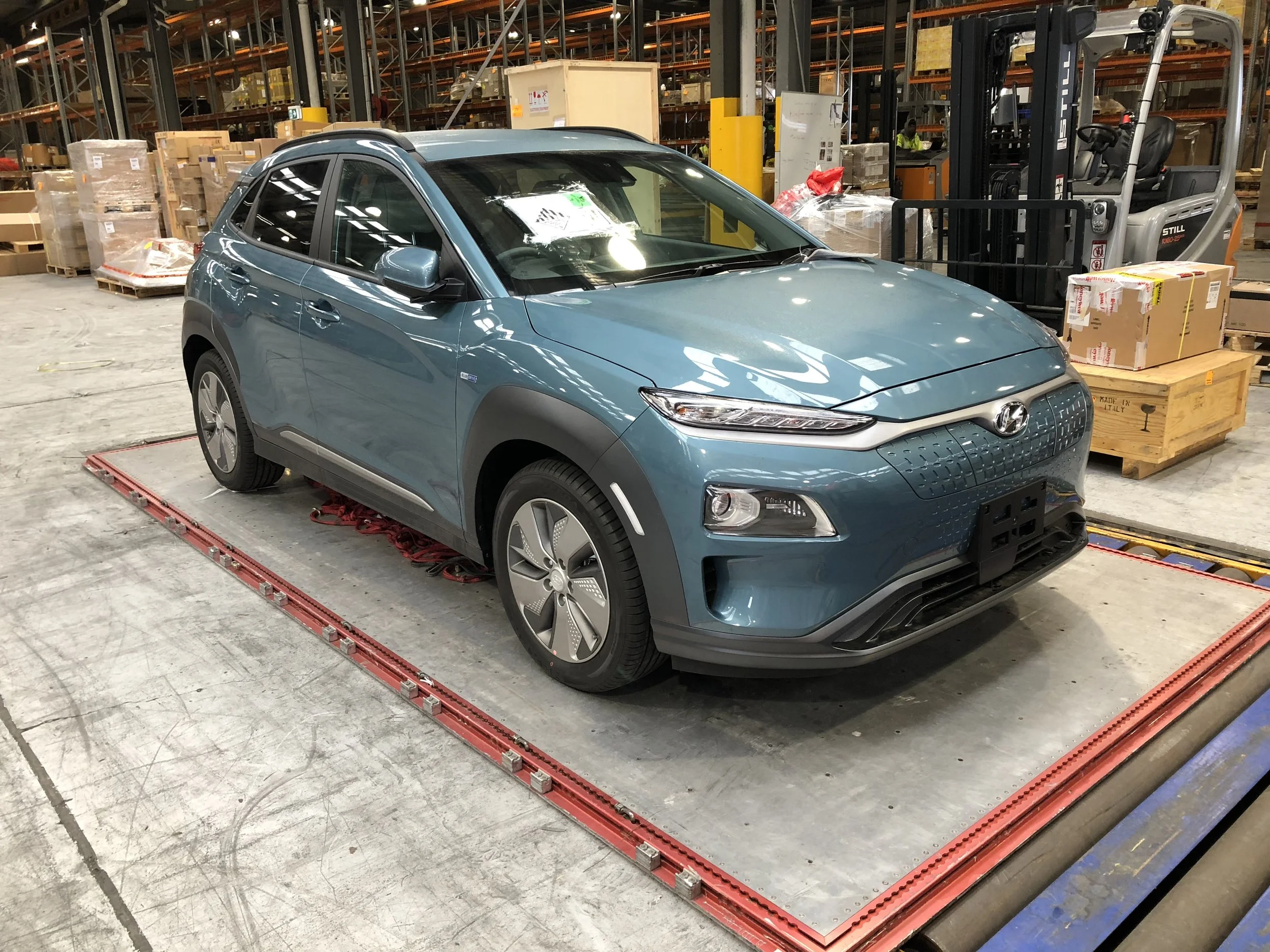


Next Santa Fe fronts up

Hyundai has provided a first look at the next generation of its crucial sports utility.

the ‘luxury’ grille

the ‘luxury’ grille


GRADUAL unveiling of the next Hyundai Sante Fe has begun, with Seoul sending out shadowy preview images revealing the new car’s front.

There are two images, the reason being to demonstrate that the flagship car will have a slightly different gloss black grille to that meted the regular editions.

Either way, the new face is quite different to what we see now.

And those grilles are a significant departure from the 'waterfall' design that has evolved over the past decade across the Hyundai family.

In its new form, the Hyundai grille frame extends across the face of the new Santa Fe, tapering at each end to merge with the driving light housings.

Also new is the 2021 Santa Fe's daytime running light (DRL) signature, described as a ‘T’ shape.

the standard grill

the standard grill

The new lighting signature is described as reflecting "Hyundai's new integrated vehicle architecture". Is that a suggestion that what the SUV presents first will migrate into other Hyundai’s? 

No other angles have been revealed at this time, although Hyundai says we can expect “interior design updates providing premium amenities and comfort.” 

Also unclear are details on the new-look Santa Fe's mechanical package, though it could be that Hyundai also moves to adopt a hybrid set-up that is going into the Santa Fe’s sister ship, the new Kia Sorento.

The latter is taking a 1.6-litre petrol with battery assist – in ultimate form this being a 44.2kW electric motor and a 1.49kWh lithium ion polymer battery, for a total output of 169kW and 350Nm.

The new powertrain is presented under a new mantle, ‘Smartstream’, that also applies to the purely fossil fuel-reliant engines also going into the vehicle.

With the latter the choice with Kia is a new 206kW/421Nm 2.5-litre petrol and a refined version of the outgoing cars’ 2.2 turbodiesel, making 148kW and 440Nm. These marry to an eight-speed wet double-clutch automatic.

Kia NZ has yet to signal a firm local launch date for the Sorento, save for an indication some months ago that it might be here by the third quarter of this year. However, that timeframe was given pre-coronavirus; like so many others, Hyundai and its subsidiary have had to close down its assembly lines. 

Regardless of that, there is emergent possibility that the Sorento will beat the Santa Fe to market.

Both models stand on a new-generation midsize SUV platform and the Santa Fe is sure to align with Sorento in implementing a range of high-tech safety and convenience features.

Prime among these are a multi-collision brake system that mitigates the severity of secondary collisions. It automatically applies vehicle brakes when the airbags have been deployed after an initial collision, further protecting occupants from secondary frontal or side impacts. 

Kia’s new rig also has a remote smartphone Surround View Monitor. This allows users to check the vehicle’s surroundings with their smartphone in conjunction with the in-vehicle Surround View Monitor to maximise parking convenience.

Last year Kia registered 462 Sorentos in NZ while Hyundai NZ found homes for 1477 Santa Fes.

the current model santa fe

the current model santa fe


Man draws ute, media goes nuts

Everyone loves a good ute. Does the Tarlac meet those tastes?

8d431e96203525.5ea9142389d8b.jpg

FOR the past couple of years, anyone gloating about their new car might, in reality, be talking about something taller, heavier and – despite all the mod cons – less polished.

Despite new car registrations having faltered a touch in 2019, utility vehicles continued to dominate, with the Ford Ranger and Toyota Hilux the top two selling vehicles, with 9486 and 7126 sales respectively.

Demand tapered off by the December quarter and no-one’s yet brave enough to bet on how many might be sold this year. 

But chances are the ute – and by that we really mean well-trimmed dual cabs, since they account for the bulk of interest - sector might yet recover more quickly from the Covid-19 pandemic’s impact than the general passenger car market.

0a713c96203525.5ea916075a8f9.jpg

They’re so strongly entrenched. Also, if and when recovery comes, it’s going to be led by builders and farmers – two key buyers of utes.

What might also stir up interest is that this is the first if several years when traydeck turnover occurs. As in, model cycle change. Some are set to be rebirthed and most of the others are going to be refreshed.

Isuzu’s reskinned and re-engineered D-Max and its new under-skin twin, the Mazda BT-50, are coming out this year. We expect to see another radical revision for the Hilux. In 2021 comes the successor to the mega-hit T6 Ranger, retiring after a decade on the job.

A conjoined effort with Volkswagen and likely to be the last Ranger designed and engineered fully in Australia, the next one runs on a new version of the current platform and is expected to add a pair of turbocharged V6 engines added to the line-up; a 24wk@ petrol and a 187kW diesel. And hot on its heels, the Amarok – still a German product despite the Aus-shared influences.

And there’s another, also eagerly anticipated …. 

So, anyway, today’s images are of the Tarlac.

 Hyundai’s dual-cab ute has been in the works for an eon, but finally the wheels are set to be rolling. And instead of one kind, it’s becoming increasingly likely there will be two 

America is being targeted as the primary recipient for a load-lugger that will retain the name, and much of the look, of the Santa Cruz concept shown in 2015. This will come out of Hyundai’s plant in Alabama in 2021. The Santa Cruz will differ from other dual-cab utes as it will be built with a monocoque chassis.

5a44f896203525.5ea914238f3f3.jpg

However, Hyundai has also confirmed it also has a traditional ladder-frame light commercial vehicle is in development. Costs of this one shared with sister company Kia. This yet-unnamed model is expected to become available in 2022-23.

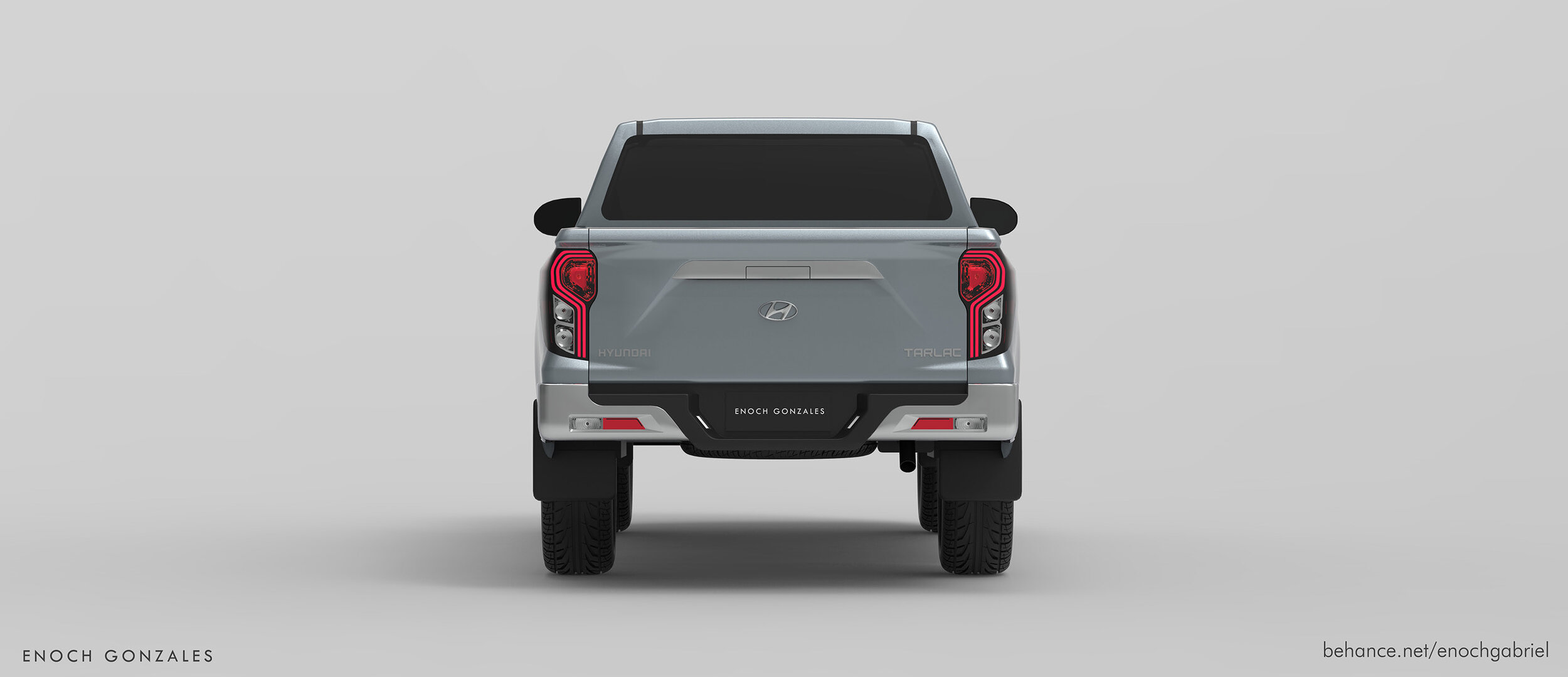
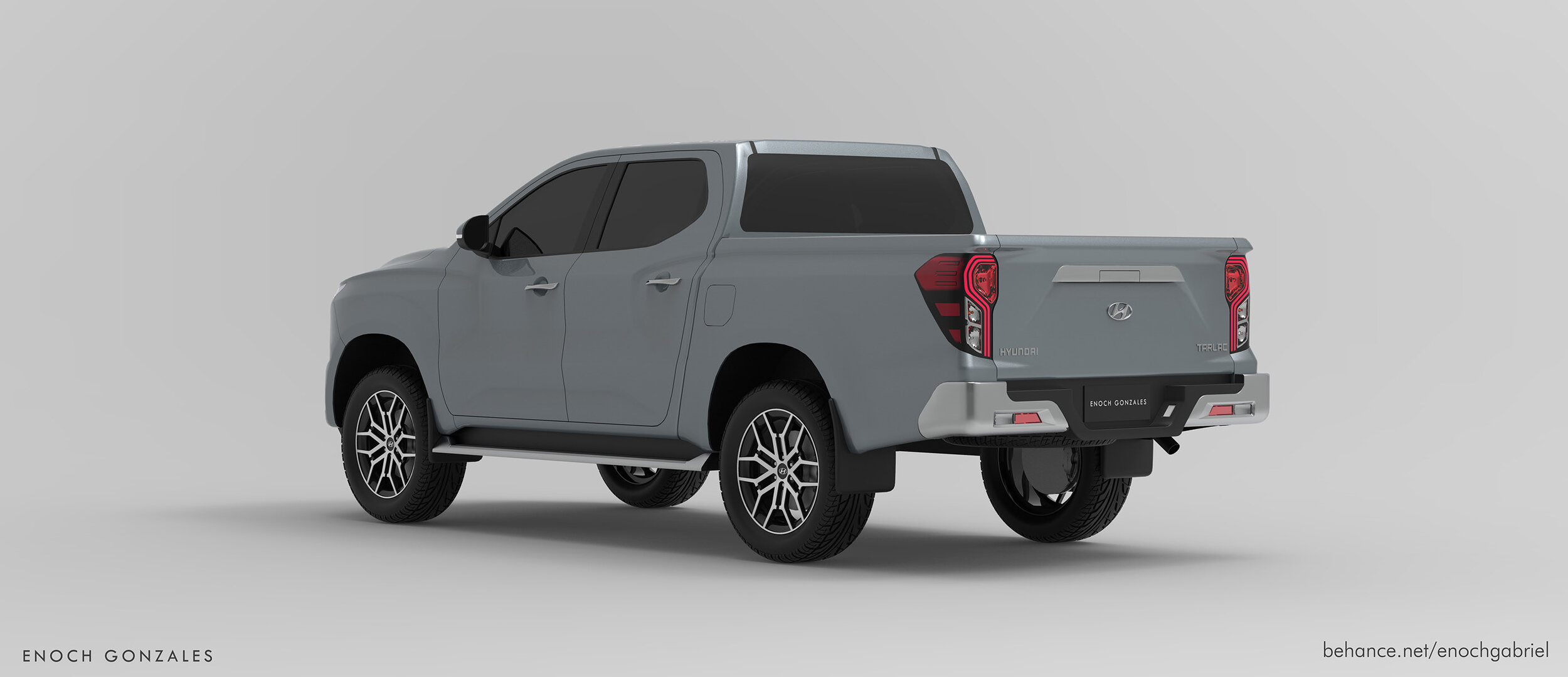
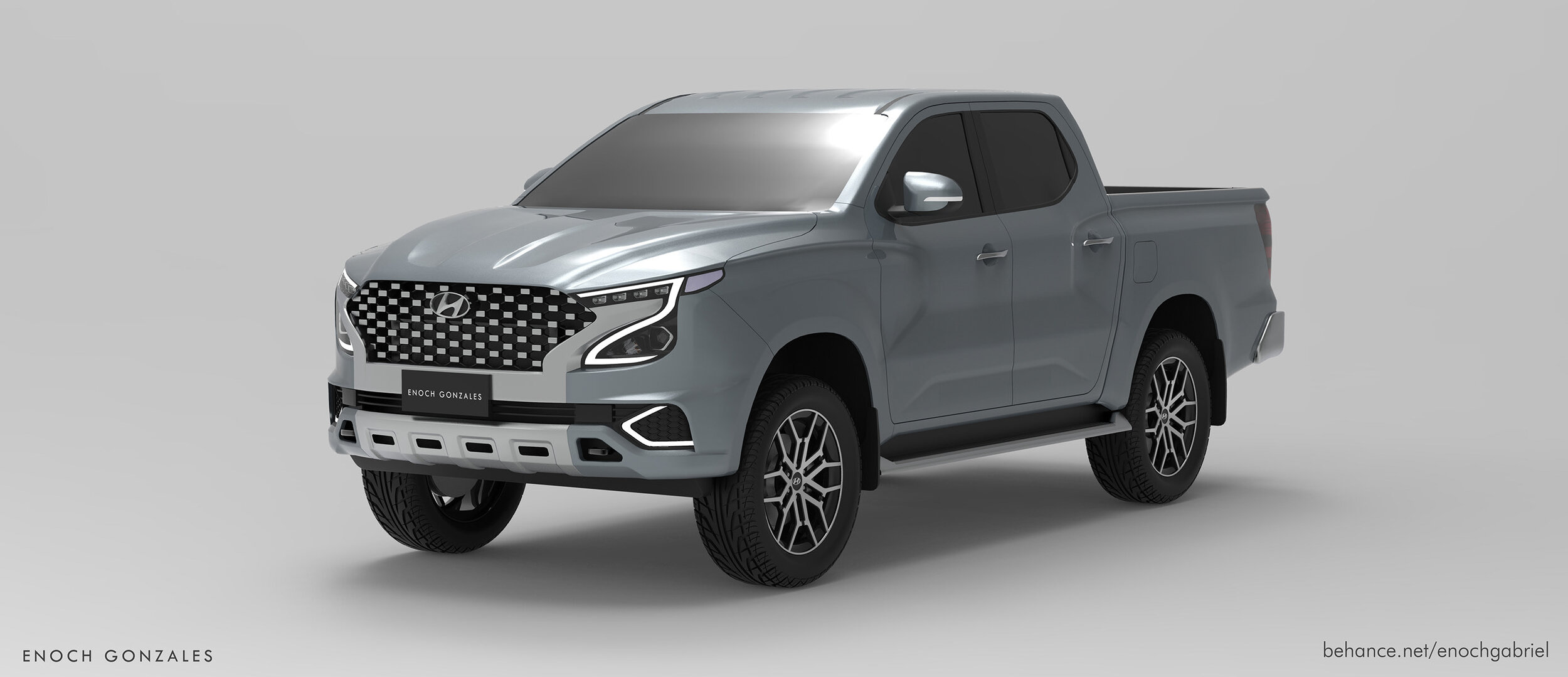
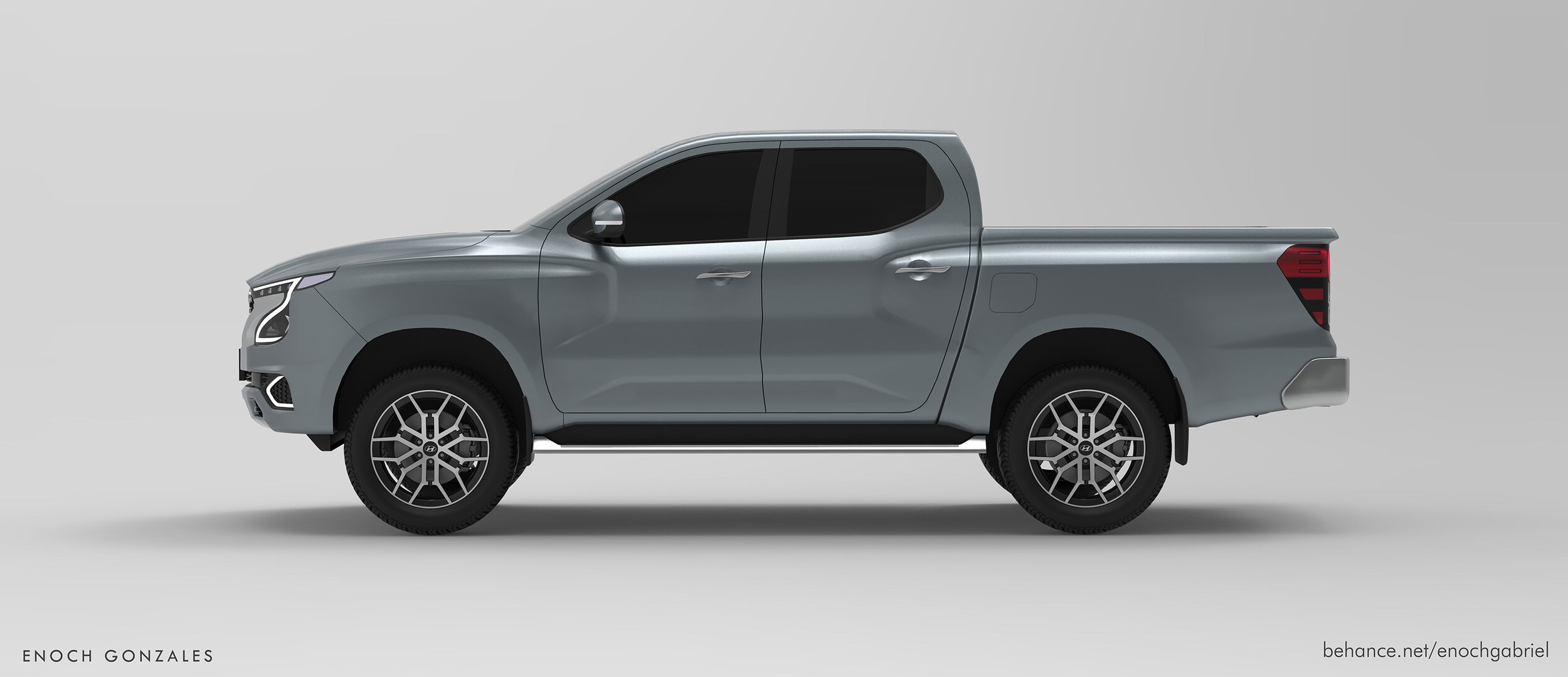
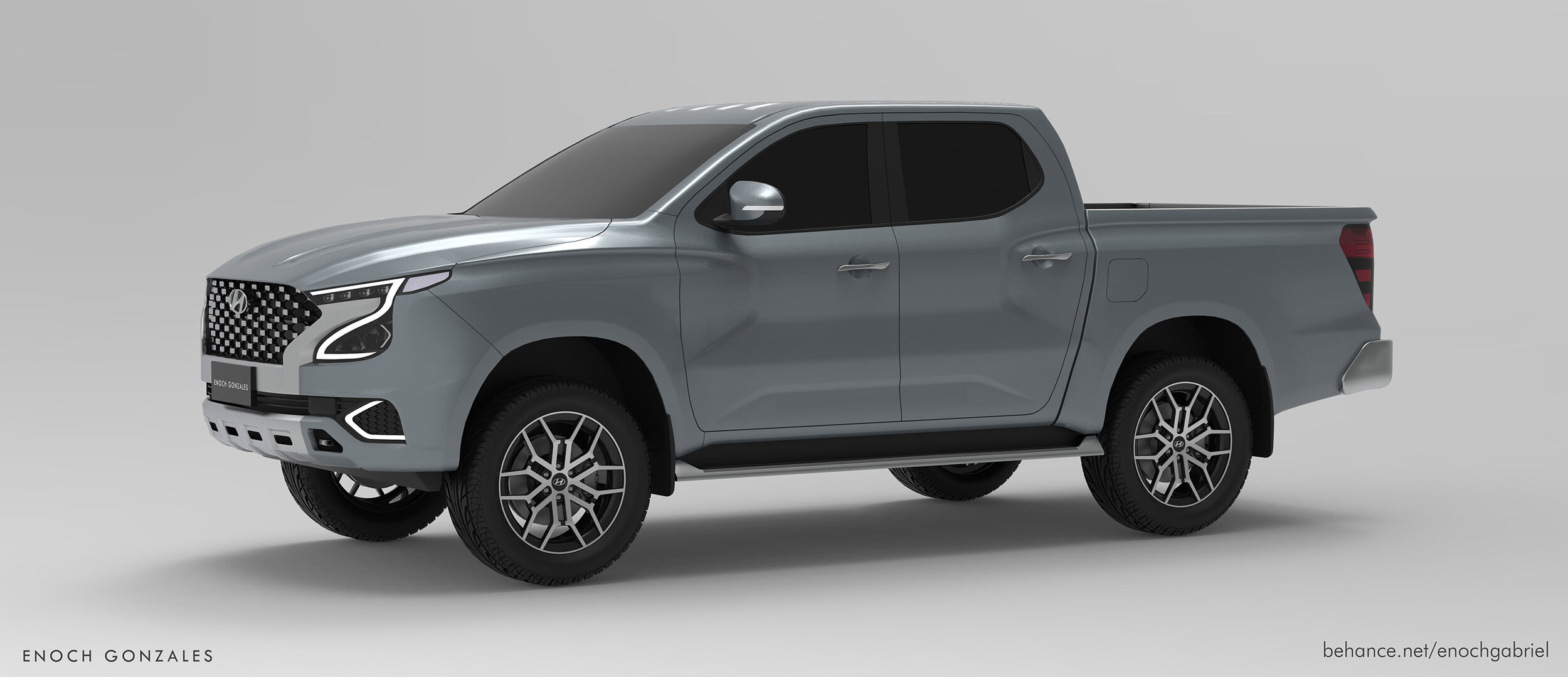
So what will it look like? Well, an industrial designer in the Philippines reckons he has a pretty good idea.

Enoch Gabriel Gonzales has fired up motoring sites all over this part of the world by publishing numerous images of a virtual model whose configuration is based on the few published images of the actual vehicle when it’s been snapped when out testing.

Given the real thing has always been heavily disguised, how confident can we be that his Tarlac – named after a province located in the Central Luzon region of the Philippines – is a good representation?

It’s a good question. Gonzales does admit that the workhorse he’s envisioned has a more traditional body shape than what the spy photos suggested. But he also claims to have remained faithful to Hyundai’s current design language.

The fascia is inspired by the Santa Fe sports utility and its bigger brother, the Palisade, which is expected to come on sale here at the end of the year.

Beyond that, he has designed Tarlac to look like a natural competitor for Hilux, Ranger and Mitsubishi’s Triton.

Regardless, let’s not forget this. There’s nothing official about the Tarlac. Gonzales is clearly a very good designer, but he doesn’t work for Hyundai.

A fact that seems to have escaped all the media who have used the images and allowed their imaginations to run wild. But, granted, there are excellent renditions.


Visual fizz for Hyundai sedan

Will we, won’t we? Hyundai NZ is being especially evasive.

i30 Sedan N-Line 01.jpg

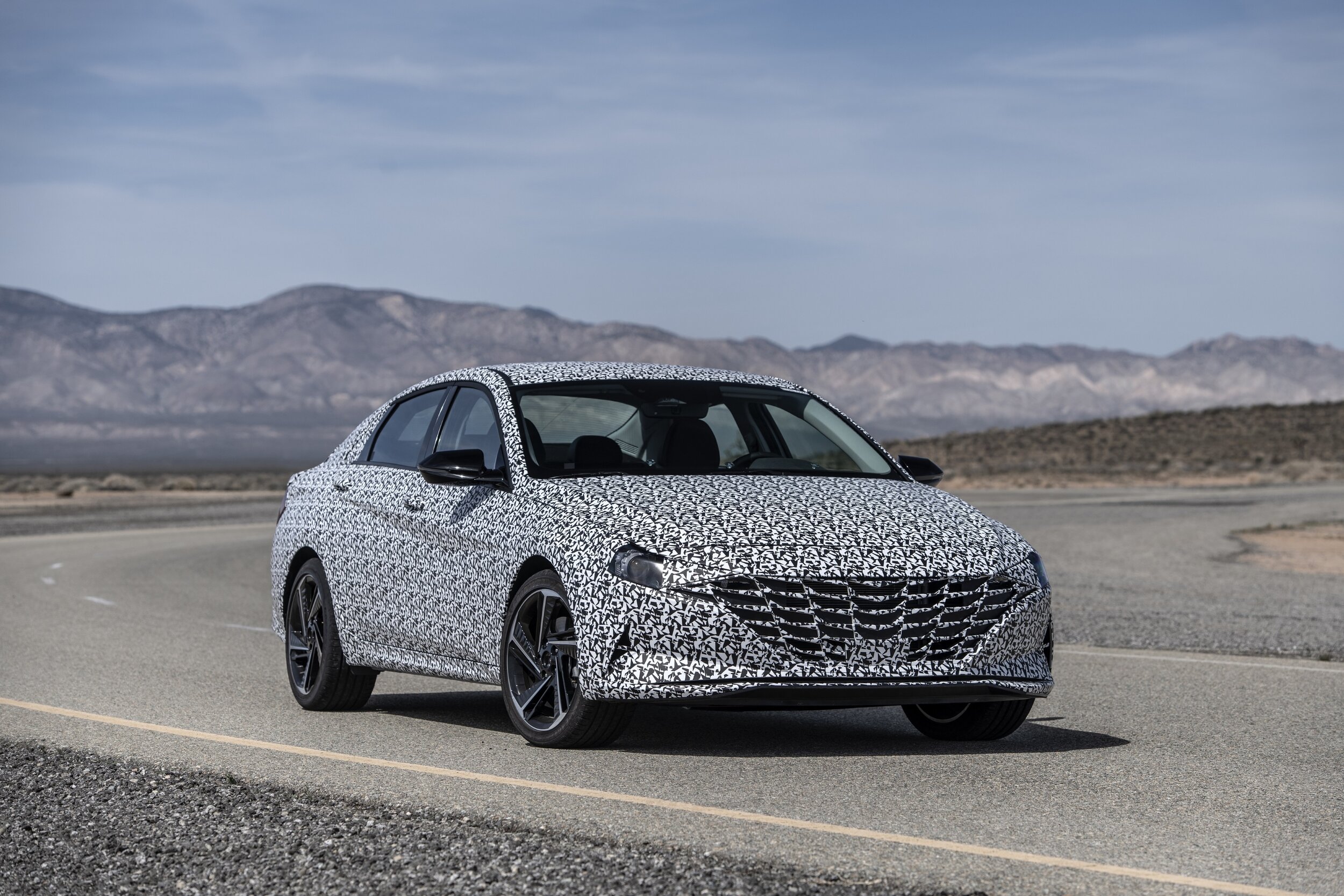
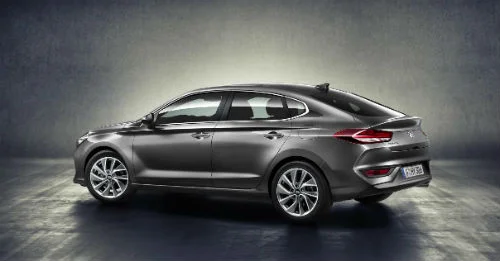
NOT an outright ‘yes’ nor an actual ‘no’ … just an acknowledgement that, should the compact sedan whose sportified look has been teased be picked up for New Zealand, it’ll more likely be called an i30 than an Elantra.

Hyundai New Zealand is being especially non-committal about local potential for a compact four-door model, to place alongside the i30 hatch and liftback, that has attracted international attention through South Korea putting out a teaser video showing the car in an N-Line trim.

This follows release weeks earlier of the standard car without the camouflage covering the N-Line edition. Can they be that much different? Well, probably not ….

Anyway, in sharing the N-Line news, Hyundai NZ’s public relations manager Kimberley Waters was making every effort to steer clear of suggesting anything that might indicate the car having local potential. Or not.

“Please note Elantra is what it this model is known as in other markets. Because Hyundai New Zealand take Australian spec and they have changed the nameplate to i30 Sedan, we too will adopt that name if we bring in the i30 Sedan and/or i30 Sedan N-Line. 

So there you go. Whatever Aussie does is what we’ll also do. Should we do it.

 Moving on. 

The N-Line should not be confused with the outright N product plan, which is basically Hyundai creating an equivalent of BMW’s M Division – indeed, the man leading this, Albert Biermann, is the former head of the Munich madhouse.

Hyundai all-new Elantra N Line, coming soon. #ElantraNLine #teaser #camouflage ------------------------ ▶Subscribe to Hyundai Motor Group YouTube channel htt...

The only N model here now is based off the i30. The Veloster N is also in production, but just in left-hand-drive. The next N model for New Zealand is expected to be a version of the Kona compact crossover, with a 2.0-litre turbocharged petrol four-cylinder engine producing around 200kW and 350Nm. Also likely to also introduce the dual-clutch automatic transmission, this model is expected to land in the second half of this year.

Anyway, back to Elantra/i30 sedan. It is built on the new K3 platform which Hyundai states is lighter and stiffer with enhanced driving dynamics, and shows the brand’s latest styling outside – yeah, we know, instant nominee for ‘scary grille of the year’  - with plenty of technology highlights inside.

The only export market to so far involve with the mainstream model (below) is the United States, where it runs front-wheel drive with a continuously variable automatic transmission and the 103kW 1.6-litre that ran in the previous generation.

With N-Line, you get a few sporty looks but not the hooligan edge. With the sedan, the dress-up encompasses black exterior mirrors, more aggressive two-tone five-spoke alloy wheels and a set of twin exhaust tips poking out of the right side of the bumper. Is this an indication the variant will run the 150kW/265Nm 1.6-litre turbo-petrol used elsewhere in the Hyundai and Kia stable?

Large-40585-2021Elantra.jpg

Well, it’d seem a safe bet given that, for its part, Seoul head office has offered: “the upcoming i30 Sedan N Line adds N brand specific design elements, chassis upgrades and a turbocharged engine to the recently revealed i30 Sedan”.

The car in the video seems to include a dual-clutch automatic transmission – most likely the seven-speed unit from the current i30 N Line.

The most pronounced of the chassis upgrades will likely include an enhanced (firmer) suspension set-up. Note that the N Line hatch rides 5mm lower than the standard models.

The i30 Sedan also has a multi-link rear suspension arrangement – only seen previously on the current N Line hatch. That bounds well for the driving feel.

So is it coming? Probably. Hyundai NZ doesn’t have a habit of sending out information about cars it doesn’t intend to sell.

Even so, setting aside the ‘will they, won’t they?’ side, sedans – previous Elantra very much included - have become such slow sellers, the more relevant question might be: ‘Will you notice?’

i30 Sedan N-Line 02.jpg


Right gear, wrong car

The transmission that would definitely broaden the appeal of the best driver’s car Hyundai sells here has been unveiled.

VelosterN8-DCT02.jpg


HERE’S something to make you smile – a wet dual clutch transmission with a ‘grin’ feature.

No, for real. In releasing information about the two-pedal eight-speed box that will provision into its hard-out i30N hot hatch as an option to the six-speed manual that’s the sole choice now, Hyundai has identified one of the box’s three settings is called … ‘N Grin Shift’. Only in Korea, right?

Laugh along, because the joke will be on rivals who might dare to diss. The i30 N as is rates really well and this new transmission is simply going to broaden the appeal.

We likely won’t know by how much for a little while yet, unfortunately.

The make has decided the Veloster N coupe should be the first recipient of this tricky tech. Indications from the factory have long been that this car is only available in left-hand-drive and might only avail in two places, South Korea and the United States.

The brand claims that the DCT Veloster N will accelerate from 0-100kmh in just 5.6 seconds – exact-matching its six-speed manual counterpart.

Slotting into ‘N Grin Shift’ doesn’t make it any faster, yet promises a feistier more feral feel as that ups torque by seven percent to 378Nm thanks to a turbocharger overboost function for 20s.

An ‘N Power Shift’ feature is also included, which stays in the torque band when upshifting at more than 90 per cent throttle.

There’s also an N Track Sense Shift feature can pre-select gears depending on driving conditions, such as downhill or racetrack settings, for “optimal performance”, according to Hyundai.

The edition also retains functions such as rev matching and launch control, while also gain steering wheel-mounted paddle shifters. Expect also see them on the two-pedal i30 N whenever it rolls out.

VelosterN8-DCT01.jpg