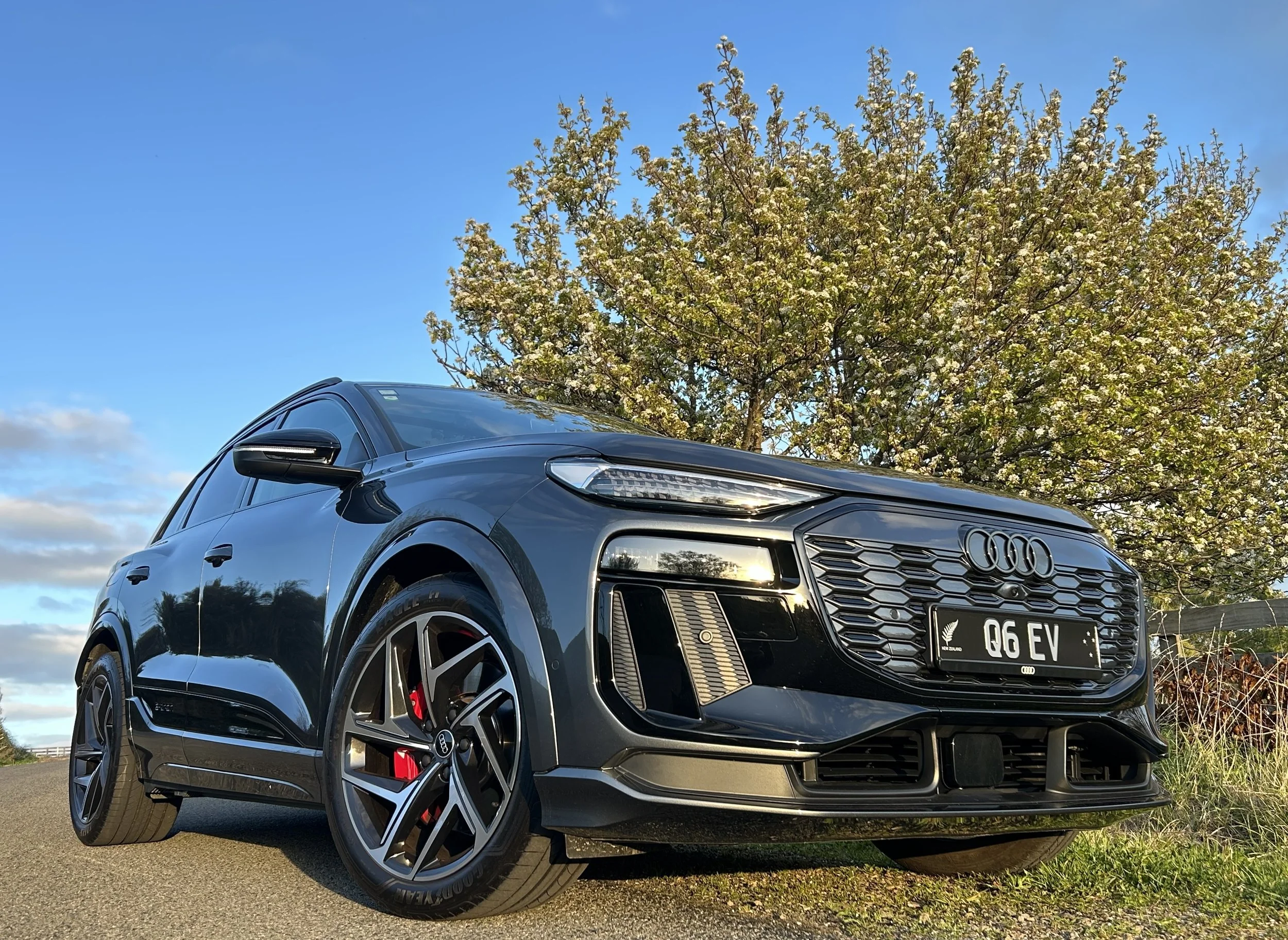
He acknowledges Audi NZ has enjoyed massive success with its S and RS badged models. RS penetration here is world-leading on a per head of population count.
A wide span of more than a dozen models – not just the traditional passenger models, but also sports utilities from the Q3 up to the Q8 – are presently leveraging that interest, with more than 200 registered this year alone.
Yet times are changing. While some have 48 volt electrical architectures that alleviate some fuel burn burden, all these heavy hitters rely on souped up petrol engines – from fours to also turbocharged V6s, V8s, plus a V10 - that are the biggest drinkers within their respective model families.
That actually raises another point. When it comes to range, most of Audi’s electrics will prove superior to some of the big banger petrols; the GT, for instance, is expected to arrive with a 96kWh battery that delivers a respectable 400km electric range on the official WLTP test cycle. Try getting that far in an RSQ8.
Sheed isn’t sure the argument needs be that direct. “You can burn a lot of petrol and diesel in any car … we’re just talking about using another fuel type and it happens to be electricity.
“The cool thing about EV technology is that you can ‘refuel’ your car overnight and your running costs are an absolute fraction of what you would normally have.”
Alternately, an 80 percent charge should be possible in as little as 20 minutes if you can find a rapid charger that allows the car to absorb energy at its maximum 350kW rate. Present E-trons replenish at a maximum 150kW.
Dynamics-wise? Even though EVS carry lots of weight, they need not be elephantine.
“You can also do all the things you might enjoy doing in an ICE (internal combustion) car,” Sheed says, pointing out that as well as being massively accelerative, the S models and GT are tailored to undertake drifting naughtiness.
That close relationship with the Taycan also suggests that the handling should be pretty special, as does the fact the battery occupies the entire underfloor area between the front and rear axles.
This helps to give the car a centre of gravity comparable with the Audi R8 supercar which, ironically, is set to be the other model rolling out of the Neckarsulm factory that will host GT production.
Plus, there’s an additional feel-good: “If you’re focussed on sustainability and on wanting to leave the world in a better place … well, there is one clear choice.”
Audi has not signalled intent here or internationally to curtail any of its combustion-engined performance models, but simply the VW Group’s determination to leave ICE behind for an electric future says everything.
Sheed says moves in the United Kingdom and Europe to make the sale of ICE models illegal from as early as 2030 are obviously being noted by makers. The NZ scene is obviously influenced by that, yet of course there’s yet to be direction from Government about fleet intention so “without clear direction … we have no plan.”
However change is unavoidable. “I understand why people are petrol heads and I started life that way, too.
“But I understand where the electrical strategy is and I understand how good an EV can be. If I had a future view about leaving our wonderful country in a better place, my choice is electric.”
Audi NZ has not yet shared specific volume expectation for GT, which stands as the brand’s fifth production-confirmed electric car. Two others that have been made public, the Q4 E-Tron and Q4 e-tron Sportback, are coming to NZ at the start of 2022.
The GT’s finished design is set to be revealed soon, but pictures of camouflaged prototypes suggest that it won’t stray far from the 2018 concept car of the same name.
One last thing. The sound signature: Nothing beats the roar of a performance petrol engine, right? Well, true, electrics cannot emulate that level of noise, but Audi promises the GT will be pleasing to the purist ear. A team of sound engineers have, through blending combinations of 32 different audio tracks, created what they claim will be ‘one of the most aurally active’ EVs on the market.