S-Class schmoozes in

Plenty of luxury and tech, lots of extras too – but just one engine choice for now.

MB_SC_11.jpg

SO much tech and so much additional kit to box tick – but when it comes to powertrains, the decision is dead easy: Though more will turn up in time, there’s just the one at launch.

So it goes with the seventh-generation of the Mercedes-Benz S-Class, available from next week in S450 4MATIC and long-wheelbase S450 L 4MATIC formats, with a common six-cylinder petrol, pricing starting from $215,000.

This is the car touted as the world’s most advanced and, though not every technology developed for it packs into the ‘base’ (yes, wrong word, but …) format – and, indeed, some is not yet available for this part of the world – the car in kick-off form has pretty decent specification.

New Zealand piggy-backing on Australia’s choice has proven a good idea. Our neighbour has gone big on signing up for comforts and assists that have been extras in the European spec.

What we miss out on, though, is the full gambit of semi-autonomous gadgets. While the Australasian-spec cars have adaptive cruise control with stop-and-go, lane centering assist, lane change assist, evasive steering assist, and a traffic-sign assist system that reads speed signs and adjusts the adaptive cruise control system accordingly, the ability - soon to show in the German-market car – to drive itself with the driver's hands off the steering wheels on at up to 60kmh is not featuring. Our laws seem to allow it but Australian legislation does not. And since our neighbour has done the choosing …

MB_SC_02.jpg

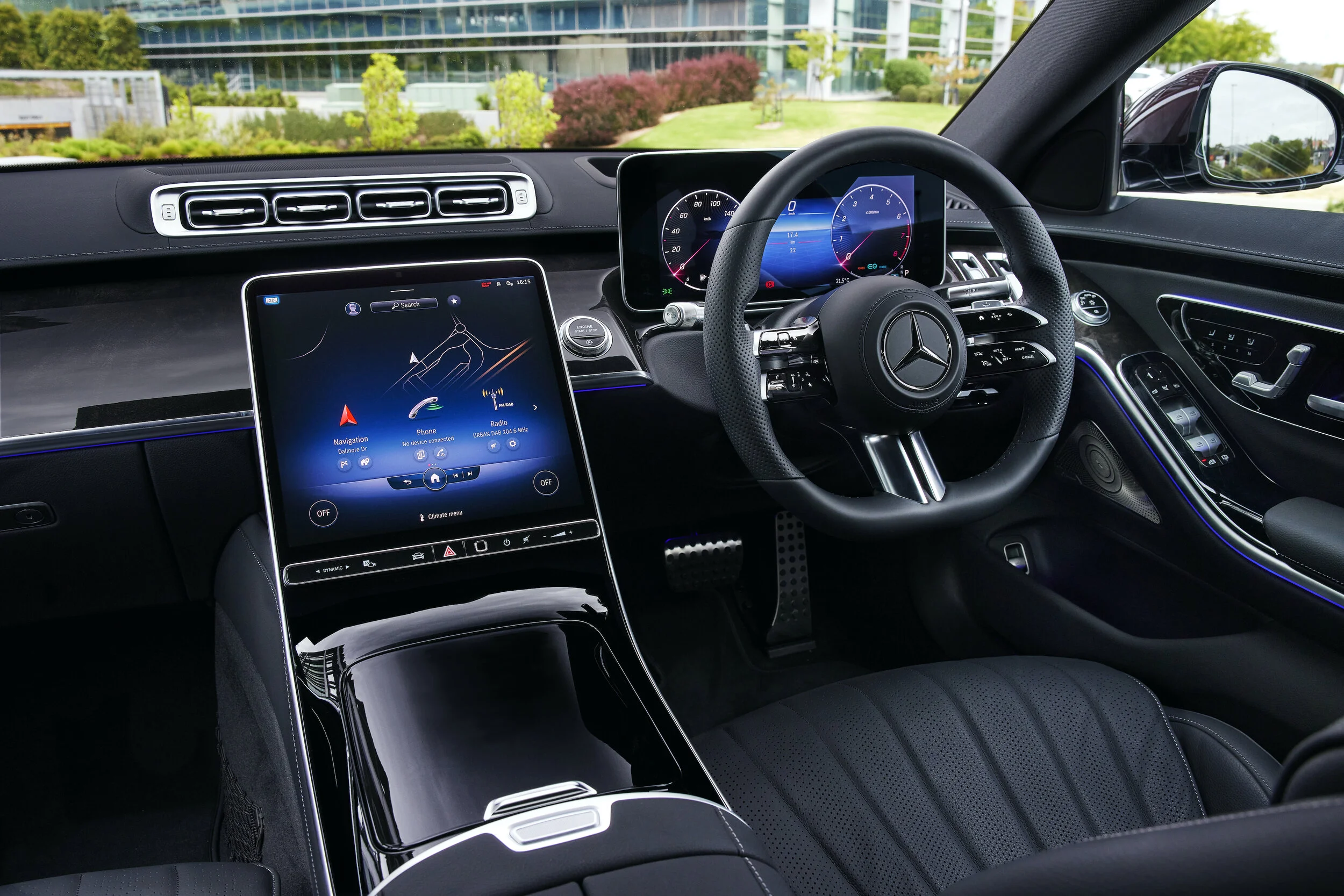
Still, plenty of other gee-gaws to impress. Both cars achieve a 12.3-inch 3D digital instrument cluster (with eye tracking) and a 12.8-inch OLED infotainment touchscreen running Mercedes' latest MBUX operating system, the MBUX Interior Assistant and the "Hey Mercedes" voice assistant.

The car’s satellite navigation system is a new step-up; in addition to projecting live traffic it has a predictive functionality. The head-up display with support for an augmented-reality function which can virtually project navigation directions on the road up to 10 metres ahead.

Other standard features include air suspension, power-closing doors, dual-zone automatic climate control, ambient LED interior lighting, puddle light projection, keyless entry and push-button start, flush retractable door handles, a 360-degree camera and semi-autonomous Active Parking Assist.

There's also an electric glass panoramic sunroof (with sliding and tilting functionality), a power-operated rear sunblind, electrically-adjustable front seats with heating and cooling, memory functionality for the steering column, a fingerprint scanner, a hands-free power boot lid, heated power-folding exterior mirrors, rear privacy glass, and insulated acoustic glass for the front side windows.
MB_SC_14.jpg

 It runs a 15-speaker, 710-watt Burmester 3D surround sound system, with Apple CarPlay/Android Auto of course, wireless smartphone charging and support for the Mercedes Me Connect smartphone app.

You want more? Even though it has LED headlights, Benz locally perceives one popular cost-extra enhancement will be a special feature the brand made a big noise about during last year’s international launch: Adaptive Digital Light LED headlights. These are capable of projecting warnings onto the road with a range 150 metres greater than that of the standard LED units, thanks to 2.6 million 'pixels.' Also possibly set to be popular, for those who park in tight places, is the enhanced rear-wheel steering (with an angle of up to 10 degrees). The 'active' ambient interior lighting and the Energising package also tend to get ticked on other high-end products.

The long-wheelbase model (with 110mm extra length) achieves extras of power-adjustable rear seats with memory, automatic rear climate control and forward-facing airbags in the backs of the front seats but can also be ordered in with a pair of 11.6-inch entertainment touchscreens.

Both models derive power from a turbocharged 3.0-litre inline-six, sending 270kW and 500Nm to the road through a nine-speed automatic transmission and 4Matic all-wheel-drive, for a 5.1-second 0-100kmh sprint time.

MB_SC_15.jpg

The engine is assisted by a 48-volt mild-hybrid electrical system, which can supply an additional 16kW/250Nm boost for short periods under hard acceleration, and enables combined fuel economy ratings of 8.2L/100km and 8.4L/100km for the S450 and S450L respectively.

 A higher-grade S580L variant is expected to be offered later down the road, pairing a 4.0-litre twin-turbo petrol V8 with a 48-volt system for a total of 370kW and 700Nm, and it’s expected head office will hear a New Zealand pitch for the plug-in hybrid edition, with 100kms’ pure electric running.

MB_SC_26.jpg


Peugeot brand on outlets ahead of cars

First NZ-market model with new emblem will be next year’s 308.

PEUGEOT_PR_DEALERDAY.jpg

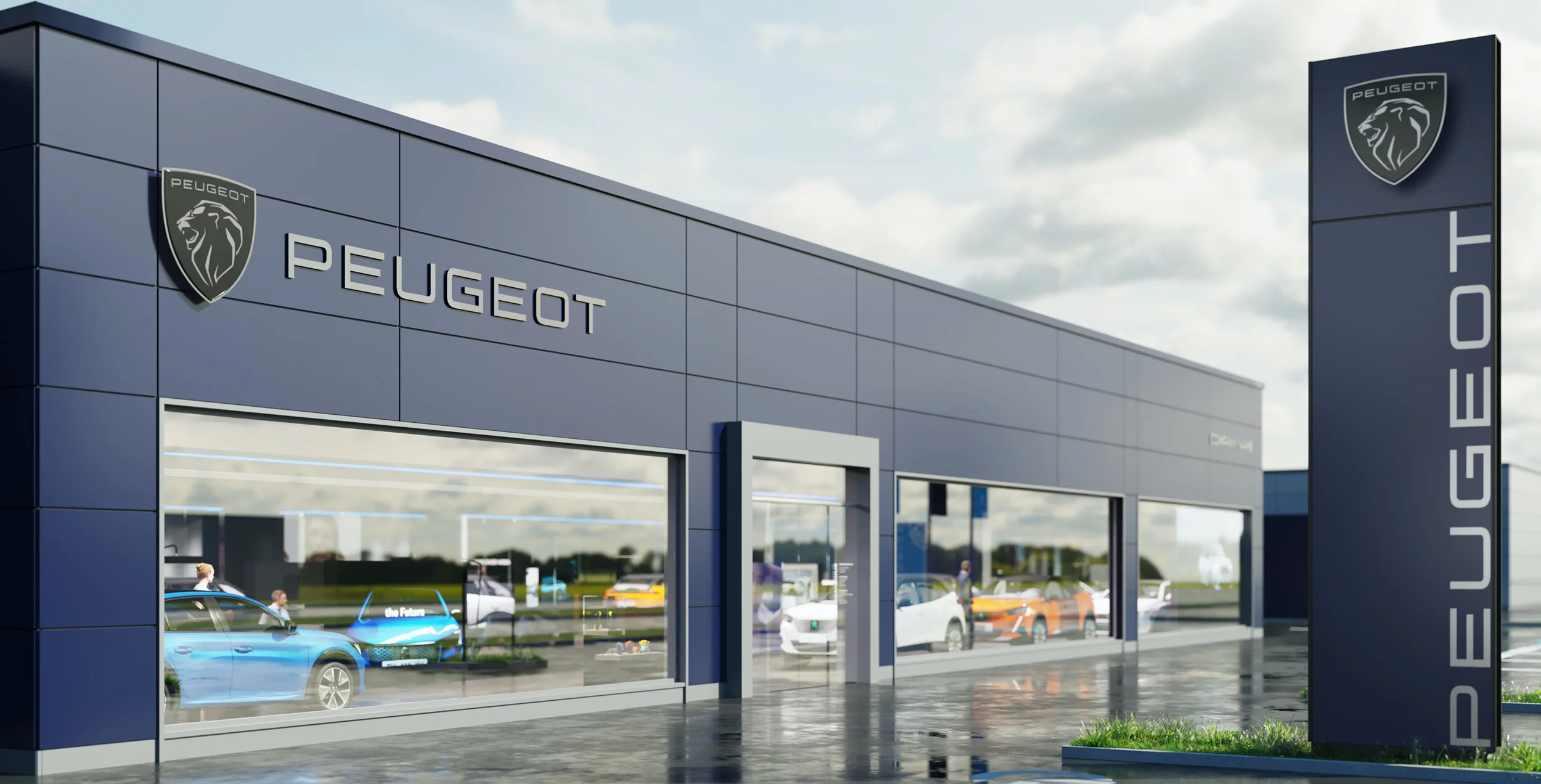
 DEALERSHIPS will likely have at least a six-month head start on displaying Peugeot’s new logo over the first product to bear the back-to-the-past emblem.

 Arek Zywot, commercial manager for Autodistributors NZ, which holds brand rights here, says national sales outlets are probably going to be refitted with the latest corporate identity by late this year.

The first car to take the emblem, which in displaying the head of a roaring lion in profile within a shield is effectively a modern reboot of the black and white badge worn by the brand in the 1960s, is the next 308 medium hatchback, disguised examples of which have been pictured during trials, as seen below.

That car unveils internationally next month but won’t be in New Zealand until some time after February, 2022.

The rebranding has occurred in the wake of Peugeot’s parent, PSA, merging with Fiat-Chrysler to become a new entity, Stellantis.

new 308.png

Along with a fresh logo comes a new intent for Peugeot, to lift its game as one of the more aspirational and upmarket marques within this new combine entity, which with annual sales of approximately eight million vehicles and 400,000 employees, becomes the fourth-largest global automaker by volume.

Last night’s unveiling of the new brtanding ends a busy week for Autodistributors, as it has just landed supply of three new models about to hit the market – the 3008 mid-size SUV, the 5008 three-row SUV and the 208 hatchback, which avails solely in a GT format. The franchise holder’s hope of keeping these cars out of the spotlight until it had media material prepared was blown by a national motoring news provider. 

The just-added models will likely stand out from the 308 as the latter is the first Peugeot production model expected to move to a new styling language so far only seen on the brand’s concepts. 

Peugeot is targeting a worldwide completion of the rebranding exercise by 2023. The rebrand also coincides with Peugeot’s plan to electrify its entire line-up by 2025. 

“Peugeot is moving upmarket,” claimed new Peugeot boss Linda Jackson. 

“We’ve already spent a lot of time working on the vehicles, and this is the second part of the journey, which is all about the customer experience. The trigger is the fact that we love the way that we are now going with the cars.”

Stellantis comprises of Fiat, Fiat Professional, Abarth, Chrysler, Alfa Romeo, Abarth, Jeep, Dodge, Ram Trucks, Maserati, Lancia, Peugeot, Citroen, DS, Opel and Vauxhall.

At present the French marques are with one distributor in NZ whereas the American and Italian brands that export are with another, Ateco. Opel and Vauxhall have historically been part of the General Motors portfolio, but how stands now that Holden has become defunct is unclear.

There has been no public comment from either about the potential for any changes; it is not known if Stellantis prefers all its brands to be with one distributor.

PEUGEOT_PR_NEWLOGO_BLACK.jpg


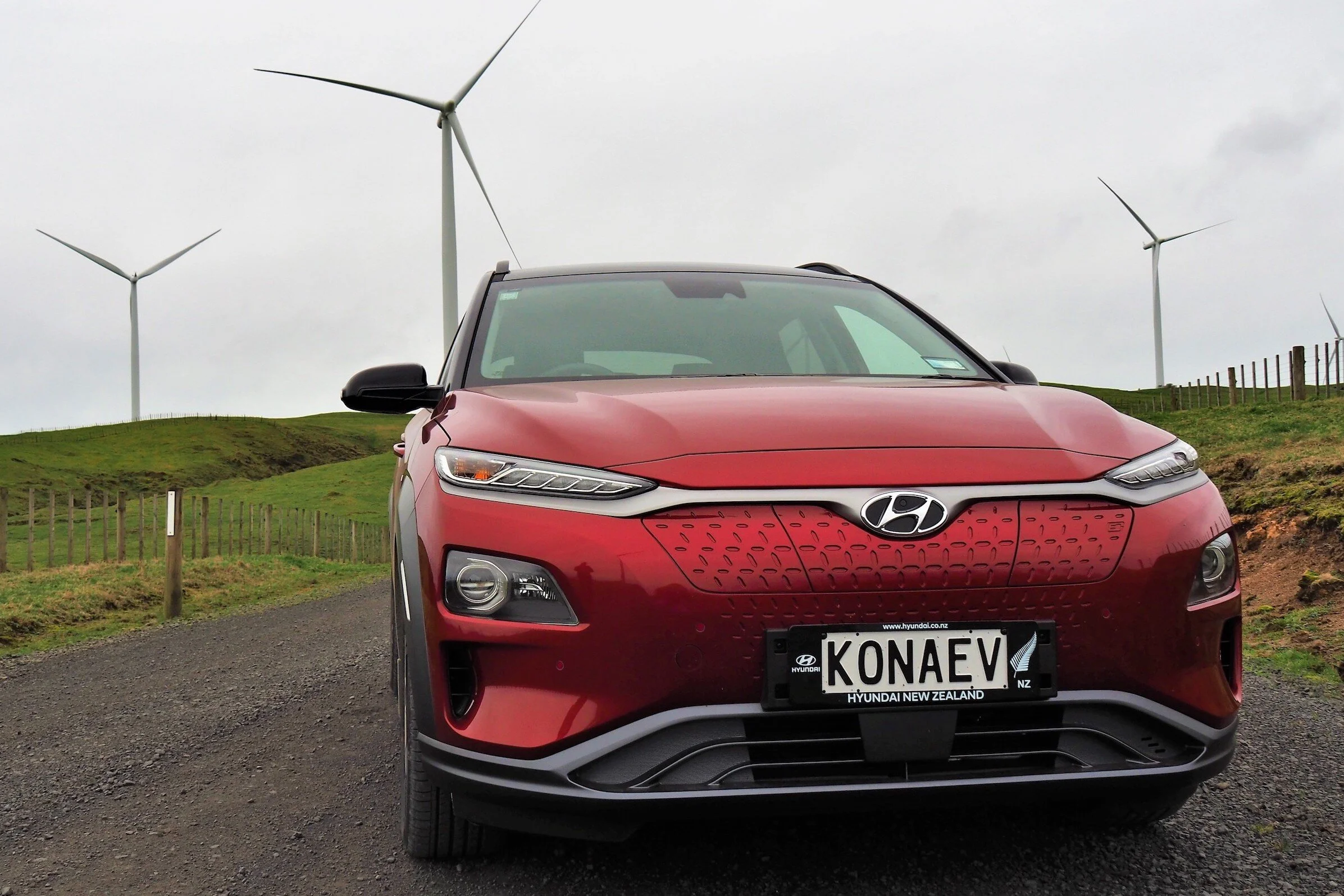
Latest Kona EV kerfuffle not the first glitch

Requirement to change the Kona EV’s battery has a familiar ring to some NZ owners.

The Kona EV battery effectively fills out the entire floor area.

The Kona EV battery effectively fills out the entire floor area.

A PROBABLE recall that demands replacing the lithium ion battery that powers in Hyundai’s highest-profile electric car seems set to hit hundreds of Kiwi owners, including a handful for whom this could well seem deja vu.

Comment from electric vehicle owners about yesterday’s MotoringNZ story relating how Hyundai is moving toward recalling its Kona electric car internationally – and potentially also at least some examples of the battery-pure version of the Ioniq – following a spate of fires in South Korea, has drawn attention to the Kona already being subject to a remedial action here that began five months ago, is only now wrapping up and also sometimes demands the same extreme action of a complete battery exchange.

In November, Hyundai New Zealand recalled 724 Kona EVs it had sold, having been advised by the factory that "the lithium-ion battery may have internal damage or the battery management system control software may cause an electrical short circuit after charging" which could result in a fire.

It is unclear if this is the same fault at the centre of the recent fires overseas.

The immediate remedy for this was to change the battery management system and, if that did not work, Hyundai advised the same procedure it proposes for this new recall – pulling out the battery, a hefty and large item which completely fills out under the floor and is all but a structural component, and replacing it.

Hyundai NZ has said it awaiting confirmation that the Kona EV will be recalled again, however reports from overseas say this is a given and from the tenor of comment it has offered, the local distributor also seemed resigned.

This latest action is a whopper. It is expected to cost $US900 million to execute, a sum that makes it the most expensive recall involving an EV so far, and will cover 82,000 vehicles worldwide.

Conceivably, it will draw in the NZ cars involved in last year’s recall. These were built between September 29, 2017, and March, 20, 2020.

It is thought many were put right with an update to the battery management software. However not all these examples were remedied that easily.

the updated Kona, due to come here later this year, has the same battery pack as cars likely to be recalled.

the updated Kona, due to come here later this year, has the same battery pack as cars likely to be recalled.

MotoringNZ has spoken with a North Island Kona owner whose car, bought in 2018, was off the road from early December until mid-February while it awaited a battery replacement. His vehicle has since faulted again. Learning that it might require yet another battery was exasperating news. 

Kimberley Waters, a spokeswoman for Hyundai NZ, explained the original action.

“We updated the BMS software to allow for detection of abnormalities in the high-voltage battery system while parked.

 “If the software detected any early electronics deficiencies a full battery replacement was required.

“We are 96 percent through the initial recall and through the inspection process some Li-ion batteries were identified as needing replacing.”

The latest action has resulted after a Korean government investigation into why Hyundai EVs – which included a bus as well as some cars - were catching fire. That probe revealed the possibility of short circuits in certain defective battery cells produced by the supplier, LG Energy Solution.

According to Reuters news agency, the battery maker and automaker are currently hashing out a deal to split the cost associated with completely replacing batteries for the EVs.

It's not clear if this news will push back the arrival of the updated Kona EV, which has already been revealed globally and was supposed to arrive in New Zealand this year. The refreshed car boasts an updated design, but its electric powertrain continues unchanged.


Hyundai NZ awaiting EV fire risk recall news

Remedial action for Kona and Ioniq EVs has begun in South Korea; battery replacement for Kona has been proposed.

P8080558.JPG

POTENTIAL that two popular Hyundai electric cars might be drawn into a massively expensive recall triggered by a fire danger that has made headlines in South Korea has been acknowledged by the make’s New Zealand distributor.

Hyundai New Zealand says it is aware of the situation in the marque’s home market in respect to a spate of battery fires reported there in the Ioniq and Kona electric models.

No such events have been reported in New Zealand.

The tenor of the reply from the make’s representative, an independent distributor, in respect to questions about this seems to leave impression a recall might not be out of the question, all the same.

This is supported by latest reports from Seoul, in which the brand is on record as saying it intends to replace the batteries in 82,000 electric vehicles, including 75,680 Kona EVs, 5515 Ioniqs and 305 buses at a cost of more than $US900 million, a record amount for an EV recall.

This comes after multiple South Korean news outlets have reported the manufacturer will voluntarily replace batteries, made by another Korean brand, LG Chem, in all local market examples.

While ignored by mainstream news outlets, the issue has nonetheless become a hot topic of discussion in recent weeks for EV owners subscribing to a national Facebook forum.

Hyundai NZ spokeswoman Kimberley Waters said today that “to date, there have been no fires recorded in NZ attributable to this condition.” 

She did not address a question asking if owners have expressed concern to Hyundai NZ. 

In respect to the potential for a recall, she offered: “We are aware of the news that has come out of Korea.

“However, (we) are waiting for official communication from Hyundai Motor Company with regards to this recall and the number of EVs affected here in New Zealand.

“Safety of our customers is paramount, so as soon as we have a list of affected vehicles we will contact those customers to advise next steps.”

A major South Korean news outlet, Business Korea, has reported 15 individual incidents of battery-related fires having been recorded in Kona EVs.

Similar fires have also been reported in Ioniq electric cars. Recently, a Hyundai electric bus caught on fire while operating in Seoul. 

Hyundai has also been caught up in an issue with the Tucson sports utility, citing a potential fire risk deriving from a braking circuit board.

The Kona launched in 2018, a year after the Ioniq released here as Hyundai’s first electric car. A heavily updated Kona EV is set for release in NZ soon and, of course, Hyundai has just revealed its first electric car to be sold under a new sub-brand, called Ioniq, that is intended to go on sale here in the second part of 2021.


Lexus revives V8 IS

There’s a catch to this good news. While the hot rod has returned …. It’s only for the land of the hot dog.

2022_Lexus_IS_500_F_SPORT_Performance_019-scaled.jpg

NO chance: That’s the response in precis from Lexus New Zealand when asked about potential of the just-revealed flagship of its new IS compact luxury sedan line reaching this market. 

The local distributor, operating as an adjunct to Toyota New Zealand, has reiterated a view expressed in other right-hand-drive locales: Namely, that the new car is only for North America. Specifically, the United States.

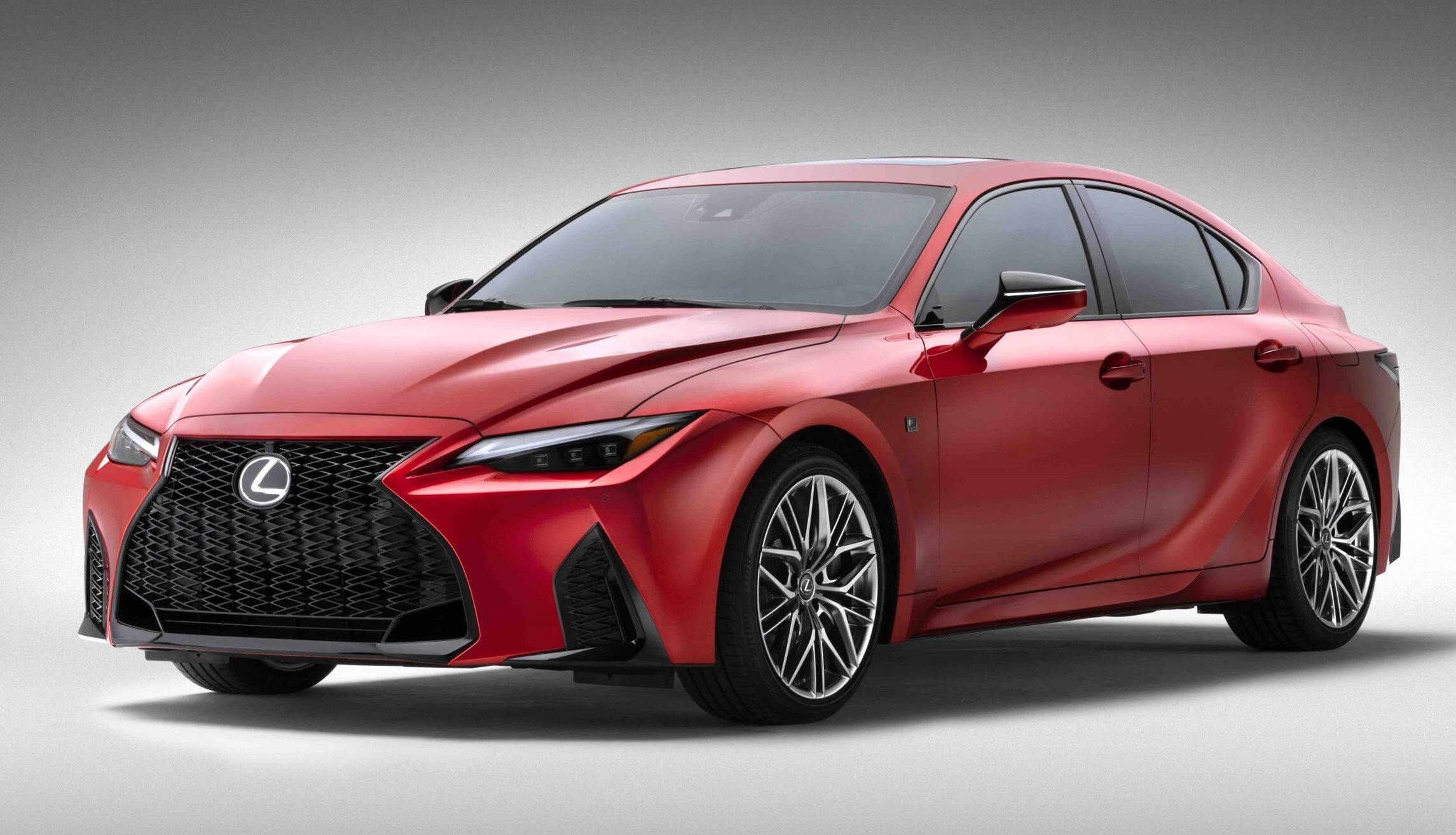
What Kiwis knew as the IS-F, ultimately in a sizzler Redline edition, until it was curtailed in 2014 is now called the IS500 F Sport Performance.

Power is from the 5.0-litre naturally-aspirated petrol V8 seen under the bonnet of the RC-F and GS F performance cars, but also involved with the IS-F since it was born in 2008.  

In this latest application it develops 352kW of power at 7100rpm and 536Nm of torque, at 4800rpm. That’s a 41kW and 31Nm lift over the outputs cited for the last of the IS-Fs, which in its own right moved with astounding alacrity.  

The extra wallop would certainly enhance the pedigree when measured against two of the best in the business, the BMW M3/M4 and Mercedes Benz C63.

Lexus claims a 4.5 second 0-100kmh time. Kerb weight is rated at 1765kg, up just 65kg over the most exciting model in the current NZ line-up, the rear-wheel-drive IS350 F Sport.

2022_Lexus_IS_500_F_SPORT_Performance_033-scaled.jpg

Under the skin, the 'standard' IS's 'Dynamic Handling Package' has been fitted as standard to the IS500 to help cope with the extra grunt, with additions including adaptive suspension, a Yamaha rear performance damper (designed to reduce body flex and increase rigidity), and a Torsen limited-slip rear differential. 

19-inch Enkei alloy wheels fill the arches – which are said to be 2.7kg lighter in total versus the regular IS F Sport's 19-inch wheels – hiding larger 356mm two-piece front and 323mm rear sports brakes.

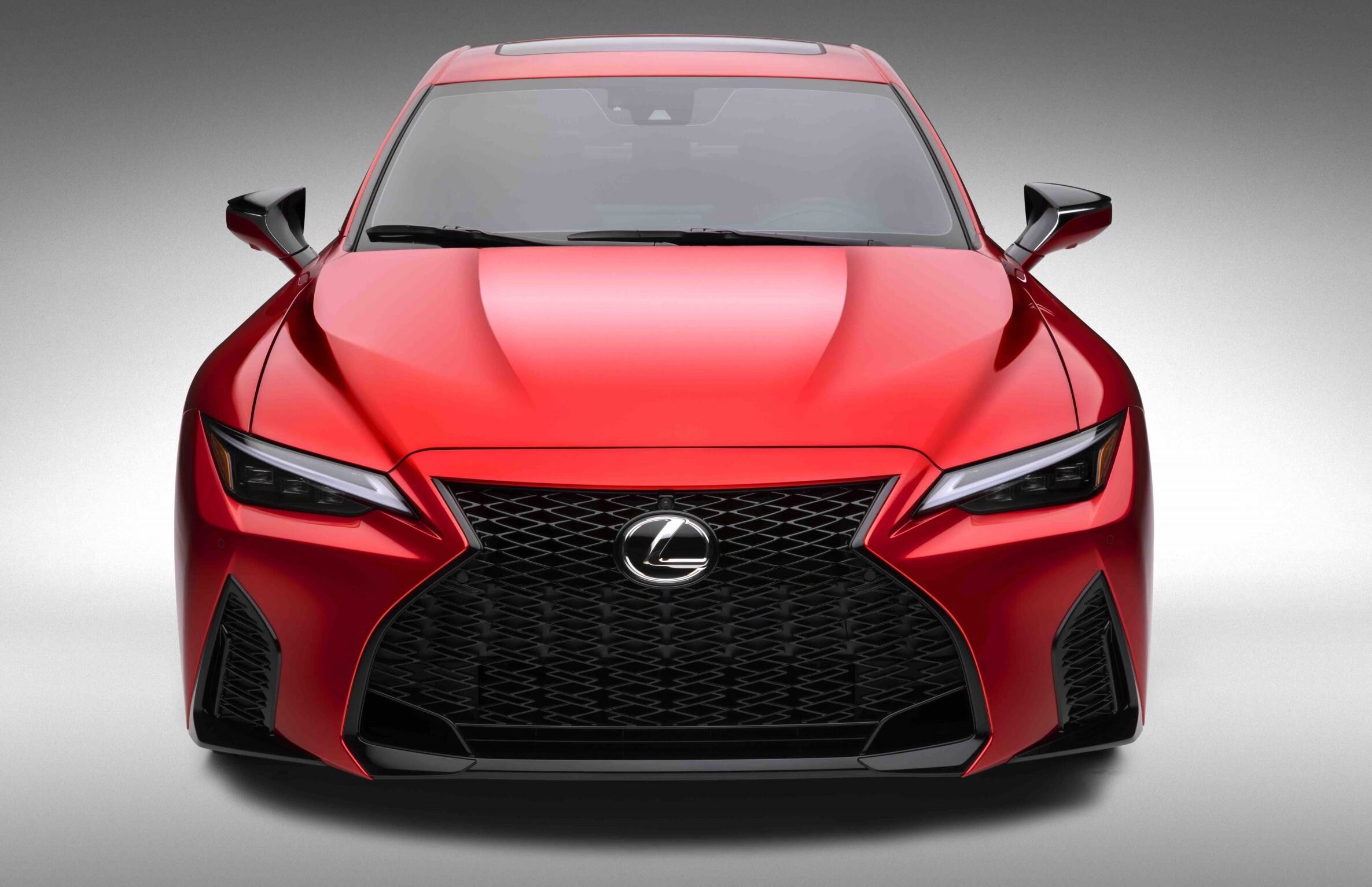
Styling upgrades over NZ-familiar IS F Sport models largely comprise a 51mm-taller bonnet to accommodate the V8 engine, "lengthened" front bumper and quarter panels, a new rear diffuser with the brand's signature stacked quad exhaust tips, black window surrounds, black badging and a black lip spoiler.

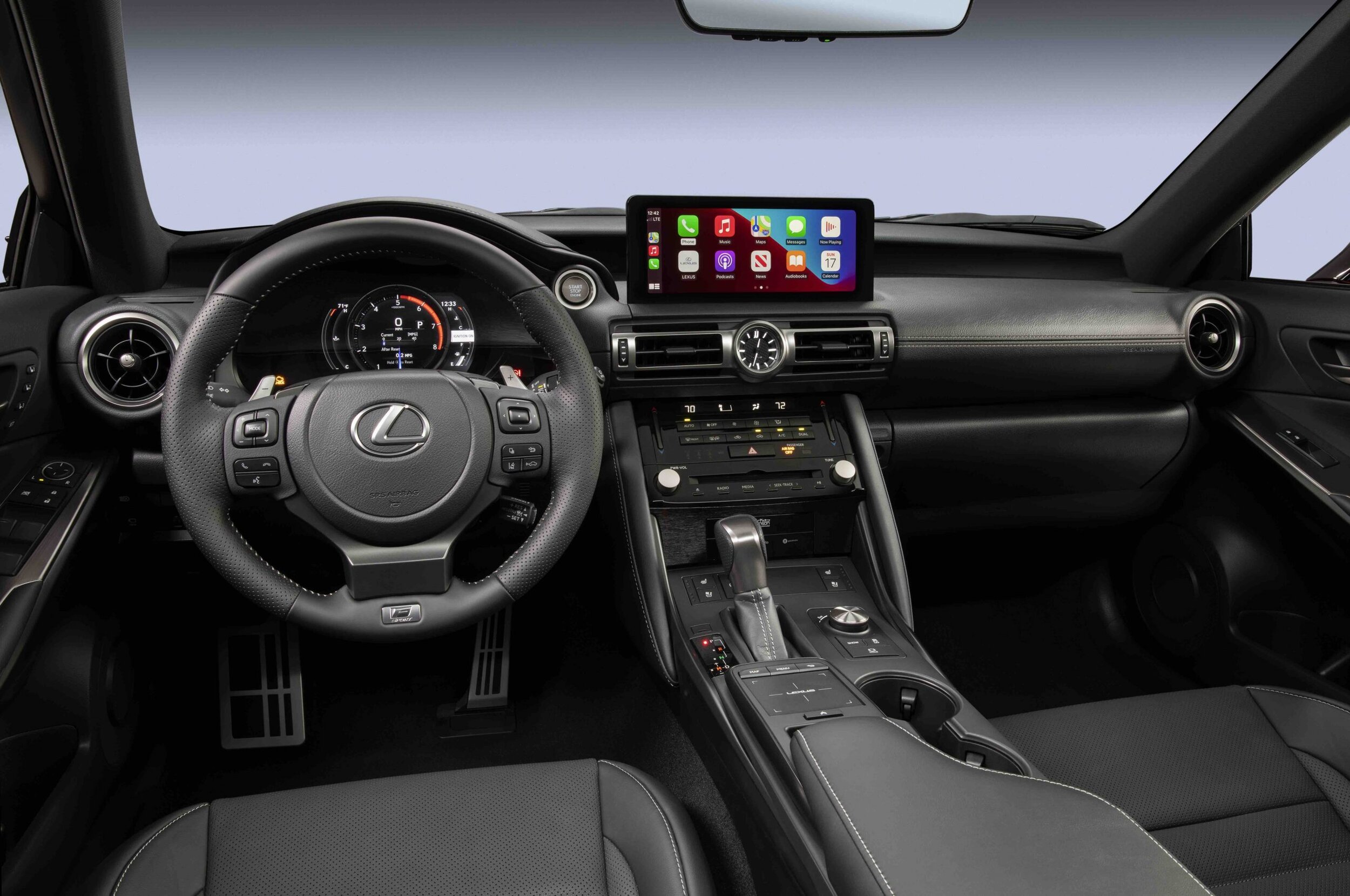
Inside, the standard model's 10.3-inch infotainment touchscreen and digital instrument cluster are carried over, with changes limited to F Sport Performance badging on the steering wheel, metallic pedals, unique illuminated door sill plates and an IS500-specific start-up animation for the instrument cluster.

 The full Lexus Safety System Plus driver assistance suite carries over to the flagship.

By chance, in an interview given to MotoringNZ.co, just weeks ago – when the IS500 was still under wraps – the potential of there ever being another IS-F was discussed by Lexus NZ boss Andrew Davis.

At that time, he said he did not know of anything on the horizon, but added: “There is speculation on IS-F and I think this speculation just shows there is still market interest in those sorts of cars.”

Lexus has RC-F and has had GS-F, so there’s logic to think there might still be space for another IS-F, he said then. That the old model has established a cult following also weighed into it.


C seen – Mercedes new-gen compact exec unveiled

The make’s smallest rear-drive passenger road car goes big on S-Class tech.

20C0673_002.jpg

WHAT derivatives are coming, when do they arrive and, of course, how much will they cost?

Sorry, it’s premature asking those questions yet in respect to the all-new 'W206' Mercedes-Benz C-Class.

The car’s official international uncovering has only occurred today, so Mercedes’ New Zealand distributor says answers to any questions in respect to the local lineup will have to wait until much closer to the car’s release here. Which will occur late this year.

For now, then, it’s all big picture stuff – and that, alone, is quite a story in itself.

20C0673_130.jpg

Suffice to say, the German company's latest compact executive car, so far revealed in mainstream sedan and wagon formats (as per tradition – the coupe, convertible, crossover and AMG editions of everything will follow in due course) is pukka premium in more than just presentation, pedigree and pricing.

This fifth generation family also channels much of the look and technological content of the make’s flagship S-Class uber-sedan and has an entirely electrified range of drivetrains from the get-go.

Yes, it’s bigger. The wheelbase has gone up 25mm to 2865mm in total on both body styles, resulting in a sedan that is 65mm longer (4751mm) than its four-door forebear and a wagon that's 49mm longer (also 4751mm).

The car’s 10mm wider in the body and 13mm wider across the mirrors, while their track widths have increased, too. Both shapes are slightly lower than the previous versions, with reward in improved drag coefficients (0.24 sedan, 0.27 wagon).

20C0673_012.jpg

The general shape is sort of C-generic but it’s quite different to what we get now, with a swoopy air abetted by short overhangs, a long wheelbase and a cab-rearward design.

All models roll on alloy wheels of between 17 and 19 inches in diameter. The radiator grille design varies depending on the trim grade. Base cars have a large three-pointed star and louvre details, higher-spec editions – including AMG Line models – achieve a star-design chrome pattern. The headlamps are all new as are the tail-lights. Three new colours - Spectral Blue, High-Tech Silver and Opalite White – join the C's colour palette.

The dimensional changes reward occupants. Both seat rows have more headroom, legroom, elbow-room and shoulder-room. The wagon gains 30 litres more luggage space; there’s 490 litres capacity with all seats in play and 1510 litres with everything folded. The sedan’s boot retains the same 455 litres’ capacity as the current car.

But roominess will be less of a focus than the tech. This C-Class enters the heavily digital age with its boots on … there’s a a TFT instrument cluster (minimum 10.25 inches across the diagonal, with the option to upgrade to a 12.3-inch unit) and a large infotainment screen reclining on the centre stack, this being at least 9.5 inches, or 11.9 as an option.

20C0677_040.jpg

The dashboard design lends to an aviation theme; Benz has split it into two tiers for a wing-like formation, and the rounded air vents are said to be reminiscent of jet engines. Various leather, leatherette, wood and metal upholstery/trim choices are available, a colour head-up display is an optional extra and the connectivity of the car is boosted with several software packages plus over-the-air technical updates.

Under the bonnet? As expected, four-cylinder, mild-hybrid turbocharged drivetrains pervade; performance pep is important, but this is Benz driving into an eco future. An integrated starter-generator (ISG), running off a 48-volt electrical system, is a standard ingredient to provide 'gliding' when off the throttle, power-assistance under acceleration and energy recovery too, all to save some fuel. There's also Mercedes' EQ Boost, which adds 15kW power and 200Nm.

NZ will presumably only have eyes for the petrols, which start with a 1.5-litre in the C180, this engine making 126kW and 250Nm from the engine, plus the EQ Boost involvement, which can do 0-100kmh in 8.6 seconds.

The C200 also uses a 1.5-litre engine and it has 152kW/300Nm before EQ Boost, resulting in a 0-100kmh time of 7.3 seconds. The C300 is a 2.0-litre unit with the same EQ Boost function, adding to the engine's 192kW and 400Nm for a six second 0-100kmh run and 250kmh top speed.

21C0053_029.jpg

Fuel economy and emissions counts figures will be shared once the cars’ WLTP homologation is completed.

If mild hybrid doesn’t seem good enough, don’t worry. Mercedes also has a plug-in hybrid model in the pipeline. This pairs a 95kW electric motor to a 152kW 2.0-litre petrol engine for system outputs of 233kW and 550Nm, along with up to 100km of all-electric driving range, courtesy of a 25.4kWh lithium-ion battery pack, at 100kmh, or higher.

The nine-speed automatic gearbox is carried over, but now calibrated to work with the ISG. Everything is rear-drive, of course, but  4Matic all-wheel drive is an option on some models in some markets.

The chassis is a development of the current underpinning, but with a new four-link front axle and a multilink rear end that's mounted to a subframe form a suspension set-up that is said to provide a good blend of agility, comfort and fun. Optional adjustable damping, a Sport specification and even air suspension on the rear axle of the plug-in hybrids will all be offered, as will rear-wheel steering.

There’s a massive array of advanced driver assist safety systems and it achieves the schmanzy digital light headlamp technology from the S-Class, in which the light from three powerful LEDs in each cluster is refracted and directed by 1.3 million micro-mirrors, resulting in a resolution of 2.6 million pixels per vehicle.


Five a big numbers car

A host of clever tech comes with the first product from Hyundai’s new EV sub-brand

IONIQ5-01.jpg

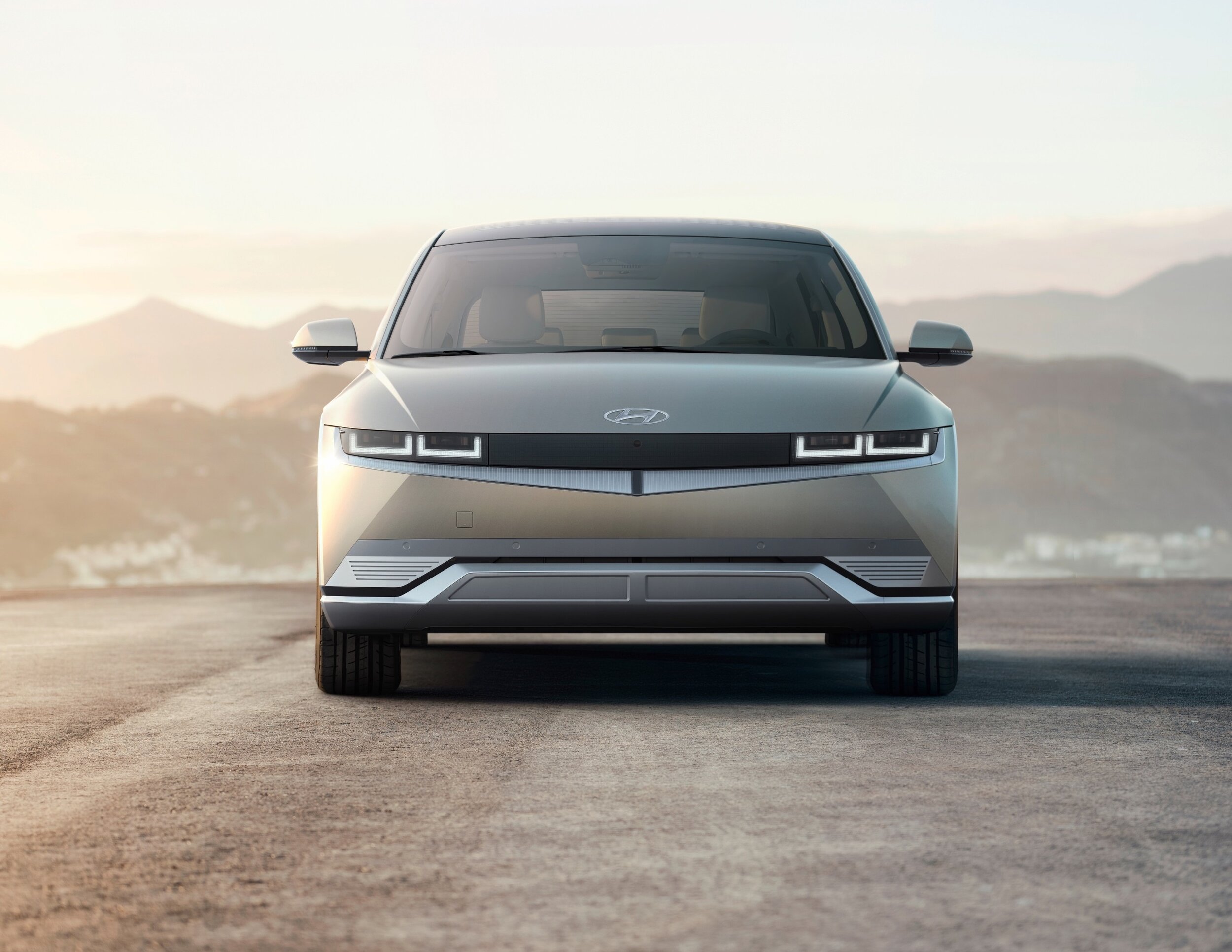
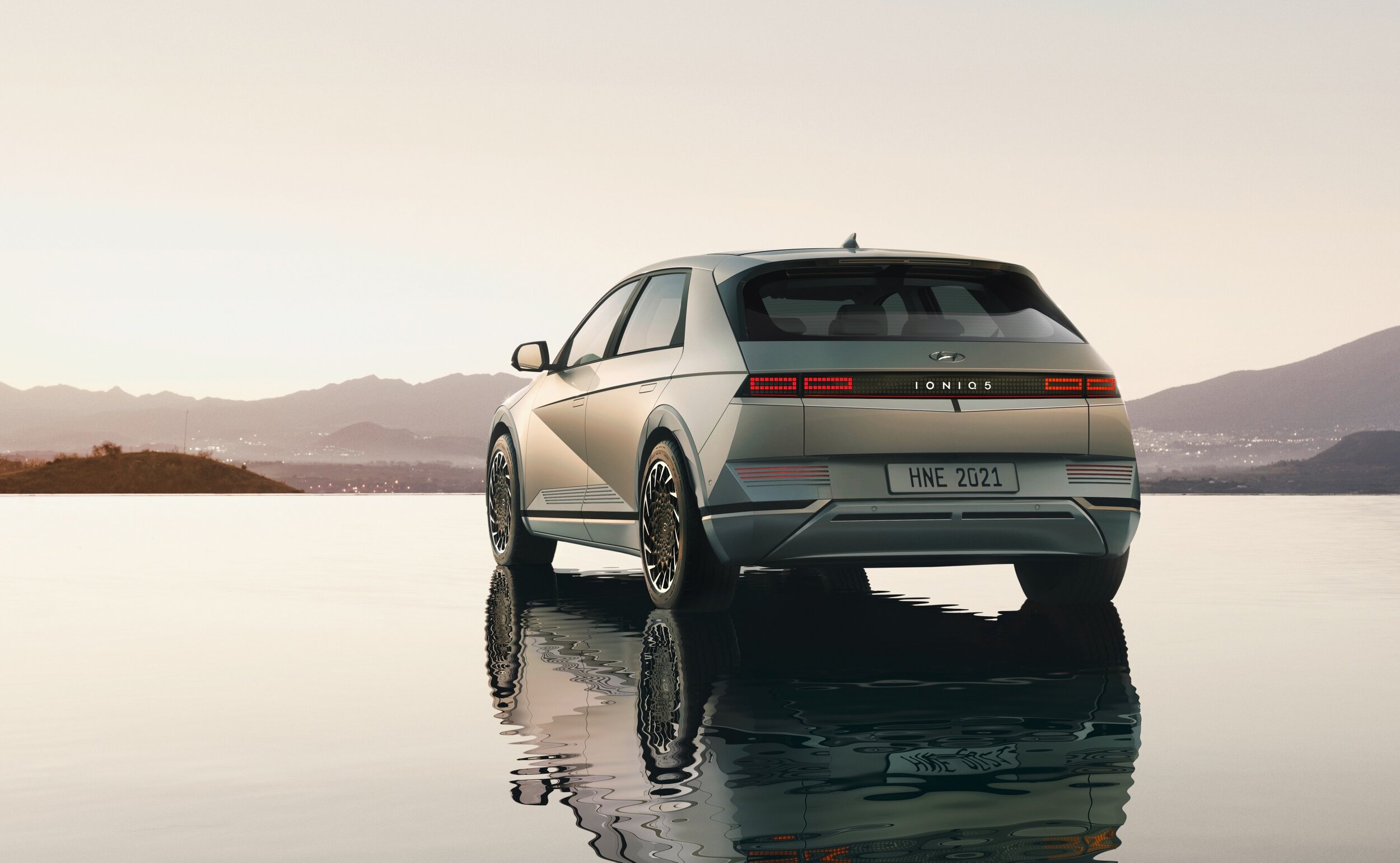
ANTICIPATED local availability is the second half of his year – oh, and what you see may or may not entirely be what you get.

That’s the initial message out of Hyundai New Zealand in respect to the ‘5’, the first of a new lineup of all-electric Ioniq-branded cars, and the first to use Hyundai's high-tech new Electric-Global Modular Platform (E-GMP).

In comment timed with the car’s global unveiling overnight, local brand spokeswoman Kimberley Waters has offered: “Please note that this is a global release so specifications will vary per country/region.

 “Once we are in a position to share more about the IONIQ 5 specifications for the NZ market (anticipated arrival is the second half of the year) we will so.”

That cautionary comment seems reasonable – this initial unwrap suggests there’s  conceivably a lot offered with this car that stretches, if not outright breaks, existing local boundaries.

It’s fair to suggest that that platform is arguably the most important thing about this hatchback.

It means that not only does it have a flat-floor interior, optional four-wheel drive, and a range of up to 500km, but it also a facility barely supported in New Zealand -  800-volt charging, until now the preserve of high-end EVs such as the Porsche Taycan and Audi e-Tron GT.

This means that the Ioniq 5 can draw as much as 220kW of power from a high-speed public charging point, meaning that an 80 percent battery charge can be achieved in as little as 18 minutes. Just charging up at maximum for five minutes adds 100km of driving range.

Also, the Ioniq 5's charging system is also the first to come to market with something else Kiwis have yet to experience: Vehicle-to-grid capability. That means it’s a portable generator in itself.

The idea is can power tools, camping equipment, laptops and an electric bike. Hyundai envisages that, in the future, you will be able to sell excess charge in the battery to the national grid at peak times and then recharge your Ioniq 5 later on, at cheaper night rates.

The car also provisions with either one or two electric motors, for two- or four-wheel drive. The single motor version uses a 126kW rear-mounted motor. The all-paw is a dualy, with a combined power output of 227kW and 605Nm of torque. In latter form, the Ioniq 5 will accelerate from 0-100kmh in just 5.5 seconds.

Range depends on the battery. There’s a choice of two - a 58kWh unit or a 72.6kWh unit. Hyundai hasn't indicated the range for the smaller, but the bigger one, with a single electric motor, lends 480km on the WLTP test.

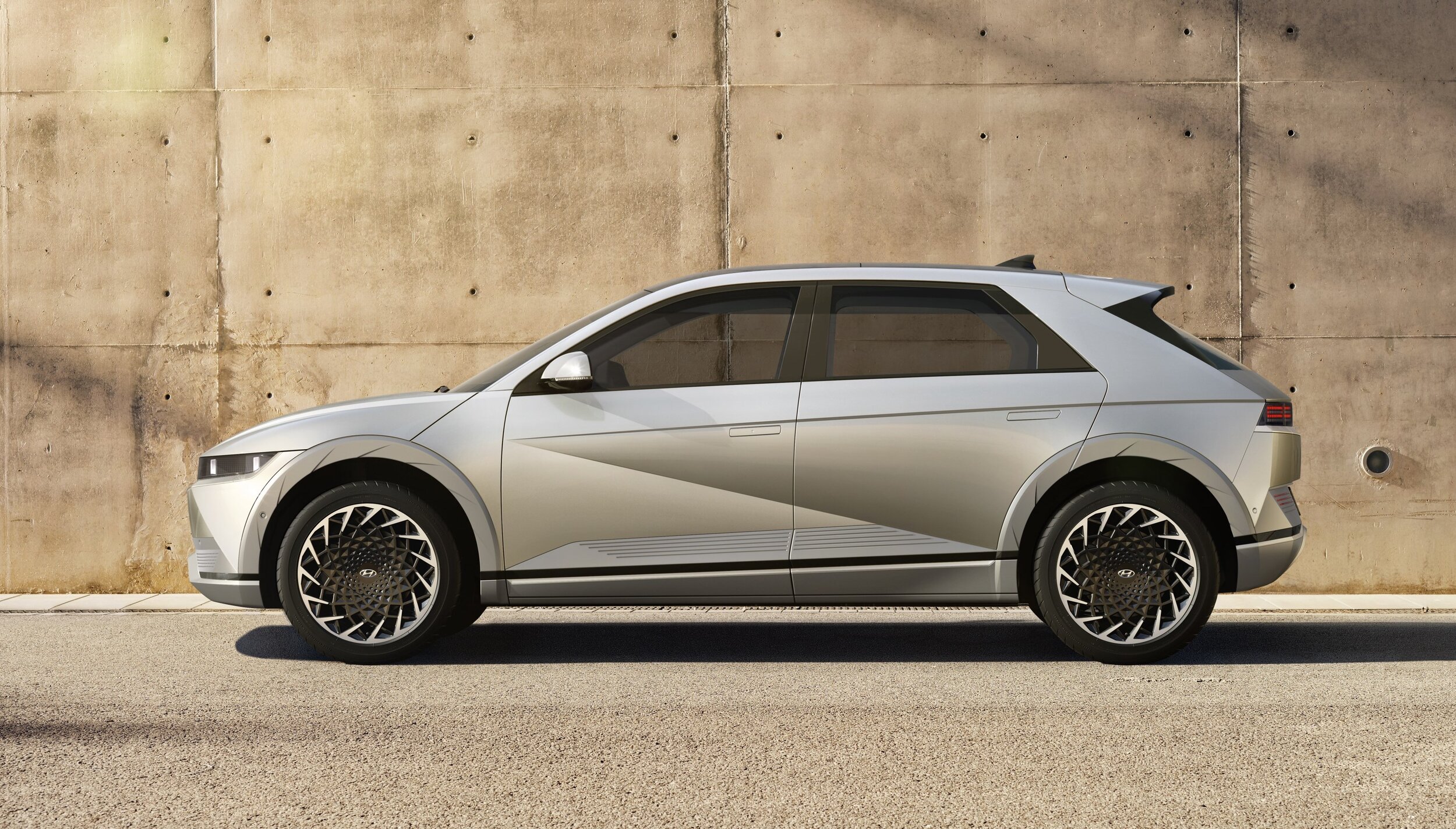
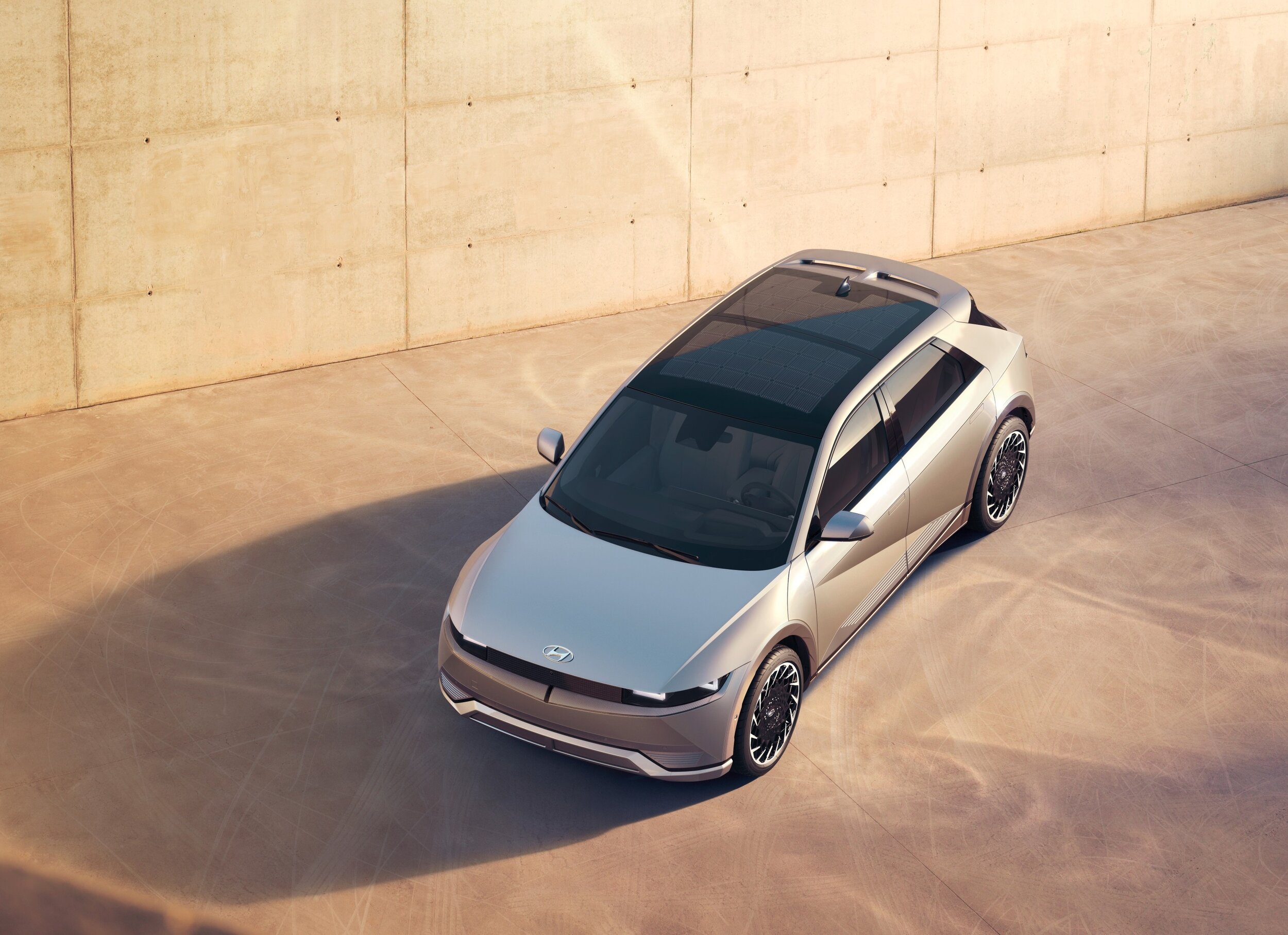
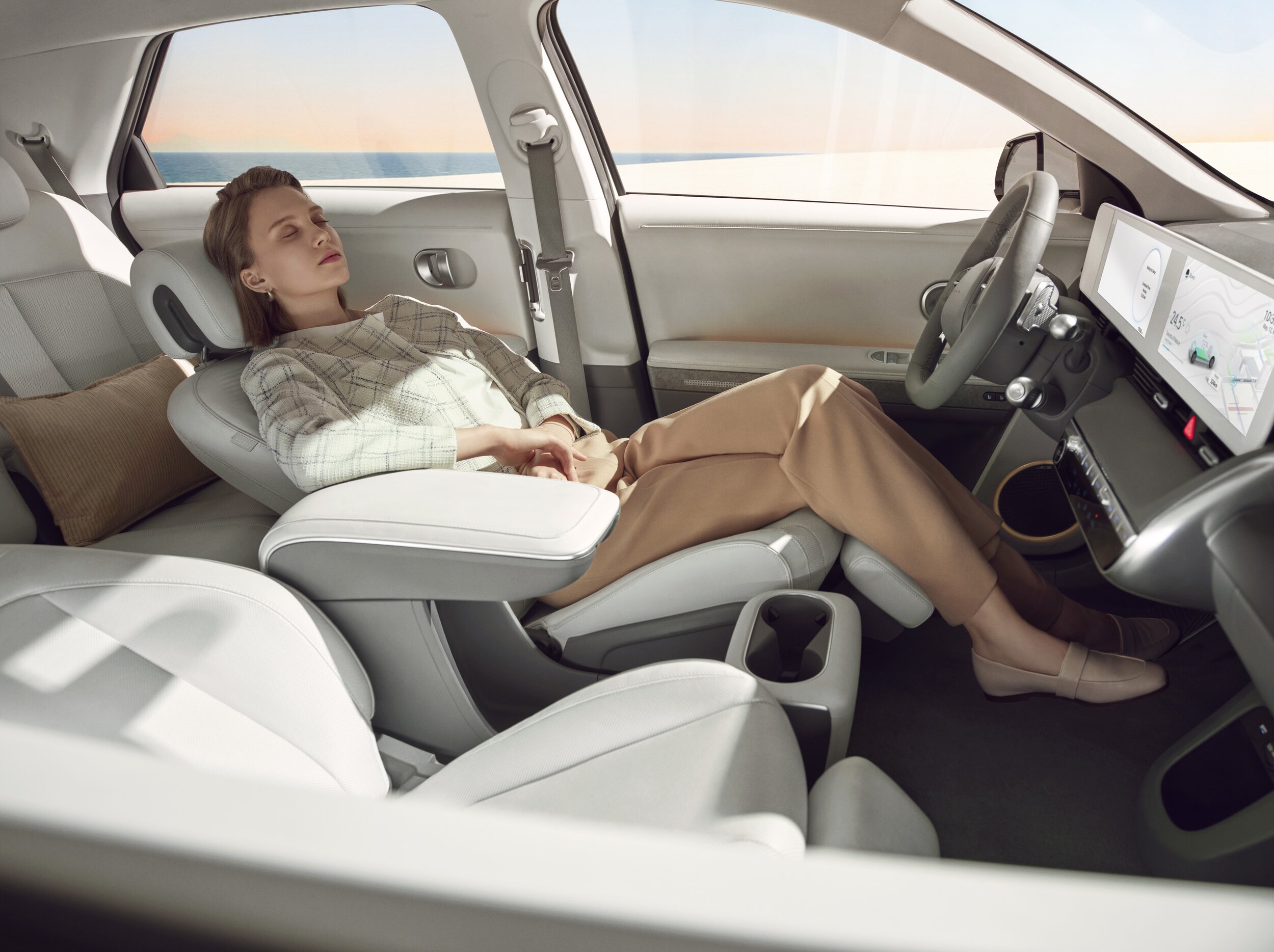
The styling influence is the first car Hyundai sold in NZ, the Hyundai Pony, but not seriously; size-wise it is much larger, too. It seems spacious, with a three-metre wheelbase, flat-floor, and lie-flat seats. The centre console slides back and forth; one reason being so front seat passengers can get in and out through either front door. There's a spacious 531-litre boot as well.

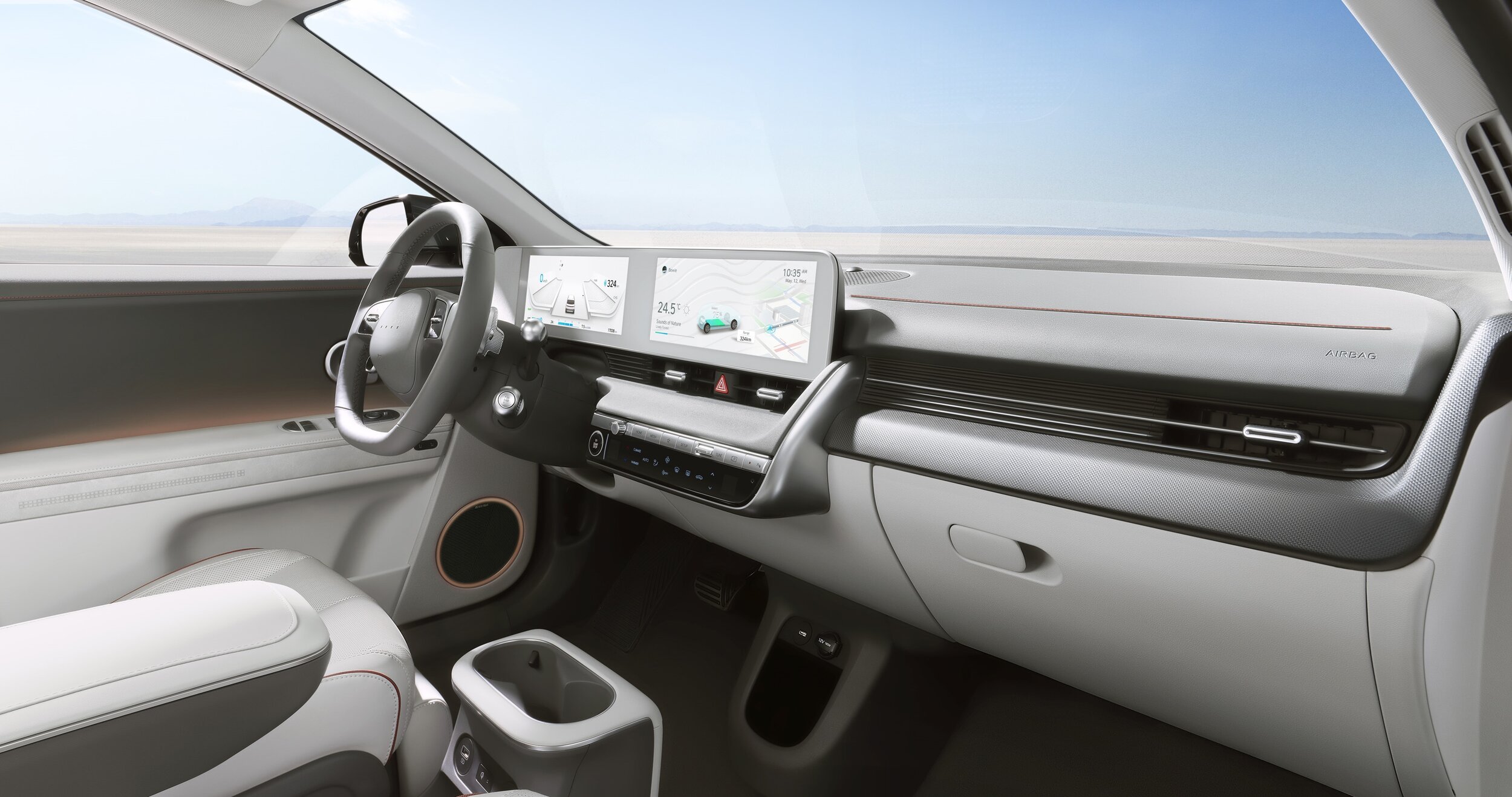
There are two 12-inch displays up front for the instrument panel and the infotainment system, plus an 'augmented reality' heads-up display. The Ioniq 5 will also come with the full suite of 'BlueLink' connectivity, meaning in-car internet connection, smartphone control, and more.

Price? There’s been all sorts of speculation, but nothing confirmed, let alone locally.But given the spec, the car’s size, the fact that its job is to establish Ioniq as a more techy and glam alternate to the parent brand’s own electric cars, the Kona and, erm, Ioniq (hatch) and even the factor of Hyundai here being represented by an independent distributor rather than as a factory shop (as sub-brand Kia effectively plays) … well, don’t be surprised if at least the AWD pushes aside the up-to-$130k Palisade large SUV as Hyundai’s most expensive product here.


Grunty turbo four assigned to NZ Outback

 Promoted as a good replacement for the now defunct 3.6-litre six cylinder in the old model, the new engine is expected to arrive late next year.

Goat 1.jpg

 A PERFORMANCE four-cylinder engine with six-pot-equalling kapow and a more rugged off-road specification will deliver to the new Subaru Outback, launching in New Zealand tomorrow.

At an event for the new car in Queenstown, Subaru New Zealand managing Wallis Dumper said a highly-celebrated 2.4-litre turbocharged four-cylinder engine that presently only avails to the model in North America is NZ-bound, potentially before the end of next year.

It seems possible this engine will place into several derivatives, one with a Wilderness specification that is also set to hit the US soon and is designed to give the car even greater off-road robustness. Wilderness is intended to be a sub-brand - so, ultimately, there will likely be a Forester Wilderness as well, also fitting out with a lifted suspension, knobby tires, black six-spoke wheels, and a rougher appearance, including a reprofile front bumper and beefier side protection.

As things stand, the sixth generation Outback is here in three specification levels – Outback, Outback X and Touring – that respectively price at $49,990, $54,990 and $57,990.

 All run an updated version of the previous car’s mainstay 2.5-litre.

This normally aspirated, direct injection flat four unit generates 135kW and 245Nm – so, 6kW and 10Nm more than the outgoing engine. Optimal fuel economy is slightly improved, with 7.3 litres per 100km claimed.

That the new range does not continue with the 3.6-litre six-cylinder engine that ran in a $59,990 flagship appears to be of concern to  Subaru NZ.

 The H6 was popular with a sector who enjoyed its extra oomph for towing. At peak popularity, it achieved 25 percent of volume, though that desire cooled to an 18 percent take-up toward the end. 

Dumper is certain the 2.4-litre, which outputs, in US market format, 193kW and 360Nm would placate Outback fans who had supported the 3.6-litre, which delivered 191kW/350Nm.

All the new Outbacks cost more than their predecessors. In the outgoing line, the entry 2.5-litre car cost $47,490, the medium spec was $49,990 and the 2.5-litre Premium cost $52,490.

Even though the new car looks a lot like the one it replaces, it is by and large a fresh start. Dumper says it is a step up for sophistication; the biggest, safest, most technologically advanced and luxurious Outback ever.

 Subaru NZ is also driving interest with an intriguing customer support offer; the warranty cover will double to six years for any owner who also selects a servicing plan that costs $999.

There is no mystery about the MY21’s look and details as it has been on sale in North America for more than 12 months, with the world getting its first look when it was revealed at the 2019 Detroit motor show.

The NZ market look achieves a different grille to the US models and the wheel arch surround design is altered as well.

Outback has been available in NZ for 25 years and the recipe remains highly familiar: A high-riding wagon with a constantly variable transmission always full-time all-wheel-drive. 

The body is slightly larger and roomier and bases on the Subaru Global Platform (SGP) that debuted with the latest Impreza some years ago.

The MY21 car has an uprated towing capacity of 2000kg – an increase of 25 percent over the current model.

Goat 2.jpg

Subaru New Zealand has tailored an advertising campaign that centres on it being a GOOAT – a play on ‘greatest of all time’ altered to stand for ‘greatest Outback of all time.’

The outgoing Outback contributed about 35 percent of SNZ’s volume but Dumper reckons this one can bring it back to when the model delivered 50 percent of the brand’s volume here. 

However, he concedes Subaru will be constrained, because of Covid-19 and also a worldwide shortage of computer microchips, in how many cars it can built.

Dumper says he has been allocated 3500 cars for this year, of which around half will be new Outbacks, yet he is concerned if the model takes off demand could outstrip ability to supply immediately. So, he will work to achieve extra cars if he can.

The new car delivers a 11.6-inch infotainment touchscreen and the latest generation of the company's 'EyeSight' driver assist system, including a driver awareness monitoring system using facial recognition software that arrived with the Forester.

Lane centring, autonomous emergency steering, emergency lane keep assist, speed sign recognition with intelligent speed limiter, lane departure warning with steering wheel vibration and lane departure prevention are fitted, but the full-strength kit is restricted to the Touring.

Other available technologies include forward and reverse autonomous emergency braking, adaptive cruise control and a 360-degree camera.

The model adopts as standard the updated X-Mode selectable terrain response system that has been an ingredient of the current Outback X and also first showed in the current Forester.

This combines driver-selectable drive modes for terrain and weather management with differential locks and hill descent control to simplify and improve capability on non-optimal driving surfaces.


Hybrid confirmed as Qashqai fully revealed

The next generation of Nissan’s core crossover has been uncovered, along with more detail about its electric-assisted e-Power drivetrain.

All-NewNissanQashqai-Exterior26.jpg

CONFIRMATION that a potent hybrid powertrain will feature in the next-generation of Nissan’s Qashqai crossover has come with the brand now fully revealing the car.

Nissan New Zealand has still not offered any comment about the new model, which once again is being produced in the United Kingdom.

Whether this market will be in line for the new hybrids – psrticularly the top version of which combines a 1.5-litre petrol engine with an electric motor - remains unknown, though given the national climate for such powertrains is warming, the tech would seem to have a good chance.

As previously reported, also offering is a 1.3-litre turbocharged petrol related to that of the current car, but with its own internal improvements to reduce fuel consumption. This unit is now mated to an uprated 12-volt electrical system, known as Advanced Lithium-ion battery System. 

All-NewNissanQashqai-Exterior31.jpg

With Nissan’s hybrid the 115kW petrol engine doesn’t ever drive the wheels directly - instead it sends all of its exertions to a power generator, inverter and 140kW (electric motor that's similar to the one found in the likes of the Nissan Leaf fully electric.

It drives through the Xtronic CVT automatic and also comes with the option of four-wheel drive, with five driving modes - Standard, Eco, Sport, Snow and Off-Road.

The e-Pedal system that features on the Leaf also enacts on the five-door crossover, meaning drivers can make use of one pedal driving. Stepping off the throttle can provide up to 0.2G of regenerative deceleration without any need to touch the brake. 

The revised 1.3 turbo comes in two states of tune, 102kW and 116kW. The more powerful avails with a CVT automatic gearbox and four-wheel drive; the other with a manual six-speed.

The styling is familiar, but the shape is more smoothed-off and more creased in places; it also has the same family face premiered by the smaller Juke. There's also, for the first time, the choice of having 20-inch alloy wheels.

All-NewNissanQashqai-Interior2.jpg

Inside, visibility is said to be improved and there's more room for passengers in the rear - with the back doors opening by up to 80 degrees to make ingress and egress as simple as possible - and the boot space has gone up by 50 litres compared to the old model, too. This is accessed by a powered tailgate as standard.

 Up front, there's an updated and significantly sharper infotainment system plus heavily digital interface. Besides the nine-inch touchscreen, which contains the navigation, onboard entertainment and more, there's a 12.3-inch TFT instrument cluster, while a 10.8-inch head-up display is the biggest in this segment.

All-NewNissanQashqaiCGI-Exterior14.jpg


Grecale blows into view

Teaser images have been released of Maserati’s medium sports utility.

01_Maserati_Grecale_Prototype.jpg

THE name? Maserati’s long-time tradition has been to name its models after winds – Grecale is said to be the “fierce north-east wind of the Mediterranean Sea.”

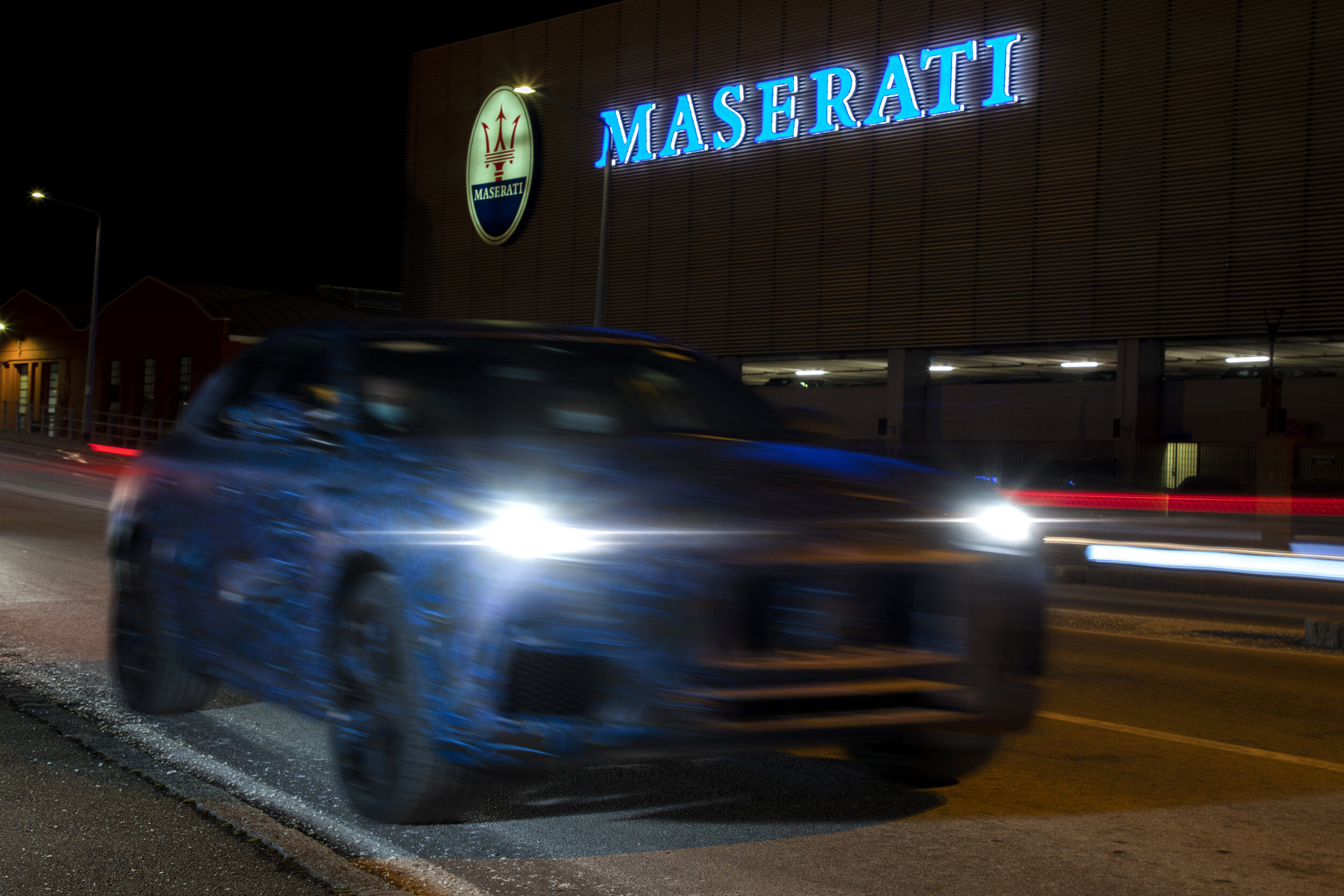
In year from now it’ll be in the showroom, affixed to the rump of Maserati’s first  medium sports utility, which has just been photographed on the road for the first time.

Blurred images of the car outside the brand’s factory in Modena, Italy, came via a hammy marketing stunt – they were distributed to employees who were then tasked with seeding the images out on social media.

 The smaller sibling to the Levante SUV is expected to be based on the same underpinnings as the Alfa Romeo Stevlio, but powered by the same twin-turbocharged 3.0-litre V6 engine as the new MC20 supercar, overseas’ reports say.

Performance figures for the SUV are yet to be confirmed, but Maserati’s Nettuno engine is capable of producing 463kW and 730Nm of torque. However, it will be detuned for use in the Grecale. 

It’s believed Maserati will also offer the Grecale with a pure-electric powertrain. Power and torque figures for the electric model are yet to be confirmed, but Maserati has suggested that the architecture will feature the 800-volt battery technology and support up to 300kW rapid-charging.

03_Maserati_Grecale_Prototype.jpg

Maserati's electric powertrain, branded Folgore, Italian for “lightning,” will consist of a three-motor system with one motor up front and two at the rear.

It’s likely to be shared in due course with the Levante and the Ghibli sedan, which already represents with a mild-hybrid option.

The images support contention that Grecale prototypes are currently undergoing road, track and off-road testing. An official reveal is scheduled for later this year but distribution is set to be a 2022 task.

Maserati is aiming for Grecale to have the greatest top speed of any SUV in its class, while also being the fastest accelerating, best handling and most spacious. Ambitiously, Maserati also plans to go up against the Germans in terms of technology, claiming the Grecale will offer the best in class sound system.

Maserati is busy refettling its entire family. A redesigned GranCabrio is supposed to arrive this year with an electric version in  2022. Also en route is a convertible version of the MC20.

Redesigned versions of the Quattroporte and Levante are also planned, with every job complete by 2023.


New HR-V revealed

Hybrid-only powertrains for primary markets.

4210218_007H.jpg

TECHNICAL details remain unconfirmed, save that it’s a petrol-electric drivetrain promising “exceptional” efficiency, obviously wrapped into a brand new shape.

 More detail is expected to follow in respect to the new-generation Honda HR-V, revealed by the brand today ahead of a global sales roll out that, according to overseas reports, might keep it from New Zealand for some months yet.

Europe is a priority market – yeah, all to do with need to meet that tough and now fully-enforced emissions target – and versions sold there will fitted as standard with a hybrid powertrain, combining a small petrol engine with two electric motors.

Engine size, power and torque outputs, and fuel economy figures have all yet to be announced, as of publishing, but there’ll be no great surprise if it transpires to be a variation of the single-motor hybrid set up version that develops 80kW in the related Jazz hatchback offered in Europe and also set for NZ release soon.

See much new in this third-gen car’s look? Of course you do.

The shape retains a trademark styling cue, those 'hidden' rear door handles but is now far more coupe-like and it takes LED head and tail lights, light strips, a stripe-pattered grille and high-spec models adopt 18-inch rims, whereas entry-level grades have16s.

The dominant feature within a cabin redesigned to maximise the feeling of spaciousness is a new 9.0-inch central infotainment touchscreen with satellite navigation, an inbuilt Wi-Fi hotspot and 'Honda Connect' connected services.

4210218_012H.jpg

The current car’s versatile folding 'Magic Seats' are retained and it achieves a hands-free power tailgate.

Heated seats, LED interior lighting, a premium sound system, a 'Honda Digital Key' service allowing owners to unlock their car via their smartphone an an air diffusion system that sends a "curtain" of fresh air through new L-shaped vents are other stand-outs worthy of animated discussion at the garden centre.


Ford Europe going electric – NZ to follow?

Blue Oval battery drive ties with Volkswagen and starts with a small SUV.

the website for British weekly AutoExpress is picking this as the look of Ford’s first small electric for Europe, a small SUV based off Volkswagen’s MEB platform.

the website for British weekly AutoExpress is picking this as the look of Ford’s first small electric for Europe, a small SUV based off Volkswagen’s MEB platform.

 EVERY Ford passenger and commercial model presently sold in New Zealand might potentially be affected by a bombshell electric drive announcement.

Ford’s decision to transfer its entire passenger vehicle line-up in Europe to electric power within the next few years and also to electrify its commercial vehicle range, including the next-generation of the Ranger utility – a top-seller here in its present form – was delivered overnight. 

The repercussion here is still being considered by Ford New Zealand, with spokesman Tom Clancy saying “we have no news for New Zealand on that one. It’s too early to see how that relates to us.”

However, the inevitability of some degree of impact seems clear enough.

fancy an electric Ford Ranger? It’s on the cards.

fancy an electric Ford Ranger? It’s on the cards.

While Ford is suggesting some of its electrics are just for Europe, the whole plan also appears to draws in future versions of core passenger lines – Fiesta, Focus, Puma and Mondeo (recently discontinued here, but set to re-emerge in 2022 as a SUV that Ford NZ says it will look at) – that NZ takes from that region, with no Plan B.  

We also commit to its Transit van, which is already available in plug-in electric form locally and will go to full electric year.

This schedule also draws in the new-generation Ranger coming next year. That line is a co-development with Volkswagen, whose new Amarok will be a doppelganger, with the programme handled by the same team operating from Melbourne that were behind the current T6.

Talk from Ford Europe is for the one-tonne ute to deliver it with a plug-in hybrid or all-electric option by 2024; presumably these being optional to the diesel engines it will assuredly continue with. Ford has cited intent to achieve two-thirds of commercial sales to be electrified in Europe by 2030. 

The Blue Oval also announced overnight that its first full electric car out of Europe will base off the German giant’s bespoke MEB platform that’s also underpinning all VW Group’s battery-compelled passenger models.

Ford’s model will effectively be a cousin to the to VW ID.4, Skoda Enyaq, SEAT El-Born and two Audi Q4s that are all already NZ-confirmed.

That car will be a small sports utility similar to the Puma. The website for a British weekly, Auto Express, claims the model will derive its styling influence from Ford’s only current electric car, the Mustang Mach-E. It has published images of how it sees it looking.

Fords’ first EV out of Europe is likely to be similar in size to the new Puma.

Fords’ first EV out of Europe is likely to be similar in size to the new Puma.

Ford has also implied the Escape medium SUV will be subject to more electrification beyond the plug-in hybrid treatment it will deliver to NZ later this year.

With all that going, the potential for its performance icon, the Mustang, being ignored seems unlikely. That will be news the NZ fanbase that overwhelmingly choses the current car in its V8 petrol format might find challenging.

However, Ford’s drive toward electric seems cemented. Europe needs to be a primary development site, because this is where brands need electrics if they have any hope of meeting tough European Union CO2 targets. And, of course, beyond that numerous European regions and the United Kingdom are intent on banning on internal combustion engine cars, many by 2030.

Ford says the Fiesta-like EV will be out within two years and will built at a redeveloped Cologne manufacturing plant.

The factory will become the Ford Cologne Electrification Centre - a dedicated electric car manufacturing site. Ultimately it will produce two Ford EVs tailored for European tastes.

AutoExpress says the dimensions of the MEB platform means Ford’s car will likely sit between the Fiesta and Focus in size, and “very close” to the Puma SUV.

“Although the platform is modular and can be extended or shortened with different battery options, it’s expected that Ford’s new EV will be similar in size, allowing clear space between it and the … Mustang Mach-E. However, interior space of the ‘Mini Mustang’ is likely to be in excess of that in the Focus and closer to that in the Mondeo,” the magazine surmises.

Ford will also have VW’s battery technology – so, a choice of 58kWh batteries with power outputs of 150kW or 106kW or a 77kWh battery also with 150kW, but with a longer range.

To be competitive with other MEB models and their rivals, the baby Ford EV would have to offer between 400 and 550 kilometres’ range, AutoExpress says. Fast charging will also be offered with an 80 percent charge expected in a little over half an hour.

Stuart Rowley, the president of Ford Europe, says the announcement in respect to the future of the Cologne factory, which has been outputting cars for almost a century, “is one of the most significant Ford has made in over a generation.”

Artura – the new-age McLaren


Hybrid supercar revealed, NZ pricing indicated

McLarenArturaFlux-7.jpg

FOUR specifications with New Zealand pricing to start from $375,000, our release timing as yet unadvised … that’s the local flavour for the Artura, the sports car that takes McLaren into the part-electrified drivetrain era.

The ‘High-Performance Hybrid’ two-seater that also delivers a fresh chassis architecture  - it’s the first car to sit on the McLaren Carbon Lightweight Architecture (MCLA) - and a shift from eight-cylinder to biturbo V6 power is obviously a McLaren in look, though those who have seen it identify lots of cues from the brand’s Sports Series cars. 

The roof is made from a single-piece of aluminium, while laser-cut mesh is used for a lot of the apertures on the car (including the tail section) and is found surrounding the 'chimney' that releases surplus engine heat.

Artura’s dihedral doors have an LED signature in them that outlines their shape at night, it runs 19-inch front, 20-inch rear alloy wheels, has a relatively long 2.64 metre wheelbase and there are three launch colours that are called Flux Green, Ember Orange and a moody grey-black called Plateau.

Buyers get single-piece Clubsport seats as standard; those after a plusher chair will want the optional Comfort types. Ahead of the driver, two high-definition screens provide all the driving and entertainment information. 

But so what, right? It’s a supercar, so get onto the oily bits …

McLarenArturaStudio-7.jpg

The unit replacing the 4.0-litre twin-turbo V8 petrol has a combined output of 500kW and 720Nm, in isolation the V6 makes 430kW/585Nm. McLaren suggests instant torque of up to 225Nm, ensuring the sharpest-ever throttle response from any of its cars and ferocious acceleration: 0-100kmh in 3.0 seconds, 0-200kmh in 8.3s and 0-300kmh in 21.5s. Top speed is 330kmh. 

The six-cylinder’s packaging is interesting. The cylinders are arranged in a 120-degree vee, with the two turbochargers located inside the banks of pistons, known as a 'hot-inside-V' arrangement, and it's fitted with a short, very stiff crankshaft that allows it to spin to a frenzied 8500rpm. 

Attached to the engine is a new eight-speed dual-clutch automated transmission, as well as an electric motor housed in the gearbox, and a five-cell lithium-ion battery pack rated at a modest 7.4kWh.

McLarenArtura-18.jpg

To that end, the Artura has no mechanical reverse gear - going backwards is handled by the electric motor alone; this trims weight from a car that, in its lightest dry weight form, clocks 1395kg. The DIN weight (driver and 90 percent fuel load) that figure rises to a still trim 1498kg.

McLaren says the Artura can travel around 30km on electric power only, at speeds of up to 120kmh. Its part-electric properties allow the new model to record impressive eco-stats of 129g/km CO2 and in excess of 5.7 litres per 100km), though these figures are as yet unvalidated by the WLTP test.

Proactive Damping Control is a development of the fancy suspension system seen on the 720S and even the Artura's tyres, mounted on 19 inch front and 20 inch rear rims, are high-tech - they're a bespoke set of Pirelli P Zeros with the Italian firm's 'Cyber Car Technology'. This means a chip in the rubber transmits tyre temperatures and pressures on the move. Carbon-ceramic brakes with forged lightweight callipers, these items available in seven different colours, are offered and it has a 72-litre fuel tank.

 The lithium-ion battery pack’s 7.4kWh capacity isn’t massive, but it can be replenished through the onboard 11kW AC charger in 2.5 hours or externally, via a Type 2 electric port. McLaren will offer a six-year battery warranty, a five-year vehicle warranty and a ten-year body warranty.


New Outlander fully revealed

Alliance co-sharing means the gen four car is a Nis-subishi.

OutlanderDGlaunch.jpg

 REVEALED today and set to land locally later this year, the new generation of the popular Outlander sports utility is set to be the first Mitsubishi here with Nissan DNA.

The shared bloodline with a make that has historically been a corporate foe arises from Mitsubishi and Nissan being in an alliance that also involves Renault. 

For Outlander, one of the more popular SUVs with Kiwis with 2424 registrations last year and 2838 in 2019, it means an interesting blend for Kiwis to consider when the car arrives.

Which is when, exactly? “We’re very excited about the launch of the all-new Outlander, which is due to hit our shores later in the year,” says Reece Congdon, head of marketing and communications for Mitsubishi Motors New Zealand.

As for what variants we can expect to see? “Our local line-up will be announced in the coming months.”

Back to the car. External styling is by its actual maker, taking cues from a 2019 concept called the Engelberg Tourer. Likeswise, there’s continuation of core elements such as seven seats and the make’s Super Select all-wheel-drive system. However, the engine, transmission and platform are already used by the Nissan X-Trail.

The platform change to the first all-new Outlander in nine years, and the fourth generation to hold that nameplate, enhances the general dimension and likely will deliver dynamic and safety benefit.

Screen Shot 2021-02-17 at 1.12.43 PM.png

Featuring ultra-high tensile steel for the first time, Mitsubishi claims the new platform offers greater body stiffness, while saving weight thanks to an aluminium bonnet and plastic front quarterpanels.

Measuring 4709mm long, 1862mm wide and 1748mm high, with a 2705mm wheelbase, the new family SUV is 15mm longer in overall length, 51mm wider, 38mm taller and 36mm longer in overall wheelbase – translating into 25mm of additional front and 28mm of rear legroom, and 35mm of additional shoulder room.

The only engine at launch is a 2.5-litre naturally-aspirated four-cylinder petrol, developing 135kW of power and 245Nm of torque – a lift of 9kW and 9Nm over cited outputs for the X-Trail version. The current Outlander makes 124kW and 220Nm.

5Q5A8123e2.jpg

A plug-in hybrid model is expected to debut later in 2021 or early in 2022, expected to mate a 2.4-litre four-cylinder petrol engine with an array of electric motors. No outputs are given, but the current one generates 94kW and 199Nm.

The new engine is mated to a CVT automatic transmission as standard – with eight stepped 'ratios' and a shift-by-wire set-up – sending drive to either the front or all four wheels.

The all-wheel-drive is Mitsubishi's latest Super-All Wheel Control (S-AWC), with improved torque vectoring and a new clutch-based centre coupling.

Eco, Normal, Tarmac, Snow and Gravel modes feature with front- and AWD models, but the latter also has a Mud mode.

The styling delivers Mitsubishi's 'Dynamic Shield' corporate face with split LED headlights containing upper daytime-running lights plus LED tail-lights.

 The primary feature of the interior is a tablet-style 9.0-inch infotainment touchscreen with Apple CarPlay, Android Auto and satellite navigation. This restricts to the high grades and overseas’ media say it’s identical to a display used by the Nissan. They also believe the 12.3-inch configurable digital instrument cluster and 10.8-inch head-up display – the latter pair both firsts for the Mitsubishi brand – are lifted from the X-Trail.

201109_Mitsubishi_5416_R2.jpg

Lower grades lack the head-up display and have 8.0-inch infotainment and 7.0-inch instrument cluster screens.

Available active safety technologies include adaptive cruise control with stop-and-go, lane-keep assist, lane-centring assist, traffic-sign recognition, auto high-beam, forward and reverse autonomous emergency braking, hill descent control and driver attention alert.

There's also blind-spot monitoring and rear cross-traffic alert – both capable of detecting and braking for obstacles – plus a 360-degree camera on higher grades. 

Upholstery options comprise fabric, suede, semi-aniline leather and quilted genuine leather depending on variant.

Equipment at flagship level includes a 10-speaker Bose premium sound system, heated seats, tri-zone automatic climate control, a panoramic glass sunroof, an eight-way power-adjustable driver's seat, 15-watt wireless smartphone charging, first- and second-row USB-A and USB-C ports, and rear window sun blinds.

The first market for Outlander is the United States.


E-Rifter a potential but not a priority

Peugeot’s new seven seater passenger van on local distributor’s watch list.

PEUGEOT_RIFTER_2102STYP002.jpg

AN electric passenger version of a Peugeot van just unveiled for the United Kingdom is not being discounted by the New Zealand distributor, but right now it has a lower priority than product already signed up.

Arek Zywot, commercial manager for Peugeot rights holder AutodistributorsNZ, says the e-Rifter, which can carry up to seven passengers over 273 kilometres on battery power, is certainly of interest, though it still needs to be convinced it would achieve requisite public support.

On top of this, there’s also a commitment to stay true to a Peugeot electric vehicle release strategy that first of all prioritises pure passenger models and then shifts attention to full scale commercials which rely in battery impetus.

PEUGEOT_RIFTER_2102STYP009.jpg

That rollout is expected to begin in the third quarter of this year with arrival of the e-2008, a version of the make’s popular compact sports utility with a 50kWh battery feeding an electric motor creating its 101kW and maximum possible 300Nm of torque, that will sit with the three 1.2-litre petrol derivatives already here. Price and specification has yet to be announced.

 Ultimately, Autodistributors NZ will then look to the commercial vehicles options, potentially including the Partner van from which e-Rifter derives, Zywot has explained. So, anything with e-Rifter would be left until those programmes were established.

That’s not saying the model isn’t being ignored.

“We never say no to a product like that, however at this stage we are not considering it in the foreseeable future.”

PEUGEOT_RIFTER_2102STYP100.jpg

Whether the derivative would even be available to NZ at the moment has not been explored, but he reminded that at the moment Peugeot is prioritising its EV production to sustain demand in Europe, where brands have ramped up electric effort in order to offset the impact of the now-enacted tough European Union CO2 mandate. Brands whose fleet average exceeds the EU’s 95 grams per kilometre target face stiff fines.

“At the moment Europe is trying to meet the emissions target, and that takes priority.”

On top of this, there’s still a degree of concern that actual NZ uptake for a vehicle of this type would not be strong enough to warrant having it here.

“Demand in NZ right now doesn’t show there is a big interest for vehicles like that at this stage.” That might change, of course. “Once the market proves there is a demand then we would definitely look at it.” 

Even though e-Rifter potentially positions as primarily for private owner interest, being van-based it still rates as commercial vehicle and on that side “we are more focused at the moment on the commercial variants than those in a passenger configuration.”

PEUGEOT_RIFTER_2102STYP204.jpg

Based the EMP2 platform developed by PSA, which is now a partner in the new Stellantis family, the e-Rifter runs with three driving modes - ‘eco’, ‘normal’ and ‘power’. Each mode changes the amount of battery power available, switching between performance and maximising range. 

As standard, the e-Rifter is fitted with 7.4kW single-phase charging compatibility, with an optional 11kW on-board charger offered too. At home, from a 7.4kW wallbox, a recharge will take 7.5 hours and can be managed by a charging app, allowing owners to schedule recharges for off-peak hours. At the roadside, 100kW DC charging is supported, meaning that a 0-80 percent charge can be completed in 30 minutes. 

Inside, an eight-inch central touchscreen and Peugeot’s i-Cockpit infotainment system come as standard along with Apple CarPlay and Android Auto compatibility.  

There’s a choice of ‘Standard’ or ‘Long’ variants, changing the length of the e-Rifter between 4.4 metres and 4.75m. Both offer five and seven-seat options and boot space ranges from 775 litres to 4000 litres. Unbraked towing capacity stands at a quoted 750kg. 

PEUGEOT_RIFTER_2102STYP105.jpg

NZ fast tracking for bonkers GT3

Post-June arrival for 911 racer for the road.

P21_0095_a4_rgb.jpg

 THREE hundred and thirty seven thousand dollars will buy you the car – the talent required to extract the best it has to give is presumably priceless.

Those Kiwis imagining they are up to the challenge of the new 911 GT3, which Porsche has just unveiled to the world, have just a few months to limber up; deliveries are anticipated to begin in the second half of 2021.

What’s so special? If you have to ask, you know nothing about this type. Basically, though, it comes down to this: Often, the adage 'race car for the road' is a descriptive that kind stretches the reality. Except, apparently, when it comes to the 992 GT3. According to one overseas’ journalist who has experienced this new model, it “feels like that hackneyed old adage has never been more apt.”

Because? Primarily, it’s down to the GT3's free-revving, naturally aspirated 4.0-litre flat-six engine being shared, 'practically unchanged' in Porsche's own words, with the 911 GT3 Cup competition car.

And is based on the drivetrain found in the 911 GT3 R, another motorsport icon. So, effectively, this road car has the beating heart of a full-on racer.

Said 4.0-litre lump delivers 375kW, an increase of 7.5kW from the previous GT3 and matching the ultra-rare 991 Speedster. I has a top speed of 320kmh in full old-school manual form, or 318kmh with the optional dual-clutch PDK. Either way, it accelerates from 0-100 kmh in 3.4 seconds and is faster than the previous GT3.

That has allowed it to do a lap of the 20.8km Nürburgring Nordschleife in 6:59.927s in the hands of development driver Lars Kern; it can do the shorter 20.6km track used as the previous benchmark in 6:55.2s. So either way it's a 'sub-seven' car. When the GT3 first appeared back in 1999 as the 3.6-litre 996 variant with 268kW, it was a 'sub-eight' vehicle at the Nürburgring and that was in the hands of the legendary Walter Röhrl. That's progress for you.

It's not just the mighty engine that the Porsche 911 GT3 takes from competition vehicles, but much of its aerodynamic and chassis make-up, too. It has double-wishbone front suspension, for instance, while that distinctive rear wing has a swan-neck arrangement for the supports. Both it and the rear diffuser originate from the 911 RSR.

P21_0082_a4_rgb.jpg

Overall, the aerodynamics are said to offer higher levels of downforce than the old GT3, all without noticeably increasing the coefficient of drag. The downforce can be increased even further if you (manually) adjust the rear wing and diffuser elements, to provide higher cornering speeds on track.

The bodywork is wider than the old 991 GT3's shell, while the 992 also runs on larger, forged alloys than its predecessor and it has 'additional technical features' too. The manual tips the scales at just 1418kg, while the PDK is not far behind at 1435kg. This trim figure is achieved by the deployment of carbon fibre-reinforced plastic (CFRP) for the front bonnet, as well as thinner glass in the windows, 'optimised' brake discs and those aforementioned wheels being forged.

Even the cover for the rear-seat compartment (the GT3 is a two-seater, not a two plus two) is designed down to the merest gram, while a full sports exhaust system with infinitely electrically adjustable flaps shaves another 10kg from the Porsche's mass.

P21_0078_a4_rgb.jpg

Despite the exhaust, the GT3 nevertheless manages to conform to the Euro 6d-TEMP-EVAP-ISC emissions standard, although 283-304g/km of CO2 and fuel economy of between 13.1-12.9 litres/100km is fooling nobody in terms of the environmental gains.

Oh yes, and about that. Regardless that it has committed an electric future with the fully-battery Taycan and a plug-in hybrid Cayenne, Porsche has absolutely no intention of developing any level of electric-assistance for the 911. When fossil fuels become too rare, the hope is it will be sustained by man-made alternates.

On that note, Porsche is so serious about synthetic fuels it is in partnerships with energy firms Siemens Energy, AME and Enel and the Chilean petroleum company ENAP, with the ambition of  developing a plant for the commercial production of such go-juice on an industrial scale. The first stage, called Haru Oni, is set to use southern Chile’s “excellent” wind conditions to produce synthetic fuel, aka e-fuel, with the aid of wind power.

The plant is set to be in operation by 2022, and will ramp up to producing 55 million litres of synthetic fuel by 2024, and roughly 10 times that amount by 2026. Porsche CEO Oliver Blume has outlined the motive for the project to Britain’s Autocar magazine, saying: “Their advantages lie in their ease of application: e-fuels can be used in combustion engines and plug-in hybrids, and can make use of the existing network of filling stations.”

Back to this car. The cockpit takes its design themes from the regular 992, but there's a new feature called the Track Screen. In this setting, at the touch of a button, then the 911 GT3's two digital displays that sit either side of the central rev counter (which reads to 10,000rpm) switch to showing information such as tyre pressures, oil pressure, oil temperature, fuel levels and water temperature, all of which Porsche says are essential when driving fast on circuit.

There's also a visual gearshift assistant, with coloured bars to the left and right of the rev counter, and a shift light that comes, once again, straight from the racetrack.

The announced price for NZ is just for a standard car. Who wants that, right? There are numerous individualisation options from the Exclusive Manufaktur range.

These include a lightweight roof made of exposed carbon fibre, door mirror tops also rendered in carbon, darkened LED Matrix main headlights and matching Exclusive Design rear lights that reduce the red on display when they're not illuminated. Any model with black alloy wheels can have a pinstripe around the rim of the alloys in either Guards Red or Shark Blue. The rev counter, the Sport Chrono dash-top stopwatch, the seatbelts and the trim strips can all be finished in the same colour as the body, or in another shade of the owner's choice. There's even a matching watch, from Porsche Design, exclusively for those buying the car.

P21_0091_a4_rgb.jpg


China’s BYD considering NZ?

Reports from Australia and the United States suggest this.

The Song Plus, unveiled at the 2020 Shanghai Motor Show, is one of BYD’s latest models.

The Song Plus, unveiled at the 2020 Shanghai Motor Show, is one of BYD’s latest models.

IS New Zealand an early stop on a roadmap for international expansion plotted by one of China's largest electric vehicle companies?

BYD – shorthand for ‘Build Your Dreams’ - has signed an agreement to sell cars in Australia, with the first cars due to arrive next year. According to a United States-based EV news website, InsideEVs.com, New Zealand is also part of that deal.

Meantime, Australia’s CarAdvice.com website has been first to reveal the plans for the brand’s official entry across the Tasman.

It explains that BYD, which has been experimenting in Australia with a handful of cars since 2015, will be represented by a distributor, Nexport, that plans to sell vehicles online only;. Pricing is expected to be revealed later this year.

The site says Nexport has dibs on being BYD’s right-hand drive market distributor within the Asia-Pacific region.

The arrangement marks the first third-party agreement of this kind that BYD has entered into globally and will be of benefit to buyers, as it will considerably reduce the products’ cost.

Presently, another China-based brand, MG, sells the cheapest new electric car in New Zealand. The MG ZS EV is a $48,990 proposition.

BYD also produces the HAN sedan.

BYD also produces the HAN sedan.

Nexport chief executive Luke Todd told CarAdvice his business strategy "shakes up the Australian dealership model" and will "deliver high quality electric vehicles from the manufacturer direct to the customer".

"The dealership network model is broken when it comes to electric vehicles. Under our model, we will be reducing the price to consumers by as much as 30 percent," said Todd.

"A heavy reliance on aftersales and convoluted importation processes adds unnecessary cost. By revamping these processes, we're targeting a sale price that's at parity with internal combustion vehicles."

While Nexport has already imported current-generation BYD electric vehicles into Australia, they are not the final products Australians will be purchasing.

Nexport plans to launch a future range of BYD products that have yet to be revealed globally. They might include the Song Plus, a medium SUV that was revealed at last year’s Shanghai Auto Show.

"All next generation BYD products will feature the brand's proprietary 'Blade Battery' technology, and are unlike any other offerings currently in Australia," added Todd.

CarAdvice understands the first BYD cars destined for Australia – and presumably NZ - will be revealed at the Shanghai car show, on April 21.

We also expect that the Australian line-up will consist of only fully-electric offerings, and include a medium-sized SUV, and medium-sized sports sedan – similar to the BYD Han.

Nexport plans to pre-launch the BYD brand in Australia mid-way through this year, and begin accepting pre-orders at that time

BYD reportedly sold 461,399 vehicles globally last year, all in left-hand drive format, the majority within China. Of that figure, 130,970 were fully-electric vehicles, and 48,084 plug-in hybrids with internal combustion assistance.

The brand has hired former Audi head designer Wolfgang Egger as its chief designer, and has recently opened a multi-billion dollar electric vehicle R&D centre in Shenzhen, China.

Nexport is a subsidiary of Australian-owned renewable energy investment firm TrueGreen.


JLR electric commitment excites NZ operation

All Land and Range Rovers, Jaguars set to adopt battery-fed drivetrains.

Screen Shot 2021-02-16 at 10.44.56 AM.png

 JAGUAR and Land Rover intent to undertake a full-strength switch to electric powertrains has left the New Zealand distributor eager to learn more.

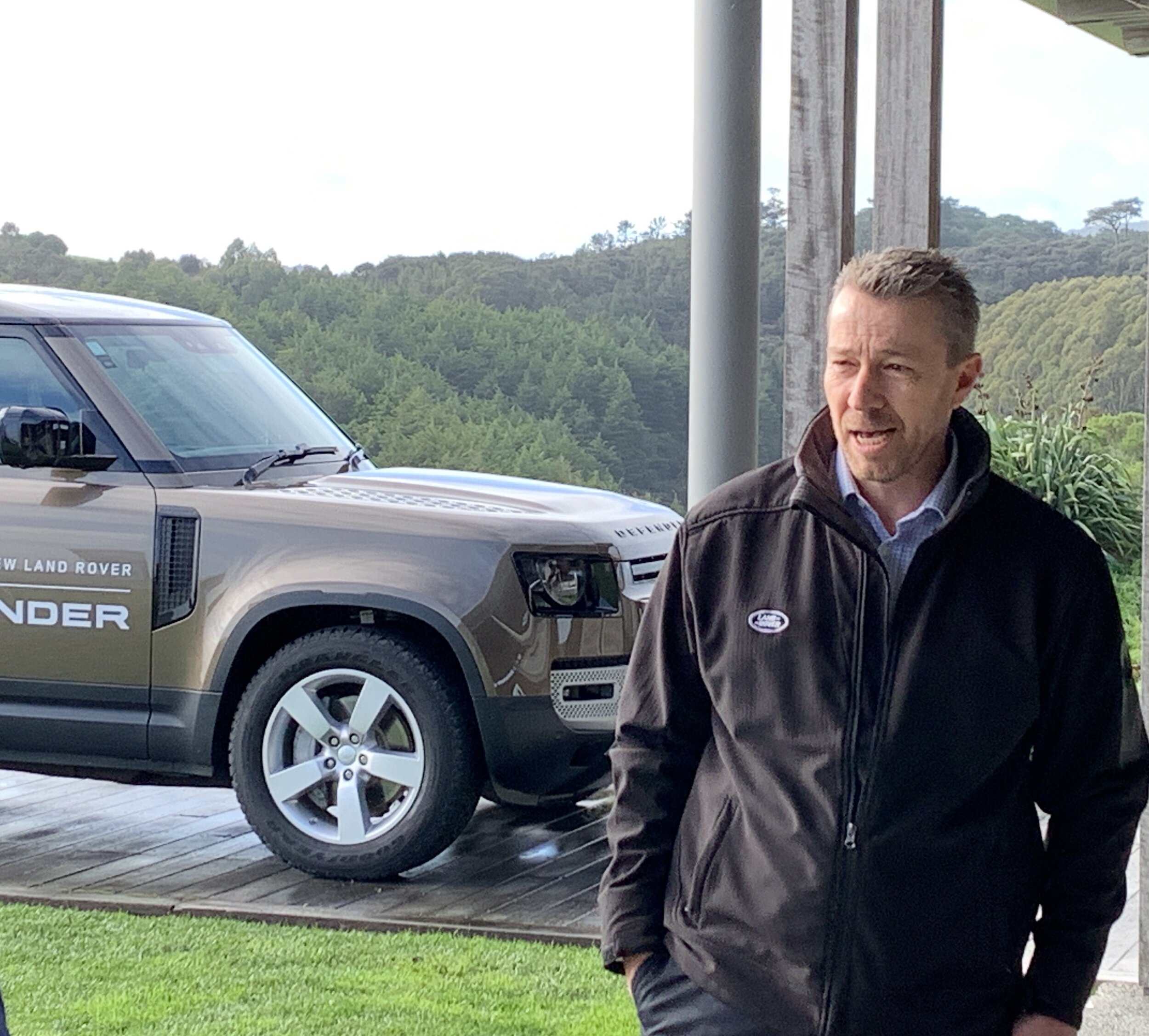
Steve Kenchington, Jaguar Land Rover New Zealand’s general manager, agrees the customer base – particularly on the Land Rover side – will need time to digest the implication of today’s announcement from the United Kingdom, but personally it’s exciting news.

“This has come as quite a big surprise to us – a pleasant surprise – in what it might it look like and what they are planning. There is much we don’t know.

“What is most exciting for us is that JLR has now defined the future direction for the brands and that this is happening on the back of a significant turnaround for them.”

The strategy unrolled today is for Land Rover to launch six pure electric models within the next five years while its sister brand is to be reimagined as an all-electric luxury marque by 2025.

How that impacts on the makes’ individual model has yet to be spelled out.

Jaguar Land Rover NZ boss Steve Kenchington is excited by today’s news.

Jaguar Land Rover NZ boss Steve Kenchington is excited by today’s news.

Jaguar is already of course engaging in the EV-sphere with its iPace sports utility, a New Zealand Car of the Year winner that accounts for 10 percent of local Jaguar volume.

Yet it still produces its other cars – the E Pace and F Pace SUVs, the F-Type sports cars and XE and XF sedans – in conventional fossil fuelled form.

Today Jaguar also confirmed the replacement XJ large sedan, which had been destined to come out later this year as an electric product, has been abandoned.

The transition period for Land Rover seems to be longer, but the end game will be even more dramatic. The green badge division has some plug-in hybrids and is about to release an update of the Range Rover Sport locally with a new six-cylinder petrol that could, Kenchington agrees, become the last orthodox conventional fossil-fuelled drivetrain it delivers to market.

Next year it will bring out a new Range Rover and beyond that the next Range Rover Sport, both expected to have a mix of mild and plug-in hybrid drivetrains. 

The prospect of diesel models continuing for much longer seems unlikely, the local man suspects – “I think the latest Ingenium engines we are now bringing out will be the last” - even though this has been a preferred choice in the current Defender – which is about to go to a plug-in hybrid petrol choice – and the Discovery, which could yet be the first Land Rover to deliver the wholly electric promise as a new one is on the drawing board for release within three years.

Alternately, the Evoque and Defender Sport might become early adopters of a battery-pure approach. It’s all speculation at the moment. 

He thinks Land Rover’s petrol engines have a future, but in hybrid formats. “They have certainly put a lot of work into making them more eco-friendly and I suspect we will continue to see the benefit of that in the short to medium term.”

He reminds that the off-road specialist is continuing research into hydrogen fuel cell as well. Last week JLR confirmed that fuel cell powertrain development forms a core part of its ‘Reimagine’ strategy and said it will begin road testing prototypes within the next 12 months. 

Last year, the company detailed its Project Zeus initiative: a serious hydrogen power research project with the aim of developing fuel cell-powered versions of its larger vehicles. It has now reinforced that ambition to prepare itself for "the expected adoption of clean fuel-cell power in line with a maturing of the hydrogen economy". 

For its part, Jaguar Land Rover nonetheless says that all of its brands’ nameplates will be available with an all-electric variant by 2030.

Land Rover should be selling around 60 percent of its cars in pure-electric form by the end of the decade. However, it has stated that its first pure-electric model will be in production in 2024.

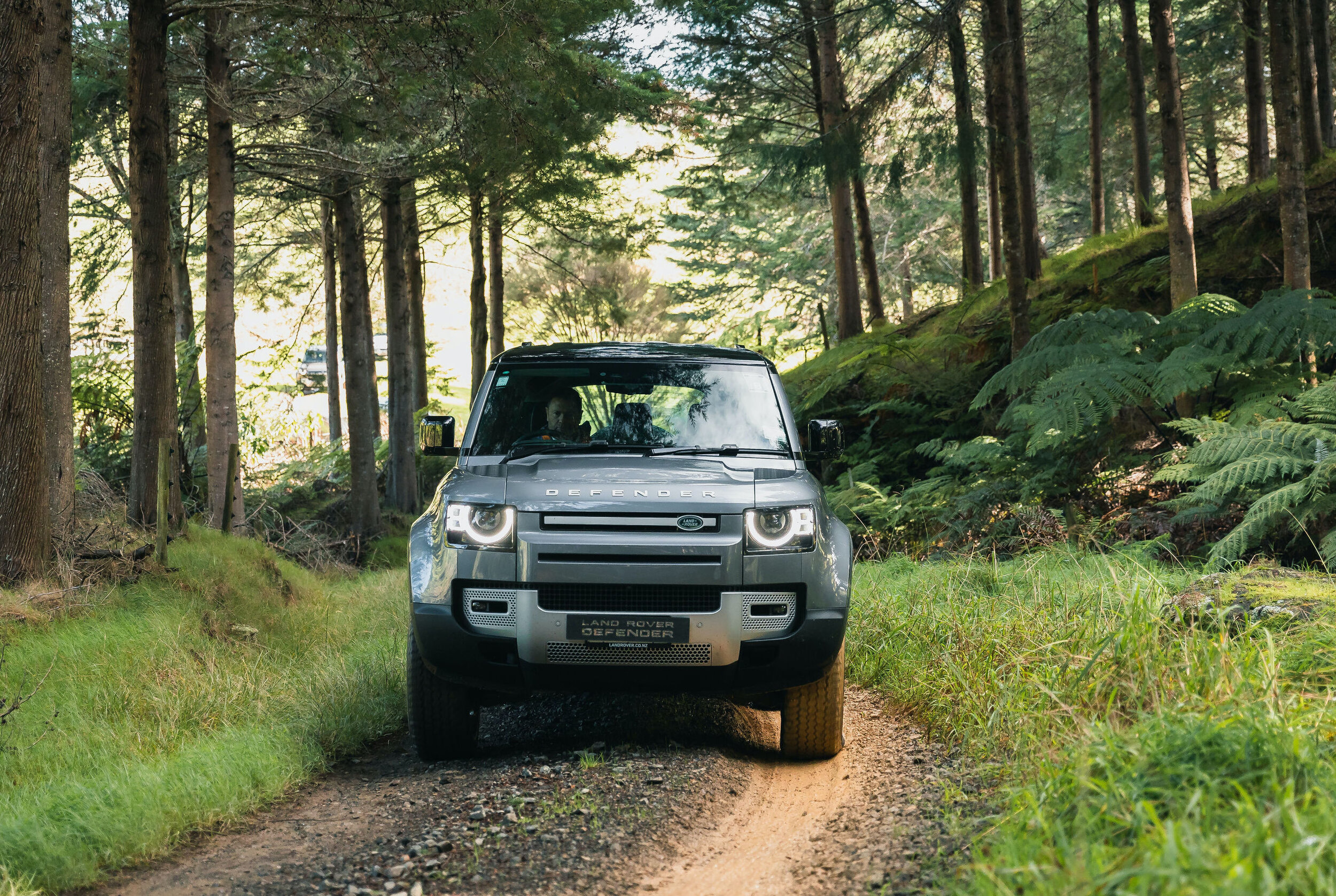
Land Rover’s latest model here, Defender, is already being built in a PHEV format.

Land Rover’s latest model here, Defender, is already being built in a PHEV format.

A company release stated, “In the next five years, Land Rover will welcome six pure-electric variants as it continues to be the world leader of luxury SUVs through its three families of Range Rover, Discovery and Defender. The first all-electric variant will arrive in 2024.”

Kenchington says it is clear that customers have a lot to take onboard and will be asked to alter their preferences: Ironically, he muses, the five-litre supercharged V8 that is the antitheses of automotive Green intent is “selling like hot cakes for us at the moment.”

If a pure electric large Land or Range Rover were magicked into sales-ready form right now, it might still be a hard sell to many brand fans. Many probably just aren’t comfortable with electric.

He says it will therefore be crucial for the brand to mount an effective campaign to convert supporters to the new direction. He thinks it will be achievable, particularly once Land Rover can show that all the historic benefits that associate with its off-roaders will be maintained, if not enhanced, by having a battery-drawn drivetrain. 

“At the moment there’s never been so much demand for big ICE engines; we’ve probably never previously sold as many V8 supercharged as we at the moment.

The successful of EV transition will “come down to how good it is, how efficient it is, what the range is ….

“But if it is going to continue to be a Land Rover in its DNA, then I think people will embrace it. There is no reason not to. We have all driven electric and we know how good it is. If it can still submerge to 900mm in a river crossing and do all the other things our vehicles are really good at then there’s no reason why anyone wouldn’t want to go there.” 

“It is all very exciting.”

The plans for Jaguar are more complex, simply because while it was heading toward electric anyway, much has changed with the XJ limousine being scrapped.

In respect to this, the statement from Jaguar headquarters said it is still possible the XJ nameplate might be retained.

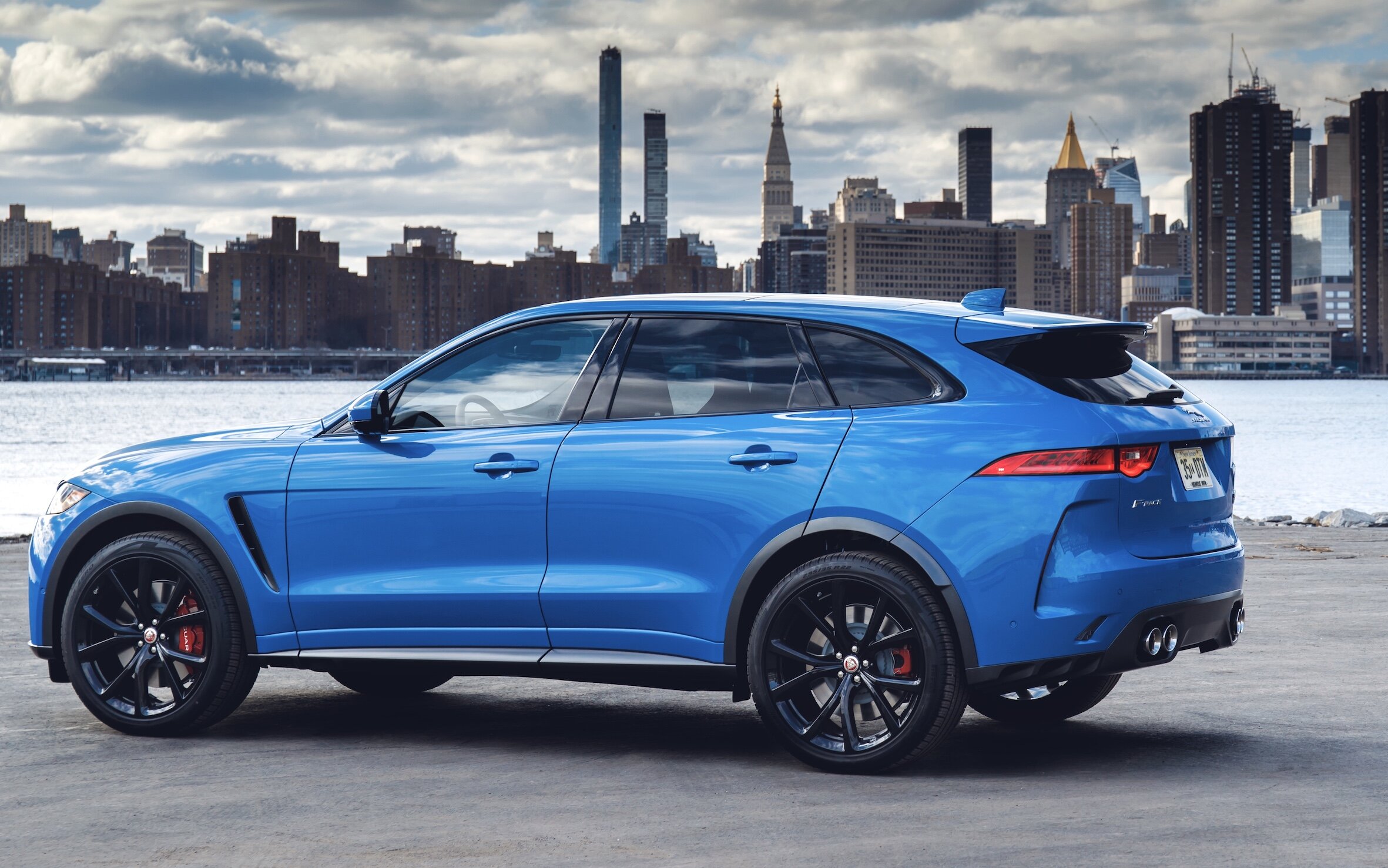
The makes’ supercharged 5.0-litre V8 petrol, used in the Jaguar F-Pace SVR as well as by Range Rover, has been a big seller lately.

The makes’ supercharged 5.0-litre V8 petrol, used in the Jaguar F-Pace SVR as well as by Range Rover, has been a big seller lately.

 “By the middle of the decade, Jaguar will have undergone a renaissance to emerge as a pure-electric luxury brand with a dramatically beautiful new portfolio of emotionally engaging designs and pioneering next-generation technologies. Jaguar will exist to make life extraordinary by creating dramatically beautiful automotive experiences that leave its customers feeling unique and rewarded.”

Overseas commentators say the XE, XF, E-Pace, F-Pace and F-Type would now appear to have a finite lifespan, with all-electric replacements due by around 2025.

Kenchington says those products present interesting potentials. As much as iPace has found a place in the local market, Jaguar really needs other electric products in more convenient price zones than the $150,000-plus SV has nestled into.

Jaguar is likely to unroll its model specific strategies in coming months, he believes. “But clearly F-Type and F-Pace will go all-electric and you would expect E-Pace to do so as well.”

The $80,000 to $100,000 zone where XE and XF mainly position is an area that he is keen to exploit.

“At the (iPace) price point there is a limited audience but I think there is an appetite for electric and we just have to get to the point where we can produce these vehicles a bit cheaper.” 

Jaguar’s sedans have struggled in fossil fuel formats and yet as much market shift to SUVs suggests orthodox four-door booted cars are a dying breed, he looks to how well Tesla has done with the Model 3 and Model S. 

“From my perspective I’m keen to understand what they will do with the sedan market. It looks like XJ will not go ahead, but what they are going to do with XE and XF is interesting – do they keep both, do they keep one, do they have an XF and a long-wheelbase XF to create an XJ alternate? I just don’t know.

 How important could electric Jaguar sedans be in NZ, given we are so SUV-centric? Conceivably, they shouldn’t be, and yet … 

The iPACE accounts for 10 percent of Jaguar volume in NZ.

The iPACE accounts for 10 percent of Jaguar volume in NZ.

“If you look at the performance of Tesla, you’d say ‘quite important.’ Model 3 and Model S have been very successful. It feels to me that electric (in a sedan format) seems to attract.”

“In saying that, it could be that this is because there has not been much to offer in the way of SUVs. Tesla were first into the market, there was nothing else to buy … and you buy what you can. It’s very clear that the SUV segments continue to grow and the sedan segments continue to decline.”

His gut feeling is that Jaguar is probably considering E-Pace, F-Pace and another ‘Pace’ model as yet undisclosed being core to the electric drive. But maybe the sedans could survive. “I don’t know.”

The decisions lading to today’s announcement come after Jaguar Land Rover appointed ex-Renault executive Thierry Bollore to replace former CEO Dr Ralf Speth. The Frenchman started his new post last September but has kept a determinedly low profile as he undertook a full review of JLR’s business, current model line-up and future launch plans.

Today’s new has affirmed that JLR is able to retain all of its current production facilities, thereby quashing rumours that one of its UK factories might have been under threat of closure. 


Ioniq 5 interior previewed

Teaser campaign continues for model also caught testing in Australia.

IONIQ 5 Interior.jpg

FRESH images – official and otherwise – are emerging of the Ioniq 5, first of a dedicated all-electric series from Hyundai under the Ioniq name.

As part of a planned teaser build-up to a global reveal of the whole car, set to occur on February 23, the Hyundai has sent out an image giving a peek of the five-door model’s interior.

Meantime, a charging network provider in Australia has also pitched in, by sharing images (below) of a disguised Ioniq 5 replenishing. 

Tritium says the car was hooked up to its new 75kW RTM75 charger at its headquarters in Brisbane. 

It’s just the latest image of the Ioniq 5 being caught undergoing pre-release trials in Australia by its maker. Others emerged last month.

Screen Shot 2021-02-15 at 5.50.55 PM.png

Hyundai itself has only sent out darkened teaser images revealing the car’s general shape, and the head and tail-light designs.

Even that has been enough to fuel speculation that the production model is set to be all but a dead-ringer for the South Korean carmaker’s “45” concept that was shown off to the world several years ago, not just in shape but also jacked-up general quasi-sports utility stance.

Hyundai New Zealand has indicated the Ioniq 5 will be on sale here, but has stopped short of fuelling thought that it might land around July or August, to join the Hyundai Kona and Hyundai Ioniq electric cars.

There will be more Ioniq models to follow under the new 'sub brand' that sits alongside Hyundai’s N-badged models as being more special than the make’s standard fare. 

In 2022, the Hyundai Ioniq 6 electric sedan will make its world debut, based on another Hyundai concept, the Prophecy. Further out there will be a Ioniq 7 electric large SUV. And then? Mystery, but the company says will usher in 23 battery-electric vehicles by 2025. 

Large-44665-HyundaiMotorCompanyTeasesFirstImageofIONIQ5.jpg
Large-44666-HyundaiMotorCompanyTeasesFirstImageofIONIQ5.jpg

All next-generation Ioniq models ride on a new Electric Global Modular Platform (E-GMP), setting them apart from Kona EV and the current Ioniq hatch that provisions in hybrid, plug-in hybrid and electric forms.

That architecture will allow for high-speed charging capability and "plentiful" driving range – although neither of Hyundai's existing EVs disappoint in that respect.

When Hyundai revealed the ‘45’, it talked up the concept’s cabin as being a "smart living space.” That descriptive was used again in conjunction with today’s official image.

The design study was innovative, with highly adjustable seats, wireless connectivity – and a glove box space designed as a set of drawers.

Hyundai Motor Group – which encompasses the Hyundai and Kia brands, plus the upmarket Genesis marque that is not represented here, aims to sell 560,000 battery electric vehicles in 2025 – with its eyes set on becoming the world's third-largest maker of "eco-friendly vehicles". That count will also include hydrogen fuel cell cars.


Boardwalk for seaside jaunts

MINI feels the sand between its toes with a special edition.

MIN_CountrymanBoardwalk_MultiImage_1_16x9_03.jpg

AN assault has left the latest from MINI looking black and blue, but no need to involve authorities.  

We’re talking about another style assault from BMW’s Brit brand.

Black highlights and blue paintwork is a hero look defining the Boardwalk, a special edition with specific styling cues and specification that applies to a limited run the Countryman small sports utility.  

Ten Cooper and 20 Cooper S petrol variants are scheduled for New Zealand, respectively priced from $56,990 and $64,600. The cheap is powered by a 100kW/220Nm 1.5-litre turbo three-cylinder while the other a 141kW/280Nm 2.0-litre turbo four.

Both models are front-wheel-drive and feature seven-speed dual-clutch automatic transmissions.

Standard equipment includes Deep Laguna Metallic exterior paint, Boardwalk-specific side scuttles and decals, black roof rails, Piano Black mirror caps, roof, grille and badges, 18-inch black alloy wheels, and LED headlights, tail-lights and fog lights.

Inside, standard features include Mini Yours black leatherette trim, Boardwalk Edition dashboard trim and door sills, Piano Black trim accents, anthracite headlining, a 5.0-inch digital instrument cluster, an 8.8-inch infotainment touchscreen with Apple CarPlay and a reversing camera, a Harmon/Kardon 12-speaker sound system, and Mini Connected services.

There's also keyless entry, push-button start, front and rear parking sensors, heated sports seats, a panoramic sunroof, autonomous emergency braking and the Picnic Bench, a small cushion allowing the boot to be used safely as a seating area during a picnic.

The Countryman Cooper S Boardwalk adds a black honeycomb pattern for the front grille, a JCW Sport steering wheels, black leather-trimmed 'Cross Punch' seats with electric adjustment and memory, and adaptive cruise control.

And if you think you might have seen the paint colour before? Correct: The same hue offered on last year’s MINI Convertible Sidewalk edition.

MINI says the Boardwalk is intended to “combines signature traits of the iconic British brand like precision engineering and beautiful craftsmanship in a handsome package, celebrating a universal love for the seaside.”