Supra finally evens power score with Z4

The Supra has extra oomph. There’s a good reason why the new output will seem strangely familiar.

50553773951_9a19f3f95a_c.jpg

WHAT two-seater sports car sold in New Zealand is built by Magna Steyr in Graz, Austria, and runs an in-line six-cylinder petrol engine generating 285kW?

The answer used to be just one car: BMW’s Z4, in M40i trim.

But now it’s two, the other being the Toyota Supra. 

The Japanese product has updated – a year after both it and the Z4 introduced – to the same performance tune that the BMW has had from day one.

Confused? Only if you’ve forgotten – and for marketing purposes, it’s not for these respective brands to remind – that these models are twins, in sense they share common platforms, drivetrains and a lot of hidden stuff.

It’s not fair to say just the bodywork stylings are different, because the BMW does offer a plusher experience and more tech (like, it has a higher grade iDrive, for instance) to justify it costing $35,000 more than the Toyota.

But even so, the other major difference has been in the state of tune of the common engine under their bonnets.

While the turbocharged 3.0-litre created the same 500Nm torque in either installation, the BMW had 35 extra kiloWatts.

This showed on timepieces – with 0-100kmh achieved 0.2 seconds ahead of Supra – and was also felt on the road; the Z4 had more edge.

Back at launch, BMW intimated the reason it had a feistier engine was thanks to involvement from M Division, it’s in-house sports department. Yet even then, there was talk that, in time, Toyota would get the same service.

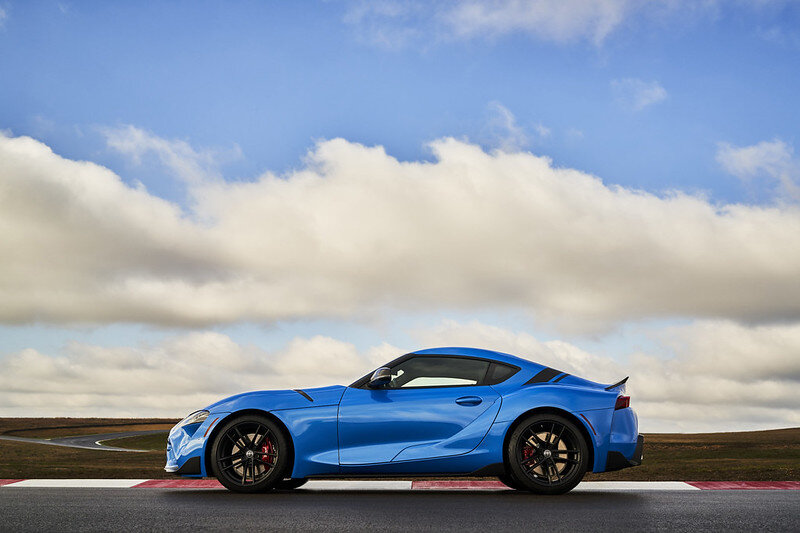
And so it’s come to being. Having started with 250kW, Supra now has 285kW. Same as the Z4. So now it also clocks 0-100kmh in 4.1 seconds. It aslso, according to Toyota, feels friskier and more alert. Sensations this writer picked up on when driving the BM W and Toyota back-to-back months ago.

How’s the gee-up achieved? Early adopters hoping for their cars to enjoy the extra gee-gees will doubtless be saddened, if not annoyed, it’s not the matter of rechipping an engine management computer.
50553773616_d661c4242d_c.jpg

Toyota cites tweaks to the twin-scroll turbocharger, a new exhaust manifold that now sits separate from the cylinder head, a new piston design that reduce compression ratio, and a raft of other mechanical changes.

Beyond the engine changes, the 2021 Supra also gains new under-bonnet aluminium braces which connect the strut towers to the radiator support for improved rigidity. It’s still paired with an eight-speed automatic.

One nice thing: It’s not just the sprint time that’s reduced. So has GR Supra pricing, albeit by $1000. It now starts from $98,990.

Unless, of course, you manage to secure one a limited edition model, identified by being  painted in Horizon Blue, and paired with 19-inch matte black wheels. That’s trim still commands the old price.

Just two are being brought in. There’s one here already and it has clocked some kays, being the personal drive car of Toyota New Zealand boss Neeraj Lala.

50553041693_415312493a_c.jpg


Ace’s rally push goes electric

Hayden Paddon is first on the road with an electric rally car.

images Geoff Ridder

images Geoff Ridder

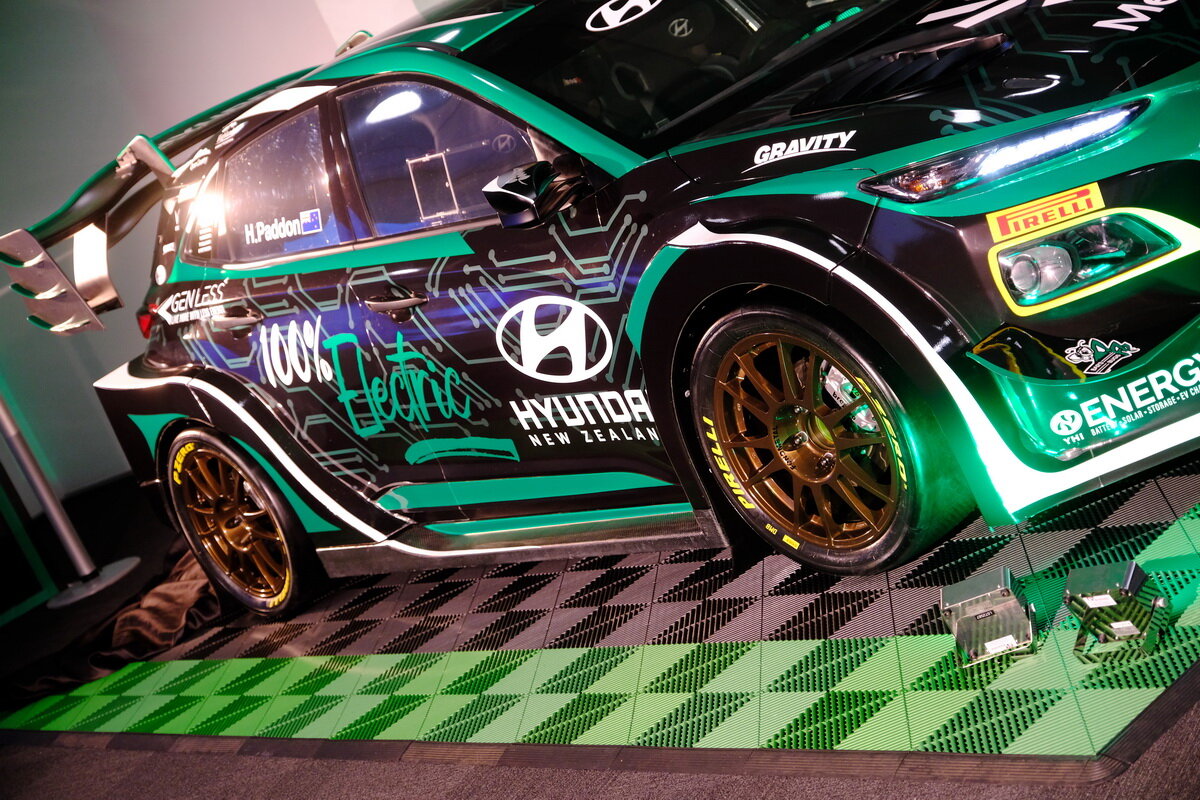
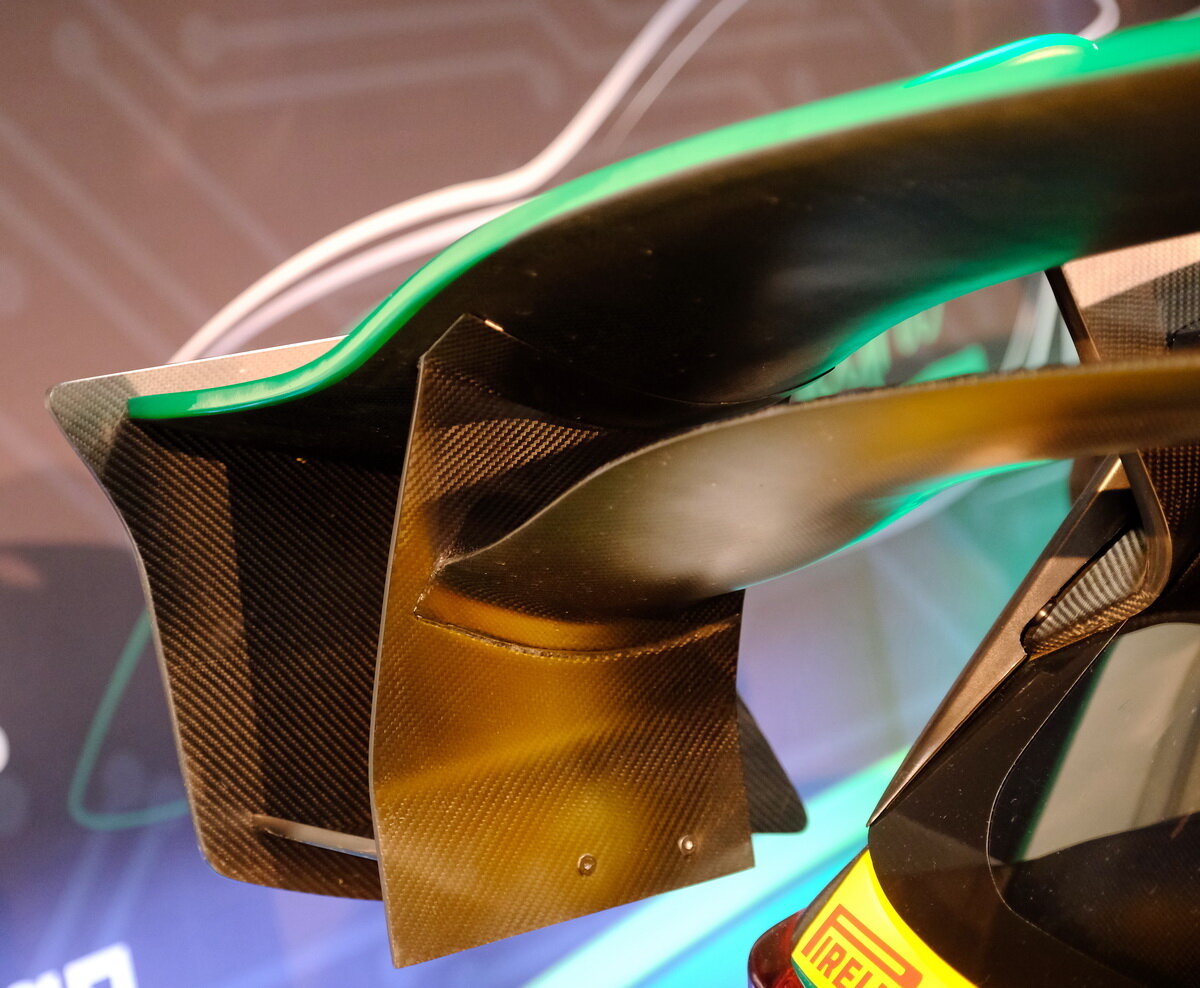
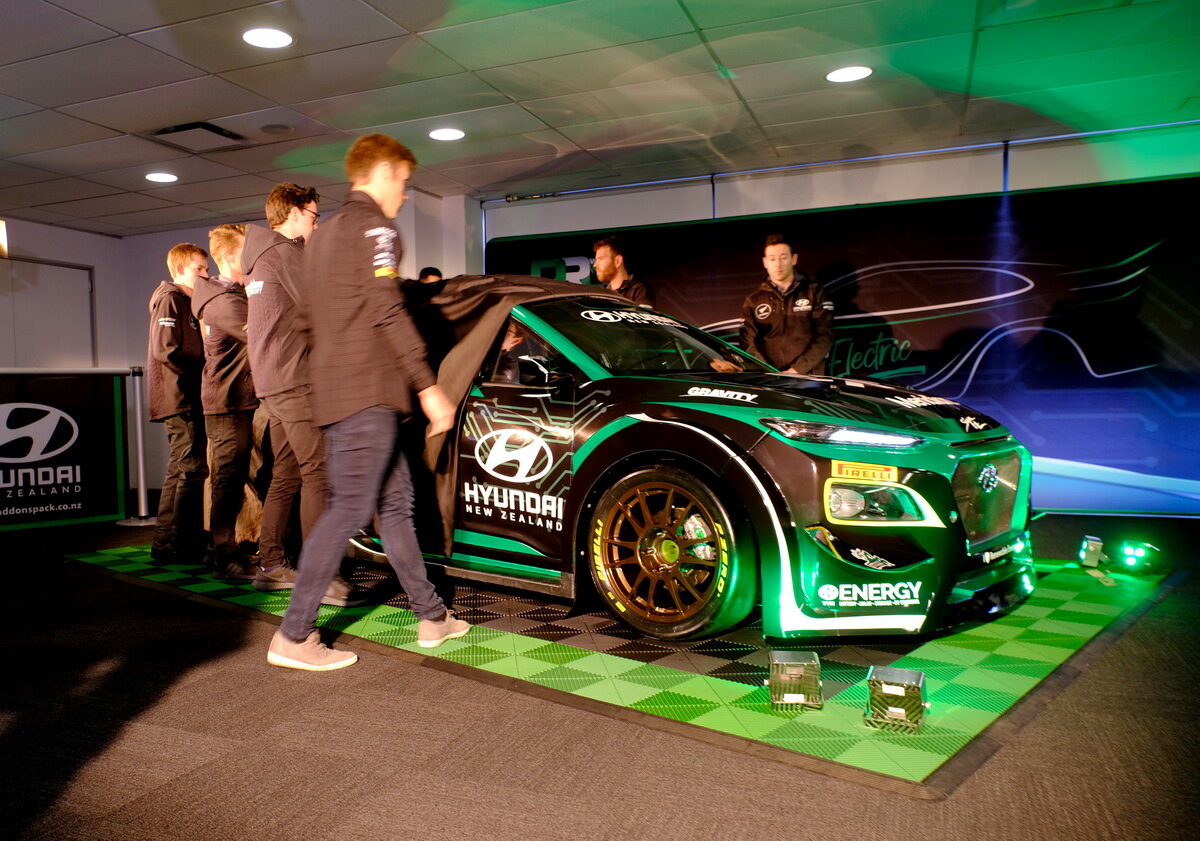
IN a variation on the theme of ``build it and they will come’’, rally ace Hayden Paddon faces a ``build it and they work out where you can take it’’ scenario with the fully electric Hyundai Kona rally car he unveiled today.

Paddon’s goal of competing in rallies with an electric car of comparable performance to modern day combustion engine gravel racers is not just a technology challenge. His pioneering programme means working with the sport’s local governing body to position the car in competition.

For the short term that means demonstration runs starting with a few quick blasts around the rallysprint course at the high-profile Battle of Jack’s Ridge event on Sunday November 14.

It will be a very public debut for a car that has only just completed two days of filming work.

By the end of November MotorSport New Zealand hopes to have published its first regulations for electric vehicles. Paddon’s hoping his car helps provide a framework for those rules.

``At the moment it’s going to be demonstrations,’’ said Paddon.

``Going forward we know we have to work with MotorSport New Zealand – one on the safety and two on the performance parameters to actually make it fit in.

``We have started that discussion but the key thing is nobody knows and we need the car running to see what it’s capable of. That gives us a benchmark to work from.

``I’d like to think within two years we can have it accepted within motorsport events including full-length rallies. In the short term we know people want it and it’s good for the sport.’’

There are few question marks over the performance potential of the car created by a small team of seven at Paddon Rallysport Group headquarters at Highlands Park.

In its current guise the car has electric motors and two-speed transmissions front and rear. Each motor has peak power of 200kW and about 360Nm of torque. Paddon says the car is geared to reach 240km/h and can accelerate from 0-100km/h in a little over 3secs.

It’s possible to lift that performace adding another motor both front and rear to double the output to 800kW. Paddon says his initial goal is to tune the car so its comparable to the AP4-spec 4WD Turbo rally cars currently competing in New Zealand.

The EV is a little heavier at 1400kg but the weight is positioned low in the chassis of the Kona.

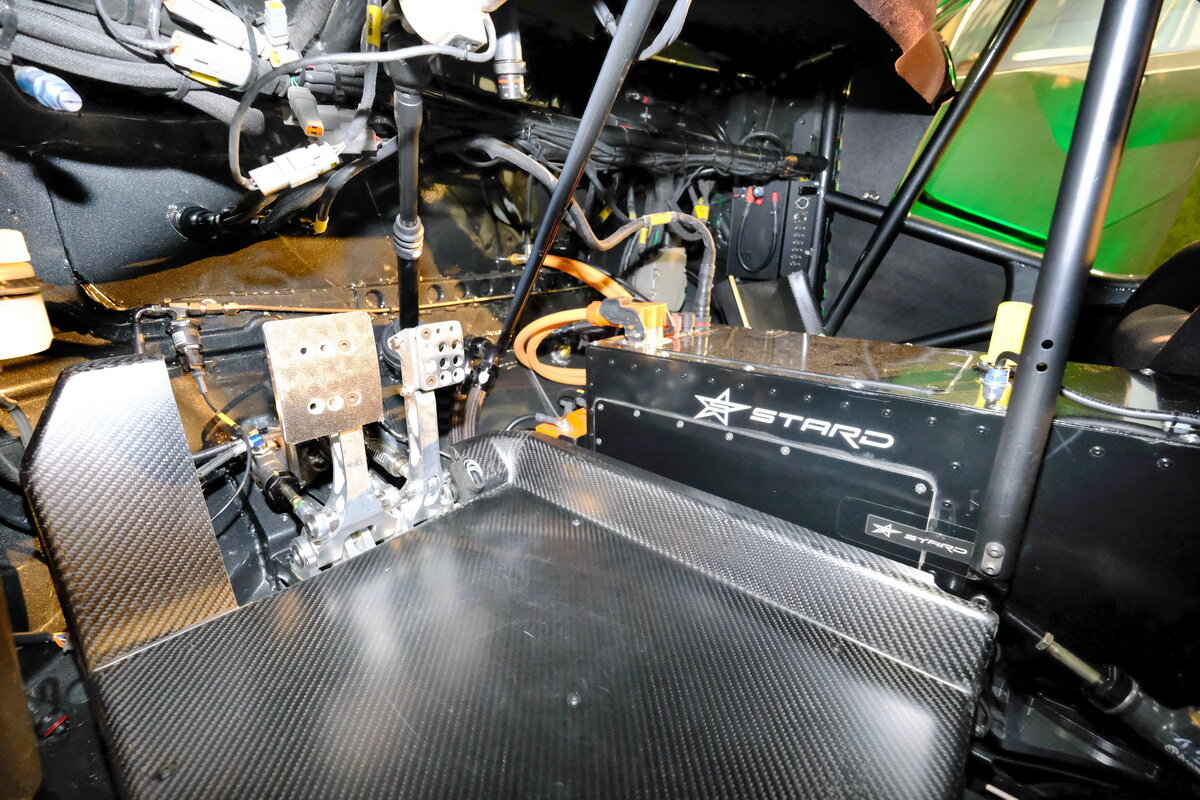
The battery electric powertrain has been developed from technology supplied by Austrian company STARD. It features advanced safety and control systems.

``It’s very similar to a Formula-E battery. It’s not like an OEM battery and it has a fire system built into it.

``If there was a problem, we have so much control technology in the car to shut things down before anything goes wrong. In the worst-case scenario, it’s got the emergency flood connectors. You flood the battery to stop the car from going on fire.

Paddon_EVLaunch_4-11-20_CopyrightGeoffRidder_GR408589_Web.JPG

``The safety in the car is quite is quite phenomenal. It’s not like taking an OEM EV car, putting a roll cage in it and making it a club car. That’s a lot higher risk.

``That’s where it’s difficult for Motorsport NZ going forward, because it’s almost like two sets of regulations between an OEM car and a be-spoke motorsport design EV car.’’

Ahead of development work in the coming months, Paddon believes the tuning the software will outweigh the challenges of mechanical fine-tuning and durability.

``It’s all software. Mechanically the car is way simpler. There are less working parts and it’s strong and simple,’’ he said.

``Mechanically it’s pretty sound. We’ve done two filming days now with a brand-new car and had zero mechanical problems. If you had a combustion car, imagine the amount of teething problems you would have had?

``But we can have bugs in the software. We have to go through all the programming and tuning and that’s a whole different kettle of fish.’’

In order to have the range to complete a full rally, Paddon’s team has created a quick-change battery solution.

``We want to do battery changes. We are not interested in charging on an event,’’ Paddon said at today’s launch.

``We have designed the car for quick battery changes – five minutes we can change a battery.’’

He’s not saying how big the battery is but confirmed it has a smaller storage capacity than the 64kWh battery in the standard Kona electric road car.

The team is working in scale at the moment with enough battery power for short runs at full performance. From there it can calculate the size of battery needed before locking into that expensive choice.

The big rally battery will have to be over 100kWh,’’ said Paddon.

``But right now we have to calculate what we need. The big problem is the batteries are six-figures and if you get the wrong size battery now, you’ve got a battery that’s no good to you.

``With this prototype battery we can simulate very condition – hot, cold, uphill, downhill, twisty, fast - and from all that we can calculate exactly what we need.’’

Other key areas of the development programme will be tuning the torque vectoring and regenerative braking systems and an important aspect of rally safety ensuring the car makes enough noise to warn spectators of its approach.

Paddon talked of airflow systems similar to air raid sirens that would generate different levels of noise as the car moves at different speeds.

``It makes a bit of noise but it’s not at the level we want yet,’’ said Paddon.

``We are still working on a sound generator. We were hoping to have it done by now but there have been some hold ups. It’s high up on our priority list to get that right.

``It will be a different sound. It won’t sound like a combustion car but it will be relevant and be from the inputs of the driver. It’s got to sound real and sound exciting.’’


Tuatara take two

It’s not that easy to achieve the production car speed record.

Tuatara 5.png

TWO misconceptions about the Tuatara.

First, in respect to the scaly reptile. Don’t call it a lizard. That’s wrong. Our national treasure, found only in our land, is in fact the last survivor of an order of reptiles that thrived in the age of the dinosaurs.

Second point, in respect to the SSC Tuatara, the made-in-America 1305kW hypercar. You likely know all about it, on strength that of claims made just over a week ago about how this machine raised the production car land speed record by racing down a desolate highway in the Nevada desert, with an average speed of 508.7kmh in both directions, fast enough to blow past previous marks held by Bugatti and Koenigsegg.  

Too good to be true? Within days, the legitimacy of that achievement was being cast into doubt.  

Based on the known distance between set points along Nevada’s Highway 160 – and the amount of time it took for the car to reach them – on-line observers including a high-profile YouTuber, Schmee 150, estimated the Tuatara’s peak speed was no higher than 450kmh. 

What's more, when maxing out the revs at 8800rpm the sixth gear ratio of 0.784 should theoretically achieve a top speed no higher than 470kmh.

Analysis of the tachometer shows the car fell slightly short of the redline, which would be consistent with the 450kmh approximation.

What’s also not helped SSC is that the road was also used in 2017 by Koenignegg, when it ran the Agera RS to what was then a 447.19kmh max. That effort was an intensely filmed as this one, so people have been comparing the footage. In comparing how long it took the Tuatara to get from landmarks on the road, they say it was actually traveling slower than the claimed speed throughout the clip.

If that wasn’t enough,  Dewetron, the data analysis firm whose tracking and timing gear was used in this and other brand’s efforts, has now come out and contradicted SSC’s inference they were on sight on the day or were involved in preparation. Dewetron says it was not. Nor has it validated any of the Tuatara’s data.


Anyway, the end result of all this hoo-haa is the video here, from SSC founder Jarod Shelby. There’s contention that some of the confusion results from SSC’s media partner for the October 10 event somehow released two different cockpit videos from the day—at least one of which was "not an accurate representation of what happened."

 He has also decided the car will repeat its run, in the very near future,this time with all the proper checks and balances.

Tuatara 3.png

“No matter what we do in the coming days to try to salvage this particular record, it’s always gonna have a stain on it … we have to rerun the record, we have to do this again,” Shelby says. “And do it in a way that it’s undeniable and irrefutable.”

Next time, the Tuatara will have multiple GPS units from different manufacturers in the car. They will have the GPS companies’ staff onsite. Additionally, Shelby invited some of the YouTubers who called the record into question with video analyses in the beginning.

There’s still no announcement on who will be doing the driving in this second run. Oliver Webb drove the Tuatara in the first run, but he has yet to come forward as the driver for the second run.


Skiddy times for Golf R fans

New looks, 235kW turbo engine and …. drift mode.

Screen Shot 2020-11-04 at 1.57.53 PM.png


VOLKSWAGEN has released its inner Hoonigan with the 2021 Golf R, finally revealed today.

In addition to ticking the required boxes in respect to being the most powerful and quickest Golf – no surprises there, obviously – it also unloads a function that VW previously steered clear of offering on its four-wheel-drive street racer.

As with the Mk 8 GTi, the R has a ‘Vehicle Dynamics Manager’ system which controls the ‘XDS’ electronically-controlled front locking differential, ‘DCC’ adaptive dampers, all-wheel-drive system and other electronics systems in tandem to sharpen driving dynamics.

As an option – in Europe at least – there’s an ‘R Performance’ package, which increases the top speed from 250kmh to to 270kmh, and adds 19-inch wheels and a larger rear spoiler, with the latter intended to increased downforce. 

Screen Shot 2020-11-04 at 1.58.20 PM.png

The package also introduces two new drive modes: Special, which softens the adaptive dampers, and Drift mode, which shuffles greater percentages of the engine’s torque to the rear axle to break traction and enable controlled drifts.

Why ‘Special?’ It’s a set-up to cater for the undulating surface of the Nurburgring Nordschleife. Using it enables to shave 17 seconds off its predecessor’s lap time around the demanding circuit. Obviously not an easy reach for Kiwi owners, but still.

Under the bonnet is the same 2.0-litre ‘EA888’ turbocharged four-cylinder petrol engine that powered its predecessor, now producing 235kW of power and 420Nm of torque (from 2100-5350rpm).

Drive is routed to all four wheels via a choice of six-speed manual or seven-speed dual-clutch automatic transmissions, though the former will be limited (at launch, at least) to North American markets.

The Golf R benefits from the same new-generation, Haldex-type all-wheel-drive system as the related Arteon R and Tiguan R.

Screen Shot 2020-11-04 at 1.58.31 PM.png

The R Performance Torque Vectoring that allows up to 100 percent of the engine’s torque to be distributed between the front and rear axles, or between each individual rear wheel, in milliseconds.

Volkswagen claims a 0-100kmh sprint time of 4.7 seconds.

Under the skin, the new Golf R sits 20mm lower to the ground than standard Golf models, thanks to retuned suspension with 10 per cent stiffer springs, revised control arms and wheel mounts, increased negative front camber, and unique anti-roll bars.

Hiding behind the alloys is a set of larger performance brakes, measuring 360mm up front and clamped by two-piston aluminium callipers.

Lighter brakes shave 1.2kg of unsprung mass off the car’s kerb weight, complemented by a further 3kg loss thanks to a lighter aluminium subframe.

Other available performance features include variable sports steering, an optional, 7kg-lighter Akrapovic exhaust system, and five additional drive modes: Comfort, Eco, Sport, Individual and Race.

Screen Shot 2020-11-04 at 1.58.45 PM.png


NZ-confirmed SM17 set to be a $150k ask

The price is likely going to be higher here than across the Tasman – but who’ll care about that?

sm17 4 copy.jpg

 KIWIS intending to enjoy a special edition Ford Mustang honouring a homegrown Supercars hero will be spending more to enjoy the car than the Australian audience it’s been initially aimed at.

While pricing has yet to be set on either side of the Tasman, Ford New Zealand – which helped broker the deal to secure the impressively muscled SM17 created by Melbourne-based Herrod Performance – has indicated a Mustang GT-based fireball honouring three-times Supercars champion Scott McLaughlin will likely sit around $150,000.

 That’s about $30k above the sticker it’s reportedly expected to carry in Australia, prior to on-roads applying, and would buy two examples of the V8 GT coupe from which it derives.

That New Zealand has become a destination for the Herrod SM17 might seem a given. Though his family shifted to the Gold Coast when he was nine, McLaughlin was born in Hamilton and like all NZ entrants in Supercars, he achieves an ardent following here.

Yet that alone didn’t guarantee access to a Mustang that delivers a supercharged V8 making a Supercars-busting 578kW and 810Nm, plus a host of suspension, aerodynamic and visual improvements.

The background as to how the SM17 gained residency was explained by Ford NZ managing director Simon Rutherford.

His operation is right behind the car’s availability but it cannot represent the model directly. Which is why the distribution rights are with Team Hutchinson Ford, centred in Christchurch. Orders can be placed at any Ford dealership, but thereafter the process goes through Team Hutchinson.

Even so, Ford NZ – whose most expensive Mustang of the moment is the $97,990 Mach 1 coming next year - has been closely involved in sorting this out and is an enthusiastic backer.

Rutherford says it’s all about getting the celebration car to an audience revved up by the “McLaughlin factor”; the driver has a high profile and strong popularity in NZ, he said.

“We think it’s important to do that because Scott McLaughlin has a fanbase here for obvious reasons,” he said in explaining the sales arrangement. 

sm17 1 copy.jpg

 “It would be a shame not to support customers who want that option.”

Even though it took Herrod to realise the dream, the concept could also be called Kiwi inspired in that it was McLaughlin’s dad, Wayne, who came up with the idea for a celebration Mustang.

“Scott’s dad was always telling Ford they should do a limited-edition car. Once he had wrapped up his third Supercars title it seemed like the right time to accelerate the program,” says Ryan Story, the managing director and principal of DJR Team Penske, the outfit for which McLaughlin knocked off three consecutive championships. 

The first of those was in a Falcon then the two following were with the Mustang. Story also has also been a key collaborator on SM17 with Herrod’s owner, Rob Herrod.

The car’s price tag is unlikely to deter enthusiasts wanting something truly special. Aside from the driver association, the car should be a beast.

It is not only far more powerful than the standard GT (339kW, 556Nm) or Mach 1(345kW but same torque as the GT) but also has more oomph than the No.17 Mustang GT McLaughlin has raced, but now retired from the pursue a new dream of being a top driver in America’s Indycar.

The key performance-lifting feature is a Whipple supercharger but it also has the largest intercooler available, plus bigger Bosch fuel-injectors and numerous other updates to handle the big lift in horsepower. 

There’s a performance transmission cooler on the 10-speed automatic transmission that’s optional to the six-speed manual. The auto also has a unique transmission calibration for crisper shifts.

The suspension features adjustable sway bars and an alternate tune in the magnetic ride, the 20-inch wheels are bespoke and the tyres are higher performance items than the standard V8 Mustang gets. It also has a more distinctive exhaust.

Herrod has already built one SM17 but production won’t start until January of 2021. The first New Zealand car is expected to land two months after that. It’s a limited-run product, so how many will cross the Tasman is anyone’s guess.


Paddon’s electric rally car push times with EVs in motorsport review

Battery-compelled vehicles are moving into motor racing and the sport’s national governing body is now working out how to accommodate them.

haydon paddon’s groundbreaking electric rally car, pictured during construction, will be fully revealed tomorrow. It is based on the Hyundai Kona electric car, pictured below.

haydon paddon’s groundbreaking electric rally car, pictured during construction, will be fully revealed tomorrow. It is based on the Hyundai Kona electric car, pictured below.

Hyundai Kona.jpg

THE public unveiling of Hayden Paddon’s highly-anticipated Hyundai Kona electric rally car tomorrow is being accompanied by a review of MotorSport NZ regulations to encourage electric vehicles in competition.

Motorsport’s national body says it is supportive of including EVs in competition and 18 months ago it established a Working Group to produce guidelines for their inclusion. The regulations are now at a final draft stage.

 ``The draft guidelines were to be released a couple of months ago but the United Kingdom recently published their regulations and guidelines so we are reviewing some of the differences,’’ said Terry Carkeek, Motorsport NZ technical manager.

``We hope to have something published by the end of November.’’

EVs can already be accommodated in some events but Carkeek says car clubs wishing to invite any battery-compelled cars to an event should contact Motorsport NZ in the first instance.

``We will then provide them with requirements based on the event and the type of vehicle being used. To date, I think we have had three requests all of which we have been able to provide guidelines for,’’ Carkeek said.

``We currently don’t see any need to limit what competition EVs may run in. There is likely to be a requirement for the venue owner to approve the use of EVs to compete on their property and we would also require the approval of the local fire and emergency agency.’’

He said EVs could compete in a separate category but there is also potential to create an equivalency formula to allow competition against conventional powertrains.

``We currently believe that standard, largely unmodified series production EVs, will be relatively easy to include in a number of motorsport disciplines,’’ said Carkeek.

``We also believe that professionally designed and constructed EVs, like Hayden’s Hyundai, should also be relatively easy to include in some events.

``For EVs that have had the high voltage system modified, we will be looking to establish a certification process for those modifications. We have had initial discussions with LVVTA with a view to using their existing standards to accept those vehicles.’’

TOM SHORT has been a pioneer of electric drive within the sport of drag racing, fronting with modified classic cars including this LH Torana.

TOM SHORT has been a pioneer of electric drive within the sport of drag racing, fronting with modified classic cars including this LH Torana.

Kiwi drag racing has been an early EV adopter with a Tesla Model S and Nissan Leaf appearing at recent Meremere Dragway street car events. 

And Taupo engineer Tom Short has built four electric drag racing cars and received a mixed reception in the straight-line sport.

Short has modified classic cars – a Datsun 1200 Coupe, an LH Torana, HT Holden Ute and most recently a 1970 LC Torana GT-R – by installing battery packs and an electric motor.

He achieved early success winning the NZ Drag Racing Association (NZDRA) Super Street national points title in the 2014-15 season with the Datsun. Other than the fact they are near-silent there is little about the performance - or appearance - of Short’s cars that identifies the pioneering role they have played in Kiwi motorsport.

Short said EVs were banned after this title win, re-admitted and then banned again by the NZDRA. At present his car is welcome at events run under International Hot Rod Association (IHRA) rules.

``They [NZDRA] said the ban was for Health and Safety reasons. Some people don’t like change,’’ said Short. 

Another area of New Zealand EV competition has been in moto trials.

A small number of Electric Motion electric trials bikes were introduced several years ago. They’ve been used in competition but are now mainly used by riders for training. 

At present the big area of EV interest is in mini trials and trail riding with the Oset brand of electric off-road bikes becoming a popular choice for 3-12-year-old riders. 

Editor’s note: The end result of a project announced two years ago, Paddon’s car is based on the Hyundai Kona, a compact fully-electric crossover that has been in the market for three years. The rally edition is a world-first for the type and delivers with four-wheel-drive, raised suspension and all the other addenda required for rallying.

It has been developed by the driver and a handful of employees, all hand-picked Kiwi engineers, working from a lock-up at Highlands Motorsport Park at Cromwell. Hyundai New Zealand, the University of Canterbury, Yes Power have supported. STARD, an Austrian racing team that specialises in electric rallycross cars, supplied the battery, inverter and motors. 

 The car is being unveiled tomorrow night in Auckland at Hyundai NZ’s headquarters.


Kia scores big during troubled October

Kia took control of passenger car sales last month, its Sportage and Seltos respectively accomplishing first and second places for registration count.

KIA SELTOS ENJOYED A STRONG MONTH. The larger Sportage did even better.

KIA SELTOS ENJOYED A STRONG MONTH. The larger Sportage did even better.

KIA scored a notable triple win during October, its compact and medium sports utilities achieving as the biggest-selling vehicles, and the brand coming out on top in total passenger registrations.

October market statistics supplied by the Motor Industry Association today show the Kia Sportage was the most popular passenger vehicle in October, with 488 sales, followed by its smaller brother the Seltos, with 471.

That was sufficient to allow the Korean brand to achieve a total of 1276 passenger vehicle registrations for the month, knocking long-time leader Toyota, which achieved 1117 sales, into second place.

It all represents a big turnaround in a 2020 new passenger vehicle scene that up until now has been dominated by the Toyota RAV4.

In September, for example, the Toyota achieved 464 sales – whereas the Sportage and the Seltos each accrued about half that. In October, however, RAV4’s sales dropped to 291 units.

There was better news for Toyota in the commercial market, where the new Hilux moved into first place with 731 sales, knocking the previously dominant Ford Ranger into second. It achieved 686 sales.

the updated toyota Hilux appeared to score well in its first month of availability, bumping out Ford’s Ranger as the country’s favourite utility.

the updated toyota Hilux appeared to score well in its first month of availability, bumping out Ford’s Ranger as the country’s favourite utility.

Both utes finished the month comfortably ahead of anything else – third place was taken by the Mitsubishi Triton with 282 registrations.

Toyota also remained the overall new vehicle market leader with a 17 percent share in October via 2070 registrations, followed by Ford with 11 percent and Kia with nine percent. And it remains dominant for the entire year to date thanks to a 17 percent share – well ahead of Ford on 10 percent.

October’s total new vehicles registrations continued their downward trend for 2020, coming in at 20.6 per cent below October last year. A total of 11,876 vehicles were registered, down 3089 units on the same month last year.

“Year to date the market is down 23.5 per cent, which is consistent recent months’ data confirming our expectations that 2020 will finish about 25 per cent down on 2019 volumes, said MIA chief executive David Crawford.

The top 10 most popular vehicles in October were: Toyota Hilux, 731 sales; Ford Ranger, 686; Kia Sportage, 488; Kia Seltos, 471; Toyota Corolla, 315; Mitsubishi ASX, 292; Toyota RAV4, 291; Mitsubishi Triton, 282; Mazda CX-5, 279; Suzuki Swift, 232.


Cannonball express – super-fast Bugatti Bolide

The fastest, most powerful Bugatti yet is a track weapon.

03_bolide_front-cover.jpg

 THE name? It’s French for “a very fast car” and performance data given out about Bolide, a 16-cylinder concept Bugatti reflects this.

A modern day homage to the 1920s’ and ‘30s Grand Prix racing cars that made Bugatti world famous, the modern two-seater can sprint from a standstill to 500 kilometres per hour in just 20 seconds, a benefit of an outrageous power to weight.

Bugatti claims the Bolide weighs 1240kg and the engine makes 1360kW. That means it is slightly lighter than a Toyota 86 sports coupe and has nine times the horsepower.

Stephan Winkelmann, the head of Bugatti, says driving the Bolide is “like riding a cannonball.”

The Bolide is a one-off, and it has not been approved for production yet, though the brand says that could happen.

The engine is the quad-turbocharged, 8.0-liter 16 cylinder in a ‘W’ configuration – so named because the four cylinder banks, using the same crankshaft, resemble the letter when viewed from the front – used by Bugatti’s production supercar, the 420kmh Chiron.

The power lift from the 1102kW maximum output Bugatti claims for the Chiron comes from the unit in the Bolide having modifications that suit race track rather than street and autobahn use.

It develops 1849Nm of torque with new turbochargers and the intake and exhaust systems being derestricted to let more air travel through. The oil system has been revised to cope with the high centrifugal forces experienced on the track. It also burns 110 octane race fuel.

The car’s top speed has not been tested in real life. The figure comes from a computer simulation undertaken at the headquarters in Molsheim, France, which was the home town of the brand’s founder, Ettore Bugatti.

The claim that the car could lap the Nurburgring race track, often used by car brands for testing and to establish performance records, in just five minutes and 23.1 seconds is also calculated.

The Bolide does not just rely on a massive engine. The car benefits from weight-saving techniques, including some not found in production cars. Every screw and fastener is made from titanium, auxiliary drive shafts use a blend of carbon fibre and 3D-printed titanium.

Aerodynamic innovations to reduce drag also feature, but one styling cue is also a nod to history. The X-shaped lights flanking the four exhaust tips were loosely inspired by the Bell X-1, which was the first plane to break the sound barrier.

The cabin features a pair of carbon fibre seats, a rectangular steering wheel and a small screen imparting vital information; it’s not as stripped out as a full competition car but neither is it as plush as a Chiron.

23_bolide_garage_interior-2.jpg

The car complies with safety requirements set by the world motorsport governing body, the FIA, so it would in theory be allowed to be raced, assuming any category would allow it.


Electric-assisted Escape delayed until late 2021

A battery issue is not the only reason why PHEV Escape is now going to land much later than expected.

Escape PHEV2.jpg

A battery fire risk that has caused a New Zealand-promised plug-in hybrid flagship of the new Ford Escape to be temporarily pulled from production is not the only reason why it won’t be here in January, as planned.

Ford New Zealand managing director Simon Rutherford now picks a model promised in a base front-drive and a high-end four-wheel-drive will now arrive in late 2021.

Rutherford said although customers have shown interest in the highly-anticipated model, no orders or deposits had been taken.

He cannot say if the prices - $58,990 for the front-drive and $64,990 for the top spec – announced some months ago will still hold when the car finally arrives.

The car has made headlines recently for being pulled out of production due to risk its lithium ion batteries might catch fire. Yet Rutherford said Ford having prioritised production for Europe – where the fire issue was exposed – had already stymied the original release programme for NZ.

As is, Ford has four petrol Escapes, all powered by a common 2.0-litre engine, in the market, these comprising a $42,990 front-drive base model simply called Escape, a mid-grade ST-Line in front ($47,990) and all-wheel-drive ($50,990), and a ST Line X, at $55,990.

 Rutherford says while it’s disappointing not to have a plug-in hybrid model here, it was more important that the battery issue was rectified.

That situation became public in August, when Ford in Europe advised drivers that they should not charge their vehicles and drive them in the EV Auto mode due to danger of the battery cells catching fire, due to overheating. 

The make’s response to the problem, which arose with cars in Spain, where NZ-market Escapes in all formats are built, has been dramatic.

Production has stopped and 20,500 delivered vehicles have been recalled. Plans to build the car in the United States have also been postponed until next year.

Ford says the problem is not with the car’s design, but with the battery. This comes from the same supplier that is used by BMW, which has also just recalled its plug-in hybrid cars because of operability issues. Overseas reports have traced the issue back to one of the battery pack’s control modules.

What also hurts Ford is that the PHEV has been a big success.

The Escape plug-in, which badges as a Kuga in Europe, and a PHEV version of the Ford Puma that has also just launched in NZ (as a 1.0-litre petrol) have been strong sellers in Europe, where electric vehicles have risen so much in popularity that they historically outsold diesel cars for the first time in September

The 14.4kWh battery in question provides an electric-only driving range of more than 50km and claimed fuel consumption on the combined-cycle test is 1.5 litres per 100km.

The PHEVs are powered by a 2.5-litre four-cylinder Atkinson-cycle petrol engine paired with an electric motor and generator which draw power from the battery. Combined maximum power is rated at 167kW.

The petrol-pure editions are motivated by an updated version of the brand’s turbocharged 2.0-litre four-cylinder ‘EcoBoost’ petrol engine, now good for 183kW/387Nm.

Drive is sent to either the front or all four wheels via an eight-speed automatic transmission.


Escape gets optimal star billing

Latest Ford’s safety provision earns a five star result from ANCAP.

PHOTO-FordEscape(FWF)B.png

THE independent organisation that sorts passenger car safety ratings for cars sold here has given a Ford sports utility about to come on sale here a top score.

The five star rating from the Australasian New Car Assessment Programme, which is funded by the New Zealand Government and the Automobile Association, results from determination of how the Escape performed in a test conducted last year by NCAP in Europe, where the model is sold as the Kuga.

It achieved full points from the Euro NCAP regime in both the side barrier and the more severe side pole impact tests.

The five-seater’s structure utilises high-strength steel throughout the skeleton and intelligent designs to improve impact protection, including ultra-high-strength 3D-rolled steel tubes incorporated into each A-pillar and along the rooflines.

Escape also has Driver Assist Technology across the range offered to New Zealand. That means AEB with pedestrian and cyclist detection, evasive steering assist, and emergency assist.

2020_Escape-ST-LINE_FR34-AU.jpg

The local market rating only applies to the petrol-powered variants coming on sale now and not the plug-in hybrid coming next year. ANCAP has made a point of saying the PHEV car remains unrated.

ANCAP gave the Escape strong scores in all four of its testing categories: Adult Occupant Protection (92 percent), Child Occupant Protection (89 percent), Vulnerable Road User Protection (82 percent) and Safety Assist (77 percent).

PHOTO-FordEscape(pole)C.png


New-gen MU-X on D-Max trail

As expected the new MU-X has dramatically modernised.

Screen Shot 2020-10-29 at 9.12.58 AM.png

THE next-generation Isuzu MU-X four-wheel-drive has been unveiled. 

As with the existing model sold here, the new vehicle shares the majority of its underpinnings with the latest D-Max one-tonne utility, which is about to go on sale in New Zealand and also comes from Thailand, where the MU-X is to be built. 

How long before we see it here? If the same timeline that applied to the ute continues for the wagon, then it could be arriving this time next year, or even later. There’s been a 12-month delay between the D-Max’s unveiling in Thailand and arrival here.

Isuzu has released limited information about the new MU-X and the national distributor could not be reached for comment.

It would seem a safe bet that the vehicle will benefit from many of the key improvements applied to the D-Max.

Also, in being derived from the new ute, the wagon will also be just as new from the ground up: The D-Max body, chassis and drivetrain have all altered significantly.

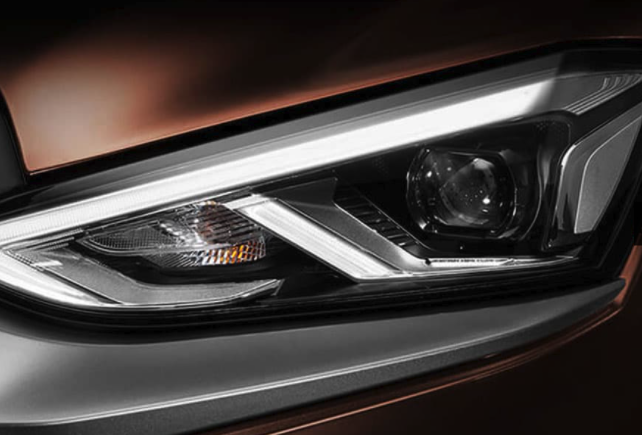
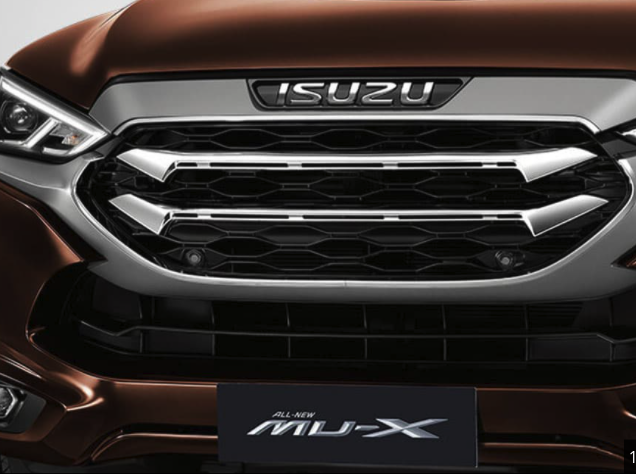
In saying that, it’s apparent the styling is not only far more modern, with LED headlamps arriving, but also far more removed from the D-Max look.

Whereas the current MU-X and outgoing D-Max were very clearly related, the new wagon seems to deliver its own appearance.

There’s every chance that the new MU-X will sharpen up considerably on safety features through adopting everything that now loads in the D-Max.

The ute has a centre airbag between the front seats as well as advanced technology such as radar cruise control, twin-camera autonomous emergency braking, blind zone warning, rear cross-traffic alert, speed sign recognition, and more.

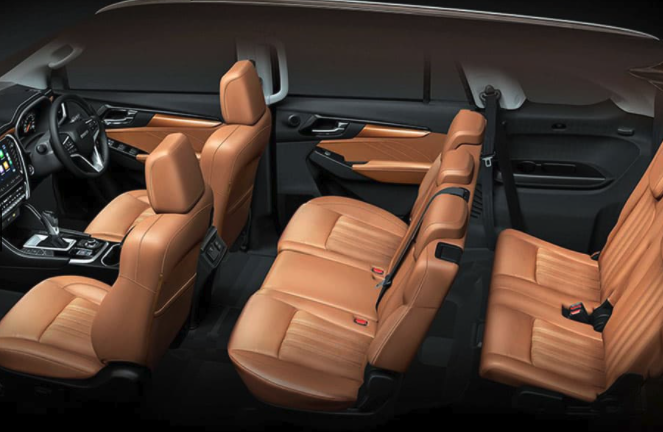
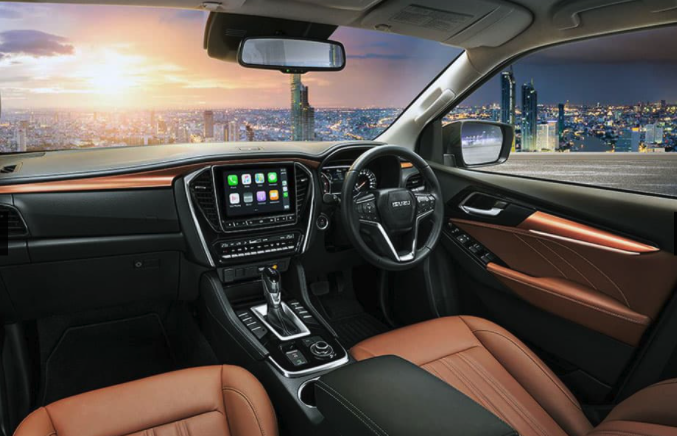
Infotainment is expected to include a large 9-inch screen with Apple Car Play, Android Auto and a digital speed display in the instrument cluster. Top end models will likely have dual zone air-conditioning and rear air vents.

Screen Shot 2020-10-29 at 9.11.20 AM.png

Drivetrain commonality is ticked. So that means a 3.0-litre turbo diesel four-cylinder generating 140kW and 450Nm paired with a choice of a six-speed auto or six-speed manual, in 2WD or 4WD on certain models.

A rear differential lock is also expected to be available on the 2021 Isuzu MU-X, as per the new Isuzu D-Max.

Media information provided from Thailand suggests the vehicle will deliver a more fulsome comfort level and specification.

The specification of the vehicle here runs to cooled front seats, an auto-dimming rear-view mirror, a household power socket inside the cabin, extra USB charging ports front and rear, premium audio, an electric park brake, and an adjustable electric tailgate.  

Exterior design touches include 20-inch wheels and LED tail-lights. Automated parking tech – which works with front and rear sensors and the new electric power steering system – is also likely to be available.

 MU-X has been a quiet achiever in the market, with 208 registrations last year and 169 so far in 2020, but it potentially has greater potential now that the Holden Trailblazer -  which was a co-development of Isuzu’s current model but more richly-appointed, better engineered and more powerful - is out of the market.

This time of course, the D-Max and Mazda BT-50 are strongly co-related, but there has been no indication of interest from Hiroshima about created a robust seven seater MU-X offshoot.


Latest Rolls special offers worldly view

 A Rolls-Royce whose special paintjob and fixtures take cues from how the Earth looks from Space. As you do.

EarthCarWraith(2).jpg

TWO years ago it was with a Barbie car … now the Abu Dhabi outlet for Rolls-Royce has made headlines again, this time for outfitting another example of the brand’s Wraith coupe to an even more outrageous extreme.

 The latest work from Bespoke Rolls-Royce, a division of the brand that cashes in on the rich reward from creating one-offs of its toffiest wares, is ‘Wraith – Inspired By Earth’, which takes its design cues from the entire Solar System, and our own planet as seen from space.

Extravagant? Yes. Yet really it’s just another typical job for Bespoke, a 100-employee division at the make’s factory in Goodwood, England.

This crowd is well-used to upgrading the company’s already vie-star fare with a range of upgrades including televisions, champagne fridges and even paint mixed with crushed diamonds.

Common demand is for James Bond-style built-in champagne fridges, while other customers have had TVs and climate-controlled humidors (cigar containers) installed. 

Back in January, The Guardian newspaper reported how one Swedish billionaire paid for a one-million-satin stitch rose garden fabric interior. 

Others have the roof of the vehicle studded with a thousand or so LED lights to recreate the night sky – complete with shooting stars.

The costs of Bespoke cars, which can take a team of designers and engineers years to create, easily run into the millions of dollars. Actual prices are never discussed publicly, but the make has admitted one two-seater Rolls-Royce coupe cost “double digit millions”.

The ‘Earth’ car won’t have come cheap. The exterior is finished in Royal Blue, representing the 75 percent of the Earth’s surface that is covered by water. The most striking feature, however, is the bonnet artwork, which depicts a satellite’s-eye view of the Middle Eastern region.

Centred on the United Arab Emirates, the panorama extends across the Red Sea, the Arabian Sea and the Gulf of Oman, all meticulously air-brushed by hand in a process that took over 100 hours to complete.

The exterior is finished with a hand-painted Emerald Green coachline incorporating the Sun and the eight planets of the solar system. Just to remind, that’s  Mercury, Venus, Earth, Mars, Jupiter, Saturn, Uranus and Neptune. 

EarthCarWraith(10).jpg

The interior aesthetic focuses on the Earth’s surface and the human and natural life that inhabits it.

The seats are made from Moccasin leather to mimic the sands of the Emirates’ deserts. Navy and Cobalto Blue accents are suggestive of rivers and lakes. Emerald Green piping symbolises nature in all its forms. Arctic White ‘RR’ monograms and stitching hint at clouds and translucent running water, the brand says in a release. 

The rear waterfall features a spectacular scene of atmospheric clouds rendered in minutely detailed embroidery using Photoflash technology.

On the fascia, the Piano Milori veneer is embellished with a satellite image of the Middle East, also to photograph-realistic standard though in fact it is skilfully air-brushed. 

The Bespoke Starlight Headliner is embroidered to illustrate all the planets of solar system, centred on the Sun. Other Bespoke details include treadplates, a clock with metal radial background, and inlays showing the planets in silver, with planet Earth accentuated in gold. 

By comparison, then, the Abu Dhabi showroom’s previous commission was potentially run-of-the-mill. 

The ‘Barbie car’ – designed to look like the kind of Rolls the doll might like to drive – was a two-tone Wraith in pink and white, with a pearlescent white lower body, Pepto-pink upper and matching coachline.

The interior was all white leather and dashboard trim to match the exterior, with pink accents extending from the steering wheel, door panels, and seats. It also had to a starry-sky headliner.


New 500 – the eclectic electric

Fiat’s third gen 500 is reborn as an electric charger – with a neat door design.

Nuova500(2).jpg

THE Hyundai Veloster is no longer the only asymmetrical ‘three-door’ car in production – it now has a little friend, from Italy.

Fiat’s determination to push the 500 into a third generation, but this time as wholly electric vehicle to say ciao to the MINI Electric, has come with a novel design twist that can only be experienced in this market at the moment by those who buy into South Korea’s sports coupe.

La Prima' 3+1 is so named because it has an extra, rear-hinged, side door that opens up to allow extra access to the back seats.

The whole point of the 3+1 is an effort to keep buyers within the 500 and Fiat brands when they outgrow a conventional 500, the maker says.

As Fiat puts it: “The young person who darted onto the city streets aboard their 500 after a day's work, is now a 'working mom or dad', struggling to get their one or more children to school in the morning before heading to work, then to their dance class or foreign language lessons in the afternoon, all the while keeping their own personal commitments going. That customer has therefore become a family that needs the interiors to be more accessible, but still 'cool'.”

Olivier François, Fiat’s brand president, says the extra door is a nod to the heritage of the original 1957 500, as that had doors hinged at the rear.

There's no centre pillar for the 500 3+1, and Fiat reckons that it makes getting kids in and out of the back, and especially loading up child car seats, that much easier. The only penalty, according to Fiat, is an extra 30kg of weight.

Nuova500(3).jpg

It has no impact of the car’s overall dimension. In measuring in at 3632mm long, 1683mm wide and 1527mm tall, with a 2322mm wheelbase, the third generation is 60mm longer and wider and has 20mm extra wheelbase over the current car, yet remains a compact choice.

Will we see the new 500 here? The question has been put to brand rights’ holder Ateco Group NZ; no response has been forthcoming yet. 

That the car has been confirmed for sale in the United Kingdom, with deliveries there starting in March, suggests it will be produced in right-hand-drive. Whereas the hatch and cabriolet are international, the 3+1 styling is for left-hook only.

Small cars have been losing ground to like-sized crossover equivalents in this market, but Fiat reckons the world – particularly city dwellers – can do with an “urban Tesla.” 

Even so, the current car, which now restricts representation in New Zealand as an Abarth hot shoe, will continue in production for a while yet.

François acknowledges that as much as electrics are the future, because fossil-fuelled small city cars are among the cleanest on the market already there’s no absolute guarantee all consumers will feel need straight away to switch to a wholly zero-emission line.

“What we don’t really know, what we have no visibility on, is future demand for electric vehicles,” he has explained.  

“But we need to be ready. We know that demand for sure will explode, because of the regulations in city centres. We don’t know to what level it will explode, but we are ready because we have one great nameplate with two approaches.”

Despite all the obvious familiarities, the design is fully all-new. It’s the first fully-electric vehicle designed from the ground-up on an all-new platform from Fiat Chrysler Automobiles.

The car delivers in 24kWh and 42kWh battery formats, with 85kW fast-charging available from middle of the range, and three trim levels, Action, Passion and Icon.

The entry-level 500 EV is fitted with a 23.8kWh battery pack and a 68kW electric motor, which provides a 0–100kmh time of 9.5 seconds and a top speed of 134kmh. The maximum claimed WLTP range of 118 kilometres will climb to 240km under city driving conditions, Fiat claims. 

Mid-range models and up are fitted with a 42kWh battery pack and 86kW electric motor. The 0-100km time drops to 9s, top speed raises to 149km, and range climbs to 320km, according to the maker. Recharging also picks up, as it will take direct current fast charging, so will recover an 80 percent charge in half an hour. 

Both powertrains offer three driving modes. ‘Normal’ is as being “as close as possible to driving a vehicle with a normal combustion engine”. ‘Range’ engenders higher brake energy recuperation, to the point where it’ll entertain one pedal operability. ‘Sherpa’ preserves as much range as possible, so it limits the top speed to 80kmh, reduces throttle response and deactivates the climate control and other comfort features.

The car is, of course, tailored for around town. So, though it’s 60mm wider, 60mm longer and with a 20mm longer wheelbase, it’s still small. 

The centre console holds a 10.25-inch infotainment system supporting a range of chic smartphone apps, including for checking pre-drive battery level checks and cabin warming and cooling.

Fiat also claims the car is capable of “Level 2” semi-autonomous driving, using a front-facing camera system to monitor the road ahead. Adaptive cruise control with automatic braking and accelerating, lane keep assist, speed limit assist, blind spot warning and 360-degree sensors also arrive.


Max score for Mazda sister ship

What’s good for the D-Max is good for the BT-50, our crash testing agency decides.

BT50--ThomasWielecki--06.jpg

DIFFERENT badges, same basic engineering, technology and design – and it’s paid off for Mazda’s twin to the Isuzu D-Max in crash testing. 

A month after determining Isuzu’s soon-to-release new one tonne ute was worthy of a maximum five star score from a crash test that became tougher this year, the national crash testing agency has decided the BT-50 that is a co-development of that model should achieve the same score. 

Surprised? Well, there’s potential you might be because, even though the sister utes are both on the top rung, it’s questionable the Mazda can claim utter category-first equality.

Mazda’s ute scores just slightly lower for impacts regarding pedestrians and cyclists in the vulnerable road user criteria due to the different nose design.

That in itself might seem an interesting outcome as, when it came to assessing the Mazda, the New Zealand Government-funded and NZ Automobile Association-supported Australasian New Car Assessment Programme didn’t put one into the wall, as occurred with the D-Max. 

Rather, the outcomes determined for the Mazda accrue from the agency extrapolating results from the D-Max test and also giving consideration to technical data provided by Mazda.

All this means the BT-50 carries the exact same ratings for adult occupant protection (83 percent), child occupant protection (89 percent), and safety assist (81 percent).

The safety system on the Mazda, like the Isuzu, consists of a comprehensive suite of tech such as AEB, adaptive cruise control, lane departure warning with steering assist, blind spot monitoring and advanced speed assist, and many others. 

ANCAP’s rating applies for all BT-50 models.

Isuzu will have a head start on leveraging the score, with the D-Max expected to be on sale within the fortnight; timing which gives it around four week’s head start over the Mazda, this to honour an international agreement between the makes that gives Isuzu first dibs on strength that the ute is their basic design and comes from their factory.


PM's diesel limo parked up for electric alternate


Black day for BMW as Ardern pulls the plug on her diesel Seven limo and goes for an electric Audi.

Audi NZ boss Dean Sheed, pictured at the E-Tron’s launch last year, says one of the three cars signed up for Government VIP use will be Auckland-based and has been checked out for suitability to carry a baby seat.

Audi NZ boss Dean Sheed, pictured at the E-Tron’s launch last year, says one of the three cars signed up for Government VIP use will be Auckland-based and has been checked out for suitability to carry a baby seat.

AUDI’s flagship electric model could well have bumped a BMW diesel as Jacinda Ardern’s choice of state-provisioned home town ride – with her toddler likely also set to enjoy the car’s Green vibe.

Government’s historic step up to wholly battery-driven cars as VIP transport has just been confirmed by Audi New Zealand. 

The distributor says three examples of its plush five-seater sports utility-formatted and wholly battery-reliant E-Tron in swishest $156,000 ‘55’ format have been accepted onto the fleet of limos provisioned for highest-level state duties, meaning they are silver, Crown-plated and chauffeur-driven. 

The cars’ permanent sign-on came after months of trial when they were measured up again the incumbent provision; BMW’s turbodiesel Seven Series.

Audi has been an approved Government fleet supplier for several years, but never at this level.

It is hoping to enlarge the imprint soon, as it seems a tender seeking a replacement for the entire fleet of VIP product is about to be called. 

That procurement process is run by the Ministry of Business, Innovation and Employment (MBIE).

While two of the E-Trons are being retained in the capital, primarily to shuttle ministers from the Beehive to Wellington airport, the third is based in the Prime Minister’s home town and it seems set to become to her priority work car.

While coy to offer too much insight, Audi New Zealand’s boss, Dean Sheed, let slip when discussing the arrangement that a request specific to the Auckland car is that it is fully sorted to accommodate a baby seat.

Ms Ardern and her partner, Clarke Gayford, have a daughter, Neve Ardern Gayford, who turned two in June. The PM is not unfamiliar with electric cars as she already drives a Hyundai Ioniq EV.

Mr Sheed said today that feedback about the E-Trons “has been positive for all parties.”

While he did not name BMW directly, he said the Audis had replaced “three current  diesel long-wheelbase sedans” and that more of those cars were set to be replaced.

“They are trialling alternatives to optimise their fleet mix. We are putting our hand up to supply more E-Trons.”

The PM need not imagine her new ride is only suited to urban driving - the E-Tron’s SUV credentials allow it to explore into the most remote electorates.

The PM need not imagine her new ride is only suited to urban driving - the E-Tron’s SUV credentials allow it to explore into the most remote electorates.

The Government recently said it now has 18 vehicle suppliers on the motor vehicles contract with 14 of those being able to provide EVs for purchase to meet all-of-Government fleet potentials, which span all Government agency usages. 

In a press comment about this delivered in October, it said: “The new catalogue offers Government agencies the choice of 19 models of battery EVs available, an increase of 9 more models. There will also be 11 models of plug in hybrid EVs added onto the panel.”

Audi’s deal has especially huge kudos – Government VIP fleet contracts are highly valued and the other German premium brands generally enjoy more success globally.

BMW New Zealand has met the contract to supply limos for a decade with the biggest and most expensive sedan it makes, across two contract periods, the second time delivering a variant specially-created to suit the Government’s tastes. The cost of those cars has never been disclosed, however it has always been assumed they were availed at a price significantly below any recommended retail.

The Sevens were chosen on strength of being vastly more economical than the petrol-dedicated Ford Fairlanes that held the job for years. The current contract was cemented in 2016 and picked up 32 examples of the BMW 730Ld (3.0-litre turbo diesel, long-wheelbase), with two models from the previous fleet being retained. They were understood to be cars built to a high security level. MBIE said then that all the vehicles were leased rather than purchased.

However, issues such as Dieselgate and the emergent concern about the carcinogenic properties of diesel particulates has blackened the Sevens’ standing.

On top of this, Government expressed determination two years ago to go electric whenever possible as it work toward a stated ideal of an emissions-free fleet. 

BMW NZ cannot fulfil that dream. 

It has a number of plug-in electric cars, that use limited battery impetus but still rely on petrol engines for primary motivation, here but so far its wholly electric spearhead is represented by two small city cars - the i3 that’s almost at the end of its production life and the Mini-E. It will soon also have an all-electric version of the X3 compact crossover here.

An electric Seven is under development, but has yet to reach production, whereas the E-Tron has been on sale here for a year.

* Subsequent to this story’s publication, the Department of Internal Affairs has notified that “The Audi e-tron is part of the overall Crown fleet and is not dedicated to the Prime Minister.”


Paddon’s old racer inspires road special

Hyundai’s WRC racer has finally inspired a road-legal hot hatch  … which, in turn, has inspired another rally car.

Hyundaii20N(5).jpg

TURN the clock back four years – Rally Argentina has just ended and Hayden Paddon has claimed his - and New Zealand's - first world rally championship win by 13.3 seconds from Sebastien Ogier.

What better way to celebrate a hero than with an appropriate hero car?

Back then, the timing was just all wrong. 

Hyundai’s performance arm was certainly ramping up a hot hatch division then, yet it was already apparent the first model to benefit hadn’t obvious link to the works World Rally Championship racer.

No argument, the resultant i30 N hatch turned out to be a masterstroke and the more recent liftback is just as good. 

Yet it always seems a pity that Hyundai didn’t do the obvious and start with a road legal firecracker edition of the i20 small hatch, given that’s the car they were running then – and are still running now – in WRC.

Amends have finally been made. An i20N road car is in the making. 

Sure, it’s not a fiery four-wheel-drive and Paddon has left the team in which he achieved his best international successes though, sadly, never another world championship victory.

Yet it’s still a car that has good ‘fit’ here:  Paddon’s still very heavily involved with the Hyundai brand at national level and there’s a neat twist in that, since announcing the road car, the maker has also made clear that it’ll be a basis for a dirt-tuned competition car, developed for privateers. Which surely also rises a potential for a driver who is still racing and preparing gravel blaster fare. 

Hyundaii20N(2).jpg

So what’s stopping this realising? Remarkably, it could well be Hyundai New Zealand.

Whereas other distributors, including Australia (which also celebrated Paddon) have been quick to sign up the model, have rushed to sign on the new talent, Hyundai NZ – which is a locally-owned independent rather than a factory shop - is dragging its feet. So far there’s not yet any local commitment beyond comment that the car is “under consideration”.

Maybe a petition is needed. Though pocket rockets don’t create big sales, they have potential to be huge image makers. The Ford Fiesta ST and Volkswagen Polo GTI are good examples of being attention magnets.

The i20N could well be up to their mettle, given Hyundai says it used its WRC expertise in this project, and not just to give it a nicely muscular look.

Under that bonnet is a pukka performance mill, in the same of a reworked (as in, exclusive turbo, remapping, a high-pressure injection rail) version of the 1.6-litre turbo-petrol four-cylinder engine found in a number of other Hyundai and Kia models, tuned to produce 150kW from 5500-6000rpm and 275Nm from 1750-4500rpm. That’s less torque than the Ford and VW spin out, but slightly more power.  

The engine is mated exclusively to a six-speed manual transmission and while four- wheel-drive isn’t on the menu, it does achieve a limited-slip differential in order to aid handling and grip. The chassis has also been reinforced at 12 different points, while the suspension features reinforced front domes and knuckles, new anti-roll bars, springs and shock absorbers and increased camber. 

Hyundaii20N(14).jpg

It also delivers with launch control, which facilitates 0-100kmh in 6.7 seconds. Top speed is 230kmh. power to weight looks good, too. Surely it’s no coincidence the car clocks 1190kg – the same as the i20 Coupe WRC car? 

Five drive modes are delivered: Normal, Eco, Sport, N and N Custom, with the latter allowing customers to individually adjust the parameters of the engine, ESC, exhaust and steering. The stability system can also be programmed into three stages – on, sport and fully off.

The car states its intent at the kerbside, too. The ride height is lowered by 10mm, it sits on 18-inch rims (behind which are tucked enlarged brakes) and the styling includes red accents around the front, rear and side skirts, plus a WRC-inspired roof spoiler. A lip spoiler and wide radiator grille – with a pattern inspired by a chequered flag - enhance visual menace. 

The interior also adopts sports seats, N-specific steering wheel, gear knob and pedals and there’s a 10.25-inch touchscreen navigation system, N driving data, digital instrument cluster.

Hyundai’s SmartSense suite of active safety tech is included, with forward collision warning, autonomous emergency braking with pedestrian and cyclist detection, lane departure warning, lane keep assist, blind-spot collision warning, intelligent speed limit assist, driver attention warning system, high beam assist, lane following assist and rear cross-traffic collision warning.

i20NRally2Front3-4View(1).jpg

And if you’d prefer it for weekend gravel road play? Well, that’s the i20 N Rally2, designed by an N-sport division, Hyundai Motorsport Customer Racing, and intended for privateer teams and drivers. 

This one follows on from the Hyundai i20 R5 with which Hyundai Motorsport entered the Customer Racing arena at the end of 2015. That car has claimed numerous titles with customers, including national titles in Spain, Portugal and Poland since debuting late in 2016.

However, the brand says the i20 N Rally2 will be better, being “an improved all-round package” that builds on the experience gained by the department over the last five years.

Though the five-speed sequential gearbox from the i20 R5 remains the transmission for the new design nearly every other part, including the 1.6-litre turbo engine, is brand new.

The developer says new suspension components and dampers give the car more driver-friendly handling characteristics on all surfaces. This, it says, is vital in the Rally2 category, “which forms the basis for numerous national and regional championships as well as the international WRC 2 and WRC 3 classes, and are the cars of choice for both professional rally drivers as well as drivers who compete purely for pleasure.” 

An extensive testing programme for the i20 N Rally2 will begin later this month, with the first deliveries to customers and final homologation scheduled for mid-2021.


Mach 1 just under $100k

More detail about the next special edition Mustang for NZ has been released.

just in case you’re uncertain … it’s the one in the middle.

just in case you’re uncertain … it’s the one in the middle.

SOMETHING attendees of this weekend’s national gathering of Mustang owner clubs in Christchurch to consider - announcement the Mach 1 will leave small change from a $100,000 spend. 

The specific tag on the car, in either six-speeds manual or 10-speed automatic form, is $97,990.

The former is a Tremec rev-matching six-speed borrowed from Shelby and the latter a re-calibrated version of the company’s familiar 10-speed.

Also confirmed is that the car achieves a version of Ford’s 5.0-litre Coyote V8 generating 345kW and 556Nm. 

Those are lower outputs than are given for the car in its home market guise.

Ford has explained right-hand drive market emissions regulations are the issue.

Even so, it’s a gain over the standard Mustang GT, which makes 339kW and 556Nm, and leaves this edition on equal footing with Ford New Zealand’s last special edition, the Mustang Bullitt that hit the scene in force last year … for $4500 less than the Mach 1.

wdmp_200510_00434.jpg

Is that a problem for you? Bear in mind they’re not exactly the same car in different special edition colour scheme.

 In saying that, both are limited count cars – Bullitt restricted to 50 units, Mach 1 might be 50 or even 80 – and both take bits from the Shelby 350 GT that has now been dropped in the US.

But different bits. The Bullitt, you might recall, had the Shelby’s intake manifold. The Mach 1 gets more. 

In addition to the gearbox, the engine oil cooler, oil filter adapter, rear toe-link, and sub-frames are also Shelby products. Ford has complemented these by adding in stiffer sway bars and bushings, MagneRide dampers as standard, and ticking off on a set of Michelin Pilot Sport 4 tyres. 

A new front splitter, rear diffuser, lengthier undertray and a rear spoiler … these are also Mach 1-specific items. 

The Mach 1 also has Recaro buckets and a 12-speaker B&O sound system.

Meantime, all the blue bloods are in Christchurch for the Ford National Mustang Convention, hosted by the Canterbury Mustang Owners Club, with the public highlight being the Grand Mustang Show at Horncastle Arena tomorrow. The gathering is expected to build on a 2014 event that was the country’s biggest Mustang convention – not a bad effort given that this was a year before the first factory-built right-hand-drive models started coming in.

wdmp_200510_00408.jpg


RS and S today, E-tron GT and S tomorrow?

Are you ready to say auf wiedersehen to performance petrol engines? Audi NZ’s push to point purists toward an electric future is about to kick off.

E-tron GT is expected to stay true to the styling presented by the same-named concept here.

E-tron GT is expected to stay true to the styling presented by the same-named concept here.

INTENT to steer Kiwis away from their fossil fuel-frenzied Audis and toward full fizz electric equivalents is about to step up.

The trigger is the E-tron GT, a performance-focused four-door coupé combining enough rapid performance with rapid charging to match the platform-sharing Porsche Taycan, whose supercar-slaying stomp has won global acclaim.

 The first electric out of Audi that’s been purpose-designed to specifically appeal to the marque’s petrolhead audience, especially fervent in this country, is a confirmed starter here.

 The model received mention at today’s media event for the E-Tron Sportback, a $169,990 car that’s also set to develop into an S-badged flagship that’ll also represent in the SUV bodystyle that’s been here for a year.

Audi NZ boss Dean Sheed also shared why he’s comfortable promoting all three future additions with revheads presently driving fossil-fuelled S and RS models. 

“We’ll definitely be talking to them because they are right in the sweet spot. The reason I say that is because this is the first complete car from Audi Sport … it has a huge credibility and it just happens to also be electric.”

Will the old-school buy into the new way? Sheed reckons he can talk most around to at least thinking about it.

“When people see it, when they understand the technology and when they find out how it drives .. well, they’re going to want it.”

The GT won’t be here until mid-2021 and the S derivatives are likely to land in the third quarter, yet the hearts and minds campaign starts in January.

 The GT’s full development path is exciting, with high certainty it will ultimately achieve RennSport accreditation, so becoming the first non fuel pump-reliant RS car ever. That breakthrough might occur in 2022.

Those S models and the GT in its initial roll out won’t be lacking, either.

Whereas the mainstream E-Tron SUV that has been here since last year and the new Sportback that releases this week run dual motors, and offer power and torque of 300kW and 664Nm (there’s also a base E-Tron SUV with 230kW and 540Nm), the S editions are the world’s first EVs with three motors – one of the front and two in the back – and pack 370kW and 973Nm.

A cited 0-100kmh time of 4.5 seconds places the models as the second fastest S models Audi presently makes, beaten only by the petrol-gulping S8 sedan. Top speed is regulated to 210kmh.

As for the GT? Outputs have yet to be given, but Taycan presumably gives a good idea of what’s in store and Audi has already made clear that even if some GTs are dual motor like the Taycan, the RS will provide with three as well. 

Porsche’s model line spans from a 4S with 320kW (390kW on overboost) and 640Nm, a Turbo with 460-500kW and a flagship Turbo S with up to 560kW. Zero to 100 times range from 4.2 to just 2.8 seconds.

Talk overseas is that the GT RS will pack no more than 522kW, so as not overshadow the top trumps Porsche. For his part, Sheed assures the car will be comfortably quicker and gruntier than the E-Tron S and will also serve up with varying levels of hotness.

“We have not made up our minds which ones we will take yet but, if you have an S car with around 370kW, we are unlikely to a GT at the same level. We will likely go with a hot car and an even hotter car.”

The e-tron Sportback (above) that has just gone on sale here now will be joined by a S variant in 2021 that makes history as the world’s first tri-motor electric car.

The e-tron Sportback (above) that has just gone on sale here now will be joined by a S variant in 2021 that makes history as the world’s first tri-motor electric car.

e tron s.jpg

He acknowledges Audi NZ has enjoyed massive success with its S and RS badged models. RS penetration here is world-leading on a per head of population count.

A wide span of more than a dozen models – not just the traditional passenger models, but also sports utilities from the Q3 up to the Q8 – are presently leveraging that interest, with more than 200 registered this year alone.

Yet times are changing. While some have 48 volt electrical architectures that alleviate some fuel burn burden, all these heavy hitters rely on souped up petrol engines – from fours to also turbocharged V6s, V8s, plus a V10 - that are the biggest drinkers within their respective model families.

That actually raises another point. When it comes to range, most of Audi’s electrics will prove superior to some of the big banger petrols; the GT, for instance, is expected to arrive with a 96kWh battery that delivers a respectable 400km electric range on the official WLTP test cycle. Try getting that far in an RSQ8.

Sheed isn’t sure the argument needs be that direct. “You can burn a lot of petrol and diesel in any car … we’re just talking about using another fuel type and it happens to be electricity.

“The cool thing about EV technology is that you can ‘refuel’ your car overnight and your running costs are an absolute fraction of what you would normally have.”

Alternately, an 80 percent charge should be possible in as little as 20 minutes if you can find a rapid charger that allows the car to absorb energy at its maximum 350kW rate. Present E-trons replenish at a maximum 150kW.

Dynamics-wise? Even though EVS carry lots of weight, they need not be elephantine.

“You can also do all the things you might enjoy doing in an ICE (internal combustion) car,” Sheed says, pointing out that as well as being massively accelerative, the S models and GT are tailored to undertake drifting naughtiness.

That close relationship with the Taycan also suggests that the handling should be pretty special, as does the fact the battery occupies the entire underfloor area between the front and rear axles.

This helps to give the car a centre of gravity comparable with the Audi R8 supercar which, ironically, is set to be the other model rolling out of the Neckarsulm factory that will host GT production.

Plus, there’s an additional feel-good: “If you’re focussed on sustainability and on wanting to leave the world in a better place … well, there is one clear choice.” 

Audi has not signalled intent here or internationally to curtail any of its combustion-engined performance models, but simply the VW Group’s determination to leave ICE behind for an electric future says everything.

Sheed says moves in the United Kingdom and Europe to make the sale of ICE models illegal from as early as 2030 are obviously being noted by makers. The NZ scene is obviously influenced by that, yet of course there’s yet to be direction from Government about fleet intention so “without clear direction … we have no plan.”

However change is unavoidable. “I understand why people are petrol heads and I started life that way, too.

“But I understand where the electrical strategy is and I understand how good an EV can be. If I had a future view about leaving our wonderful country in a better place, my choice is electric.”

Audi NZ has not yet shared specific volume expectation for GT, which stands as the brand’s fifth production-confirmed electric car. Two others that have been made public, the Q4 E-Tron and Q4 e-tron Sportback, are coming to NZ at the start of 2022.

The GT’s finished design is set to be revealed soon, but pictures of camouflaged prototypes suggest that it won’t stray far from the 2018 concept car of the same name.

One last thing. The sound signature: Nothing beats the roar of a performance petrol engine, right? Well, true, electrics cannot emulate that level of noise, but Audi promises the GT will be pleasing to the purist ear. A team of sound engineers have, through blending combinations of 32 different audio tracks, created what they claim will be ‘one of the most aurally active’ EVs on the market.


X-rated Wildtrak a limited run … but not a runout

Another special edition Ranger has been announced. But don’t misconstrue why it is here. The current model has more life left it in yet.

wildtrakX_Fmedres.jpg

“WE’RE getting there … but we’re not there yet.”

So goes the line from Ford New Zealand’s communication manager in response to the obvious question in relation to Wildtrak X, the latest special edition Ranger announced today – namely, is it a ‘runout model?’

Categorically, no.

Rather, says Tom Clancy, a dress-up that purportedly adds $7000 worth of gear for a $2000 premium over the model’s regular sticker is “a special edition.” Nothing more, or less.

“It’s not a runout action … just an awesome action.”

Already rolled out into the dealer network, and restricted to 150 units, the Wildtrak X is a $75,490 variant of the biturbo 2.0-litre automatic that, the national distributor says, builds on a Ranger tradition of delivering greater choice and personalisation to Kiwis.

“Ford continues to adapt, grow and expand the Ranger offering, bringing more targeted, specific capabilities and attributes to customers to help them meet any challenges they face; whether at work or on the weekend,” says Ford New Zealand Managing Director Simon Rutherford.

“Now with Ranger Wildtrak X, customers can get even more out of their off-road adventures.”

wildtrakX_Rmedres.jpg

The donor is the 157kW and 500Nm bi-turbo diesel 10-speed auto version that is the second most popular choice with Ranger fans, beaten only by XLT in monthly sales that consistently keep the type in sector leadership, with an impressive 750 registrations per month average.

The X variant wears unique 18-inch alloy wheels with +35 offset in tough matte black finish, has fender flares - also finished in black, to emphasise the new alloys and give the Wildtrak X an unmistakable on-road presence – and has a black nudge bar, complete with an LED light bar for improved night-time vision, as a work light or to light up a campsite.

Also fitted is an A-pillar-mounted snorkel, which allows the Ranger Wildtrak X’s powertrain to breathe better on dusty roads, while reducing the risk of water entering the engine compartment so that owners can make the most of the Ranger’s best-in-class 800mm water wading capability, Ford says. 

This is the second additional Ranger announced recently, following the FX4 Max that is set to land in early 2021. At $69,990, the Max will effectively offer as a ‘working man’s’ version of the flagship Raptor but with a $15k saving.

It delivers with Fox suspension all-round, 32-inch off-road rubber and plenty of other dirty work upgrades … yet retains a 3500kg tow rating and one-tonne payload, largely through eschewing the Raptor’s fancy independent rear suspension and instead sticking with the standard leaf-sprung set-up.

Clancy has no comment on thought that Ford is going to keep outputting special editions to keep Ranger interest on the boil as the current generation, which released in 2011, heads into a final full year of full production before restarting all over in 2022.

The next Ranger will be a co-development with Volkswagen, though with Ford’s design and engineering base in Melbourne still taking the lead, just as it did with the current generation. 

Thought is that the next Ranger will continue on the current Australian-developed T6 platform, a version of which also underpins the Ford Everest four-wheel-drive wagon and the Ford Bronco built specifically for North America, but potentially yet to be re-engineered for right-hand-drive.

The next gen Ranger is expected to maintain strong styling similarity to what we have now, but will be slightly larger and will continue to be the class leader for technology.

WildtrakX_sidemedres.jpg

The current generation Ranger’s strength in respect to advanced safety – remember, it was first ute in its class globally to earn a five-star rating from the national safety auditor, ANCAP  – will be built upon, with available safety aids such as blind zone warning, rear cross-traffic alert, and a 360-degree camera implementing to supplement the autonomous emergency braking, radar cruise control and speed sign recognition on today’s model.

The model will be likely obliged to adopt a centre airbag in the middle of the two front seats, a feature that has already come to the Isuzu D-Max and its Mazda BT-50 twin. That device is a new requirement to meet increasingly stringent crash safety ratings to prevent contact between the front occupants in a collision. Having it earned the D-Max a five-star under the latest ANCAP testing process, which kicked in at the start of this year.


Golf GTi specials running hot

The Golf GTI celebrating motorsport success that recently released here has already been shown up by an equivalent in the next-gen line still months from NZ launch.

two levels of heat - the golf gti tcr (above), a sizzler final fling version of the seventh generation line still offered in New Zealand, has just been gazzumped by the gti clubsport in trhe gen eight line already in Europe.

two levels of heat - the golf gti tcr (above), a sizzler final fling version of the seventh generation line still offered in New Zealand, has just been gazzumped by the gti clubsport in trhe gen eight line already in Europe.

DB2020AU01691_medium.jpg

AS Kiwis are seeing off the seventh-generation Golf GTi with a hot version that’s an ode to motorsport, Volkswagen’s home market is preparing for an even spicier equivalent in the all-new family arriving here next year.

The announcement several days ago from VW headquarters in Wolfsburg, Germany, of a Clubsport version of the really new – as in, generation eight model that is set to replace the variant still on sale here – Golf GTI has been a surprise.

Generally, VW practice has been to deliver fizzed up specials of the world’s most famous hot hatch only after the core versions have settled into sale. 

In this instance, though, the Clubsport – a name that could probably be legitimately promoted in NZ by VW because the original user, Holden Special Vehicles, ceases to be at the end of this month – is being introduced just a few months after the latest GTI has hit production.

When, or even if, the Clubsport reaches NZ is up in the air. The new Golf that it derives from is coming, of course, but has been delayed until 2021, Covid-19 delays having ruined the original plan to have it here by Xmas.

Meantime, VW New Zealand is working to push out remaining stock of the seventh-gen car that, of course, was discontinued in Europe months ago.

Part of that runout has been to bring in the Golf GTI TCR, a $65,990 special edition with an interesting back story, in that it celebrates the brand’s success in a motorsport category that has been promoted as a potential for NZ, yet has yet to reach the grid.

That’s the FIA’s Touring Car Racing motorsport formula; VW won the TCR title when the series was running red hot in Europe and seemed set to become the next bi thing globally. You might recall seeing the cars run in Australia last year. The concept was set to also come to NZ … but, then, Covid hit. Also, some brands also pulled back their support. One of those being VW. 

The end result is that it has a Golf GTI TCR that celebrates being in a category it no longer involves in at manufacturer level. 

Whether that really matters is moot. NZ has 40 TCR units and basically all have been accounted for. So it’s also done a great job of keeping this evergreen hot hatchback competitive. The allure is more power – whereas the regular GTI makes 180kW the TCR has 213kW. 

That’s courtesy of it having a version of the 2017 GTi Clubsport Edition 40’s ‘EA888’ 2.0-litre turbo four pot that’s been updated with new software management, furnished with a couple of extra radiators, and made WLTP-emissions compliant. 

gen eight GTI retains the famous EA888 engine.

gen eight GTI retains the famous EA888 engine.

The TCR also gets VW’s electronic locking ‘eDiff’ as standard, but it adds the sizable composite brake discs and 17in calipers of the old GTI Clubsport S, as well as forged 18in alloy wheels. It comes as standard with passive suspension developed from that of the GTI Performance, with revalved, firmed-up dampers, and with shortened, stiffened coil springs that drop the car 5mm. 

Nice car, right?

The new (meaning, in case you’re confused, gen right) GTI Clubsport also seems set to have the same status. 

Most of the exterior changes to the very latest, still in Europe Golf GTI that denote it as a Clubsport model are designed to enhance the car's aerodynamic performance. There’s a redesigned bumper incorporating a splitter-like lower spoiler and larger open area for engine cooling. The default wheel is an 18-incher, sitting on 225/30 R18 tyres, but potentially it will have 19s in export form. 

A side sill graphic sets the Clubsport apart, though its most prominent feature is a new two-tier roof spoiler at the back. Restyled exhaust outlets are further apart than in the regular GTI and the diffuser between them has been redesigned.

It also runs that EA888 engine, but in an evo four tune that increase the power to 3223kW and pushes torque to 400Nm, so a 30Nm gain on the optimal claimed for the standard gen-eight Golf GTI and 50Nm more than the TCR has.

That's all sent to the front wheels via a seven-speed DSG dual-clutch automatic gearbox and the official 0-100kmh time is six seconds (0.3 seconds quicker than the standard car).

Considerable changes have been made to the chassis, starting with a 15mm reduction in ride height. The McPherson front struts and four-link rear axle layout are retained, but there is increased positive camber on the front and the variable ratio steering is more direct.

Like this cabin? the new Golf has stepped up considerably in respect to the interior.

Like this cabin? the new Golf has stepped up considerably in respect to the interior.

As in the regular GTI, there is the XDS 'electronic differential lock' system and the electromechanical locking differential called VAQ (for 'Vorderachsquersperre' in German, meaning simply 'front axle differential lock').

Both are under the control of the Vehicle Dynamics Manager system that debuts on the gen eight GTI, as are the shock absorbers of the optional Dynamic Chassis Control (DCC). All of this has been ramped up for the Clubsport with an emphasis on response, reducing understeer and allowing higher cornering entry and exit speeds and traction on a racetrack.

Actually, there’s a special driving profile that has been optimised for driving at one particular racing circuit. Surely you know it’s name?

Anyway, according to Benjamin Leuchter, a racing driver employed by Volkswagen to help develop the Clubsport's driving dynamics, the Clubsport when put into ‘special’ mode is up to 13 seconds per lap faster than a regular GTI around the Nurburgring Nordschleife.